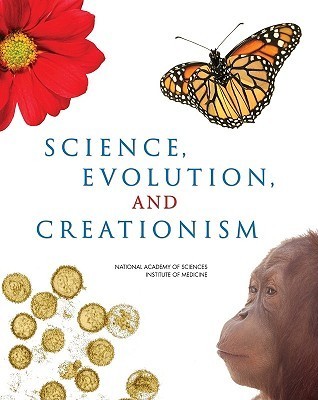
Science, Evolution, and Creationism by National Academy of Sciences and the Institute of Medicine
“Science, Evolution, and Creationism" is a booklet that provides succinct and accessible information to the public on evolution. This booklet is the result of the collaboration between the National Academy of Sciences and one of its components, the Institute of Medicine. It’s a good resource and it comes from a trusted and valuable source. This 88-page booklet includes the following four chapters: 1. Evolution and the Nature of Science, 2. The Evidence for Biological Evolution, and 3. Creationist Perspectives, and 4. Conclusions.
Positives:
1. A well written and succinct book.
2. The National Academy of Sciences is a reputable and trustworthy source.
3. The fascinating topic of how life changed over time, evolution.
4. A nice looking and colorful book. Good use of charts and illustrations.
5. A nice introduction that goes over the purpose of this book. “It is written to serve as a resource for people who find themselves embroiled in debates about evolution.”
6. The book does a fairly good job of defining key terms. “Biological evolution refers to changes in the traits of organisms over multiple generations.” “It is populations of organisms that evolve, not individual organisms.”
7. Goes over the discovery of Tiktaalik. Shows why science works.
8. In defense of the evidence. “The theory of evolution is supported by so many observations and experiments that the overwhelming majority of scientists no longer question whether evolution has occurred and continues and instead investigate the process of evolution.”
9. A practical approach of why understanding evolution is important. “An understanding of evolution was essential in the identification of the SARS virus. The genetic material in the virus was similar to that of other viruses because it has evolved from the same ancestor virus.”
10. Provides areas of science outside of biology that supports biological evolution.
11. Clarifies key misconceptions of the public. “Humans are not descended from chimpanzees or from any other ape living today but from a species that no longer exists. Nor are humans descended from the species of fish that live today but, rather, from the species of fish that gave rise to early tetrapods.”
12. The role that molecular biology played in confirming and strengthening the grand theory of evolution.
13. A look at human evolution.
14. The danger of creationism. “Despite the lack of scientific evidence for creationist positions, some advocates continue to demand that various forms of creationism be taught together with or in place of evolution in science classes.”
15. The importance of basing policies on good science. “To make informed decisions about public policies, people need to know, how scientific evidence supports those policies and whether that evidence was gathered using well-established scientific practice and principles.”
16. A good final chapter that includes frequently asked questions.
17. Articles and a bibliography provided.
18. Committee members’ biographies provided.
Negatives:
1. More like a very good appetizer instead of a main dish.
2. Even acknowledging that this book is intended for the masses, I still felt it was too basic.
3. Doesn’t translate as well on the black and white Kindles versus the Fire.
4. It tries to show why science and religion can be compatible, I respectfully disagree.
In summary, this is a useful, accessible and brief look at evolution from a reputable and trustworthy source. If you are looking for an appetizer on the grand theory of evolution this book will do but there are honestly much better and equally accessible books on the market. This book is a very accessible reference for people with little time.
Further recommendations: “Undeniable: Evolution and the Science of Creation” by Bill Nye, “Evolution vs Creationism” by Eugenie C. Scott, “Why Evolution Works (and Creationism Fails)” by Matt Young, “The Greatest Shown On Earth” by Richard Dawkins, “Evolving Out of Eden” by Robert M. Price, “Your Inner Fish” by Neil Shubin, “Understanding Evolution and Ourselves” by Dennis Littrell, “Why Evolution Is True” by Jerry A. Coyne, “The Rocks Don’t Lie” by David R. Montgomery, “What Evolution Is” by Ernst Mayr, “Evolution: What the Fossils Say and Why it Matters” by Donald R. Prothero, and “The Making of the Fittest” by Sean B. Carroll.