The complete BATMAN: CONTAGION storyline is available for the first time ever, along with chapters that lead into the thrilling confrontation with the mastermind behind the outbreak in BATMAN: LEGACY.
A mysterious and lethal virus is unleashed on the unknowing inhabitants of Gotham City, causing excruciating pain-and ultimately death-within 48 hours of contact. Batman, Robin and Nightwing must race to contain the chaos while finding a cure-with the help of unlikely allies Azrael, Huntress, Catwoman and Poison Ivy.
But can the Dark Knight and his team of vigilantes stop an invisible enemy? And what happens when one of them is infected?
Collects AZRAEL 15-16, BATMAN 529-532 BATMAN CHRONICLES 4, BATMAN: SHADOW OF THE BAT 48-52 CATWOMAN 31-32 DETECTIVE COMICS 695-696 and ROBIN 27-30.
Charles "Chuck" Dixon is an American comic book writer, perhaps best-known for long runs on Batman titles in the 1990s.
His earliest comics work was writing Evangeline first for Comico Comics in 1984 (then later for First Comics, who published the on-going series), on which he worked with his then-wife, the artist Judith Hunt. His big break came one year later, when editor Larry Hama hired him to write back-up stories for Marvel Comics' The Savage Sword of Conan.
In 1986, he began working for Eclipse Comics, writing Airboy with artist Tim Truman. Continuing to write for both Marvel and (mainly) Eclipse on these titles, as well as launching Strike! with artist Tom Lyle in August 1987 and Valkyrie with artist Paul Gulacy in October 1987, he began work on Carl Potts' Alien Legion series for Marvel's Epic Comics imprint, under editor Archie Goodwin. He also produced a three-issue adaptation of J. R. R. Tolkien's The Hobbit for Eclipse with artist David Wenzel between 1989 and 1990, and began writing Marc Spector: Moon Knight in June 1989.
His Punisher OGN Kingdom Gone (August, 1990) led to him working on the monthly The Punisher War Journal (and later, more monthly and occasional Punisher titles), and also brought him to the attention of DC Comics editor Denny O'Neil, who asked him to produce a Robin mini-series. The mini proved popular enough to spawn two sequels - The Joker's Wild (1991) and Cry of the Huntress (1992) - which led to both an ongoing monthly series (which Dixon wrote for 100 issues before leaving to work with CrossGen Comics), and to Dixon working on Detective Comics from #644-738 through the major Batman stories KnightFall & KnightsEnd (for which he helped create the key character of Bane), DC One Million , Contagion , Legacy , Cataclysm and No Man's Land . Much of his run was illustrated by Graham Nolan.
He was DC's most prolific Batman-writer in the mid-1990s (rivalled perhaps in history by Bill Finger and Dennis O'Neil) - in addition to writing Detective Comics he pioneered the individual series for Robin , Nightwing (which he wrote for 70 issues, and returned to briefly with 2005's #101) and Batgirl , as well as creating the team and book Birds of Prey .
While writing multiple Punisher and Batman comics (and October 1994's Punisher/Batman crossover), he also found time to launch Team 7 for Jim Lee's WildStorm/Image and Prophet for Rob Liefeld's Extreme Studios. He also wrote many issues of Catwoman and Green Arrow , regularly having about seven titles out each and every month between the years 1993 and 1998.
In March, 2002, Dixon turned his attention to CrossGen's output, salthough he co-wrote with Scott Beatty the origin of Barbara Gordon's Batgirl in 2003's Batgirl: Year One. For CrossGen he took over some of the comics of the out-going Mark Waid, taking over Sigil from #21, and Crux with #13. He launched Way of the Rat in June 2002, Brath (March '03), The Silken Ghost (June '03) and the pirate comic El Cazador (Oct '03), as well as editing Robert Rodi's non-Sigilverse The Crossovers. He also wrote the Ruse spin-off Archard's Agents one-shots in January and November '03 and April '04, the last released shortly before CrossGen's complete collapse forced the cancellation of all of its comics, before which Dixon wrote a single issue of Sojourn (May '04). Dixon's Way of the Rat #24, Brath #14 and El Cazador #6 were among the last comics released from the then-bankrupt publisher.
On June 10, 2008, Dixon announced on his forum that he was no longer "employed by DC Comics in any capacity."
A deadly virus is spreading quick through the city by any means necessary. The biggest way is coughing and the virus getting onto other people.
Sounds like 2020? But this was made in 1996!
So Gotham is under a lot of pressure as a deadly virus begins to spread and Batman and Co have to find a way to stop this. With the help of Catwoman, Robin, Nightwing, and Azurel. So this let's the book spin off from various titles to let expand the world. While Batman looks to Poison Ivy to fix the problem, Robin and company go to try and find people who have survive the virus first. This is basically a chase to whomever can get the cure first before more people die.
Some parts are stronger than others. Easily the two best stories going are Batman trying to convince Poison Ivy for help and Robin working with Cat Woman as it is entertaining. The strongest part to me was the start and also the chapter that focused on different points of view the night of the virus. The strongest story in the entire collection for me was Robin suffering from the virus and you see into his mind for a bit, ending on a speechless and sad moment.
Overall, this event of Batman was pretty fun. Sure having various writers makes the quality jump up and down. I especially think Azurel chapters were pretty bad. The art was atrocious for that. But worse of all he's a key part of the fix for the virus, and I had to force myself to get through his stuff. But the rest ranged from decent to great. Overall a good story worth checking out, especially during this Pandemic.
You can find my review on my blog by clicking here.
There’s nothing like a pandemic to put humanity in turmoil. Recent years can certainly attest to the trials and errors that it has brought humankind to contemplate in hopes of retaining some form of normalcy, of familiarity, or of status quo. Unfortunately, misery, pain, and death bring us to envisage change and adaptation. It is after all wise to seek ways to prevent history from repeating itself, especially when numerous lives are lost, countless others are scarred for life. For the Dark Knight, a deadly virus is exactly what appears in his criminally-active city, the very one that continuously serves and protects, and taking down this latest invisible enemy is a task that goes beyond his usual line of business.
What is Batman: Contagion about? A lethal and mysterious virus has been unleashed on the unknowing inhabitants of Gotham City. Infected victims suffer through an incredibly terrifying ordeal, witnessing unbeknownst pain, before succumbing to death within 48 hours. While fear might be Batman’s greatest ally, it is now an invisible threat that has taken control over his city and he must work with Robin (Tim Drake) and Nightwing (Dick Grayson) to protect civilians and find a cure as quickly as possible. Throughout this race for answers, unusual allies tag along to stop this madness before the decimation of an entire population.
It is quite in our nature to imagine worse case scenarios for humanity and writer Chuck Dixon and his friends looked into one that scars us today in unimaginable ways: a relentless plague. Collecting the entire Batman: Contagion storyline, as well as chapters that lead up to the classic confrontation with the mastermind behind it all, found in Batman: Legacy, this story does go down an odd path, maintaining the intrigue through potential subjects who might have the cure within them and a goose chase by a wild cast of odd heroes, such as Azrael, Catwoman, Huntress, and Poison Ivy, who all try in their own way to save their home by tracking down these individuals.
As you progress through the volume, shifting viewpoints between these characters, you are introduced to mostly mediocre to average stories that are all over the place, unified only by the premise of a contagion. Most of the characters exhibit a hint of their character’s most obvious traits without going much further than necessary into their psychological and emotional condition. However, one hero does catch the virus and tension suddenly increases as the stakes exponentially increase. Will that person survive? You would want to care but the story evolves in such a tiresome fashion that the only thing you look forward to is the end of this volume and the next story that will offer you the escape you were looking for in the first place.
Beyond what can easily be qualified as an anticlimactic and boring adventure with no particularly original or captivating twists, the artwork cements the frustrating reading experience. And what a visual trainwreck it is! It might have in fact been the primary reason behind this sluggish ordeal too. From oversexualized women antiheroes and villains to the amateurish artistic vision for Gotham City and just about any character that had the misfortune of being included in this story, there’s not much left to appreciate, whether it would be in the pencils, the colours, or the inking. Although it’s nothing that detracts the reader from understanding events, emotions, and action, the artwork certainly looked more to encapsulate the incongruous narrative direction than capturing the potential of this story arc’s premise.
Batman: Contagion is a dull and uninspiring chapter into the Dark Knight’s crimefighting adventures as he battles a plague, hunts for a cure, and searches for the mastermind behind it all.
Batman, Robin and Catwoman, Azreal ('retired' religious fanatic Bat-clone), Alfred, and ex-Commissioner search out virus survivors to rescue Gotham from an ebola-like plague. Also an unrelated Deadman/Batman team-up, and a post-virus fiend to defeat.
Contains the Contagion story line plus some stand alone stories that are supposed to lead into the Batman: Legacy trade. The individual issues of the Contagion story vary in quality depending on who the writer and artist are. Overall it's an interesting story that probably would have been a bit better if the same writer wrote all the issues, or at least the same editor to make the story more cohesive.
There's also 3 separate stories at the end that bring the overall book down a star.
The first is a 2 part Robin story with terrible art by Frank Fosco. Robin takes on Maxie Zeus in this story and it is boring.
Next up is a 3 part Batman story by Doug Moench and Kelley Jones where Batman teams up with Deadman and they go to Peru. The story has a ton of mumbo-jumbo about how ghosts are scientifically real. It seems to just be a poor excuse to allow Jones to draw Incans and Deadman.
The last story is a Batman story from Shadow of the Bat going up against a new villain Nocturne. Alan Grant typically writes solid Batman stories but I hate dream-based stories. They always just feel like filler to me. Dave Johnson does provide some spectacular art though.
Ehhh. Ebola strikes Gotham. And stuff happens. I'm trying to read the arcs that lead up to No Man's Land, and unfortunately I didn't catch that the denouement isn't really in this collection. After 500+ pages of rather atrocious art, and some seemingly unrelated and very boring issues, I'm unsatisfied. The plague is gone, but the people who caused it didn't get their comeuppance (which they apparently do in Batman:Legacy, which I'm not going to bother reading). Cataclysm it is.
(Azrael is okay. Didn't think I'd say that, but I felt bad for him because he vanished after delivering the thing that solved the crisis, and no one bothered to even mention him by name.)
I’ll give this 3 stars because I really liked the Contagion story, but everything after that was 2 stars at best. This is like the same situation with the Knightfall story for me. What is in the original collection is good, but what they tacked on in the “New Edition” drags the story down.
The Robin story, Deadman story and the typical weak motivation villain story at the end are all skippable and I would highly recommend you to just not read them.
This is a tough slog for me. I’m a big big fan of Batman but I’m finding it hard to get through this much 90’s material. I don’t know how I would’ve kept up with this in the 90’s there’s so many average issues that add nothing to the story.
So, as for the first 11 issues of this trade, which encompassed the actual ‘Contagion’ arc, I didn’t think it was that bad. For the first 8 issues I was interested and invested. But they really fumbled the ending in this one. The conclusion sucks.
As for the rest, I don’t quite understand why any of it’s there. None of it added anything to the main contagion arc or expanded on it. Robin’s issues were loosely connected only because the events of it came directly after Contagion. It’s just whacky.
I’m starting to regret my choice to read all of my 90’s Batman trades in a row.
Took a big break in reading this because I didn’t really have the motivation to read it after the main story finished. But I enjoyed the contagion story, it was entertaining and gave me no man’s land vibes I just didn’t love it especially the short stories after the main one. A solid Batman story here!
This is the first of many collections I'm reading to bridge the gap between two Batman Omnibus Volumes: Knightfall Vol. 3 (ends in 1995) and Road to No Man's Land (begins in 1998). The collected editions available in between are all over the place.
Yet, this one collects a complete 11 issue event from 1996 and collects a few more issues in the aftermath. It's a satisfying collection, because it feels self contained and complete. A plague is in the city, the rich are crappy people, the villains try to profit from the situation and the heroes try to fight an uphill battle.
The status quo established in the various Batman books is fantastic in the mid 90's. Batman, Robin, Nightwing, Catwoman, Azrael and Huntress each contribute to the event and all of them are interesting for different reasons. The story is scattered in six different ongoing series, each with different artists and writers, so the quality does vary, but none of the stories are flat out bad.
My highlight of the book is the interactions between Robin & Catwoman, while the lowpoint would be the Deadman story in the main Batman series.
I do recommend this book and it can be read mostly without any prior knowledge, because the stories explain and reflect on the status quo quite well.
**may contain spoilers ** Oh wow. I don't even know what to say. It started off slow. I had a hard time getting into the story then BAM! The Ebola storyline got interesting! So I found myself smiling with my nose in a book (It's my happy place). Then BAM! It got lame again. My smile was wiped off my face and I was left with an increase in frown lines and a sadness in my heart. Then BAM! Once Ebola was cured, the storyline went completely tits up!! We went from Ebola killing off Gotham, to Robin worrying about his girlfriend going blonde. Robin almost dies from Ebola, and he suddenly starts worrying whether his girlfriend's carpet matches the drapes??? Kids these days. Then BAM! There was some storyline about Gods or smthng. They lost me for that one. I zoned out really. 2/5 stars because I enjoyed the Ebola storyline and how sassy Catwoman was.
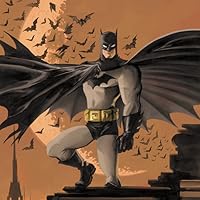
I read this out of interest but it's not an essential read. The story is all over the place and as an event styled structure, it's somewhat anti climatic. I love that cover art though. The issue is that the core virus story doesn't hold a lot of weight or fear. Chuck Dixon needed to tighten the narrative a little and play more on the overall threat. I just couldn't get into this book sadly. I'm waiting on the No Man's Land omnibus so it might explain why I'm reading Contagion and Legacy part I & II.
It was a coincidence that I pulled this book from the library at the same time that Coronavirus COVID-19 got big in the US and we went on "shelter in place". Really! I'd had it on my 'read next' list for several weeks, and when it 'naturally' floated to the top of that list I requested from the library, and then *bang* Coronavirus crazyness. I liked the overall story -- just 'ok'. Sinister plot plus bungling wannabe over-achiever leads to mass infection. Setting aside the superhero comic embellishments, the base premise is scarily plausible. But this was one of those stories that crosses over several titles, using different writers and artists, bringing capricious and disorienting changes in tone, pacing, and visuals. Yuck! I wish they didn't do that! (Tangent: When people read these stories as they're published are they not lost and confused when the story leaps from title to title?) I also dislike when writers throw in really dumb confounding details to prevent the good guys from solving the case too easily. In this book we have Batman and allies searching for virus survivors to collect samples of their blood to develop a treatment. But then we learn that the sample must be taken from a living person, which means, in the logic of the book, that a sample taken from a person who died 10 seconds earlier will not work. Which is obviously ridiculous. Stinks of metaphysical. The other odd thing about this collection is that it has 3 stories (one Robin, two Batman) tacked on at the end with only silk-thread thin connections to the main "Contagion" story line. I found the Robin story, about "Maxie Zeus" (oh and also about Robin's gf changing her hair color!) to be meh. The two Batman stories I liked well enough. Especially, to my surprise because the description would not appeal to me, the story featuring "Deadman" Boston Brand. This story featured highly stylized art by Kelley Jones (pencils), John Beatty (inks), and Gregory Wright (colors) that I really liked despite it having features that I normally don't like. For example: Jones drew Batman's cowl with extremely long ears, longer than Batman's head, that changed shape almost as if they were a living part of him. And his cape displays very different styles and characteristics from panel to panel. But this all worked in context, it suited the style of the story.
Considering this was first written in the 90’s, I can’t say whether or not the whole epidemic apocalypse-type narrative was original or not for that period, but reading this series today the plot is been-there-done-that. The focus on Tim Drake was an interesting twist that kept me hooked, and the brief piece concerning The Huntress and her search for one of her students, but over-all I felt like I was reading something I had read a thousand times before. I am so, so, sooooooo over the whole contamination idea: there’s a disease. This disease is bad Jube-jube. Everybody panics. Violence. Chaos. Banda-bing, bada-boom, and we all know the rest.
Also, it wouldn’t kill for Batman and his crew to wear some sort of mask over their mouths like ya’ll KNOW you could contract the plague from any air-source and yet you choose to play with God, WHY?
I kind of dig the gothic art-style with Batman’s ridiculous cape and cowl, and the jaggedly edged swirls and skulls decorating some of the pages. This would be a fun comic to pick up around Halloween, but it isn’t one I would recommend as a must-read. Batman Contagion is fine, but nothing new and exciting.
Side note: I know Nightwing’s ponytail is an exhausted topic but COME ON that thing needs a series of its own. The 90’s must have been such a weird time for comics.
Los únicos personajes que se lucen son Catwoman (con sus referencias a que una mujer tiene que trabajar mucho más para ganar lo que gana un hombre) y Poison Ivy (y su discurso de que menos humanos significaría más plantas); Batman se queda medio corto, y los demás personajes son esa caricatura de los 90 que no brindaban mucha trascendencia más allá de algunas patadas y alguna relación amorosa imposible.
En cuanto al tema claro que ahora nos pega más, y lo criticamos más, y entendemos que pandemia no necesariamente significa destrucción total del mundo en 24 horas. Pero el planteamiento está bien (porque es el mismo planteamiento de siempre, alguien experimentó con un virus que se escapó y destruyó el mundo). Después tenemos alianzas y escenas de acción, donde lo molesto puede llegar a ser que se mencionan o se toman en cuenta sucesos que solo entiendes si has leído historias anteriores (como quién es la chica que ayuda a Jeal Paul, quién es Huntress o quién es Óracle).
El final es terriblemente malo y sin sentido. Y al final la historia me recuerda más a la película esa de un famoso edificio gigante que se incendia y todos quieren escapar, más un final de 5 minutos y luego la historia se va por una rama completamente diferente, tanto que ya no quise seguir leyendo.
Gotham has been hit by a deadly virus! Batman has got to race against time to save the citizens who got infected, among them someone Bruce cares deeply about.
This was a really good story. I do wish it was longer, because imo the ending was a bit rushed and so the emotional impact of some scenes was ruined, but otherwise I really enjoyed it. It captured perfectly the feeling of helplessness and desperation and fear against an enemy you can’t see nor fight with punches. It was interesting to see Batman deal with something like that.
I love this book! 90's Batman and his family working against impossible odds... the city crippled by disease. Arzrael, Nightwing, Oracle and Huntress get into the mix but my favorite teamup is Robin and Catwoman! Catwoman is so awesome in this run. Theres also a Deadman story near the end. Great collection!!!
Batman vs covid 19 besides Kelley Jone’s few illustrated comics there is very little to be excited for here. Story is weak and illustrations are subpar from certain inkers compared to what Kelley Jones was doing in the same series. 3/5 stars.
Batman: Contagion, written and illustrated by various creators such as Chuck Dixon, Doug Moench, Alan Grant, Kelley Jones, Barry Kitson, and Graham Nolan, is a Batman crossover event that spans multiple titles, including Azrael, Batman, Shadow of the Bat, Catwoman, Detective Comics, and Robin. A deadly virus called the Clench is spreading rapidly through Gotham, threatening to wipe out its citizens, leaving the Bat Family in a desperate search for a cure. The only hope of stopping the outbreak is to locate a survivor.
This story stands out from the usual Batman stories because there is no villain for Batman to capture or outsmart. Instead, the enemy is an intangible force: a deadly virus that spreads relentlessly through Gotham. This shifts the narrative from a typical battle against a rogue gallery to a race against time to find a cure.
Looking back, this story feels especially relevant given the COVID-19 pandemic that we just experienced. The depiction of a city in lockdown, with citizens falling ill, resonates in a new way after the recent health crisis.
The only way to stop the outbreak is to locate a survivor. With the city descending into chaos, Batman and his allies must race against time to track down this key survivor before the virus spreads beyond control, endangering everyone in Gotham.
In this story, the Bat-Family bands together to combat the deadly virus spreading through Gotham. Robin teams up with Catwoman, despite their differences. Huntress, whose lethal methods often put her at odds with Batman, offers her skills to assist the team while sporting a new costume. Meanwhile, Azrael, once an adversary during Knightfall, now plays a crucial role by supporting the Bat-Family during this crisis.
Unfortunately, one of the members of the Bat-Family contracts the deadly virus, showing that even Gotham's heroes aren't immune to the dangers of the outbreak. Seeing one of their own at risk from the virus adds a powerful emotional layer to the story. It forces the Bat-Family to confront their vulnerability and the very real possibility of loss. They are no longer just fighting to save Gotham—they are fighting for each other. My only criticism is that the story did not finish as strongly as it started. The story builds a lot of tension and urgency early on, but the resolution feels rushed.
My copy, the 2016 edition, is the expanded edition, which collects Azrael: Agent of the Bat (1995) 15-16, Batman (1940) 529-532, Batman: Shadow of the Bat (1992) 48-52, Batman Chronicles (1995) 4, Catwoman (1993) 31-32, Detective Comics (1937) 695-696, and Robin (1993) 27-30. The expanded edition includes 8 more issues. However, if you're only interested in the Contagion event, the original version, which collects the 12 main issues, will suffice.
Album warty zachodu i tej swojej ceny, który ukazuje jeden z ciemniejszych etapów w historii działalności Batmana. Wydanie Egmontu jak zwykle świetne, przez co idealnie nadaje się na półkę, choć zawartość też jest niczego sobie.
Grupa interesu wypuszcza w Gotham wersję wirusa, który eliminuje chorych w ciągu 48 godzin. Zarażonym cieknie krew z różnych części ciała, w dodatku kona się w agonii. Batman ma naprawdę mało czasu, aby uratować miasto przed zagładą. Na domiar złego w pewnym momencie zaraza dotknie kogoś bliskiego bohatera, więc sprawa stanie się bardzo osobista.
Jest jednak szansa na ratunek. Wirusa użyto jakiś czas temu na Grenlandii, gdzie znalazło się kilka osób, które przeżyły i mają przeciwciała. Szkopuł w tym, że na celownik bierze je za dużo grup interesu. Trzeba działać szybko, a kłopoty się piętrzą. Szczęśliwie Batman może liczyć na pomoc Nightwinga, Robina, Catwoman czy Azraela.
Wątek zarazy zajmuje jednak nieco ponad połowę zbioru. Dalej mamy też kilka innych historii, które skupiają się to na działaniach Robina, to na pewnej wyprawie do Ameryki Południowej, gdzie Batkowi potowarzyszy sam Deadman. Końcowo Batek stoczy też bój z nowym przeciwnikiem o ksywce Narcosis (który ma sporo wspólnego ze Strachem na Wróble).
Plusem tego zbioru jest jego równość. Zeszyty są naprawdę jakościowo i fabularnie ładnie zestrojone, w dodatku oprawa nie razie w oczy, choć bywa specyficzna, zwłaszcza w serii Shadow of the Bat. Deadman wygląda niepokojąco, ale i Batman ma nieco odmieniony image. Dla mnie całość jak najbardziej na plus, choć miejscami czuć te 'przebyte' lata dla serii.
Niemniej czyta się to przyjemnie i fanom DC nie trzeba tego zbiorku polecać. Za to fani Spider-mana przekonają się, że momentami w wizerunku Robina jest zaskakująco dużo z Parkera. A może to ja mam jakieś zwidy.
"Contagio", como muchas otras historias épicas de los 90's, tenía todo para ser una gran historia: escritores clásicos (Chick Dixon, Alan Grant, Doug Moench, etc), un abanico de dibujantes, la posibilidad de disponer de toda la bat-familiy, y una buena premisa: un virus desconocido y letal ha llegado a Gotham. Pero falla por completo en la resolución. Parte bien: Batman no sabe de dónde ha venido el virus, el cual comienza a afectar antes a los ricos, quienes se aíslan en un edifico de lujo y se dedican a emborracharse y a esperar la muerte; surgen trifulcas entre los ciudadanos atemorizados, y se da la búsqueda desesperada por unos supuestos sobrevivientes portadores de anticuerpos. Cierto, no es muy original: es lo que se ha visto en cualquier película de pandemias, pero es manejada bien (al comienzo). Catwoman y Azrael, van en búsqueda de los supervivientes y hasta un integrante de la bat-familia, cae enfermo y roza la muerte. El Robin de Tim Drake resplandece con su humor y su pureza, demostrando que es el mejor Robin que ha habido. El problema es que el final es tan poco sorpresivo, absurdo, y apresurado, que es imposible no sentirse decepcionado. El otro problema es Azrael: es un personaje tan pobre, de motivaciones tan vagas, que su vínculo con la resolución de la historia lo hace todo peor. Lo mejor: la historia de Catwoman y la tensión ante la posible muerte del miembro de la Bat-Family. Dos detalles: en algunas historias el dibujante es el gran Kelley Jones, cuyo arte es tan particular, que parece pertenecer a otra historia. Y aparece Rene Montoya siendo "heterosexual". ¿En qué momento se decide que es lesbiana? Por último: las mejores partes son las escritas por el legendario Chuck Dixon. Siempre cumplidor.
This is an epic length story about a deadly plague attacking Gotham City. Batman gets help from Nightwing, Robin, Alfred, Catwoman, Azrael, and the GCP to try to find a cure.
It is easy for a story this size to become confusing and/or feel drawn-out. Luckily, this story moves at a quick pace and is easy to follow. I am not a fan of Azrael, however his part in the story is well done and enjoyable. For me, the highlight character is Catwoman. The way she is written and her purple and white costumes are excellent. The Tracker character is boring and seemed unneccesarily tacked onto the story.
As expected with a story reaching across many comic book titles the art work is done by different artist. So, it is a mixed bag with some outstanding art work and some less than average art. My favorite being Jim Balent, Kelly Jones, and John Betty.
There are two additional stories. These include a Dead Man story and a story with a new villain named Narcosis. Overall these stories are fine, however they do no fit the main story arc of Batman: Contagion. According to the back of the book these lead up to the next book, Batman: Legacy. If so, then it should have been tacked onto those books or as a stand alone trade. As is, it just does fit the rhythm of the main story and is confusing why it is included in this trade.
This crossover includes stories by Doug Moench, Alan Grant, Chuck Dixon, and even one by Garth Ennis.
Some good moments, but streched alot more than it had any right to, was often reptetitive, and the end to the plague came abruptly, and in a very anti-climatic fashion. Some elements worked pretty well, and it was kind of interesting how it sometimes mirrored current events. But overall, its a bit of a messy crossover, with a fair amount of uninteresting issues to wade through, overly repetitive, and that ended with a whimper.
Also, what kind of unintentionally funny name is "The Clench"? It really sounds like some kind of intestinal problem, and not a terrible, mortal virus.
The edition I read also included a few issues that had a very marginal connection to the Contagion storyline. They weren't bad, but nothing too impressive either. I am still glad they included it, as they weren't a bad read.
The best issues were by far and wide the ones written by Alan Grant, even if the villain Narcosis is derivitive of Scarecrow, and its motivations somewhat bland, as was his plan. I am glad that they included "The Deadman Connection", by Doug Moench, with superb art by Kelley Jones. While the story was just ok, the artwork was fucking incredible.
An airborne plague and even Batman doesn't think to wear a mask? *slow clap*
A note on the unrelated stories towards the end of the book - they're a "lead-in" to Legacy only in the sense that during original publication, that was when the stories came out. They're included more for completists than anything, to fill in the gaps that previous collections left out, so that it's possible to get a complete run of certain titles in TPB. It's the same reason that some random stories are in the beginning of Legacy Vol. 1. You don't have to get angry about it, you can just skip them if you like; you're not losing out on anything major.
Reading this during a pandemic was kinda oof. Anyway, for a crisis that was supposed to be a huge thing, we never really get a sense of scale beyond the words. "Millions face death", but we hardly see a handful of those millions. And with the hindsight of experiencing a real pandemic now, I couldn't help but roll my eyes at the lackadaisical attitudes towards PPE shown by people who really should know better, like our heroes.
Ambition of the story was commendable, but the execution was rather dull, with lots of rather pointless "side quests" that are just running around different locations punching different bad guys.
The 1990s were really quite a terrible decade for comic stories lol.
The Contagion plot could have been great. It gets two-and-a-half stars. It has some good elements: And it has some the drawbacks:
The remainder of the pages (two-fifths of the book) are pretty much throwaway stories, separate from the plague or its aftermath. Allegedly, they tie in with Legacy, but I guess I'll see. Based on how much I disliked them, I hope not.
Batman and Robin (Tim Drake) must race against the clock to stop a deadly plague with connections to the dangerous Order of St. Dumas that makes its way into Gotham. The Ebola Gulf-A virus as known as "the Clench", an air-borne virus that begins with flu-like symptoms then causes agonizing pain, desiccating the muscles and the bones to break. Also the victim weeps blood. With only a 10 percent survival rate, the fate of Gotham hangs in the balance as the dynamic duo must quickly find the cure.
Perhaps I would be great impacted if I read this before living through an actual pandemic but I didn't bat an eye at "the Clench". Aside from the bleeding eyes and the underworld man-hunt/bidding war, I think Gotham made it out easy as their corrupt government officials were actually ousted and replaced with effective leadership. My favorite issues of the book were actually the post-Contagion subplots that it included such as issues 50-52 of Batman: Shadow of the Bat so my rating may be a bit generous if one is strictly wondering about the Contagion storyline.
This was really the first of three disaster stories that were pretty much back-to-back-to-back in the late 90s. The idea was taking Batman out of his comfort zone of fighting criminals and supervillains and deal with disasters. In this case the insane Order of St. Dumas featured in Azrael comics has loosed an ancient plague on Gotham. Batman's allies Catwoman, Robin, and Azrael try to hunt down survivors of an outbreak in Greenland while Batman and Nightwing try to quell riots and such. But it turns out the cure was pretty easy to find; Azrael had it all along and didn't know it! So it was pretty underwhelming. More so was the last 8 issues aren't even part of this story! They're just filler added to pad the length of the book. It's always annoying when companies do that, though I guess I got this cheap enough that it didn't matter too much.
One of the best post-Crisis stories I've read thus far. The actual Contagion storyline is better than the six or so issues at the end, which are just "okay." The story sees the entire Bat Family fighting against The Clench, a virus running rampant in Gotham. Setting aside how surreal it was to read this during the time of Covid, it was a great read. It featured a lot of detective work, with just enough fighting to keep it comic-y. I particularly liked seeing the entire Family working together, which is really the first instance of a true Family story after Knightfall. The characters are good and developed, the writing was strong, and the plot really gripped me. There were a few instances of very cartoony art that I did not enjoy, and the final six issues or so are outside of the Contagion story, which keeps this from a 5/5.