Collects Batman: Legends of the Dark Knight #65-68 and 100. Written by J.M. DeMatteis, Eddie Campell and Daren White. Art by Joe Staton, Bart Sears and Steve Mitchell. Cover by Joe Staton and Steve Mitchell. "Discover whether The Joker would become sane if Batman disappeared in this thriller! After a life-and-death struggle, The Joker seemingly kills Batman. Faced with the loss of his nemesis, the insane Joker can only retreat...into sanity."
This has got to be one of the dumbest Batman books ever written.
The Joker somehow manages to KILL BATMAN and then magically decides - just like that - to give up being the Joker and become a normal person! (There aren’t enough exclamation marks to stress how stupid that setup is so I’m not going to bother)
I can understand the Joker’s existence centering around Batman but to just change on a dime like that is just ridiculous. And what does Joker decide to do? Goes to see “Dr. Epstein” about his “skin condition”, get a job, get a wife and settle down!
So, the Joker was pretending to be insane? So it was an act - why exactly? Or he was insane and Batman’s death miraculously cured him? None of it makes sense.
I’m not going to get into it much further, the setup shoots itself in the foot and doesn’t need a detailed critique of why it’s garbage, but I will say JM Dematteis’ writing is his usual piss-poor standard, Joe Staton’s art is horrible to look at, and the book fails on every creative level.
One other thing - when the Joker becomes “normal”, he changes his name to Joseph Kerr - geddit?! As if we readers are too dumb to suss it out, he gets a pen and scribbles out “seph” and an “r”.
What a pile of shit. I’ve give this minus stars if I could.
These mid 1990s tales are divided into two big stories with the first one being more emotionally interesting and the second being more of your typical action piece.
The first one is titled “Going Sane” which focuses upon Joker “killing” Batman and concluding he no longer needs to stay Joker. He goes off to get plastic surgery and then he changes into a normal person and gets a life which includes marrying a very trusting woman who helps him with his mental problem. And yet at the same time Batman is recuperating under the care of a female doctor who keeps his secret for a mysterious reason. Batman considers giving up his life as a superhero at the same time as Joker tries to create a normal life. But when Batman returns Joker sees it in the news and loses it. This tale focuses very much on how the two of them “need each other” for the sake of their identity but arguably more so for the Joker (compare to the Joker in the insane asylum when Batman comes back in Frank Miller's “Batman: The Dark Knight Returns”).
The second is titled “Gotham Emergency” and is a standard situation in which Batman tries to stop the Joker from setting off a bunch of bombs as told through the perspective of a new doctor in ER. There's a lot more demonstrative action panels and Joker close ups of his craziness with better artwork angles than the first story.
All said keep in mind this is artwork from the 90s so it will feel dated to some people.
The first tale was written by J.M. DeMatteis with artwork by Steve Mitchell, Joe Staton, Willie Schubert and Digital Chameleon.
The second tale was written by Eddie Campbell and Daren White with artwork by Bart Sears, Pat Brosseau and Mike Atiyeh.
STORY/PLOTTING: B to B plus; ARTWORK PRESENTATION: B; CHARACTERS/DIALOGUE: B plus; JOKER/BATMAN FOCUSES: B to B plus (higher for the first tale); WHEN READ: end of August 2012; OVERALL GRADE: B to B plus.
The biggest problem I have with this is the fact that I didn't enjoy looking at it. Both the art and the text is unpleasant to the eye, and despite the fact that it's not very long, I found myself wishing for it to be over. The content itself is...okay. It moves at far too fast a pace, and all signs of character development are severely rushed. Awfully presented, there's a story there somewhere, but its buried beneath a visual abomination.
I have read many comics which pit Batman against the Joker, but none come close to this story when it comes to defining the relationship between the two. J.M. DeMatteis has a knack for taking well established characters and giving us new insights into their personalities which enhance, rather than contradict, their established characteristics. A stark contrast to many other "great" Joker stories such as "The Killing Joke," this story shows Batman as a detective as well as a man with the heroic qualities of courage, compassion, and resourcefulness. The psyche of the Joker has never been as thoroughly explored, and we see that while the deranged Joker needs the Batman to exist, the sane Batman does not need Joker.
A note on the art: Joe Staton's art style is unusual and may take a short while to get used to. However, his decidedly old school take on Batman, his truly deranged Joker, and the warm (rather than blatantly sexual, as was the usual style of the era) manner in which he presents the female characters, are the perfect crowning touches on this phenomenal story.
This started off really strong but lost some momentum as it went on. Still, the central idea sticks with you, essentially a Joker vs. Batman story with an interesting twist. In the first issue, the Joker believes he’s finally killed the Bat... and with that, he stops being insane.
It's a concept that's been explored before, but this might be one of the earliest versions to tackle it. The idea that Joker is chaos born from Batman’s order makes total sense, and watching him slowly unravel into normalcy was a fascinating ride.
Of course, when Batman inevitably returns, the Joker spirals back into madness, and we end up where you'd expect. The ending’s solid, but nothing hits quite as hard as that first issue.
Bruce Wayne is a filthy socialist! (...says the Canadian chick. Ha ha haaaa.) I took a picture of the panel that made me remark as much to an empty room but I don't have it uploaded yet; you'll just have to write me off as having not gone sane for now.
Anyway! About the book!
My friend Elisabeth loaned this to me, along with THE JOKER: DEVIL'S ADVOCATE and BATMAN: JOKER'S LAST LAUGH (which I Did. Not. Love.), a few months ago. The latter title I read right away, but it took her reminding me to spur me to knock these other two down. I'm glad I read this one, because I've been a Joker fan since I was a kid (my parents were thrilled, as I'm sure you can imagine), and I like getting a reasonably well-told character backstory, especially for villains. GOING SANE lets us take a good look into the life of "Joseph Kerr"...
...before he loses his last bit of sanity, and it's interesting to see him in a not-dysfunctional romantic relationship...however briefly.
I just saw THE LEGO BATMAN MOVIE a couple of nights ago, and there's a lot of "Batman as yin to Joker's yang" stuff in it - done for laughs there, obviously - which made GOING SANE entertaining on a different level for me. We've seen plenty of origin stories in print and onscreen for the Joker, but this one felt especially good at exploring what he would be if he didn't have Batsy to torment.
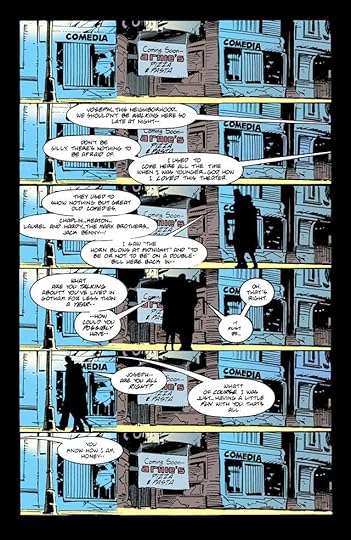
And there were several pages like this one, which I felt were used to good effect:
The cons? I found the tangents focusing on Batman kind of dull - this is Joker's story, after all - but they were relatively short. The addition of a single story after GOING SANE says "The End" was a bit jarring, too; read on its own, I'd have liked Eddie Campbell's GOTHAM EMERGENCY more, but not realizing it was separate from the collected issues I'd just read made me do a few "WTF?" frowns until I read the back copy and understood the context.
Then there are the clichés in the basic story arc (big bad kills superhero but superhero's Not Actually Dead! And then superhero almost kills big bad but then saves him!), but I found the overall experience of the art and writing enjoyable enough to let that stand. I'm curious to now go and read what other Goodreaders thought (I only look at the star average before reading and reviewing!), because I suspect that might be what has held the book at a lukewarm 3-ish score, and I couldn't argue with that.
And while I'm dinging stars off, I could've done without yet another "female character's survival of rape incites male character to avenge/freak out/do XYZ" trope. (That's not a spoiler; the rape happened well before the storyline here and didn't involve any principals.) Thankfully it was more or less touched upon and then left alone. Were it not so common in media since forever I may not have paid it much mind. But it warrants being mentioned here as one of the things I didn't like.
A strong 3.5, creeping-up-on-4 stars. Definitely recommended as the unlikeliest companion piece to LEGO BATMAN. (Ha ha ha ha ha haaaaa.)
The worst Batman story I ever read. The first story-arc is full of clichés (arch-enemies fight and one of them is left for dead; surprise surprise! the good guy is found by a bunch of kids on the riverside and nursed back to health by a young attractive doctor in a quiet little town; and some feelings spawn out of nowhere...etc). The story is so generic that you could easily take Batman and The Joker out and put other characters in their places and it wouldn't make a difference. There are other flaws, like the chaotic frame arrangements or characters remembering scenes they didn't witness. Most of my complaints target the first story for being lazy, poorly drawn, predictable and annoying at every step. The second one is just plain. And on the first page of the story (Gotham Emergency) Batman has faun legs (yup, goat legs for the Bat-man har-har)
Wow. Just wow. I think there are very few that question the ranking of the Batman/Joker relationship as one of the best in comic history. Given my limited knowledge of comics as a whole, I'd argue that only Professor X and Magneto even come close, and for entirely different reasons. This arc could not exemplify more all of the reasons why the Batman/Joker relationship is the best in comics.
I will avoid saying too much more due to spoilers, as I think everyone even remotely interested in Batman should read this arc. But I do want to just highlight how perfectly painted their complete reliance on each other is.
'Batman: Going Sane' may not be one of the most widely known Batman stories, but it’s highly regarded by those familiar with it. The premise, written by veteran comics writer J.M. DeMatteis, offers a fascinating psychological exploration of both Batman and the Joker. DeMatteis, known for his deep dives into the psyches of superheroes and villains, poses the compelling question: what happens when the Joker finally succeeds in killing Batman? With his greatest triumph achieved, the Joker decides to “go sane,” taking on the persona of the ordinary Joe Kerr, adopting a normal job, falling in love, and living a seemingly peaceful life. Meanwhile, Batman struggles with his own sense of purpose as he recovers and reflects on a world without crime to fight.
The story’s strength lies in the inevitable tension between Batman’s return to the chaos of Gotham and the Joker’s fleeting chance at happiness. The slow build up to their inevitable reunion keeps readers engaged, but unfortunately, the final confrontation feels underwhelming. Several interesting narrative threads, such as the Joker’s adjustment to a mundane life and his job, are left unexplored. Instead, the focus shifts to his unconvincing new romantic relationship, which feels rushed and lacks depth. Similarly, Batman’s journey during his six months of recovery stretches believability.
For those familiar with DeMatteis' 'Kraven’s Last Hunt' for Spider-Man, some of Batman’s introspective monologues here may feel overly familiar, lacking the freshness one might expect. The art by Joe Staton, while competent, doesn’t quite suit the tone of the story. Staton’s cartoony style feels out of place in a dark, psychological narrative, and it detracts from the gravitas the story strives for.
Despite these shortcomings, 'Going Sane' remains a poignant and thought-provoking Joker story, offering an intriguing exploration of the Batman/Joker dynamic. If you’re a fan of 'The Killing Joke' and want to dive deeper into their complex relationship, this book is a worthwhile follow-up—provided you can find it at a reasonable price. The included self-contained story, where Batman transports a comatose Joker to the hospital, adds an extra layer to the Batman/Joker mythos, and though not part of the main narrative, it’s a fitting addition.
I would say this is easily one of the best Batman stories, due to the character development of both the Caped Crusader and the Clown Prince of Crime.
When Joker supposedly kills Batman, he gets a job and falls in love. Bruce recovers in a small town and meets a woman whom he could spend the rest of his life with, but these symbols of justice and chaos get in the way of these character`s attempts for happiness.
The following is a tragic yet poetic look at the calm in between the storm of Batman and his arch nemesis, and why they can never have the things they want because of what and who they are.
An oddity: mid nineties storyline repackaged with a mid-two thousand tale. I like the idea of Joker giving up his role and trying to live a normal life and the writing was not only decent, but structured the tale interestingly. The art was reminiscent of the eighties, however: garish and not dark enough.
Batman: Going Sane is a collection of five issues from the original run of Batman: Legends of the Dark Knight. It mainly features a story centering on Joker, who goes sane, when he thinks that he has killed Batman. Batman: Going Sane collect five issues (Batman: Legends of the Dark Knight #65–68 and 200) from the 1989 series run and collect two stories: "Going Sane" and "Gotham Emergency".
"Going Sane" is a four-issue storyline (Batman: Legends of the Dark Knight #65–68), which has the Joker trapping Bruce Wayne as Batman in an explosion and believes that he is finally rid of his arch-nemesis. As a result, his insane mind returns to sanity, and the Clown Prince of Crimes forgets his bloodstained past, starting a new life as the average citizen "Joseph Kerr". However, Batman is still alive, and his return to Gotham City means the end to the Joker's newfound happiness.
"Gotham Emergency" is a one-issue storyline (Batman: Legends of the Dark Knight #200), which has Natalie, a rookie doctor from the Emergency Room of Gotham General Hospital, who is overworked, but the hospital scene becomes pure pandemonium when the Joker is admitted. His life must be saved, because the Joker knows a secret that threatens all of Gotham and Bruce Wayne as Batman must keep him alive at any cost.
With the exception of one story (Batman: Legends of the Dark Knight #200), which Daren White penned, the rest of the trade paperback was penned by J.M. DeMatteis. For the most part, it is written moderately well. DeMatteis has an interesting idea of what would the Joker do if his arch-nemesis is killed off. However, the execution is much to be desired. The Joker going sane is too much for my suspension of disbelief as one could become sane like turning off a light switch – I can see the Joker quitting crime, but become sane – no.
With the exception of one story (Batman: Legends of the Dark Knight #200), which Bart Sears penned, the rest of the trade paperback was penned by Joe Staton. For the most part, the penciling styles of each penciler are rather distinct, but the interruption in the artistic flow wasn't too bad as there is a clear divide on each story.
All in all, Batman: Going Sane is a mediocre collection that centers on the Joker and his complicated relationship to Batman.
Two interesting Joker stories here, the first has the Joker believing that he killed Batman, so believing that he's accomplished his greatest goal, he basically becomes a normal guy, meets a girl, gets a job, plans to get married. Of course, Batman's not dead, just recovering in the home of a lovely young female doctor upstate, and she convinces him that he's not going insane and is doing the right thing, so Batman returns, Joker's personality re-emerges, and they fight again. It's a neat idea, but comes off a little stiffly.
Campbell's story (there's a co-writer, but I can't recall the name and I'm too lazy to look now) is a little tighter. Joker's planted three bombs. As the hospital emergency room - big props to the writing team to making the ER dialogue read very authentic to my untrained eye - copes with victims of the first bomb, Batman disables the second but winds up dosing Joker with his own toxins. So Batman brings Joker to the hospital for anti-toxin in order to find out where the third bomb is. Nice bit of detective work by Bats (although it's fairly predictable where the third bomb is), and some sharp banter in the hospital. The POV character of a young female doctor, just out of grad school, works very well. Sears' art isn't completely terrible either, a stunning surprise.
Pretty good book. The story kind of works as a standalone non-cannon tale that involves the Joker seemingly killing Batman, and seeing no reason to continue being the Clown Prince of crime. He changes his appearance, becomes “sane” and even meets a woman he loves. But as time has shown, the battle between Batman and the Joker is inevitable. The artwork is fairly good and the story is well-written with pretty good pacing. There are times the story jumps between different time lines, but most of the time it is easy to follow (though sometimes it could have been done to make it more obvious for the reader). While I did like the book, it is obvious to say that it is definitely a set of very unlikely circumstances. I had to imagine it as a standalone story, otherwise I might have hated it. For Joker to suddenly become “sane” after killing Batman seems almost impossible. However, Overall it was a good story to read consisting of 4 chapters and I enjoyed each one! Unfortunately, the second story was fairly average, but enjoyable enough. Would recommend to a Batman or Joker fan.
The Joker killed Batman and threw his body into a river, however he had not died although it took some time for him to recover. Meanwhile, the Joker believes that with the objective accomplished, it is time to do something different. He leaves the criminal world and starts a new life, falls in love and even gets engaged to Rebeca. As expected, Batman returns and so does the Joker and they have a rather mediocre final encounter in my opinion. I expected a return of the most aggressive joker or in any case violent against what he loves. That particular sensation that he could suddenly explode had me intrigued until the end but it didn't happen and at the same time it was a relief and a disappointment. In short, it is a small story and without any expectation other than to entertain.
Acabo de terminar hoy mi primera lectura de Going Sane, el dibujante de repente hace cosas muy bien y otras muy mal. Supongo que en los 90 no se notaba tanto y la historia de DeMatties parece un remix de momentos de Kraven's Last Hunt pero con un peor dibujante. Es súper interesante la vida de ambos sin su enemigo y el papel de sus parejas en ello, pero por lo demás, creo que es una historia que no alcanzó a pulirse muy bien. Seguro me van a odiar, pero creo que Snyder/Capullo tomaron esa idea y la exploraron mejor al final de su saga de Batman.
Although the story has good aspects, it is rather weak due to other bad aspects. For example, I think it was good that the characters, moods and obsessions of both Batman and Joker were shown parallel to each other. In bad aspects, for example, we see almost no effect of Bruce Wayne / Batman being missing for 1 month. It should've been a disaster for both Wayne's reputation and Gotham. It was a bit of a hassle for Joker's turning into a normal person, getting married, even going on vacation with a normal ID.
i mean it's interesting but it definitely drags on and has some issues with writing. like the fact that he's for some reason 200 miles north of gotham makes no sense, and i also find batman to be kind of mischaracterized a little bit in this book, but overall it's still a fun read, with it's main weakness being that issues 2 and 3 drag on for way too long and repeat information. also i actually kind of like that he changed his name to joseph kerr, i thought it was funny and it fits since he would make his name obvious since deep down he wants batman to come back.
It doesn't work. Do you really think the essential element of the Joker's character is that he loves 1940s comedies? I'm not sure that's right.
Then the story at the end attempts to do a Batman story from the perspective of a ER resident. IT's a cute idea but she seems so divorced from the story. In the end, Batman out-medicines her, too.
This is a great Batman story arc and reflective of Legends of the Dark Knight at its best. Going Sane is a compelling story about the Joker and Batman's relationship with sanity told through fantastic paneling, captivating art, and some incredibly well written dialogue. Lynn herself is on the underwritten side, but her conversations with Bruce are so good.
Sam Quixote's review has missed an important point. This book approaches Joker as having dissociative identity disorder. You may love this approach, you may find it stupid. I don't really care, you're entitled to your opinion. But you should interpret the story properly. That's kind of a big deal.
I feel like I've seen this story a million times before, but I'm just going to give this story the benefit of the doubt and assume this is the first time Joker pulled this stunt. It's very predictable, but still a fun little ride.
Una de las mejores historias del Joker. Por momentos recuerda un poco a La Broma Asesina, pero el final es casi perfecto. Otra de las "grandes historias de Batman" surgida de la mítica Legends of the Dark Knight
Going Sane is a fun and clever look at what happens when the Joker wins...or at least he thinks so. DeMatteis does a great job of showcasing the Joker's mania. Staton's art was basic but worked for the book. This should be remembered more fondly.