Jump to ratings and reviews
Rate this book
Rate this book
It all began thirty years ago on Mars, with a greenperson. But by the time it all finished, the town of Desolation Road had experienced every conceivable abnormality from Adam Black's Wonderful Travelling Chautauqua and Educational 'Stravaganza (complete with its very own captive angel) to the Astounding Tatterdemalion Air Bazaar. Its inhabitants ranged from Dr. Alimantando, the town's founder and resident genius, to the Babooshka, a barren grandmother who just wants her own child-grown in a fruit jar; from Rajendra Das, mechanical hobo who has a mystical way with machines to the Gallacelli brothers, identical triplets who fell in love with-and married-the same woman.

Ian McDonald is the author of many science fiction novels, including King of the Morning, Queen of the Day, Out on Deep Six, Changa, Kirinya, River of Gods, Brasyl, and Cyberabad Days. He has won the Philip K. Dick Award and the BSFA Award, been nominated for a Hugo Award, and has several nominations for the Arthur C. Clarke Award. He lives in Belfast, Northern Ireland. Visit Ian McDonald online at ianmcdonald on LiveJournal.

365 pages, Mass Market Paperback

First published January 1, 1988

77 people are currently reading
2204 people want to read

About the author

Ian McDonald

265 books1,262 followers
Ian Neil McDonald was born in 1960 in Manchester, England, to an Irish mother and a Scottish father. He moved with his family to Northern Ireland in 1965. He used to live in a house built in the back garden of C. S. Lewis's childhood home but has since moved to central Belfast, where he now lives, exploring interests like cats, contemplative religion, bonsai, bicycles, and comic-book collecting. He debuted in 1982 with the short story "The Island of the Dead" in the short-lived British magazine Extro. His first novel, Desolation Road, was published in 1988. Other works include King of Morning, Queen of Day (winner of the Philip K. Dick Award), River of Gods, The Dervish House (both of which won British Science Fiction Association Awards), the graphic novel Kling Klang Klatch, and many more. His most recent publications are Planesrunner and Be My Enemy, books one and two of the Everness series for younger readers (though older readers will find them a ball of fun, as well). Ian worked in television development for sixteen years, but is glad to be back to writing full-time.

Ratings & Reviews

What do you think?
Rate this book

Friends & Following

Create a free account to discover what your friends think of this book!

Community Reviews

5 stars
459 (29%)
4 stars
566 (35%)
3 stars
385 (24%)
2 stars
127 (8%)
1 star
44 (2%)
Displaying 1 - 30 of 200 reviews
Profile Image for Eva.
8 reviews5 followers
August 19, 2007

I have five words for you: Gabriel Garcia Marquez on Mars.

If that doesn't make you want to read this book, I don't want to know you.
Profile Image for Terry .
449 reviews2,196 followers
September 18, 2013
4 – 4.5 stars

I was reminded, while reading _Desolation Road_, of two authors in particular: John Crowley and Gene Wolfe. This is not to say that I think Ian McDonald was in any way aping them or merely writing some kind of amalgamated pastiche, but there were elements to his tale that made both author’s names spring to mind. I think the first one was Wolfe, largely because of the way in which McDonald made the magical seem almost commonplace (or was it that the commonplace was made to seem magical?) in a way that reminded me of the inversions of the various aspects of the world in both Wolfe’s New Sun and Long Sun series, not to mention the presence of time-travelling Green Men, technological angels and various other oddities. It is almost as though Clarke’s 3rd law has undergone an apotheosis and is not merely a case of technology being incomprehensible such that it seems magical, but that it truly has melded with the magical to produce a sort of moebius strip in which we don’t know where the technology ends and the magic begins. I was reminded of Crowley primarily in the poetic prose and gently fable-like aspects of the story which called to mind some elements of my favourite Crowley work Engine Summer. There is also the fact that this is a generational epic, telling the story of Mars from the perspective of the families that make up the founding members of the tiny habitation of Desolation Road and their descendants, not altogether unlike Crowley’s own generational epic Little, Big, though I enjoyed McDonald’s efforts far more than Crowley’s in this case.

Many reviewers have noted that this book is a kind of sci-fi magical realist novel, even explicitly comparing it to the work of Gabriel García Márquez. I have not read that author’s work, but will take their word for it. To me, though, it may be a bit of a misnomer. I imagine that the whole point of magical realism is that the author is incorporating elements of the “unreal” or “magical” into what is otherwise “everyday” life and thus creating a juxtaposition that is saved from being jarring by the poetic way in which the story is written. This can certainly apply to _Desolation Road_, but McDonald’s novel does seem to differ in one significant element: here we have a science fiction tale set in a world whose basic accepted tenets are already well beyond the “everyday” experiences of what we perceive as a “normal life” and I think the real surprise is simply the way in which McDonald expresses himself as opposed to the elements themselves. In this way I think the aspects mentioned above that reminded me of Wolfe and Crowley melded, or reacted, to create something new. If you want to call this “magical realism” I will not argue with you (and granted there are distinctly magical elements that may fit comfortably here such as a snooker match with the devil or a guitar-playing rainmaker that are definitely more magic than sci-fi in feel), but I think it might be more a label of convenience than a case of true generic affiliation.

The first chapters of _Desolation Road_ have the feel of inter-linked short stories since they tell the individual tales of the various people who will become the founders of the eccentric community of Desolation Road. It is an unsanctioned community of misfits on a recently terraformed Mars (also known as Ares, or simply Earth to those who live there, our own planet being called the Motherworld). This beginning may strike some readers as very slow, and it is true that McDonald takes his time in building up to what could be considered the novel’s plot and ultimate conflict. I think this is a virtue and not a vice in this case, however, since it allows us to get to know not only the founding members of the place, but also their children as we watch the tiny and haphazard conglomeration of huts and caves grow into a true community. We are thus able to get a necessary feel for the community itself as an organic thing, a living organism that impacts those whose lives are made there as much as it is impacted by them. As I mentioned above this is a generational epic of sorts and we need to learn about the lives of all of those whose actions will shape not only the town in which they lived or were born, but also the very planet on which it exists. There is a lot going on in this book, though much of it is simply the everyday experiences that go to making up life in Desolation Road. Slowly, however, these events start to build towards a larger purpose. Members of this small outback community start to move into the wider world, both by happenstance and by design, and the impact they have on their entire planet is not negligible. Whether they learn to master the chronodynamics of time and space, become the greatest snooker player the universe has ever known, or commune with the numinous machine powers that created the world to become cybernetic saints the people of Desolation Road find that their small-seeming lives can lead to great world shaking events.

Ultimately Desolation Road becomes the hotly contested heart of the planet, a battleground for greedy megacorporations, self-interested pilgrims, megalomaniacal warriors, and ambitious politicians. McDonald handles all of this deftly and manages to combine a lyrical telling with some very down to earth occurrences and over-the-top action. Indeed, for a writer of such a fable-like story wrapped in poetic prose style, McDonald is surprisingly good at writing action scenes where things go boom in a big way and combatants have a cinematically super-heroic style. Somehow he manages to make it all work instead of ending up with an ungodly mess. This was a great read, both fun and thought provoking in the tradition of the best sci-fi. Highly recommended.

Also posted at Shelf Inflicted
Profile Image for Fuchsia  Groan.
168 reviews238 followers
June 14, 2018
¿Western espacial?, ¿ciencia ficción?, ¿fantasía?, ¿una novela épica marciana?, ¿realismo mágico? Sí, sí, sí, sí, y sí. Y un derroche de imaginación, de humor, de buena escritura, una rareza de lectura obligatoria.
A pesar de que, sin haberla leído, pueda pensarse que es una novela de ciencia ficción, pues tiene todos los elementos típicos, la mejor manera de enfrentarse a esta novela es estar preparados para encontrar algo más parecido a Cien años de soledad, algo más místico que científico, desde luego.

En el primer capítulo nos encontramos con la peculiar fundación de la ciudad, Camino Desolación, por el Dr. Alimantando, en un Marte del futuro que conecta sus ciudades mediante ferrocarril, y a partir de ahí asistimos a la llegada de los que serán sus peculiares habitantes, memorables y perfectamente individualizados, marginados, excéntricos, reales: Ed Gallacelli, Persis Jirones, Mikal Margolis, Taasmin Mandela...
En cada capítulo vamos conociendo a cada uno, sus circunstancias y qué los llevó a ser unos “pioneros”. Quizás pueda parecer un relato algo inconexo hasta bien avanzada la novela, y es que casi podría leerse como una recopilación de relatos con un punto en común. Si tenemos algo de paciencia y nos dejamos llevar, si somos capaces de disfrutar de la pequeña maravilla que es cada capítulo, asistiremos a todas las situaciones que ese Marte puede ofrecer: viajes en el tiempo, asesinatos, la vida entera.

Una verdadera lástima que el segundo libro ambientado en este mundo (que no es una continuación), Ares Express (2001), no haya sido traducido.
Profile Image for Oscar.
2,235 reviews580 followers
September 8, 2018
‘Camino Desolación’ (Desolation Road, 1988) es una de las mejores novelas de ciencia ficción que he leído nunca, pero también hay que añadir que posiblemente no sea una novela para cualquier público. Alejada del marco científico, la opera prima del inglés Ian McDonald fue un soplo de aire fresco para el género. La novela nos cuenta una historia del futuro en Marte, aunque no se trata de un Marte al estilo Kim Stanley Robinson o Greg Bear; estaría más cercano a las ‘Crónicas marcianas’ de Ray Bradbury. Lo que hace McDonald es mezclar la ciencia ficción con el realismo mágico. Sin abandonar el sentido de la maravilla, la historia nos presenta una serie de historias y personajes que se van entremezclando, mostrándonos un universo calidoiscópico. De esta manera, la narración se vuelve evocadora y cercana al cuento tradicional.

La historia, que como toda novela-río abarca una serie de años, es imposible de resumir. Todo comienza con el doctor Alimantando atravesando el desierto en su tabla eólica, que va siguiendo las indicaciones de un hombrecillo verde. En un momento dado, se encuentra con una órfica, una máquina terraformadora de la compañía ROTECH, lugar en el que se fundará el pueblo que Alimantando da en llamar Camino Desolación. Y a partir de aquí los personajes, todos ellos memorables, irán añadiéndose, cada uno con su historia personal: el señor Jericó, Rajandra Das, Persis Jirones, los Mandela, Mikal Margolis, Marya Quinsana, la Feria Ambulante y Fantasía Educativa de Adam Black, etc.

La imaginación de McDonald es soberbia y su estilo portentoso. Las breves piezas de que se compone la novela están perfectamente trazadas, y los personajes destilan humanidad y humor, siendo absolutamente creíbles. De esta manera, entre la ciencia ficción, el surrealismo, la sátira y la novela fronteriza, el conjunto convierte ‘Camino Desolación’ en todo un clásico. (Desgraciadamente, la edición en castellano lleva descatalogada desde hace más de veinte años, y solo se encuentra en librerías de viejo, mercado de segunda mano y ediciones digitales pirata.)
Profile Image for Carmen.
2,025 reviews2,425 followers
April 18, 2017
There are 69 chapters in this book.

When I first started reading this book, I thought, "Oh, how delightful."

McDonald has succeeded in taking the Wild West and transplanting it onto Mars. This leads to charming tales about strangers with strange pasts blowing into town, in this case a little, tiny town called Desolation Road that isn't really supposed to exist. We are introduced to interesting character after interesting character, and see how they get along with each other, and it is wonderful.

It's also fun to see the Wild West on Mars and watch how McDonald adds fun science-fiction things to this such as cloning, test-tube babies, aliens, time travel, and cyborgs.

Then around Chapter 35 everything goes to heck. The book starts getting confusing, and with every chapter gets more and more confusing, until I can't tell who the characters are anymore, how they are related to any of the other characters (wife, daughter, granddaughter, adopted daughter, etc. etc.), and MOST IMPORTANTLY, what is their motivation for doing all the crazy *&%@ that they're doing. Chapters 35-65 I had very little idea what was going on. It was frustrating and confusing and I didn't like it.

That's not to say that there weren't little gems tucked in those chapters - there were still passages I liked and paragraphs I liked and concepts I liked, but they were buried up to their eyeballs in crazy-confusing-stuff-that-I-don't-understand.

McDonald has an amazing writing style that I adore. He's funny and poetic and eloquent. I enjoyed reading his prose a lot!

The end of the book, the last four chapters (66-69), brings back the charming, understandable first half of the book. So the book ended for me on a note of sweet relief.

It's fair to note that I am not a.) an engineer or b.) a person who usually reads science fiction. So perhaps it's aimed at a different audience and the fact that it goes over my head is due to a lack of some kind of nerdy understanding on my part. My friends (some engineers, and some not) who read science fiction regularly usually seem to understand complicated science fiction plots with no problem. I am not one of those people.
Profile Image for Adam.
558 reviews435 followers
July 7, 2009
McDonald combines the story telling techniques of Gabriel Garcia Marquez with the weird future fables of Cordwainer Smith and Jack Vance (the fable like story telling of all three authors isn’t as different as one would think). It also exists as an examination of our contemporary myths about Mars, including little green men, Bradbury's colonists, and Wells's tripod death machines. A beautiful stories within stories structure. Mcdonald has the mixed blessing of writing a classic in his first book. Enviable but how do you match it. Endlessly inventive and just filled with so many great characters, events, and ideas I couldn’t even begin to hint at it in this review (the book barely contains it all). This would have been my favorite book of all time if I read it earlier and probably would have changed my life for the better. As it stands very, very recommended!
Profile Image for Ajeje Brazov.
950 reviews
August 6, 2019
Ero alla ricerca di libri di fantascienza che andassero oltre i mostri sacri, quali: Dick, Asimov e tutti gli altri della prima ondata (anni 50/60).
Ian McDonald, classe 1960, scrive questo romanzo nel 1988 (suo primo romanzo), è giovane e si percepisce subito da un'esplosione di creatività, fantasia, voglia di esprimere tutta la sua immaginazione. All'inizio mi ha sbalordito davvero, le prime 100 pagine circa, sono un tripudio di fantasia estrema e la scrittura (immagino che la traduttrice abbia fatto un ottimo lavoro) enfatizza questa voglia di stupire. Arrivato a metà libro (pagina 200) però il tutto incomincia a stufarmi e pian piano la noia prende il sopravvento, ad aggiungersi a questo, c'è il fatto che la seconda metà libro è banale in generale, soprattutto rapportata alla prima metà, insomma alla fine è stata una delusione, le ultime decine di pagine le ho lette con una velocità tale perchè non ne potevo più.
Quindi direi un "ni", sarà per la prossima volta, forse... c'est la vie
P.S. alcuni passaggi del libro mi hanno fatto pensare a come Giovanni (del trio) spiegava il loro lavoro in "Tre uomini ed una gamba" ahahahahah :-P
http://www.youtube.com/watch?v=D2mBHA...
Profile Image for Raffaello.
197 reviews74 followers
August 30, 2020
La storia di un paese sorto per caso nel bel mezzo del deserto marziano, raccontata in una serie di episodi perlopiù slegati l'uno dall'altro. Questo sembrava Desolation Road nelle sue prime 250pagine. La città cresceva di episodio in episodio, si popolava di personaggi curiosi e di storie immaginifiche e strampalate. Tutto sommato, pur faticando a digerire la struttura episodica, il libro non mi stava dispiacendo. La scrittura curata e le atmosfere oniriche mi cullavano piacevolmente ed ero piuttosto incuriosito dallo scoprire che destino avrebbe inventato l'autore per questa sua sorprendente cittadina.

Poi però tutto cambia. Nelle ultime 150pagine il libro comincia ad incanalarsi in una vicenda, fatto che solitamente avrei accolto con piacere se non fosse che questa si rivela una inspiegabile storia di guerra, guerriglia e speculazione industriale. Una storia che sembra cozzare totalmente con quel che era stato il libro fino a quel momento, tradendo quello che pareva essere (almeno fino a quel momento) l'intento dell'autore. Boh. Questa parte del libro mi ha lasciato davvero perplesso.
Gli ultimi capitoli per fortuna tornano a rievocare le atmosfere oniriche di inizio libro, in un finale malinconico che risolleva in parte la valutazione.

Desolation Road non è stato una delusione totale, ma una mezza delusione sicuramente si. Il libro, a mio parere, cade vittima della stessa fantasia sfrenata dell'autore (croce e delizia del testo) e si perde in una confusione di potenzialità sprecate.
Ian McDonald resta comunque uno scrittore da tenere in considerazione per il futuro.
Profile Image for Ignacio.
50 reviews
December 7, 2019
Mientras el Doctor Alimantando vagaba por el Gran Desierto de Marte tras ser expulsado de Deuteronomio por sus extrañas y heréticas ideas poco sospechaba que, guiado en su camino por una misteriosa Persona Verde, llegaría a fundar al pie de un promontorio rocoso plagado de cuevas un pueblo llamado Camino Desolación.

Contando como base una olvidada estación de radio meteorológica y los restos aprovechables de una vieja misión de ROTECH, en Camino Desolación terminan varando una serie de personajes inolvidables que huyen de su pasado. Variopintos y llenos de vida como el señor Jericó con su mente conectada a sus Exaltados Antepasados, Rajendra Das y su toque mágico con las máquinas, Persis Jirones del Asombroso Bazar Aéreo, los hermanos Gallacelli, la familia Mandela, así como las rivales Tenebrae y Stalin que tanto influirán en los acontecimientos de los años por venir.

El pueblo arranca su existencia con todos estos personajes fundacionales, que, como en un western del planeta Marte, dan vida a un pueblo pionero en un páramo desértico al borde de una vía férrea camino de la ciudad Paraíso. Por esa vía discurren trenes de impulsión nuclear que empiezan a parar esporádicamente, como el tren parlante de la Feria Ambulante y Fantasía Educativa de Adam Black, hasta convertirse en una parada oficial del Cuarto de Esfera Noroccidental de la Compañía Belén Ares de Marte.

La prosa de McDonald es de una gran belleza desgranando los originales nombre de gentes y lugares de Canino Desolación y describiendo las situaciones a las que se enfrentan en el marco de un Marte soñado, terraformado por ROTECH.

Las vidas de los habitantes de Camino Desolación se van entrecruzando a partir de las primeras generaciones de nativos del pueblo. Sus pasos hacia la madurez les llevarán a destinos muy diferentes que terminarán decidiendo no sólo el destino de Camino Desolación sino el de Marte y el de la realidad misma.

Camino Desolación es un lugar donde las tribulaciones amorosas han sido comparadas con los estudios de la Universuum de Lyx sobre la dinámica de un sistema de tres estrellas y su naturaleza inestable.

La belleza de Camino Desolación toca el límite de Roche del corazón. Su esencia surrealista reside en descripciones circulares y encadenadas. Es un lugar donde los acontecimientos se rigen por horas de palabras simétricas. La música abre los cielos y el lenguaje y el misticismo te llevan a comulgar con el Panarcos, o al menos con Santa Catherina de las Máquinas y su coro de ángeles mecánicos.-

Los largos años marcianos avanzan y Camino Desolación cambia: ¡la gente grita durante la hora de la siesta y entra sin llamar!. Los cimientos fundacionales de Camino Desolación se ven amenazados.

La Compañía Belén Ares desde su gigantesca capital de Kershaw, defiende el Feudalismo Industrial impuesto sobre sus Obreros-Accionistas.

¿Hacia dónde se precipitan los acontecimientos? La cronodinámica de Alimantando abre las posibilidades de todas las realidades del Omniveros. ¿Podrán los habitantes de Camino Desolación regir sus propios destinos? Todo personaje arrastra su pasado y los fantasmas son las cosas más sustanciales del mundo. Los cimientos del presente. Los recuerdos

Una lectura fascinante y original que me ha mantenido hechizado por su extraña belleza. Posiblemente uno de los debuts más impresionantes en novela de ciencia ficción.
Profile Image for Jacob.
88 reviews551 followers
July 4, 2021
August 2009

This is the story of Desolation Road, a ramshackle, hodgepodge little town of misfits that, over the course of its decades-long existence, would grow to be the home of scandals, time travelers, a religious movement, terror cells, labor disputes, a baby in a jar, and an all-out war which would, briefly, turn the accidental colony into the most important place on Mars.

Despite its sci-fi setting, Desolation Road fits more in the magical realism genre with its colorful setting and dreamlike plot; other readers have compared it to the work of Gabriel García Márquez. I’ll take their word for it, since I haven’t read him yet (I know, I know), but I wouldn’t be surprised if they’re all right. It’s a great story, although McDonald tends to meander a bit despite the brevity of some of the chapters, and the second half of the book, when the focus shifts from the little episodes of the townspeople to the greater factions working in and around the town proper, loses some of the magic and starts to feel a bit dull. Overall, though, it’s a fantastic tale, and certainly the most imaginative work of science fiction I’ve ever read.

(There’s probably a lesson here about judging books by covers. I saw the book advertised on Pat’s Fantasy Hotlist and knew I had to read it. Gorgeous artwork. Story sounded good too. But the library had a sense of humor and sent me an older edition, with the original cover, and almost put me off reading it altogether. Took me a few more days to track down the newer edition, and then I had to deal with a godawful amount of typos. Should've stuck with the older copy. I wouldn't have been able to admire the artwork between chapters, but I also wouldn't have been so annoyed with every misspelled word and misplaced punctuation mark...)

Next: Ares Express
Profile Image for Amanda.
282 reviews186 followers
September 14, 2013
This book had all the creativity, uniqueness I want to find in a sci-fi book, but most importantly, it was actually saying something. My first reading of an Ian McDonald book and I can't wait to read the next one!
Profile Image for Psychophant.
546 reviews21 followers
July 27, 2009
This is a book that is tailor made for me. A well done mix of Magic Realism and Science Fiction, with homages and small details from many writers I enjoy, from Borges to G. Wolfe, from Vance to Zelazny, going through Bradbury. The short chapters really grip you and keep you reading a little more, till the night is almost gone.

It tells the story of a place through the lives of several of its inhabitants. Some of them are unforgettable, and all are special in their own way. In a way, it presents Humankind, even if they are in Mars, with its virtues, defects and all those aspects that will be either depending on who does the telling.

Another advantage of Magic Realism applied to Science Fiction is that, as it is really Fantasy with a science veneer, it does not age so badly, so this book is still as fresh today as when it was published.
Profile Image for Javir11.
671 reviews297 followers
November 30, 2016
Esta es una de esas lecturas que por un lado me ha encantado, pero por otro ha llegado a desesperarme. Dándole 4 estrellas obvia decir quien de los dos sentimientos ha triunfado al final.

Como no tengo mucho tiempo, destacaría los personajes por encima de todo. Hay que leer la novela para entender de que estoy hablando si os digo que cuanto menos son curiosos.

La prosa de McDonald también es de muchos quilates y la trama aunque algo surrealista en ciertos momentos, esta repleta de frescura y originalidad.

Sus pegas, pues sobre todo su narración algo irregular. Hay capítulos tremendos, mezclados con otros bastante pesados. Y un desenlace que al final parece algo forzado en ciertos puntos.

Por cierto, aviso que esta no es una lectura para todo el mundo y que si después de 50-60 páginas no os ha enganchado, es mejor que lo dejéis.

Como siempre os dejo el enlace a mi blog para que le echéis una ojeada a la entrada que publiqué allí.

http://fantasiascifiymuchomas.blogspo...
Profile Image for Olethros.
2,724 reviews534 followers
November 14, 2014
-Arriesgada hibridación para ofrecer una rara avis en su género.-

Género. Ciencia-Ficción.

Lo que nos cuenta. El Doctor Alimantando, tras un extraño encuentro que le prepara para ello y otro que termina proporcionándole los materiales necesarios, crea un asentamiento en una zona montañosa aislada y con cavernas del Gran Desierto de Marte, en su Cuarto de Esfera Noroccidental, al que llamará Camino Desolación (aunque pensó en llamarlo Camino Destino antes de abusar del vino de vainas de guisantes) y al que irán llegando distintas clases de parias, fugitivos e inadaptados a lo largo de los años, creando una sociedad pintoresca debido a sus circunstancias.

¿Quiere saber más de este libro, sin spoilers? Visite:

http://librosdeolethros.blogspot.com/...
Profile Image for Bokeshi.
42 reviews60 followers
April 30, 2016
Another dud by McDonald, Desolation Road is too weird even for me. It reminded me of Salman Rushdie's Grimus , another failed attempt in blending science fiction with magic realism. There are echoes of Márquez's One Hundred Years of Solitude too, but this was nowhere near it, as Márquez obviously knew that it takes more than pretty language and vivid imagery to create an engaging story. I didn't get it, I didn't like it, and I didn't finish it.
Profile Image for Jason Pettus.
Author 20 books1,453 followers
October 30, 2009
(Reprinted from the Chicago Center for Literature and Photography [cclapcenter.com:]. I am the original author of this essay, as well as the owner of CCLaP; it is not being reprinted here illegally.)

Regular readers know that in the last year, I've ended up becoming a huge salivating fanboy of science-fiction author Ian McDonald, and that I have no problem with people knowing this; that's part of what being a book lover is all about, after all, is finding certain writers that we can go all nutso crazy for. So ask me how excited I was when our friends at SF publisher Pyr recently sent me a copy of McDonald's very first novel, 1988's Desolation Road, re-released last year on its twentieth anniversary with an all-new layout and a stunning new cover by in-house wunderkind Stephan Martiniere; because this is why I started the "Tales From the Completist" series here at CCLaP to begin with, because sometimes it's simply fun to attempt to go back and read every single thing an author has ever done, although admittedly in McDonald's case I still have a long way to go (his 19th book, the Turkey-set day-after-tomorrow tale The Dervish House, comes out next summer).

And in fact Desolation Road is quite the intriguing title to start with if you've never read any of McDonald's work before, and it's easy to see why it made such a big splash twenty years ago to begin with; because instead of the usual Blade Runneresque cyberpunk tale that was so popular at the time, this is a rather literal ripoff of Gabriel Garcia Marquez's 1967 postmodernist classic One Hundred Years of Solitude, only in this case set entirely on a semi-terraformed Mars thousands of years in the future. (And just to make it clear, I myself have not yet read Solitude, although it's scheduled to be reviewed next year as part of the "CCLaP 100" series of classics essays; I have, however, already read and reviewed yet another Solitude ripoff from these same exact years, Gilbert Hernandez's "Palomar" stories from the old seminal comic book Love & Rockets, which is why I feel qualified enough to at least make the comparison.)

See, like Solitude, Desolation Road is essentially the story of an isolated village out in the middle of the Martian desert, literally forgotten by the rest of society because of it technically not even supposed to exist (turns out that an artificially intelligent terraforming machine, bored with the ennui of life, secretly created the town's infrastructure one day without telling anyone, then committed suicide); the story itself, then, is a multi-generational look at the stragglers who all end up at this forgotten village in the middle of nowhere (through getting lost, being exiled from other towns, running from the law, etc), and how the dramas of these families pass from parents to children as time passes and the village takes on a life and history of its own. And hey, it turns out that McDonald even incorporates the Latin-flavored magic-realism that made Solitude such a stunner when it first came out (in fact, it can be argued that the original Solitude single-handedly started the now way overused trend of magic-realism within postmodernist novels); it's just that McDonald very cleverly filters his magic-realism through the prism of hard science, so that for example there are "angels" in his story made up of semi-forgotten biomecha drone workers from long before the planet was habitable to humans, and "ghosts" who in reality are an alien species who have mastered the art of quantum-mechanical time travel.

And all of this is indeed very very clever, and as a result Desolation Road reads like no other SF novel you've ever seen -- more like a densely poetic folktale than the usual robots-n-lasers stuff, albeit with lots of actual robots and lasers and stuff, a bewitching combination of scientific conceits and third-world superstition, which in its incidental passages just happens to also lay out the ultra-complex thousand-year history of Mars' transformation into a habitable planet in the first place, a virtual wet dream for fans of world-building stories like me. (And yes, just like both Solitude and Hernandez's Palomar stories, certain young characters within Desolation Road end up sick of the provincial life and moving to one of several huge cities, giving McDonald a chance to greatly expand the scope of this novel; in fact, this is how most of the population of Mars lives, within a small series of giant, packed megapolises, usually founded by one particular Earth nation or another, and thus each of them taking on the flavor of, say, an Indian city or a Mexican city or whatnot, separated by thousands of miles of barren desert and connected by an impossibly long railroad track that circles the planet.)

But of course there's a problem with Desolation Road as well, albeit in this case a welcome problem; that just like it is with any brilliant mature author, McDonald has ended up becoming a much better writer in the twenty years since this first came out. And so that's bound to make any current fan of his a little disappointed with this early classic, when compared to such contemporary masterpieces as Brasyl and River of Gods; because just to cite one example, the flip-side of all the poetic magical-realist writing seen here is that it often tips into overwritten purplish fussiness, the kind of Victorianesque finery that will make many modern audience members roll their eyes in exasperation. If there's any legitimate criticism to be made of this book, it's that McDonald at the beginning of his career leaned a little too heavily on writers like Marquez, and had not yet found that strikingly original voice that has made him now so loved; to get technical about it, in fact, there are huge sections of Desolation Road that contain no scientific or futuristic elements at all, entire chapters that could literally be reset in a small village in Mexico without anyone telling the difference, which is bound to make many SF fans frustrated indeed.

But still, just like any early novel by a mature author who has since acquired a strong following, Desolation Road is more than worth your time; and in fact, this may be one of those cases where those not yet familiar with McDonald may end up liking it even more than existing fans of his, a fantastic place to start before moving on to his mature works that will literally blow your head clean off your neck. Especially now that it's available in such a gorgeous new edition (and seriously, designer Jacqueline Cooke, you should be commended for a book design that is both stylish and non-distracting, a hard balance to find with full-length novels), it is more than deserving of your money and attention. As with all of the books by McDonald I've now read, it comes highly recommended.
Profile Image for Daniel Roy.
Author 4 books74 followers
May 22, 2012
Desolation Road is a the magic realist tale of the birth, life, and ultimate destiny, of a desert town. It just so happens that this town is set on a terraformed Mars.

I'm a big fan of Ian McDonald since reading the brilliant The Dervish House, and this, his first novel, has many of the hallmarks of his future talent. There's the stellar prose, of course; often brilliant, sometimes good enough that you want to put down the book to applaud. There's this sense of worldliness: his futuristic Mars is not a mere projection of Western culture, but a cool patchwork of many different societies, including Middle Eastern, South Asian, and African. There's the plethora of characters, sometimes barely more than a sketch, but never boring nor cliché. And, above all, there's a powerful sense of place, of location as character, as we see the town of Desolation Road grow from a one-man outpost, to an industrial hotbed and beyond.

There isn't much about this book that's conventional SF in any way. Despite being set on something approaching Kim Stanley Robinson's Mars, McDonald takes Arthur C. Clarke's "any sufficiently advanced technology" maxim for a spin, by using SF brushes to paint a deeply fantastic world. The foundations of the novel may be hard science fiction, but the execution is fantastic, even mythological and messianic in parts. A sense of wonder permeates the story's fantastical elements, a sense that miracles are possible, that magic exists in this technological world. The narrative keeps the reader off-balance, as it introduces new SF concepts at inopportune moments, instead of laying them out early on and staying consistent with them. Elsewhere it would be a terrible flaw, but here it's sheer brilliance.

The novel evolves more as a patchwork of individual stories than a series of linear events. Throughout the course of the narrative, we meet three generations of Desolation Road inhabitants, and the side-characters keep piling on. Almost all chapters function as snapshots or short stories using Desolation Road as its setting, which makes for a whimsical though uneven read. Eventually the stories coalesce; but paradoxically, this is where the book loses some of its impact. When all the characters converge for a final act, it becomes hard to keep track of who is who. Furthermore, the whimsical tone of the previous chapters means that it's hard to take sides when a real conflict erupts. Given the gentleness of the tone of the first 300 pages, the final act of the novel are filled with a terrible amount of noise and blood.

If there's one major flaw to the novel, it's the sheer volume of inventiveness and characters that McDonald throws in. There's enough here for at least five different novels, and some of the ideas and characters begin to trip on one another after a while. Characters who had been introduced fifty pages earlier pop up unexpectedly, sometimes so out of context that it's hard to remember who they are. SF concepts struggle for breathing space.

But when it's not trying to stir up a reality-shattering conflict, in the quieter parts of its narrative, Desolation Road is brilliant in its evocative restraint, in the wonders it pulls from the terraformed Martian soil. Some stories, like that of the guitar-wielding Hand, or the emprisoned angel, were beautiful SF of a sort I had never read before. And in this, Desolation Road far exceeds its biggest flaws.
Profile Image for Libby.
Author 6 books44 followers
February 2, 2010
Each chapter of this book reads like a standalone short story, and even though the McDonald's elevated figurative language only really works for me about 50% of the time, it's an ambitious book that largely succeeds in what it's trying to do, which is to combine science fiction with magical realism.

The book has much in common with Garcia Marquez's "One Hundred Years of Solitude" in that the book centers on a group of families in a geographically isolated village and spans the village's founding near a strange abandoned structure to its destruction, and encompasses births, deaths, people with mythical skills, wars, and how the development of the outside world encroaches upon their way of life. However, unlike the Marquez, the setting is Mars, there's time travel, mind-bending amalgamations of religion and technology, and even some green men.

All in all, this book stands in stark contrast to most hard sci-fi because of its blatantly literary ambitions. It's a book that takes its time to tell the story and isn't afraid to linger in allegorical places, like the loom of one fate-like inhabitant of Desolation Road who weaves the story of the town and its inhabitants into a tapestry. I occasionally found myself growing impatient with the language, largely because I have been spoiled by the likes of Calvino and Borges, but the patience I expended getting past short forays into stream-of-consciousness and the occasionally clunky metaphor was well rewarded by the richly imagined world that succeeded in feeling as strange as it does familiar.
Profile Image for Tomislav.
1,161 reviews99 followers
May 14, 2016
In the beginning, Ian McDonald's first novel reminds of Ray Bradbury's Mars. An unintended town growing up on the side of the tracks, each citizen arriving through odd circumstance, and contributing their eccentricities to the overall tapestry. McDonald draws on the tropes of the American West in establishing the town as a character itself. But growing from there, it experiences the industrial revolution, and a political revolution, and a time storm all more or less simultaneously. There is just so much packed into the 23 year (Martian year) history; it is hard to believe this is just one novel.

I have read and enjoyed a few of Ian McDonald's subsequent books, and it was good to see where he started. No wonder he was noticed as a new writer.
Profile Image for Michael Battaglia.
531 reviews64 followers
November 29, 2018
There are probably people who hear Bob Dylan songs and want to spend hours analyzing them, or writing their own songs. Ian McDonald may be the only person who heard "Desolation Row" and thought "Oh man, this song is begging for someone to write about this as if it were a real place on Mars!"

I have no idea if that's what actually happened but its a good enough explanation as any.

McDonald's first published novel and the first novel of his that I've read, which is strange since he's fairly prolific and been nominated for several awards, which generally attracts me like mice to cheese (I think I have "River of Gods" around somewhere, so there's that). Its set on a future Mars in a desert that's been terraformed, where a scientist named Dr Alimantando comes across a greenman who leads him to a device that allows him to convert the area around it to a livable oasis. He names the town "Desolation Road" because "Lonelyville" isn't quite as catchy and sits back expecting to exist in complete solitude forever with only his own thoughts to keep him company.

Except we've all seen "Gilmour Girls" and we know if there's one thing that adorably isolated small communities attract, its adorably quirky townsfolk. And before you can compose your Martian Stars Hollow fanfiction here they come rolling in! In fact, the first batch of chapters are basically explanations for how the various townsfolk arrived, mostly one at a time. In what people seem to interpret as an homage to Jack Vance, everyone has quirky names like Mr Jericho and Persis Tatterdemalion and equally strange backstories that sometimes sound like entries for some weird contest that no one bothered to give out an award to . . . its interesting to a point and for me the first hundred or so pages were the roughest going. The chapter are short, but each one introduces a new character, gives their cute backstory and then integrates them into the new town, just in time for us to admit a new person or persons to the family. It makes for a very episodic read at first, and without any real plot forming you start to wonder if he's just going to parade an endless cast of people with funny names at you and strange characteristics (he talks to machines! they're triplets that no one can tell apart! he's in love with sister! and so on).

But just when you're about to start marking this off as tedious, it very gradually begins to gather some momentum. People start to grow old, start to die, new generations are born and they start to grow up and very slowly McDonald starts to expand the world these people live in and make it less hermetic. People leave and we follow them for a bit on what they do outside the town and before long what some of the characters are doing outside the town begins to have an effect on everyone who stayed behind. For better or for worse, the characters start to become more than their names, although the writing style always seems to keep everyone at a slight distance.

Its not hard science and anyone expecting an early version of Kim Stanley Robinson's Mars Trilogy aren't going to find that level of detail here. Instead McDonald delves into a SF version of magical realism where getting the feel and mood right is more important than getting the science exactly right. A lot of it is just wacky enough that it fits right into everything (the girl with the charmbursts, the guitar player who can make it rain, the woman who talks to gods) but there are going to be moments when you want to flip back to the front cover and makes sure you're not reading some kind of Borges story. Still, while its never relentless it may rub some people the wrong way if you're looking for a more realistic experience (yes, I know, about future Mars).

Fortunately it trends closer to more normal SF territory by including an evil corporation, a union strike that turns violent and at least two warring paramilitary groups. Some people who prefer the quieter early chapters that just about life on Desolation Road may not enjoy the later sections of the book as much when the laser guns come out and the body count starts to rise alarmingly high. For me, it felt like the book was progressing toward something, an arc the story itself acknowledges toward the end as it becomes clear the book isn't about the characters so much as the life and death of the town itself.

By this point the story has become more easier to digest as all the little threads that he's been populating the book in its multiple small chapters suddenly start coming to fruition (or get cruelly snipped off). By the time we reach the end the tone has become elegiac and even a little sad, becoming the tale of a town's lifecycle but also about generations and how they survive and move and persist, how you can love where you live and leave where you came from and never want to go back, and how it still hurts even when it turns out you actually can't. Almost all of his characters make bad decisions and pay for it in one form or another but when you extend a life out long enough don't we all take that risk? Our chances of survival diminish the further out we go and while we only sometimes imagine that to pertain to our immediate selves, its more than that, its our homes, its the cities we live in, and where we look to either side of our worlds and see only eternity the truth is it came from somewhere and it'll go away, too. Years ago I found myself walking to the next town over and found the street where I grew up, only to discover that the house had been knocked down and entirely replaced. Yet the memories still exist. And yet one day we won't even have those. And if the book is saying, hey, that's okay, that's what supposed to happen and everything is working like it should, whether its here or Mars or you or your parents or your descendants then all I can say is, fair enough. Its not ideal, but as both the characters and us eventually find out, very little is. It makes its own peace and that's what stays with you.
Profile Image for آرزو مقدس.
Author 36 books204 followers
August 15, 2020
Started out fun then got real dark, real fast. Had no idea what was going on in this madhouse of a town for like 65% of the time, but a very delightful read nonetheless.
Profile Image for Bandit.
4,943 reviews578 followers
September 8, 2017
I've wanted to read this book for so long, Mars has always been one of those destinations I can't resist an armchair trip to. And this one did not disappoint and was well worth the wait. To describe it as entry #1 in a universe is actually incredibly apt, because that's exactly what Ian McDonald has dreamt up, an entire microcosm of a small settlement on Mars complete with a detailed story of its denizens, for generations, inception to dust, entire arc of a place. The sheer breadth of it is just awesome, it's such an ambitious undertaking and so well executed that it deserves to be referred to as an epic, not to mention can really use a personae dramatis. In fact there is so much going on, it often reads like a compendium of stories as opposed to one giant seamless narrative. I tried to read the novel in as few sittings as possible (which ended up being something like 3 in two interrupted days) just to make sure I can maintain grasp on all the individual threads without being overwhelmed. But it does get overwhelming, especially toward the end, the sheer weight of the book works...if not against it, then at least to alter its aerodynamics. So, in fact, as exceptional as the chronologies were and as exciting as the action was, it did (to continue the alliteration) get exhausting at times to read it (and dense enough to read longer than 373 pages promises), though, as I've mentioned before, utterly worth it. And so if I didn't passionately love the book, I liked and appreciated it tremendously and I think it's a stunning achievement and a striking display of imagination and talent. McDonald's greatest strengths as an author are in his world building and his fairy tale like narrative and, because I believe most adults read fiction, especially genre fiction, to revisit the thrill of being told a great fairy tale as a child, this book gets the most enthusiastic recommendation. Destination...Desolation Road, Mars. What a trip, what a journey, what a ride.
Profile Image for Ian.
125 reviews579 followers
January 9, 2011
Okay. I give up. I've been trying to read this book all the way through since it came out, about twenty years ago. I've given it at least four college tries. My best try saw me to about page 100, whilst the try that I'm just now giving up only made it to page 43. I have never so badly wanted to like a book that I just can't finish.

First off, I love Ian McDonald. Some of his books are among my all-time favorites. I love his mix of surrealism, poetry, and stream of consciousness with concise descriptions of scenes and events. Some of the language in Desolation Road is brilliant, just plain brilliant.

So why can't I finish it? Why can't Desolation Road maintain my interest for more than a day at a time? I don't know. I can't figure it out. When I pick it up to read it, the book fascinates me. But when I put it down, I lose all desire to pick it up again. It's a mystery I can't explain ... and I'm genuinely open to suggestions. A little help?
Profile Image for Lyudmila  Marlier.
319 reviews35 followers
August 22, 2020
Очень! У меня правда какая-то неподвластная описанию связь с мирами и историями Макдональда. Любой настоящий уважающий себя любитель фантастики, конечно, возразит, что это и не фантастика, и миры-то топором вырубили, но я просто не могу оторваться, хочу, чтобы это всё не заканчивалось, а что хуже, не исключаю, что перечитаю
Profile Image for Xabi1990.
2,126 reviews1,386 followers
December 1, 2016
3/10.

Y colorín, colorado, mi relación con el autor se ha acabado (léase se acabó. Allá por el 97)
Profile Image for Gordie.
67 reviews11 followers
August 29, 2018
Finito Desolation Road, il romanzo d'esordio di Ian McDonald.
Già dal primo approccio si capisce la ricercatezza stilistica e l'enorme fantasia di idee e situazioni di questo autore britannico classe 1960.
Per apprezzare a fondo questo libro ci vuole, secondo me, un minimo bagaglio di letture fantascientifiche o comunque una mente aperta e pronta a tutto ciò che è fantastico, pronta ad accettare tutto e il contrario di tutto senza barriere e preconcetti.
Premesso questo, il romanzo risulterà godibilissimo, divertente, ma anche ricco di concetti profondi di natura umanistica, tecnologica, scientifica e teologica, quasi mistica.
Una storia epica insomma, la storia di un borgo sorto ai margini di un deserto rosso su un pianeta da poco terraformato, fondato da alcuni tra i personaggi più strambi e complessi di cui io abbia mai letto.
Un insieme di storie e di generazioni che cescono e si legano alla città di Desolation Road, punto centrale della vita nonostante così lontano dai grossi centri del pianeta, luogo nato lungo i binari di una ferrovia che attraversa il Grande Deserto, quasi un omaggio a C'era una volta il west di Sergio Leone.
Un romanzo ironico, una scrittura ricercata e ridondante che entra a forza nell'immaginazione del lettore, un coacervo di situazioni inimmaginabili che racconta l'evoluzione dell'uomo, dell'ambiente, da poco reso vivibile grazie a macchine al di fuori di ogni concezione tecnologica. Il misticismo e l'evoluzione trascendente di alcuni personaggi, la nascita di un feudalesimo industriale, i conseguenti moti reazionari, infine la guerra e il finale che non ti aspetti.
Da leggere assolutamente, non una passeggiata, ma gradevole e godibile come un bicchierino di Lagavulin, che rilascia piano piano al palato tutta l'essenza delle sue sfumature e alla fine, un retrogusto appagante: le stesse sensazioni che questo grande romanzo di McDonald lascia chiudendo l'ultima pagina.
Profile Image for Paul.
1,021 reviews41 followers
did-not-finish
May 3, 2016
February 2012:

Not rated because I abandoned it halfway through. If I were to rate it, a two star read at best.

I'm very disappointed. I recently read Ian McDonald's novel The Dervish House and thought I'd found a new author to recommend to all my friends. But this one? It purports to be science fiction, but it's really just a bunch of magical hoo-hah: impossible and unreal. McDonald's writing is friendly and engaging, as are almost all of this characters, good and bad alike, but the story has nothing really to say ... page after page of inconsequential fluff.

I read this as a Nook book, and like so many ebooks, it's filled with typos and errors, more than enough to make reading it an unpleasant experience ... I feel ripped off by the publisher.

I simply cannot get over the contrast between Desolation Road and Dervish House. It is as if they were written by two different authors.

May 2016:

I recently finished McDonald's Luna: New Moon, another very good exercise in world building, and decided to give Desolation Road a second go. I mean, how could McDonald so grab my attention with his other SF novels, and yet so totally lose me with this one? Desolation Road deserved another chance.

It still doesn't stand up. It's a trivial book with trivial characters and trivial observations.
Profile Image for Alan.
1,268 reviews158 followers
October 24, 2014
Marvelous how all human strife and conflict was a symbolic enactment of loftier struggles between the Powers Cosmic so that every moment of the present was merely a fragment of the past repeating itself over and over again.
—pp.251-252


Destination Road, Desperation Road, Desecration Road... Desolation Road. Through a series of unlikely accidents, Dr. Alimantando (and what an effort it must have been for Ian McDonald to type that name over and over, in the days before search-and-replace!) has constructed an oasis on Mars—Ares, that is—in the middle of its rust-red Great Desert, where rain has not fallen for some one hundred and fifty thousand years.

McDonald's take on our fourth planet (or something very much like our fourth planet, anyway) is only one of many, of course—there was something of a glut of Mars novels in the 1990s, in fact, of which this novel could be seen as a harbinger. But Desolation Road is unique, vivid and hallucinatory, partaking much more of Ray Bradbury's Mars as Heaven than of the prosaic planet explored by the Curiosity rover, or even the fictional but harder-edged environment of Kim Stanley Robinson's R/G/B Mars.

McDonald squanders more inventiveness in a dozen pages of Desolation Road than most authors manage to pack into entire series. Every chapter, throughout at least the first half of the book, introduces at least one new character. The only consistent feature is the town of Desolation Road itself, and even that grows and changes with each arrival of the Bethlehem Ares Railroad's fusion-powered trains.

There are echoes of both Cordwainer Smith and K.W. Jeter, and perhaps also of the film Brazil (1985) in this version of the Red Planet as well. Beyond the ken of the mortals whose stories are told directly, great powers and principalities manipulate reality at the quantum level, their agents easily mistaken for angels and demons, wielding technologies indistinguishable from magic. Despite (or because of) that, the human society of Ares is curiously archaic—an era of soi-disant "Industrial Feudalism." Steel and steam rule (even though the steam is generated by tokamaks rather than burning coal and wood). Buttery brass and polished leather fittings abound. If this novel isn't quite steampunk, it's certainly a nearby neighbor.


Desolation Road was McDonald's first novel, published in 1988, and in some ways it shows. His prose is florid, and often repetitive, scattering images and ideas with profligate disregard. In latter years McDonald has become much more economical. But these elements of youth and enthusiasm are part of what make this book the fascinating thing it is.

Consider lists like this one, about the Aresian city of Belladonna:
And in a city with more bars, sushi houses, tavernas, sex boutiques, wineries, whorehouses, seraglios, bath houses, private cinema clubs, all-night cabarets, cafés, amusement arcades, restaurants, pachinko parlors, billiard halls, opium dens, gambling hells, dance palaces, card schools, beauticians, craps joints, body shops, massage parlors, private detective's offices, narcotics refineries, speakeasies, saunas, bunco booths, gin palaces, bondage basements, singles bars, flesh markets, flea markets, slave auctions, gymnasiums, art galleries, bistros, reviews, floor shows, gun shops, book stalls, torture chambers, relaxariums, jazz clubs, beer cellars, costermongers' barrows, rehearsal rooms, geisha houses, flower shops, abortion clinics, tea rooms, wrestling rings, cock pits, bear pits, bull and badger pits, Russian roulette salons, barber shops, wine bars, fashion boutiques, sports halls, cinemas, theaters, public auditoria, private libraries, museums of the bizarre and spectacular, exhibitions, displays and performance areas, casinos, freak shows, one-armed-bandit malls, strip shows, sideshows, tattoo parlors, religious cults, shrines, temples and morticians than any other place on earth, it can be hard to find a man if he does not want to be found.
—pp.143-144
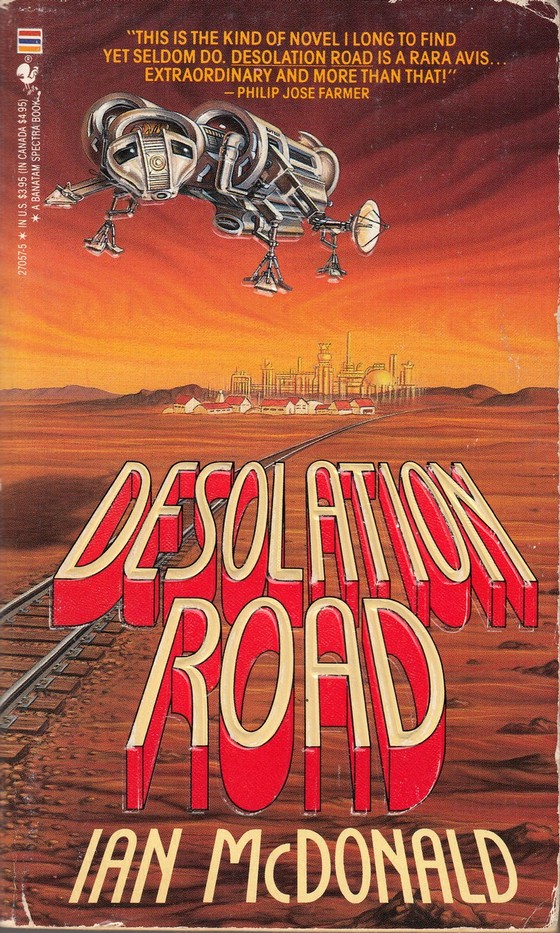

Some physical aspects of this mass-market paperback were a bit less polished than I've grown used to in recent years. The cover sketch on the edition I own (which, for some reason, is not the default image for this ISBN!) is awkward, even for its era, though it does get the job done—the flyer overhead, its insectile head cocked quizzically, is especially expressive:
Desolation Road cover

Also, the book was patently proofread by human beings, not spell-checked by automata. Nonexistent words—"strickly," "fauning"—were sometimes enough to pull me (briefly) out of the story.

McDonald's descriptions of nine-year-olds falling in love weren't quite as disturbing after I remembered that Martian years are two Earth years long. Of course, McDonald was only fourteen himself (in Ares years) when he wrote Desolation Road.

The very concept of "Industrial Feudalism"—not the essential division between management and labor, but the crudity of its implementation on Ares—also strikes (heh) me as wildly unlikely. The rust-red sands of Mars may explain why there's so much smelting of steel, but there's no such obvious explanation for a society-wide regression to a version of capitalism that pits strikers against robber barons in open battle, when even in 1988 our own corporate overlords had already moved on to subtler methods of control.

Even on this second and more critical reading, though, I never got the feeling that McDonald had gotten lost, nor that he was just throwing in bizarre elements because he'd run out of ideas. Everything fits, eventually.


I had to dig deeply into my basement vault to retrieve this one (what... doesn't everyone have a basement vault full of carefully-preserved mass-market paperbacks?), spurred by fellow Goodreader Amanda's recommendation of its sequel, Ares Express—a book I hadn't even known existed. I'm glad I made the effort.
Profile Image for Arsenovic Nikola.
459 reviews14 followers
May 21, 2020
Odustajem ne mogu ovu apstrakciju da pročitam do kraja. Ima zanimljivih delova zato dve zvezdice.
Displaying 1 - 30 of 200 reviews

Can't find what you're looking for?

Get help and learn more about the design.