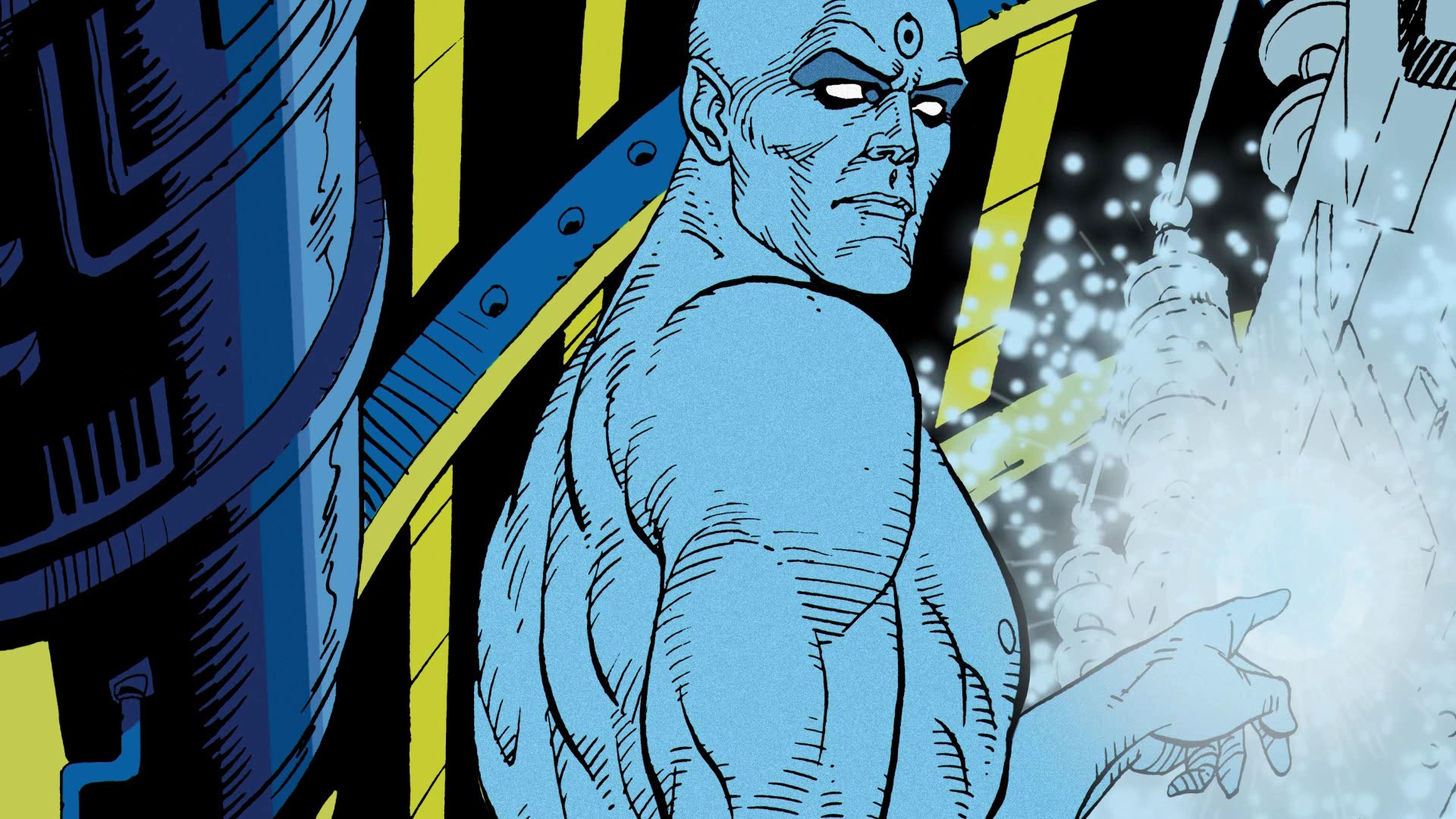
Watchmen, 4 of 12: Watchmaker. Dr. Manhattan sits on Mars using his precognitive powers to determine when the picture he is holding will fall the surface. He spends the next several panels thinking about his past.
Alan Moore is an English writer most famous for his influential work in comics, including the acclaimed graphic novels Watchmen, V for Vendetta and From Hell. He has also written a novel, Voice of the Fire, and performs "workings" (one-off performance art/spoken word pieces) with The Moon and Serpent Grand Egyptian Theatre of Marvels, some of which have been released on CD.
As a comics writer, Moore is notable for being one of the first writers to apply literary and formalist sensibilities to the mainstream of the medium. As well as including challenging subject matter and adult themes, he brings a wide range of influences to his work, from the literary–authors such as William S. Burroughs, Thomas Pynchon, Robert Anton Wilson and Iain Sinclair; New Wave science fiction writers such as Michael Moorcock; horror writers such as Clive Barker; to the cinematic–filmmakers such as Nicolas Roeg. Influences within comics include Will Eisner, Harvey Kurtzman, Jack Kirby and Bryan Talbot.
I thought a lot about what I am going to say in this review. No way, it will do this issue justice. My review can never be perfect like this issue. By perfect I mean it deserves my special 10 stars rating. This is the best thing I have read in a long time A story from Dr. Manhattan perspective of the world. What an extraordinary character! Before that though, what an extraordinary writer to write such a legend! OMG I will remember this experience for the rest of my days. January 2016 the photo drops at my feet (end of text)
Of all the four issues I've read so far, this would have to be my favorite. I liked Jon's story, and how his world evolved into something else, just because of one freak accident.
I liked how I saw into his mind. Saw into his past. Saw into his future.
Seguimos los pasos del Dr Manhattan a lo largo de su vida, como obtuvo su poder y como observa el tiempo como un continuo, sin presente, pasado o futuro. Interesante.
This is what everyone's been waiting for ever since meeting that bald, blue god: his backstory. How did physicist Jon Osterman become Dr. Manhattan? All the life events that brought him to this unpredictable transformation are illustrated in this amazing issue. It opens with a breathtaking trip into his perspective. I finally understand how he lives contemporarily in past, present, future, how he makes sense of it and how the future is inevitable and that nothing we can do will affect its forthcoming. Living like this must be confusing and overwhelming and yet Jon had never quit from being a fair visionary for mankind. Now everything is changing and as his past and future unravel for us so does every hope for humanity.
In the fourth installment of Watchmen, we now get to have a little more background, with more insights and the backstory of Dr. Manhatan. The more I get to know him the more I dislike him.
**Warning: this text may contain spoilers** I really liked the timelessness in this issue and how it was shown beautifully. An how it all made sense in the end and you could actually imagaine it as a movie playing in your head. How it ended and how all the foreshadowing came out to be was really good. The paragraphs and snippets on the end of every issue is really good and makes the work easier for you to make a world inside of your head and have a more detailed perception. This ones ending was really good and it made me think about It for a couple of minutes gazing on the abyss.
“The release of atomic power has changed everything except our way of thinking ... the solution to this problem lies in the heart of mankind. If only I had known, I should have become a watchmaker” qué volumen más precioso ;;;;
Watchmen 4 of 12, Collector's Edition pág. 0: créditos #4 pág. 1: WATCHMAKER Pág. 29: DR. MANHATTAN: SUPER-POWERS AND THE SUPERPOWERS by Professor Milton Glass Pág. 33: créditos editoriales
este número me hizo comprender más sobre lo que significa dr manhattan para el mundo, el alcance de su poder y ¿qué hace dios cuando nos abandona? manhattan se está volviendo mi favorito de esta historia por el miedo que me provoca (y las acciones cuestionables que ha hecho)
The release of atomic power has changed everything except our way of thinking ... the solution to this problem lies in the heart of mankind. If only I had known, I should have become a watchmaker. (1945)” - Albert Einstein
Out of the first four books in this series, I think this would be my favorite. The evolution of Dr. Manhattan and Jon's story is explained in a non-linear yet intriguing manner. It may get a bit confusing but I liked how the timeline and narration are interlaced in this book.
En este capitulo centrado en Dr. Manhattan, se revela su naturaleza no lineal y su falta de limitaciones temporales y espaciales. La historia comienza en 1945 con Jon Osterman, un joven relojero que, tras el bombardeo de Hiroshima, se adentra en la ciencia atómica. Un accidente lo transforma en Dr. Manhattan, quien puede manipular la materia.
A medida que se convierte en un símbolo de poder para el gobierno de EE. UU., su humanidad se desdibuja, afectando sus relaciones, especialmente con Janey Slater y Laurie Juspeczyk. Durante la guerra de Vietnam, enfrenta la brutalidad humana y la apatía del Comediante.
La narrativa culmina en Marte, donde reflexiona sobre el destino y la responsabilidad, cuestionando quién es culpable de los males del mundo. Se destaca que su nombre simboliza tanto un arma como un protector, y su desconexión emocional se refleja en su vestimenta, que evoluciona hacia la desnudez.
Finalmente, se explora su cambio en la percepción de la moralidad; mientras Jon Osterman discernía el bien del mal, Dr. Manhattan ve solo hechos, lo que le impide intervenir en tragedias como el asesinato de JFK.
Watchmen was a very interesting read and I’m glad to have finally gotten around to it. While I really appreciated some aspected such as the gritty world and symbolic, satirical plot line, there were times when it really didn’t live up to the hype surrounding it, at least not in my opinion. When compared to V For Vendetta, one of Moore’s best in my opinion, it just didn’t cut it for me, nor strike me with anything really meaningful afterwards. This is going to be a really hard one to rate and review for me— but here it goes.
P.s. If haters wanna hate, please go hate elsewhere. ;)
"This Hugo Award-winning graphic novel chronicles the fall from grace of a group of super-heroes plagued by all-too-human failings. Along the way, the concept of the super-hero is dissected as the heroes are stalked by an unknown assassin.
One of the most influential graphic novels of all time and a perennial best-seller, Watchmen has been studied on college campuses across the nation and is considered a gateway title, leading readers to other graphic novels such as V for Vendetta, Batman: The Dark Knight Returns and The Sandman series." -Book Blurb
Because I’m reviewing the entire series, and want to avoid an overly long review as well as story spoilers, in this review I’m just going to cover a few things, some things that stood out, things I liked, things I didn’t etc.
In the beginning of Watchmen the readers are introduced to this dark world, an alternate history, and are initiated into the story through the mysterious and grim character of Rorschach, whom I instantly liked albeit his strange attitude and growingly apparent fact that he was lacking some amount of sanity. He operates outside the law, as superhero’s are outlawed by the government. The mystery was compelling enough, the world is very dark and interesting.
As the story goes on we are introduced to other ex-heroes like Nite Owl II, (who seemed ironically a parody of Batman), and Ozymandias, as well as heroes contracted by the government such as Doctor Manhattan (the only actually superhuman in the series), The Comedian and Silk Spectre II. While the characters were interesting at times, most notably Doctor Manhhattan and Rorschack, many of the others felt dull to me, like bland caricatures.
One aspect I disliked was the weird, and seemingly pointless romance between Silk Spectre II and Nite Owl II. It felt creepy and out of place, boring me and ultimately jarring me from the otherwise interesting plot. Why was it necessary to bog the plot down with their awkward affair, (including facts about his erectile dysfunction)? What was perhaps meant to flesh out the side characters, just ended up feeling like a lot of filler material. Bleh. It slowed the overall momentum for me.
Another irritant was the issue concerning the backstory of Silk Spectre I and The Comedian, and the flippant way her sexual assault/rape was dealt with. It felt only a cheap tactic used to give the readers a twist later on, which was obvious to me miles away, and ultimately felt an easy way to manipulate the reader and story. It did not have that effect on me. The matter was not handled very tastefully, in my opinion. Silk Spectre I’s response— or lack thereof—to the crime against her made the writing and overall story have a very misogynistic undertone, which continuously reared its head throughout the following issues.
That continuous feeling was highlighted and accentuated by the apparent uselessness of most of the female characters, who rarely if ever, contribute to the story in any meaningful way. Not to mention the fact that so few women were present at all, the story tiresome by their lack of contribution. One obvious exception being Silk Spectre II’s pleading with Doctor Manhattan on Earth’s behalf later on, even then he probably would have come to the decision on his own, given how his mind worked. So perhaps I’m reading between the lines here, but that’s how it struck me. It didn’t sit well, and I’m overly used to comics using women in the usual ways, to titillate as eye candy and fan service, serving no real purpose. I guess I expected more, too much, from something hailed as an innovative masterpiece.
Moving on.
There were things I did really like, though the story was bogged down with politics, propaganda and misogyny. I really like the satirical take of the golden age superhero story, the way the story makes you think about things in a different light, albeit a very pessimistic—dare I say—nihilistic light. I like the jaded hero perspective. The art was very fitting and did a good job setting the overall tone, even though it wasn’t as pleasing on the eye. It conveyed the general vibe of the plot really well.
I loved the fact that the series read more like a mystery noir novel that a traditional action comic book. I really enjoyed the characterizations of Rorschach and Doctor Manhattan the most. I LOVED Doctor Manhattan’s backstory. It was so epic and philosophical; those chapters really made me think. While Rorschach’s background was very sad, it was also a bit underwhelming, considering how much I loved his character. He made an excellent anti-hero.
Overall, I really enjoyed it, but could not say I loved it by any means. I appreciate what it means to the world and legacy of comic books and graphic novels, I think it changed the industry in many ways, not all for the better, but in many ways it was good. I liked how original it was. I like the philosophical mindset it gets you in. Some of the characters were so memorable, but the bad somewhat equals the good for me. There was a lot of filler material that felt tedious to read through, dragging the story out. As much as I enjoyed it, I also felt annoyed by it. I felt it was lacking in some pivotal areas, where it could have done more. Many of the characters were so unlikeable and dull, like cardboard cutouts. Seeing how much depth Rorschach and Doctor Manhattan had, I think all of the characters had that potential as well.
So I guess I’m in a love-hate thing with Watchmen, no matter which way I slice it, I can’t seem to pick a definite stance. I was pretty disappointed with the ending. I would recommend reading it, to appreciate the leaps Watchmen gave the genre of graphic novels, and for the interesting plot and setting, but in my opinion V for Vendetta was better in most regards.
[VOLUMN RATING: 5 STARS]
[OFFICIAL RATING: 3.5 STARS]
This entire review has been hidden because of spoilers.
best one so far, and the other ones are really good. dr Manhattan story had me bursting into tears from the first few lines. victim of someone else's "dream", victim of fate he finds himself in a body that it's not his, learns how to live with it, in it, finds out that he gives diseases to those around him. his character is very complex, he knows everything in advanced but can't prevent the future. he knows when his girlfriends are going to leave him, but can't help it. i'm really sorry for him and i love the way the entire series is turning out, no one had ever thought about describing superheroes' humanity, everyone imagines they are gods and goddesses but they're just human beings that feel and suffer.
Set in an alternate history where costumed heroes have helped shape society since the beginning of time, the controversial yet prolific costumed hero Edward Blake (more commonly known by his alias The Comedian) is found dead and the perpetrator is nowhere to be found. Unable to solve such a bizarre murder by conventional means, the masked vigilante Rorschach who once served as a costumed hero alongside Comedian and four others takes matters into his own bloodstained hands to track down a mysterious assassin that's taking out costumed heroes one by one. Conspiracies abound, political tensions are through the roof, the threat of WWIII is lurking just around the corner and the gritty and depressive atmosphere of a rotting New York City during the 1980's sets the scene for a grim dissection and criticism of classic superhero archetypes.
Watchmen redefines the term superhero. With the exception of Dr. Manhattan, none of them have any notable powers. The Comedian is merely a grotesque reflection of American society and all its shameless faults, as well as how misguided patriotism can be used to justify mindless violence and prejudice. Rorschach is a vigilante who throws around the words good and evil to justify his brute force and questionable methods of solving problems. Silk Spectre is a normal woman struggling between following her own path in life and forever remaining trapped in the shadow of her mother's legacy. Nite Owl almost feels like a comedic parody of Batman, poking fun at the fact that he's an awkward old nerd that loves owl-themed gadgets and dressing up in what is essentially a big Halloween costume. Dr. Manhattan is the embodiment of how power, knowledge, wealth and limitless freedom to do anything imaginable can alienate and dehumanize a person from the rest of the world. All of the superheroes are extremely flawed everyday people with everyday issues and imperfections who hide behind masked personas to cope with the questionable acts they're performing and the faulty morals behind them.
The heroes of this tale defy the image of flawless paragons of justice that can do no wrong. They are just as capable of being selfish, abusing their powers and doing evil things out of spite and unchecked negative emotions as everyone else. This critiques the very idea of putting idols on a pedestal in the first place. This can be compared to the famous actors, pop stars and politicians of today. It's easy for people to treat the words and actions of their idols like the words of God himself, forgetting that they're ordinary people with many imperfections just like everyone else. Again, most of the Watchmen have selfish reasons for hiding behind their costumed personas, because they feel powerless, guilty and ordinary without them. What does it say about who you are when you can't even show yourself in public without hiding behind a carefully crafted disguise? Why wear a mask if you're in the right and have nothing to hide?
All of this deception and abuse of authority is where the popular slogan (Who watches the Watchmen?) comes from. The people in power are constantly watching and judging the actions of the average person, but who are watching and judging the actions of the people in power? The people in power punish us for our wrongdoings but who punishes the people in power for theirs? Dismantling the infallible images that figures of authority try to maintain, dissecting issues of confused morals and identities hiding behind literal and figurative masks, tearing the veil from the one-dimensional definition of superheroes, all of these things are masterfully challenged in the shape of a dark psychological crime-thriller with many timeless themes that go harsh on politics and society.
Our heroes and leaders are never the flawless, perfect beings we romanticize them to be.
Watchmaker is the fourth issue in the twelve-issue series Watchmen, written by Alan Moore and drawn by Dave Gibbons.
In this issue, Dr. Manhattan sits on Mars using his precognitive powers to determine when the picture he is holding will fall to the surface. Then, he starts reminiscing about his past. Yes, this particular issue functions as an origin story told in flashbacks for this character and it entirely worked. Yes, it stopped the progression of the story, but it was necessary to give us some context, especially for the only character with real superheroic powers.
In this very introspective, deep part of the story, we get to learn how Jon Osterman became Dr. Manhattan through a freak accident. Admittedly, this origin story is very typical for the superhero genre, but his story is significantly deepened due to his ambiguous morality and now godlike, but somewhat cold demeanor that still contains some humanity beneath all of that sternness.
Watchmaker once again looks gorgeous thanks to stunning larger panels, in particular the panel where he starts a city on Mars is breathtaking and instantly iconic. Gibbons did a phenomenal job once again, but Moore also has to be praised for his handling of mature themes and for deepening the standard superhero origin story. An insight into his problematic love life was especially potent.
The structure was particularly effective and unique as the story jumps through time and we even get to see the future, not just the past. We get a full picture of Watchmen’s most interesting personality. The literary supplement at the end was another winner – it was uncommonly sophisticated and unbiased as they made a comment about US’s problematic relations with Russia and how the latter’s important role in WWII has been horribly brushed aside.
Overall, Watchmaker is one of the best issues in Watchmen – it gives us a strong origin story for Dr. Manhattan while significantly deepening the character in the process.