

What do you think?

Terminal
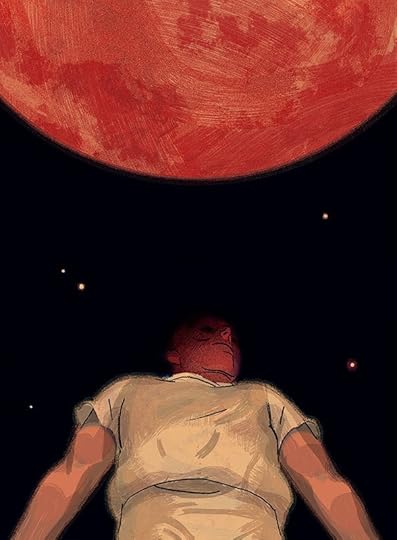
Terminal by Lavie Tidhar is a science fiction story about people, who, either having nothing to lose or having a deep desire to go into space, travel to Mars via cheap, one-person, one-way vehicles dubbed jalopies. During the trip, those in the swarm communicate with each other, their words relayed to those left behind.
21 pages, Kindle Edition
First published April 13, 2016
About the author
Lavie Tidhar
401 books755 followersLavie Tidhar was raised on a kibbutz in Israel. He has travelled extensively since he was a teenager, living in South Africa, the UK, Laos, and the small island nation of Vanuatu.
Tidhar began publishing with a poetry collection in Hebrew in 1998, but soon moved to fiction, becoming a prolific author of short stories early in the 21st century.
Temporal Spiders, Spatial Webs won the 2003 Clarke-Bradbury competition, sponsored by the European Space Agency, while The Night Train (2010) was a Sturgeon Award finalist.
Linked story collection HebrewPunk (2007) contains stories of Jewish pulp fantasy.
He co-wrote dark fantasy novel The Tel Aviv Dossier (2009) with Nir Yaniv. The Bookman Histories series, combining literary and historical characters with steampunk elements, includes The Bookman (2010), Camera Obscura (2011), and The Great Game (2012).
Standalone novel Osama (2011) combines pulp adventure with a sophisticated look at the impact of terrorism. It won the 2012 World Fantasy Award, and was a finalist for the Campbell Memorial Award, British Science Fiction Award, and a Kitschie.
His latest novels are Martian Sands and The Violent Century.
Much of Tidhar’s best work is done at novella length, including An Occupation of Angels (2005), Cloud Permutations (2010), British Fantasy Award winner Gorel and the Pot-Bellied God (2011), and Jesus & the Eightfold Path (2011).
Tidhar advocates bringing international SF to a wider audience, and has edited The Apex Book of World SF (2009) and The Apex Book of World SF 2 (2012).
He is also editor-in-chief of the World SF Blog , and in 2011 was a finalist for a World Fantasy Award for his work there.
He also edited A Dick and Jane Primer for Adults (2008); wrote Michael Marshall Smith: The Annotated Bibliography (2004); wrote weird picture book Going to The Moon (2012, with artist Paul McCaffery); and scripted one-shot comic Adolf Hitler’s I Dream of Ants! (2012, with artist Neil Struthers).
Tidhar lives with his wife in London.
Tidhar began publishing with a poetry collection in Hebrew in 1998, but soon moved to fiction, becoming a prolific author of short stories early in the 21st century.
Temporal Spiders, Spatial Webs won the 2003 Clarke-Bradbury competition, sponsored by the European Space Agency, while The Night Train (2010) was a Sturgeon Award finalist.
Linked story collection HebrewPunk (2007) contains stories of Jewish pulp fantasy.
He co-wrote dark fantasy novel The Tel Aviv Dossier (2009) with Nir Yaniv. The Bookman Histories series, combining literary and historical characters with steampunk elements, includes The Bookman (2010), Camera Obscura (2011), and The Great Game (2012).
Standalone novel Osama (2011) combines pulp adventure with a sophisticated look at the impact of terrorism. It won the 2012 World Fantasy Award, and was a finalist for the Campbell Memorial Award, British Science Fiction Award, and a Kitschie.
His latest novels are Martian Sands and The Violent Century.
Much of Tidhar’s best work is done at novella length, including An Occupation of Angels (2005), Cloud Permutations (2010), British Fantasy Award winner Gorel and the Pot-Bellied God (2011), and Jesus & the Eightfold Path (2011).
Tidhar advocates bringing international SF to a wider audience, and has edited The Apex Book of World SF (2009) and The Apex Book of World SF 2 (2012).
He is also editor-in-chief of the World SF Blog , and in 2011 was a finalist for a World Fantasy Award for his work there.
He also edited A Dick and Jane Primer for Adults (2008); wrote Michael Marshall Smith: The Annotated Bibliography (2004); wrote weird picture book Going to The Moon (2012, with artist Paul McCaffery); and scripted one-shot comic Adolf Hitler’s I Dream of Ants! (2012, with artist Neil Struthers).
Tidhar lives with his wife in London.
Ratings & Reviews
Friends & Following
Create a free account to discover what your friends think of this book!
Community Reviews
Displaying 1 - 30 of 42 reviews

August 13, 2016
There is such freedom in the letting go.
review to come.
read it for yourself here:
http://www.tor.com/2016/04/13/terminal/

January 26, 2017
Beautifully written story about a swarm of "jalopies" carrying passengers to an uncertain future on Mars. Like most of Tidhar's shorts, Terminal is about the journey, not the destination. Ironic, considering the title.

May 19, 2019
Another author new to me that I am delighted this Tor collection has introduced me to. Tidhar's tale of migration to Mars is a wonderful poetic piece, beautifully written and thoughtful philosophical sci-fi. A dying woman, en route to Mars Terminal in, floats while listening to the collected music of centuries and giving hints of what brought her here. She strikes up a conversation with a man in one of the hundreds of other solo 'jalopies' - who may be the husband who went before her, or perhaps just shares his name.
The 'Terminal' metaphor is obvious, but Tidhar weaves threads of moving forward and loss and letting go in with the clear analogy.
The 'Terminal' metaphor is obvious, but Tidhar weaves threads of moving forward and loss and letting go in with the clear analogy.

March 1, 2017
The latest trend: one-way trips to Mars!
Advertised on every street corner, mass-produced, cheap, one-person vehicles will rocket you up on your way to the red planet. The trip is admittedly dangerous - but people everywhere are taking the chance, especially those with an abundance of imagination and those with nothing to lose.
The story is written mostly for the opportunity to give voice to those lonely travellers to speak to each other over their radios during the long, lonely months in space. Some of those dialogues are poignant, but I was distracted by the many questions: does the city of Terminal really exist? How could a Martian colony support itself with a bunch of terminally ill people and nothing-to-lose artists arriving daily? What are the main character's motivations for choosing to go?
Advertised on every street corner, mass-produced, cheap, one-person vehicles will rocket you up on your way to the red planet. The trip is admittedly dangerous - but people everywhere are taking the chance, especially those with an abundance of imagination and those with nothing to lose.
The story is written mostly for the opportunity to give voice to those lonely travellers to speak to each other over their radios during the long, lonely months in space. Some of those dialogues are poignant, but I was distracted by the many questions: does the city of Terminal really exist? How could a Martian colony support itself with a bunch of terminally ill people and nothing-to-lose artists arriving daily? What are the main character's motivations for choosing to go?

August 22, 2016
Terminals are those at the end of their lives who decide to go into space, alone in their jalopies, and travel to Mars. The story revolves around three characters: as Mei travels, she listens to earth music; Haziq decides to leave his wife and family to venture to Mars though he is not dying and Eliza, a nurse orbiting Earth, listens to Mei’s and Haziq’s conversations as they fly toward the long trip to Mars. It’s a good short story overall. 3.5/5

June 22, 2016
This is the sort of sci-fi I like: just this side of doable and focused on the characters.
More than anything else, it reminds me of a textbook I constantly pored over as a kid: Thought Probes. It's a (very old) philosophy textbook that frames its themes with science fiction stories, then follows up with essays analyzing each ethical dilemma and connecting them to broad topics in philosophy.
This short story feels like it would be right at home in that collection. Dying humans can donate their money and last 18 months to pilot junkers to Mars and only have each other for company via radio. Think the Dr.Who episode with the cars and cats or Outcasts, the (excellent) BBC show about a forgotten planetary colony.
You can read it online here.
More than anything else, it reminds me of a textbook I constantly pored over as a kid: Thought Probes. It's a (very old) philosophy textbook that frames its themes with science fiction stories, then follows up with essays analyzing each ethical dilemma and connecting them to broad topics in philosophy.
This short story feels like it would be right at home in that collection. Dying humans can donate their money and last 18 months to pilot junkers to Mars and only have each other for company via radio. Think the Dr.Who episode with the cars and cats or Outcasts, the (excellent) BBC show about a forgotten planetary colony.
You can read it online here.

Read
May 4, 2016A lovely little story about the hopeful, desperate urge to leave everything you know behind for a new world, or simply to get away. The image of countless tiny one-person ships strung across the void between Earth and Mars really brings home the sheer emptiness of space; at times it's practically a prose-poem, recalling Ray Bradbury's bittersweet colonisations, but recast for our modern, lifeless Mars which nonetheless still somehow exerts a siren pull.

May 27, 2017
A psychological work, powerful and emotional, about loneliness, grief, hope, love wrapped in a story where cheap single-person shuttles are heading for Mars for a kind of colonization.

September 9, 2026
People who feel hopeless or in pain evacuate Earth in one person pods to travel to Mars, but how can the mind cope when it is starved if contact.
Tidhar is an always interesting writer.
Tidhar is an always interesting writer.

April 13, 2016
Terminal is a haunting story about people who choose to make the incredibly risky journey to Mars to become colonists. People leave for a lot of reasons, and the hope and desperation of their positions is captured well by the conversations between the individual ships. Though a small story for one about space colonization, it makes an impact and is worth a read.

August 27, 2018
★★★★☆ (4/5)
A selection of my favourite passages from the book
• At first, Mei slept and woke up to a regiment of day and night, but a month out of Earth orbit, the old order began to slowly crumble, and now she sleeps and wakes when she wants, making day and night appear as if by magic, by a wave of her hand
• These hypothetical people, not yet born, already laying demands to his time, his being. To be human is to exist in potentia, unborn responsibilities rising like butterflies in a great big obscuring cloud
• Across the swarm’s radio network, the muezzin in A-5011 sends out the call to prayer, the singsong words so beautiful that Mei stops, suspended in mid air, and breathes deeply, her chest rising and falling steadily, space all around her
• but at long last everything they ever knew and owned is gone and then there is only the jalopy confines, only that and the stars in the window and the voice of the swarm
A selection of my favourite passages from the book
• At first, Mei slept and woke up to a regiment of day and night, but a month out of Earth orbit, the old order began to slowly crumble, and now she sleeps and wakes when she wants, making day and night appear as if by magic, by a wave of her hand
• These hypothetical people, not yet born, already laying demands to his time, his being. To be human is to exist in potentia, unborn responsibilities rising like butterflies in a great big obscuring cloud
• Across the swarm’s radio network, the muezzin in A-5011 sends out the call to prayer, the singsong words so beautiful that Mei stops, suspended in mid air, and breathes deeply, her chest rising and falling steadily, space all around her
• but at long last everything they ever knew and owned is gone and then there is only the jalopy confines, only that and the stars in the window and the voice of the swarm

January 23, 2025
Terminal by Lavie Tidhar is Tor original short. You can read this story (and all the other ones in this series) for free on the Tor.com site https://reactormag.com/terminal/
Terminal is an emotionally wrenching science fiction story about people, who, either having nothing to lose or having a deep desire to go into space, travel to Mars via cheap, one-person, one-way vehicles dubbed jalopies. During the trip, those in the swarm communicate with each other, their words relayed to those left behind.
Poetic and melancholy. I love how Tidhar writes.
My ongoing quest to get current with the Tor short stories.
4 Stars
Terminal is an emotionally wrenching science fiction story about people, who, either having nothing to lose or having a deep desire to go into space, travel to Mars via cheap, one-person, one-way vehicles dubbed jalopies. During the trip, those in the swarm communicate with each other, their words relayed to those left behind.
Poetic and melancholy. I love how Tidhar writes.
My ongoing quest to get current with the Tor short stories.
4 Stars

Read
April 28, 2021I found this to be confusingly fracture in the way it told the story... Though it seemed more like a concept being explained than a true narrative experience. Too many POVs muddied things for me - I think it's meant as a thought piece about a particularly grim idea of what sace exploration could become than an entertaining story. I wish we could just have followed Mei and Haziq rather than the other sometimes-named-others-not random people, or else have had something that bound them together more as a storyline. Cool concept, but I guess the execution just wasn't my cuppa.

May 7, 2018
Melancholy. Almost poetic. Terminal follows snippets of the conversations of people who have chosen to take a one-way trip to Mars. Each enclosed in his or her own vehicle, able to communicate with others, but not able to touch.

October 18, 2018
I liked the story and the idea was interesting if not really credible, scientifically wise, maybe (thousand personal jalopies couldn't be cheaper than one big spaceship couldn't they?)
I particularly appreciated the non American nor European point of view!
I particularly appreciated the non American nor European point of view!

March 11, 2019
The writing was beautiful, but at times confusing. I liked the idea so much, a one way trip to mars in tiny, one person, units. I liked the back and forth between individuals flying through space but I wanted a bit more in terms of pacing and plot.

April 20, 2025
Un racconto molto particolare.
Non l'ho trovato molto impressionate, solo molto confusionario.
Se lo si prende come uno spaccato della realtà dei disperati, invece, potrebbe avere un senso. A parte questo, per fortuna non è molto lungo.
Non l'ho trovato molto impressionate, solo molto confusionario.
Se lo si prende come uno spaccato della realtà dei disperati, invece, potrebbe avere un senso. A parte questo, per fortuna non è molto lungo.

July 10, 2017
An interesting take on one-way trips.

July 14, 2017
Melancholy but poetic.

January 9, 2022
Not for me I am afraid. A very claustrophobic story which was hard to get into.

September 13, 2022
a beautifully melancholic story, my only complaint is it felt more like a series of vignettes rather than a cohesive narrative

August 7, 2024
The definition of "it's okay". Some poetic imagery, but I found the writing itself to be a bit flat and rote.



January 26, 2025
TW: Moderate death.
I read this in the Best of Tor dot com 2016.
The reality of Elon’s dream of Mars colonisation bites. This is not an in-depth character study, but is a bit of needed fresh air for all those space operas with human galactic empires.
I read this in the Best of Tor dot com 2016.
The reality of Elon’s dream of Mars colonisation bites. This is not an in-depth character study, but is a bit of needed fresh air for all those space operas with human galactic empires.

May 2, 2025
Li aqui.
Achei um tantinho interessante como a palavra terminal pode ser usada com dois significados nesse conto, mas acho que faltou substância pra mensagem que ele queria passar. Aquela coisa: eu entendi, mas não senti.
Achei um tantinho interessante como a palavra terminal pode ser usada com dois significados nesse conto, mas acho que faltou substância pra mensagem que ele queria passar. Aquela coisa: eu entendi, mas não senti.

July 9, 2021
This is a beautifully written, melancholic and contemplative story. Terminal takes place in a future where people - often the terminally ill - can buy cheaply made, one-person spacecrafts called jalopies to make a one-way trip to Mars.
Is there actually a colony waiting for them on Mars? It's chillingly ambiguous, and these are people who had nothing on Earth and were willing to walk away from their lives for one reason or another, to take a chance on stepping into the unknown.
". . . they are legally dead, now, each in his or her own jalopy, this cheap mass-manufactured container made for this one singular trip, from this planet to the next, from the living world to the dead one."
EDIT: Bumped up my rating to 5 stars because I honestly have never stopped thinking about this short story.
This hit me:
"Does one need a reason? Haziq wonders. Or is it merely the gradual feeling of discomfort in one's own life, one's own skin, a slowly dawning realisation that you have passed like a grey ghost through your own life, leaving no impression, that soon you might fade away entirely, to dust and ash and nothingness, a mild regret in your children's minds that they never really knew you at all."
I found this intriguing and would love an entire novel exploring this concept and what - if anything - is waiting for these lonely travelers on Terminal Beach.
Is there actually a colony waiting for them on Mars? It's chillingly ambiguous, and these are people who had nothing on Earth and were willing to walk away from their lives for one reason or another, to take a chance on stepping into the unknown.
". . . they are legally dead, now, each in his or her own jalopy, this cheap mass-manufactured container made for this one singular trip, from this planet to the next, from the living world to the dead one."
EDIT: Bumped up my rating to 5 stars because I honestly have never stopped thinking about this short story.
This hit me:
"Does one need a reason? Haziq wonders. Or is it merely the gradual feeling of discomfort in one's own life, one's own skin, a slowly dawning realisation that you have passed like a grey ghost through your own life, leaving no impression, that soon you might fade away entirely, to dust and ash and nothingness, a mild regret in your children's minds that they never really knew you at all."
I found this intriguing and would love an entire novel exploring this concept and what - if anything - is waiting for these lonely travelers on Terminal Beach.

July 2, 2020
"Is it merely that gradual feeling of discomfort in one's own life, one's own skin, a slowly dawning realization that you have passed like a grey ghost through your own life, leaving no impression, that soon you might fade away entirely, to dust and ash and nothingness, a mild regret in your children's minds that they never really knew you at all."
A well-written, absorbing story that is unremittingly bleak and almost a metaphor for deep depression. Other space-colonization stories I've read focus on the excitement and hopefulness of discovery; this one portrays people so weary of life that they have nothing to lose by boarding cheap capsules on one-way journeys to Mars. Even so, they cling to the most fragile of hopes for their lives to be different.
I was completely engaged by the writing and felt the loneliness of the characters. I'll seek out more by this writer even if I can't call this a favorite simply because it was so desolate.
A well-written, absorbing story that is unremittingly bleak and almost a metaphor for deep depression. Other space-colonization stories I've read focus on the excitement and hopefulness of discovery; this one portrays people so weary of life that they have nothing to lose by boarding cheap capsules on one-way journeys to Mars. Even so, they cling to the most fragile of hopes for their lives to be different.
I was completely engaged by the writing and felt the loneliness of the characters. I'll seek out more by this writer even if I can't call this a favorite simply because it was so desolate.

August 13, 2016
This was a free read on Tor.com, and I really liked that it was free. I also loved this short story. This was the first time I'd ever read anything by this author, but I know by the way she writes that she's going to be a long favorite in the time to come.
“This is jalopy B-2031 to jalopy C-3398, bishop to king 7, I said bishop to king 7, take that Shen you twisted old fruit!”
The words are so beautifully linked together, and Mei is a single individual on a Jalopy traveling across space so that she may join others on Mars and start a new life. She travels, listening to all the music of the world, and it has a very Star Wars feel to it-it feels like it's a living, breathing story.
I would label this as one of my "top five books of the year" but sadly, it's a short story and therefore doesn't quite count.
If you haven't yet read it, I highly recommend that you do.
“This is jalopy B-2031 to jalopy C-3398, bishop to king 7, I said bishop to king 7, take that Shen you twisted old fruit!”
The words are so beautifully linked together, and Mei is a single individual on a Jalopy traveling across space so that she may join others on Mars and start a new life. She travels, listening to all the music of the world, and it has a very Star Wars feel to it-it feels like it's a living, breathing story.
I would label this as one of my "top five books of the year" but sadly, it's a short story and therefore doesn't quite count.
If you haven't yet read it, I highly recommend that you do.

April 18, 2016
In a not too far future, Mars colonization is starting. It became possible to travel to Mars via cheap, one-person, one-way vehicles, the "jalopies". But there is no coming back. The voyage in the cramped space is hard, it has a high fatality rate, and it is one way. As a result, people signing up for it are legally dead.
The story focuses on the people taking the leap, all with different motivations, all desperately clinging on each other to maintain sanity, via asynchronous communications relayed from Earth.
This is a very poetic story, with a very original and extremely fascinating world-building, and an unsatisfying ending. I really hope that the author will develop the story further in the future.
The story focuses on the people taking the leap, all with different motivations, all desperately clinging on each other to maintain sanity, via asynchronous communications relayed from Earth.
This is a very poetic story, with a very original and extremely fascinating world-building, and an unsatisfying ending. I really hope that the author will develop the story further in the future.
Displaying 1 - 30 of 42 reviews