A masterful adaptation of the timeless literary classic, faithfully and beautifully rendered by an award-winning artist. In striking black-and-white illustrations, Chaboute retells the story of the Great American Novel. Captain Ahab strikes out on a voyage, obsessively seeking revenge on the great white whale that took his leg. This hardcover edition collects both of the Vents d'Ouest volumes, printed in English for the first time.
Christophe Chabouté is a French author and illustrator.
D’origine alsacienne, il suit les cours des Beaux-Arts d’Angoulême, puis de Strasbourg. Vents d'Ouest publie ses premières planches en 1993 dans Les Récits, un album collectif sur Arthur Rimbaud. Mais il se fait surtout connaître en 1998 en publiant Sorcières aux éditions du Téméraire (primé au Festival d’Illzach) puis Quelques jours d’été aux éditions Paquet (Alph’Art Coup de Cœur au Festival d'Angoulême). Il a également illustré des romans pour la jeunesse.
Artist Christophe Chaboute adapts into comics what is considered to be THE Great American Novel, Herman Melville’s classic Moby Dick. What’d I think? Call me… ambivalent!
Chaboute’s adaptation is faithful to the original, including all the major themes/scenes/characters and hitting the same story beats, bar the most famous opening line in all world literature - “Call me Ishmael” - which is cleverly relocated. The story, if you’re somehow unfamiliar with it: set in the 19th century at the height of the whaling industry operating out of Nantucket, New England, our humble narrator Ishmael sets sail on what turns out to be the tragic final voyage of the doomed whaling ship, the Pequod. Its captain is the mad Ahab whose obsession with hunting down the vicious white sperm whale who ate his leg, Moby Dick, threatens to kill his entire crew.
It sounds like a way cooler story than it actually is. I thought Melville’s original wasn’t bad but very overrated. The writing style is outdated, the pacing is near glacial, the symbolism is far too heavy-handed (the life raft is a literal coffin!), and it’s overstuffed with laborious passages detailing the utterly boring pedantic minutiae of whaling. By far the best aspect of reading Chaboute’s comic over Melville’s original is the absence of these dreary chapters, not least because visually showing the whaling process instead is vastly more effective at giving you an idea of what it entailed.
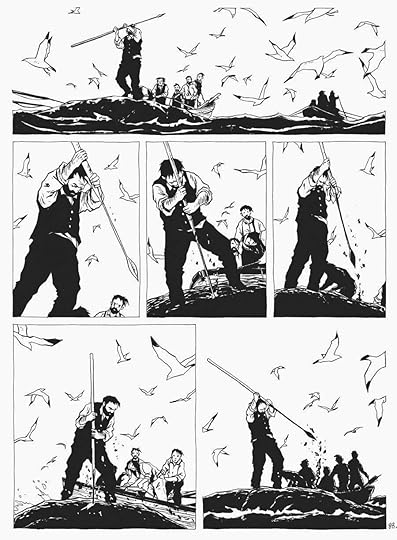
Some of the pages are quite haunting with its black and white aesthetic and moody silence due to Chaboute’s choice of having a largely unobtrusive narrator, but I found the art mostly unimpressive. Also, the characters designs were unmemorable with too many characters looking alike.
I’m probably overfamiliar with the story which is why I wasn’t that engaged with the narrative. It’s not a standout version of the tale but on the whole it’s a decent book. New readers looking to read Moby Dick quickly without having to trudge through Melville’s thick prose will be well-served by Christophe Chaboute’s adaptation.
250 page black and white tome, a solid graphic/illustrated/comics adaptation of the central action of one of the Great American Novels about Captain Ahab obsessively seeking revenge on the Great White Whale (uh, that would be your titular character, Moby Dick) that took his leg. The original novel, much admired and much hated, is not just an adventure story, it’s a wonderfully messy and wide-ranging exploration of ideas. Charcoute enacts a version of the tale that visually gets at the madness and obsession of Ahab.
I was reminded of Pablo Auladell’s Paradise Lost, another literary mountain to climb. Charcoute, like Auladell, largely turns the text into a visual poem, and does an admirable job ob it visually, especially of the madness of Ahab. And with confrontations with Starbuck. And the actual action scenes with the whale! Reminds me a bit of the black and white adventure comics of Jacques Tardi or Hugo Pratt’s Corto Maltese: The Ballad of the Salt Sea. It falls short of the glory of the original, but if you like adventure stories/comics, here you are, a powerful rendition.
Moby Dick is considered one of the great American novels. Many also consider it a terrible drag what with all the details the autor, Herman Melville, included about whaling and living on a whaling ship.
This is an alternative, or an addendum. A graphic novel version in black-and-white panels with gritty art. Personally, I think it's a great way to ease readers into the story (or replace the novel form). The gritty art underlines the harsh life of whalers and the horrible things they did to those poor animals (yes, I'm team whale all the way). It also puts an emphasis on the determination and obsession of Ahab, his spiral down into his psychological abyss.
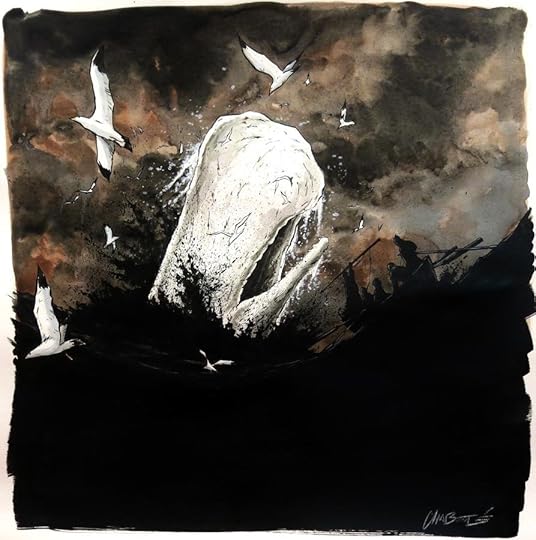
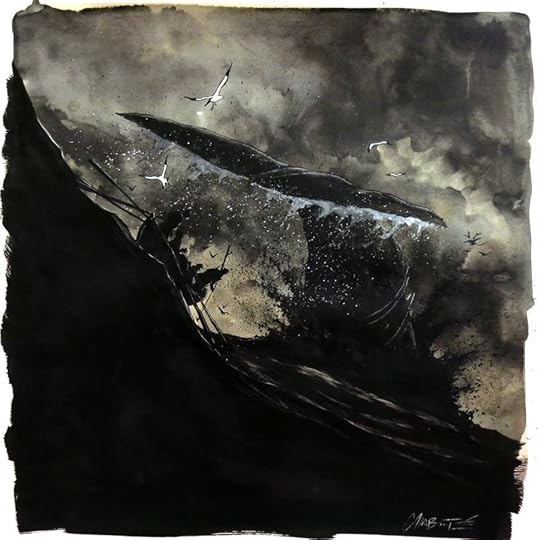
So yeah, this is about Nantucket and Ishmael and Ahab and the whale and the sinking of the whaling ship and the fate of the remaining crew that we know of from the novel. However, at least as important as the story told is the story shown in the panels. These, however, were my favourites:
So yeah, the book is as dark as the story, complimenting the transferred words of the novel wonderfully.
I met Moby Dick at ten. Classics Illustrated Comic Books introduced us. That little 48 page comic started a fascination within me that has lasted a lifetime. I first read the novel in my twenties, and was awed by it — by its insistent symbolism, its massive bulk that engulfed my imagination rather than repelling it, by its surprising humor. I have reread it, have listened to it on audiobook, each time captivated once again. Now, with Christophe Chaboute’s graphic novel adaptation, I’ve closed the circle, coming fully back around from pictures to pictures.
Charboute’s adaptation is faithful to both the text and the mood of the novel. He takes his time, letting the story breath and amble. Sometimes he lets the images speak for themselves, going multiple pages with no text to interfere with the feelings that they conjure. The artwork is stark and striking, glossy black and white images that are wholly appropriate to the story. It’s a nice package.
I feel that this adaptation will be more fully appreciated by those who have already read and enjoyed the novel. But hey, I was first introduced to this masterpiece through a simple comic book, so even if you’ve never read Moby Dick — haven’t had the time, have been intimidated by its length or reputation — maybe pick this up and get a taste. But do yourself a favor and make sure you move on and read the book.
Inutile presentare Moby Dick, credo tutti conoscano il celeberrimo romanzo di Melville. Un romanzo che si presta a moltissime letture, da quella semplicemente legata all’avventura in sé a quelle più metaforiche e bibliche.
La bellezza del libro direi che sta proprio in questi diversi livelli di lettura, che ne fanno un romanzo pieno di punti ciechi tutti da scoprire. Proprio in virtù di ciò, onestamente fatico a ricordare il motivo per cui ho acquistato questa graphic novel di Moby Dick de fumettista francese Chabouté; perché è quasi impossibile rappresentare graficamente la complessità di un libro come Moby Dick.
Chabouté sceglie il bianco e nero per le sue bellissime tavole, che riescono benissimo a mostrarci tutti i dettagli del Pequod e del suo strano equipaggio. Ma ciò che a mio parere purtroppo la rappresentazione visiva fa è annullare la magia della metafora, a togliere l’immaginazione al lettore, a cancellare tutti i significati trasversali, lasciando solo la parte più avventurosa della vicenda di Achab e della balena bianca.
Assolutamente meritevole la qualità delle tavole, ma poco interessante per me il soggetto. Preferisco, senza ombra di dubbio, il libro.
Unbelievable adaptation, this one. Leaves no doubt in the reader’s mind that Chabouté is intimately familiar with Melville’s original work. I think what will remain with me from this one will be the look of crazed mania on Ahab’s face.
The story of Herman Melville's "Moby Dick" is told with dramatic black and white illustrations in Christophe Chabouté's graphic novel. The pages are large with dialogue that is easily read. Chabouté has captured the movement of the large waves, the power of the great white whale, and Captain Ahab's obsession turning into the madness of revenge. While I missed some of Melville's beautiful writing from the original book, I was also impressed by the graphic artwork which was true to the original story line.
Adaptations of classics can be tricky things. Television and film often come up against the usual suspects: problems with length, translation, or the fact that some novels don’t lend themselves well to other art forms. Whether a reinterpretation or a stickler for source material, updated versions of literature’s great works have their work cut out for them. Christophe Chaboute’s graphic novel of Herman Melville’s masterpiece Moby Dick is no different, though it makes a valiant effort and harpoons a good deal of the targets set before it.
Chaboute’s version follows Melville’s book closely, particularly in spirit. This is no small feat as narrative is almost nonexistent and dialogue dominates the pages. He effectively says more with less, letting his pictures paint thousands of words. Drawn in a stark pen and ink pared-down style, the work has a throwback vibe that works well in the context of a classic. It’s got a sharp edge and bleak tone to it, helping to render characters as the hard seafaring men they are, as well as showing the relentless pursuit of Moby Dick as the cold, calculated, vengeful act it is.
The panels are often tilted, giving a superb off-balance sense of life aboard an old sailing ship on the open ocean. Chaboute often speaks only in silhouettes to great effect. The black and white also recalls a time and era when people thought much more in terms of such. Captain Ahab’s madness and single-mindedness of purpose are reflected commendably, as well as the alternating loyalty and increasing worry of his men aboard the Pequod. The tale of the great white whale moves at a good pace in this form, granting a fair amount of valuable insight to a sailor’s lonely life as well as the savagery, courage, and often misguided heroism of whaling in its early days.
This graphic novel was not without a few faults, however. Right off the bat, the introduction written by John Arcudi is a bit presumptuous. The heaps of praise and endorsement are to be expected, but there are some substantial claims made before a reader has even got to the first official page. Arcudi takes great pains to insinuate (if not downright tell us) what we should think of the book before judging for ourselves. By the finale of this version of Moby Dick it seems obvious he was off the mark on a couple things. As the introduction is the first thing read, it proves to be a slight turn off going in, while also setting the bar a little higher than appropriate. The expectations set are not entirely met.
The minimalist artistic style of Chaboute has its merits, but at times one can’t help but think that Moby Dick deserved more, maybe even simply some needed shades of grey. The sheer black and white lacks depth after a while, something that Melville’s original book had plenty of.
Also, someone needs to educate Chaboute in a more nuanced use of the exclamation point. Practically every sentence of dialogue (and it’s almost all dialogue) ends in an exclamation point, giving the impression that all characters are constantly raising their voices, even when they’re clearly not. It seems a trifling complaint at first, but becomes increasingly annoying as the pages wear on, soon establishing a monotonous feeling of forced volume throughout the novel. This overuse feels a bit childish, akin to a cheap comic book, a detraction that could have been easily rectified before publication.
Despite these setbacks, Chaboute’s adaptation is well worth the time of any fan of Herman Melville’s definitive classic. In the hands of this artist, the graphic novel proves a compelling vehicle for a retelling of one of the world’s greatest stories. In fact, it is one we can all get on board.
How does someone take a massive tome like Moby Dick and then adapt it to comic graphic novel format? Witness "Moby Dick" by Chaboute. Instead of trying to emulate the prose of the classic book, Chaboute instead tells the story of Ishmael through his eyes. The comic doesn't just focus on the hunt for the whale- it delves into the life of a harpooner during these times. Ahab is wonderfully represented as a dark, brooding, obsessive captain that has no real feeling for his crew save that they get the elusive White whale. This comic really is about a voyage. It's Ishmael's voyage and his adventures that we see. In this state-everyone and everything else is viewed through this prism. It works very well. The artwork is black and white. It works for this tale and the lettering style is also good for understanding the gravity of the words between characters.
In short-it is always difficult to adapt a classic to GN format. Few do it well. I would add Mr. Chaboute to that list. Even if you are familiar with Moby Dick-this is a great way to be introduced to a classic that can often turn the average reader off with this ponderous style. The GN doesn't do that. A visual medium to describe the sensation of being a whaler is well transmitted through the words and art. Ahab is a great character and I appreciated the GN version of Ishmael as we see the world of whaling during the 1850's.
So if you're a huge Moby Dick fan or someone who was curious what the fuss is about-this is an easy and wonderful way top be introduced to one of the great classics. Well done Mr. Chaboute!
I have to admit that I haven’t read Moby Dick in its original form. What I knew of the story before reading the graphic novel was gleaned from watching the classic movie starring Gregory Peck. That was years ago, yet many of the characters and scenes from that movie still haunt me today. So when I went looking for another graphic novel by Christophe Chaboute, after enjoying his book Alone, I couldn’t resist taking a look at his abridged adaption of Moby Dick. It seemed like it would be a match made in heaven, with Chaboute working in his trademark stark black and white detailed ink drawings, the style mirroring the foreboding mood of this story of one man’s destructive obsession. And I wasn’t disappointed in Chaboute’s skill in illustrating this monumental novel, many frames often left without text to open up contemplation by the reader, and just like a camera, Chaboute often panning in and out and across various scenes to dramatic effect.
But having watched the movie first, I did expect more character development, plus involvement and interaction between those characters, especially between Ishmael and Queequeg. Instead, the graphic novel focused mainly on Ahab and Starbuck, but in a way that was still quite compelling. I don’t have the original novel to compare it to, but reading a summary of the original work afterward, I saw that the graphic novel followed the original story as closely as an abridged novel could do, which I was glad to learn. I think this graphic novel would be a fine introduction to the classic for a teen, as well as any skittish adult reader of classics such as me.
As an aside, while reading about Moby Dick in my research of it, I learned the first publication of it in England somehow neglected to include the epilogue which contained the all important dramatic ending. All those poor puzzled readers back then, or so I imagine them to be. Plus, while that first publication was being printed as a proof, Melville was still writing the story and could barely finish great sets of pages before they needed to be submitted to meet a deadline as he had anticipated the book taking six months to write when it took eighteen. And incredibly, when the final version was being typeset, Melville was still editing, making corrections that were barely a step ahead of the printing process. This forced him to accept he had no second chance at making earlier corrections in former pages. Talk about pressure.
Sadly, he never won the accolades the final work garnered many years later as it wasn’t generally well received during his lifetime, which is tragically the case with some famous works and their authors. I don’t know what Melville would have thought of this version of his story, but I imagine he would be pleased and fascinated, especially if it brought the current generation of younger readers to read his original work.
This is a remake, in graphic form, by one of my favorite illustrators and authors, Christophe Chabouté. It is the retelling of Moby Dick, the famous whale story, done in black and white and mostly in the format of comic strips.
Chabouté is French, so all his books must be translated to English. His first book Alone, hooked me immediately. And slowly - too slowly - more of his books have been translated for our enjoyment.
I will read anything with his name attached. Chabouté is an all time favorite for his ability to take a 400 page book and make it meaningful with only a dozen words, or retell a classic favorite in his great artistry of pictures. My only objection is they don't translate his work quickly enough.
As black and white line art, this is superb. The wide shots, of the ships, the sea, the boats are fantastic. But I'd be lying if I said I liked the way he draws people.
Some characters work better than others. It's a gritty, ugly style arguably well suited to a bunch of 19th century whalers. But even if I don't have mental images of all the characters, I know what they don't look like, and a number of the central characters here definitely don't work for me as the characters they represent, beyond general issues like some of the characters eyes looking more like olives pinned onto their faces.
The bigger issue for me is it just really didn't capture the feel of the novel at all. Obviously a 250 page graphic novel adaptation isn't going to include everything from a 800+ page novel, but this is all grim adventure, whereas the novel is poetry and humor. Honestly, if you find the novel boring, all I can say is stop focusing on what Ishmael/Melville is saying, and try focusing on how he's saying it, cuz it's non-stop comedy folks. It's not going to work for everyone, sure. It's clear from a lot of writing about Moby-Dick that lots of people read a completely different book than I did, and doubtless this adaptation will be more satisfying for some of them. But stunning as the artwork is, as an adaptation, it missed the mark for me.
I have absolutely no desire to read the original Moby Dick, so I'm glad this comic exists.
As a comic fan, I liked this quite a bit, but I have no idea how it stacks up to the original. From what I've seen in other reviews, this adaptation is more straightforward and focuses on the action/plot instead of the philosophical musings of the original. I'm okay with focusing on the action, but I do admit I wouldn't have been mad if this was written a little more densely.
I think where the adaptation really works is how it handles depicting the ins and outs of whale fishing. From what I know of the novel, Melville goes into exhaustive detail about fishing and sea life - Chabouté does a really great job at illustrating this, eliminating the need for tedious prose.
Chabouté's b&w is wonderfully expressive and stylistic enough that it captures Ahab's mad energy without being cartoony. The action scenes are also well-drawn and evoke excitement.
The only thing about this work that gave me pause was the depiction of the Queequeg - a primitive tribesman who's also tattooed and a cannibal. I understand that he's a character from the original novel and that Chabouté wouldn't want to stray too far from Melville's characterization of him, but his characteristics are cliché (ie. his broken English) which put me off a bit (though it should be noted that *none* of the characters get a lot of development, due to the narrative being more focused on action).
Overall, this was an enjoyable read and a nice digestible way to read Melville's intimidating classic. I look forward to reading more of Chabouté's work.
Moby-Dick or, the Whale is a sprawling, digressive novel, and it's hard to imagine capturing the essence in an adaptation.
Have to agree with the publisher's foreword: Melville's novel is more amenable to adaptation as a graphic novel than as a movie. Here text and drawings are both put to good use. A fascinating rendering of the classic novel that captures the essence of the obsession.
Rereading an an accompaniment to a novel about the relationship between Melville and Hawthorne (The Whale: A Love Story). Captain Ahab is not the only person who has been known to pursue his obsessions hither and yon!
Seit Kindheitstagen fasziniert mich diese Geschichte des einbeinigen Kapitäns Ahab, der in seiner wahnsinnigen Rache ein instinkt-geleitetes Tier verfolgt und dabei den Tod von 30 Seeleuten in Kauf nimmt. Ich habe stets gebannt den Film verfolgt und ebenso verzaubert eine originelle Bühnenfassung gesehen. Die Erwartungen an das gezeichnete Format waren somit vergleichsweise hoch. Doch bereits auf den ersten Seiten stellte ich glücklich fest, dass ich ein graphisches Kunstwerk in meinen Händen halte. Ich wünschte, mir stünden zehn Sterne für eine Bewertung zur Verfügung, um meine Schwärmerei für dieses Buch angemessen auszudrücken.
Chabouté ist mit Liebe und Leidenschaft an seine Bilder gegangen. Die Wahl von Schwarz-Weiß ist perfekt. Das Spiel von Licht und Schatten, Vernunft und Wahnsinn, Mensch gegen Natur fasziniert auf jeder Seite. Die Art, wie einzelne Zeichnungen Bewegung, Stille, Sturm, tosende See, Zweifel, Angst und Tiefe erzeugen, ist grandios. Hierbei gefielen mir besonders die Szenen, in denen die Matrosen in ihrer Koje liegen und angstvoll den Geräuschen des über dem Deck stolzierenden Holzbein Ahabs lauschen oder wie Moby Dick den Kapitän in die Tiefe zieht. Auch die Schlüsselszene, in der Starbuck in die Kapitänskajüte schleicht und die Gelegenheit hätte, dem Irrsinn ein Ende zu bereiten, in dem er den schlafenden Ahab erschießt, hat mich tief beeindruckt. Bilder ohne gedruckte Worte, lassen dennoch die quälenden Gedanken der Protagonisten, ihrem christlichen Abwägen nach Recht und Unrecht, vor dem geistigen Augen erscheinen.
Chabouté ist ein wahrer Künstler, der die emotionale wie dramatische Tiefe der Geschichte wirkungsvoll erfasst und auf's Papier gebracht hat. Ich weiß bereits jetzt, dass ich dieses Buch regelmäßig zur Hand nehmen werde, schon allein um seinen künstlerischen Wert gründlicher zu erfassen.
Con questa graphic novel veniamo nuovamente catapultati nella storia di Moby Dick. La narrazione è molto scorrevole e coinvolgente; nell'adattamento del romanzo è stato giustamente tagliato molto, in particolare la parte saggistica dell'opera e la parte centrale della narrazione. Ma questo taglio non indebolisce la trasposizione poiché le parti che sono state riprese ricalcano fedelmente il romanzo. Il pregio principale dell'opera ovviamente è quello di portare alla vita le scene e rivelarci i volti del personaggi: da Ismaele a Queequeg passando da Starbuck a Stubb. Alcuni erano come li immaginavo, altri (come Ismaele e Stubb) completamente diversi. I disegni sono fantastici: bianco e nero si alternano sapientemente, il tratto simile ad una penna a inchiostro, i visi tirati, smunti, stralunati, i particolari della nave, della caccia e della lavorazione della balena perfetti, le citazioni del testo all'inizio dei capitoli un tocco di classe. E' un'opera che consiglio a chi ha amato Moby Dick e vuole riviverne la caccia in forma più snella ma con una marcia in più grazie ai disegni fantastici.
“In the amazing book Moby Dick by the author Herman Melville, the author recounts his story of being at sea. In the first part of his book, the author, calling himself Ishmael, is in a small sea-side town and he is sharing a bed with a man named Queequeg, and I felt saddest of all when I read the boring chapters that were only descriptions of whales, because I knew that the author was just trying to save us from his own sad story, just for a little while."
Šabute je vizuelno obogatio Melvilovu priču i nacrtao je likove koji su, po mom mišljenju, značajno jači nego što su ikada bili u romanu. Najviše od svega iznenadilo me je Šabuteovo umeće da nacrta oči likova, na koje često u krupnom kadru stavlja fokus i koje savršeno prenose tačno onu emociju koja je u datom trenutku potrebna.
Since I haven't read Melville's novel I am not able to say if the adaptation is good or bad but I suppose that everyone somehow knows the story. Chabouté's graphic novel adaptation is fine and captures the atmosphere very well.
Unfortunately, Dark Horse had a terrible idea to print it on glossy paper which completely ruins the charm of Chabouté's black & white art at it was bugging me all the time.
If you want to read the story about the White Whale but can't be bothered to read the actual novel I am pretty sure you won't be let down. But if you want to explore the work of Chabouté, try something else (Alone would be my recommendation).
3,5/5. A good adaptation of the classic novel of the same name. Chabouté is a very good French graphic novel artist. I love his style and the way he does his comic/graphic novel. This one does suffer from the same problems the novel did in my opinion. It's very slow! We did skip all the biological part on the whale from the novel, but still it felt slow even if just 250 pages. Anyway, the adaptation his well done and loyal to the original material so no fault to Chabouté here. Not a personal favorite but well done!
This was the epicest graphic novel I've yet read (actually, wait, it's the first graphic novel I've ever read, if you exempt manga and comics). I am already familiar with the story of Moby Dick, but never understood a lot of what was going on, so it was awesome to have many things cleared up. Full review coming soon once it's up on Constant Collectible!
ক্রিস্টোফ শাবুটের মবি ডিক গ্রাফিক নভেল এডাপশন - হারম্যান মেলভিলের মবি ডিকের কাছাকাছি আসতে পেরেছে। উইল আইজনারের আঁকা মবি ডিক যেখানে অতি স্বল্প পরিসরের কমিকস বলে মূল উপন্যাসকে ধারন করতে পারে নাই, সেখানে শাবুটের গ্রাফিক নভেল মোটামুটি বড় পরিসরের (২৫৬ পাতা) ক্যানভাস হওয়ায়, মেলভিলের মবির স্পিরিট অনেকাংশের ধরতে পেরেছে। তরুণ নাবিক ইশমায়েলের দৃষ্টি ও জবানবন্দিতেই সম্পুর্ন অভিযান দেখানো হয়েছে। বই পড়লে ক্যাপ্টেন আহাব আর তার নাবিকের দল যে ভাবে কল্পনায় আসে, এ গ্রাফিক নভেলে ঠিক সেভাবেই দেখানো হয়েছে।
আর্টওয়ার্ক অসাধারণ, সাদা কালো এই কমিকসে আলো ছায়ার খেলার মাধ্যমে ধু ধু সমুদ্র, সমুদ্রে ঢেউ, ঝড়, মবি ডিকের হার্পুনের পর হার্পুন বিঁধা কন্টকিত বিশাল দেহ, ছোট্ট ছোট্ট নৌকা নিয়ে তিমি শিকার করা, আহাবের উন্মত্ত হয়ে মবি ডিককে ধাওয়া করা, সবই এ গ্রাফিক নভেলে সুন্দরভাবে ফুটে উঠেছে। একমাত্র ফেদাল্লাহ চরিত্রকে মন মতো লাগে নাই, ফেদাল্লাহকে এখানে হুজুরের মতো আঁকা হয়েছে, যেখানে মেলভিলের মবি ডিক পড়লে ফেদাল্লাহ সেভাবে কল্পনায় আসে না।
I spent the entire summer after I graduated high school forcing myself to read the Moby Dick novel. It was a dreadful experience, and like the compulsive need to pick at a scab, I keep picking up the inevitable graphic novel adaptations that come out every five years or so to revisit the pain. I was hoping Chaboute would lean toward a mostly wordless adaptation like his The Park Bench GN, but he still included sentences that seem to come directly from the novel, and each time I came across one, I felt sickened.
Chaboute probably does a decent adaptation, but I just cannot be impartial enough to judge that separate from the source material.
It's easy to get lost in the sauce when reading Moby Dick. This works as a fantastic companion piece that illustrates the core action of the novel. But it also stands on its own with enough character and explanation that people who haven't read the novel could enjoy.