Jump to ratings and reviews
Rate this book

Barn Burning

Rate this book
"Barn Burning" is a short story by the American author William Faulkner which first appeared in Harper's in 1939 and has since been widely anthologized. The story deals with class conflicts, the influence of fathers, and vengeance as viewed through the third-person perspective of a young, impressionable child. It is a prequel to The Hamlet, The Town, and The Mansion, the three novels make up the Snopes trilogy.

47 pages, Paperback

First published June 1, 1939

45 people are currently reading
2235 people want to read

About the author

William Faulkner

1,348 books10.7k followers
William Cuthbert Faulkner was an American writer. He is best known for his novels and short stories set in the fictional Yoknapatawpha County, Mississippi, a stand-in for Lafayette County where he spent most of his life. A Nobel laureate, Faulkner is one of the most celebrated writers of American literature and often is considered the greatest writer of Southern literature.
Faulkner was born in New Albany, Mississippi, and raised in Oxford, Mississippi. During World War I, he joined the Royal Canadian Air Force, but did not serve in combat. Returning to Oxford, he attended the University of Mississippi for three semesters before dropping out. He moved to New Orleans, where he wrote his first novel Soldiers' Pay (1925). He went back to Oxford and wrote Sartoris (1927), his first work set in the fictional Yoknapatawpha County. In 1929, he published The Sound and the Fury. The following year, he wrote As I Lay Dying. Later that decade, he wrote Light in August, Absalom, Absalom! and The Wild Palms. He also worked as a screenwriter, contributing to Howard Hawks's To Have and Have Not and The Big Sleep, adapted from Raymond Chandler's novel. The former film, adapted from Ernest Hemingway's novel, is the only film with contributions by two Nobel laureates.
Faulkner's reputation grew following publication of Malcolm Cowley's The Portable Faulkner, and he was awarded the 1949 Nobel Prize in Literature for "his powerful and unique contribution to the modern American novel." He is the only Mississippi-born Nobel laureate. Two of his works, A Fable (1954) and The Reivers (1962), won the Pulitzer Prize for Fiction. Faulkner died from a heart attack on July 6, 1962, following a fall from his horse the month before. Ralph Ellison called him "the greatest artist the South has produced".

Ratings & Reviews

What do you think?
Rate this book

Friends & Following

Create a free account to discover what your friends think of this book!

Community Reviews

5 stars
999 (25%)
4 stars
1,282 (32%)
3 stars
1,094 (27%)
2 stars
431 (10%)
1 star
142 (3%)
Displaying 1 - 30 of 301 reviews
Profile Image for Adina.
1,287 reviews5,496 followers
March 31, 2023
Read with the Short Story Club.

This is another famous and excellent short story by Faulkner . It is about, you guessed it, a burning barn. Also, about fathers and sons, revenge and class differences. All packed in 18 pages.

Funny fact, I've been running away from Faulkner but I've read at least two retelling after his work. Well, I am not running anymore. I am planning to finally read The Sound and The Fury this year.
Profile Image for Vit Babenco.
1,781 reviews5,777 followers
October 3, 2023
Barn Burning is a landmark of a story.
A class conflict… Generation gap… To me it is more like a conflict between magnanimity and meanness… A conflict between a despotic foolish father and his honest little son…
The wrongdoer of the story is pathologically envious and full of hate… And he looks for any pretext to do something nasty… 
“Get out of my way, nigger,” his father said, without heat too, flinging the door back and the Negro also and entering, his hat still on his head. And now the boy saw the prints of the stiff foot on the doorjamb and saw them appear on the pale rug behind the machinelike deliberation of the foot which seemed to bear (or transmit) twice the weight which the body compassed.

The costly rug is deliberately and with no reason ruined… Even to the little boy his father’s behaviour seems to be odd… For the damage the father must pay a part of his crop as a penalty… As a revenge the father decides, as he already did it before, to burn the master’s barn…
Greed and envy ruled over the arsonist during all his life… 
“He was! He was in the war! He was in Colonel Sartoris’ cav’ry!” not knowing that his father had gone to that war a private in the fine old European sense, wearing no uniform, admitting the authority of and giving fidelity to no man or army or flag, going to war as Malbrouck himself did: for booty – it meant nothing and less than nothing to him if it were enemy booty or his own.

Some men are born to become heroes and some – to parasitize as poisonous vermin. 
Profile Image for Cecily.
1,320 reviews5,327 followers
December 24, 2022
The prose of this short story is unusual: long, somewhat opaque sentences, that go on odd tangents, but they’re viscerally immersive, putting the reader in the time and place, and in the mind of the young protagonist.

The opening words are typical, including the 117-word second sentence:
The store in which the Justice of the Peace’s court was sitting smelled of cheese. The boy, crouched on his nail keg at the back of the crowded room, knew he smelled cheese, and more: from where he sat he could see the ranked shelves close-packed with the solid, squat, dynamic shapes of tin cans whose labels his stomach read, not from the lettering which meant nothing to his mind but from the scarlet devils and the silver curve of fish - this, the cheese which he knew he smelled and the hermetic meat which his intestines believed he smelled coming in intermittent gusts momentary and brief between the other constant one, the smell and sense just a little of fear because mostly of despair and grief, the old fierce pull of blood.

The dense cloudiness creates a bit of distance from the brutality, and it fits the bemusement ten-year old Sarty often feels.

Father and son

Abner Snopes has a musket wound from the civil war thirty years earlier, but his stiff walk is the least damaged part of him. He’s a violent itinerant farm labourer with “wolflike independence” who takes his family from farm to farm, after they are banished from each. “They had owned a saddle once”, their mules are “gaunt”, and even their broom is “worn”. He hates the rich, whereas Sarty is merely awestruck and feels insignificant.


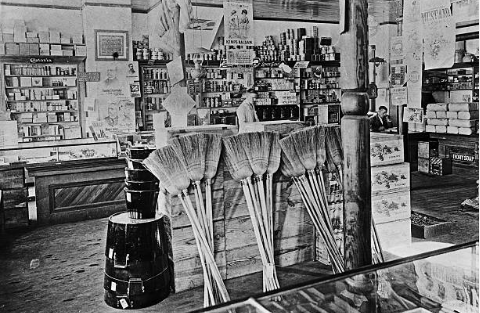
Image: A general store in the 1890s - with nice new brooms (Source)

Sarty's mother, older brother and twin sisters, and aunt feature, but the story is about him and his father. A scrawny, wide-eyed boy who is increasingly aware of his father’s faults and criminality, who is torn between wanting to defend him, hoping he will change, and standing up for truth and honour. Where should ultimate loyalty lie?

Several dramatic events occur over the course of a few days, creating a complex character study of man and boy, with no definitive explanation or even interpretation.

Blood and fire

The element of fire spoke to some deep mainspring of his father’s being, as the element of steel or of powder spoke to other men, as the one weapon for the preservation of integrity, else breath were not worth the breathing, and hence to be regarded with respect and used with discretion.
Fire is obviously a major theme, as is blood; both are used literally and metaphorically. When combined, they’re an explosive mix.

Particularly notable is that five times in this short story, Abner does something violent, but “without heat”.
His father… struck the gaunt mules two savage blows with the peeled willow, but without heat. It was not even sadistic; it was exactly that same quality which in later years would cause his descendants to overrun the engine before putting a motor car into motion, striking and reining back in the same movement.

Perhaps it's meant to make us sympathise just a little with Abner: his violence is instinctive, habitual, and in his blood, but not necessarily done with anger. If I were on the receiving end, the lack of heat wouldn't be any consolation - if anything, it would make me more afraid. But for Sarty, it's life.
His father struck him with the flat of his hand on the side of the head, hard but without heat… his voice still without heat or anger: ‘You’re getting to be a man. You got to learn. You got to learn to stick to your own blood or you ain’t going to have any blood to stick to you.’
Sarty takes note of the lesson on loyalty, but it’s hard to apply when your father is a man like Abner.


Image: Divided loyalties, illustrated by a split tree (probably not where the story is set) (Source)

Hard to rate

I think my relative ignorance of US life of the period puts me at a slight disadvantage - but that's not a criticism of Faulkner.

I’ve never read this Nobel laureate before, nor any prose quite like this. It’s probably brilliant, but I can’t say I enjoyed it.

After this, I read a story from nearly ten years earlier, which was a much easier to read, though in some ways darker: A Rose for Emily, which I reviewed HERE.

Quotes

• “Eyes gray and wild as storm scud.”

• “He felt no floor under his bare feet; he seemed to walk beneath the palpable weight of the grim turning faces.”

• “That stiff foot striking the hollow portico with that wooden and clocklike deliberation, that outrageous over-statement of the weight it carried.”

• “A small fire, neat, niggard almost, a shrewd fire; such fires were his father’s habit and custom always, even in freezing weather. Older, the boy might have remarked this and wondered why not a big one; why should not a man who had not only seen the waste and extravagance of war, but who had in his blood an inherent voracious prodigality with material not his own, have burned everything in sight?”

• “He went on down the hill, toward the dark woods within which the liquid silver voices of the birds called unceasing–the rapid and urgent beating of the urgent and quiring heart of the late spring night. He did not look back.”

Short story club

I read this as one of the stories in The Art of the Short Story, by Dana Gioia, from which I'm aiming to read one story a week with The Short Story Club, starting 2 May 2022.

You can read this story here.

You can join the group here.
Profile Image for Φώτης Καραμπεσίνης.
434 reviews221 followers
September 26, 2018
"Εξ όνυχος τον λέοντα" έλεγαν οι παλιότεροι. Το απόφθεγμα ισχύει απόλυτα για το συγκεκριμένο διήγημα του Φώκνερ, το οποίο εμπεριέχει σε μικρογραφία τα στοιχεία εκείνα που τον καθιστούν ανυπέρβλητο συγγραφέα. Αρκεί.
Profile Image for Tadiana ✩Night Owl☽.
1,880 reviews23.3k followers
March 20, 2017
I try to mix up my reading diet, including some more literary and thought-provoking reading along with F&SF and brain candy romances. William Faulkner is always good for a mental workout, and his short story "Barn Burning" is free online here.

I studied two Faulkner short stories in college, this one and A Rose for Emily. "Barn Burning" doesn't have quite the shocking impact that "A Rose for Emily" does, but it is a profound and moving story of an impressionable young boy living in the South during the post-Civil War period. He's burdened, or perhaps uplifted, by his given name of "Colonel Sartoris Snopes," or "Sarty" for short. Colonel Sartoris was a Civil War hero and a symbol for truth and justice. But the "Snopes" part of his name reflects his low class, degenerate family. So, Sarty's full name epitomizes his internal conflict between his yearning for beauty and honor and justice, and his desire to be accepted by his family, especially his cruel, grim, mean-minded father.

As the story begins, Sarty's father has been hauled before a Justice of the Peace in a small town, accused of setting fire to a richer man's barn. In rural 19th century society, losing your barn and all of its contents would have a devastating effect on a person's livelihood. The Justice lacks sufficient evidence to find Abner Snopes guilty, but warns him to leave the county. The family does leave, but they carry their troubles along with them, particularly inside of Abner Snopes' vindictive, jealous heart. And as the title suggests, it's only a matter of time before his hatred of those who have more than him leads to another barn burning.

Faulkner's tendency to use long, complex, layered sentences is on full display in this story. Here, for example, is the second sentence of the story:
The boy, crouched on his nail keg at the back of the crowded room, knew he smelled cheese, and more: from where he sat he could see the ranked shelves close-packed with the solid, squat, dynamic shapes of tin cans whose labels his stomach read, not from the lettering which meant nothing to his mind but from the scarlet devils and the silver curve of fish - this, the cheese which he knew he smelled and the hermetic meat which his intestines believed he smelled coming in intermittent gusts momentary and brief between the other constant one, the smell and sense just a little of fear because mostly of despair and grief, the old fierce pull of blood.
It's a mouthful, but it tells you so much about Sarty's confusion, his hunger, his despair, and the pull of his family ties.

I love Faulkner's imagery and the way he uses words and symbolism to build tension:
[T]he element of fire spoke to some deep mainspring of his father's being, as the element of steel or of powder spoke to other men, as the one weapon for the preservation of integrity, else breath were not worth the breathing . . .
Faulkner's words pull me into Sarty's head and heart, and made me feel both the tragedy and the hope in his life. Highly recommended.
Profile Image for Mark  Porton.
600 reviews801 followers
December 20, 2022
Barn Burning by William Faulkner is not easy to read. I’ve read a couple of Faulkner’s novels As I Lay Dying being my favourite, and surprisingly I found his stream of consciousness writing easy enough to follow with a little bit of effort. So, I am kind of a fan.

This nine-page wonder, written in the third person, was more difficult to read than either of the novels I have read. It took me a while to get into the swing of things and there seemed to be a lot of extraneous material contained within the narrative. There are certainly some passages I don’t completely understand, and some I had to re-read.

This is set in the late 1800s and is about a family of tenant farmers whose patriarch has a history of arson – putting it simply. Now this father is a dark, miserable creature who has been to war and finds himself having to defend allegations of burning property.

The story opens with a testy scene where his little boy is required to lie to defend him after another barn burning at a hearing before a Justice of the Peace. The prose describing how the wee boy feels during certain times in this story hits home like a punch in the stomach – he was always conflicted between the love and obligations towards his family and doing what is right.

Why the father did what he did is open to question (in my mind) – was he anti-authoritarian? He certainly has those tendencies, didn’t he like the rich? Ditto. Or was he just an arsehole?

There is a lot here and I highly recommend it, it will make you think about the rich/poor interface, obligations to family and poverty – and probably a bit more.

4 Stars

Another great offering from Leonard and the Short Story Club – magic 😊
Profile Image for Olga.
446 reviews155 followers
March 30, 2025
The Short Story Club

It is just the third work by Faulkner I have read (the first two are 'The Sound and the Fury' and 'A Rose for Emily') and I realize that Faulkner is becoming one of my favourite authors. In spite of the fact that he is 'painful' and difficult author to read.
'Barn Burning' is a an unbearably poignant story about the heavy burdens of loyalty and morality. The protagonist is a ten-year-old boy torn between the loyalty to his father, a bitter, vengeful, tyrannical and self-destructive sharecropper who is obsessed with burning barns as an act of defiance, and his own developing sense of justice. The choice is impossible, it requires a lot of courage from the little, hungry boy but he makes it anyway. The ending is ambiguous and, I am afraid, this is not the end of the boy's suffering. And this is what makes the story even more heartbreaking.

'You got to learn. You got to learn to stick to your own blood, or you ain’t going to have any blood to stick to you.'
-----------------------------------------------------------------------------
'His father, stiff in his black Sunday coat, stood as though he had been carved from tin.'
-----------------------------------------------------------------------------
'The stiff foot dragged again, across the porch. A sound harsh, and sharp, quick.'
-----------------------------------------------------------------------------
'They are safe from him. People whose lives are a part of this peace and dignity are beyond his touch.'
----------------------------------------------------------------------------
'Maybe it will all add up and balance and vanish—corn, rug, fire; the terror and grief, the being pulled two ways like between two teams of horses—gone, done with for ever and ever.'
Profile Image for AiK.
726 reviews269 followers
March 11, 2023
Перед нами короткий рассказ, но психологически очень глубокий и драматический, это рассказ о классовой ненависти, зависти и мелкого подличанья, которое характерно для упрямых, гордых неудачников. Этот рассказ – важный кирпичик для Йокнапатофской саги», события этого рассказа упоминаются в романах Фолкнера «Поселок», «Город» и «Особняк» и некоторых рассказах, которые мне предстоит прочитать. Начинается с суда на Эбнером Сноупсом, потравившего по злобе посевы соседа. Сосед ему и проволоку давал, и уговаривал, потом поставил условие вернуть свинью против доллара. Доллар ему был заплачен, но и сарай сожжен. За недоказанностью суд его оправдал, но посоветовал убираться из этих мест. Эб Сноупс – строптивый издольщик, из тех, которые молча гнут свою линию, не говоря ни слова. Во время Гражданской войны он не признавал над собой никакого начальства, не считал себя связанным верностью ни к чьей стороне, он был обыкновенным мародером, грабил и серые, и синие мундиры. Это очень хорошо характеризует его, как личность – он подонок, без каких-либо моральных устоев. Фолкнер рассказывает историю глазами его сына, которого Эб назвал Полковником Сарторисом, коротко Сарти. Но Сарти не знал, кем был отец на войне, он думал, что он был героем. Фолкнер дополняет портрет Эба: «В его волчьей неукротимости и отваге было что-то, вызывавшее уважение посторонних, словно его сдержанная, но неистовая свирепость не только ограждала его независимость, а и внушала им, что эта неистовая уверенность в своей правоте будет полезна всем тем, кто с ним заодно.» Действительно, в повадках Эба есть что-то волчье – одиночество, необоснованная свирепость, даже лютость.
О его классовой ненависти характеризует то, что в первый раз явившись в дом своего нового нанимателя и еще даже не зная его, он намеренно наступил сапогом в навоз и изгадил ковер, несмотря на мольбы старого чернокожего слуги и кухарки. Выйдя из дома и счистив навоз о ступеньку крыльца, он произносит полные ненависти слова: « - Беленький! Красивый! – сказал он. – И все же это пот. Негритянский пот. Может быть, теперь негритянский пот недостаточно бел для такого дома. Может быть, надо ему и нашего пота.» То есть злоба в нем была не персонально к арендодателю, а вообще к богатым или даже просто, кто богаче его. Так иногда бывает, вызовешь сантехника, а он отказывается снимать обувь, требует, чтобы его в грязной обуви пропустили по ковру. (Но но обычно с сантехниками, все решается мирно - одеванием бахил.) Конфликт стремительно развивался. Из усадьбы прислали ковер на чистку. Эб мог бы почистить, и на этом бы все закончилось, даже без принесения извинений. Но его строптивость не позволяла ему закончить спровоцированный им же конфликт миром. Он намеренно портит ковер и возвращает. Идет суд, суд присуждает 1/20 от запрошенной владельцем ковра суммы, что кажется справедливым. Но Эб не может успокоиться.
«Самая стихия огня отвечала чему-то глубинному в сознании его отца, - как стихия пороха и стали отвечает чему-то в сознании других людей, - становилась средством уберечь свое, заветное, без чего и жизнь не в жизнь…» Не обращая внимания на крики и плач жены, умоляющей его не делать этого, Эб сливает в канистру керосин из лампы, с побоями отправляет Сарти в сарай за маслом и отправляется поджигать, сказав жене держать Сарти, чтобы тот не побежал в усадьбу…. В общем, потерял Сарти своего отца. Казалось бы, сам нарвался, зачем надо было идти поджигать, зачем надо было с самого начала провоцировать конфликт этим навозом? А мальчонку жаль. Любил он отца. Фолкнер умеет ставить моральные дилеммы.
Profile Image for Annetius.
357 reviews117 followers
March 1, 2021
Έχοντας αγγίξει τον κόσμο που έπλασε ο Φώκνερ στο "Καθώς ψυχορραγώ", έπεσα στα "μαλακά" μέσα στον φλεγόμενο αχυρώνα. Υπήρχε οικειότητα, χωρίς να το έχω καταλάβει. Προφανώς το "Καθώς ψυχορραγώ" είχε δουλέψει μέσα μου - δεν το είχα πάρει μυρωδιά.

Αγαπώ τη λογοτεχνία αυτή, όπου το κλίμα φτιάχνεται τσιγκούνικα, με λίγα υλικά - όπως η φτωχική απατεωνίστικη φάρα των Σνόουπς -, το συναίσθημα κοχλάζει εσωτερικά και υπονοείται - όπως η εσωτερική πάλη του Σάρτυ -, το τέλος έρχεται με αμφιλεγόμενη κάθαρση - όπως το σπάσιμο της αλυσίδας του Πατέρα από τον Σάρτυ -, και ό,τι κατάλαβε κι ένιωσε ο αναγνώστης κατάλαβε κι ένιωσε.

Σάρτυ ελπίζω να έγινες ο Σάρτυ που ήθελες.
Profile Image for Connie  G.
2,143 reviews708 followers
December 19, 2022
"Barn Burning" is a short story that is a prequel to William Faulkner's Snopes trilogy set in the American South during the late 19th Century. It shows the conflict between the father and son, and the inequity between classes. The son has to decide whether to do what he considers to be morally right, or be loyal to his destructive father. It's a story to be read more than once for its many layers of meaning.

Reread for the Short Story Club.
Profile Image for Joshua.
39 reviews21 followers
March 17, 2023
This short story struck a nerve in me. I can’t quite put a finger on what it was other than maybe the stream-of-consciousness style of writing, the raw visceral descriptiveness, or it could have just been the events within the story. Anything that leaves this type of impression on me is worth my time to at least examine my initial thoughts and try to uncover what in this story drank my milkshake.

I want to characterize the story’s theme as something called ‘man’s curse’. Now, there is no mention of a curse in this story, so all this mention of curses is purely my own notion. I first heard the expression ‘man’s curse’ when I was a child, but there was no explanation for what it meant, so ever since then this curse has been lodged in my psyche waiting for a definition…which I finally have found after all these years later in William Faulkner’s character ‘Abner’ from Barn Burning. The curse is a multifaceted concept, beginning with the resentment that is born from not being able to meet expectations that at one time seemed easily attainable. Failure to achieve success can make life seem meaningless, leaving a bitter taste of jealousy and envy toward other people who seem to be flourishing.

This is where I see the curse becoming dangerous, when resentment shapes someone’s thoughts and judgments about people who accomplish their goals or inherit privileges, leading to further ponderance about how it can all be taken away from anyone with a swift act of violence by any person motivated enough to do so – knowing that each human is capable and are at times tempted to satisfy this urge for retribution over any number of petty offenses in the same exact manner as Abner here. He heaps the blame for all his failures and unfulfilled promises on the rest of the world and uses that as justification for burning people’s barns, destroying their property, terrifying them, and making his family go through the misery of being labeled as dangerous criminals. (Also of note, “Barnburner” was a political term used at the time this was written to describe someone who was willing to burn down their own barn to get rid of a rat infestation, which the rat infestation was analogous to the abuses of government and financial institutions.)

The story is about a young boy’s experience of being raised by a psychopathic father during the late 19th – early 20th century. The title explicitly spells out an activity that the father, Abner, does often. Whenever he feels slighted, he will burn the person’s barn down to satisfy his pyromaniac urges. Abner enlists the help of his family to burn the barns. All the family members are conditioned to the father’s irrational behavior, justified by a sense of family loyalty that he teaches them to uphold as more important than anything else, including the law. The boy, Sarty, his mother, and his aunt Lizzie, seem to be the only ones who realize it is wrong to start the fires, while the older brother’s (name not mentioned) desire to please his father motivates him to treat arson as a normal family activity. Sarty was terrified by his father, and the thought of carrying the same blood as his father convinced him he was doomed to be the same way. The boy had become cognizant that his family’s barn burnings were a crime by his father’s repeated trips to the Justice of the Peace.

Abner may have felt some duty to take care of his family, and his work ethic made that possible by doing odd manual labor jobs, but his impulsiveness and bad attitude kept him and his family in constant dire straits while holding onto his distorted view of independence, placing more value on his rebellious attitude than his own families’ well-being. Abner was a man who stood for nothing other than satisfying his own depraved desires, he was self-centered, lacked empathy, did not consider his family or the victims of his arsons, felt the need to inflict harm whenever he was offended, and blamed everyone else for his problems, taking no responsibility for his actions. Abner reminds me of various people I have met throughout my life; rude, self-absorbed, uncouth, careless, reckless, negative, never wrong, and act as if the world owes them something, never feeling the need to contribute to making the world around them a better place. Abner’s bad leg represents a broken human being or anyone who is suffering from trauma or injury and then takes their pain out on someone else. Abner himself is the symbol of the curse of man; the wickedness inherent in almost everyone, such as the need to “even the score” after feeling disrespected by someone from whom respect has not yet been earned, leading to the misplaced frustration over the personal failure to adhere to the common banalities that serve to guide us in acknowledging the value in each other.

Coming into Major De Spain’s home without wiping his feet showed Abner’s lack of consideration and respect for people and their boundaries. Then the resulting consequences of his rude behavior did not change his selfish thinking. So, any time there ever was a negative attitude, just look to Abner in this story, and you will see all those other sourpusses of the world dragging horse manure all over every pristine white rug that was ever made. The white rug represents the culture, refinement, education, and values of civilized society which Abner has no regard for whatsoever. Abner stepping in horse manure and then tracking all over Major De Spain’s white rug was symbolic of the voice and agency that white supremacists have in this country. The scene summarizes how their insecurities about losing status in the racial hierarchy pushes them to espouse the fallacies about the virtues of their skin color, making themselves look as foolish as Abner tracking manure all over a 100$ white rug while spouting non-sensical racist rhetoric.

Taking the curse further, Abner is described as having wolf-like independence and even courage, which me’ thinks if he were real then he probably could have been a celebrated anti-hero of Americana folklore that would have had songs written about his rebellious exploits. He could have easily gained cult hero status, who used fire as a weapon to fight against oppressive aristocracy and he would be eternally remembered all the while more deserving and contributing members of society would be forgotten. Fire is the symbol of anger and rebellion, a wild and destructive force to be used against authority. The reference to Abner’s ‘wolf-like independence’ connects Abner’s behavior to lycanthropy. Man having the ability to turn into a beast is a legend dating back thousands of years when paleo-man painted pictures of the transformation on cave walls. The action of burning barns also links Abner to the Wild Hunt of northern European folklore, and Abner fits the archetype of the wild huntsman called ‘oskerai’ who were wolf-like creatures that would terrorize the countryside and even burn down farmers’ barns during said Wild Hunt. In old Norse, the word “varg” is used to classify criminals that would be hanged, and coincidentally the word varg also translates into wolf. Native American cultures share similar legends about skinwalkers who terrorize the lands they inhabit, as well as in Russia, France, Scotland, and just about everywhere else in the world. When many different cultures share the same legend, it is enough to make me wonder if there is any truth to the stories, or if they all share recognition of the primitive side of man, each having seen evidence of a monster within a human form. And that there is the final piece of man’s curse – unmet expectations leading to resentment which left unchecked could potentially tap into the atavistic personality.

Abner shows the reader a stark example of rugged independence to its negative fault, so fiercely bent on defending his own pride that he saw no other option than to infringe on the liberties and freedom of others while forcing his family to follow his way of life, the way of the criminal, of the wolf, of the varg, of the misanthrope. The boy realized this, and despite the father-son bond Sarty felt for Abner, he was glad to finally get away and be free from his father’s tyranny and his curse.
Profile Image for Eva Pliakou.
113 reviews222 followers
August 22, 2021
«Χρειάστηκε να συγκρατηθεί. Ο πατέρας του έκανε πάλι τα ίδια. Κάποιο στοιχείο στην ανεξάρτητη φύση του -φύση που θύμιζε λύκο- και, ακόμα ακόμα, στην τόλμη που έδειχνε όταν ο αντίπαλός του ήταν εξίσου δυνατός ή και δυνατότερος από τον ίδιο εντυπωσίαζε όσους τον γνώριζαν, λες και από την κρυφή και λυσσαλέα αγριότητά του δεν αντλούσαν τόσο ένα αίσθημα αξιοπιστίας, όσο την αίσθηση ότι η παράφορη πίστη του στην ορθότητα των πράξεών του θα αποτελούσε πλεονέκτημα για όσους το συμφέρον τους ταυτίζονταν με το δικό του.»

Αν κάποιος μπορεί να σκιαγραφήσει το πορτρέτο ενός πατέρα, αυτός είναι ο Φώκνερ.


υ.γ. Όποτε διαβάζω Φώκνερ, νιώθω σαν να μην έχει νόημα να διαβάσει κανείς ποτέ κάτι άλλο. Ούτε να γράψει. Σαν να σταμάτησε η λογοτεχνία το 1962, τη μέρα που πέθανε.
Profile Image for ☾da.
28 reviews
December 13, 2025
هربار هوا سرد میشه دلم میخواد برگردم به دوره ی فاکنر خوانی هرساله م، چون فقط کتابای اونه که بهم حس غروب و سرما و تنهایی رو میده. تریلوژی خانواده اسنوپسم تو راهه و این داستان کوتاه از خانواده اسنوپس انتخاب خوبی برای برگشت بود. توی مجموعه داستان یک گل سرخ برای امیلی از نشر نیلوفر این داستان با عنوان انبار سوزی همراه با داستان های کوتاه دیگه هست.

پدر سیاهپوست خلافکار و یاغی ( ابنر اسنوپس ) که هرجایی برای کار میره با کارهای مختلف ابراز نارضایتی میکنه و باعث خشم صاحب خانه میشه. و وقتی هم صاحب خانه ازش شکایت میکنه انبارشون رو آتش میزنه. متوجه اشتباه بودن کارهای خودش نیست چون این اعتراض و یاغی گری رو حق خودش میدونه و با ایمان راسخی اینکارو انجام میده. توی دادگاه همیشه قسر در میره و مجبور میشه بعد از هر انبار سوزی نقل مکان کنه و خانواده ی خودش رو در سرما بریزه توی یه گاری و به جایی جدید ببره.

پسر کوچک به نام کلنل سارتوریس اسنوپس رفتارهای پدر رو میبینه، با ناامیدی و ناراحتی توی دادگاه ها اتهامات رو میشنوه ولی پشت پدر میمونه چون فکر میکنه باید بین اخلاق و وجدانش و وفاداری به هم خون خودش یکیو انتخاب کنه و از این انتخاب ناراحته. چون پدر و بیشتر از وجدانش دوست داره.

تا اینکه روزی سعی میکنه جلوی پدر رو بگیره. بهانه های کوچکی که هربار برای بخشیدن پدر توی ناخوداگاهش داشت این بار وجود ندارن (پدر هیچ سیاه پوستی برای هشدار انبارسوزی برای صاحب خانه ی جدید نفرستاده) پسر به صورت ناخوداگاه طغیان میکنه و از دست خاله و مادرش فرار میکنه و میره به صاحب ملک اطلاع میده. و میدوعه به سمت جنگل تا با شکستن بتش به دست خودش کنار بیاد.

مثل وقتی که کسی رو به خاطر دوست داشتن زیاد بابت تمام اشتباهاتش درک میکنی، توجیه های ریز و درشت برای اون اشتباه پیدا میکنی که حق رو بهش بدی ولی آخرش واقعیت مثل پتک رو سرت فرود میاد و میفهمی تمام این مدت خودت رو به خاطر دوست داشتن زیاد اون آدم گول میزدی.

آذر ۱۴۰۴
Profile Image for Έλσα.
638 reviews131 followers
November 20, 2018
Ξεκίνησα την πρώτη μου επαφή με τον Ουίλλιαμ Φώκνερ μέσω αυτού του διηγήματος. Η γραφή του είναι αδιαμφισβήτητα πολύπλοκη. Πυκνογραμμένη τόσο δομικά όσο κ νοηματικά. Κυριαρχεί ο μακροπερίοδος λόγος εμπλουτισμένος με πληροφορίες, νοήματα κ συναισθήματα.

Ο συγγραφέας λοιπόν, περιγράφει μία πατριαρχική οικογένεια στην οποία ο πατέρας εξουσιάζει όλα τα μέλη. Εμφανίζεται άτεγκτος και βλοσυρός και φέρεται αυταρχικά και πολλές φορές βίαια στο δεκάχρονο γιο. Βέβαια, είναι σχέση σεβασμού, εξάρτησης, φόβου αλλά κ εκβιασμού μεταξύ πατέρα και υιού. Το παιδί βρίσκεται σ ένα μεγάλο δίλημμα. Θα πρέπει να επιλέξει ανάμεσα στην υποταγή του στον πατέρα και στην επώδυνη χειραφέτηση. Στο τέλος αιωρείται η πεποίθηση της ελευθερίας.

Επίσης, στο διήγημα διαφαίνονται οι ταξικές κ φυλετικές διακρίσεις, ο ρατσισμός που μολύνει τις ανθρώπινες σχέσεις, τα προβλήματα της καθημερινότητας των αγροτών κ οι συνθήκες διαβίωσής τους.

Η ιστορία δε με ενθουσίασε όμως, δεν μπορώ να αγνοήσω το ταλέντο κ τη δεξιότητα του Φώκνερ, εξού κ το 4/5.
Profile Image for Ο σιδεράς.
390 reviews48 followers
August 31, 2025
"Βγήκε στο δρόμο υπό το φέγγος του εναστρου ουρανού κι εκεί, στρέφοντας το κεφάλι, αντίκρισε τον πατέρα του με φόντο τα άστρα αλλά δίχως να βλέπει  το πρόσωπο του και δίχως να διακρίνει βάθος - μια σιλουέτα σκοτεινή, επίπεδη, λες και στις φλέβες της δεν κυλούσε αίμα, σαν να ήταν μια τσίγκινη φιγούρα κομμένη στο περίγραμμα της ρεντιγκοτας του.. " 


Μια δεσποτική πατρική φιγούρα, τραγική μέσα στη σκληρότητα της ανημπόριας, μια οικογένεια γαντζωμένη σ' ένα κάρο, ένα μικρό παιδί που για να ζήσει πρέπει να σπάσει τα δεσμά της εξουσίας του αίματος.. 

Ο Φώκνερ, πιστός στη φωκνερική παράδοση,  αποτυπώνει μία αρχετυπική εικόνα ενός Πάτερ φαμίλια, βασιλιά με στέμμα από άχυρα. 

Περισσότερο όμως σκιαγραφεί - με ελάχιστες γραμμές,  τη βουβή λύσσα της φτωχολογιάς.. της αιώνιας φτώχειας που καμιά φορά, μέσα από τις γλώσσες της φωτιάς, υψώνεται πάνω από την καθορισμένη τάξη - καταδίκη της.. 

Κορυφή Πλαστάρι, 2174 μ. 


Woody Guthrie- This Land Is Your Land - YouTube https://m.youtube.com/watch?v=wxiMrvD...
Profile Image for foteini_dl.
568 reviews166 followers
October 23, 2019
Μέσα από την - πετυχημένη και αρμονική - εναλλαγή των σκέψεων και των συναισθημάτων του δεκάχρονου Σάρτυ Σνόουπς και της περιγραφής των γεγονότων, και τη χρήση μακροπερίοδου λόγου ο Φώκνερ αναρωτιέται:
Πώς μπορείς να εναντιωθείς στον ίδιο σου τον αυταρχικ) πατέρα; Πώς μπορείς να ξεφύγεις από μια μοίρα που φαίνεται να είναι προδιαγεγραμμένη από την ίδια την κοινωνία; Και πώς αυτή η καταπίεση επιδρά στην ψυχολογία ενός παιδιού;

Πέρα από την ατομική χειραφέτηση, ο συγγραφέας θέτει και το ζήτημα της κοινωνικής: μην ξεχνάμε ότι μιλάμε για την γεμάτη ταξικές και φυλετικές αντιθέσεις, Αμερική στα τέλη της δεκαετίας του 1890, με τα τραύματα του εμφύλιου πολέμου να είναι ακόμα ανοιχτά.

Ένα βιβλίο που μοιάζει να είναι γραμμένο για το θέατρο, χωρίς μελοδραματισμούς και με εσωτερική ένταση, που μιλάει για το πόσο δύσκολο είναι να αμφισβητήσεις και να συγκρουστείς με τον κόσμο γύρω σου και ό,τι έχεις μάθει. Και αυτό είναι μια επίπονη διαδικασία, όσο χρονών και να είναι κανείς.
Profile Image for George K..
2,758 reviews368 followers
April 26, 2018
Το δυνατό και πολύ καλογραμμένο αυτό διήγημα αποτελεί την πρώτη μου επαφή με το έργο του Γουίλιαμ Φόκνερ. Εδώ και αρκετά χρόνια έχω κάμποσα βιβλία του στη συλλογή μου, όμως πάντα κάτι με άφηνε σε απόσταση από αυτόν. Όμως η ολοκαίνουργια έκδοση της Κίχλης μου φάνηκε σαν μια καλή ευκαιρία να γνωρίσω επιτέλους και αυτόν τον μεγάλο συγγραφέα. Το διήγημα από τη μια είναι μια κλασική ιστορία ενηλικίωσης, αφού ουσιαστικά παρακολουθούμε τα γεγονότα από την πλευρά ενός παιδιού, το οποίο καλείται να επιλέξει ανάμεσα στην υποταγή στον βίαιο πατέρα του και τη χειραφέτησή του, ενώ από την άλλη ασχολείται και με διάφορα σοβαρά θέματα όπως οι ταξικές και φυλετικές ανισότητες στον Αμερικάνικο Νότο κατά την περίοδο της Ανασυγκρότησης, οι συνθήκες διαβίωσης των αγροτών και των φτωχών, οι αναμενόμενες συγκρούσεις των ανθρώπων που ανήκουν σε διαφορετική κοινωνική/οικονομική τάξη, και πάει λέγοντας. Η γραφή είναι πραγματικά πολύ καλή και οξυδερκής, αρκετά ιδιαίτερη αλλά συνάμα εύληπτη. Τέλος, η όλη έκδοση της Κίχλης είναι εξαιρετική, με προσεγμένη μετάφραση, ένα πολύ καλό επίμετρο, χρήσιμες σημειώσεις και χρονολόγιο του συγγραφέα.
Profile Image for blondie.
286 reviews
November 28, 2021
Η αλήθεια και η δικαιοσύνη πάνω από την έλξη του αίματος!!!
Profile Image for Manolis V.
102 reviews24 followers
July 28, 2019
Όμορφο ανθρώπινο διήγημα. Μου θύμισε Στάινμπεκ στο πιο ανθρωποκεντρικό. Ενδιαφέρον παρουσιάζει και το χρονολόγιο της ζωής του συγγραφέα που περιλαμβάνεται στο τέλος της (πολύ επιμελημένης) έκδοσης (Κίχλη). Μου άρεσε πολύ.
Profile Image for PattyMacDotComma.
1,776 reviews1,058 followers
December 25, 2022
4★
‘This case is closed. I can’t find against you, Snopes, but I can give you advice. Leave this country and don’t come back to it.’

His father spoke for the first time, his voice cold and harsh, level, without emphasis: ‘I aim to. I don’t figure to stay in a country among people who . . .’ he said something unprintable and vile, addressed to no one.

‘That’ll do,’ the Justice said. ‘Take your wagon and get out of this country before dark. Case dismissed.’


I have not read the Snopes Trilogy or any of the Snopes stories, but I bet this is a pretty good taste of what they are like. The young boy, the narrator, was very nearly questioned by the judge at this trial, but fortunately was not.

He seems torn between idolising his father and being deathly afraid of him. His father knows the boy wouldn’t have lied for him, and the boy can’t even bring himself to lie to his father to say he would have.

In the court case, the man suing Snopes said that after their argument about a hog, Snopes sent someone to him with a message.

“Wood and hay kin burn. ‘That night my barn burned. I got the stock out but I lost the barn.’

The Snopes family moves, again, to do more share-farming, with people shouting “Barn Burner” at them. The next place has an imposing homestead for the owner, unlike the small towns they've been in.

“Because, for all the twelve movings, they had sojourned until now in a poor country, a land of small farms and fields and houses, and he had never seen a house like this before. Hit’s big as a courthouse he thought quietly, with a surge of peace and joy whose reason he could not have thought into words, being too young for that: They are safe from him. People whose lives are a part of this peace and dignity are beyond his touch, he no more to them than a buzzing wasp: capable of stinging for a little moment but that’s all; the spell of this peace and dignity rendering even the barns and stable and cribs which belong to it impervious to the puny flames he might contrive . . . ”

He hope his father will be bested this time. This is not a cheery story. It is full of long, convoluted sentences, which require paying close attention, or you miss the subtleties. I don't know Faulkner's usual style. I felt for this boy, his mother, and their circumstances. Father Snopes is something else again.

This short story is included in many collections. It was published in ‘Harper’s’ in June 1939 and is available in a few places online. It’s another that was discussed by the Short Story Club Group on Goodreads.
Profile Image for Aggeliki.
340 reviews
April 10, 2022
Μέσα σε λίγες μόνο σελίδες, το διήγημα του Faulkner μας μεταφέρει αυτόματα στην ψυχοσύνθεση ενός δεκάχρονου αγοριού που παλεύει με τα συναισθήματά του, με την υποχρέωσή του προς την οικογένειά του και με το αίσθημα του δίκαιου και του άδικου.
Με φόντο τις φυλετικές ανισότητες της εποχής και έναν πολωμένο και βαθιά εκδικητικό πατέρα, καταφέρνει να σπάσει την αλυσίδα της βίας, φτάνοντας στην προσωπική του λύτρωση. Ό,τι κι αν σημαίνει αυτό.
Profile Image for Ευα Μηλιά  Κουτσουμπα.
416 reviews40 followers
June 17, 2020
" Ο αχυρώνας φλέγεται"

Το τελευταίο καιρό, έχω αρχίσει να πειραματίζομαι με διάφορες κατηγορίες λογοτεχνίας, με προτροπή ανθρώπων που μου αρέσει να διαβάζω τις απόψεις τους, αποφάσισα ότι ήρθε η ώρα να διαβάσω Φωνκερ.

Πρώτη επαφή με το συγγραφέα & πρώτη επαφή με επίμετρο.

Ο αχυρώνας φλέγεται δεν είναι ένα εύκολο ανάγνωσμα, είναι από εκείνα τα μικρά διαμαντάκια που πρέπει να διαβάζεις ξανά και ξανά, για να αφήσουν ισχυρό το αποτύπωμά τους στην ψυχή σου.

" Για άλλη μία φορά ακολούθησε την άκαμπτη πλάτη, το άκαμπτο και αμείλικτο χωλό βάδισμα, ανηφόρισε την πλαγιά, βγήκε στο δρόμο υπό το φέγγος του έναστρου ουρανού κι εκεί, στρέφοντας το κεφάλι, αντίκρισε τον πατέρα του με φόντο τα άστρα αλλά δίχως να βλέπει το πρόσωπό του και δίχως να διακρίνει βάθος - μία σιλουέτα σκοτεινή, επίπεδη, λες και στις φλέβες της δεν κυλούσε αίμα, σαν να ήταν μία τσίγκινη φιγούρα κομμένη στο περίγραμμα της ρεντιγκοτας του που δεν έχει ραφτεί για τον ίδιο.*

Η πλοκή του βιβλίου στην ουσία είναι ένα ψυχογράφημα για την πατριαρχία και τη χειραφέτηση που μπορεί να έχουν επάνω στα παιδιά τους οι γονείς, σημαντικότερος δε ρόλος αυτός του πατέρα.
Ένας πατέρας αμείλικτος, χωρίς συναισθήματα που προσπαθεί να δώσει το ευνασμα στο παιδί του να ανδρωθεί με τις δικές του φιλοδοξίες και προσδοκίες.

Από την άλλη όμως ένα σημαντικό κομμάτι του βιβλίου είναι ο ρατσισμός.
Τόσο στο επίπεδο του διαφορετικού χρώματος που έχουμε οι άνθρωποι, και στην κοινωνική τάξη.
Εδώ βλέπουμε δύο διαφορετικούς φυλετικούς κόσμους που αν και ανήκουν στην ίδια κοινωνική τάξη ο λευκός έχει περισσότερα δικαιώματα από έναν μελαμψό άνθρωπο.

Οι εναλλαγές της ψυχολογίας του παιδιού σε προβληματίζουν, κάνοντας να αναρωτιέσαι:
Πως η ψυχολογική και πατριαρχική καταπίεση μπορούν να αλλάξουν τις σκέψεις και το χαρακτήρα ενός παιδιού;
Πώς η σύγκρουση συναισθημάτων με το πως έχεις μεγαλώσει, και με τις αξίες που έχεις πάρει από την οικογένειά σου μπορούν να εναντιωθούν ανάμεσα στα συναισθήματα της ψυχής σου, για να πράξεις σωστά απέναντι στη δική σου ηθική.


Ο αχυρώνας φλέγεται θα μπορούσε να σταθεί ως ένα θεατρικό μονόπρακτο, και να σε καθηλώσει ακόμα και σε αυτή τη μορφή της τέχνης.

Είναι ένα βιβλίο που εκτός από τα μαθήματα ζώης που διδάσκει, βγάζει μία συναισθηματική παράλληλη αναζήτηση ανάμεσα στους σκληρούς ανθρώπους χωρίς ψυχή και στα αθώα πλάσματα που είναι τα παιδιά.

Αν και έχει γράψει το 1939 στέκεται απόλυτα και στη σημερινή εποχή, καθώς κάποια πράγματα και καταστάσεις δεν αλλάζουν ποτέ, οσο υπάρχουν άνθρωποι που οι ψυχές τους δεν είναι φωτεινές, και μένουν "καθηλωμένοι" στην πατριαρχία, και σε παλιομοδίτικες ηθικές αξίες.

Η γραφή αν και πολύπλοκη είναι ιδιαίτερη.
Άρτια χρήση της γλώσσας, με κορύφωση των συναισθημάτων που σε κάνει να νιώθεις σπαρακτικά τα σημάδια που αφήνει στην ψυχή σου.

Τέλος θα ήθελα να αναφέρω, την υπέροχη έκδοση των εκδόσεων Κίχλη που εκτός από την ιστορία του μυθιστορήματος, έχει φωτογραφικό υλικό από τη ζωή του συγγραφέα, μετατρέποντας με αυτό το τρόπο το μισό βιβλίο σε βιογραφικό λεύκωμα.
Profile Image for Katy.
374 reviews
December 19, 2022
This is my first foray into the writings of William Faulkner. Likely I will have to re-read this short story to fully appreciate the depth of Faulkner’s work.

This classic was read as part of the Short Story Club studies.

The story is really quite sad as the ten year old Sarty struggles to obey and respect his father’s instructions. His father is a very angry and vindictive man who is trying to draw his son into his vengeful ways. But Sarty, who at first struggles with blindly following his father soon realizes he must take his own stand on what he knows and believes is right and wrong.

The writing is very powerful, very descriptive, and often with sentences that run on and on, creating an atmosphere that matches the anxiety of the characters. It is very effective. Sometimes the pace which is reflected in the writing caused me some confusion as to who the speaker was, so a re-read should be helpful.

I’d like to read more from Faulkner before I come back to this one so perhaps I will better understand his writing style. The very compelling nature of Faulkner’s writing is rather intriguing and yet can be a literary conundrum, in that it is not always clear as to his perspective or intent. I suppose that is why we continue to review and discuss the classics. They are always open to interpretation.

3.5 stars rounded up to 4
Profile Image for Marilena ⚓.
795 reviews71 followers
September 14, 2021
Το βιβλίο εμπνευσμένο από τον αμερικανικό νότο, μας παρουσιάζει τις ταξικές διαφορές της εποχής, με επίκεντρο τον Σαρτυ-το μικρό μας πρωταγωνιστή- που με την οικογένεια του αναγκάζονται να διωχθούν από την πόλη, επειδή ο πατέρας του κατηγορείται για εμπρησμό.

Ο Σαρτυ θα βρεθεί αντιμέτωπος με την δύσκολη απόφαση για το αν θα υπερασπιστεί ή θα καταδώσει τον πατέρα του.Ο πατέρας του είναι βίαιος και σκληρός ,αλλά είναι οικογένεια του,αίμα του.
Να αποκαλύψει την αλήθεια ότι έ��αλε την φωτιά και να βρεθεί αντιμέτωπος με την πράξη του ή να μην μιλήσει για να προστατέψει την οικογένεια του;

"Ίσως και εκείνος να νιώσει όσα νιώθω εγώ.
Ίσως έτσι ν’αλλάξει,να ξεφύγει απ’τον παλιό του εαυτό,απ’τον οποίο,ποιος ξέρει,δεν μπορούσε ως τώρα να ξεφύγει"

Ένα βιβλίο που μας υπενθυμίζει πόσο δύσκολο είναι να έρθεις αντιμέτωπος με τον κόσμο και να υπερασπίσεις τα πιστεύω σου και τις ηθικές αντιλήψεις,χωρίς να σκέφτεσαι τις συνέπειες.
Profile Image for Matt.
1,142 reviews758 followers
June 20, 2013

Thing is, this is the story that gets so widely anthologized that it becomes people's first- and only-exposure to the world of Faulkner; the runonsentences; the stream-of-consciousness; the family drama (or what Freud called 'the family romance'); the pervading fatalism and doom and shame and endurance on the part of the characters, no All-American hero or come from behind, Horatio Alger here, no sir...

What happens, as I see it at least, is that unsuspecting kids who have to take a higher-level English class in high school sort of peruse it and turn the pages and write notes for the test or the 5 page paper that's due by the end of the month or something and therefore don't get the chance to adjust the mental scenery enough to absorb Old Bill's gravitas and pensiveness and rare and sparkling immediacy...

The thing is, style is destiny. Always has been and always will be. What I mean by that, at least in part, is that style is the very thing that sets a writer apart from the thousands of other scribblers. It's the unified field theory of a particular writer. The writer in question here, remember, went broke and saw all his books go out of circulation and was pretty much living on Hollywood money (David Thomson called it a form of grant) and it took Malcolm Cowley and several years' reflection to appreciate the moral sweep and tragic oomph of Yoknapatawpha County.

Water runs slow through flat land, friends and neighbors. It just do.

So anyway the writer's style is his substance in large part because it's the individual stamp they put on their texts. I mean, Shakespeare is Shakespeare and Coltrane is Coltrane and Godard is Godard, y'know?...the minute they step into the room the whole atmosphere changes. The air crackles in a different way. And that also counts for the space between the ears of the audience that sits down to read or listen or watch what these guys come up with.

Style is a huge part of things because I can't shake the thought (I believe, voiced by Sartre) that a writer's style is his metaphysics. It's the relation between the individual consciousness of the human making art and the more nebulous and ephemeral insights into Being and Time and Faith and Action and Agency and Desire and Fate and Society and all that business...

It anchors the words or music or images or colors or clay or whatever within the space of the work itself; emphasizing one aesthetic attribute or another, one image or insight that the artist is trying to put together. Style's the whole ball game in a sense, because you know it when you see it and what you're seeing and reacting to (positively or negatively) is what's pretty much at stake with the whole experience itself.

So what happens is, of course, since Old Bill has ambled his way into the canon- you can't really talk about truly Great Writers in America in the 20th Century without mentioning him, let alone giving him a plumb position as chronicler, bard and seer- that means that a fairly respectable High School English class has got to offer him, a la carte if you will, as an example of foreshadowing or symbolism or what-you-will...

And so of course the real meaning or statement or ambiance or ascertainable quality of the work gets passed over completely. Cat's got a style that doesn't harmonize with your own predilections as a reader (and, let's face it, what kinds of predilections as a reader does a Sophmore English student have, when they don't have a passion or a particular interest in mind) and so it all seems like a bunch of boring, droning, over-written stuff and gets shoved in a distant mental drawer forever.

I only say this because it happened to me.

Thank god I took a class on Faulkner in undergrad and I had the calm and the quiet and the peace of mind to focus my attention on the scene that was being set for me as I read As I Lay Dying for the first time ever.

Something about the hushed, portentous opening chapters with the drinking water from a wooden bucket ("water should never be drunk from metal"- why? Because then you lose the churning of the autumn wind moving through the thin, prickly leaves of the pine trees, and the warmth of the sun radiating off the ripples- that's why, city boy!)

Not to mention the "Chuck. Chuck. Chuck" of the adze. Mama's in the coffin, boay, and we gotta cut it down ourselves. Woosh. Chill runs through me, still. And then there's Darl's soliloquies, Dewy Dell's desperate helplessness in puberty, Addie's furious and unsparing monologue from the Great Beyond..

See Kurosawa's Rashomon (if you haven't already) for a similar multiple-perspective narrative, which also gains momentum and power from being explained and narrated from both outside and inside the story proper almost simultaneously- Reality as explained and lived through, a distinction without a difference in these hermetic worlds- by both immediate participants and observers and re-tellers alike. Kurosawa knows how to do justice to a pissed-off, disembodied, avenging soul come back from the grave to tell you all, like Eliot's Tiresias. So does Faulkner.
The effect is sublime.

I mention all this not just to digress (though that's sort of an ancillary benefit) but to make the familiar point that, after all, one doesn't always necessarily remember the PLOT of these kinds of stories as much as one remembers all the little detours and ephemeral moments of recognition while they're on the way up the Freytag Pyramid.

When you travel, getting there should be half the fun. Style is the transportation device that puts you into that other world, the diagesis, the mise en scene. Style is what they can't teach you in English class but its what is retained and kept and what one is nourished by after the initial shock of the text wears off and you numb up and adjust to the various shallows and depths.

I think this is what passionate readers talk about when they call a text 'rewarding' or 'enlightening' or 'enchanting' or whatever. I think it's not only the meat and potatoes, it's the wine and the dessert, too.

As in romance, as in literature: it's not the climax that you remember, not quite, it's the infinite amount of details that one holds onto in the steady onrush of oblivion. The way you wear your hat, the way you sip your tea...

So anyway poor Barn Burning gets to be the sort of introductory Faulkner and thus becomes that which can only lose its enticement through it being suggested by your teacher before you really know anything for certain and are on the road to find out.


Profile Image for Jess ❈Harbinger of Blood-Soaked Rainbows❈.
582 reviews322 followers
March 12, 2015
3.5 stars
I realized I never reviewed this one because I am a dummy with a crazy friggin life right now:(

Thank you to Miss Tadiana who pointed me in this little shorty's direction. I seem to have missed all the classes in high school and college where Faulkner was being taught. I remember my brother reading (and loathing) As I Lay Dying in eleventh grade, but the only Faulkner I ever read that year was the short story, A Rose for Emily. And while I loved that short story (and even more upon an adult re-read), I wish I had the opportunity to read more of his longer works in school where a critical eye and class discussions would have helped me appreciate and understand him. I also wish that my class had read this short story as well.

This short story from Faulkner is vastly different from A Rose for Emily and from what I understand of Faulkner, it is more akin to his particular style and subject matter addressed in more of his novels. Where Rose was very haunting, and lyrical, and slightly but beautifully macabre, Barn Burning was crass, and raw, and gritty, and exposed, and while those are all things I love in my stories, I just feel like there was an overdose of it here.

I have heard many many things about Faulkner's overabundant use of detail and description and since A Rose for Emily is the only thing I had thus far read of his, I had a hard time understanding that particular representation of him. Oh boy, I saw it here. This story was swimming in detail. And unfortunately, it did detract from my enjoyment of it. But only slightly.

There is no doubt that Faulkner is a master of his craft, and though he does have a very particular style of writing, he is very good at it. But you have to know and understand what you're getting yourself into and be prepared to take your time, study, and trek through his beautiful details instead of just zipping straight forward into the marrow. Because this story does have some delicious marrow to it, but you have to search for it. And I don't think I was quite prepared to do that.

Above all, this story is an amazing character study of a young boy who is torn between following his own instincts to become the man he wants to be and following his tough callous prick of a father and defending his own flesh and blood to the end. This story definitely delves into that persistent dilemma that ensues when you know what you're doing is wrong, but pressures out of your control force your hand to take part. This short was jam-packed with raw emotions and a lot of tough questions with not so black and white answers. This story was extremely haunting just like A Rose for Emily but in a totally different way. Highly recommended for those who love grit lit and supercharged emotional and character-driven stories. But remember, take your time.

Read this short online for free here.
Profile Image for Mostafa.
433 reviews51 followers
August 20, 2022
4 stars
داستان با توصیف یک طویله و دادخواهی یک کشاورز در محضر قاضی شروع می‌شود. از همان ابتدا می‌توان فهمید موضوعی که داستان حول آن شکل می‌گیرد از چه قرار است:ر

«آخر شما چه مدرکی دارید آقای هریس؟»

«گفتم که. خوک آمد تو محصول من. من گرفتمش و پس فرستادم پیش‌اش. او اصلاً حصاری نکشیده بود که جلوش را بگیرد. دفعۀ بعدش خوک را انداختم تو آغل خودم. وقتی آمد ببرش به‌ش سیم دادم سوراخ‌های آغلش را بندد. دفعۀ دیگرش به خوک جا دادم و نگهش داشتم. بعد سوار شدم رفتم خانه‌اش، دیدم سیمی که به‌ش داده بودم همان‌طور با قرقره‌اش افتاده تو حیاطش. به‌ش گفتم وقتی می‌تواند خوک را بگیرد که یک دلار خرج نگهداریش را به من بدهد. غروبش یک سیاه آمد و یک دلار را داد و خوک را برد. غریبه بود. گفت او گفته به‌ت بگم چوق و علف خوب می‌سوزن. همان شب طویله‌م آتش گرفت. حیوان‌ها را نجات دادم اما طویله‌م از دست رفت.» ر

مرد(هریس) برای حرف خود نمی‌تواند سندی بیاورد. پرونده مختومه اعلام می‌شود. داستان از زبان پسربچه‌ای به نام «کلنل سارتوریس اسنوپز»_یعنی کسی که پدرش مظنون به سوزاندن طویله است_نقل می‌شود. در خلال توصیف متوجه می‌شویم اسنوپزِ پدر یک خلافکار است : ر

«پدرش چرخید و او دنبال کت سیاه شق و رق و بدن باریک ورزیده‌ای که در ناحیۀ پاشنۀ پا به علت تیری که سی سال پیشتر به خاطر دزدیدن یک اسب از تفنگ گماشتۀ مباشر یک زمیندار ایالات مؤتلف خورده بود کمی شق و رق راه می‌رفت راه افتاد.»ر

پس از اتمام دادگاه قاضی به مظنون می‌گوید بهتر است آن منطقه را ترک کند. او می‌گوید اتفاقا دارد همین کار را می‌کند. ادامۀ داستان شرح اسباب‌کشی این خانواده به جایی است که نمی‌دانند کجاست. بارها اتفاق افتاده پدر خانواده راه افتاده و اعضا به دنبالش و همیشه یک خانه برایشان بوده که در آن سکنی بگزینند و پدر کشت و کاری راه بیندازد....ر

«گاری جلو می‌رفت. و او نمی‌دانست دارند کجا می‌روند. هیچ کدامشان نمی‌دانستند و سؤال هم نمی‌کردند. چون همیشه جایی بود، همیشه یک جور خانه‌ای به فاصلۀ یکی دو روز یا حتی سه روز آن‌طرف‌تر انتظارشان را می‌کشید. حتماً پدرش ترتیبی داده بود که محصولی در مزرعۀ دیگری کشت و برداشت کند تا بعد … باز باید جلوی خودش را می‌گرفت. او (پدر) همیشه این کار را می‌کرد. استقلال و حتی شهامت گرگین او وقتی که سودی هم برایش نداشت غریبه‌ها را تحت تأثیر قرار می‌داد، انگار از حرص وحشیانۀ نهفتۀ او بیش از آنکه اتکاپذیری را نتیجه بگیرند به این احساس می‌رسیدند که ایمان وحشیانۀ او به درستی کارهایش به سود همۀ کسانی تمام می‌شود که منافعشان در گرو منافع اوست.»ر

داستان دائما با واکاوی شخصیت این پدر مستبد که به قول پسر « در خونش حرص فطری ولخرجی کردن از مال دیگران وجود داشت» پیش می‌رود. پدر در جنگل آتش کوچکی برپا می‌کند و پسر سعی می‌کند درک کند چرا پدر آتش بزرگتری _علیرغم سرمای هوا_ درست نمی‌کند؟

عنصر آتش با علت‌العللی در کنه وجود پدرش رابطه برقرار می‌کرد، چنان که با "مردان دیگری ممکن بود شمشیر یا تفنگ رابطه برقرار کند، به عنوان تنها سلاح برای حفظ تمامیت، وگرنه زندگی بی‌ارزش می‌شد، از این‌رو باید آن را ارج می‌نهادند و عاقلانه به کار می‌بردند ... ر

پس از کمی استراحت پدر مستبد، راویِ داستان را محکم و با خونسردی می‌زند. چون معتقد است پسرش می‌خواسته هرچیزی را که از طویله‌سوزی می‌دانسته به قاضی بگوید. پدر نصیحت‌وار به کلنلِ کوچک می‌گوید:

«تو داری مرد می‌شوی. باید یاد بگیری. باید یاد بگیری به هم‌خونت بچسبی، وگرنه هیچ هم‌خونی به‌ت نمی‌چسبد. فکر می‌کنی امروز صبح از آن‌هایی که آنجا بودند کسی این کار را می‌کرد؟ می‌دانی فقط دلشان می‌خواست دست‌شان به من برسد، چون پوز همه‌شان را به خاک مالیده بودم؟ هان؟» بعدها، بیست سال بعد، به خودش می‌گفت: «اگر گفته بودم آن‌ها فقط حقیقت را می‌خواستند، فقط عدالت را می‌خواستند، بازهم مرا زده بود.» ولی الان چیزی نگفت. گریه هم نمی‌کرد.» ر

در محل جدید متوجه می‌شویم که پدر از راه تعدی به اموال دیگران روزگار می‌گذراند و مدام جریمه می‌شود اما به جای پرداخت کردن آن جریمه‌ها و جلب رضایت شاکیان، یک اشتباه را با اشتباه بزرگتری همراه می‌کند و از این کار کوچکترین اظهار ندامتی ندارد. در جایی از داستان هم دیدیم که از نظر راوی او به درستی کارش «ایمانی وحشیانه» دارد! دریغ از آنکه انسان هرچه می‌کشد از همین ایمان‌های وحشیانه به باورها و رفتارهای غلطی است که تحت تأثیر القائات محیطی/ خانوادگی/ جامعه به آن رسیده است!

در این داستان فردی را می‌بینیم که علنا به دیگران و اموال ایشان آسیب می‌زند (تعمدی دیگران را عصبانی می‌کند و از خود رد به جا می‌گذارد) و وقتی به بن‌بست می‌رسد و محکوم می‌شود می‌کوشد به مال آن‌ها آسیب جدی‌تری وارد کند. اما از آنجا که شترسواری دولا دولا نمی‌شود! در طویله‌سوزی آخری که از آن سرگرد دسپین است گلوله می‌خورد::: ر

علتش هم این است که کلنل کوچک به منزل سرگرد دسپین می‌دود تا خبر دهد طویله در خطر است! گفتنی است که دیگر اعضای خانواده هرچند می‌دانند رفتار پدر غیراخلاقی و پر خطر است اما با او در همکاری دائمند (شاید چون جرأت مخالفت ندارند) و تنها خطر همین کلنل کوچک است که شخصیتش هنوز آنچنان شکل نپذیرفته و گویا در خود نیروی عصیانی دارد...ر

نهایتاً پسر کوچک بین محیط و آموزه‌های خانوادگی با اخلاقِ فطری انسانی دومی را برمی‌گزیند. (البته انتخاب کردن نمی‌تواند فعل دقیقی برای رفتار او باشد. گویی خودجوش و یا شاید حتا برای نجات پدرش از این عمل است که اقدام می‌کند.) اما این مسئله عواقب هولناکی در پی دارد. پدر که گفتیم در جریان طویله‌سوزی آخری _که برای مالیدن پوزۀ شاکیان به زمین است _تیر می‌خورد؛ احتمالا می‌میرد. دقیقاً مشخص نمی‌شود زیرا داستان با کسی که دارد می‌دود تا فقط از آن محیط دور و دورتر شود تمام می‌شود. هرچند هنگامی که سارتی با خود تنها می‌شود سعی می‌کند از پدر چهرۀ خوبی بسازد اما گویی سارتیِ سال‌ها بعد که دارد به آن واقعه فکر می‌کند، اشتباهش را دربارۀ شناخت نادرستش از پدر اصلاح می‌کند:ر

«پدر. پدرم_ با خودش فکر می‌کرد. «او شجاع بود!» ناگهان فریاد زد، با صدای رسا نه بلند، نه بلندتر از زمزمه‌ای: « او هم بود! در جنگ بود! در سواره‌نظام سرهنگ ساتوریش بود!» نمی‌دانست که پدرش در آن جنگ فقط سرباز صفری به معنی ظریف اروپایی قدیم آن بود و اصلاً اونیفورمی نداشت و نسبت به هیچ‌کس یا ارتش یا پرچمی مقید به فرمانبری یا وفاداری نبود و مثل خود مالبروک به جنگ می‌رفت: «برای غنیمتش_ و برایش فرقی نمی‌کرد، هیچ فرقی نمی‌کرد، غنیمت را از دوست می‌گرفت یا دشمن.» ...ر
Profile Image for Roula.
762 reviews217 followers
November 16, 2025
Το "ο αχυρώνας φλεγεται " είναι η ιστορία -ή κομμάτι της ιστορίας - της οικογένειας Σνοουπς . Ο Φωκνερ πιστος στην αγάπη του για την εξιστόρηση των παθών -κυρίως- της αμερικανικής οικογένειας ,αναλαμβανει και εδώ να μιλήσει για αυτά ,μέσα από την διήγηση ενός 10χρονου ,γιου της οικογένειας ,ο οποίος προσπαθεί να βρει το θάρρος να σπάσει τα δεσμα που τον δένουν με επαναλαμβανόμενες καταστάσεις που τον πληγώνουν .
Ένα "σφηνάκι" με όλα αυτά τα στοιχεία που κάνουν τον Φώκνερ αυτόν που είναι : έναν τεράστιο συγγραφέα .
🌟🌟🌟🌟/5 αστερια
Profile Image for George Ilsley.
Author 12 books314 followers
April 15, 2022
Full disclosure — Faulkner is an American author I've never really been able to read. I know he is considered masterful, and was awarded the Nobel Prize, so any restrictions on my appreciation must be due to my own limitations.

Perhaps it is his material, writing about "the south" with its casual racism, brutal racism, and institutionalized racism. Is that too much to say? Sorry—perhaps William Faulkner should be cancelled because his prose can be used to fuel the fires of critical race theory.

So much meandering without even getting to the burning barn in this short story from 1939. Did I like the story? Not really. Why 3 stars? Felt I should like it more than I did. Was it a literary achievement? I don't know. Will I ever read it again? No.

Sometimes, with southern writers, I just don't want to know, don't want to learn more, don't want to get involved.
Displaying 1 - 30 of 301 reviews

Join the discussion

Can't find what you're looking for?

Get help and learn more about the design.