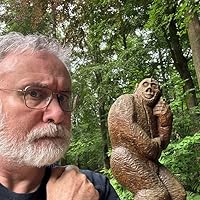
A two-time winner of the prestigious British Fantasy Award, Mark has published his epic, imaginative novels in many countries around the world. He grew up in the mining community of the English Midlands, and was the first person in his family to go to university. After studying Economic History at Leeds, he became a successful journalist, writing for several of the UK's renowned national newspapers as well as contributing to magazines and TV.
When his first short story won Fear magazine's Best New Author award, he was snapped up by an agent and subsequently published his first novel, Underground, a supernatural thriller set in the coalfields of his youth. Quitting journalism to become a full-time author, he has written stories which have transcended genre boundaries, but is perhaps best known in the fantasy field.
Mark has also forged a parallel career as a screenwriter with many hours of produced work for British television. He is a writer for BBC Drama, and is also developing new shows for the UK and US.
An expert on British folklore and mythology, he has held several varied and colourful jobs, including independent record company boss, band manager, production line worker, engineer's 'mate', and media consultant.
Having travelled extensively around the world, he has now settled in a rambling house in the middle of a forest not far from where he was born.
I thought this was an interest story and was well written but it really didn't seem very Troughtonesque to me and the Doctor could have been anyone if Ben and Polly hadn't been present.
Trippy Dippy and not in that fun way, Wonderland is a pretty poor caricature of the free love and easy highs lifestyle. Unfortunately this one is not narrated by The Doctor, Polly or Ben and so we're forced to spend a lot of time with a stranger while she searches for her brother.
This is a rough and gritty story set in 60s San Francisco and it just doesn't feel like a Doctor Who adventure at all. Read it so you can say you've read them all, but whatever you do, don't try the Blue Moonbeams.
I bought this book in 2006/2007, from a glass cabinet inside the Doctor Who Up Close exhibition, in Cardiff's Red Dragon Centre. It feels apt that, twenty or so years on, I'm finally reading it, in Cardiff.
So firstly, it's probably good that I didn't finish this as a kid. It's very dark at times for a Doctor Who story (it's *very* Wilderness Years, and it's characterisation of the Second Doctor is closer to the Seventh at times, which I quite enjoyed tbh). But it's very good. I found the setting fascinating and fitting for Ben and Polly. This was probably my first exposure to them as characters when I read the first ten pages or so all those years ago, and it stuck with me. Now I know them a little better, I can see how well they're written, and Polly especially is brilliant; the way she talks about the situations that occur can be so funny sometimes, and feels very sixties.
It's a quick read, and it's easy to invest in Summer's search for her lost boyfriend. I loved all the historical stuff about JFK and the hippie movement, and the structure of the story doesn't feel that different to a 60s Who at all (or even a detective novel). The monster is portrayed absolutely terrifyingly at times - appearing invisible unless you take a specific brand of LSD, and it's frightening in both guises - and though I was a little disappointed by the revelation as to what's going on with the Colour-Beast, it's very Doctor Who. This really does have elements of a horror novel to it at times, which I enjoyed.
The ending has stuck with me the most. It's a spot-on characterisation of a different incarnation of the Doctor (and it's nice to see more of the character, since he doesn't feature quite enough in the novella for me), and it's a really beautiful, bittersweet, hopeful ending. It has a sense of softness that a lot of the settings of the book are devoid of.
There's fun little cameos for the Doctor, Ben, and Polly, of various different monsters, and again, though the reasoning for their appearances (and, indeed, the reasoning for the Doctor being absent for so much of the novella) aren't quite satisfying enough, they are such lovely little moments.
I feel like this novella influenced me a lot - even if only in the first ten pages I read when I was younger - and it's nice now to return to it. Especially since, really, the book feels exactly as I imagined the rest of it would be, and it retains that throughout, meaning this is a really consistent, but also, for me, a very nostalgic read.
As a big fan of the Second Doctor, Ben, and Polly, I was really excited to read this. The idea of putting them into a very unfamiliar landscape to deal with some darker themes sounded like a great idea with a lot of potential for character development. The problem, however, was the point of view it was written in. Normally, Doctor Who novels are written in third person omniscient so we can see what the different companions are doing and thinking when everyone is split up. Instead, this time we are stuck with an original character as a first person narrator. That means we get less time with the main characters AND we have to put up with an unreliable (and actually pretty annoying) narrator describing everything. The narrator spends most of the time pining after her lost boyfriend rather than actually building a bond with the TARDIS team, and she has a massive misunderstanding of the Doctor himself. So, the whole time the characters we are actually reading the book for, are far out of reach. Overall, the point of view made the book really a lot less enjoyable than it could have been. However, it is a really fast read and if you are desperate for more Second Doctor, Ben, and Polly, it's there. I really wouldn't recommend it though.
A Doctor Who story set amid the Summer of Love and centred around a bad batch of LSD is certainly a novelty, though the results are mixed. The atmosphere gets carried away trying to evoke the spirit of the era and the companions feel sidelined and underwritten, although Ben & Polly seem apt for the period.
Excellent book. Well written. Great plot. Characters done really well. A bit different from the usual approach being written in the third person and taking a slightly more adult slant. Would fit well with the current TV format if toned down. Will look out other books by this author.
I loved this book. It’s great in of itself, but I love it even more for the potential of the way it describes its world. I want to run a DnD games set in it it’s so awesome.
"Wonderland" plonks the 2nd Doctor, Ben, and Polly in San Francisco a couple of days before the Summer of Love kicks off. Chadbourn is trying desperately to get the atmosphere right, without a great deal of success. Part of the problem is that the story is a first-person narrative. Chadbourn never really gets her voice right, and she just does not come across as a disillusioned young woman from Texas. Another problem is the alien that is the source of the trouble in the story. It is not really explained just what it is, what its powers are, or how it got where it got. There are some interesting touches involving bad LSD used to create killers. Yet, not much in the novel is really all that convincing.
http://nwhyte.livejournal.com/1973119.html[return][return]The last of the run of Doctor Who novels set between The Power of the Daleks and The Highlanders takes the Doctor, Ben and Polly to San Francisco in 1967, where a flower child called Summer tells the story of an alien power trying to take over the world through bad acid. The first-person perspective is quite rare in Who books, but done well here, though the story has few surprises.
Rated R, for sure, so beware. A very unusual Doctor Who story. It was a novelty but I didn't enjoy it much.
The characters were all in character and the imagery was vivid, but it was much too morbid for my liking. Almost as if the gritty reality of it took prominence over any Doctor Who-ish story.