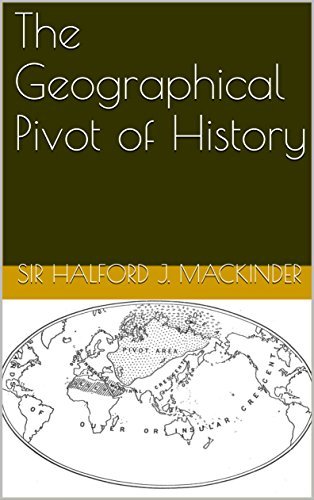
Halford Mackinder's seminal work, "The Geographical Pivot of History," presents a groundbreaking geopolitical analysis of global power dynamics and the role of geography in shaping historical events. Mackinder's theory revolves around the notion of a geopolitical "pivot," a strategic region that, if controlled, could determine global supremacy. This review aims to provide an academic evaluation of Mackinder's arguments, discussing the book's strengths, weaknesses, and its significance within the fields of geopolitics, international relations, and historical geography.
"The Geographical Pivot of History" by Halford Mackinder explores the profound influence of geography on the course of history. Mackinder contends that control over the Eurasian "Heartland," with its vast resources and strategic position, is crucial for world domination. He analyzes the historical struggles for dominance over this region, highlighting the geopolitical significance of central Asia and its surrounding territories. Mackinder's theory not only offers insights into past conflicts but also provides a framework for understanding contemporary global power dynamics.
Mackinder's work stands out for its interdisciplinary approach, combining historical analysis, geopolitical theory, and geographical understanding. He draws upon a wide range of sources, including historical records, geographic data, and political observations, to construct his theory of the "pivot." Mackinder's analysis prompts critical reflections on the interplay between geography, power, and historical development, offering a unique perspective that remains relevant to contemporary geopolitical discussions.
One of the notable strengths of "The Geographical Pivot of History" lies in Mackinder's ability to connect geographical factors with broader historical processes. His theory of the pivot presents a compelling framework for understanding the struggles for global power throughout history. By emphasizing the significance of geographical resources, strategic positioning, and transportation routes, Mackinder provides valuable insights into the motivations and actions of historical actors.
Furthermore, Mackinder's analysis has proven prescient in many instances. His identification of the Eurasian Heartland as a region of geopolitical significance anticipated the subsequent rivalries and conflicts that unfolded during the 20th century. The book's ability to predict and explain geopolitical developments, such as the rise of the Soviet Union and the challenges faced by maritime powers, demonstrates its enduring relevance.
While "The Geographical Pivot of History" offers a groundbreaking analysis, it is not without its limitations. Critics argue that Mackinder's theory may oversimplify complex historical events, reducing them to geographical determinism. A more nuanced consideration of the role of other factors, such as ideology, culture, and technology, would enhance the book's analytical breadth and provide a more comprehensive understanding of historical dynamics.
Additionally, Mackinder's work has faced criticism for its Eurocentric perspective, focusing primarily on the Eurasian Heartland and neglecting the complexities of other regions in global power relations. A more inclusive analysis that accounts for the multiple geopolitical "pivots" around the world would provide a more balanced and comprehensive assessment of global power dynamics.
"The Geographical Pivot of History" holds significant importance within the fields of geopolitics, international relations, and historical geography as a foundational work that revolutionized our understanding of global power dynamics. Mackinder's theory of the pivot has had a lasting impact on strategic thinking, informing the strategies of nations and shaping geopolitical debates. The book's contribution lies in its ability to illuminate the profound interplay between geography and history, fostering critical reflections on the enduring relevance of geographical factors in shaping political and historical developments.
GPT