Jump to ratings and reviews
Rate this book

H(a)ppy

Rate this book
Imagine a perfect world where everything is known, where everything is open, where there can be no doubt, no hatred, no poverty, no greed. Imagine a System which both nurtures and protects. A Community which nourishes and sustains. An infinite world. A world without sickness, without death. A world without God. A world without fear.

Could you...might you be happy there?

H(A)PPY is a post-post apocalyptic Alice in Wonderland, a story which tells itself and then consumes itself. It's a place where language glows, where words buzz and sparkle and finally implode. It's a novel which twists and writhes with all the terrifying precision of a tiny fish in an Escher lithograph – a book where the mere telling of a story is the end of certainty.

Kindle Edition

First published July 20, 2017

27 people are currently reading
2246 people want to read

About the author

Nicola Barker

34 books305 followers
Librarian Note: There is more than one author in the Goodreads database with this name.

Nicola Barker is an English writer.
Nicola Barker’s eight previous novels include Darkmans (short-listed for the 2007 Man Booker and Ondaatje prizes, and winner of the Hawthornden Prize), Wide Open (winner of the 2000 International IMPAC Dublin Literary Award), and Clear (long-listed for the Man Booker Prize in 2004). She has also written two prize-winning collections of short stories, and her work has been translated into more than twenty languages. She lives in East London.

Ratings & Reviews

What do you think?
Rate this book

Friends & Following

Create a free account to discover what your friends think of this book!

Community Reviews

5 stars
121 (13%)
4 stars
286 (30%)
3 stars
285 (30%)
2 stars
151 (16%)
1 star
83 (8%)
Displaying 1 - 30 of 165 reviews
Profile Image for Meike.
Author 1 book4,943 followers
August 29, 2019
Winner of the Goldsmiths Prize 2017
What would happen if we lived in a world of total moderation and mindfulness, where any excess of emotion - both good and bad - was considered undesirable, and our ability or willingness to oblige to these standards was monitored 24/7? Nicola Barker's "H(a)ppy" is definitely a fun read for anyone who does yoga and tracks his/her lifestyle on a fitbit (i.e., me)! :-)

Barker's protagonist Mira A lives in a dystopian future, a totalitarian world governed by a mental and technological system established by The Young. Imperfection has become an anachronism, as the system has managed to eliminate most curses under which The Old have suffered: Hate, anger, sadness, pain, war, death, etc. The success of The Young has dehumanizing consequences. The control mechanism tracks every person's thoughts and actions, its access is public (hello, social media). The pressure on the individual is intensified by the fact that people are also judged as parts of groups, meaning that if an individual thinks or acts in a way that is considered wrong by the system, it affects how the whole group is judged, thus institutionalizing peer pressure.

Now Mira A, a musician, quite suddenly experiences difficulties trying to oblige to the sytem, although she aims to: Her mind keeps thinking and feeling things that are deemed unacceptable as they reveal deep emotions and attachment. Is it a "kink" indicating that there is something wrong with her, is it a chemical imbalance, can it be rectified with an operation? Will Kite, who is sent as an official agent to eliminate the kink, help her or does he intend to send her to the few remaining humans living outside the system, which is considered a horrible punishment?

It would certainly be possible to write a dissertation trying to find all the ideas, hints, and concepts Barker has planted in her book, and taking her baits while reading the text is great fun. What fascinated me most though is how Barker celebrates ambiguity and how it renders language and music beautiful: Because there is more than one way to understand language and hear music, because art communicates with our indvidual character, because it makes random connections depending on who we are, language and music represent our humanity: "The meaning is contained in the ...the gap." - "Blackness and whiteness collapsing into each other." - In the world outside the system "(...) words are fluid. (...) freedom kills certainty. (...) narrative pervades every tiny chink and crack and orifice and poisons everything."

Narratives are dangerous because controlling your own life means writing your own story, and whoever does that becomes uncontrollable and thus an enemy of the system. Barker makes letters and words oscillate, until Mira A herself is oscillating between desire and restraint. This is also where Paraguyan guitarist Augustín Barrios comes into play, a musician who was a wanderer between his South American heritage and European classical music, between the languages of Guaraní and Spanish, between traditional ways of appearance and conforming to Western standards. Barker lets Mira A connect with Barrios in fantastical ways.

There are also some interesting thoughts on religion in this book: The Young are their own Gods, so faith, which again refers to something beyond our grasp and cannot unambiguously be pinned down, is forbidden. A cathedral becomes a symbol for human desire - and Barker showers us with related images. This can as well be seen in the context of music (Bach is mentioned, who was very religious, and Barrios, whose major work is named "The Cathedral"), totalitarianism (which generally also opposes religion, as every totalitarian ideology wants to see its own belief system as absolute), and human fallibility.

Plus: There is also a lot of humor in the book: "The Banal is a warm blanket." - sentences like these give the text partly an ironic turn, which I really enjoyed. In a twisted way, Barker makes you appreciate everything that is wrong with our society: Perfection suddenly seems way worse, or at least this kind of perfection.
Profile Image for BlackOxford.
1,095 reviews70.3k followers
November 7, 2021
Escaping the ‭Law‭‭ ‭Written‭‭ on the Heart

A prominent theme in Barker’s clearly allegorical novel is “The tuning fork is in our hearts.” This refers to the internal moral compass of those who live within The System in harmony with their fellows who are an homogenous group called The Young. For me, the reference to theology seems unmistakable

In the second chapter of his epistle to the Romans (echoing the fourth chapter of the book of Exodus but reversing the meaning), Paul extols the superiority of the “the law written in the heart” over that of the traditional Jewish law of the Torah. Reinforced in the letter to the Hebrews, this law of the heart is also extended to a “law inscribed on the mind.”

These Pauline pronouncements constitute not just the new religion of Christianity but also a new kind of religion. This is a religion of personal conversion rather than ritual participation. It demands faith in, unwavering commitment to, the contents which have been divinely inserted into the heart and mind, the conscience in other words.

Similarly, each individual in the Barker novel is monitored continuously by his or her personal conscience, The Sensor, which monitors all speech, including the speech of thought. Every word is evaluated as to its meaning and emotional correctness in the context in which it is expressed. Narratives are assessed in terms of their conformity with established narratives stored within The System

In Paul’s idea of religion, the contents to be inserted into the mind and heart were linguistic, consisting of key words and narratives. It was therefore necessary to have a reliable mode of transmission between God and human beings. The church eventually declared itself a Societas Perfecta, that is, the source all information that is needed - from what is allowed to be read, to how what is read should be interpreted. Paul’s church was the ultimate source and authority for truth.

In the novel “The Young are Perfect and The System is Perfect and everything is Known.” Like the Societas Perfecta, there is nothing outside itself which is worthy of knowing. Any extraneous knowledge is at minimum distracting, and potentially disruptive to the harmony and ultimate happiness of the community. Desire to acquire such knowledge is a transgression, a sort of editorial discontinuity as in the H(A)PPY of the title. As such, independent thought is discouraged: “Our survival is dependent upon our unity. We must be dispassionate. The System is our unity. The System is our dispassion.”

Paul’s narrative of ‘conversion by faith’ proved remarkably successful. It still dominates a large part of the world’s population. And it is a narrative which has infected other religions originally founded on a commonality of genetic or cultural heritage. Paul’s influence is so great that many of these other religions now often consider themselves to be ‘faith-based.’

In other words, the narrative of faith has become a global phenomenon and consequently must be more or less continuously adapted to new circumstances, established religious feeling, and unforeseen challenges. This implies that the interpretation of the words of faith must be decided by an ultimate authority - the Magisterium, the Board of Elders, the Conference of Churches, Caliph, Ulama, Chief Rabbinate, etc.

So also in the novel, “The System is, in essence, a creative entity; a truth, an aspiration, a hope, an imagining.” The System adapts and interprets as necessary, and as it does so it adjusts personal narratives accordingly in order to neutralise their disruptive impact before they are made legitimate in The System:
“The Sensor automatically deconstructs [all existing] stories for us, so that we may fully comprehend their true meaning, their immense reach and their invidious power, their ultimately deeply conservative urge to comfort and pander and bolster and reassure. To understand them is to disable them. It’s how we stay safe. By knowing. By being aware. It’s how The Young remain strong and Clean. By keeping vigilant.”

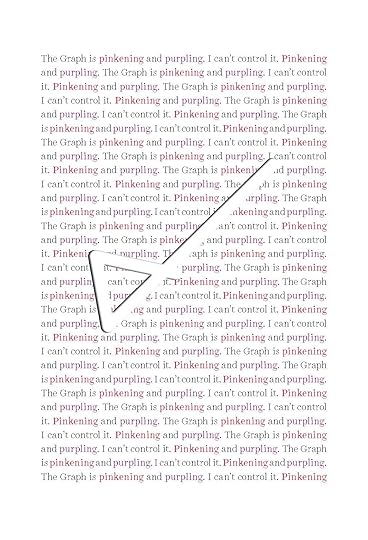
But there is always the possibility of a kind of heresy, unauthorised personal narratives, new stories which have not been vetted and approved by the The Sensor. These have the potential for polluting the entire System and undermining its unity. The protagonist in H(A)PPY, Mira A, is plagued by numerous random thoughts which she is trying to make sense of by fitting the pieces together into a coherent story. She is advised that she is “trying to make sense out of nothing,” which is exactly what she’s doing. And this, she is told, will have dire consequences. “‘You must determine to stop telling this story,… or you will poison The Graph. You will pollute The Information Stream. You will unbalance The Sensor.’”

The Graph is the measure of the well-being of the entire community. A deviation in The Graph for one member shows up in measure for all, since all are one. The protagonist recognises her fault and essentially confesses. “I’m so sorry,… how I have . . .SINNED,” she laments. She knows that doubt is the unforgivable sin and deserving of TERRIBLE DISCIPLINE. In this she conforms exactly with Paul’s proclamation in his letter to the Corinthians that to err in an expression of faith is to affect the entire “one body” ,which is the church, adversely.

Based on these clues, it seems to me a pretty safe bet that Barker’s allegory is one of escape from an encompassing faith-based culture such as that invented by Paul. But yet it also seems clear that the book is not about Christianity per se. Within Barker’s System, for example, personal names are replaced by numeric designators that look remarkably like internet IP addresses, suggesting that technological narratives can be as compelling as religious ones. And The System’s sensitivity to the nuance of language seems an allusion to the extreme’s of today’s ‘woke’ culture.

Getting trapped within official and generally accepted faith-based narratives is what we humans seem to do as a matter of routine since Paul and his friends started the ball rolling 2000 years ago. Perhaps this is what Barker’s novel is about - an escape route. For Mira A the escape involves music which of course evades the language of System indoctrination. But is her escape to merely another prison of faith? Or perhaps worse.
Profile Image for Dannii Elle.
2,331 reviews1,830 followers
April 17, 2018
This is my fourth book read in the Women's Prize for Fiction longlist.

H(a)ppy is set in a future, Utopian world where the concept of unhappiness is obsolete. But so, to, is creativity. the art of story-telling - through song, or picture, or the written word- has ceased to exist, but somehow Mira A can not seem to stop herself from the internal narration of her everyday life. This inner-monologue is starting to have a detrimental effect on the community she resides in, but instead of discontinuing this new act it pushes Mira A to further question the world she lives in, and the emotion of happiness she is supposed to eternally feel.

I really appreciated the experimental layout of this novel. Some sections were written in a differing format from the rest. Some words were highlighted in a variety of colours, or altered in text style or size. And other parts used imagery to, instead, convey its meaning. This constantly kept me excited to turn the page and feast my eyes on the visionary wonders this book continually delivered.

Mira A, herself, was another intriguing element of this book. At first, her robotic transmission and austere thought-process were a little disconcerting for one who usually appreciates a more prosaic and ocular style of delivery. This was, instead, stark and direct, but I soon found it an impeccable fit with its surroundings and helped the reader to better understand the character this style of delivery was continually and systematically creating.

This was a story-line full of intriguing concepts that both Mira A and the dystopian landscape could only hint at. Much is left for the reader to decipher and I found this added yet another layer, to this the archaeological puzzle of a novel, that I adored discovering. Whilst unsettling in nature, everything about this prompted me to move out of the passive mode usually reserved for reading and become an active participant in this novel's clever and elegant design.
Profile Image for Paul Fulcher.
Author 2 books1,952 followers
August 5, 2019
'I told her to be careful,' The Stranger said, 'not to be seduced by language. It can often be beguiling - seductive - beautiful, yet it is also unpredictable, dangerous, even lethal.'

Update: Now winner of the 2017 Goldsmiths Prize

Nicola Barker’s H(A)PPY is the final of the 6 books for me on the 2017 Goldsmiths Prize, a Prize intended to "celebrate the qualities of creative daring associated with the University and to reward fiction that breaks the mould or extends the possibilities of the novel form." The Goldsmiths Prize was launched in 2013 the tercentary year, specifically chosen as the tercentenary year of the births of Diderot and Laurence Sterne, and Barker’s novel is a fitting heir to Sterne in her use of typographical innovation, as well as very different (indeed similar only in its difference from other more convention works) to Barker's previous novels.

H(A)PPY is set in a future, post-apocalyptic, world of The Young:

We are Innocent. We are Clean and Unemcumbered. Every new day, every new dawn, every new minute, we are released from the right bonds of History (the Manacles of The Past). We are constantly starting over and over from scratch. Right here! Right now! A new beginning. A New World. Everything is possible. We are reborn.

Our narrator is Mira A, named after the pulsating red giant star (https://en.m.wikipedia.org/wiki/Mira), with its white dwarf companion Mira B. But it is difficult not to also see an authorial nod to Shakespeare's Miranda and hence to Huxley's Brave New World.

The world in which she lives has The Young, looked over by the benign Altruistic Powers, living a seemingly idyllic existence, free of stress, worry, disease and jealousy, their lives regulated by The System, their mental well-being monitored by The Sensor, and recorded in real-time for all to see on The Graph, and where necessary adjusted by neuro-chemical intervention by Neuro-Mechanicals. Their access to information is controlled by The Information Stream a type of fire-walled system (reminded me a touch of aol.com in the early days of the internet!) where information isn't banned but rather drip-fed so as not to disrupt The System: all information is available, but not all is healthy:

The Young do not believe (as The Old once did) that they have a natural right to information. Information - like all the other old vices (money, lust, possessions) - can be stored up - amassed - and exploited, or used to manipulate and undermine others.

As genre dystopian fiction, the novel wouldn't be entirely successful – the New World isn’t really explained in coherent detail (who are The Altruistic Powers, what exactly was the trigger leading this world to be created and how did it evolve?) and Mira A's, almost accidental, rebellion against the system isn’t followed through in terms of its wider implications (e.g. she comes across a sub-group called The Banal – possibly rebels or possibly more hard-line on the preservation of The System, but the story line rather peters out). But that isn’t Barker’s aim.

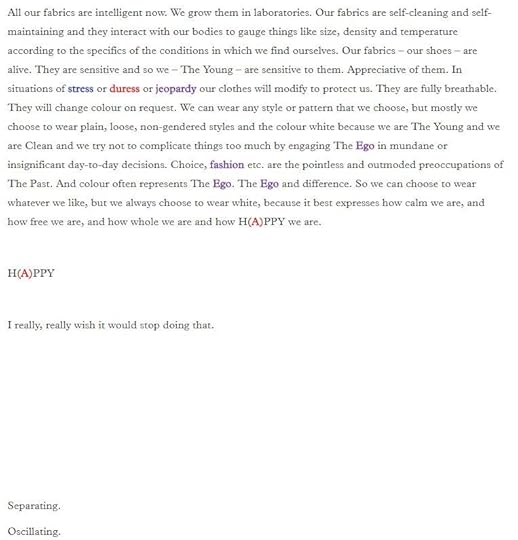
Mira A is a guitarist, and her dissonance results when she comes across the early 20th Century Paraguayan guitarist Agustín_Barrios [whose music Barker recommends listening to when reading the novel] and also a picture of the guitarist with a young-girl in the corner. She notices her graph 'pinking and purpling' – the colours are re-produced in the text - as she starts to get emotionally involved in his story (an Excess of Emotion being a thing to be avoided at all costs by The Young) and his story starts to intrude, literally, on her own thoughts.

Even the word happy literally starts to separate and oscillate (like Mira A and its twin star) - H(A)PPY, hence the novel’s title - as in this visual excerpt (http://i68.tinypic.com/33nbvoh.jpg):

description

A Neuro-Mechanical is sent to fix her, Kite, a character who plays an ambiguous role in the novel as he seems to both try to bring Mira A back to the calm and happy world of The Young, but also to provoke her to further investigation of The Cathedral she has constructed in her own mind (itself based on Barrios’s most famous composition - La Catedral: see e.g. this John Williams performanc https://www.youtube.com/watch?v=wYJ6f...).

In a pivotal passage he warns her of the dangers of constructing a narrative, such as those of The Old:

The narratives of family and romance and adventure, the masculine and the feminine narratives, the narratives of class, of nationalism, of capitalism, of socialism, of faith and myth and mystery, historical narratives, science fiction narratives, experimental narratives, horror narratives, literary narratives, ‘reality’ narratives, crime narratives. The Sensor automatically deconstructs those stories for us, so that we may fully comprehend their full meaning, their immense reach and their invidious power, their ultimately deeply conservative urge to comfort and pander and bolster and reassure.

Narrative is not really your speciality, Mira A. Your story is only half a story. Occasional. Trite. Partial. Meandering. And, strange as this may seem, this is actually a very good thing.


Barker herself has pinpointed the desire to deconstruct narrative, but also the fear of doing so, as key to the novel:
I’m not destroying narrative for everyone, I’m destroying it for myself. Which is disastrous for me, because obviously I understand the world through narrative. When you destroy the thing that explains everything to you, then what is that process? What have I done? So the last year has been trying to understand why I did that, what it means for me. But also what it means in terms of the novel, because I’ve sort of deconstructed the novel to such an extent – what is left of it?
https://www.theguardian.com/books/201...
This destruction is most evident in the novel in the 2nd half. The relatively simple typographical variation in the first half – occasional words in blue, pinks, red and purples, reflecting the way The Graph behaves - becomes something far more spectacular (and much more ambitious on Barker and the typesetter’s behalf).

I have seen others refer to House of Leaves as a precedent for the different fonts, while I was reminded of the beautiful Gould's Book of Fish: A Novel in Twelve Fish, which was produced at much the same time. But Barker goes well beyond either, and in any case, as noted above, and as discussed in Reading the Graphic Surface: The Presence of the Book in Prose Fiction, typographical innovation dates back much much further than this, at least 250 years to The Life and Opinions of Tristram Shandy, Gentleman.

As extracts from Barrios's story, taken from The Paraguay Reader: History, Culture, Politics intrude, as well of that of the indigenous population of Paraguay, with extracts from Chronicle of the Guayaki Indians (slight echoes of the Savage Reservation in New Mexico in Brave New World), Barker also brings in the classic novel I, the Supreme and intriguingly the Guarani language, alongside Spanish still an official language in Paraguay and which (per Wikipedia) 'is one of the most-widely spoken indigenous languages of the Americas and the only one whose speakers include a large proportion of non-indigenous people'.

Mira is introduced by Kite to the Stranger, ostensibly to persuade her to return to the tranquility of The Young, but he also speaks to her direct in Guarani, to suggest an alternative.

We generally like to use it because your Sensors find it difficult to interpret. Many of the words have dual meanings. It is incoherent - contradictory. Your System will not allow for variation.

And at the novel’s end, Mira finds herself out of the system, joining The Stranger outside of The System in The Unknown:

How might I describe this place?
How might I describe this feeling?
This strangeness?
This fearfulness?
This filth?
This confusion?
This mystery?
This hopefulness?

'Do not try.' He smiles, as if reading my thoughts. 'There is no need.'

I smile back at him. I inhale. I exhale.

Of course. But of course. I softly embrace silence.
Profile Image for Paul Bryant.
2,408 reviews12.6k followers
February 24, 2022
If Pol Pot had succeeded in his insane ambition to create the perfect society, and if his grandchildren had invented the internet, then a hundred years or so after that – I hope you’re still with me – you would arrive at the weird half-virtual half-real world of H(a)ppy.

We eschew the old Capitalist Modes of Production and quietly consider them the greatest human evil


Yeah, it is strange all right, but I must say that there’s something of an old-wine-in-a-new-bottle thing going on here.

First, science fiction has got a bazillion stories of utopias that are really dystopian – there’s always some tiny annoying person (our protagonist) who can see that Multivac* has no clothes, that all this glassy eyed repetition of the three basic truths is a strong indication that the whole world has become one gigantic cult and that the sheeple should wake up, you’ve all been here before from 1984 to Logan’s Run to The Matrix.

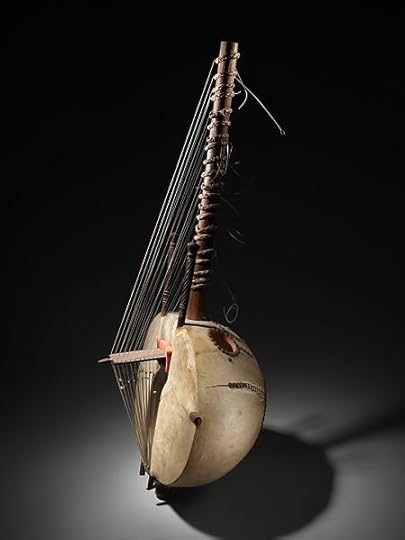
Second, this novel throws in some left-field stuff – obsessing over the obscure Paraguayan guitarist Augustin Barrios (1885-1944) – a real person; fretting (haha) over whether it’s okay to play a guitar with steel strings; copypasting bits and pieces from the history of Paraguay; and many pages ruminating on how to tune a kora, a west African version of the harp.


And yes, this is all a bit disorientating, what with all the other bizarre stuff going on, but we have had very weird before too.

Third, Nicol(a) B(a)rker swandives into the world of WILD ‘N’ CRAZY typesetting, with psyched out pages like


and yes, we have enjoyed stuff like this before too, especially from Mark Danielewski in House of Leaves and The Familiar and going all the way back to 1982 Janine by Alasdair Gray. (James Joyce would have LOVVVVVVED all the typographical possibilities available now, I bet he is looking on from Book Heaven and gnashing his teeth).

So anyway.

This is the first person woozy repetitive meditations of anxiety-ridden Mira, who works on a farm as a cowherd. The cows are “simulacra” but are “utterly lifelike”. Later she gets a dog, or should I say a robodog. But she doesn’t give too many details away about her actual world and how it’s organised. She just frets about not really fitting in and having this creep called Kite breathing down her neck saying stuff like

Your graph is purpling

Or

Something is wrong with Mira. She has retuned her kora.

She really wants to fit into her utopia but something continually niggles, there’s always a loose thread, you know how it is with these protagonists. Tweak tweak, tug tug.

And that's it for the plot.

In the end this was either too deliberately peculiar or not strange enough, hard to tell. Kind of fun, if you don’t mind a lot of repetition.


**old sf joke : the scientists switch on the most powerful computer ever and ask it the first question : Is there a God? After a brief pause the answer comes : There is now…

PLAY LIST

Jali Musa Jawara plays the kora

https://www.youtube.com/watch?v=n9Tcq...

Agustin Barrios plays the nylon string guitar

https://www.youtube.com/watch?v=NvTgR...

(rather lovely – thanks Nicola!)

Bola Sete likewise plays the nylon string guitar, he is from Brazil

https://www.youtube.com/watch?v=cLRdV...

John Fahey plays the steel string guitar

https://www.youtube.com/watch?v=GYB7d...

Neil Young sings in a funny distorted voice about the computer age

https://www.youtube.com/watch?v=WoczM...
Profile Image for Gumble's Yard - Golden Reviewer.
2,189 reviews1,794 followers
July 3, 2025
The 2017 Goldsmith Prize winner - ahead of a strong shortlist and now longlisted for the 2018 Women's Prize.

We [The Young] were given just enough choices to make us feel as though we were free, but not so many that our minds (our still-fragile intellects) became overloaded. Doubt ended. The information stream was purified ……….. We live Now. We live in Light. And when darkness threatens (darkness? Can there ever truly be darkness again?) they simply adjust the chemicals. Sometimes – while we sleep, as we gently dream – they remind us of how it used to be so that we appreciate how good things are now. Now that we are Free From Desire. And we are H(A)PPY to be reminded of this because it reinforces our sense of peacefulness, of calm, of conformity, of equilibrium. They tell us about the lies of The Past. Of how The Young were told that the needed to rebel against the norm in order to feel Whole. That creativity is dependent on struggle and suffering.


H(A)PPY, in a way similar to Brave New World is set in what seems to its inhabitants a utopia but to us potentially a dystopia.

The core inhabitants of this post-apocalypse world, The Young, live in a largely asexualized society which has rejected emotion (particularly an Excess of Emotion). Instead The Young strive to stay In Balance, both individually, as small communities and as a broader society, this Balance being measured on The Graph. Their thoughts and actions are recorded and visible to all on their Information Stream, with dangerous concepts highlighted in different colours and a pinkening of their graph. Any inadvertent deviation is controlled by chemicals or if required by recalibration of physical Oracular Devices. Their access to information (particularly information which may disturb The Balance) is controlled by the Sensor.

In the past, The Old were completely awash with facts and non-facts. They asked a question and it was properly answered. A fountainhead of information was released. But was the water clear. Did it quench, revive or simply deluge?.


Clearly some of this initial set up can be regarded as a satire of Generation-Snowflake, of safe-spaces, of the increasing self-censorship of the internet, and of the increasing trend for public figures to have to issue a public apology if they ever give rise to comments which reflect their unguarded thoughts and which deviate from now socially-established liberal values. In the hands of Dave Eggers his book would have remained there.

The main plot development comes when the narrator Mira A, a musician, starts researching into a guitar player who she knows as 91.51.9.81.81.1.2, but who is the (real life) Paraguayan guitarist Agustin Barrios (whose works Barker recommends the reader to listen to while reading the novel). While viewing a picture she spots a small girl in the margins of the picture. Further information on Barrios, his music, his country and the language of that country (part Spanish, part Guarani) is dotted throughout the book. In the hands of Ali Smith– the book would then alternate between the narrative and reflections on the artist.

However Barker is neither Eggers or Smith and instead of remaining where she is and following through on these early directions, the book very deliberately spirals off (and largely out of control) in two different ways.

Firstly in its story. Shortly after the book starts she notes that the word Happy is coming out as H(A)PPY in her stream and tries to understand why the word is “Disambiguating, parenthesising” – something which seems to be linked to her enquiries into the past and which appears to threaten the entire edifice of the new order. From there we have a hardline faction within The Young, The Banal, a shadow twin Mira B (at times we are unclear which of the two is our narrator), a word or text Cathedral and much else even harder to explain.

Secondly typographically – the book is already unusual in mimicing the colouring of the words monitored by the Information Stream but we start to have blank pages, pages of repeated coloured text, different typefaces (including mirror writing), symbols (including some which we are lead to believe are written directly into the stream and therefore onto the pages we read by Mira’s hands in a dream like state).

Early on Mira A is examined by Kite, a Full Neuter who describes himself as a Mechanic to The System. He says to her

Of course you will be familiar with the narrative form ….. those curious narrative structures employed so often and so successfully in the past. The narratives of family and romance and adventure, the masculine and the feminine narratives, the narratives of class, of nationalism, of capitalism, of socialism, of faith and myth and mystery, historical narratives, science fiction narratives, experimental narratives, horror narratives, literary narratives, ‘reality’ narratives,
crime narratives. The Sensor automatically deconstructs those stories for us, so that we may fully comprehend their full meaning, their immense reach and their invidious power, their ultimately deeply conservative urge to comfort and pander and bolster and reassure.


This passage seems to strike at Barker’s main motivation here (and in most of her writing), a rejection of conventional novels and stories. Instead in this book, she systematically seeks to undermine and deconstruct the very concept of narrative and story.

Kite says just before this to Mira A

I have inspected [your] narrative …. Its flow is, well its plodding – pedestrian – fluctuating - halting – occasional. It’s intermittent, at best. Narratives are not your speciality …… The real danger with your narrative … is that it is lazy. …. You are idly playing with random details. You are forcing things together. You are making strange connections. And you are struggling to make a kind of sense out of them


Barker clearly herself does not even seek to specialise in narrative. Her work though is far from lazy or idle-play, and the opposite of plodding or pedestrian. Instead it sparkles with ideas and invention. However, at times she (or at least I as reader) did struggle to make sense out of what seemed random details and strange connections. Ultimately once something is undermined and deconstructed what is left lacks real form. Nevertheless this was a stimulating read and one which seems entirely designed to be shortlisted for the Goldsmith prize.
Profile Image for Jennifer (Insert Lit Pun).
314 reviews2,220 followers
Read
May 22, 2018
No more Women's Prize books! I AM DONE. HOLY SHIT AM I DONE.
Anyway, this is a strange intellectual romp set in a post-post apocalyptic world (whatever that means). I had a lot of fun with it, but there's a key structural/philosophical issue that leaves the whole experience feeling more gimmicky than sincere. Video review coming soon.
Profile Image for Neil.
1,007 reviews757 followers
September 21, 2017
"…the Old were completely awash with facts and non-facts. They asked a question and it was promptly answered. A fountainhead of information was released. But was the water clean? Did it quench, revive or simply deluge? Did it not often threaten to saturate and drown?"

So says a character in H(A)PPY, looking back from a future time to, we are undoubtedly meant to assume, our information rich age. The quote above is a thinly disguised criticism of the Google-age. The world our protagonist, Mira A, lives in has managed to go beyond this to create a utopian world where it seems the aim is to level everything out, avoid all extremes. Perfected citizens in this utopian world (known as “The Young”) live with The Information Stream which makes everyone’s thoughts, dreams and actions visible and where every thought and action is measured against The Graph: the aim is to not disturb The Graph. Words that disturb the graph appear on The Information Stream in pink or purple so you can see if a person is straying from The Graph by the colour of their Stream.

Clearly, from our current perspective, this control, this avoidance of emotion is far from utopian and we would probably describe such a world rather as dystopian.

It will come as no surprise to learn that this is story of someone who begins to worry about the utopian world she lives in, begins to rebel against it, discovers rumours of a rebel band that lives outside the boundaries.

The basic story in H(A)PPY is not original. If I was judging the book purely on story, I would probably give it a fairly low rating.

However, the story in this book is really just a vehicle for Barker to use. The thing you notice most about the book as you read it is the very creative use of typography. Early on, words are coloured (see above for colours in The Information Stream). Then you come across a page set out with white space such the words leave gaps that form the shape of a guitar. Later on, there are all kinds of weird and wonderful page layouts. Do not attempt to read this book on a black and white Kindle (fortunately, I knew this and bought a paper copy).

The guitar is a motif that continues through the book. It is worth noting that Barker puts a note at the start of the book suggesting that readers listen to Augustin Barrios playing guitar as they read the book. This is because Barrios and his guitar feature heavily and several pieces of his are discussed during the story. I did as Barker suggests and played the music in the background as I read. Obviously, I can’t compare it with the experience of not playing the music because I didn’t do that. But I can say that music did, I think, add something. The recordings are poor quality because they are very old, but somehow that emphasises the fact that the book is set sometime in the future: we as readers end up sat in the middle between the recordings and the “brave new world” in which Mira A lives. I like the idea of an author providing a sound track for their book! And, as you discover things about Barrios, the music playing in the background starts to take on more significance.

All this means that I am slightly conflicted when thinking how to rate this book. The story does not have anything particularly interesting to say: anyone who has read Brave New World, 1984 or any of a large number of other dystopian novels will recognise the story and know roughly where it is heading (although the end does get kind of interesting!). But the layout and the ideas about narrative mean that it is a book with a lot to say for itself. I’m settling on 3 stars which is a average of 2 for story and 4 for creativity. I would not be surprised to see this on The Goldsmiths list when that is announced next week - it seems to tick all the boxes for that award.
Profile Image for Hugh.
1,293 reviews49 followers
December 21, 2020
Winner of the Goldsmiths Prize 2017
I finished this a few days ago and I now have a reviewing backlog so I'll try to keep this short.

This book has been on my to-read list for ages - I didn't read it when it came out in 2017 because the hardback was expensive, and no cheaper printed edition was ever produced (understandably because much of the text is coloured, and this, along with other graphic trickery, must have made the printing costs too high for a cheap paperback edition prohibitive). Fortunately, second hand copies are now available fairly cheaply.

The book is an ideal candidate for the Goldsmiths prize - there is plenty of innovation, not just in the way it is printed (I probably didn't follow all of the nuances of the colours, but the gist is fairly easy to pick up from the context). It is set in an imaginary future society in which "the Young" live their lives regulated by a system which monitors their activities and interactions and measures their net contribution to the balance of the community. The narrator Mira A is a musician, which allows her more creative liberties, but her consciousness is unbalanced by the music of the (real) Paraguayan musician Agustín Barrios and the book follows the increasingly disruptive effects this interest triggers.

Overall it is an interesting experiment, and there were parts I liked, but I am not sure it is an altogether successful one.
Profile Image for But_i_thought_.
205 reviews1,796 followers
October 12, 2023
How can I possibly capture this trippy, eccentric adventure of a novel? 🤔

In this Women's Prize longlisted book, Nicola Barker essentially describes a post-post-apocalyptic world where everyone is "happy" and people live in "perfect balance", free of poverty, strife and pain. Citizens exercise a committed form of non-attachment (to ego, people and things), and avoid an EOE (excess of emotion) at all costs. This progress is charged via an openly accessible "graph" on each person that indicates how "in balance" they are.

The narrator, a young woman called Mira A, works as a musician and lives in perfect contentment until she starts experiencing a "glitch" of sorts, prompted by research into a 20th century Paraguayan virtuoso guitarist. Despite her best efforts to return to equilibrium, this "kink" threatens to spread out like a bruise, infecting others in the system, unbalancing their graphs and effectively declaring "war" on the establishment.

While there are nods to Huxley's Brave New World and Zamyatin's We here, this is not a typical dystopian novel with extensive world-building. Instead, it's a much more introspective, cerebral novel, exploring the psychology of thought control, social conditioning, surveillance, and ultimately the power of ideology and our search for truth ('What is real? What is truth?').

As Mira A wanders further down the "rabbit hole", the narrative starts to unravel, becoming more abstract, restless, disjointed, hallucinatory – a state increasingly mirrored by the book's typography and design. There are also historical clippings of Paraguayan history and Guarani culture inserted into the story, which act as "cookie crumbs" for the reader to follow.

In short, I would describe this as a "heady jungle of words", trippy and thoroughly engrossing, while also enigmatic and elusive!

Mood: Cerebral, restless, psychedelic
Rating: Impossible to rate

Also on Instagram:
https://www.instagram.com/p/BhyYVOhFd...
Profile Image for MJ Nicholls.
2,274 reviews4,848 followers
November 6, 2017
Having milked the frenetic oddball comedy until the teats were scabbed and bleeding (The Yips & In the Approaches), Barker is back at her inventive best in this striking dystopian novel that introduces a tone of unease and mild hysteria to her wide repertoire. Mira A, a diluted Barker heroine (frequent exclamation marks still in evidence), is finding her increasing thought crimes against The System—where no thought or negative emotion is tolerated—to cause her to lose her brackets and colours. Her slow tumbling from The System (and her own narrative) is entwined somehow with Paraguayan guitar maestro Agustín Barrios, in a warp of illogic native to Barkerland, and as Mira A loses her handle on h(a)ppiness, the novel unleashes a series of beautiful typographical images of tuning forks superimposed over kaleidoscopic text, and cryptic swirls of spooky prose. Barker’s abstract approach to the dystopic, replete with metafictive flourishes, a unique use of coloured text, and a subtle parodic edge, places H(A)PPY in a league of its own as far as novels about the fear-filled future are concerned.
Profile Image for Eric Anderson.
716 reviews3,919 followers
July 26, 2017
Nicola Barker’s novels consistently surprise and puzzle me with their wide-ranging subject matter, discursive style and wondrously mind-bending sensibility. She’s a writer frequently in tune with what’s happening now whether it’s memorialising a magician’s 2003 performance art in her novel “Clear” or investigating the contemporary cultural and ethnic landscape of England through the life of a boorish pro-golfer in her novel “The Yips.” So it feels like another creative feat that she sets her new novel “H(A)PPY” not just in a dystopian future, but in a post-post apocalyptic time. Here she charts the journey of a musician named Mira A as some inner rebellion forces her to question the meaning of freedom, creativity, individuality and, yes, happiness itself. The result is a fascinating tale which speaks strongly about our modern times and demonstrates impressively daring narrative ingenuity.

Read my full review of H(A)PPY by Nicola Barker on LonesomeReader
Profile Image for Jonathan Pool.
714 reviews130 followers
September 28, 2017
On page 265 Mira B says:
" I can't really comprehend this, at first. I start to re-read it "
Mira B speaks for me!!!

I haven't read Nicola Barker previously and so I don't know the extent to which H(A)PPY is a departure from her previous style. This is experimental writing. It's difficult to analyse formally and interpretation is likely to be even more subjective than is the case for other difficult books.
The easy bits:
* the delivery of words on the page is unusual. Colour text is used to highlight mood and sensation. Blank pages convey silence; repetitive blocks of words appear, with shapes and different typefaces making the story multi dimensional. Mark Danielewski is an exponent of this format in his House of Leaves and Familiar series. I think there's something rather striking about this layout, but I don't dispute that to some readers it will just seem gimmicky.
* the critique of "primitive" societies is conventionally written, and shocking in its own very different way. In Paraguay the Guarani and Ayoreo peoples have their own traditional customs. These are physical societies as distinct from the futuristic main body of H(A)PPY which is thought and mind based.
* expression of freedom through music (a theme explored among others by Madeleine Thien and William Vollmann). Barker cites the true life guitar player Augustin Barrios as her inspiration for H(A)PPY

The harder bits of H(A)PPY concern the interpretation of the dystopian future.

As ever, Orwell casts his 1984 shadow as we are in a world of thought control; of The Graph, The Sensor, The Stream, EOE (excess of emotion), The Banal.
People are happy as there is an absence of awful things happening to them, and of sadness; but the happiness that arises from the absence or suppression of bad things doesn't compensate for the removal of improvised joy and freedom that comes from some individualism, expressed in our passions (e.g. music).
Barker is singularly unimpressed by the Big Brothers of the Internet age, the corporations
"information is dangerous, it is a weapon."(39)

Putting this all together I struggle to make a satisfactorily coherent meaning of H(A)PPY
My middle ground rating of three stars masks the fact that I enjoyed elements of the book while also remaining largely bemused by large swathes of it.

A strong contender for the forthcoming 2017 Goldsmiths Prize for creative writing.
Profile Image for Jill.
200 reviews88 followers
October 6, 2017
I didn’t see anything special in this book other than some colored font. While parts were clever, I didn’t find much meaning or pleasure in it. It may be that I’m not clever enough, but it is not a book for me.
Profile Image for Blair.
2,038 reviews5,857 followers
January 28, 2019
In a dystopian future – it's impossible to say how distant – optimised citizens known as The Young live their lives in a state of extreme neutrality. The Young must always be In Balance. EOE (Excess of Emotion) is frowned upon; words used to describe strong feelings are flagged (indicated within this narrative by the use of colours). Thoughts and activities are monitored via The Information Stream, and displayed on The Graph for everyone to see. Mira A, named after a fluctuating star, is causing worrying irregularities, creating concern in the community.

I know all the capitalised Things and thought-policing might make this sound like a tedious rehash of common themes, but Nicola Barker's playful approach to language and form elevates it. H(A)PPY is partly a story about music: Mira A plays guitar, and her problems begin when she develops a fixation with a composition by the Paraguayan guitarist Agustín Barrios. The Stream bombards Mira A with information, a montage of historical accounts of Barrios and Paraguay, a flood that cannot be silenced. In the novel's more experimental segments, Barker twists and spins chunks of text as if conducting a musical performance.

As Mira A/Barker tells us, 'word' and 'soul' are synonymous in the Guaraní language. Mira A is subject to a system which demands perfection by obliterating the soul, in part by forbidding the words used to express emotion. In 1870, following the Paraguyan war, allied forces attempted to ban Guaraní, prohibiting it from being spoken or written in schools. The Young have forgotten the lessons of the past (or, as they'd have it, The Past), but these voices demand to be heard. As it turns out, H(A)PPY is not just an effective sci-fi novel but a stealth historical novel, commemorating those stories in danger of being erased from official accounts of history.

TinyLetter | Twitter | Instagram | Tumblr
Profile Image for Tim.
70 reviews33 followers
October 27, 2017
I cannot put what this novel is about into my own words, and others here and in the The Mookse & The Gripes group have done so much more eloquently than I ever could.
Suffice it to say that H(A)PPY is a lot of fun to read, try to decipher, and think about. A real treat if you're in the mood for it.
Profile Image for Stephen.
2,174 reviews463 followers
December 9, 2017
this book was a mixture of brave new world, 1984 and alice in wonderland all mixed together, where there is no pain, war but at what price though. enjoyed it myself as you followed the journey of mira A and her guitar experiences.
Profile Image for Robert.
2,302 reviews258 followers
January 6, 2020
It’s been a couple of days since I read Nicola Barker’s H(A)PPY and I’m still trying to figure out how to get all the ideas out as a coherent whole. It’s not only a multi-layered novel but is open to a variety of interpretations.

On the surface H(A)PPY is a dystopian novel. The main protagonist, Mira A lives in a world where emotions are controlled and all thoughts are assessed by a sensor (which puns on the word censor) and are charted on a graph which can be seen by other people.Incidentally the only time her sensor does not work is when she is facing the light – i.e. the source of knowledge. All information is available via a information stream, which is available but to all but is monitored. The biggest crime, it transpires, in this world is an EOE ( Excess of Emotion). In fact when emotive related words are used then they start to flash in different colors. Mira A’s role in this society is a musician although everyone has to help in this community by performing community tasks.

Mira A’s problems start when she sees a picture of Paraguayan guitarist Augstin Barrios

Which leads to malfunctions to her sensor as she is now questioning her existence and the restrictions that are put upon her in this supposedly free society, one example is Mira A wanting to learn the guitar but instead she has to play the Kora, an instrument with a limited number of playing techniques – a perfect metaphor for this world. Eventually a person called Kite comes in, which sparks off a love interest and a discovery that the fact that Mira A’s sensor is working overtime because she is narrating her own story. This leads to a complete breakdown in the narrative.

Although this story gently echoes George Orwell’s Nineteen Eighty-Four. The use of emotions as rebellion, the love interest, the person from a secret society (in the case of H(A)PPY it is the banal) and therapy to bring the main protagonist to the original state, the difference being that Winston is back at square one, while Mira A breaks free.

But that is not Barker’s aim. Here’s my theory:

H(A)PPY is a post modern message about the breakdown of language. Mira A rebels by creating a narrative and despite the fact that the authorities (or system as it is called) try to put restraints she breaks free and the novel H(A)PPY is that result of Mira A’s escape. Yet despite the physical book in our hands, the words are in a state of chaos. Some pages have different font sizes, some pages are blank, despite the Wittgensteinian belief which states that silence is a language into itself as here Barker uses it as restraint, the text is littered with pictures. This is a deconstruction of text and narrative. I feel that Barker is harking back to Wittgenstein’s language games, which is the simplification of language and this is made clear throughout the novel. Despite the fact that H(A)PPY is a work of fiction we are seeing language games all around us – Text messages , tweets even Facebook updates should be short.

Probably my review is just scratching the proverbial surface as there’s much more to discuss and analyse but I’ll leave it here. I do believe, though that Barker has written an important piece of fiction which questions both the existence of literature and life, a hyperbolic statement? maybe but one can’t help gushing over a book which is fun to read and is open to interpretation.
Profile Image for Nadine in California.
1,186 reviews133 followers
December 7, 2021
This is a social satire of a surveillance state, but this bald description does nothing to explain the mischievously playful way it's imagined and written. Barker is a genius at using white space, typeface and punctuation to create the earnestly befuddled voice of her protagonist, Mira A. When I first discovered Barker's voice in The Cauliflower, I couldn't imagine it working in any other story - it seemed so uniquely suited to the character of the guru Sri Ramakrishna. But boy, is it the perfect vehicle for Mira A. to tell her story, a narrative she didn't know she had and desperately wants to lose. This narrative is destabilizing the perfect Zen-like life she and The Young live, and she wants it to go away at any cost. Her problems start when, to her horror, she finds that she is no longer happy, but h(a)ppy:
H(A)PPY

H(A)PPY

H(A)PPY

But why is this happening?

H(A)PPY

Why? Why does the A persist on disambiguating? On parenthesising?

And why am I talking? What am I doing? Why am I rehearsing this?

Where is the need?

H(A)PPY

H(A)PPY

How curious....
How perplexing.
A malfunction?
A blip?
A kink?
But where....?


If this snippet annoys you, skip Nicola Barker, but if you're among the happy (not h(a)ppy!) few who are tickled by it, you'll love this book and The Cauliflower. I'm not sure where to go next with Nicola Barker - her longer books scare me a bit - can I take this for 500-800 pages? I hope so.....
Profile Image for Jay.
75 reviews13 followers
December 2, 2017
Well, I’ve finished reading H(A)PPY, and although I appreciate and enjoy experimental writing, and feel that she’s been reasonably successful in her approach (it was clear I was reading an author with talent), I’m still a bit dissatisified with this book. It functioned more as an intellectual exercise, something to puzzle out, and it’s smart enough and clever with it’s typeface and color, but sadly that’s about all I was left with when I finished. There’s not much surprisingly insightful or emotionally engaging in this novel. I wanted the stakes to be higher and I wanted to gain some fresh perspectives on reality due to the virtual/electronic culture that exists in this post dystopian world, but I didn’t really come away with any of that. Like many books, it could possibly reveal more with a second reading, but there was nothing compelling enough about this one to make me read it again. I suppose I’d give this book a 3 out of 5 for the skill involved and the creativity displayed. But I ended the book simply saying, “well, okay”. (On a side note, I did learn about the Paraguayan guitarist, Agustin Barrios, and I’m glad of that.)
299 reviews60 followers
September 23, 2022
H(A)PPY, or: All bow for the divine Nicola Barker.

No novel from Barker's wonderfully extravagant mind is ever the same and she H(A)PPily outdoes herself in her last one.
The future belongs to The Young. They are Innocent. They are Clean and Unencumbered. They work (but never struggle) to stay Perfect, thanks to The Graph, The Information Stream and The Sensor.
Mira A, however, is merely H(A)PPY, with the A struggling in parenthesis. Despite the administration of chemicals and the readjustment of her Oracular Devices, the music of 91.51.9.81.81.1.2 (or Agustin Barrios as the Paraguayan guitarist was known in the Manacles of The Past) keeps leading her astray.

Prepare for a book unlike anything you have read before.
Profile Image for Nick.
Author 31 books53.7k followers
May 15, 2018
Zinger. Strange, challenging, increasingly experimental. A short read which stays in your head and does things to it. The overlaps of concept with GNOMON are positively alarming, but the style and form are very different. I loved it.
Profile Image for George.
3,258 reviews
March 4, 2020
A very original, imaginative, creative, unconventional, dystopian novel set in the future where individuals are nurtured, protected, sustained and nourished. Where there is no sickness, death, god and fear.

It’s an odd read as the first forty or so pages are very repetitious as we learn about Mira A’s world and her conformity within it. Mira A plays a type of guitar and starts doing non conformist things like ‘narrating’. Deviating from the norm risks instant public shame. Chemicals are used to bring Mira A back in balance.

Within the story is a story about Barrios, a guitarist, and Paraguay, a country dominated by the Spanish, where the native Indian’s language is silenced. Music is a means of self expression.

It’s an easy to read, short novel, but it’s not so easy to comprehend. There is little plot and character development. This book is a very new reading experience for me.

This book is listed in Boxall’s 2018 edition of ‘1001 Books You Must Read before You Die’.


Profile Image for MisterHobgoblin.
349 reviews50 followers
September 22, 2017
Nicola Barker does sci-fi. Barker has made her name with quirky stories set in the less glamorous suburbs of southern England, mixing zany people with everyday situations. So when we meet Mira A in a future utopia it is a real departure.

And Utopia it is. The world is run by and for The Young. People are hooked up to Sensors that turn pink or purple when a person starts to display an Excess Of Emotion, and it will be recorded on The Graph for others to read. This will encourage The Young to return their thoughts to neutral matters as soon as possible, perhaps using chemical assistance.

But all is not well. Mira A’s Graph often turns pink or the purple. She discovers forbidden guitar music by Agustin Barrios that veers dangerously in the direction of free expression. So dangerous is music that musicians can only be referred to in code (numbers that, when read backwards, give each letter’s position in the alphabet). Her alter ego, Mira B seems to be determined to knock her off course.

Through subversion, Mira A experiences sensory overload and accesses a world where her Graph shows shades of green and blue, words forming patterns and blank space.

This is a masterpiece of fun and games, beautifully set in coloured text and graphics. It is a novelty item, yes, but it is also a highly lyrical story which should make us question how far social media is forcing us in a direction of increased social compliance and false emoting.

I loved H(A)PPY and read it in a day.
Profile Image for Charlott.
294 reviews74 followers
June 4, 2018
Nicola Barker's H(A)PPY surprised me most as being included on the Women's Prize longlist - Not because I heard bad things about it, but because it was lauded for its quite experimental style. I now picked it up finally, rushed through the book in two sittings and absolutely loved it.

H(A)PPY is set in a post-post-apocalyptic future, in which technology regulates life and all kinds of extremes are banned: people are just content, they work (but not too hard!) to keep themselves and their communities in balance. Mira A lives in this world, she is a musician, works on a farm - and as she begins to get sucked into the power of narration, the world around her begins to crumble. This disintegration is reflected in the text, which plays with colours, fonts, graphics. The textual experiment is not just a play on form, but an integral part of what is narrated - it reflects Mira's narration mediated through the technical surveillance system. A breathtaking novel on (self)narration, society, information, and the question what makes us happy.

"I don't want to talk any more. I am done with talking. Yet still, still, something compels me to speak out. To tell."
Profile Image for Charlotte Jones.
1,041 reviews140 followers
September 4, 2018
I have been wanting to read this since it was longlisted for the Women's Prize for Fiction 2018. The concept was intriguing to me but I knew that I wanted to read a physical copy rather than the ebook because of the unusual format so I had to wait until I could get it from the library.

Nicola Barker throws you straight into the world and the unusually formatting with very little introduction. The world-building is something that is drip-fed throughout and is something you can pick up on as you go along. In terms of the plot, having finished the book I'm still not sure what happened - I just know that I enjoyed it! 

This book won't be for everyone, however I thoroughly enjoyed it. Although I wasn't clear what was happening at points, I enjoyed the confusion and I think that the author definitely deserves the acclaim she is receiving for this novel. I will be looking into getting hold of more of her works in the future.
Profile Image for Mary.
271 reviews13 followers
April 13, 2018
Started off with a wonderful self mocking tone towards health and wellness enthusiasts (of which I am one) with strange changes in font type and color that were intriguing. The story transitioned into many technical musical references that I just don't have the background knowledge to appreciate or understand where the author was going with the story.

As a side note Barker recommends listening to Paraguayan guitarist Agustín Barrios whn reading the novel - which I really enjoyed. Fantastic music.
Displaying 1 - 30 of 165 reviews

Can't find what you're looking for?

Get help and learn more about the design.