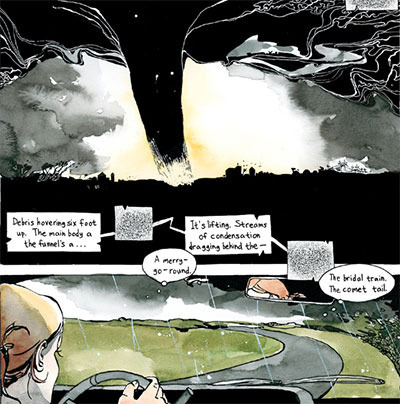
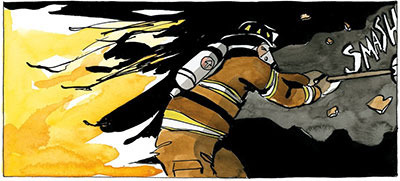
A firefighter in rural Kentucky, Ursa searches for her place in life, struggling to meet her own expectations. When a tornado hits her town, the ensuing chaos brings her world into sharp focus, somehow making everything clearer, and Ursa finds that she just can’t stomach the way her life is going. It is then that she meets Rafi, an illegal immigrant whose life isn’t going the way he’d pictured it either. Their encounter is the catalyst for Ursa and Rafi, who take different roads to the realization that wanting your life to change isn’t enough to make it happen.
Slow Storm stands apart as a graphic novel with its literary heart and charged, atmospheric watercolor and ink artwork. The storm builds around the characters and inside them, and moments of violence and tenderness suddenly crack like lightning. With Slow Storm, Danica Novgorodoff takes her place as a talent to be reckoned with in the literary world.
Danica Novgorodoff is a writer and New York Times best-selling illustrator. Her books include the graphic novels Slow Storm, The Undertaking of Lily Chen, Refresh Refresh, and Long Way Down, written by Jason Reynolds, and the picture books Alexander von Humboldt: Explorer, Naturalist, and Environmental Pioneer; and Not a Cat, written by Winter Miller. Danica loves learning the names of plants, climbing mountains, and drawing animals.
We follow our female firefighter in this story. She is fighting a fire at the beginning. She is bad-ass. A barn burns. An immigrant is living in the barn and now needs a place to stay. I'm not really sure what the book was trying to say. Is it about immigration? Is it about a firefighter? I felt confused by the book most of the way through. The whole time storms are raging all around and tornados are touching down in this Kentucky setting. Is the storm a metaphor for immigration? I have no clue.
The watercolors were beautiful in this book. It uses many mute and gray tones to set the tone as a storm. I was still intrigued by the book and I got into it toward the end. I would have liked to know more about our main character. This is a story that gives little and leaves it open to the reader to figure out what it says.
At least First Second takes risks and comes up with interesting and unusual topics. They are always unique stories told, good or bad.
Danica Novgorodoff has created something that was worth picking up but maybe not worth picking up instead of something else. Slow Storm is a pretty even blend of good and bad elements—and this elemental counterpoint so strongly governs the book that it may not be worth speaking about the short work in any other terms.
The art Novgorodoff employs is a strange sort of bugbear in that it represents both the best and the worst the book has to offer. To Slow Storm's benefit, the painted colours set both mood and stage wonderfully. Novgorodoff's colour sense is, especially in the land- and skyscapes, extraordinary. To her credit, she uses the art to convey certain non-abstracts in abstracted ways—giving the men who ferry immigrants over the border surreptitiously the literal heads of coyotes and having the corrupted immigration police ride around on the backs of pigs. Her penwork is loose and gives the story a fluid sense and demonstrates through immediate, visual terms the lack of rigidity that her story will hold throughout.
Negatively, however, her loose character-work prevents her protagonists and their supporting cast from being able to express the things the reader (and Novgorodoff's story) requires of them. It can often be difficult to get a visual sense of why characters are speaking the words they offer. Further, apart from some special moments (like Ursa car being enveloped in radio static), there seems little sense of visual storytelling. I like that Novgorodoff is escaping traditional cartooning here. I just wish it actually worked better than it did.
The writing is lean and dialogue short. And while silence can convey moments of great depth, here they only serve to alienate the reader. It is fine that Novgorodoff doesn't delve too deeply into the animosity she feels toward her brother (that stuff rarely comes about in any way that a book like this could explain without sounding pat), but there is so much ambient chatter that any movements within characters are lost. Too little is said so that when characters do speak, it is often unclear what they are trying to communicate. It's as if the world of Novgorodoff's Kentucky is verbally delinquent. And maybe that's how the real world of Kentucky really is, but if Novgorodoff wants to bring me in as a tourist, the experience will be better assimilated if certain communicative dissonances are soft-peddled.
Storywise, the book's strong point is Rafael's immigrant experience. Anything that doesn't involve him in Chiapas or him crossing the border into America falls rather flat. This may be because the verbal and visual inadequacies already mentioned hinder the storytelling or it may be simply that Ursa's story is dull. It's never quite apparent what the significance of tornadoes and horses are beyond the facile explanation given near the story's climax (was there a climax?).
Basically, from a rather stilted conversation, we come across the idea that if you are afraid, the storms of life will destroy you—because life, like horses, can sense your fear and your fear terrifies them. Or something like that. Though why that is important to the story is unclear. If Ursa fears anything that took place before the barn fire, it's unclear what it is. There is some sort of rejection in her of the feminine ideal, a rejection perhaps spurred by her own physical proportions, and that clearly causes some anguish (not that we can see it in her character, only in her actions), but beyond that?
At the end of the day, I'm glad I got the chance to look at Slow Storm's art and visual choices, but I'm sad that I spent a whole lunch hour doing it. And isn't that just the saddest thing to say about a book that clearly took its author a fair amount of time to produce?
This was a quiet, subtle graphic novel with wonderfully moody watercolor images. The story centers around a lonely, misfit firefighter and an undocumented worker from Mexico during the night of a terrible storm. Very touching and great art.
Review from Badelynge Although Danica Novgorodoff's Slow Storm is a good 170+ pages in length the sparsity of the written narrative makes this book a short one sitting read. It's sort of a character piece about a Mexican illegal immigrant, Rafi, and Ursa, a somewhat unloved female firefighter who spends most of her working hours fighting a sometimes vindictive sibling rivalry with her brother and fending off the unwanted advances of another of her workmates. Their brief connection occurs at a time of emotional crisis when Ursa is at breaking point and Rafi is caught in the fallout. It sort of works with some quite poignant scenes though the best thing about the book is the quality of the artwork. The character linework can look a bit too simplistic but taken as a whole it does succeed in both telling the story and painting the emotional landscape. The literal landscapes of Kentucky and its sky and weather painted in startling watercolour washes are superb. Combining storms and weather with mental turmoil is a much used device but the art is good enough to break through any possible triteness. Although on the surface very little is happening there is a lot going on below the surface. Relationships, family, religion, homesickness, dreams, resentment, guilt, wonder, love, hope, freedom - the list goes on. Well worth a look.
Full disclosure: a lot of what I liked about this book is its setting. It's set in the Louisville, Kentucky area, my hometown. The main part of the story takes place the day after the Kentucky Derby. There are tornadoes, something I closely associate with this area. I enjoyed seeing references to I-71 and the Ohio valley landscape with car and train bridges that I could see in ten minutes if I left work right now to go to the waterfront. All that makes this book nostalgic to me, and I presume colors my perception of the book.
It's a nice, subtle story, though. It tells of a female fire fighter with some serious emotional issues and a young Mexican illegal immigrant working on a horse farm, victim of lightning strike and raging fire (the horse farm, not the immigrant.) Novgorodoff's watercolors and ink drawings are lovely and moody and intense.
The dialogue, however, feels unreal. The dialect is off (I know because this takes place in my backyard) and it feels like a bad mimic job of Cormac McCarthy's philosophical banter. It's a quick, immersive read, though, and like a good book should, it makes you want to know more and more about the characters. Rafi, especially, the illegal immigrant, holds more story that I wish I could know.
Beautiful watercolors, and loose ink artwork, which is a strategy that works better for setting and mood than character and plot. The story, one of an encounter, in Crestwood, Kentucky, between local Ursa and an immigrant from Chiapas, has its moments, including the title tornado, but the story is sometimes confusing to me. Neither main character has anything good going on in their lives, and the storm is a kind of metaphor for that and a catalyst for needed change. The effect of swirling movement connotes the slow and continuous emotional storm in their lives. If we knew more about them it would be even more haunting, though.
This one was a little confusing at parts. I'm not sure how I feel about it. The story is about a firewoman and a Mexican man she helps out. Ursa gets no respect from her coworkers for being a woman. Even her brother who works at the same station tries to show her up by taking jobs from her that he's not qualified for. You see some sexual harassment going on and that kind of disappointed me to see. Sometimes I feel like I must live in a bubble because I get easily shocked that stuff like this goes on in the workforce, especially in a fire station. I mean, I know it goes on, but I for some reason want to have faith that there's certain places that would really consider that behavior inappropriate and unacceptable. But in this case, the captain and her brother and the rest of the crew act like it's ok for one of the guys to keep pestering Ursa for a date or to slap her butt as they're about to get the equipment ready. We can see Ursa's blood boiling as she and her brother are about to enter a burning barn to rescue a Mexican man that's been living there.
The Mexican man, Rafi, has crossed over illegally into the U.S. and has been helping the owner of the farm take care of his horses. During a lightning storm, the barn catches fire and Rafi enters the barn to save the horses that are inside. Believing Rafi is still in the barn, the fire captain orders Ursa and her brother to do a rescue mission. This is where the story takes a wild turn and I was left a little dumbfounded about what happened. I had to reread it a couple of times because the artwork did not help at all. There's panels where the watercolors are just beautiful but there's panels that are so muddy that it's very hard to tell what's really happening. The faces are really bad at showing emotion and it's hard to tell the firemen apart. This is what I believe happened:
After everyone leaves and Ursa stays behind to keep watch, she finds Rafi in the back of a truck, nearly passed out from smoke inhalation. He is frightened that she will take him to the police and refuses medical care. She promises she will not take him to the police, but guess what's the first thing she does when her captain calls her to tell her she needs to go talk to the police and give a report? Rafi seeing that Ursa tricked him runs away. Ursa eventually finds Rafi again and this time promises she will not trick him again. She takes him home, feeds him and asks him to tell her about his home. Rafi tells her about all that and how much he loves his brother who didn't end up coming to America with him because he didn't want to leave his family behind. Ursa then offers Rafi her bed to sleep on while she sleeps on her couch.
I feel like this took such a sharp turn without more background leading up to it. There was no inner struggle shown to at least make it feel that a hard choice was being made by Ursa. I'm not even sure if this needed to include the story of Rafi to counteract the story of Ursa. The story left me scratching my head.
Ursa is a female firefighter who doesn’t have the respect of her fellow firefighters, including her brother. Rafi is an illegal immigrant who gets blamed for a crime Ursa committed in a fit of rage. With their paths crossing, their lives will be forever changed.
My Thoughts
Even my summary up there sounded gooey and pretentious, which just couldn’t be helped, because this book bleeds pretension. It wants to say something important. It wants to resonate so badly. A book should never feel as if it’s screaming for you to care, because it’s such a repulsive feeling, I fight it with every step. It’s like watching a movie that is clearly gunning for an Oscar, and it makes you cringe with the intentional weight of it.
I didn’t even care for the art style like I’d hoped. It was all very gestural, which is fine, but not to my tastes. There were moments when it was hard for me to tell what was happening, because the drawings weren’t clear. If you’re going to tell a visual story, it’s paramount you get your point across in your drawings, so I have to say that it failed on that level.
The story wasn’t bad, but it definitely didn’t go in the direction I would’ve wanted it to. It sets itself up for intrigue, and there is none. There could’ve been some very explosive drama, and there wasn’t. It just quietly petered out, and I felt robbed. There was a powerful story here, and a much weaker one was the story that got told.
If anything, I think my rating is for the setup. Otherwise, it should be skipped.
This is a beautiful book. I received a free copy of this at the MSU Comics Forum and was instantly impressed with the artwork. The plot features both a tornado and fire and Novgorodoff captures the rawness of both within each panel. I wish the narrative could match the art - I really wanted more depth to the verbal story and felt the verbal did not do justice to the visual. The plot concerns an out of place firefighter and a Mexican groom who is working illegally at a Kentucky horse farm, whose paths cross when lightening causes a fire at the farm. However, I think because this book is so visually stimulating, the thread of the narrative continually got lost for me. I repeatedly found myself devouring the panels and paging through without reading a single word. However, regardless of what I felt were narrative shortcomings, this is truly one of the most beautiful graphic stories I have seen.
I...really didn't like this book. The artwork just doesn't appeal to me at all and almost made me nauseous in a "King of the Hill" way. I felt no connection to the story either. I think I was intended to sympathize with Ursa over her struggle with body image and her interaction with her brother, but I was simply horrified at her methods of overcoming them. As a firefighter's significant other, I was appalled; the bond between fellow firefighters is incredibly strong; they don't shut each other in burning barns. Perhaps others with less of a connection to the fire service will find it an interesting twist, but this book is not for me.
This entire review has been hidden because of spoilers.
Danica Novgordoff's art is really the show stopper in this graphic novel, although I liked the understated humanity she brings out in the story as well. All the coloring of the panels is done through watercolors, which brings a lot of expressiveness and emotion into the work that really suits the subject matter in addition to being very beautiful. Many of her individual panels could easily be paintings that I'd love to put on my wall. There are also a lot of poetic touches in the writing that really fit well with the art. Definitely recommended.
Actually, this wasn't bad. It deserves more than two stars. There are moments I had to go back to and think, 'Oh man, this was beautiful symbolism'. The pacing isn't bad either. And the main character, Ursa, is relate-able.
I just really can't get behind the art. It's not my cup of tea at all, and sometimes it's bad enough (bad: I mean, in a sense that I don't enjoy the artwork at all, not that it's ugly. Like I said, it's not my cup of tea at all) makes it hard for me to focus on the story.
I know I know I keep promising to stop reviewing :01 and RB books, but THIS IS AMAZING. DANICA IS AMAZING. This is her first book and holy moly! It's so stunning in story, literary layers, and art. In sales meetings they kept saying this was "the great american graphic novel" and for once I think those sales people are telling the truth! FIND IT. READ IT NOW. I promise you will thank me for it.
I am so conflicted with this book. I liked it, but at the same time I didn't. I really don't think it deserves less than 3 stars but at the same time I don't know if it deserves 3 stars. The Story was choppy at times and weird. I didn't enjoy the first half all that much but the second half redeemed the book for me. One thing is for sure, the art is absolutely beautiful.
Danica Novgorodoff had already established her comics pedigree before her first full-length work was published. In 2006, she won the Isotope Award for her creative efforts in mini-comics, and the following year she was nominated for an Eisner. Expectations were thus high for her debut graphic novel, Slow Storm, which was released at the beginning of September of this year.
To a small degree, Novgorodoff lived up to these expectations by delivering a book which features some very arresting imagery at times. Her full page illustrations of Kentucky landscapes both set the scene and create a dark mood for the story to be enveloped in. They are brilliantly colored and make heavy use of shadow, as in one such image which features a horse bending down for a drink, both it and its reflection in the water a silhouette to the orange and red of the sunset behind it.
In other scenes, the artwork is less polished, more rough around the edges. These scenes tend to occur when the characters are at their most frazzled, and the art is used to heighten the emotions. Throughout the novel the female lead, a firefighter named Ursa, is constantly berated or subjected to sexist comments by her male colleagues, one of which is her brother. In one scene in particular, when tensions during a fire are at their highest and her brother makes a disparaging remark to her, the art goes haywire as the words echo in her brain and we are made privy to the weight those words carry in her mind.
Such scenes add to the surreal quality of the story. At another point Rafi, an illegal immigrant and the story's male lead, is remembering his journey from his home in Mexico to America, and the flashbacks end up distorted. The people that help him cross the border are portrayed as literal coyotes, walking upright and wearing clothes, while the border guards ride around on pigs. The sketchy nature of the artwork conveys these more surreal elements of the narrative very well.
It is only when the story is at its most ordinary that the art fails it. Occasionally when characters are interacting with one another, as Ursa and her fellow firefighters do in a moment of quiet at the firehouse, the characters' poses are exaggerated to the point of abstraction for no clear reason. In other instances, the facial expressions of the characters become almost grotesque in order to fully convey the range of emotion they might be feeling. Sometimes Novgorodoff takes this technique a bit too far, as can be found in a scene towards the end of the novel in which Ursa and Rafi are having a conversation which is overwrought with emotion.
Aside from the inconsistency of the artwork, the story itself feels incomplete. There is not much of a plot to the book in the first place, with Novgorodoff focusing more on mood and theme, bending the plot in contrivance to bring her two main characters together to talk. But when the novel finally reaches its conclusion, there is no clear resolution to what has happened; it just ends. The characters too are rather thinly sketched. We learn a little about Rafi's background in flashbacks, but Ursa is a cipher. We only see what she deals with in the present and only get a slight insight into her head in occasional bursts. Both characters have their hardships they must face, Rafi that his family is so far away and Ursa the torments of her colleagues, but these details are all we know of them.
Overall, Slow Storm is an interesting debut that is full of mood and quite beautiful when it is at its most abstract. But the novel never fully gives over to its surreal qualities, hanging them on flat characters and a threadbare plot. Sadly the novel falls short of expectations as there is not enough meat to it to really satisfy its audience.
Absolutely gorgeous art. I wanted more emotional development in the principal characters. I wanted more overall story development. Maybe that’s a good thing? The art, though: gorgeous.
There's a particular kind of graphic novel popping up more and more these days that's kind of like the on-the-page version of mumblecore (or, for those of you old enough to remember it, eighties fiction). It's intensively interested in character study, much to the detriment of plot. Not much goes on, if anything at all, and the characters do the particular-setting equivalent of the wannabe-socialites sitting around a coffee table full of coke in Annie Hall. I've never been quite sure how I feel about books like this. Slow Storm didn't really help me decide one way or the other, despite a real affinity for the setting. Louisville, Kentucky, is a horse lover's paradise. Thanks mostly to tradition, like most horsey communities it's also a hotbed of illegal immigrants who work as grooms, exercise riders, hot-walkers, etc. Rafi is one of those illegal immigrants, working at a horse barn that catches on fire one night during a storm. Ursa is a firefighter, one of those who responds to the call. She's having a lot of problems with her brother, also a firefighter, and when the opportunity presents itself, Ursa locks her brother in the burning barn. He is rescued, however, and the act is blamed on Rafi—who ends up hiding from the cops with Ursa.
There's so much potential here, in any way Novgorodoff might have wanted to take this plot. Crime thriller? Romance? Disaster flick? Courtroom drama? Horror? None were outside the realm of possibility, and in the end none were realized. Novgorodoff focuses intently on a couple of days in the lives of these characters, and that is not a bad thing in itself (look at what happens during the twenty-four hours depicted in the movie Closetland, for example). The problem is that once Novgorodoff gets us there, and she is a good enough artist that we are willing to follow, she doesn't do anything with it. There's no payoff. What we're left with is a couple of intriguing characters and a lot of really, really good pictures. If that's enough for you, this will be right up your alley. And while I respect both aspects of this book, I did find myself wanting more from it. There's a point where you've taken ambiguity too far, and this book embodies it. ** ½
There are two primary characters in this graphic novel, the first is a female firefighter/first responder (Ursa Crain) and the second is an undocumented young man (Rafi) from Mexico. The setting is Oldham County, Kentucky and during a very violent storm a flash of lightning strikes a barn containing horses and sets it on fire. Rafi lives in the barn and cares for the horses, so he runs in and releases them from their stalls. During this act of heroism Rafi hits his head and knocked unconscious. Ursa is one of the firefighters that enters the burning structure in an attempt to save him. Through a set of circumstances that he was not a part of, Rafi is blamed for the near death of a firefighter. This leads to a quick and unusual friendship between Ursa and Rafi, largely born out of a sense of helplessness that both of them have. Being a female in a largely male profession, Ursa experiences significant sexism, leading her to an extreme response. Rafi has no other place to go, so for the moment they each have very few options as to what to do. The story is an engaging one, many undocumented workers have a history of severe struggle and deprivation when making the journey to the United Sates and Rafi is one of them. All he wants is to be left alone and to be able to earn a decent living. Ursa is also struggling to be successful in a world where she does not fit in very well. If they are lucky, two people having such things in common will find each other and in this case they did.
In this graphic novel, Danica Novgorodoff crafts a darkly haunting story illustrated with lush watercolor and ink illustrations. As a tornado spirals at the edges of their Kentucky town, the lives of a troubled firefighter and an illegal Mexican immigrant intersect. Well-paced panels vary in size and oscillate from foreboding, stormy grays to flaring oranges to serene, eerie blues. While the story seems simple at first, subtle scenes, background characters and frequent silent panels develop enough subtext to warrant a rich second reading. Supernatural elements weave into the tale, which contrast with the hard work and rough natures and jobs of the firefighters and townsfolk. Novgorodoff handles the various accents in intriguing but natural ways, and her juxtaposition of the difference between characters’ speech and suggested or illustrated thoughts create moments that range from contemplative to heartbreaking. Slow Storm is a gorgeously drawn graphic novel whose narrative incorporates cultural, familial and social themes without departing from the characters at its focus.
Wow -- So many mixed feelings about this book. The artwork, especially the landscapes with the tornado wall clouds, is impressive. I didn't like her portraits of the characters as much. They seemed as sketchy as their back stories. WHY do Ursa and Grim seem to hate each other? Why do they choose to work together? Why did Ursa go to college and not Grim? What's up with their mother? WHy does their boss allow the kind of sexual harrassment that Ursa suffers? Rafi's past is better spelled out for us: a complete contrast to Ursa's relationship with her brother. He, as the illegal immigrant, actually has a better support system than she does.
The ending concerned me. What's going to happen? Does Grim really think Rafi trapped him in the barn? Will Ursa admit what she did? Has anyone learned anything that will make him or her a stronger, more confident, character?
The NWP graphic novel group will discuss this book later. I'm eager to see what others feel. Ultimately, I was dissatisfied, but glad I read it.
I haven't read a ton of graphic novels. Mainly I have read Neil Gaiman's stuff and that's about it. When I saw this on Amazon Vine it looked interesting and I decided to give it a try.
The artistic style of the graphics wasn't my favorite. It's fairly stylized and looks like it was done in watercolor. This style may appeal to a number of people but I thought it was a little too washed out looking.
The story itself involves a woman who is a firefighter and her encounters with a Mexican immigrant during a colossal series of tornadoes. This is also not usually the type of story that I would enjoy, but despite myself I was very drawn to it.
The story is very engaging and you can't help sympathizing with the characters. I was amazed at the depth of character the characters had, given that this was a graphic novel. Some of the scenes with the Mexican and his god of wanderers were very reminiscent of some of Neil Gaimon's graphic novel stories.
All in all a great book and I am looking forward to more work from this artist/author.
This graphic novel probably would have been two stars except for the fact that it takes place in Oldham County, Kentucky, my hometown. So it was nice to see the town of Crestwood and the North Oldham Fire Department featured. The plot seemed very simple and if you read the description of the book, you get the entire story. Rafi, one of the main characters, is an undocumented worker from Mexico, His journey across the border is guided by "coyotes," whom the author depicts as men with coyote heads. The American border guards ride pigs and accept bribes to allow their passage into the US. The other main character is Ursa, a female firefighter who is sexually harassed on the job by her brother and other co-workers, and protects Rafi. Even though it was a tragic story, I felt little connection with the characters. I always felt that a graphic novel should be able to tell the story with the illustrations and evoke emotions with the same. I did not think that these illustrations did that. Even though it was a tragic story, I felt little connection or empathy with the characters.
A sprawling southern dreamland of tornados, lightening, horses, saints, and loneliness. Gorgeous watercolour drawings perfectly illustrate the fluid images of landscape, weather, and emotions. Ursa, the protagonist, doesn't quite fit into her community even though she dresses and acts out a common life. Proportioned more like a man than a young woman, she lives her life as a bachelor: living alone, eating canned food, keeping dogs in her yard, and developing a career as a firefighter. The story that follows explores the sensitivity, compassion, and vengance of the human spirit.
I read this one twice within a month and found that the second time through was even more rewarding than the first. This is epitome of an effective graphic novel. I could complain that it may have been a bit short, but the extisting story was perfectly paced, and to extend the narrative would dilute the content.
Novgorodoff is really on her game with this one. Slow Storm is a story about two characters (Ursa and Rafi) and a chance meeting. The plot-structure of this story is irregular, instead relating the characters, their pasts, and their beliefs in a way that suggests the importance of their meeting.
The artwork of this novel is particularly notable, and Novgorodoff's style really contributes to a growing sense of anxiety that is represented by the storm itself.
I think that this would be an important (and appropriate) text for high school students to read. It would be a good introduction to issues about immigration. But, also, the way that meaning is attributed to the book's characters (by the story's details as well as its artwork) is really impressive, and English students might also benefit from studying this process.
Not for everyone, due to a few of its political positions, but this is a powerful story about a young man from Mexico who has crossed the border illegally to seek his fortune, and has found a job he loves, but no pot of gold at the end of the rainbow. When a storm starts a fire at the horse farm where he works, he finds himself on the run from the authorities and from himself, and in the hands of a local firefighter. It bothered me a little that the border patrol guys were portrayed in an insulting and cartoonish fashion, but it actually bothered me more, storywise, that the horse farm owner blamed the fire on his stableboy. That part just didn't work for me, and didn't seem to make sense within the story.
The water colors are remarkable. I'd really like to see more books colored this way. The colors shift slowly or suddenly in a way that you certainly don't see in digitally colored work. The colors also accentuate the tooth of the paper in a way I don't remember seeing in other books. The story could be told just by the tonal shifts in color.
I wish the writing behind the story and characters had the same depth and nuance as the colors. While I found myself caught up in the emotions of any one moment, I struggled to understand why the character was there or reacting the way they did. The art keeps you engaged with the characters, but the writing struggles to fill in the details outside the panel.
The art in this was great, as the cover would suggest - a tough, burly lonely fire-fighting girl and a homesick unlucky illegal immigrant and their notions of home and disaster and comfort. Not a ton happened, not even a big tornado or anything (it's kind of what I was hoping for!) but it was good especially - "Even when in Kentucky, I miss Kentucky." and the immigrants being guided and protected by Saint Christopher! Oh he was a good-looking, hard-partying giant of a man. There was a brief, incorrect assertion by the girl that spirituality is against the physical world (manichean heresy i think!) but um she was a firefighter in Kentucky I can forgive her. And there was a great hand-holding. Nice reflection on home and feeling like an outsider yay.
What I found most striking about this book was the art work. The story was fine. But the art was sensational -- beautiful watercolors created the feel of the country in both Kentucky and Mexico.
The story idea was a good one -- two strangers, each with difficulties in their lives, thrown together by circumstance. One is a young female firefighter who has some kind of unexplained issues with her brother, also a firefighter. The other is an illegal immigrant from Mexico, who loses all his belongings in a barn fire. There were just some times when I couldn't quite follow what was happening, which detracted a little for me.