A student at the University of Pennsylvania bore Donald Barthelme. Two years later, in 1933, the family moved to Texas, where father of Barthelme served as a professor of architecture at the University of Houston, where Barthelme later majored in journalism.
In 1951, this still student composed his first articles for the Houston Post. The Army drafted Barthelme, who arrived in Korea on 27 July 1953, the very day, when parties signed the ceasefire, ending the war. He served briefly as the editor of a newspaper of Army before returning to the United States and his job at the Houston Post. Once back, he continued his studies of philosophy at the University of Houston. He continued to take classes until 1957 but never received a degree. He spent much of his free time in “black” jazz clubs of Houston and listened to musical innovators, such as Lionel Hampton and Peck Kelly; this experience influenced him later.
Barthelme, a rebellious son, struggled in his relationship with his demanding father. In later years, they tremendously argued about the kinds of literature that interested Barthelme. His avant-garde father in art and aesthetics in many ways approved not the postmodern and deconstruction schools. The Dead Father and The King , the novels, delineate attitude of Barthelme toward his father as King Arthur and Lancelot, the characters, picture him. From the Roman Catholicism of his especially devout mother, Barthelme independently moved away, but this separation as the distance with his father troubled Barthelme. He ably agreed to strictures of his seemingly much closer mother.
Barthelme went to teach for brief periods at Boston University and at University at Buffalo, and he at the college of the City of New York served as distinguished visiting professor from 1974-1975. He married four times. Helen Barthelme, his second wife, later entitled a biography Donald Barthelme: The Genesis of a Cool Sound, published in 2001. With Birgit Barthelme, his third wife and a Dane, he fathered Anne Barthelme, his first child, a daughter. He married Marion Barthelme near the end and fathered Kate Barthelme, his second daughter. Marion and Donald wed until his death from throat cancer. People respect fiction of Frederick Barthelme and Steven Barthelme, brothers of Donald Barthelme and also teachers at The University of Southern Mississippi.
Let me begin with an admission: I was initially reluctant to write a review of this four-page piece of Donald Barthelme experimental fiction since I didn’t find the author’s usual reference to literature, philosophy or the arts, and, even more to the point, I had difficulty getting my mind around the story - in a word, I was coming up with a blank when I asked myself: Why did Barthelme write this? Is there a deeper, underlying meaning I should be grasping?
I mean, take a look at the three bodyguards in the above photo. Do these gentleman strike you as members of the literary scene or art crowd? I was on the cusp of moving on to the next piece in my Penguin collection of forty Barthelme stories, but then, fanfare with horns – Salman Rushdie to the rescue.
After listening to Salman read and discuss the story (link below), I have blended my own reflections with his and have come up with the following themes and highlights any reader can have fun considering:
Point of View: With a series of sharply focused questions, Donald Barthelme lets readers inhabit the world of a bodyguard, a world forever shrouded in uncertainty and suspicion, a world where, in order to perform his job, he is always interrogating all aspects of what he encounters moment to moment. Does anybody in the crowd look like they have a weapon? Is there a sniper on a rooftop or at an open window in one of the buildings?
Questions: Nearly every sentence in the story is posed as a question. Who is asking all of these questions? Is it the bodyguard himself or Donald Barthelme as he writes the story? Or, are we as readers being asked these questions? It appears the identity of the questioner can slide from bodyguard to author to reader, back and forth, and, on occasion, can embrace all three. As Salman observes, many of the questions are rhetorical and answer themselves.
Action Drives Plot: Does this story contain an event? Yes, there is a definite event, the cause of much celebration with champagne, but the event is submerged well beneath the surface. I agree with Salman Rushdie – Donald Barthelme is one of the few authors where indirection and obscurity can be employed as a definite virtue. And there was a time in his life when Salman had his own direct experience with bodyguards and members of the secret police so he speaks with authority when he observes that a bodyguard is doing their job when nothing happens, when there is no drama. No drama means a job well done - exactly the opposite of a fiction writer!
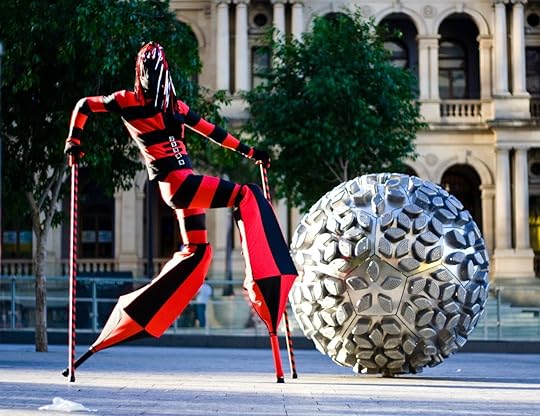
Postmodern Absurdity: In the next to last paragraph we read: “Stilt-walkers weaving ten feet above the crowd in great papier-mâché bird heads, black and red costumes, whipping thirty feet of colored cloth above the heads of the crowd, miming the rape of a young female personage symbolizing his country?” Ironically, such zany street theater can be extremely effective to incite a crowd. Now the bodyguard can quickly be faced with an explosion of violence. Thus, does this short tale become an instance of postmodern absurdity in form rather than in content?
A Reader's Comfort Zone: Is such fiction meant to test a reader’s conventional sense of boundaries? Stated another way, when reading such an oddly constructed story, are we being asked to expand our literary horizons? We come to know in small measure the personal life of an individual bodyguard as he goes about doing his job but is this really adequate? Perhaps Donald Barthelme is asking us to be as cool and as removed as an actual bodyguard!
Satisfying Ending: Empty champagne bottles overflow garbage cans throughout the entire country. Bad news for the bodyguard since the prime question is: “Which bodyguard is at fault?” This might be a satisfying ending to the story for a reader but it most certainly is not a satisfying end for the bodyguard, even if he or any of his fellow bodyguards are not at fault in the least.
Salman Rushdie reads Donald Barthelme's Concerning the Bodyguard, and discusses the story with New Yorker fiction editor, Deborah Treisman. Link: http://www.newyorker.com/podcast/fict...
It is an interesting take on a narrative through questions that aid with the story's progression. Barthelme plays with the concept of authority through the portrayal of the principal or the boss. Why does he need so many bodyguards? There seems to be an obvious dilemma between the rich and the poor.
Themes to explore: The loss of identity, the conflict between the rich and the poor.
At the end, we discover that the man in power got overthrown. It's said through the champagne bottles that were first chilled and then they were all thrown out. And since champagne was used, it indicates that people were happy.
This entire review has been hidden because of spoilers.
Is it possible to tell a story with 4 pages of questions? Lately I’ve been interested with the way a writer tell a story and this is quite an amazing way. The work of the bodyguard is full of questions (Is the situation under control? Does this man have a weapon? Is the car secure? Etc..) and in the story the questions of the bodyguard mix up with the question of the writer and the reader to tell a story, to reveal an action, a meaningful one.
Missing the most vital question: Do the bodyguard's feet hurt?
In seriousness, I know I am missing every deeper meaning in this short little story, but it still has captivated my lizard brain with its questions and rhythm.