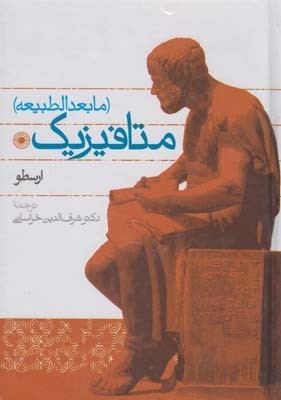
Metaphysics (Greek: τὰ μετὰ τὰ φυσικά) is one of the principal works of Aristotle & the first major work of the branch of philosophy with the same name. The principal subject is "being qua being", or being understood as being. It examines what can be asserted about anything that exists just because of its existence & not because of any special qualities it has. Also covered are different kinds of causation, form & matter, the existence of mathematical objects, & a prime-mover God.
Aristotle (Greek: Αριστοτέλης; 384–322 BC) was an Ancient Greek philosopher and polymath. His writings cover a broad range of subjects spanning the natural sciences, philosophy, linguistics, economics, politics, psychology, and the arts. As the founder of the Peripatetic school of philosophy in the Lyceum in Athens, he began the wider Aristotelian tradition that followed, which set the groundwork for the development of modern science. Little is known about Aristotle's life. He was born in the city of Stagira in northern Greece during the Classical period. His father, Nicomachus, died when Aristotle was a child, and he was brought up by a guardian. At 17 or 18, he joined Plato's Academy in Athens and remained there until the age of 37 (c. 347 BC). Shortly after Plato died, Aristotle left Athens and, at the request of Philip II of Macedon, tutored his son Alexander the Great beginning in 343 BC. He established a library in the Lyceum, which helped him to produce many of his hundreds of books on papyrus scrolls. Though Aristotle wrote many treatises and dialogues for publication, only around a third of his original output has survived, none of it intended for publication. Aristotle provided a complex synthesis of the various philosophies existing prior to him. His teachings and methods of inquiry have had a significant impact across the world, and remain a subject of contemporary philosophical discussion. Aristotle's views profoundly shaped medieval scholarship. The influence of his physical science extended from late antiquity and the Early Middle Ages into the Renaissance, and was not replaced systematically until the Enlightenment and theories such as classical mechanics were developed. He influenced Judeo-Islamic philosophies during the Middle Ages, as well as Christian theology, especially the Neoplatonism of the Early Church and the scholastic tradition of the Catholic Church. Aristotle was revered among medieval Muslim scholars as "The First Teacher", and among medieval Christians like Thomas Aquinas as simply "The Philosopher", while the poet Dante Alighieri called him "the master of those who know". His works contain the earliest known formal study of logic, and were studied by medieval scholars such as Pierre Abélard and Jean Buridan. Aristotle's influence on logic continued well into the 19th century. In addition, his ethics, although always influential, gained renewed interest with the modern advent of virtue ethics.
On the one hand, he's so tedious and uninspiring. This is only partially his fault: everything we have of his are lecture notes, and so it is no surprise that they are stylistically wanting. Many scholars think that Metaphysics contains many sections written at different times and for different purposes, which Aristotle never intended to be read together. There is even one section which may not have been written by him at all. This makes his work (particularly this book) often difficult and confusing.
That being said, his ideas are not poetic either. His Ethics contains ingredients to live a well-balanced life, but a life curiously devoid of great passion or excitement. His Rhetoric reads like a handbook for lawyers. His interest in biology pervades his thinking: he loves to catalog, to systematize masses of details. He was the original stamp collector.
On top of this, Aristotle's ideas often take the form of common sense pedantically expressed (to paraphrase Bertrand Russell). His temper was the opposite of Plato's, who seemed to deliberately try to draw counter-intuitive conclusions. One often gets the feeling that Aristotle found Plato a bit excitable, and longed to make philosophy into a more respectable, hard-headed enterprise. When engaging with his mentor's ideas, Aristotle is either (1) opposing them, or (2) trying to reconcile them with common sense. The result of the latter is a strange admixture of the mundane and the mystic.
But his positive qualities are equally compelling. Compare Aristotle's careful claims, his scrupulous definitions, and systematic procedure to Plato's more artistic style. Plato was the master of the straw man. Compelling as the dialogue form is, it allowed Plato to caricature his opponents' positions and get away with some pretty sloppy thinking. Aristotle will have none of this. Plato sought to banish all poets from his Republic, and maybe he himself would have been barred entry. Aristotle would have waltzed right in.
It is hard to evaluate the argument of this book, if only because it is so disorganized and wordy. Aristotle does do a good job in pointing out the logical absurdities of Plato's theory of Ideas. However, his own theory of Form and Substance is curiously similar, and is liable to some of the same criticisms. To me, this shows just how much Aristotle was under the influence of his old teacher—even though he tried to wrest himself free, he gets sucked back in.
[An Afterthought: Plato and Aristotle are perfect antidotes for different places and times. When emotion, superstition, fanaticism, and sophism reign, Aristotle is where it's at. But, for me, our world is sometimes too systematic, too commonsensical, and too averse to abstract argument. Plato is like a glass of cool water.]
Aristotle's Physics that I have recently read discussed things that change within space and time. Whereas, Aristotle's Metaphysics discusses things that do not change relative to space and time.
Metaphysics is Aristotle's principles and causes of being. Aristotle believed that everything around us consists of a substance, or the essence of a thing, where this substance is a mixture of actual form and potential matter. In these discussions of being, Aristotle, states that matter is only found in that what is being created, changing, and is perishable such as the things of the observable world and the celestial bodies and eternal sky. Whereas, that, what has no matter and just actual form is the embodiment of perfection which is stationary, indivisible and unobservable; the immovable mover of all (God).
Aristotle does not use the term metaphysics in book. There is this notion that the book was given the title Metaphysics by the ancient compilers of Aristotle's writings simply because these works came after his Physics book; where 'meta' means 'after' in Greek.
Aristotle presents his philosophical ideas and conclusions superior to those of the Pythagoreans, Empedocles, Anaxagoras, Parmenides, and even his teacher Plato. He does give them partial recognition, but more often is critical (at times unjustifiably) of their philosophy. For instance, Aristotle is not content with Plato's mathematization of philosophy. So instead of using numbers and shapes to express a thing for what it precisely is, Aristotle, uses the semantic power of words to express a thing or being by giving it a precise name that would distinguish it from other things. Therefore, Aristotle, wants to detach and create a clear distinction between philosophy, on the one hand, and mathematics and physics, on the other. Consequently, Aristotle names the philosophy of this book, which he often refers to as theology and the study of being (ontology), as a first philosophy and physics and mathematics as a second philosophy.
Perhaps with all the scientific discoveries of the last couple of centuries metaphysics ‘elbow room’ has considerably narrowed, although, it was Aristotle and his emphasis on employing observation using our senses, not just reasoning, the backbone for gathering data in all of the sciences today. On the whole, the book is very readable, even though, the term being is used in many ways and the interpretation at times can be tricky or ambiguous. But some chapters (books) were truly amazing, and the content of the book withstood the test of time better than that of his Physics book.
From Book 4 onwards, it becomes slightly harder to talk about the books in isolation. Also, A became easier to follow - so I stopped using so many supplementary resources. I will try to put up a review here incorporating my reading notes, additional thoughts, criticisms, doubts, ideas and a few unwarranted digs at Aristotle as soon as I can. Meanwhile, I am planning to now move into The Organon and Physics next.
The original plan was to progress in an orderly fashion through the great philosophical works before reading the modern ones (all first-hand) but Sartre has thrown a spanner into that plan by being so irresistible. So now the new plan is to read in parallel the moderns and the ancients - and to meet somewhere in the middle, some day...
Wow. I finished my study of Aristotle. Admittedly, I watched a lot of lectures in conjunction with reading his original works, which is - I must emphasize this - necessary to understand what he's talking about. Aristotle's works are not readable (at all) and most works are characterized by their unfinished, unorganized structure.
Metaphysics is the illustration par excellence of this problem. The work consists of 13 books, which sometimes are coherent wholes, but more usually parts of longer lines of thoughts - spanning multiple books. This makes the book impossible to summarize properly, so I won't even attempt it.
Suffice to say that in Metaphysics Aristotle is occupied with First Philosophy (his term) - the study of the first principles and causes of Being. All sciences spring from this one foundational science, which looks for the ways in which things in this universe 'are'. There are some central doctrines within Aristotle's conception of First Philosophy that outline his approach:
1. The doctrine of four causes (cause meaning explanation). All things are explained in terms of four causes - matter, form, efficiency (our modern notion of 'cause') and end/purpose. 2. The doctrine of hylemorphism. All things are a composition of form and matter. Form does not exist independently from matter - contra Plato! 3. The doctrine of actuality and potentitality. Matter has multiple potentialities, form actualizes one characteristic potentiality, giving the matter its unique essence. 4. All things in the universe have effective causes, meaning that everything is created/destroyed, altered in number, changed quantitatively or displaced due to some other thing effecting this change. 5. All things in the universe have final causes, i.e. a specific purpose or end. This means that the whole world is purposeful, and that all things are ensouled by a form which gives the thing its essence so that it can fulfil its purpose. 6. How can a composite thing be a unity? This is due to the identification of efficient and final cause. The efficient cause imposes the essential form on the particular matter, in order to give it its unique purpose.
These are the core ideas that make up the essence of Aristotle's metaphysical framework. There are two major implications of this way of viewing the world.
1. There is a threefold distinction within science, which is based on three types of substance. Substance can be either perceptible or purely intelligible (ideal). Perceptible substance can either be changing or eternal. Perceptible changing things are placed in the sublunar world: everything that happens on Earth. Everything in the sublunar world is made of earth, water, air and fire; this is the study of the earth and life sciences (to use an anachronistic term). Perceptible eternal things are placed in the heavenly spheres: the Sun, Moon, planets and the starry heaven. These bodies move in eternal paths and are made of a perfect type of matter (ether); this is the study of astronomy. Intelligible substance occurs outside of the universe and is unchanging and eternal, it cannot be perceived by us and is only intellectually knowable. This is the study of theology (and - maybe - of logic and mathematics?)
2. Why is the study of the unchanging and eternal called theology? Because Aristotle claims the unchanging and eternal is the final purpose of the universe as a whole. It is the unmoved mover, which inspires wonder, desire and love in the stars to become as perfect as the unmoved mover, and this sets in motion the heavenly sphere. This sphere subsequently sets in motion the planetary spheres, which in turn cause all the change on Earth.
It is important to notice that the unmoved mover is not an efficient cause, this would mean that this entity acts and hence is not perfect - Aristotle calls this universal principle of the cosmos 'pure actuality' - a thing which is fully realized - and with an anthropomorphic touch he claims that it is leading the best possible life. Since all practice is imperfection (i.e. actualizing potentiality), it is only contemplating. About what? About itself contemplating - the best possible life is thus a God which does not create or destroy, does not crave affection or wonder in any sense, does not occupy itself with anything at all, besides thinking about his thinking about himself. Talk about a narcissist...
Later on, Aristotle claims on the basis of astronomical and logical evidence, that there are, in effect, 47 or even 55 of such unmoved movers, after which he immediately claims that multiplicity is impossible so there is one Unmoved Mover after all...
The last two books deal with an important corollary of all the above: What is the status of mathematical objects and Forms?
Since Aristotle claims that the metaphysical foundation of the world is substance and substance only (making metaphysics the study of substance), it is logically impossible that mathematical objects exist as entities. This would make them substances - which would imply that mathematical objects (like numbers or ratios) are principles and causes of the things in this world. Aristotle then proceeds to show how numbers are not formal, material or efficient causes. He goes to greater length to dispel the claim that numbers might be formal causes, since this would imply Plato's theory of Forms to be true - in one way or another.
Plato claimed that perfect Forms exist as ideal entitites in a realm beyond this world - all perceptible things in the world participate in their respective perfect Forms and hence acquire a status of imperfect derivatives. Occupying oneself with the study of worldly things thus gets relegated in favour of the contemplation of the perfect Forms. But Aristotle claims throughout the work that it is entirely unclear how Platonic Forms cause things to exist, just like the harmonies and ratios of the Pythagoreans don't explain how things are caused by numbers. Both participation and imitation are literally senseless concepts and don't explain anything.
According to Aristotle, mathematics treats normal objects in a special way: the mathematician treats physical objects as being not physical objects. He seems to mean that we induce certain concepts from sense-perception, placing both mathematics and logic in the realm of human psychology. We first experience things through our senses, we store these experiences in our memory, we organize these experience into unified classes, and subsequently intuit the essences of species of things. This would mean that numbers are nothing but psychological constructs - a debate which continues until this day: Do numbers exist as entities? Are they psychological constructs? Or are they something else entirely, and if so, what?
In my opinion, the Metaphysics cannot be appropriately understood if one doesn't grasp both Aristotle's natural philosophy (Physics and De Anima) as well as his logic (Categories, On Interpretation, Posterior Analytics) - once you understand these fields, the Metaphysics will tie all of these different domains together in a very beautiful way. Also, his ethics (Ethica Nicomachea) and theology spring logically from his metaphysical framework - both cannot be understood in the right way if one is unfamiliar with the Aristotelean metaphysical doctrines.
After finishing Aristotle, I feel baffled. I have read much about his philosophical doctrines - mostly from a physical perspective - but the conception I formed based on these second-hand sources was wholly a misrepresentation. Having read his original works and followed a lecture course on his philosophy, I feel enlightened and (very) satisfied. Truly an amazing philosopher and perhaps one of the most original and complete thinkers that ever lived... (Don't mind my ratings of his works - they have more to do with style and difficulty rating ancient works than with the quality of Aristotle's philosophy.)
“Meta-,” or μετὰ-, is a Greek prefix meaning "beyond"; “metaphysics,” therefore, literally means that one is going “beyond physics.” Really? Really? When I start reading Aristotle’s Metaphysics, I’m committing to go beyond physics? And I thought that reading Aristotle’s Physics was difficult. But for all that is difficult or even self-contradictory about the Metaphysics, it turns out to be one of the richest and most rewarding reading experiences in all of classical philosophy.
As Hugh Lawson-Tancred of the University of London points out in a helpful foreword to this Penguin Books edition of Aristotle’s Metaphysics, the text of The Metaphysics is itself problematic. While Aristotle speaks of the ideas gathered here as a follow-up to ideas previously discussed in The Physics and Categories, Lawson-Tancred suggests that The Metaphysics may actually be something of a scattershot gathering of texts that cannot always be reconciled with one another.
Whatever the case may actually be regarding The Metaphysics and the process by which these Aristotelian texts came to be brought together as they are today, we can all agree that Aristotle is interested here in the most fundamental philosophical questions of what it means to be – “being qua being,” as one key term is repeatedly translated here, even though qua is a Latin preposition rather than a Greek one.
Aristotle begins The Metaphysics by writing that “By nature, all men long to know” (p. 4). Update it to say, “all people,” and I am fully in agreement. Throughout The Metaphysics, as with The Physics and Categories, Aristotle follows that longing-to-know, proceeding in accordance with a rigorous logic of predication: can one thing follow upon another, with complete logical consistency, as a predicate follows its subject in a sentence that expresses an agreed-upon truth? Characteristic in this regard are the passages in which Aristotle states, as a principle, that “It is impossible for the same thing at the same time both to be-in and not to be-in the same thing in the same respect” (p. 88), and when he subsequently writes that “there can be nothing intermediate to an assertion and a denial. We must either assert or deny any single predicate of any single subject” (p. 106).
With his interest in the idea of “essence as substance” as a core element of “being qua being,” Aristotle suggests to the reader, “[L]et us make the further suppositions that we have three things on our hands – matter, form, and the composite – and that matter, form, and the composite are each a substance. Then, (i) in a way even the matter will be said to be a part of something, but (ii) in another way the matter will not be taken as a part, the parts of the thing being only those comprised by the account of the form” (p. 201; emphasis in original).
Readers of Aristotle’s work will recall his setting forth, in The Nicomachean Ethics, the idea that every virtue is a desirable mean between two opposite and equally undesirable extremes. That interest in setting up an all-encompassing and all-inclusive system of categorization similarly in forms Aristotle’s claim, in The Metaphysics, that contraries always come in pairs:
“On the assumption that a single thing has a single contrary, a possible question might be in what way unity and plurality are opposites, and in what way equality is opposite to greatness and smallness. A clue is the use of the interrogative ‘whether.’ It is, after all, only in cases of opposition that we use this term. We ask ‘whether’ something is white or black and ‘whether’ it is white or not white, but not ‘whether’ something is a man or white” (p. 300).
Scholars of religion and theology may take particular interest in Aristotle’s positing the existence of a “first mover” that comes before everything else and is not moved by anything else, as when Aristotle suggests that “there must be a kind of eternal unmoved substance” (p. 368). Aristotle subsequently explores this idea in greater detail, writing that “there exists a kind of eternal, unmoved substance that is separate from sensible things….[I]t is without parts, and indivisible. The reason is that it is a source of movement for infinite time….[I]t is without affection or alteration, since all the other motions are posterior to those in space” (p. 375).
One immediately senses how this line of reasoning might have influenced theologians and church leaders at the time of Christianity’s beginnings, centuries after Aristotle’s death. To have the support of Aristotelian logic, in any contest of ideas, is always a thing to be desired. Or, to paraphrase one of the songs from Lin-Manuel Miranda's musical Hamilton (2015): It must be nice, it must be nice, to have Aristotle on your side…
Subsequent parts of The Metaphysics, I must admit, were not as interesting to me. Here, one sees the problems inherent in a book that basically contains a great mass of lecture notes, assembled by students and put together as they saw fit. It can get a bit tiring hearing yet more of Aristotle’s speculations (and attacks) on Platonist assertions of a link between mathematical concepts and Platonic Forms, as when Aristotle writes that “In any case, all methods employed by [Platonists] to demonstrate the Forms fail. There are some which can be given no logical form. Others produce Forms even for those things for which they do not suppose there to be Forms. Take the Argument from the Sciences. It will yield a Form for every possible object of a science!” (p. 402) And the extensive numerological reflections toward the end are likely to be of interest only to students of numerology.
And yet I am very glad to have read The Metaphysics. Aristotle, after all, stands at the beginning of so many scholarly conversations – about ethics, logic, physics, politics, rhetoric, natural science. So it is with metaphysics. That whole grand conversation that goes beyond physics, to the most fundamental questions of being and reality – that conversation that now includes the work of Leibniz, Descartes, Spinoza, Mill, Locke, Kant, Schopenhauer, Hegel, Russell – started with Aristotle. The Metaphysics takes us back to where that conversation began.
Les Métaphysiques d’Aristote sont un ensemble de livres qui traitent plus ou moins du même sujet, assemblés et édité par ses élèves bien après la mort du maitre. On y parle de sagesse, de science, de méthodes, des causes et des définitions, et de l’être tel qu’il est. Malgré sa nature fragmentaire, le travail d’édition a rendu cette œuvre remarquablement cohérente. Aristote se pose des questions sur la nature de la sagesse, de la science, y a-t-il une seule ou plusieurs, comment aborder l’être et comment adapter les différentes sagesses à ces objets de recherche. Entre l’universel et le particulier, l’éternel et le changeant, le sensible et l’idéal. Ainsi, les questions que se pose Aristote sont de l’ordre fondamental, et se situent au cœur de toute tentative de savoir ou de contemplation et réflexion sur la nature de ce qui existe. C’est ce qui est la difficulté majeure du texte, la nature du sujet impose un langage assez complexe et abstrait qui peut être insaisissable pour le lecteur amateur. Néanmoins, Aristote en grand penseur qu’il est, atténue la gravité de son texte en exposant au début de l’œuvre les différentes tentatives des anciens pour expliquer l’être, le changement et la génération. Il analyse et critique leurs réponses aux problématiques posées en signalant les absurdités et les contraintes imposées par chaque solution proposée. Ainsi, on rencontre les philosophes de la nature, qui avancent un ou des éléments naturels comme principe de tout ce qui existe, les phytagoriciens qui avancent la primauté du nombre, Héraclite et Parménide et leur réflexion sur la nature de l’être et du changement, et enfin Platon et sa théorie des Idées. Suite aux incapacités de ces systèmes de rendre compte de ce qui existe, Aristote avance les deux éléments principaux de sa pensée dans Les Métaphysiques, certainement plus développés ailleurs dans d’autres œuvres. Il s’agit de sa théorie des causes, et le principe de non contradiction. Il défend longuement sa solution tout en montrant que ce qu’il avance est inspiré et basé sur les efforts de ces prédécesseurs en esseyant de dépasser leurs difficultés. Avec sa méthode de présenter sa pensé, on commence à avoir l’impression que Aristote est vraiment la synthèse et l’aboutissement le plus glorieux de toute la tradition philosophique grecque la plus glorieuse. En lisant Aristote, on commence à se rendre compte de son statut colossal dans la tradition philosophique et scientifique occidental. Il a défini les paradigmes de la recherche du savoir, l’importance et l’étendue de sa contribution à toute forme et genre de savoir sont vraiment inégalées. Les Métaphysiques n’est pas un texte très confortable à lire, il est très difficile avec un langage très sec et abstrait, des argumentations denses et condensées, mais il se situe à une des sources de notre savoir actuel. Puisque Aristote lui-même définit la sagesse comme recherche des causes premières, il est important pour toute personne cherchant la sagesse et le savoir de le lire.
Jednog dana na samrtnoj postelji kajaću se što jednu Jelenu iz srednje Grafičke nisam pozvao na kolače i što sam desetak godina kasnije čitao "Metafiziku"... Šalim se, možda i prežalim Jelenu.
The story goes thus: Jaeger was working on a text of the Metaphysics, when W.D. Ross published (with Oxford) his magnificent two-volume text with commentary in 1924. Of course, Jaeger, who had already done a lot of work, had to scrap his project. He did, however, then publish two long articles (in German) on the text and manuscripts of the Metaphysics, discussing various textual crux' in a series of lemmata. These are reprinted in his Scripta Minora. They are an utter embarrassment. Illogical, confused, they show that Jaeger had no grasp at all of technical philosophy, and (what is worse!) no grasp of Aristotle. And even less sense of what textual criticism is all about.
By the time the OCT decided to put out a Metaphysics in the 1950's, someone there decided to give old Jaeger (who was now living in the U.S. -- having conveniently 'forgotten' his Dritte Humanismus of the 1930's...) a chance to salvage some of his old work. So Jaeger -- and I have this on good authority -- took out Ross text, pulled out his old notes, and a red pen, and started making changes. Of course, this is not how a scientific text is put together -- one doesn't just add or subtract words based on mood or on 'how it strikes you' -- it has to be done in a thoroughly scientific manner based on the rules of textual criticism (which is based on stemmatics, etc.) -- conjecture being only the move of last resort.
Well..., Jaeger was not daunted by scruples of this sort, and produced a text that is an absolute mess -- unrecognizable in nearly every sentence. He turns Ross' elegant Aristotle into gibberish -- adding clauses, deleting clauses, rearranging not just words, but clauses and sections -- all based on... his (Jaeger's) own surmises..., surmises that are themselves based on a very poor understanding of what Aristotle was all about.
Anyway -- avoid.
(BTW -- even Jaeger's "developmental" interpretation of Aristotle was not original, but was based on the obscure work of a man named Case from an article in the famous 11th edition of the Encyclopedia Britannica.)
Considered by many academics to be the most challenging work throughout all of literature, Aristotle's "Metaphysics" is more than just fancy words and non-sensical theorems. It deals with the most important theme possible: being/existence - both generally and specifically. For the Greek philosopher, nothing takes precedence over being because without being, there would be nothing. In other words, Aristotle deals with First Principles of knowledge by determining what composes the fabrics of our very existence. Ultimately, he concludes that substance, essence, form and matter and the unity established between them is - out of necessity - the so-called fabrics of not just being but nearly everything, with a few exceptions. The most difficult challenge in reading a work of this intellectual magnitude is understanding the difference between substance, essence, form and matter and how they apply differently to becoming (a potentiality, therefore a non-actualized state of being) and being (the state after becoming is actualized - like ourselves). Moreover, Aristotle's treatise on being is not devoid of faith for he will demonstrate in the final books that the so-called "Unmoved Mover" (i.e. God) is responsible for setting all actions into motion which allows everything that is in a potential state to be actualized (being). Without sparking controversy, many scholars claim that Aristotle's interpretation of God as the Unmoved Mover - being the first philosophy to conceive of a single, omnipotent God - greatly influenced "The Holy Bible" and the way God is portrayed throughout its holy pages. On a final note, I fear that this read would be too difficult for most readers which is why I highly recommend taking a course (like I did) or read additional guides to aid you in your endeavour in conquering this intimidating book. Read it for its genius, read it for its impact on Western culture but most of all, read it for a personal challenge and feel proud that Aristotle was indeed mortal and human like ourselves, even though his timeless wisdom suggests otherwise.
I really enjoyed his Ethics, but I feel like I could engage with that book. This one I just felt like I should be reading a more modern take on the subjects.
It's one I may revisit again in the future. But for now I've been preferring secondary sources to learn this subject.
June 2021 - I have no doubt that Metaphysics is Aristotle’s most important work. Unfortunately, the fragmented nature of the work results in a barely coherent thesis. Nor does the disastrous prose help. My only takeaway is pity that Aristotle’s lectures on this topic were not arranged in a lucid manner.
The book started off really well. I think Books 1 and 2 were the best part of this. You find really good takes on the nature of knowledge and truth —
The investigation of the truth is in one way hard, in another easy. An indication of this is found in the fact that no one is able to attain the truth adequately, while, on the other hand, no one fails entirely, but every one says something true about the nature of things, and while individually they contribute little or nothing to the truth, by the union of all a considerable amount is amassed.
For as the eyes of bats are to the blaze of day, so is the reason in our soul to the things which are by nature most evident of all.
You also find an ancient critique of postmodernism(!)—
If, however, they were not limited but one were to say that the word has an infinite number of meanings, obviously reasoning would be impossible; for not to have one meaning is to have no meaning, and if words have no meaning reasoning with other people, and indeed with oneself has been annihilated; for it is impossible to think of anything if we do not think of one thing
Let it be assumed then, as was said at the beginning, that the name has a meaning and has one meaning; it is impossible, then, that being a man should mean precisely not being a man
For the second paragraph, I think this problem could be resolved by adopting the Hartian idea of words having settled meanings versus a penumbra of uncertainty. So while the word “man” may have a penumbra around it, it can never include “not-man”.
However, from books 3-6, I felt like this got bogged down in semantical definitions which were not very helpful to the discussions in later books. Overall, I only liked books 1-2, 7, and 11-12: 5 out of 14 books.
I encourage any reader to help me figure out the meaning of this line (talk about prose disasters!)—
Therefore that which is coming to be is ceasing to be when it has come to be coming to be; for it cannot cease to be at the very time at which it is coming to be coming to be, nor after it has come to be; for that which is ceasing to be must be.
In his (partial) takedown of the Platonic idea of Forms, Aristotle’s meticulousness is praiseworthy. However, I feel like while this empiricist method may have been revolutionary in its time as a deconstruction of the mystics, its results are painfully obvious to modern readers, making the whole pursuit of answers according to Aristotle’s process appear pedantic. Further, few people even believe the positions that he takes so much effort to refute. This being so, I can only gauge historical and pedagogical value from reading Aristotle. I fail to see how he could make a significant contribution to a reader’s philosophical position today. Note that this could very well be because I didn’t read him closely and didn’t watch lectures or read essays on this book.
That being said, as I stated while reviewing Physics, I appreciate and can understand some of the implications of his idea of potentiality vs actuality. It was nice to see him elaborate on that here. This leads to the conclusion that a thing must already contain the material for everything it can potentially become (excluding that with which it reacts to become this new thing). Interestingly, he also uses this concept of potentiality to concede to the nondualists that all things were together potentially (in the primary substance), but not actually. Most of the non dualists, being mystics, couldn’t care about this difference and probably meant it anyway, which really makes Aristotle’s effort in combatting their position look worthless.
Lastly, the unmoved prime mover, which made complete sense in Physics, sneakily becomes god (with a capital G) here, and has all the positive qualities of the Good and the Beautiful associated with it. I am still not quite sure how such a move was made, or if this is a modern translation error. My issue is that if the prime mover is a continuous being, this being must have all qualities associated with it. I fail to see how Aristotle only associates the good and the beautiful with his god. This discussion finally makes it clear to me why the medieval Christians (particularly the Thomists) associated themselves with Aristotle, who made no explicit mention of god in the books I’d read until now.
This translation of Aristotle's Metaphysics by Hippocrates G. Apostle is apparently now out of print. When I read it in 1969, I was impressed with the accuracy of the translation as well as with Hippocrates Apostle's Glossary and editorial commentary. Equally serviceable translations are doubtlessly available today, though I have not consulted them.
The term "metaphysics" should not mislead the twenty-first-century reader. Unlike Plato, Aristotle exhibited no trace of mysticism in his surviving works, including this one. In this treatise Aristotle explored the fundamentals of being and of the logic of being. He approached these questions from a philosophical rather than from what we would now call a scientific perspective. Aristotle addressed scientific matters in many other treatises, including his Physics (which is properly translated as "physical nature" rather than that branch of science that is now called "physics"). Metaphysics, for Aristotle, was the study of first principles, of being qua being. Although modern science makes Aristotle's concepts unfamiliar to us, this work sets forth some of the architectonic principles of scientific thinking, including Aristotle's famous principle of contradiction (or noncontradiction): A thing cannot both be and not be at the same time and in the same respect.
7/5/2018 Note: I have now concluded that the following is a more accurate translation: Aristotle's "Metaphysics", trans. and ed. Joe Sachs (Santa Fe, NM: Green Lion Press, 2002).
This was fascinating. I summarized the whole thing after I finished, as I am wont to do with books of this nature. I just don't feel like reproducing the summary. There is so much to go over, it is ridiculously intense. Getting a glimpse inside Aristotle's mind is fascinating. Everything is a cycle. And everything is explained/touched upon. I look forward to reading Ptolemy's additions to his cosmology and Proclus' comments on this book in his Commentary on Euclid. Five stars, because although there were some contradictions here and there, overall I thought it was a solid piece of literature that expanded my view of the universe and mathematics.
برای کسانی که می خواهند فلسفه رو شروع کنن کتاب جمهوری افلاطون و مابعدالطبیعه ارسطو خیلی مناسب هستند. نکته ای که هست ارسطو در بعضی جاها اول مطلب رو لیست کرده و بعد در فصل ها و کتاب های بعدی توضیح داده و بعضی وقتها اول مطلب رو توضیح داده و بعد لیست کرده.
به نظرم برای شروع این کتاب، بهتر هست که از کتاب پنجم که کلمات و عناوین اصلی رو توضیح می ده شروع کرد و بعد به سراغ اول کتاب رفت و بعد کتاب های بعد از کتاب هفتم رو مطالعه کرد.
Aristotle is painfully pedantic. It was very hard to keep my mind focused on the endless digressions he took in order to refute other philosophers in mind numbing detail. He spent very little time actually laying out his own system in much needed detail. Specifics on his own system were lacking in this work. One element that was noticeably absent was his approach to time. If time is uncreated, then his first mover is in a dualistic relationship with time; if it is created, then he faces the consequence that time itself is an ideal form; and all of his digressions in order to point out the contradictions of idealist philosophers become moot at that point. Time must be eternal, if the contradictions of ideal forms in regards to time, be valid. If time is eternal, there are many problems Aristotle has to address that are just as contradictory as those he points out in the idealist philosophers. This work didn't cover any of that. Maybe his other works do. I will have to read more of him later, but it won't be anytime soon. I admit I tried to read through this quickly. I will read his Physics next, whenever I get around to it. There are too many questions I have that this book didn't address. It more or less was a refutation of other Greek philosophers and little else. I am not a fan of Aristotle. Reading this work hasn't changed that. I do think there is some good exercises in logic in this book, but I see very little value in anything else here. His system is flawed I believe. I still remain more of a Platonist.
Mi s-a extins creierul de două ori și acum se simte mai gol ca niciodată :))) Lăsând gluma la o parte, cartea e foarte abstractă, se citește lent, în liniște și cu mintea cât se poate de limpede. Mie mi s-a părut genială și m-am bucurat de un mod diferit de a privi lucrurile din jur, dar cu siguranță nu e o carte adresată publicului larg și nu m-ar mira dacă majoritatea ar vedea-o ca o lectură ”inutilă” - într-adevăr, nu rămâi cu fragmente memorabile, expresii suculente sau citate de reținut, dar modul în care a gândit Aristotel mie mi s-a părut absolut fascinant.
Ediția aceasta (a 3-a în traducerea lui Andrei Cornea) este excelentă în toate privințele (coperta, calitatea hârtiei, modul de amplasare a notelor de subsol - mai ales dacă comparăm cu volumele recente a lui Platon, de exemplu, unde și-au cam bătut joc de aceste aspecte).
Introducerea și, în special, interpretarea la metafizica lui Aristotel (50 pagini în total) sunt superbe și ar putea fi o carte în sine. Traducerea mi s-a părut excelentă și am apreciat mult unele decizii de traducere, cum ar fi cea de a redenumi potență/act cu virtualitate/actualizare care redă mult mai bine sensul acestor concepte.
Cartea n-ar fi fost nici pe jumătate atât de inteligibilă fără efortul depus de domnul Cornea așa că aștept ziua când o să-i ridice statuie cei de la Humanitas :))
It is extremely difficult to review this book because on the one hand, Aristotle pioneered a branch of philosophy which is still discussed today and on the other hand, he basically jumpstarted the dark ages in philosophical thought. It wasn't until the Enlightenment, more than 2000 years later that Aristotle's philosophy became a little bit less relevant.
Still, in terms of 'logical hygiene' Aristotle does quite well. In terms of writing style, it leaves much to be desired. Also, the entire book is a series of lecture notes from confused students, so he was actually a boring speaker first, a philosopher second. He comes under scrutiny, but at the time he was reconciling conflicting theories, always trying to compromise and salvage ideas from antagonistic philosophies. The essence of it all is "plato is wrong" and "substance rules", which after 450 pages I still have no idea what the hell substance is.
I like the movement he started, I just don't like how far it was taken.
In The Metaphysics, Aristotle investigates Substance, the most fundamental category of being. He comes to the profound conclusion that Substance equals Essence, i.e. what a thing is is what it was to be that thing.
The climax is certainly Lambda 7, in which Aristotle proves the existence of God - the prime mover who moves the heavens by contemplating his own contemplation.
This is not an easy read at all, it took me almost six months and there were many instances where I understood nothing of what Aristotle meant. However, Aristotle can be rather funny, especially when he roasts Plato and other philosophers.
In the end it was worth it because this book might just be the most influential work in the history of Western philosophy. Would recommend to people interested in the Western canon.
Aristotelis meistriškai kritikuoja Platoną, pitagoriečius ir kitus filosofus, bet pats savo filosofiją dėsto labai painiai. Taigi skaitinys ne iš lengvųjų, nors ir vertas įdėtų pastangų.
Labiausiai Metafizikoje patiko dalis apie teologiją. Visatoje viskas juda, bet kas pradėjo judėjimą? Juk jis negalėjo prasidėti savaime. Čia įvedama Pirmojo judintojo - Dievo sąvoka. Dievas pradėjo judėjimą, nes buvo geidžiamas (dar verčiama “mylimas”). O Dievo esmė yra mintis, kuri apmąsto pati save (palygink iš Evangelijos: ”Pradžioje buvo Žodis. Tas Žodis buvo pas Dievą, ir Žodis buvo Dievas”). Aristotelio Dievas yra gyvas, ir jis yra geras, tad ir visas pasaulis, kuris iš jo kilo, taip pat yra geras.
Viduramžiais, kai Aristotelis buvo iš naujo atrastas, jis tapo didžiuliu autoritetu ir paskatino iš naujo permąstyti krikščioniškąją teologiją. Tiek skaitydamas Platono Faidoną, tiek Aristotelio Metafiziką stebėjausi, kaip daug krikščionybė perėmė minčių iš šių pagonybės laikų filosofų. Tačiau nereikia manyti, kad besąlygiškas kliovimasis Aristotelio autoritetu viduramžiais vertinamas labai teigiamai. Greičiau priešingai, filosofijoje jis nulėmė sustabarėjimą ir dogmatiškumą. Bertrandas Russellas apie Aristotelio įtaką vėlesniais laikais rašė taip: “He came at the end of the creative period in Greek thought, and after his death it was two thousand years before the world produced any philosopher who could be regarded as approximately his equal. Towards the end of this long period his authority had become almost as unquestioned as that of the Church, and in science, as well as in philosophy, had become a serious obstacle to progress.”
This collection (while dense and at times seemingly semantically exhausting) is exceptional. Be prepared to contend with the rich strife in Aristotle’s fastidious discernment and terminology, his almost unabashedly effortful nature of his undertaking, but herein lies the value of his contemplation. Our individual nature is, by definition, one of seeking. This innate thirst serves not only as the genesis of our intellectual undertakings, but also as our basis for all experience, for where else does one start to know but by one’s own senses, perception, and history? This activity has empowered us to develop knowledge of the world and how to operate within it but such knowledge is not the end goal. Though we begin with the individual and the particular, it is not sufficient to cease here. As Aristotle embarks on his first philosophy, a study of the universal principles of being and existence, he takes great care to establish his focus on that which endeavors beyond the material and the perceptible. Just as “he who invented any art” must have “[gone] beyond the common perceptions” Aristotle must continue this push beyond (2). After identifying the foundational elements that comprise our experience, he delves into the self that is experiencing – the self not as a physical form, but as possibility, capacity, actuality. Contending with “Wisdom” that might address “the first causes and the principles of things” (3). Or, more simply: what might it mean to be a thing capable of reflecting on its own ability to reflect? Experiencing its own experience? These questions could come off as clever linguistic play, something intellectually haughty and therefore inaccessible, but to truly savor the purity of the questioning, to appreciate the context and time in which Aristotle questioned, is to discover the delightful paradoxes at the core of being human. Surely, it is not enough to study that we exist, but why and how and in what manner we exist. It is the effort to transcend the immediacy of experience – that, as it were, the fire is hot – and to delve deeper, ask more, seek more expansively.
Aristotle's “first act of divine motion” in his Physics is a set of logical implications and applying his scientific method-rightfully so given he invented it. He justifies what he calls the “first mover” or "Divinity" by continuing the Aristotelian narrative of placing the mind or intellect as the ultimate objective; surpassing the soul.
This would be an example of Aristotelian privilege. Here Aristotle doesn't need to explain his divine inception into what God is, he asserts it, and by asserting it he had made the mistake of being corrected-ironically from himself.
Duality and as well as sub having different functions. An example of having duality in thoughts is when a person is drinking coffee with a friend, he’s simultaneously enjoying the coffee and the conversation. Moreover, he uses a multiplicity to try to escape the idea of dual thinking and initiates only a first
To elaborate, Aristotle's Divine mover or God in his physics is unchanging, yet influences change in substances. The problem here is his assertion on a beginning. Here he arrives at multiple paradoxes; if his divine is in a state of self-contemplation, how did we access it, and find it? Why should his first mover be unique and exempt from anything?
Aristotle’s “Metaphysics” was for me a very difficult book that I did not understand very well. This review is intended to serve purely as a personal record for my GR database that I can refer to at a later date. As it is not going to help any GR member understand the work, I do not encourage anyone else to read any further. Through good luck I chose the French translation by J. Barthélemy-Saint-Hilaire published in 1879. While I do not think that I understood a single thing from what Aristotle wrote, Barthélemy-Saint-Hilaire’s excellent introduction provided number of interesting notions that I feel confident that I will be able to retain. Barthélemy-Saint-Hilaire begins by alerting the reader to the fact that the book is highly disorganized and full of repetitions being an unorthodox compilation of writings by Aristotle about being and God. Aristotle never himself used the term Metaphysics which seems to have been coined by whoever compiled the work. Without excluding the possibility, the compiler may in places have twisted Aristotle’s writing to support one his own theses, Barthélemy-Saint-Hilaire still believes that “Metaphysics” can be regarded as having been authored by Artistotle. Barthélemy-Saint-Hilaire sees three strong points in the “Metaphysics”. First, it posits that a prime mover having many of the attributes of the Christian God created a good universe that moves in the direction of good. Second, it enunciates the important doctrine of contradiction by which a thing cannot both be and not be. Third, finally despite having neither a true author nor a subject, the work contains the basic framework which has guided and directed all subsequent writing on Metaphysics. Barthélemy-Saint-Hilaire, however, has two major problems with the work. A great deal of space is devoted to a critique of the theory of numbers developed by Pythagoras and other pre-Socratics. The issue here is that since the pre-Socratic writings in question have disappeared, one is simply not able to determine if Aristotle’s criticism have any validity. The second major complaint of Barthélemy-Saint-Hilaire is that Aristotle misinterprets and distorts Plato’s theory of ideas. This point further undermines Aristotle’s criticisms of the pre-Socratics, for if he is proven to be unreliable as a critic of works that we can still read, we have even more reason to distrust him on works that no longer exist. Finally, my own criticism of the “Metaphysics” is that in it, Aristotle often writes as a mere taxonomist rather than as a philosopher; that is to say, Aristotle shows a tendency simply categorize rather than to truly analyze. I found in the “Metaphysics” a work that indeed does support the Christian world view. I wish then that I could have liked more than I did.
The thirteen books making up Aristotle’s Metaphysics are dry but not especially difficult to read and it is undoubtedly a valuable thing to have read Aristotle in his own words. They appear to be produced from lecture notes and often read as though Aristotle is working out on paper a set of problems that perplex him, of which some seem close to resolution, others (especially in the later books) being rather inconclusive. He is very systematic – or perhaps relentless - in the way he examines his topics from many points of view, he gives a lot of information about the opinions of other philosophers up to his own time and in Book V especially he gives an incredibly helpful collection of definitions and explanations of important terms. He repeats himself a lot, and I get the impression that he sometimes is over elaborate because he is failing to discover the solutions he wants. He does attempt to give practical examples to illustrate his arguments but he has a very restricted palette in this respect, partly because science was in its infancy, partly because he lacks Plato’s flair. I can imagine a modern lecturer, though, giving a lot more colour to the material by pointing out its many connections to modern arguments that either rest on the same ground that Aristotle prepared or, just as interesting, fail to take Aristotle into account and are thereby exposed as deficient.
Aristotle laid much of the groundwork on which Western philosophy was to be constructed. His contribution was to be a pioneer in virgin territory. His solutions have required improvement and often radical changes but philosophy has not changed out of recognition, the questions he posed and the lines of argument he mapped out have not lost their relevance. In fact, perhaps it would be better to approach Aristotle not as an introduction to Philosophy but alongside more contemporary writing, because there are many current debates that would benefit from a look back to what Aristotle has to say. What he wrote is not scripture (and for a time people tried to treat him that way) but it is foundational and it is a valuable benchmark. If it is indeed dry and ponderous, it comes to life when its continuing relevance becomes clear.
For one example, this quote: “Since, then, some predicates indicate what the subject is, others its quality, others quantity, others relation, others activity or passivity, others its ‘where’, others its ‘when’, ‘being’ has a meaning answering to each of these.” I suggest this is very close to Roy Bhasker’s Critical Realism and specifically his view that we can appreciate that we are dealing with an external material reality, quite independent of our imaginations, rather than a mere mental construct, to the extent that we can find an infinite number of ways to examine and understand any aspect of it. So if we take a topical argument saying that sex is a social construct, we can agree that it has a social dimension, we can analyse its social context, cultural differences in thinking about sex, and its history, we can explore sex in literature and other cultural expressions, we can study sexual behaviours, we can compare this with sexual behaviour in other species, we can study the anatomy, the physiology, the hormonal chemistry of sex, we can explore sex differences – for instance in responses to medicines or symptoms of ill health such as heart attacks - and we can compare all this with the same qualities in other species, we can examine the generation of sexuality both at the level of chromosomes and in either physical, psychological or social development across the life cycle, we can study the evolution of sexual reproduction over 1.2 billion years and we can explain it at any level and utilising almost any branch of science… Bhasker would say that sex permits infinite layers of analysis, Aristotle would say it has infinite predicates, but both would infer that this is only possible because there is a reality to sex – an object independent of our imaginations. Sex is not predicated of a subject but everything else is predicated of sex.
Aha, the sceptic will protest, but is not sex a characteristic predicated of many species? That is not a question that Aristotle failed to consider but you have to read his Metaphysics for his answers. Postmodernity is a painful procedure of unlearning everything we know and substituting it with word salad, but it’s not new and it’s not different to the arguments answered long ago by Aristotle. I really wonder how we could cope with today’s culture wars without reading the Greeks or why we would try.
Quotes
There are many sense in which a things may be said to ‘be’ but all that ‘is’ is related to one central point, one definite kind of thing, and is not said to ‘be’ by a mere ambiguity. [Bk IV Ch 2]
For if it is not the function of the philosopher, who is it who will inquire whether Socrates and Socrates seated are the same thing…? [Bk IV Ch 2]
Cause means (1) that from which, as immanent material, a thing comes into being, e.g. the bronze is the cause of the statue… (2) The form or pattern, i.e. the definition of the essence, and the classes which include this (e.g. the ratio 2:1 and number in general are causes of the octave) and the parts included in the definition. (3) that from which the change or resting from change first begins; e.g. the adviser is a cause of the action and the father a cause of the child and in general the maker a cause of the thing made …. (4) The end; i.e. that for the sake of which a thing is; e.g. health is the cause of walking. For ‘Why does one walk?’ we say: ‘that one may be healthy’ and in speaking thus we think we have given the cause. [Bk V Ch 2]
Things are said to ‘be’ (1) in an accidental sense, (2) by their nature. .. In an accidental sense, e.g. we say ‘the righteous doer is musical’ and ‘the man is musical’ … ‘the musician builds’ because the builder happens to be musical or the musician happened to be a builder; for here, ‘one thing is another’ means ‘one thing is an accident of another’… The kinds of essential being are precisely those that are indicated by the figures of predication; for the sense of ‘being’ are just as many as these figures. Since, then, some predicates indicate what the subject is, others its quality, others quantity, others relation, others activity or passivity, others its ‘where’, others its ‘when’, ‘being’ has a meaning answering to each of these. [Bk V Ch 7]
We call ‘substance’ (1) the simple bodies. i.e. earth and fire and water and everything of the sort, and in general bodies and the things composed of them, both animals and divine beings, and the parts of these. All these are called substance because they are not predicated of a subject but everything else is predicated of them. –(2) That which, being present in such things as are not predicated of a subject, is the cause of their being, as the soul is the being of an animal. –(3) The parts which are present in such things, limiting them and marking them as individuals, and by whose destruction the whole is destroyed….. –(4) The essence, the formula which is a definition, is also called the substance of each thing. [Bk V Ch 8}
The term ‘race’ or ‘genus’ is used (1) if generation of things which have the same form is continuous, e.g. ‘while the race lasts’ means ‘while the generation of them goes on continuously’. –(2) It is used with reference to that which first brought things into existence; for it is thus that some are called Hellenes by race and others Ionians, because the former proceed from Hellen and the latter from Ion as their first begetter… in definitions the first constituent element, which is included in the ‘what’, is the genus, whose differentiae qualities are said to be. Genus then is used in all these ways, (1) in reference to continuous generation of the same kind, (2) in reference to the first mover which is of the same kind as the things it moves, (3) as matter, for that to which the differentia or quality belongs is the substratum, which we call matter. [Bk V Ch 28]
There are several senses in which a thing may be said to ‘be’; …for in one sense the ‘being’ meant is ‘what a things is’ or a ‘this’, and in another sense it means a quality or quantity of one of the other things that are predicated as these are. While ‘being’ has all these senses, obviously that which ‘is’ primarily is the ‘what’, which indicates the substance of the thing… And one might even raise the question where the words ‘to walk’, ‘to be healthy’, ‘to sit’ imply that each of these things is existent, and similarly in any other case of this sort, for none of them is either self-subsistent or capable of being separated from substance, but rather, if anything, it is that which walks, or sits, or is healthy that is an existent thing. Now these are seen to be more real because there is something definite which underlies them (i.e. the substance or individual), which is implied in such a predicate; for we never use the word ‘good’ or ‘sitting’ without implying this. Clearly then it is in virtue of this category that each of the others also is. Therefore that which is primarily, i.e. not in a qualified sense, must be substance. [Bk VII ch 1]
By the matter I mean, the bronze; by the shape the pattern of its form, and by the compound of these the statue, the concrete whole. [Bk V ch 3]
Both separability and ‘thisness’ are thought to belong chiefly to substance. [Bk V ch 3]
…thisness belongs only to substance. [Bk V ch 4]
But we must articulate our meaning before we begin to inquire: if not, the inquiry is on the border-line between a search for something and a search for nothing. [Bk VII Ch 17]
The infinite does not exist potentially in the sense that it will ever actually have separate existence; it exists potentially only for knowledge. For the fact that the process of dividing never comes to an end ensures that this activity exists potentially, but not that the infinite exists separately. [Book IX Ch 6]
For from the potentially existing the actually existing is always produced by an actually existing thing: e.g. man from man, musician by musician: there is always a first mover and the mover already exists actually. We have said in our account of substance that everything that is produced is something produced from something and that the same species as it. [Book IX Ch 8]
First of all, I would like to begin by thanking Ahmet Arslan, who translated this book into Turkish and is regarded as a respected master of philosophy in Turkey. For translating this book, and moreover rendering it into a language the public can understand, is by no means an easy task. Translation is not merely the transfer of words, but the revival of thoughts that have come to us from across the ages. As for the book… Metaphysics is, in a sense, a bedside book for those who love philosophy. For those who love Aristotle, it is a treasure that contains reason and intuition, inquiry and a profound sense of peace. There has long been a debate about the title of the book: Did Aristotle really call it Metaphysics? Or was the name simply a coincidence, born out of the arrangement of the works? To me, this debate is not of great importance. What truly matters is the content of the work itself; what Aristotle implicitly meant by metaphysics, how he sought to uncover the mystery we call “being.”
As we all know, what he said about God is that He is an unoffending, pure and abstract “unmoved mover.” In this way, he explains the sacred argument of the first cause; something like a nous, the highest form of thought. Aristotle’s God does not intervene in the universe, does not write destinies; He is closed upon Himself, perfect and immutable. He is “thought thinking itself.” At this point, perhaps, one can sense a shadow of Platonic understanding.
According to Aristotle, metaphysics is the foundation of all sciences. For while the other sciences examine particular beings, metaphysics investigates the most general principles of being. That is why he calls it the “first philosophy.”
This makes it truly invaluable. Its reading is strongly recommended. Let me end my writing with a saying of Ahmet Arslan: Plato is an important man, but Aristotle is valuable.
It is very strange to read a 2,300 years old foundational text in a modern translation. Moreover, this is not a book as intended by Aristotle, but a slightly loose gathering of different texts done by some scholarly monk and named “meta-Physics” because it was placed in a library shelf after/next to Aristotle's “Physics”. As such, “metaphysics” started to name the quest for “first principles”, “being qua being”, or of philosophy/theology – as pursued here by Aristotle. As a point of inflection in Western culture, Aristotle and his work stood for an unprecedented opening. Eventually, it all collapsed into our modern, materialistic, scientific, rational, theological, correct, uniform, and logical understanding. Physics, logos, aletheia, being, unity, categories, and so on are inevitably translated here as material world, movement, logic, reason, truth, universal, representations, principles, conscience, and so on. Emergence, unconcealment, gathering, coming to presence, and so on disappeared without a trace from the translation work. Subject, object, reason, space, language, and so on appear in translation – even if to my understanding there were no such concepts in ancient Greek. We moderns completely accepted some of Aristotle's statements and took them as trivial/obvious, and similarly rejected and overcame others and find them ridiculous today. Thus the strangeness we find in ourselves while reading this book – trivial, obscure, obviously false, self-evident, unexpected, archaic, and so on.
J'étais très curieux de lire ce petit livre, sur lequels se penchèrent des commentateurs célèbres, comme Maïmonides, Averroes, ou encore Thomas d'Aquin. J'ai vite compris pourquoi des hommes prétendant trouver leur chemin dans le labyrinthe de la Métaphysique ont pu en imposer à leur semblables, tant le brouillard qui enveloppe les idées exposées dans l'ouvrage est épais. Cette épaisseur tranche d'ailleurs avec la clarté d'autres ouvrages d'Aristote, comme la Poétique ou la Rhétorique. On pourrait peut-être expliquer une partie de cette obscurité par une certaine lourdeur de la traduction, due au fait qu'il est difficile de rendre en français les tours serrés que permettent la richesse grammaticale du grec. Ensuite, la paternité du texte est douteuse, comme l'expose la préface : a-t-il été constitué par l'assemblage de fragments éparts, comme le suggère les répétitions, ou l'histoire du manuscrit? On trouvera une critique de la théorie des Idées de Platon, et la quête d'une science des "principes", une science qui gouverne toutes les autres, et en particulier ces satanées mathématiques qui jouissent d'une insupportable autorité. Les raisonnements et spéculations sur lesquelles le lecteur se casse la tête font disparaitre la distinction entre la finesse et les finesses, et l'on est bien heureux d'en voir la fin, pour oublier le dépit d'avoir été payé de sa peine par beaucoup plus d'ennui que d'instruction.