Montague Rhodes James, who used the publication name M.R. James, was a noted English mediaeval scholar & provost of King's College, Cambridge (1905–18) & of Eton College (1918–36). He's best remembered for his ghost stories which are widely regarded as among the finest in English literature. One of James' most important achievements was to redefine the ghost story for the new century by dispensing with many of the formal Gothic trappings of his predecessors, replacing them with more realistic contemporary settings.
Librarian note: There is more than one author in the Goodreads database with this name.
The Treasure of Abbot Thomas is the final story in M.R. James's first collection of eight Ghost Stories of an Antiquary, published in 1904. It is in three chapters, the first beginning with quite a long passage of Latin, which fortunately is translated. The reader becomes aware that the passage being read and dissected has been written by the eponymous Abbot Thomas von Eschenhausen of Steinfeld, who died in 1529. The scholar reading the manuscript is the antiquarian and squire, Mr. Somerton.
This scholar is now learning clues about the hiding place of the treasure of the Abbot, which is a much more intriguing prospect than his commission of searching for the whereabouts of the painted windows of the Abbey church at Steinfeld, in Germany. Much of this stained glass from both Germany and Belgium had made its way to England after the Dissolution. There follows a fascinating description of how the mystery of the missing treasure is solved,
Much of the explanation of this, however, follows later. It has become evident that there is a background narrator, and that Somerton is not, as was first indicated, always the viewpoint character. The narrator - the voice of M.R. James - continues in chapter 2 by introducing the Rector of Parsbury, in Berkshire. We are now given the year; it is 1859. Readers conversant with M.R. James's particular preoccupations may have a fair idea what this could be.
Chapter 3 is a flashback, and starts with Somerton's story, as it was told to Gregory. True to form in this archetypal M.R. James story, It has many classic features of this author, including his penchant for many narrative layers, and stories within stories. Sometimes this does disturb the narrative flow, as the reader becomes embroiled in the structure rather than the story's development. The readability of The Treasure of Abbot Thomas suffers greatly to modern eyes from this. It is particularly complex as the story is mainly told in flashback by Somerton to Gregory. Yet neither man is the narrator of the story; it is narrated by the voice of the author. However, the climax of horror is very well depicted and worth waiting for.
As with several of M.R James's short stories, this has been dramatised for television, notably in 1974. It formed part of the BBC's "Ghost stories for Christmas", made and aired over several decades. The structure of the story was considerably simplified, the events taking place chronologically. A completely new sub-plot was introduced extraneous to the story. Also introduced were 5 more characters, one of whom took the place of the rector. The rector Gregory and Somerton's manservant Brown were not in the dramatisation. The bulk of the "puzzle" was however kept in the dramatisation; this part was fairly authentic.
This 1904 short story starts out as a treasure-hunt mystery spiced up with a little cryptography, like Edgar Allen Poe's The Gold Bug, but then takes a serious turn toward the spooky. A British gentleman, Mr Somerton, is perusing some old Latin texts talking about one Abbot Thomas, who died in 1529, and was reputed to have hidden away a treasure in gold. Somerton puts this text together with the pictures depicted in an old stained glass church window that he tracks down and realizes that he's got a serious clue as to the whereabouts of this fortune in gold.
Some intriguing sleuthing ensures, as Somerton figures out the clues, engages in some amateur cipher-breaking, and heads off to the area of Koblenz, Germany to try to track down the treasure ... but then something goes wrong. The next thing we know is that Somerton's valet has written an anxious and rather incoherent letter to a rector friend, Mr Gregory, begging him to come to Germany and help his master. And the mystery unfolds from there.
The turn-of-the-century writing is rather old-fashioned and it can get a little esoteric with all the Latin (which does get translated for the reader, thank goodness). But it's a well-crafted story with some pretty decent spookiness to it, once it gets rolling. It's worth reading if you like classic suspense stories. You can read it free online here at A Thin Ghost.
This is the worst story in M.R. James first collection, Ghost Stories of an Antiquary. But don’t let my observation stop you from giving it a try. It is charming tale, well worth a reading—indeed, well worth repeated readings—but it is one of eight stories contained in the greatest of all ghost story collections, and I find it to be slightly inferior to the other seven. If it were in any other writer’s ghostly collection, it would rank as one of their best.
Still, although it is not as scary as M.R. James other seven, I believe “The Treasure of Abbot Thomas” a wonderful story, the greatest treasure-hunting short story ever written (and, no, I haven’t forgotten about Edgar A. Poe’s “The Gold Bug.”)
From a ghost story perspective, perhaps the treasure-hunting is part of the problem. The gothic setting of the treasure-hunt is so atmospheric, the clues James furnishes so tantalizing, the working-out of the puzzle so ingenious, that I believe James himself got too caught up in the hunt itself, and by so doing transformed what should have been a terrifying tale into a great adventure story with a couple of very scary parts at the end.
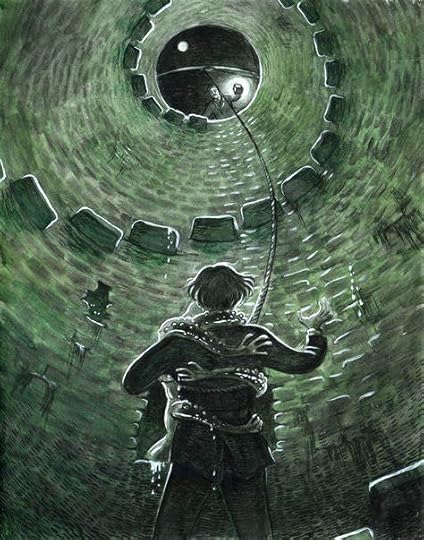
Perhaps—now that I think about it—I am being too hard on “Abbot Thomas.” Those two scary parts—one a sudden tactile sensation of Mr Somerton’s, the other a brief glimpse of something (or someone) peering down a well at his valet William Brown—are terrifying indeed. Scary enough, at least, that this story definitely merits inclusion in the greatest ghost story collection of all time.
Втората книжка от комплекта ми хареса дори повече от първата. Получих точно това, което очаквах, макар историите тук да бяха по-малко призрачно ориентирани и по-диаболични. В седемте разказа ще се срещнем с необясними мистерии, дебнещи кошмари извън нашата реалност, дълбоко криптирани тайни, зли адепти и обитавани от зловещо присъствие местности. Може би, най-голямо впечатление ми направи „гравюрата“, макар и не-толкова стряскаща я разпознах като първоизточник на една от любимите ми новели – „Слънчевото куче“, и един от любимите ми тайландски филми – „Призрачна бленда“.
И на края се надъхах да издиря единственият непреведен разказ от оригиналния сборник и да видя защо, аджаба за вече втори път не го превеждат.
Not bad, but absolutely no explanation for why the Abbot was so evil and why he did what he did. So 2 stars for the whole point of the story not making any sense. Not badly written though. Would read more by this author.
Well, not bad but dated. I'm planning to read it again as it didn't really hold my interest. Could be the slightly older style that failed to pull me into the terror of the story.
If you've read anything by M. R. James, this particular story will hardly surprise you: you know from the title that there's a treasure, and you probably can imagine that finding hidden treasures is not all it's brought up to be.
What I've found enchanting about this particular story is that it's more overtly humorous that some of James' other stories. Also, there's a lot of Latin (but no fear, there are translations), and a cypher.
Initially very dull and swamped in Latin. James’ trope of setting stories within religious antiquity with scholars who know nothing of life but then it became a mystery and a treasure hunt. I must admit I got bored again even though I think I should have been alert- I think it’s the Latin to be honest! I love the fact the guardian is unknown, could be natural or supernatural. His famous ambiguity with sense of terror, and vague details works well to actually give the reader an unexpected shock. Although James is known for his scholarly antiquity the Latin does get a little much for the average, yet educated, reader.
2/5 of the M.R James short stories selected by my “Twentieth Century Gothic” professor.
Mr Somerton is a scholar, who finds clues in stained glass windows at the church. What makes this piece a 20th century Gothic, is the return of the past, literally. Abbot Thomas, died long ago, supposedly hid treasure in the Abbey’s ruins.
This comes second in my ranking, it’s smart, specially the deciphering part.
Something of the Lovecraftian haunts this short tale, with the unnamed tentacled horror lurking beneath the cemented stone in the depths of the well, the lingering smell of damp and mould, the mystery of the obscured ciphered writing on the repurposed stained glass windows, the evil Abbot returning to view the misfortune befalling the discoverers of the hidden treasure.
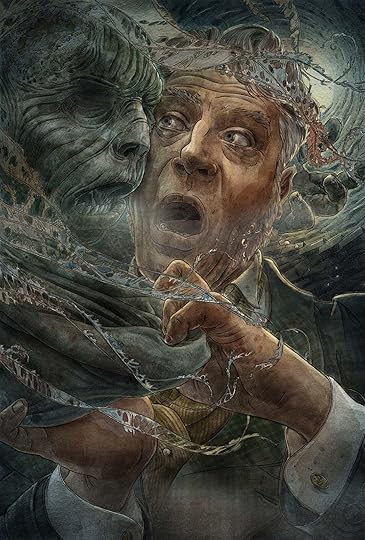
There is something very real, almost visceral in the scene of the removal of the stone down the well, (chiselled with a cross in the form of seven eyes) the reaching in to the damp and sequestered space underground, the drawing forth of the damp leathery form and then the horror of the damp tentacled arms reaching around the neck of the protagonist. Chilling indeed.
Somerton, an antiquarian, has the wit to solve the mystery of a long hidden, almost forgotten treasure. Centuries before, according to record he reads and translates, Abbott Thomas of the Abby at Steinfeld, Germany had hidden a large quantity of gold, and made sly clues about it being hid in a well he had dug on the Abby grounds.
Somerton connects it with the stained-glass windows that came from the Steinfeld Abby and studying them solves an ancient cryptogram embedded on the glass. He and his valet, Brown find the gold, but soon regrets it and wishes he had not, for Abbott Thomas had left a guardian to watch over and protect the gold.
The beginning opens as a trip to see a friend who’s ill and want to share a secret. However the story is presented from an unreliable and distant narrator. Alike a lot of James stories you wait for something to happen, in this case almost a treasure hunt. Translating clues and finding secret undiscovered places - only to not actually gain the thing they were looking for, the men run away from the well they don’t discover the treasure and moreover they go over the clues to hide them so that others don’t find the treasure. The ghost of abbot Thomas does not actually appear neither does any guardian protector over the treasure, it is the fear that makes them run.
Умерено плашещ, не твърде заплетен, добре написан сборник от истории, които карат човека да се замисли за свръхестественото. Като вярваща жена, не ми харесва начина, по който са изобразени свръхестествените проявления, но все пак това е сборник на класически разкази от готиката, та разминаването е очаквано.
Предполагам, че за хора, които търсят да навлязат повече в този жанр, това е добра книга за начало - както казах, не е “твърде много” по никакъв начин, уравновесена книга. Прочетох я, за да разширя кръгозора си и вече със сигурност знам, че готиката не е за мен.
Изключително приятно издание. Много ми харесва формата на книгата и корицата. Самите разкази ни връщат назад към Викториянската епоха и са точно в нейният мрачен и мистичен дух. Особено ми харесаха "Ясенът", "Съкровището на абат Томас" и "Училищна история".
In 1974, the story was adapted as part of the BBC's A Ghost Story for Christmas strand by John Bowen. It was first broadcast on 23 December 1974 and is available here: https://www.youtube.com/watch?v=EIMQ1...
A very well told story by a true master. Mr Gregory listens to the account of Mr Somerton. Where in the abbey is the treasure hidden? Why wasn't he able to rescue it? Captivating tale you can't put down. The climax is great and will run shivers down your spine. Really enjoyed this classic mystery with horror elements. Highly recommended!
Well written and a fun story to read, the climax nevertheless disappointed. I would definitely constitute this short story a thriller though! Recommend for a quick, gripping read.
This was a real chiller! The scene towards the end, where the treasure is discovered, was genuinely frightening, although not so bad as to keep one up at night. A great scary story.
When a man searches & finds a long-lost hidden treasure, he doesn't know what he is in for when warned by the protectors of the treasure! Highly Recommend this creepy tale.








![Profile Image for Ивайло [IF Tomeff].](/_next/image?url=https%3A%2F%2Fi.gr-assets.com%2Fimages%2FS%2Fcompressed.photo.goodreads.com%2Fusers%2F1350231715i%2F3193915._UX200_CR0%2C11%2C200%2C200_.jpg&w=128&q=75)


