There’s a lot of material in this omnibus. Covering three one-off annual Halloween comic books (published from 1993-96, and collected as a trade paperback under the title “BATMAN: HAUNTED KNIGHT”), “BATMAN: THE LONG HALLOWEEN” (13 issues, published from 1996-97), “BATMAN: DARK VICTORY” (13 issues, published 1999-2000), and “CATWOMAN: WHEN IN ROME” (6 issues, published in 2006), this hardcover includes all of the Batman comic books produced by the writer & artist team of Jeph Loeb & Tim Sale (respectively).
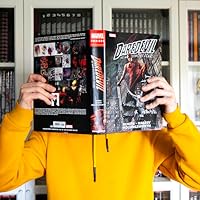
The physical package itself is very nice, if a bit unwieldy. Clocking in at over 1150 oversized pages, this hardcover weighs in at over 7lbs. It’s nice having all of the Loeb/Sale work together in one volume, but I’ve got my fingers crossed that the spine & binding will hold up to repeated reads. The large Tim Sale artwork mostly makes up for that risk.
The artwork is fantastic. Tim Sale pencils and inks all of the stories, and he also handles coloring for DARK VICTORY and WHEN IN ROME. The glossy pages work well with Sale’s tendency to use thick lines and heavy shadows, as does the subject matter —- it’s Batman, so of course he looks great in a lot of shadows. Sale starts to employ some ink washes in DARK VICTORY (in flashback scenes) and WHEN IN ROME, and those pages are nearly perfect. I don’t think of Tim Sale as a definitive artist for any comic character —- he’s not necessarily a pin-up artist —- but the overall visual aesthetic of his work is awe-inspiring.
Jeph Loeb’s writing is a lot more hit and miss. The Halloween specials are...fine. Nothing too special or noteworthy, aside from the debut of Loeb’s version of the Scarecrow —- who inexplicably speaks in nursery rhymes only when Jeph Loeb writes him.
THE LONG HALLOWEEN is the most famous of these stories, and it’s pretty engaging in the moment. Set shortly after the events of legendary Batman story BATMAN: YEAR ONE (published in 1987), this story attempts to dance between the raindrops of Batman’s comic book continuity to answer this question: “There sure were a lot of mobsters in Gotham in BATMAN: YEAR ONE. Whatever happened to those guys?” A murder mystery weaves throughout the story, where the victims are mostly taken from that classic 80s Batman tale, and it also features 6 or 7 of Batman’s classic rogues. At its best, this story focuses on the husband/wife and parent/child relationships. At its worst, it is a choppily plotted mess whose mystery plot falls apart under minimal scrutiny. It’s fun to read, but isn’t nearly as clever as it wants to be. I’m also not sure just how successfully it blends the supervillain and mobsters into a single narrative.
DARK VICTORY is the sequel to THE LONG HALLOWEEN, and the story takes place a couple of years later. We again have a murder mystery, and once again the victims tended to be characters from BATMAN: YEAR ONE —- this time, though, they are policemen. Again, the villains are a blend of mobsters and supervillains, although now the mobsters are clearly the struggling minority. This story also incorporates Batman taking on Robin as a sidekick, and a larger theme of of trust. It’s not as entertaining as THE LONG HALLOWEEN, but it’s still pretty good, largely due to the art. Specifically, Sale’s use of contrast —- in color and size —- is what makes this story feel special. This time around, the mystery’s reveal is less terrible (but still not great!), but the story is less interesting.
CATWOMAN: WHEN IN ROME takes place concurrently with DARK VICTORY, and features Catwoman on her own adventure that ties into the other stories only tangentially. The story probably doesn’t deserve 6 issues, and neither mystery (there are two central ones) is particularly interesting. Loeb writes Catwoman like a teenage boy who doesn’t talk to girls —- there’s a lot of “wouldn’t it be naughty if she said/did THIS?” energy in this story. The primary mystery —- the question of Catwoman’s parentage —- could have been much better with only a little more work, but that time was spent on an unnecessary supervillain subplot instead. The artwork leans into cheesecake at times, but is overall the most impressive work Sale produces in this volume.
Individually, I’d say that there are warts on all of these stories, particularly with regards to the writing. However, the artwork elevates the writing, and the sheer volume of enjoyable —- until you reflect on the plot —- comics here is well worth your time.