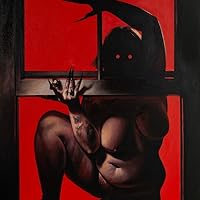
Paradise Rot is a trippy sensory overload taking place in a rotting Garden of Eden. It’s disgusting, it’s weird, it’s… enthralling. It captures you completely for 148 pages then spits you out disoriented and confused. In fact, this is such a surreal and disorienting book that when I finished it yesterday morning I tried to write a review for hours, failed, then picked up this book at 1am and read it all over again. This book burrowed itself into my brain and has left me in an odd, obsessive state. The world feels louder right now, when I close my eyes all I see is a rotting Garden of Eden, and my brain feels absolutely numb.
The writing creates a nauseating sensory nightmare as the words jumped off the page and I could hear and feel them so loudly. I heard juices dribbling, pulp oozing, muted trickling (yes, of piss). I could feel yolks bursting, a Spanish slug’s antennas tickling the roof of my mouth, something warm and slimy white in my throat, warm spores melting into my skin. I wanted to scream at the girls to please drink some water as I listened to thick milky urine stream against a porcelain bowl and when Jo’s urine was described as acrid. I was horrified and deeply intrigued as various bodily fluids, oozes, and runny substances were described in just a little too much detail. I felt everything and I’m not really sure I wanted to (I actually am sure – I didn’t want to).
“In the hostel my body became light and insubstantial, and I imagined that I, too, was being swallowed by fog, that I was dissolving in it.” / “Maybe it wasn’t the house, but me that was porous.”
Jo has just moved from Norway to Australia for school and due to issues, such as a language barrier and loneliness, she has lost her sense of self. Before she finds the brewery, she is constantly drifting in and out of space feeling like it is impossible to connect with anyone. She finds comfort in the weird and disgusting as experiencing those things tend to transcend this new barrier that she is facing. When something gross happens on public transport in the beginning of the book, instead of being absolutely disgusted she thinks about how everyone is connected temporarily, and once the moment ends, she thinks “They could return to themselves, disappear into their enclosures. I was alone again.” In the outside world this language barrier is pervasive. When trying to explain things to her new friends she has trouble finding the right words, on the first day of class her inner monologue reveals “I became increasingly aware how unprepared I was to study in English.” … “I suddenly knew nothing about myself, nothing seemed right in English, nothing was true.” But when she finds this apartment and meets her new roommate Carral – a native English speaker – she never seems to have this problem. In this inside world, where she is cocooned against the unfamiliar, she feels a safety and familiarity that she hasn’t felt in Australia yet. Her combined fascination with mycology and pretty gross bodily fluids intertwines to produce a very interesting surreal world.
“But the apple was first, and it never stops rotting, it just gets blacker. The apple has no end, just like this fairy tale.”
The catalyst of this story and the introduction to the rotting Garden of Eden is when Carral brings home a bunch of apples, and they start rotting: “Through the drumming, something else could be heard: apple skin against the wood, rolling through the kitchen, back and forth, like eggs ready to hatch.” We get so much imagery of symbolism from these apples that intertwines with Jo and Carral and their desires. As the book progresses, the apples rot further as do Jo and Carral. ”An apple is never just an apple.” As their inner world begins to rot, their desire begins to grow until mushrooms begin to grow and then their desire (especially Carral’s) starts to show itself in very fungi-like ways.
The brewery/Garden of Eden is an interesting place in itself. The moldy it gets, the more languidly we rot in it. There is a safety in this version of Eden, but there is also ruin. This version of the creation myth is also distorted, with a new story for every character. I liked this aspect because, while it was easy to figure out who some characters were meant to be, they didn’t necessarily have the same story. It’s an interesting way to depict a queer awakening/finding yourself story and Jo rushing to escaping the infected Garden in seared into my brain.
“when she turned and lay behind me, firmly against my body, I thought we were synchronized, or I wished we were: that she should dream what I’d dreamt, that she should taste what my mouth tasted.
There are two major transformations that begin to take place in this book, both have two different dynamics. With the neighbor Pym, we see how a male centered view on relationships can literally consume and destroy the woman. In his book, Pym writes about how “two girls took turns satisfying the man’s every sexual fantasy and eventually melted into him.” While claiming that the book is “somewhat feminist”, he shows his true intention of consuming the girls, taking the things that will benefit him, and discarding the rest. Even when him and Jo kiss, either Jo is consuming him and making him shrink, or Pym is doing the same to Jo. There is this dynamic where they only take and never give. Even when she gets physically close to him, he rarely leaves any residue/bodily fluid on her. And when she does feel a lingering mark, she is repulsed.
Jo’s relationship with Carral based on fluids early on, representing this weird desire. In the beginning, Jo is already fascinated by how Carral crushes the sweet flesh of an apple between her teeth and dissolves the flesh into foam and the sound of her peeing. Instead of consuming Jo, Carral desires a conjoining of the two of them. She even adds a new ending to Pym’s story: “From his ashes will a four-breasted creature arise.” This seems to show a different kind of consumption where Carral still wants to meld with Jo but in a way where both of them are equals. They both seem to be consuming each other at equal rates.
Before the storm, we are languidly rotting in a moldy Eden, moving as if we’re in a trance but, when she is awoken to the true dangers of this place, Jo must act before it is too late. There is this sense of urgency and fear towards the end as we watch Jo try to escape the clutches of the brewery.
“I kept going to lectures, and every time I left, it felt like I crossed a threshold between dream and reality, sleep and wakefulness.”
I don’t know if I’d recommend this book to most people, but if you do read this book read it by yourself, in a dark room, between the wee hours of 12am and 5am. A time and space where you’re completely isolated from the outside world and anything can happen.