

What do you think?

Redburn
Drawn from Melville’s own adolescent experience aboard a merchant ship, Redburn charts the coming-of-age of Wellingborough Redburn, a young innocent who embarks on a crossing to Liverpool together with a roguish crew. Once in Liverpool, Redburn encounters the squalid conditions of the city and meets Harry Bolton, a bereft and damaged soul, who takes him on a tour of London that includes a scene of rococo decadence unlike anything else in Melville’s fiction. In her Introduction, Elizabeth Hardwick writes, “ Redburn is rich in masterful portraits—a gallery of wild colors, pretensions and falsehoods, fleeting associations of unexpected tenderness. . . . Redburn is not a document; it is a work of art by the unexpected genius of a sailor, Herman Melville.”
This Modern Library Paperback Classic is set from the text of the first American edition of 1849.
This Modern Library Paperback Classic is set from the text of the first American edition of 1849.
416 pages, Paperback
First published January 1, 1849
About the author
Herman Melville
3,163 books4,863 followersThere is more than one author with this name
Herman Melville was an American novelist, short story writer, and poet of the American Renaissance period. Among his best-known works are Moby-Dick (1851); Typee (1846), a romanticized account of his experiences in Polynesia; and Billy Budd, Sailor, a posthumously published novella. At the time of his death, Melville was no longer well known to the public, but the 1919 centennial of his birth was the starting point of a Melville revival. Moby-Dick eventually would be considered one of the great American novels.
Melville was born in New York City, the third child of a prosperous merchant whose death in 1832 left the family in dire financial straits. He took to sea in 1839 as a common sailor on a merchant ship and then on the whaler Acushnet, but he jumped ship in the Marquesas Islands. Typee, his first book, and its sequel, Omoo (1847), were travel-adventures based on his encounters with the peoples of the islands. Their success gave him the financial security to marry Elizabeth Shaw, the daughter of the Boston jurist Lemuel Shaw. Mardi (1849), a romance-adventure and his first book not based on his own experience, was not well received. Redburn (1849) and White-Jacket (1850), both tales based on his experience as a well-born young man at sea, were given respectable reviews, but did not sell well enough to support his expanding family.
Melville's growing literary ambition showed in Moby-Dick (1851), which took nearly a year and a half to write, but it did not find an audience, and critics scorned his psychological novel Pierre: or, The Ambiguities (1852). From 1853 to 1856, Melville published short fiction in magazines, including "Benito Cereno" and "Bartleby, the Scrivener". In 1857, he traveled to England, toured the Near East, and published his last work of prose, The Confidence-Man (1857). He moved to New York in 1863, eventually taking a position as a United States customs inspector.
From that point, Melville focused his creative powers on poetry. Battle-Pieces and Aspects of the War (1866) was his poetic reflection on the moral questions of the American Civil War. In 1867, his eldest child Malcolm died at home from a self-inflicted gunshot. Melville's metaphysical epic Clarel: A Poem and Pilgrimage in the Holy Land was published in 1876. In 1886, his other son Stanwix died of apparent tuberculosis, and Melville retired. During his last years, he privately published two volumes of poetry, and left one volume unpublished. The novella Billy Budd was left unfinished at his death, but was published posthumously in 1924. Melville died from cardiovascular disease in 1891.
Herman Melville was an American novelist, short story writer, and poet of the American Renaissance period. Among his best-known works are Moby-Dick (1851); Typee (1846), a romanticized account of his experiences in Polynesia; and Billy Budd, Sailor, a posthumously published novella. At the time of his death, Melville was no longer well known to the public, but the 1919 centennial of his birth was the starting point of a Melville revival. Moby-Dick eventually would be considered one of the great American novels.
Melville was born in New York City, the third child of a prosperous merchant whose death in 1832 left the family in dire financial straits. He took to sea in 1839 as a common sailor on a merchant ship and then on the whaler Acushnet, but he jumped ship in the Marquesas Islands. Typee, his first book, and its sequel, Omoo (1847), were travel-adventures based on his encounters with the peoples of the islands. Their success gave him the financial security to marry Elizabeth Shaw, the daughter of the Boston jurist Lemuel Shaw. Mardi (1849), a romance-adventure and his first book not based on his own experience, was not well received. Redburn (1849) and White-Jacket (1850), both tales based on his experience as a well-born young man at sea, were given respectable reviews, but did not sell well enough to support his expanding family.
Melville's growing literary ambition showed in Moby-Dick (1851), which took nearly a year and a half to write, but it did not find an audience, and critics scorned his psychological novel Pierre: or, The Ambiguities (1852). From 1853 to 1856, Melville published short fiction in magazines, including "Benito Cereno" and "Bartleby, the Scrivener". In 1857, he traveled to England, toured the Near East, and published his last work of prose, The Confidence-Man (1857). He moved to New York in 1863, eventually taking a position as a United States customs inspector.
From that point, Melville focused his creative powers on poetry. Battle-Pieces and Aspects of the War (1866) was his poetic reflection on the moral questions of the American Civil War. In 1867, his eldest child Malcolm died at home from a self-inflicted gunshot. Melville's metaphysical epic Clarel: A Poem and Pilgrimage in the Holy Land was published in 1876. In 1886, his other son Stanwix died of apparent tuberculosis, and Melville retired. During his last years, he privately published two volumes of poetry, and left one volume unpublished. The novella Billy Budd was left unfinished at his death, but was published posthumously in 1924. Melville died from cardiovascular disease in 1891.
Ratings & Reviews
Friends & Following
Create a free account to discover what your friends think of this book!
Community Reviews
Displaying 1 - 30 of 150 reviews

February 20, 2025
A boy seeking monetary compensation since the demise of his bankrupt father by joining a merchant ship in New York City for his first trip to Liverpool and to be honest anywhere else on the ocean . Things start inauspiciously as the ponderous St. Lawrence rolls side to side, the sea lifts up his ship above and down however his stomach remains skyward in the watery valley of death. Sailors laugh at seasickness such weakness aren't acceptable not on a floating sailing vessel. So ailing Wellingborough (a silly name indeed) Redburn trying to hide this detriment unsuccessfully. Mr. Jackson the leader of the uncouth seamen on board ship doesn't conceal unfavorable feelings towards him and others the same, poor landlubber. Crawling up the towering mast by the riggings seems quite impossibly high, scrapping the clouds he makes a mistake looking down, petrified, the winds blow hard rocking the structure around, far below the waves strike the ship however the royal sails must be loosen. Buttons his new moniker, because of the coat he wears descends much faster and getting a somewhat compliment by Max an experienced sailor. Captain Riga a kindly soul ashore is otherwise on the sea, none talk to the aloof man but the mates, as will Mr. Redburn soon discover to his chagrin barely escaping a whipping. Life in the nineteenth century can be barbaric, customs much more strict, deviations not tolerated for any but a few. To make matters worst the filthy conditions below deck could turn a strong constitution to jelly, even people who seen it all would shortly drop tears down their cheeks. Reaching Liverpool the biggest port in the world at that time...and the dirtiest, shocked Redburn from New York too, his eyes can't , wont believe things are so bad in any place on Earth, literary starving people. Still nobody cares , the dying in the streets, neighbors , policemen , fellow humans not important. The only compensation meeting Englishman Harry Bolton in the city, seemingly a gentleman just a few years older than Wellingborough with a secret problem, maybe gambling? A quick unproductive trip to London where our anxious visitor needs to see the sight ,but disappointed the strange Harry keeps him in the dark...four wall he views. Herman Melville was one of America 's finest writer though this is not his best, however any novel or short story from the author is well worth reading I can truthfully say, since reading them all and enjoying. Almost forgot friends, the trip back home is even more excruciating.

March 25, 2011
This novel is, I see now on second reading, a proto-Moby Dick without the hyper-intrusive narrator (Ishmael) but with the usual gay (overt?) subtext.
Melville rarely, almost never, wrote extensively about women. “As for ladies, I have nothing to say concerning them; for ladies are like creeds; if you cannot speak well of them, say nothing.” (p. 347)
Redburn is the often amusing story of a young man’s first crossing as “boy” on a merchant ship from New York to the Liverpool. The traveler’s name is Willingborough Redburn and he is the narrator.
Published in 1849 it remains highly readable. And sometimes – there are pages which take the breath away. For example, on the return trip a plague runs through steerage which is occupied by 500 mostly Irish immigrants. This is the quote.
“But those who had lost fathers, husband, wives, or children, needed no crape to reveal to the others who they were. Hard and bitter indeed was their lot; for with the poor and desolate, grief is no indulgence of mere sentiment, however sincere, but a gnawing reality, that eats into their vital beings; they have no kind condolers, and bland physicians, and troops of sympathizing friends; and they must toil, though tomorrow be the burial, and their pallbearers throw down the hammer to lift up the coffin.” (p.379)
This among the blackest moments in a book which otherwise evinces a broad range of tones and moods—in other words, nothing like Thomas Bernhard.
Melville rarely, almost never, wrote extensively about women. “As for ladies, I have nothing to say concerning them; for ladies are like creeds; if you cannot speak well of them, say nothing.” (p. 347)
Redburn is the often amusing story of a young man’s first crossing as “boy” on a merchant ship from New York to the Liverpool. The traveler’s name is Willingborough Redburn and he is the narrator.
Published in 1849 it remains highly readable. And sometimes – there are pages which take the breath away. For example, on the return trip a plague runs through steerage which is occupied by 500 mostly Irish immigrants. This is the quote.
“But those who had lost fathers, husband, wives, or children, needed no crape to reveal to the others who they were. Hard and bitter indeed was their lot; for with the poor and desolate, grief is no indulgence of mere sentiment, however sincere, but a gnawing reality, that eats into their vital beings; they have no kind condolers, and bland physicians, and troops of sympathizing friends; and they must toil, though tomorrow be the burial, and their pallbearers throw down the hammer to lift up the coffin.” (p.379)
This among the blackest moments in a book which otherwise evinces a broad range of tones and moods—in other words, nothing like Thomas Bernhard.

April 12, 2020
Veni - vidi - vici :) I have read Melville´s semi-autobiographical masterpiece ´Redburn´ and decided to include it in my researches around organizational values in corporate environments. My intention was to take an interdisciplinary approach by excavating from literature to amplify the meaning of my findings and to harness the power of literature as a vehicle to discover social dynamics in an organization.
Now my actual review of this Bildungsroman:
Melville´s book was first published in London in 1849. The Bildungsroman deals with the 15-years old Wellingborough Redburn who signs on the Highlander, a merchant ship out of New York City bound for Liverpool, England. Redburn is eager to follow his deceased father´s footsteps to become an importer traveling around world collecting stories and experiences on exotic countries and cultures. However, Redburn soon gets to realize that the voyage is far from what he had envisioned in the first place.
He presents himself as a ´gentleman´s son´ to Captain Riga. Though Redburn´s family is no longer rich and is rather bankrupt in the meantime, he insists on presenting himself as an aristocrat’s´ son clinging on his family’s virtues and image when they used to be rich. Captain Riga reveals to be a duplicitous man who cares only about his image to the world outside his merchant ship, displaying no empathy nor care for his crew on the Highlander.
Trapped on the ship with a crew of seamen of various characters, backgrounds and values, Redburn tries to make sense of the social dynamics and malfunctions embedded in a hierarchical structure. The complexity of social relations and collaboration is augmented by Jackson, the best seaman and a tyrant on the Highlander who manages his crew by fear. Barely educated, Jackson got the hang of the business on the merchant ship by experience and is constantly worried about defending his position by bullying his crew.
Redburn´s voyage starts off with seasickness, sleepless nights, lack of food and no support from his crew mates or leaders. A conservative Christian holding onto the values and beliefs of his religion, he soon makes compromises on them to survive on the Highlander. In all situations including passing through ferocious storms or accidents, Redburn learned the key to his survival is the strict adherence to the rules imposed by Jackson. Only handling his chores and tasks as expected will bring him respect from his crew mates.
Neither the landscapes, the whales, nor the cities in his fantasies live up to the reality. Even the ´prosy old guide-book´ titled ´The Picture of Liverpool´ designed by his father led to a huge disappointment when he set foot in Liverpool to track down some of the places his father had visited there. Misery, famine and human actions resulting from despair make Liverpool no longer attractive to Redburn as once again the city was not what he had imagined, so he is left to experience disappointments at all levels. On top, may it be for his own survival or helping others survive, Redburn is constantly compromising on his core values that were once solidified by his religion and family.
Emigrants who are smuggled on the Highlander on the way back to New York increase the feuds as everyone suffers from parsimony and dysfunctional relations. Redburn is exposed to people of various nations such as from Ireland and Italy, which leads him to challenge his initial assumptions and prejudices on different nationalities by overserving everyone whilst engaging in reflexive processes to make sense of their behavior and actions, though he is not always able to draw logical conclusions from his analyses.
He meets with Harry Bolton, a damaged soul that introduces Redburn to the decadent places of Liverpool and subsequently embarks the voyage from Liverpool to New York. In denial to see who Bolton really is or does, Redburn stays in their friendship with a portion of distrust. His friendship to Bolton is rooted in their common inexperience of sailing and abruptly ends once Redburn disembarks the Highlander in New York. Yet, he will hold himself accountable of Bolton´s tragical death when he finds out only years later.
At the end of the book, a narration by an older and mature Redburn sheds light on his very first journey filled with reflections on his experience.
Find me on instagram
Now my actual review of this Bildungsroman:
Melville´s book was first published in London in 1849. The Bildungsroman deals with the 15-years old Wellingborough Redburn who signs on the Highlander, a merchant ship out of New York City bound for Liverpool, England. Redburn is eager to follow his deceased father´s footsteps to become an importer traveling around world collecting stories and experiences on exotic countries and cultures. However, Redburn soon gets to realize that the voyage is far from what he had envisioned in the first place.
He presents himself as a ´gentleman´s son´ to Captain Riga. Though Redburn´s family is no longer rich and is rather bankrupt in the meantime, he insists on presenting himself as an aristocrat’s´ son clinging on his family’s virtues and image when they used to be rich. Captain Riga reveals to be a duplicitous man who cares only about his image to the world outside his merchant ship, displaying no empathy nor care for his crew on the Highlander.
Trapped on the ship with a crew of seamen of various characters, backgrounds and values, Redburn tries to make sense of the social dynamics and malfunctions embedded in a hierarchical structure. The complexity of social relations and collaboration is augmented by Jackson, the best seaman and a tyrant on the Highlander who manages his crew by fear. Barely educated, Jackson got the hang of the business on the merchant ship by experience and is constantly worried about defending his position by bullying his crew.
Redburn´s voyage starts off with seasickness, sleepless nights, lack of food and no support from his crew mates or leaders. A conservative Christian holding onto the values and beliefs of his religion, he soon makes compromises on them to survive on the Highlander. In all situations including passing through ferocious storms or accidents, Redburn learned the key to his survival is the strict adherence to the rules imposed by Jackson. Only handling his chores and tasks as expected will bring him respect from his crew mates.
Neither the landscapes, the whales, nor the cities in his fantasies live up to the reality. Even the ´prosy old guide-book´ titled ´The Picture of Liverpool´ designed by his father led to a huge disappointment when he set foot in Liverpool to track down some of the places his father had visited there. Misery, famine and human actions resulting from despair make Liverpool no longer attractive to Redburn as once again the city was not what he had imagined, so he is left to experience disappointments at all levels. On top, may it be for his own survival or helping others survive, Redburn is constantly compromising on his core values that were once solidified by his religion and family.
Emigrants who are smuggled on the Highlander on the way back to New York increase the feuds as everyone suffers from parsimony and dysfunctional relations. Redburn is exposed to people of various nations such as from Ireland and Italy, which leads him to challenge his initial assumptions and prejudices on different nationalities by overserving everyone whilst engaging in reflexive processes to make sense of their behavior and actions, though he is not always able to draw logical conclusions from his analyses.
He meets with Harry Bolton, a damaged soul that introduces Redburn to the decadent places of Liverpool and subsequently embarks the voyage from Liverpool to New York. In denial to see who Bolton really is or does, Redburn stays in their friendship with a portion of distrust. His friendship to Bolton is rooted in their common inexperience of sailing and abruptly ends once Redburn disembarks the Highlander in New York. Yet, he will hold himself accountable of Bolton´s tragical death when he finds out only years later.
At the end of the book, a narration by an older and mature Redburn sheds light on his very first journey filled with reflections on his experience.
Find me on instagram

April 14, 2023
So what's all this talk about Melville's 'Redburn' dripping with homosexuality? Turns out, it doesn't consistently drip with the stuff - but it does spring a leak. That leak is the totality of Chapter 46 (XLVI): 'A Mysterious Night in London'.
It has got to be one of the gayest chapters in American literature. The book has 62 chapters, so this sudden tornado (which is exactly what it is) has its thrust (if you will) about 2/3 of the way through the book - with nothing remotely like it prior and little to equal it later (mainly other than the penultimate chapter of sudden shipboard disease and near-disaster).
In fact, the chapter (introducing us further to the - shall we say 'enigmatic' Harry Bolton?) seems to be from a whole other book entirely. Or maybe it should have been its own novella (if expanded).
Yet here it is, tucked inside this episodic mariner's travelogue; lurking, lying in wait, before leaping in response to the particularly bucolic and strategic burst of heterosexuality that just precedes it.
There really isn't a whole lot to 'Redburn' in terms of story. It's an older gentleman's look back at his younger, naive self; a memory of his first experience as a sailor. In it, Melville gives the reader the wonderful gift of Redburn's voice. You really can almost hear it as you read his narration - it's a voice both singular and mellifluous. It's a carefully recalled account of naiveté, insatiable curiosity, an unbridled wonder at life and an unceasing, untainted compassion.
Redburn is a marvelous character; he alone makes the read worthwhile. You don't even mind when he goes on and on and on describing the seemingly endless types of sailor's knots (much like the narrator of 'Moby Dick' describes every existing type of whale). Redburn is a born storyteller; he fashions quite a few memorable (some of them nightmarish) sequences.
So it's somewhat of a disappointment to have learned after the read that, in his journal, Melville wrote, "I, the author, know [it] to be trash, & wrote it to buy some tobacco with."
I would do more than hesitate in calling the book 'trash'. But I might not object to the claim that there's something... trashy... about chapter 46 - with its veiled yet hiding-in-plain-sight depiction of male-brothel assignations.
In 1957, when Edward Gorey was asked to do a cover for a new reprint, he seemed to have the idea that 'Redburn' was mainly a tale of chapter 46:
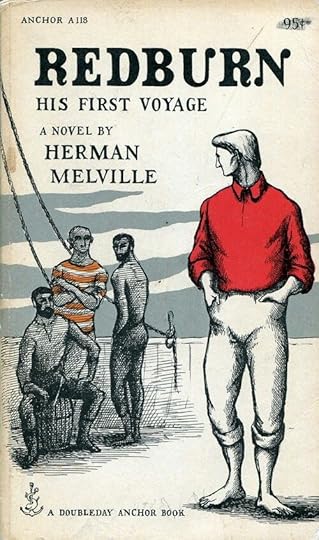
It has got to be one of the gayest chapters in American literature. The book has 62 chapters, so this sudden tornado (which is exactly what it is) has its thrust (if you will) about 2/3 of the way through the book - with nothing remotely like it prior and little to equal it later (mainly other than the penultimate chapter of sudden shipboard disease and near-disaster).
In fact, the chapter (introducing us further to the - shall we say 'enigmatic' Harry Bolton?) seems to be from a whole other book entirely. Or maybe it should have been its own novella (if expanded).
Yet here it is, tucked inside this episodic mariner's travelogue; lurking, lying in wait, before leaping in response to the particularly bucolic and strategic burst of heterosexuality that just precedes it.
There really isn't a whole lot to 'Redburn' in terms of story. It's an older gentleman's look back at his younger, naive self; a memory of his first experience as a sailor. In it, Melville gives the reader the wonderful gift of Redburn's voice. You really can almost hear it as you read his narration - it's a voice both singular and mellifluous. It's a carefully recalled account of naiveté, insatiable curiosity, an unbridled wonder at life and an unceasing, untainted compassion.
Redburn is a marvelous character; he alone makes the read worthwhile. You don't even mind when he goes on and on and on describing the seemingly endless types of sailor's knots (much like the narrator of 'Moby Dick' describes every existing type of whale). Redburn is a born storyteller; he fashions quite a few memorable (some of them nightmarish) sequences.
So it's somewhat of a disappointment to have learned after the read that, in his journal, Melville wrote, "I, the author, know [it] to be trash, & wrote it to buy some tobacco with."
I would do more than hesitate in calling the book 'trash'. But I might not object to the claim that there's something... trashy... about chapter 46 - with its veiled yet hiding-in-plain-sight depiction of male-brothel assignations.
In 1957, when Edward Gorey was asked to do a cover for a new reprint, he seemed to have the idea that 'Redburn' was mainly a tale of chapter 46:

August 5, 2017
From Wellingborough Redburn To Buttons
I decided to celebrate this past Memorial Day by revisiting a classic American novel. I chose one of my favorite authors, Herman Melville, and his "Redburn: His First Voyage" (1849).
"Redburn" was Melville's fourth novel and followed upon the visionary book, "Mardi". The author readjusted his course briefly to write a realistic, semi-autobiographical novel centering upon a sea voyage. Author's frequently are poor judges of their own work; and so, Melville spoke disparagingly of "Redburn".
The novel is both a coming-of-age story and a depiction of a changing United States. In its portrayal of a naive young man losing his innocence, the book reminded me of a later Huckleberry Finn and his journey down the Mississippi River. Wellingborough Redburn's journey was of longer scope: from New York City to Liverpool, England and back on a sailing merchant vessel, the Highlander. Melville makes much of names as a sign of change and character. Young Wellingborough is part of a distinguished once-wealthy family. His uncle had been a United States Senator and his family had been influential in Revolutionary days. With his father's bankruptcy, the family and Wellingborough fall on hard times. Wellingborough is a reader, a teetotaler, and a churchgoer. Much of the force of the book derives from the rude awakening to life he receives both during his voyage and on land. The sailors quickly change the young man's name from Wellingborough to "Buttons".
Redburn tells his story in his own voice which gives the novel a degree of intimacy. But the chapter headings, such as the first, "How Wellingborough Redburn's Taste for the Sea was Born and Bred in him" all speak of the protagonist in the third person. Much of the writing in the book seems detached from the narrator as well. Thus the book also manages to convey a sense of distance. This combination of perspectives is one of many instances of studied ambiguity in this seemingly straightforward story.
Redburn is an innocent at sea, and Melville makes much of his dress, his character, and his tastes in contrast with the rough, lonely, brutal life of the American sailor in the 19th Century. Much of the book is in a bantering tone, but a great deal is also tragic. Here and in his better-known books, Melville is enigmatic.
Besides telling the story of Redburn's transformation, the novel shows a change in the United States from the genteel character of the hero's grandparents and parents to the raw, expanding nation in the decades before the Civil War. Some of the best scenes in the novel occur at land, in Redburn's wandering the streets and ports of New York City before and after his voyage. During the voyage and while in England, Melville is again thoughtful and many sided. The book portrays the possibilities of the United States with its openness to diversity, to settlement, and new ideas (as compared with much of what Redburn sees in England). It also points out the slavery, poverty, and hard laissez-faire economy (Redburn is a reader of Adam Smith's "Wealth of Nations") of the young, growing United States.
The book is lengthy but reads relatively quickly. It is organized into 62 short chapters. The narrative moves smoothly and chronologically. The book can be divided into the following sections: 1. Redburn's life before the voyage and the considerations which led him to the sea; 2. the voyage from New York City to Liverpool; 3. Redburn's six-week stay in Liverpool; 4. the return voyage to New York City which features a storm at sea and an epidemic among the steerage passengers; 5. a short concluding section about Redburn in New York following the voyage.
The book proceeds largely in short scenes with characters moving in and out. Redburn himself is the central character. But other individuals, including the lost, forbidding seaman, Jackson, Redburn's rakishly handsome and reckless young friend Harry Bolton, and the conniving Captain Riga of the Highlander receive strong portrayals. The best scenes in the book take place in Liverpool and London, in dives, docks, cheap saloons and gaming houses as Redburn receives an unforgettable exposure to life's cruelties.
In its portrayal of a changing American character and a changing United States, "Redburn" proved an appropriate choice for thinking about the United States over Memorial Day. I was pleased to have the opportunity to revisit Melville and to reread with more understanding a book I had read long ago.
Robin Friedman
I decided to celebrate this past Memorial Day by revisiting a classic American novel. I chose one of my favorite authors, Herman Melville, and his "Redburn: His First Voyage" (1849).
"Redburn" was Melville's fourth novel and followed upon the visionary book, "Mardi". The author readjusted his course briefly to write a realistic, semi-autobiographical novel centering upon a sea voyage. Author's frequently are poor judges of their own work; and so, Melville spoke disparagingly of "Redburn".
The novel is both a coming-of-age story and a depiction of a changing United States. In its portrayal of a naive young man losing his innocence, the book reminded me of a later Huckleberry Finn and his journey down the Mississippi River. Wellingborough Redburn's journey was of longer scope: from New York City to Liverpool, England and back on a sailing merchant vessel, the Highlander. Melville makes much of names as a sign of change and character. Young Wellingborough is part of a distinguished once-wealthy family. His uncle had been a United States Senator and his family had been influential in Revolutionary days. With his father's bankruptcy, the family and Wellingborough fall on hard times. Wellingborough is a reader, a teetotaler, and a churchgoer. Much of the force of the book derives from the rude awakening to life he receives both during his voyage and on land. The sailors quickly change the young man's name from Wellingborough to "Buttons".
Redburn tells his story in his own voice which gives the novel a degree of intimacy. But the chapter headings, such as the first, "How Wellingborough Redburn's Taste for the Sea was Born and Bred in him" all speak of the protagonist in the third person. Much of the writing in the book seems detached from the narrator as well. Thus the book also manages to convey a sense of distance. This combination of perspectives is one of many instances of studied ambiguity in this seemingly straightforward story.
Redburn is an innocent at sea, and Melville makes much of his dress, his character, and his tastes in contrast with the rough, lonely, brutal life of the American sailor in the 19th Century. Much of the book is in a bantering tone, but a great deal is also tragic. Here and in his better-known books, Melville is enigmatic.
Besides telling the story of Redburn's transformation, the novel shows a change in the United States from the genteel character of the hero's grandparents and parents to the raw, expanding nation in the decades before the Civil War. Some of the best scenes in the novel occur at land, in Redburn's wandering the streets and ports of New York City before and after his voyage. During the voyage and while in England, Melville is again thoughtful and many sided. The book portrays the possibilities of the United States with its openness to diversity, to settlement, and new ideas (as compared with much of what Redburn sees in England). It also points out the slavery, poverty, and hard laissez-faire economy (Redburn is a reader of Adam Smith's "Wealth of Nations") of the young, growing United States.
The book is lengthy but reads relatively quickly. It is organized into 62 short chapters. The narrative moves smoothly and chronologically. The book can be divided into the following sections: 1. Redburn's life before the voyage and the considerations which led him to the sea; 2. the voyage from New York City to Liverpool; 3. Redburn's six-week stay in Liverpool; 4. the return voyage to New York City which features a storm at sea and an epidemic among the steerage passengers; 5. a short concluding section about Redburn in New York following the voyage.
The book proceeds largely in short scenes with characters moving in and out. Redburn himself is the central character. But other individuals, including the lost, forbidding seaman, Jackson, Redburn's rakishly handsome and reckless young friend Harry Bolton, and the conniving Captain Riga of the Highlander receive strong portrayals. The best scenes in the book take place in Liverpool and London, in dives, docks, cheap saloons and gaming houses as Redburn receives an unforgettable exposure to life's cruelties.
In its portrayal of a changing American character and a changing United States, "Redburn" proved an appropriate choice for thinking about the United States over Memorial Day. I was pleased to have the opportunity to revisit Melville and to reread with more understanding a book I had read long ago.
Robin Friedman

March 10, 2013
I would be lying if I didn't admit that I am a Melville nerd. I am a big enough Melville nerd that I have the last line of "Bartleby the Scrivener" tattooed on my arm. I am a big enough nerd that reading Moby Dick wasn't enough for me--I followed it up with Redburn.
Here's the thing: Redburn is an early effort that's passable in its own right, but really doesn't prepare you for the genius gamechanger it's laying the groundwork for. You just don't see anything like Moby Dick coming based on Redburn. Which is not to say Redburn isn't a good book, or an enjoyable one, or one worth reading (especially if you, like me, are struck with an incredibly geeky urge to go all completionist and read everything Melville wrote). But it does mean that reading Redburn after reading Melville's legitimately more famous and better-regarded books is a peculiar experience.
To just take the book on its own terms, devoid of context or history or knowledge of what comes after, Redburn is at its heart a tale of a boy just coming to terms with the fact that his view of the world, and in particular his understanding of it as a fair and just place, has been shattered. It's a pretty standard story of innocence lost and adulthood gained, told in hindsight by an older version of Wellingborough Redburn himself (and isn't that a hell of a name?*) who seems slightly embarassed at just how naive he was way back in the day. This theme is nested throughout the book, starting with the economic collapse of his father to the inherent unfairness of life on the sea, to the inherent unfairness of poverty he's first exposed to in Liverpool. The scope of the book gradually grows, like going from the innermost matroushka doll to the outermost one, which is a neat little trick on Melville's part and rings very true for anyone who's grappled with forging his or her own worldview in adolescence.
And the writing is lovely. Here, like in Moby Dick or "Bartleby," Melville is telling you a story through someone else telling you a story. And one thing that keeps me coming back to Melville time and again is just that: that he tells you a story. The writing here is intimate and immediate, like you're sitting in a comfortably overstuffed armchair with Redburn and he's recounting his youthful exploits to you -- just you -- over a cup of tea. In fact, it's a little bit purer here in Redburn than in anything else I've read by him. It's got more scope than "Bartleby" by virtue of its length alone and unlike Moby Dick, where Ishmael himself starts to fade in and out of the narrative, Redburn is always front and center. It's Redburn telling Redburn's story (as opposed to the rather elderly gentleman telling you about Bartleby or Ishmael telling you about the Pequod) and Redburn, luckily, has the wit and grace as a reflective narrator to carry it.
But if I'm being honest, I think the only people who would be willing to read Redburn and enjoy it are people like me who have already signed on for the Herman Melville Experience once and don't mind coming back for more. And since that's the case, the truth of the matter is that Redburn is most interesting to read in the context of Melville more broadly. In Redburn, you see what is essentially the first pass at themes and archetypes Melville will use to much greater and deeper effect later on. In particular, Jackson reads like a more malicious and less conflicted version of Claggart. And Redburn himself reads as a terribly naive and less observant version of Ishmael. Perhaps Ishmael ten or fifteen years before he set foot on the Pequod. Redburn, like Ishamel, is more educated and more refined than the others on his boat, and Redburn (like Ishmael) finds himself falling into very close, very fast (and very homoerotic) friendships with foreigners as soon as he gets the chance. As in Benito Cereno, Melville's ambivalence towards America -- its grandeur built on foundations of injustice, its insularity, its conformity that can (as far as Melville seems to be aware) only be escaped by shipping out to sea -- becomes a dominant theme.
More than that, Redburn gives a great deal of insight into Melville himself. If Ishmael is more or less an idealized version of Melville, Redburn is clearly who Melville thought he once was. The parallels between Redburn and Melville are striking (so striking that my copy of Redburn has an appendix which notes chapter by chapter aspects of Melville's own first voyage that he fictionalized for the book). Redburn is a book about a young man whose education and experiences lead him to sea totally unprepared, one who has to adapt without any clear guidance, and who in the process finds life at sea both utterly freeing and constraining, and really that young man is Herman Melville and not Wellingborough Redburn. It's not so surprising, then, that Melville was dismissive of Redburn. He wrote it fast and wrote it for the money and frankly, you can tell. It's an overly long, highly digressive travelogue of a book where you find yourself sifting through random chapters about churches in Liverpool and Redburn's father's unusable guidebook before Melville eventually gets around to anything resembling a plot again. This technique works a lot better in Moby Dick, but even there people find it annoying.
But I can't help but wonder if he was dismissive of it because it was a little exposing to him, too. Writing it that fast perhaps meant that it's more raw, more reflective of parts of himself he wasn't fond of, and when all is said and done that's what will stick with me most about this book.
* His name, despite what the back cover of my Penguin Classics edition of the book would have you believe, is actually Wellingborough Redburn and not Wellington Redburn. Shame on you, Penguin Classics, shame on you.
Here's the thing: Redburn is an early effort that's passable in its own right, but really doesn't prepare you for the genius gamechanger it's laying the groundwork for. You just don't see anything like Moby Dick coming based on Redburn. Which is not to say Redburn isn't a good book, or an enjoyable one, or one worth reading (especially if you, like me, are struck with an incredibly geeky urge to go all completionist and read everything Melville wrote). But it does mean that reading Redburn after reading Melville's legitimately more famous and better-regarded books is a peculiar experience.
To just take the book on its own terms, devoid of context or history or knowledge of what comes after, Redburn is at its heart a tale of a boy just coming to terms with the fact that his view of the world, and in particular his understanding of it as a fair and just place, has been shattered. It's a pretty standard story of innocence lost and adulthood gained, told in hindsight by an older version of Wellingborough Redburn himself (and isn't that a hell of a name?*) who seems slightly embarassed at just how naive he was way back in the day. This theme is nested throughout the book, starting with the economic collapse of his father to the inherent unfairness of life on the sea, to the inherent unfairness of poverty he's first exposed to in Liverpool. The scope of the book gradually grows, like going from the innermost matroushka doll to the outermost one, which is a neat little trick on Melville's part and rings very true for anyone who's grappled with forging his or her own worldview in adolescence.
And the writing is lovely. Here, like in Moby Dick or "Bartleby," Melville is telling you a story through someone else telling you a story. And one thing that keeps me coming back to Melville time and again is just that: that he tells you a story. The writing here is intimate and immediate, like you're sitting in a comfortably overstuffed armchair with Redburn and he's recounting his youthful exploits to you -- just you -- over a cup of tea. In fact, it's a little bit purer here in Redburn than in anything else I've read by him. It's got more scope than "Bartleby" by virtue of its length alone and unlike Moby Dick, where Ishmael himself starts to fade in and out of the narrative, Redburn is always front and center. It's Redburn telling Redburn's story (as opposed to the rather elderly gentleman telling you about Bartleby or Ishmael telling you about the Pequod) and Redburn, luckily, has the wit and grace as a reflective narrator to carry it.
But if I'm being honest, I think the only people who would be willing to read Redburn and enjoy it are people like me who have already signed on for the Herman Melville Experience once and don't mind coming back for more. And since that's the case, the truth of the matter is that Redburn is most interesting to read in the context of Melville more broadly. In Redburn, you see what is essentially the first pass at themes and archetypes Melville will use to much greater and deeper effect later on. In particular, Jackson reads like a more malicious and less conflicted version of Claggart. And Redburn himself reads as a terribly naive and less observant version of Ishmael. Perhaps Ishmael ten or fifteen years before he set foot on the Pequod. Redburn, like Ishamel, is more educated and more refined than the others on his boat, and Redburn (like Ishmael) finds himself falling into very close, very fast (and very homoerotic) friendships with foreigners as soon as he gets the chance. As in Benito Cereno, Melville's ambivalence towards America -- its grandeur built on foundations of injustice, its insularity, its conformity that can (as far as Melville seems to be aware) only be escaped by shipping out to sea -- becomes a dominant theme.
More than that, Redburn gives a great deal of insight into Melville himself. If Ishmael is more or less an idealized version of Melville, Redburn is clearly who Melville thought he once was. The parallels between Redburn and Melville are striking (so striking that my copy of Redburn has an appendix which notes chapter by chapter aspects of Melville's own first voyage that he fictionalized for the book). Redburn is a book about a young man whose education and experiences lead him to sea totally unprepared, one who has to adapt without any clear guidance, and who in the process finds life at sea both utterly freeing and constraining, and really that young man is Herman Melville and not Wellingborough Redburn. It's not so surprising, then, that Melville was dismissive of Redburn. He wrote it fast and wrote it for the money and frankly, you can tell. It's an overly long, highly digressive travelogue of a book where you find yourself sifting through random chapters about churches in Liverpool and Redburn's father's unusable guidebook before Melville eventually gets around to anything resembling a plot again. This technique works a lot better in Moby Dick, but even there people find it annoying.
But I can't help but wonder if he was dismissive of it because it was a little exposing to him, too. Writing it that fast perhaps meant that it's more raw, more reflective of parts of himself he wasn't fond of, and when all is said and done that's what will stick with me most about this book.
* His name, despite what the back cover of my Penguin Classics edition of the book would have you believe, is actually Wellingborough Redburn and not Wellington Redburn. Shame on you, Penguin Classics, shame on you.

September 2, 2013
“For the scene of suffering is a scene of joy when the suffering is past; and the silent reminiscence of hardships departed is sweeter than the presence of delight.”
― Herman Melville, Redburn

It must be awful as a writer to dash off a novel for money or tobacco in a couple of weeks and have it praised, but see your earlier serious novel (Mardi) panned, and your later novel (Moby-Dick) under-appreciated until years after your death. That is the genius of a select group of writers -- they are destined to exist in this weird space between art and the public. Perhaps the strong bitter of Melville's art was just too early and too strange for the public, but they WERE ready for his swipes.
If you are into literature of the sea (The Sea Wolf, The Pilot, Captains Courageous, etc.,) or you are just into Melville, you will want to read this. If, however, this is your first Melville, I'd stick with Moby-Dick.
― Herman Melville, Redburn
It must be awful as a writer to dash off a novel for money or tobacco in a couple of weeks and have it praised, but see your earlier serious novel (Mardi) panned, and your later novel (Moby-Dick) under-appreciated until years after your death. That is the genius of a select group of writers -- they are destined to exist in this weird space between art and the public. Perhaps the strong bitter of Melville's art was just too early and too strange for the public, but they WERE ready for his swipes.
If you are into literature of the sea (The Sea Wolf, The Pilot, Captains Courageous, etc.,) or you are just into Melville, you will want to read this. If, however, this is your first Melville, I'd stick with Moby-Dick.

March 6, 2011
Half way through this, young Redburn having arrived in Liverpool after his first sea voyage, from New York. Melville, of course, is wonderful at evoking sea journeys and it goes without saying that he imbues his descriptions with the allegorical and the transcendent. Here, by distancing the absent narrator who heas each chapter in the third person, there is delightful humour and irony at the expense of the growing, often so priggish, sailor. He cannot be other than who he is, and his own map of the human universe is peopled with cartoon stereotypes, including extreme racial prejudice and sheer snobbishness. Yet this is a rite of passage for him, and we see him develop into early adulthood.
Liverpool itself is subject of much of the book, and it's brilliantly evoked. Redburn has with him an 1801 guide to Liverpool (which actually exists) that belonged to his father. He discovers in it his own childhood drawings and scribbles he has made in it. A map of Liverpool shows the north east of the city as a blanks desert-coloured emptiness: child Redburn has illustrated it with monsters and exotica. Accidental irony that such as Norris Green, Fazakerley and Kirkby remain to this day so much screens for the projection of dark imaginings!
Largely drawing on Melville's own experiences, this is a wonderful book. Highly recommended.
Liverpool itself is subject of much of the book, and it's brilliantly evoked. Redburn has with him an 1801 guide to Liverpool (which actually exists) that belonged to his father. He discovers in it his own childhood drawings and scribbles he has made in it. A map of Liverpool shows the north east of the city as a blanks desert-coloured emptiness: child Redburn has illustrated it with monsters and exotica. Accidental irony that such as Norris Green, Fazakerley and Kirkby remain to this day so much screens for the projection of dark imaginings!
Largely drawing on Melville's own experiences, this is a wonderful book. Highly recommended.

March 28, 2022
Herman Melville’s Redburn has long been dismissed or misclassified by many a Melville scholar as an immature work in which Melville was still struggling to find his unique voice, one that finally shows through with brilliant translucence in Moby-Dick. This is a shame because—to my mariner’s aesthetic--Redburn remains one of the great and unappreciated American novels of the 18nth century. In fact, it remains the gold standard as far as an account of a young man (teen in this case) making his first maritime voyage amidst a crew that scoffs at his landed-gentry background, albeit a background now embalmed in the poverty of his cast-off, landed-gentry status: Wellingborough Redburn, as the sub-title of the work clearly indicates, is the “Son-of-a-Gentleman,” and not the type of person to choose maritime as a career.
While other novels, particularly Ultramarine* by the English Modernist, Malcolm Lowry, also depict the travails of an educated seaman on his first voyage where the protagonist is hazed by the crew both for being green and being from a good family, Melville did it first with much more humor, along with a keen eye for sociological observations of the era which make Redburn a chronicle of the era, as well as any ship log ever could.
Melville’s first two novels ostensibly describe the true, salacious escapades of a sailor who deserts a whaling ship in the South Pacific, only to find succor with the natives of Tahiti and other islands. The novels were an immediate sensation and made Melville an American celebrity. However, as famous as these novels were in their era, neither depicted the quotidian life of a seafarer. It is only when Melville attempted to incorporate the tale of his inaugural sea voyage voyage, on a merchant ship to Liverpool, that we glimpse so many themes that will mold Moby-Dick. There are the wry, sardonic depictions of life at sea, where even tragedies (plagues and death) are related as if they are but common occurrences. There are the barely veiled, homo-erotic undertones of a fey, British fop, Harry Bolton, whose dainty fingernails and hands are described with erotic tenderness. There is the multinational crew; Melville’s depictions of different races and nationalities never descend to the depths of the prejudices of the 18nth century, many of which—unfortunately—survive until the present day. The observations on the black steward, the Irish steerage passengers and other multinational crew members are perspicacious, but they never stray to the bigoted. Thus, Melville writes with a non-judgmental chronicler’s eye, and his observations are progressive, even—or especially-- by today’s standards. Most surprising, however, is the effusive humor which flows throughout the book.
In an earlier review of Omoo**, I quote at length from the Penguin introduction by Mary K. Bercaw Edwards, an associate professor of English at U. Conn, because it is precisely the Melvillian voice—with its humor and wry wit—which also make Redburn such a vital precursor to the Beats:
“Melville’s tone in Omoo is both ironic and comic. Omoo foreshadows a subgenre of American culture that partakes of a sort of irony that does not become part of the widespread vernacular until the 1960s and has since become a staple of popular culture. The lineage of Omoo goes forward to John Steinbeck, Jack Kerouac, Bob Dylan and the “cool sneering wit” that characterized the counterculture of the 1960s. The tone of Omoo is much like the tone in Steinbeck’s Cannery Row (1945), Kerouac’s On The Road (1957), or Dylan’s laconic interactions with earnest, conventional interviewers, especially as seen in the Martin Scorsese documentary, No Direction Home: Bob Dylan (2005). In all of these, the central characters are part of a group outside the mainstream whose motto is “If you have to ask, you’ll never know.”. . .
It is precisely this “ironic” and “comic” voice that makes Redburn as essential as most of Mark Twain’s writings. And while Melville had not yet gone all metaphysical and Modern à la Moby-Dick, he broaches so much in these “confessions” and “reminiscences” that Redburn remains an essential read for anyone interested in the mercantile maritime world--with essential depictions of steerage, a plague on ship and the condition in the forecastle--and the life of sailors. There are enough allusions to themes that later are the backbone of Moby-Dick to force any reader interested in that Great American novel to take notice; there is even an early use of the word, “monomaniacal.”
While many of Melville’s works are hard to read and border on fantasy (Mardi, which I have not yet read), the works in which Melville specifically describes life at sea remain essential reading. White Jacket, which precedes Moby-Dick, presents life on a navy vessel and shows how little that life has changed for the common sailor up until today. Moby-Dick, remains the quintessential account of whaling in the 18nth century, and—of course—much more. Without a doubt, Melville depicts the life on a merchant ship with more cunning that almost anyone, from Richard Henry Dana Jr.'s Two Years Before the mast to the late John Moynihan’s college project, The Voyage of the Rose City, which is but one of the many books that pallidly imitate the maritime works of the American master novelist.***
While almost any edition of Melvilles suffices, the Newberry edition contains an excellent historical essay by Melville biographer Hershel Parker and was my choice for the reread of Redburn.
*https://www.goodreads.com/review/show...
** https://www.goodreads.com/review/show...
***Billy Budd is essential, but somewhat atypical and will be addressed later.
While other novels, particularly Ultramarine* by the English Modernist, Malcolm Lowry, also depict the travails of an educated seaman on his first voyage where the protagonist is hazed by the crew both for being green and being from a good family, Melville did it first with much more humor, along with a keen eye for sociological observations of the era which make Redburn a chronicle of the era, as well as any ship log ever could.
Melville’s first two novels ostensibly describe the true, salacious escapades of a sailor who deserts a whaling ship in the South Pacific, only to find succor with the natives of Tahiti and other islands. The novels were an immediate sensation and made Melville an American celebrity. However, as famous as these novels were in their era, neither depicted the quotidian life of a seafarer. It is only when Melville attempted to incorporate the tale of his inaugural sea voyage voyage, on a merchant ship to Liverpool, that we glimpse so many themes that will mold Moby-Dick. There are the wry, sardonic depictions of life at sea, where even tragedies (plagues and death) are related as if they are but common occurrences. There are the barely veiled, homo-erotic undertones of a fey, British fop, Harry Bolton, whose dainty fingernails and hands are described with erotic tenderness. There is the multinational crew; Melville’s depictions of different races and nationalities never descend to the depths of the prejudices of the 18nth century, many of which—unfortunately—survive until the present day. The observations on the black steward, the Irish steerage passengers and other multinational crew members are perspicacious, but they never stray to the bigoted. Thus, Melville writes with a non-judgmental chronicler’s eye, and his observations are progressive, even—or especially-- by today’s standards. Most surprising, however, is the effusive humor which flows throughout the book.
In an earlier review of Omoo**, I quote at length from the Penguin introduction by Mary K. Bercaw Edwards, an associate professor of English at U. Conn, because it is precisely the Melvillian voice—with its humor and wry wit—which also make Redburn such a vital precursor to the Beats:
“Melville’s tone in Omoo is both ironic and comic. Omoo foreshadows a subgenre of American culture that partakes of a sort of irony that does not become part of the widespread vernacular until the 1960s and has since become a staple of popular culture. The lineage of Omoo goes forward to John Steinbeck, Jack Kerouac, Bob Dylan and the “cool sneering wit” that characterized the counterculture of the 1960s. The tone of Omoo is much like the tone in Steinbeck’s Cannery Row (1945), Kerouac’s On The Road (1957), or Dylan’s laconic interactions with earnest, conventional interviewers, especially as seen in the Martin Scorsese documentary, No Direction Home: Bob Dylan (2005). In all of these, the central characters are part of a group outside the mainstream whose motto is “If you have to ask, you’ll never know.”. . .
It is precisely this “ironic” and “comic” voice that makes Redburn as essential as most of Mark Twain’s writings. And while Melville had not yet gone all metaphysical and Modern à la Moby-Dick, he broaches so much in these “confessions” and “reminiscences” that Redburn remains an essential read for anyone interested in the mercantile maritime world--with essential depictions of steerage, a plague on ship and the condition in the forecastle--and the life of sailors. There are enough allusions to themes that later are the backbone of Moby-Dick to force any reader interested in that Great American novel to take notice; there is even an early use of the word, “monomaniacal.”
While many of Melville’s works are hard to read and border on fantasy (Mardi, which I have not yet read), the works in which Melville specifically describes life at sea remain essential reading. White Jacket, which precedes Moby-Dick, presents life on a navy vessel and shows how little that life has changed for the common sailor up until today. Moby-Dick, remains the quintessential account of whaling in the 18nth century, and—of course—much more. Without a doubt, Melville depicts the life on a merchant ship with more cunning that almost anyone, from Richard Henry Dana Jr.'s Two Years Before the mast to the late John Moynihan’s college project, The Voyage of the Rose City, which is but one of the many books that pallidly imitate the maritime works of the American master novelist.***
While almost any edition of Melvilles suffices, the Newberry edition contains an excellent historical essay by Melville biographer Hershel Parker and was my choice for the reread of Redburn.
*https://www.goodreads.com/review/show...
** https://www.goodreads.com/review/show...
***Billy Budd is essential, but somewhat atypical and will be addressed later.

July 1, 2020
I took a Melville seminar in grad school and when it came time to write a paper on Moby Dick (frankly, a book I struggled to get through), I told my teacher that I wanted to do something on homo-eroticism, especially in the bed scene between Ishmael and Queequeg. She dismissed this out of hand. Not only was Melville not gay, but she didn’t want to read about that. Well here it is many years later and just having finished Redburn, I can say, without a doubt, that yes Melville was gay, and his writing must be included as part of hidden gay literature. Many scenes in this book have gay undertones--the old Dutch sailor trying to seduce Redburn, Redburn’s love for the effeminate British boy Harry, the descriptions of the beautiful Italian “organ grinder” (and, yes the double entendres are here on purpose). To not recognize this is to miss a great deal of what is going on in this book!
Also, Melville is never afraid to look at the injustices around him, and in Redburn he explores prejudice in a way that no other white 19th cent American author gets close to. While Mark Twain and Harriet Beecher Stowe may be sympathetic to the plight of blacks, they come at it via stereotypes of African-Americans as being simple, uneducated, and childlike to elicit white sympathy. Melville treats them as equals, part of the American fabric, the same as Scotsmen, Dutch or Germans (he saves his disdain for the Irish). He never fails to mention blacks--recognizing them in everyday situations, making them visible. He shames America when he compares to how much better black sailors are treated in Liverpool. How ironic, he notes, that ours is the country that produced the Declaration of Independence.
While there are parts of this book that seem padded (too much sailing talk for my taste), I never got tired of it. I can say for the first time in 30 years that I actually enjoyed a book by this American master!
Also, Melville is never afraid to look at the injustices around him, and in Redburn he explores prejudice in a way that no other white 19th cent American author gets close to. While Mark Twain and Harriet Beecher Stowe may be sympathetic to the plight of blacks, they come at it via stereotypes of African-Americans as being simple, uneducated, and childlike to elicit white sympathy. Melville treats them as equals, part of the American fabric, the same as Scotsmen, Dutch or Germans (he saves his disdain for the Irish). He never fails to mention blacks--recognizing them in everyday situations, making them visible. He shames America when he compares to how much better black sailors are treated in Liverpool. How ironic, he notes, that ours is the country that produced the Declaration of Independence.
While there are parts of this book that seem padded (too much sailing talk for my taste), I never got tired of it. I can say for the first time in 30 years that I actually enjoyed a book by this American master!

February 4, 2022
This is certainly the most accessible of Melville's works so far. He spins a competent narrative from the perspective of a likeable, precocious, and often pitiable, semi-autobiographical narrator. I enjoyed this journey because I enjoyed the relatable clash of reverent expectation with sobering reality. Redburn's Liverpool adventures are a stirring example of this.
Moreover, while this is perhaps less grandiose than Melville's preceding forays, it finds a strength in its frankness. Redburn, too, strikes me as a convincing youth, and his boyish incredulity shaped and molded much of the narrative. It may essentially be a work of fiction, but a sense of probity permeates every page turned. It also just feels more focused, a trait in which Melville's earlier attempts often left me wanting.
Overall, I very much enjoyed this, particularly when compared to its pre-Moby Dick contemporaries, and unlike said works, I feel I could recommend Redburn to almost anyone.
Moreover, while this is perhaps less grandiose than Melville's preceding forays, it finds a strength in its frankness. Redburn, too, strikes me as a convincing youth, and his boyish incredulity shaped and molded much of the narrative. It may essentially be a work of fiction, but a sense of probity permeates every page turned. It also just feels more focused, a trait in which Melville's earlier attempts often left me wanting.
Overall, I very much enjoyed this, particularly when compared to its pre-Moby Dick contemporaries, and unlike said works, I feel I could recommend Redburn to almost anyone.

April 24, 2023
OK maybe 3.5 on account of certain rhapsodic sections

May 2, 2020
Herman Melville'in yaşamından bir kesit diyebileceğimiz bir kitap. Bir kısmı roman, bir kısmı gezi anıları niyetine okunabilir. Çokça gemicilik terimi var ve bunların ne anlama geldiği dipnotlarda çevirmen tarafından açıklanmış. Bu oldukça önemli bir çalışma gerektiriyor, çevirmeni kutlamak gerekli.

June 8, 2025
(1849) People need to know how friendly to the “general reader” early Melville can be, and what a treat these books are. The author dashed off Redburn in less than ten weeks, just to “buy some tobacco with.” Not softened by the positive reception it received, still bitter over the negative one for Mardi, he called it “trash.” But who wouldn’t want to read a trashy Melville novel? He called it a “little nursery tale.” In reality it’s a profound account of an interesting experience, a watery fish-out-of-water story, often wretched yet full of unexpected laughs, and a glimpse into the early life of a literary genius. And what nursery tale starts with a horrific suicide?
For the book is also a timeless portrayal of men in hard working conditions, focusing on the low man (or boy in this case) on the totem pole. That means merciless abuse, teasing that has long since stopped being funny, and bullying even by the bullied.
As usual, through it all, Melville retains his wry sense of humor, inquisitiveness, and resilient positivity. I think it’s safe to say that we are hearing him describe his own experiences, and himself as a boy. The novelist comes in as he subjects this younger self to those later trials as a 19-year-old at sea for the first time. Melville was, it would appear, a very good boy, pious, a member of the juvenile temperance league and anti-smoking society. Our adolescent hero venerates his mother, is gentlemanly, proud, and rather sheltered until recently plunged into gloom by his family’s sudden reversals. I liked the scene with his nurturing older brother, escorting him to his point of departure as far as ill health would allow (in fact his brother died not long after).
As he does in Omoo, Melville very methodically guides you from the beginning of the journey to the end, initiating you into a sailor’s life, and giving along the way a survey of the various characters peopling a merchant ship, from the captain to the cook to the passengers (that poor stutterer!). It’s uncanny how nothing’s changed. I once worked on the ferry to Nantucket and at a fish processing plant on the Cape and all these salty types still exist (they’re probably eternal): the psychopath whom everyone meekly pampers; the boss who flies out at you if you ask a question; Melville even accurately depicts those generally pleasant types from whom, nonetheless, no help can be expected. Everyone is simply too unhappy to be kind. Narratives are allowed to develop organically, but overall the author works off the simplest of coming-of-age plot arcs. *An innocent goes a-sailing.* Now watch him dilate on that for 365 pages.
Once we arrive in Liverpool, Melville’s voice strikes a plangent note, and he begins to channel Irving. The chapters are given to elegies and poetical lamentations, on the subject of time, of the dead, of the fleetingness of everything, and of one particularly prized guidebook from his childhood, whose outdatedness Melville turns into a seriocomic drama and defiant defense of nostalgia, which I found very relatable.
The experiences become perfectly tragic, then briefly melodramatic (in London), sentimental (Italian organ grinder), at which point you can indeed detect the cynicism with which Melville wrote the work. But he finishes with a volley of strong episodes. That bit about the sign warning of “man-traps and spring-guns” is comedy gold. The voyage is capped off as it began, with another freaky occurrence aboard (this time a rotting corpse is smuggled in among the drunken sailors, showing fantastical signs of spontaneous combustion). The pathetic behavior of the narrator’s friend Harry, as his haughty spirit is crushed by a fear of heights, is quite sad to behold. And Melville has a field day observing the 500 Irish emigrants who’d tagged along for the return trip to America. There’s one particularly heartwarming fight between a rude sailor, who tossed a lady’s bible overboard, and her many protective nephews.
“And still, beneath a gray, gloomy sky, the doomed craft beat on.”
The scenes of the cholera outbreak are harrowing.
What a beautiful book, worth rereading. Is it a tad conventional? Is the author on his best behavior? Maybe a little. But actually his voice is not that much different than in his first two books, except that the narrator is regulating his perceptions to that of a child. This is more so in the beginning, and rightly so, since Redburn is not quite the child he was by the end.
Up next: White-Jacket, then Billy Budd, the poetry, miscellany like Tartarus of Maids, and then perhaps (though it ruin all the wonderful memories) that Cerberus of novelistic infamy: Mardi, Pierre, and The Confidence Man.
_____________________
Points of interest:
*I think that laugh-out-loud funny part where the narrator gets his nickname must’ve been read by Thackeray, because there’s an anecdote by Henry James where the exact same joke is repeated by him 20 years later.
*Anyone looking for the real-life prototype of Ahab might want to look into the Jackson character: “…yet he was spontaneously an atheist and an infidel; and during the long night watches, would enter into arguments, to prove that there was nothing to be believed; nothing to be loved, and nothing worth living for; but every thing to be hated, in the wide world. He was a horrid desperado; and… seemed to run amuck at heaven and earth. He was a Cain afloat; branded on his yellow brow with some inscrutable curse; and going about corrupting and searing every heart that beat near him.”
*On encountering a wreck with corpses lashed to the railing: “So away we sailed, and left her; drifting, drifting on; a garden spot for barnacles, and a playhouse for the sharks.”
*”…my father had often spoken to gentlemen visiting our house in New York, of the unhappiness that the discussion of the abolition of this trade had occasioned in Liverpool; that the struggle between sordid interest and humanity had made sad havoc at the fire-sides of the merchants; estranged sons from sires; and even separated husband from wife.”
*”I trembled for the poor fellow, just as if I had seen him under the hands of a crazy barber…” The scene where the crazy Jackson is probing a man’s teeth with a jackknife is tense.
*As soon as the narrator so much as glimpses Ireland from afar, his ship gets swindled by a roguish Irishman in a boat, in a pretty funny trick.
*On the incognito author of his cherished guidebook: “He must have possessed the grandest and most elevated ideas of true fame, since he scorned to be perpetuated by a solitary initial. Could I find him out now, sleeping neglected in some churchyard, I would buy him a headstone, and record upon it naught but his title-page, deeming that his noblest epitaph.”
*“For I well knew that the law, which would let them perish of themselves without giving them one cup of water, would spend a thousand pounds, if necessary, in convicting him who should so much as offer to relieve them from their miserable existence.”
*Melville discusses the utter absence of black people in Liverpool and his surprise to see native white beggars, unknown to him in the US. He also says he saw one of the blacks from his ship walking arm-in-arm with a good-looking English woman: “In New York, such a couple would have been mobbed in three minutes; and the steward would have been lucky to escape with whole limbs.”
*”A man-trap! It must be so… And who put it there? The proprietor, probably. And what right had he to do so? Why, he owned the soil. And where are his title-deeds? In his strong-box, I suppose.” Melville does such a good job relaying his stupefied thought process during this scene.
*”Few landsmen can imagine the depressing and self-humiliating effects of finding one's self, for the first time, at the beck of illiterate sea-tyrants, with no opportunity of exhibiting any trait about you, but your ignorance of every thing connected with the sea-life that you lead, and the duties you are constantly called upon to perform… In more than one instance I have seen the truth of this; and Harry, poor Harry, proved no exception. And from the circumstances which exempted me from experiencing the bitterest of these evils, I only the more felt for one who, from a strange constitutional nervousness, before unknown even to himself, was become as a hunted hare to the merciless crew.”
*“…it was a still more miserable thing, to see these poor emigrants wrangling and fighting together for the want of the most ordinary accommodations. But thus it is, that the very hardships to which such beings are subjected instead of uniting them, only tends, by imbittering their tempers, to set them against each other; and thus they themselves drive the strongest rivet into the chain, by which their social superiors hold them subject.”
*It’s funny to watch the sailors who, taking advantage of the high duties in England, had greedily sold all their tobacco, now suffer without it on the voyage back, “like opium-smokers, suddenly cut off from their drug,” and desperately gamble for it, painstakingly divide scraps, smoke rope in substitution, all while the prudent Jackson lies in a cloud of tobacco smoke, hooting at them and, as the narrator says, exaggerating their sufferings… “No one dared to return his scurrilous animadversions, nor did any presume to ask him to relieve their necessities out of his fullness. On the contrary, as has been just related, they divided with him the nail-rods they found. The extraordinary dominion of this one miserable Jackson, over twelve or fourteen strong, healthy tars, is a riddle, whose solution must be left to the philosophers.”
*“On land, a pestilence is fearful enough; but there, many can flee from an infected city; whereas, in a ship, you are locked and bolted in the very hospital itself.”
*”He had served in the armed steamers during the Seminole War in Florida, and had a good deal to say about sailing up the rivers there, through the everglades, and popping off Indians on the banks. I remember his telling a story about a party being discovered at quite a distance from them; but one of the savages was made very conspicuous by a pewter plate, which he wore round his neck, and which glittered in the sun. This plate proved his death; for, according to Gun-Deck, he himself shot it through the middle, and the ball entered the wearer's heart. It was a rat-killing war, he said.”
*“And as for the ginger-pop, why, that ginger-pop was divine! I have reverenced ginger-pop ever since.”
____
Marginalia:
*From the intro I learned that at 19, Melville was 5’8.5” tall. Over a year later another ship’s records added an inch.
*This isn’t in the book, but I found this funny observation from Melville’s father about his 7-year-old boy: “…he is very backward in speech and somewhat slow in comprehension, but you will find him as far as he understands men and things both solid and profound.”
*The reviewers who talk about homoeroticism in the book really need to read more old books, so they can see it in the context of a time period where there weren’t the same hangups we have today about such things (eg describing a boy’s beauty or girlish hands etc). You find more “gay” stuff like that in Dumas, and he was famously straight.
____
Some references:
*As in Moby Dick, Melville mentions the “Norway maelstrom”—clearly he liked Poe’s 1841 short story A Descent into the Maelström as much as I.
*Interesting biblical reference when talking about how outdated his guidebook is: “I tell you it was written before the lost books of Livy, and is cousin-german to that irrecoverably departed volume, entitled, "The Wars of the Lord" quoted by Moses in the Pentateuch.”
*”They were such pictures as the high-priests, for a bribe, showed to Alexander in the innermost shrine of the white temple in the Libyan oasis.”
*Beethoven’s “Spirit Waltz.”
*”Lord Byron's Address to the Ocean, which I had often spouted on the stage at the High School at home.” Reference to the last stanzas of Childe Harold’s Pilgrimage.
*”I found myself a sort of Ishmael in the ship, without a single friend or companion.” Or “…for even in the worst of the calamities that befell patient Job, some one at least of his servants escaped to report it.”Likewise, even the (funny enough) slighting reference to whales feels very portentous, knowing what was soon coming from Melville.
*Melville says if you ever see the captain yelling at the helmsman you may as well write your will and seal it up in a bottle, like Columbus’ log.
For the book is also a timeless portrayal of men in hard working conditions, focusing on the low man (or boy in this case) on the totem pole. That means merciless abuse, teasing that has long since stopped being funny, and bullying even by the bullied.
As usual, through it all, Melville retains his wry sense of humor, inquisitiveness, and resilient positivity. I think it’s safe to say that we are hearing him describe his own experiences, and himself as a boy. The novelist comes in as he subjects this younger self to those later trials as a 19-year-old at sea for the first time. Melville was, it would appear, a very good boy, pious, a member of the juvenile temperance league and anti-smoking society. Our adolescent hero venerates his mother, is gentlemanly, proud, and rather sheltered until recently plunged into gloom by his family’s sudden reversals. I liked the scene with his nurturing older brother, escorting him to his point of departure as far as ill health would allow (in fact his brother died not long after).
As he does in Omoo, Melville very methodically guides you from the beginning of the journey to the end, initiating you into a sailor’s life, and giving along the way a survey of the various characters peopling a merchant ship, from the captain to the cook to the passengers (that poor stutterer!). It’s uncanny how nothing’s changed. I once worked on the ferry to Nantucket and at a fish processing plant on the Cape and all these salty types still exist (they’re probably eternal): the psychopath whom everyone meekly pampers; the boss who flies out at you if you ask a question; Melville even accurately depicts those generally pleasant types from whom, nonetheless, no help can be expected. Everyone is simply too unhappy to be kind. Narratives are allowed to develop organically, but overall the author works off the simplest of coming-of-age plot arcs. *An innocent goes a-sailing.* Now watch him dilate on that for 365 pages.
Once we arrive in Liverpool, Melville’s voice strikes a plangent note, and he begins to channel Irving. The chapters are given to elegies and poetical lamentations, on the subject of time, of the dead, of the fleetingness of everything, and of one particularly prized guidebook from his childhood, whose outdatedness Melville turns into a seriocomic drama and defiant defense of nostalgia, which I found very relatable.
The experiences become perfectly tragic, then briefly melodramatic (in London), sentimental (Italian organ grinder), at which point you can indeed detect the cynicism with which Melville wrote the work. But he finishes with a volley of strong episodes. That bit about the sign warning of “man-traps and spring-guns” is comedy gold. The voyage is capped off as it began, with another freaky occurrence aboard (this time a rotting corpse is smuggled in among the drunken sailors, showing fantastical signs of spontaneous combustion). The pathetic behavior of the narrator’s friend Harry, as his haughty spirit is crushed by a fear of heights, is quite sad to behold. And Melville has a field day observing the 500 Irish emigrants who’d tagged along for the return trip to America. There’s one particularly heartwarming fight between a rude sailor, who tossed a lady’s bible overboard, and her many protective nephews.
“And still, beneath a gray, gloomy sky, the doomed craft beat on.”
The scenes of the cholera outbreak are harrowing.
What a beautiful book, worth rereading. Is it a tad conventional? Is the author on his best behavior? Maybe a little. But actually his voice is not that much different than in his first two books, except that the narrator is regulating his perceptions to that of a child. This is more so in the beginning, and rightly so, since Redburn is not quite the child he was by the end.
Up next: White-Jacket, then Billy Budd, the poetry, miscellany like Tartarus of Maids, and then perhaps (though it ruin all the wonderful memories) that Cerberus of novelistic infamy: Mardi, Pierre, and The Confidence Man.
_____________________
Points of interest:
*I think that laugh-out-loud funny part where the narrator gets his nickname must’ve been read by Thackeray, because there’s an anecdote by Henry James where the exact same joke is repeated by him 20 years later.
*Anyone looking for the real-life prototype of Ahab might want to look into the Jackson character: “…yet he was spontaneously an atheist and an infidel; and during the long night watches, would enter into arguments, to prove that there was nothing to be believed; nothing to be loved, and nothing worth living for; but every thing to be hated, in the wide world. He was a horrid desperado; and… seemed to run amuck at heaven and earth. He was a Cain afloat; branded on his yellow brow with some inscrutable curse; and going about corrupting and searing every heart that beat near him.”
*On encountering a wreck with corpses lashed to the railing: “So away we sailed, and left her; drifting, drifting on; a garden spot for barnacles, and a playhouse for the sharks.”
*”…my father had often spoken to gentlemen visiting our house in New York, of the unhappiness that the discussion of the abolition of this trade had occasioned in Liverpool; that the struggle between sordid interest and humanity had made sad havoc at the fire-sides of the merchants; estranged sons from sires; and even separated husband from wife.”
*”I trembled for the poor fellow, just as if I had seen him under the hands of a crazy barber…” The scene where the crazy Jackson is probing a man’s teeth with a jackknife is tense.
*As soon as the narrator so much as glimpses Ireland from afar, his ship gets swindled by a roguish Irishman in a boat, in a pretty funny trick.
*On the incognito author of his cherished guidebook: “He must have possessed the grandest and most elevated ideas of true fame, since he scorned to be perpetuated by a solitary initial. Could I find him out now, sleeping neglected in some churchyard, I would buy him a headstone, and record upon it naught but his title-page, deeming that his noblest epitaph.”
*“For I well knew that the law, which would let them perish of themselves without giving them one cup of water, would spend a thousand pounds, if necessary, in convicting him who should so much as offer to relieve them from their miserable existence.”
*Melville discusses the utter absence of black people in Liverpool and his surprise to see native white beggars, unknown to him in the US. He also says he saw one of the blacks from his ship walking arm-in-arm with a good-looking English woman: “In New York, such a couple would have been mobbed in three minutes; and the steward would have been lucky to escape with whole limbs.”
*”A man-trap! It must be so… And who put it there? The proprietor, probably. And what right had he to do so? Why, he owned the soil. And where are his title-deeds? In his strong-box, I suppose.” Melville does such a good job relaying his stupefied thought process during this scene.
*”Few landsmen can imagine the depressing and self-humiliating effects of finding one's self, for the first time, at the beck of illiterate sea-tyrants, with no opportunity of exhibiting any trait about you, but your ignorance of every thing connected with the sea-life that you lead, and the duties you are constantly called upon to perform… In more than one instance I have seen the truth of this; and Harry, poor Harry, proved no exception. And from the circumstances which exempted me from experiencing the bitterest of these evils, I only the more felt for one who, from a strange constitutional nervousness, before unknown even to himself, was become as a hunted hare to the merciless crew.”
*“…it was a still more miserable thing, to see these poor emigrants wrangling and fighting together for the want of the most ordinary accommodations. But thus it is, that the very hardships to which such beings are subjected instead of uniting them, only tends, by imbittering their tempers, to set them against each other; and thus they themselves drive the strongest rivet into the chain, by which their social superiors hold them subject.”
*It’s funny to watch the sailors who, taking advantage of the high duties in England, had greedily sold all their tobacco, now suffer without it on the voyage back, “like opium-smokers, suddenly cut off from their drug,” and desperately gamble for it, painstakingly divide scraps, smoke rope in substitution, all while the prudent Jackson lies in a cloud of tobacco smoke, hooting at them and, as the narrator says, exaggerating their sufferings… “No one dared to return his scurrilous animadversions, nor did any presume to ask him to relieve their necessities out of his fullness. On the contrary, as has been just related, they divided with him the nail-rods they found. The extraordinary dominion of this one miserable Jackson, over twelve or fourteen strong, healthy tars, is a riddle, whose solution must be left to the philosophers.”
*“On land, a pestilence is fearful enough; but there, many can flee from an infected city; whereas, in a ship, you are locked and bolted in the very hospital itself.”
*”He had served in the armed steamers during the Seminole War in Florida, and had a good deal to say about sailing up the rivers there, through the everglades, and popping off Indians on the banks. I remember his telling a story about a party being discovered at quite a distance from them; but one of the savages was made very conspicuous by a pewter plate, which he wore round his neck, and which glittered in the sun. This plate proved his death; for, according to Gun-Deck, he himself shot it through the middle, and the ball entered the wearer's heart. It was a rat-killing war, he said.”
*“And as for the ginger-pop, why, that ginger-pop was divine! I have reverenced ginger-pop ever since.”
____
Marginalia:
*From the intro I learned that at 19, Melville was 5’8.5” tall. Over a year later another ship’s records added an inch.
*This isn’t in the book, but I found this funny observation from Melville’s father about his 7-year-old boy: “…he is very backward in speech and somewhat slow in comprehension, but you will find him as far as he understands men and things both solid and profound.”
*The reviewers who talk about homoeroticism in the book really need to read more old books, so they can see it in the context of a time period where there weren’t the same hangups we have today about such things (eg describing a boy’s beauty or girlish hands etc). You find more “gay” stuff like that in Dumas, and he was famously straight.
____
Some references:
*As in Moby Dick, Melville mentions the “Norway maelstrom”—clearly he liked Poe’s 1841 short story A Descent into the Maelström as much as I.
*Interesting biblical reference when talking about how outdated his guidebook is: “I tell you it was written before the lost books of Livy, and is cousin-german to that irrecoverably departed volume, entitled, "The Wars of the Lord" quoted by Moses in the Pentateuch.”
*”They were such pictures as the high-priests, for a bribe, showed to Alexander in the innermost shrine of the white temple in the Libyan oasis.”
*Beethoven’s “Spirit Waltz.”
*”Lord Byron's Address to the Ocean, which I had often spouted on the stage at the High School at home.” Reference to the last stanzas of Childe Harold’s Pilgrimage.
*”I found myself a sort of Ishmael in the ship, without a single friend or companion.” Or “…for even in the worst of the calamities that befell patient Job, some one at least of his servants escaped to report it.”Likewise, even the (funny enough) slighting reference to whales feels very portentous, knowing what was soon coming from Melville.
*Melville says if you ever see the captain yelling at the helmsman you may as well write your will and seal it up in a bottle, like Columbus’ log.

March 16, 2019
Maybe I'm seeing things through rosy colored glasses... Its the first nice day of 2019 and I'm outside reading a Melville novel... but I really loved this book. My hesitation with saying I love this book is that I have to admit that I found sections of the book to be quite burdensome to read. Not so much for difficult language but because of dis-interesting material. Portions of the novel, especially in the Liverpool sections, just felt dull (to me). But to be fair, this is a Melville novel and what would a Melville novel be without a bit of encyclopedic entries and digressions.
Redburn, in more ways than one, is an interesting novel. Its a novel of firsts, Redburn's first voyage at sea and his first taste of what the 'real world' is like. Redburn, and Melville, are compelled to the sea by family misfortune and subsequently experience the hardship's of a life at sea as well and the squalor and bleakness of life in Liverpool. But it's not all doom and gloom, Redburn's predicaments incite humor. We are invited not only to mourn for a loss of innocence but to also laugh at the naivety of Redburn (and often in the same chapter). The idealism and romanticism of 'seeing the world' and being a sailor give way to reality. His fathers guide book is aged and useless in the changing layout of Liverpool, the amazing places that sailors see in their travels turn out to be confined to seedy bars and boarding houses, and the idyllic British countryside is unwelcoming and dangerous. Although a great many details are made up in this novel, I cant help but to imagine that there is a kernel of truth to it and that for the first time, we gain an insight into Melville's first experiences as a sailor.
Redburn, in more ways than one, is an interesting novel. Its a novel of firsts, Redburn's first voyage at sea and his first taste of what the 'real world' is like. Redburn, and Melville, are compelled to the sea by family misfortune and subsequently experience the hardship's of a life at sea as well and the squalor and bleakness of life in Liverpool. But it's not all doom and gloom, Redburn's predicaments incite humor. We are invited not only to mourn for a loss of innocence but to also laugh at the naivety of Redburn (and often in the same chapter). The idealism and romanticism of 'seeing the world' and being a sailor give way to reality. His fathers guide book is aged and useless in the changing layout of Liverpool, the amazing places that sailors see in their travels turn out to be confined to seedy bars and boarding houses, and the idyllic British countryside is unwelcoming and dangerous. Although a great many details are made up in this novel, I cant help but to imagine that there is a kernel of truth to it and that for the first time, we gain an insight into Melville's first experiences as a sailor.

November 1, 2007
I loved this story and couldn't stop turning the pages. I felt like I actually got to know the main character and was alongside him on his travels.

July 15, 2026
A good friend recommended Redburn as superior to Moby Dick! First off, I completely disagree. Even as a book about life at sea, I find Moby Dick superior. That book wrestles with the human condition much more thoroughly. That said, I did find Redburn an interesting read.
The main character Wellingborough Redburn is a naïf who lets his romance about the sea convince him to embark on this most rugged and perilous career. He is portrayed as wearing a red hunting coat meant for fancy men. It becomes threadbare and ratty making him stick out as a clownish figure. However, during the crossing to England he becomes quite adept at the high-wire tasks of sailing that it quells the ridicule of other sailors.
There are a couple strange sections in the novel such as Redburn presenting his father’s outdated travel guide to Liverpool as another character in the book. This section interrupts the book’s narrative in a way that prefigures Moby Dick with its entire chapters devoted to some aspect of whaling. However, in Redburn the purpose of such an intrusion feels out of place in a book primarily about sailors and shipping.
The most moving and intriguing aspect of the novel is Redburn’s friendship with Harry Bolton, a pseudo aristocrat, and similarly situated in the world
as Redburn but merely the English equivalent. It’s Harry that takes Redburn to London and it is this section with the boys living it up in apparently a high priced bordello that feels oddly specific and yet didn’t land for me as fitting in with the the themes and actions of the rest of the novel.
While Harry does acquire competence at some sailing tasks, he can’t overcome his fear of heights to be effective doing the delicate work high upon the ship’s mast. I see him as Redburn’s doppelgänger and a cautionary tale of how close Redburn gets to Harry’s watery demise.
The main character Wellingborough Redburn is a naïf who lets his romance about the sea convince him to embark on this most rugged and perilous career. He is portrayed as wearing a red hunting coat meant for fancy men. It becomes threadbare and ratty making him stick out as a clownish figure. However, during the crossing to England he becomes quite adept at the high-wire tasks of sailing that it quells the ridicule of other sailors.
There are a couple strange sections in the novel such as Redburn presenting his father’s outdated travel guide to Liverpool as another character in the book. This section interrupts the book’s narrative in a way that prefigures Moby Dick with its entire chapters devoted to some aspect of whaling. However, in Redburn the purpose of such an intrusion feels out of place in a book primarily about sailors and shipping.
The most moving and intriguing aspect of the novel is Redburn’s friendship with Harry Bolton, a pseudo aristocrat, and similarly situated in the world
as Redburn but merely the English equivalent. It’s Harry that takes Redburn to London and it is this section with the boys living it up in apparently a high priced bordello that feels oddly specific and yet didn’t land for me as fitting in with the the themes and actions of the rest of the novel.
While Harry does acquire competence at some sailing tasks, he can’t overcome his fear of heights to be effective doing the delicate work high upon the ship’s mast. I see him as Redburn’s doppelgänger and a cautionary tale of how close Redburn gets to Harry’s watery demise.

December 19, 2024
Oh, the duality of Melville indeed! While Melville couldn’t stop jibber jabbering about the vastness of the ocean or the whiteness of the sea or the greatness of the whales in his acclaimed Moby Dick, he is all for land in Redburn. Redburn is everything that Ishmael wasn’t in Moby Dick. Redburn hates the sea, the day he steps into it. He yearns for the land even before he lost sight of the New York shore. He doesn’t really think whales are cool, in fact he is disappointed at how much uncool they are, contrary to his expectations. He is as much a novice as a sailor as the reader is. Tbh, I knew what a head-mast was and Redburn didn’t.
All that being said, Redburn was more wholesome and a far easier read than Moby Dick. The latter is not surprising, any book will be easier to read when you don’t have ten thousand anecdotes to emphasize the greatness of the color white. Redburn, on that other hand, is a personal story. It’s about likes and dislikes. About the inner thoughts of protagonist concerning general life. It’s almost very relatable for a novel of the 19th century. And for those fans of Ishmael-Queegueg ship, there’s much more of that in here too. Melville was at least being constant about that.
I enjoyed Moby Dick. It is a book I’d definitely return to, just to soak in the text and philosophy if not for the whales. But, Redburn would stick with me for its ease and warmth and the devastating ending.
All that being said, Redburn was more wholesome and a far easier read than Moby Dick. The latter is not surprising, any book will be easier to read when you don’t have ten thousand anecdotes to emphasize the greatness of the color white. Redburn, on that other hand, is a personal story. It’s about likes and dislikes. About the inner thoughts of protagonist concerning general life. It’s almost very relatable for a novel of the 19th century. And for those fans of Ishmael-Queegueg ship, there’s much more of that in here too. Melville was at least being constant about that.
I enjoyed Moby Dick. It is a book I’d definitely return to, just to soak in the text and philosophy if not for the whales. But, Redburn would stick with me for its ease and warmth and the devastating ending.

August 28, 2025
Redburn, a novel that could be subtitled, "The Moby Dick Prequel."
It's Melville's coming-of-age story, thinly veiled autofiction, and follows the unexpectedly funny exploits of young Wellingborough Redburn. Melville called it a "pot-boiler," which in itself is rather funny. Reader, it is not.
Instead, it is a charming tale of a very naive young man who sets out for his first sailing voyage. It's got all the harbingers of the great Moby Dick--and even a reference to Ishmael, which for reasons I can't quite pin down, felt SO SATISFYING.
The thing about Melville--or why I believe readers keep coming back to him--is that in between incredibly minute descriptions about EVERYTHING, he just comes up with these banger life observations so that you can't help but admire the guy.
When Redburn comes across a woman and her three children slowly starving to death in an abandoned Liverpool building, he tries to get food to the woman but no one cares--not the police nor his fellow sailors nor the people on the street.
He writes upon returning to a restaurant after the woman is dead: "Surrounded as we are by the wants and woes of our fellowmen, and yet given to follow our own pleasures, regardless of their pains, are we not like people sitting up with a corpse, and making merry in the house of the dead?"
Truer words I can't find to describe then as well as now. 4.5 rounded up.
It's Melville's coming-of-age story, thinly veiled autofiction, and follows the unexpectedly funny exploits of young Wellingborough Redburn. Melville called it a "pot-boiler," which in itself is rather funny. Reader, it is not.
Instead, it is a charming tale of a very naive young man who sets out for his first sailing voyage. It's got all the harbingers of the great Moby Dick--and even a reference to Ishmael, which for reasons I can't quite pin down, felt SO SATISFYING.
The thing about Melville--or why I believe readers keep coming back to him--is that in between incredibly minute descriptions about EVERYTHING, he just comes up with these banger life observations so that you can't help but admire the guy.
When Redburn comes across a woman and her three children slowly starving to death in an abandoned Liverpool building, he tries to get food to the woman but no one cares--not the police nor his fellow sailors nor the people on the street.
He writes upon returning to a restaurant after the woman is dead: "Surrounded as we are by the wants and woes of our fellowmen, and yet given to follow our own pleasures, regardless of their pains, are we not like people sitting up with a corpse, and making merry in the house of the dead?"
Truer words I can't find to describe then as well as now. 4.5 rounded up.

January 1, 2024
Harpoon practice.
March 5, 2009
A bit more readable still than Melville's first three books, but lacking the high flights of metaphor in his later works, Redburn is an interesting American bildungsroman in the 'coming of age' genre. Melville did not rise to the level of Huckleberry Finn (or anywhere close), but the novel holds interest for Melville scholars for its narrative structure and its (likely) autobiographical elements.
As in Moby Dick, the narrator in Redburn is both a first-person teller of the tale, and an older, self-reflective version of himself (the tale being told in the past tense). This structure allowed Melville to build a gentle ironic commentary around Redburn's youth and inexperience (possibly his own), as Redburn himself hints from time to time that he recognizes his former naivete.
The story is a readable but generally average to above-average story of a young man seeing the world, and growing in mind. The problem may be that Redburn's growth is not very great, his most significant experience being a slight mystification at discovering his father's old guidebook (a stand-in for the Christian Bible), does not match up with the landmarks of the contemporary British Isles. Redburn does not even seem to question whether the problem of the guidebook's truth might be with the (man-made and therefore mutable) landmarks, rather than the book itself.
As in Moby Dick, the narrator in Redburn is both a first-person teller of the tale, and an older, self-reflective version of himself (the tale being told in the past tense). This structure allowed Melville to build a gentle ironic commentary around Redburn's youth and inexperience (possibly his own), as Redburn himself hints from time to time that he recognizes his former naivete.
The story is a readable but generally average to above-average story of a young man seeing the world, and growing in mind. The problem may be that Redburn's growth is not very great, his most significant experience being a slight mystification at discovering his father's old guidebook (a stand-in for the Christian Bible), does not match up with the landmarks of the contemporary British Isles. Redburn does not even seem to question whether the problem of the guidebook's truth might be with the (man-made and therefore mutable) landmarks, rather than the book itself.

August 23, 2010
one of the many amazing passages in redburn about learning the sailor language (check out the semicolon action!):
"It is really wonderful how many names there are in the world. There is no counting the names, that surgeons and anatomists give to the various parts of the human body; which, indeed, is something like a ship; its bones being the stiff standing-rigging, and the sinews the small running ropes, that manage all the motions.
I wonder whether mankind could not get along without all these names, which keep increasing everyday, and hour, and moment; till at last the very air will be full of them; and even in a great plain, men will be breathing each other's breath, owing to the vast multitude of words they use, that consume all the air, just as lamp-burners do gas. But people seem to have a great love for names; for to know a great many names , seems to look like knowing a good many things; though i should not be surprised, if there were a great many more names, than things in the world."
"It is really wonderful how many names there are in the world. There is no counting the names, that surgeons and anatomists give to the various parts of the human body; which, indeed, is something like a ship; its bones being the stiff standing-rigging, and the sinews the small running ropes, that manage all the motions.
I wonder whether mankind could not get along without all these names, which keep increasing everyday, and hour, and moment; till at last the very air will be full of them; and even in a great plain, men will be breathing each other's breath, owing to the vast multitude of words they use, that consume all the air, just as lamp-burners do gas. But people seem to have a great love for names; for to know a great many names , seems to look like knowing a good many things; though i should not be surprised, if there were a great many more names, than things in the world."

November 21, 2023
Redburn, hayatı okumayi bilmeyen, kendisiyle ilgili tam ve gercekci fikirleri olmaysn genc bir delikanlidir. Babasının yaptigi gibi bir deniz yolculuguna çıkıp bunun kendisine katacagi degerleri dusunurken hayatin gerceklerini atlamasi onun icin hicte iyi sonuclar dogurmayacaktir.
Kitabin en sevdigim yani yavas yavas bir insanin dusunce biciminin yogurulusunu izlemek oldu. Adim adim hayatin ve getirdiklerinin sorgulanma tarzi, aile ve degerlerle ilgili kaideler, arkadaslar ve yanlislar uzerine cok iyi zamana yayilmis yavas ogrenilisi goruyoruz.
Aci gercekler ve ilk izlenimlerle dolu, herseyin tane tane aciklandigi ama sıkılmadığım muhtesem bir eserdi. Insanlar icin yozlaşmanın varligi ve ogrenilisi, zamanin getirdigi kazanimlar ve dsha niceleri bu kitapta bulabilirsiniz.
Kitabin en sevdigim yani yavas yavas bir insanin dusunce biciminin yogurulusunu izlemek oldu. Adim adim hayatin ve getirdiklerinin sorgulanma tarzi, aile ve degerlerle ilgili kaideler, arkadaslar ve yanlislar uzerine cok iyi zamana yayilmis yavas ogrenilisi goruyoruz.
Aci gercekler ve ilk izlenimlerle dolu, herseyin tane tane aciklandigi ama sıkılmadığım muhtesem bir eserdi. Insanlar icin yozlaşmanın varligi ve ogrenilisi, zamanin getirdigi kazanimlar ve dsha niceleri bu kitapta bulabilirsiniz.
February 25, 2018
This book got fuckin weird at the end, which is why you've gotta love this Melville shit. I don't think anyone has every written something quite like the scene where Redburn has to awkwardly kill time in the parlor of the gay brothel while waiting around for his friend.
April 14, 2017
This is a very nice book. It is a coming of age story loosely based on a real voyage he took in 1839, though the book sets the story about 1848. Redburn is a young man from a formerly well-to-do family who needs to earn his keep and he chooses to go to sea as a common sailor in a merchantman called 'The Highlander'. We learn quite a lot about how life is for the beginner. Redburn signs on as a 'boy', the lowest form of seaman. His age is never specified but he seems to be about 17-18 years of age - and I am assuming he is smaller than a young man would be today. Naturally this is in part a comedy of errors. He has all the wrong clothes and not enough of them. Given his upper class status he looks a bit of a dandy and the first mate calls him 'buttons'. He didn't even bring a mess kit, so he didn't have any thing to eat his food out of. The captain never talks to him and the first mate is a sadist.
We learn a lot about the life for a new sailor. Seasickness was a common problem and the veteran sailors had a cure. That cure is alcohol, something that the young temperance follower had to learn to swallow. Life on shipboard was uncomfortable with crowded and smelly accommodations, poor food and few comforts. One gets the idea that these men were always at the point of exhaustion.
The story involves one voyage from NY to Liverpool and back. Quite a bit of the story is about life in Liverpool during the weeks waiting for the return voyage. In his effort to follow his father's guide book to Liverpool, Redburn encounters quite a bit of life in Liverpool. He also learns that his father's guidebook is terribly out of date. Still he manages to visit all the other docks in Liverpool. He sees real poverty, including a family starving in what sounds like an abandoned building. He later meets a young man, Harry Bolton, of a good background, who for some reason wishes to go to sea. That man takes him on an adventure in London, and adventure that make Redburn uncomfortable, and back to Liverpool.
The return voyage is another matter, the ship is a cargo ship but on the return it seems to be primarily fitted out to take steerage passengers (one might call it human cargo). Life for steerage passengers was horrific. They were given false information about how long the voyage would take and were unprepared for the amount of food they would need. The return voyage is going against the wind and they spent several weeks not getting any father than Ireland. Sanitation is abysmal. Disease breaks out and quite a few of the steerage passengers die.
Finally reaching New York, we find that Redburn and Harry are not going to be paid for their work and their is no recourse.
I would recommend this for anyone who has read Melville.
We learn a lot about the life for a new sailor. Seasickness was a common problem and the veteran sailors had a cure. That cure is alcohol, something that the young temperance follower had to learn to swallow. Life on shipboard was uncomfortable with crowded and smelly accommodations, poor food and few comforts. One gets the idea that these men were always at the point of exhaustion.
The story involves one voyage from NY to Liverpool and back. Quite a bit of the story is about life in Liverpool during the weeks waiting for the return voyage. In his effort to follow his father's guide book to Liverpool, Redburn encounters quite a bit of life in Liverpool. He also learns that his father's guidebook is terribly out of date. Still he manages to visit all the other docks in Liverpool. He sees real poverty, including a family starving in what sounds like an abandoned building. He later meets a young man, Harry Bolton, of a good background, who for some reason wishes to go to sea. That man takes him on an adventure in London, and adventure that make Redburn uncomfortable, and back to Liverpool.
The return voyage is another matter, the ship is a cargo ship but on the return it seems to be primarily fitted out to take steerage passengers (one might call it human cargo). Life for steerage passengers was horrific. They were given false information about how long the voyage would take and were unprepared for the amount of food they would need. The return voyage is going against the wind and they spent several weeks not getting any father than Ireland. Sanitation is abysmal. Disease breaks out and quite a few of the steerage passengers die.
Finally reaching New York, we find that Redburn and Harry are not going to be paid for their work and their is no recourse.
I would recommend this for anyone who has read Melville.

December 1, 2025
Now, where’s the rhino.
December 8, 2021
Trying to ease my way into Moby Dick, I read this and found that I was drawn to Melville’s language: his way of phrasing agrees with me, and much of the phrasing is quite witty.
“Oh! He was exceedingly merry; and taking a long inspiration of smoke…letting the vapor slowly wriggle and spiralize out of his mouth.”
“Lucky would it be for the pretensions of some parvenus, whose souls are deposited at their banker’s, and whose bodies but serve to carry around purses, knit of poor men’s heartstrings, if they could easily define the difference between them and the rest of humanity.”
“Poverty, poverty, poverty, in almost endless vistas; and want and woe staggered arm in arm along these miserable streets.”
“Aboard of her were…pilots, fellows with shaggy brows, and muffled in shaggy coats, who sat grouped together on deck like a fire-side of old bears, wintering in Aroostook.”
A lot goes on here: the naive, fantasizing, idealistic young man goes to sea wearing his brother’s hunting jacket; he comes back with a “degree” from the school of hard knocks. His friend Harry doesn’t learn (e.g. a marvelous vignette of Harry forced to climb high on the rigging). Redburn also learns about the human condition ( in Launcelott’s Hey in a heart-rending episode— the finest I’ve read since Sir Walter Scott’s Sweenie drowns in The Antiquary).
There are “modern problems” of the American kind to be found here: the race and immigration dilemmas, what to do when an epidemic breaks out onboard (“when an everlasting Asiatic cholera is forever thinning our ranks”), how to avoid quarantine in port (throw everything from steerage overboard so no one will know), how to avoid being cheated, what to do about atheists or believers, how to ignore poor folks, etc.
Needless to say, Redburn finds and has experiences with evil men (Jackson), gay men (Harry), and many other categories of men (women are extremely rare in this book).
It’s all about life!
“Oh! He was exceedingly merry; and taking a long inspiration of smoke…letting the vapor slowly wriggle and spiralize out of his mouth.”
“Lucky would it be for the pretensions of some parvenus, whose souls are deposited at their banker’s, and whose bodies but serve to carry around purses, knit of poor men’s heartstrings, if they could easily define the difference between them and the rest of humanity.”
“Poverty, poverty, poverty, in almost endless vistas; and want and woe staggered arm in arm along these miserable streets.”
“Aboard of her were…pilots, fellows with shaggy brows, and muffled in shaggy coats, who sat grouped together on deck like a fire-side of old bears, wintering in Aroostook.”
A lot goes on here: the naive, fantasizing, idealistic young man goes to sea wearing his brother’s hunting jacket; he comes back with a “degree” from the school of hard knocks. His friend Harry doesn’t learn (e.g. a marvelous vignette of Harry forced to climb high on the rigging). Redburn also learns about the human condition ( in Launcelott’s Hey in a heart-rending episode— the finest I’ve read since Sir Walter Scott’s Sweenie drowns in The Antiquary).
There are “modern problems” of the American kind to be found here: the race and immigration dilemmas, what to do when an epidemic breaks out onboard (“when an everlasting Asiatic cholera is forever thinning our ranks”), how to avoid quarantine in port (throw everything from steerage overboard so no one will know), how to avoid being cheated, what to do about atheists or believers, how to ignore poor folks, etc.
Needless to say, Redburn finds and has experiences with evil men (Jackson), gay men (Harry), and many other categories of men (women are extremely rare in this book).
It’s all about life!

July 16, 2017
(Redburn published 1849, Moby Dick 1851) From chapter 20:
-"There she blows! whales! whales close alongside!"
-A whale! Think of it! whales close to me . . . I dropt the clapper as if it were red-hot, and rushed to the side; and there, dimly floating, lay four or five long, black snaky-looking shapes, only a few inches out of the water.
-Can these be whales? Monstrous whales, such as I had heard of? I thought they would look like mountains on the sea; hills and valleys of flesh! regular krakens, that made it high tide, and inundated continents, when they descended to feed!
-It was a bitter disappointment, from which I was long in recovering. I lost all respect for whales; and began to be a little dubious about the story of Jonah; for how could Jonah reside in such an insignificant tenement; how could he have had elbow-room there? But perhaps, thought I, the whale which according to Rabbinical traditions was a female one, might have expanded to receive him like an anaconda, when it swallows an elk and leaves the antlers sticking out of its mouth.
-Nevertheless, from that day, whales greatly fell in my estimation.
-"There she blows! whales! whales close alongside!"
-A whale! Think of it! whales close to me . . . I dropt the clapper as if it were red-hot, and rushed to the side; and there, dimly floating, lay four or five long, black snaky-looking shapes, only a few inches out of the water.
-Can these be whales? Monstrous whales, such as I had heard of? I thought they would look like mountains on the sea; hills and valleys of flesh! regular krakens, that made it high tide, and inundated continents, when they descended to feed!
-It was a bitter disappointment, from which I was long in recovering. I lost all respect for whales; and began to be a little dubious about the story of Jonah; for how could Jonah reside in such an insignificant tenement; how could he have had elbow-room there? But perhaps, thought I, the whale which according to Rabbinical traditions was a female one, might have expanded to receive him like an anaconda, when it swallows an elk and leaves the antlers sticking out of its mouth.
-Nevertheless, from that day, whales greatly fell in my estimation.

September 18, 2011
One of Melville's "cakes and ale" books (along with White Jacket), and one of his best despite the author's negative label. Melville seemed perturbed about the reception of Mardi, and felt that the sap-headed public only wanted travel-oriented tales of the seas. Unwittingly, he spun to very well-written books that are something more than cakes and ale--something more than what Typee and Omoo could ever be. In Redburn and White Jacket Melville touches upon his philosophical touchstones in wyas more subtle--and hence more effective--than the anvil clanging of Mardi, making these two books the true progenitors of Moby Dick.
Grades:
Redburn: B+
White Jacket: B+
Grades:
Redburn: B+
White Jacket: B+

April 11, 2024
“Let us waive that agitated national topic, as to whether such multitudes of foreign poor should be landed on our American shores; let us waive it, with the one only thought, that if they can get here, they have God's right to come; though they bring all Ireland and her miseries with them. For the whole world is the patrimony of the whole world; there is no telling who does not own a stone in the Great Wall of China.”
Displaying 1 - 30 of 150 reviews