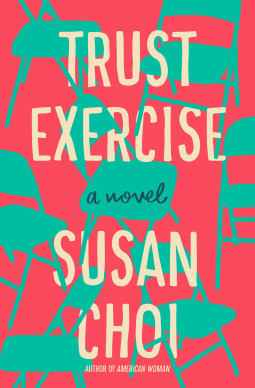
Pulitzer Finalist Susan Choi's narrative-upending novel about what happens when a first love between high school students is interrupted by the attentions of a charismatic teacher
In an American suburb in the early 1980s, students at a highly competitive performing arts high school struggle and thrive in a rarified bubble, ambitiously pursuing music, movement, Shakespeare, and, particularly, their acting classes. When within this striving “Brotherhood of the Arts,” two freshmen, David and Sarah, fall headlong into love, their passion does not go unnoticed—or untoyed with—by anyone, especially not by their charismatic acting teacher, Mr. Kingsley.
The outside world of family life and economic status, of academic pressure and of their future adult lives, fails to penetrate this school’s walls—until it does, in a shocking spiral of events that catapults the action forward in time and flips the premise upside-down. What the reader believes to have happened to David and Sarah and their friends is not entirely true—though it’s not false, either. It takes until the book’s stunning coda for the final piece of the puzzle to fall into place—revealing truths that will resonate long after the final sentence.
As captivating and tender as it is surprising, Trust Exercise will incite heated conversations about fiction and truth, friendships and loyalties, and will leave readers with wiser understandings of the true capacities of adolescents and of the powers and responsibilities of adults.
Susan Choi was born in South Bend, Indiana and was raised there and in Houston, Texas. She studied literature at Yale and writing at Cornell, and worked for several years as a fact-checker for The New Yorker.
Her latest novel, Trust Exercise, was the winner of the 2019 National Book Award for Fiction, and was a national bestseller. Trust Exercise was also named a best book of 2019 by The Washington Post, Vanity Fair, New York Magazine, Marie Claire, Cosmopolitan, Buzzfeed, Entertainment Weekly, Los Angeles Times, ELLE, Bustle, Town & Country, Publishers Weekly, The Millions, The Chicago Tribune, and TIME.
Her first novel, The Foreign Student, won the Asian-American Literary Award for fiction, and her second novel, American Woman, was a finalist for the 2004 Pulitzer Prize.
With David Remnick she co-edited the anthology Wonderful Town: New York Stories from The New Yorker, and her non-fiction has appeared in publications such as Vogue, Tin House, Allure, O, and The New York Times and in anthologies such as Money Changes Everything and Brooklyn Was Mine.
A recipient of fellowships from the National Endowment for the Arts and the Guggenheim Foundation, she lives in Brooklyn, New York with her husband, Pete Wells and their sons Dexter and Elliot
ME to SUSAN CHOI: “I did not enjoy this book.” Susan: “You did not enjoy this book.”
“I did not enjoy this book.” “You did not enjoy this book.”
“I did not enjoy this book.” “You did not enjoy this book.”
“I did not enjoy this book.” “You did not enjoy this book.”
You’ll get it after reading Trust Exercise... or maybe you won’t. Which is exactly where I am after reading this book. WHAT HAPPENED?! I really need someone to tell me because I do not understand it! I didn’t understand who was who, who was telling the truth, and what it meant to the whole story. But maybe I’m not meant to understand it.
While Trust Exercise is written well, I could not care less about the characters. And with the way it ended, I did not enjoy this book.
(BUT- I do think we’ll have an AMAZING book club discussion about it.)
Trust Exercise is a novel about a performing-arts high school in a sprawling southern city that for some reason is never named (it's Houston). The first half of it is told from the point of view of Sarah, one of the students, who goes through the usual issues with friends and boyfriends and parents, although everything is ratcheted up to 11 here, I guess to emphasize that performing-arts schools can be a tad... dramatic? Self-important? Certainly the writing in the first half of the book would support this idea: Sure, everything feels like a big deal in high school, but does it really feel like THIS BIG of a deal? Everything is overwrought. Everything is overwritten. Everything is like a tiny terrarium into which way too many lizards have been crammed. The sides of the terrarium are steaming up! Everyone is flushing pink and sweating (literally; I got a little tired of learning how everyone smelled)! Who keeps reaching into the terrarium and poking the lizards? Why, the illustrious drama teacher Mr. Kingsley, a man with such an inflated sense of the significance of himself and his theatre (never theater, god forbid) department that he was only bearable if, every time he appeared, I imagined Jon Lovitz's voice in my head, intoning:
HELLO! I AM LLEWELLYN SINCLAIR!
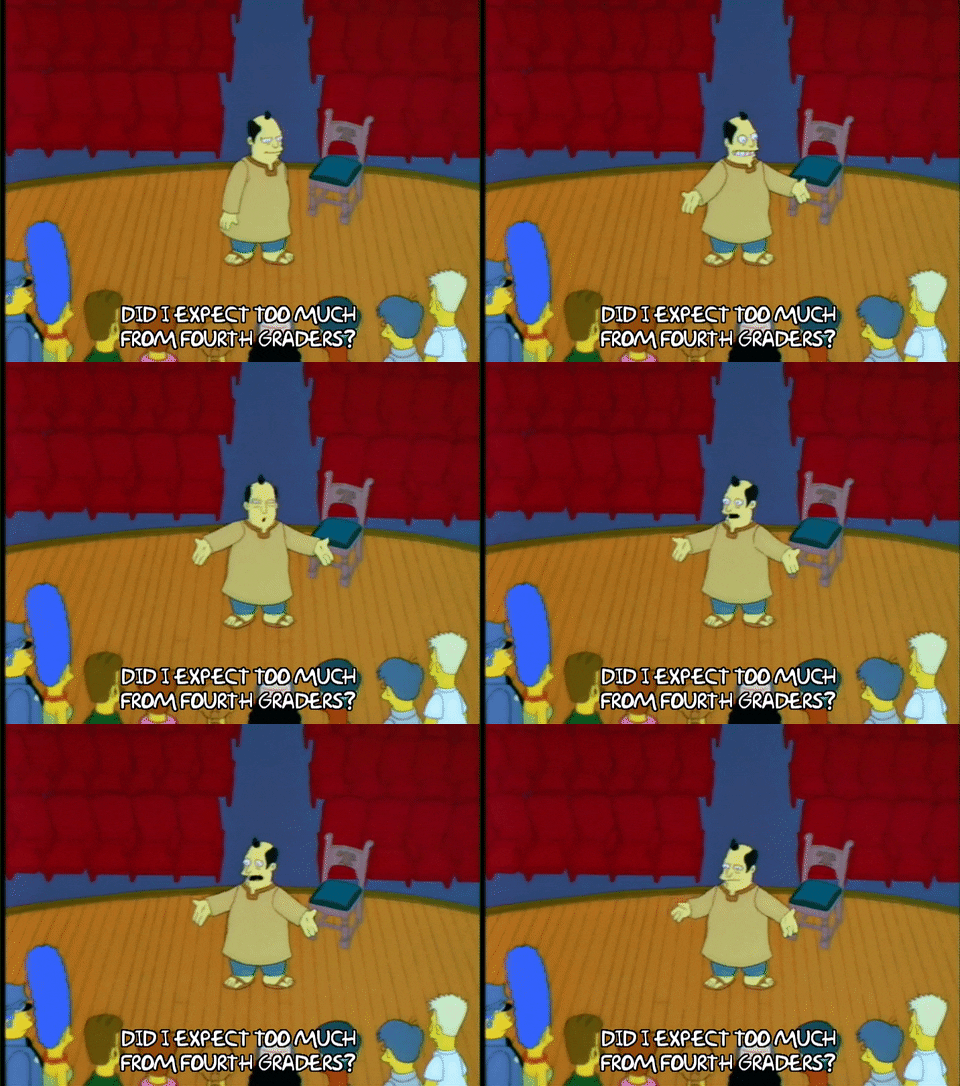
Here’s Mr. Kingsley’s oversize ego on display:
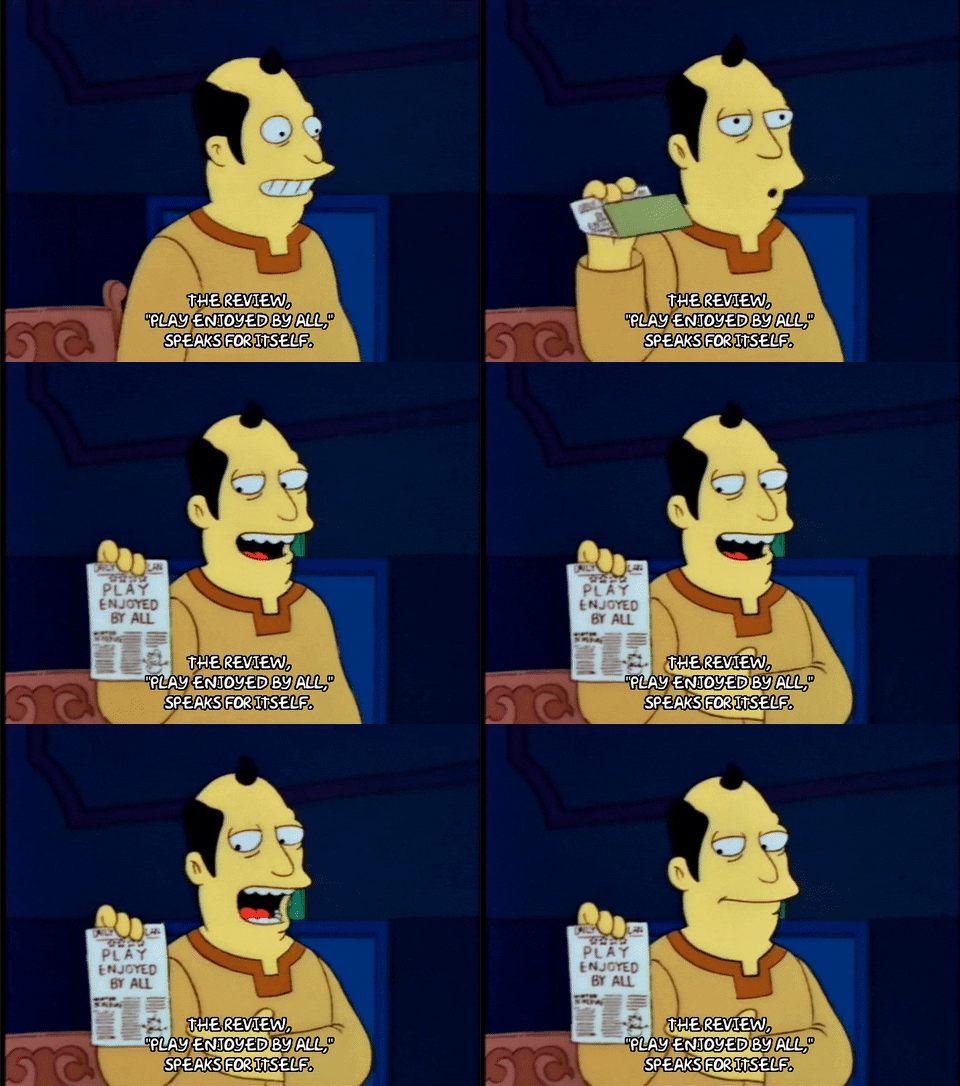
Here’s Mr. Kingsley getting inappropriately involved in his students’ personal lives:
Honestly, everything about this section annoyed me, from the creepy adults to the creepy students to the eyerolling intensity (HELLO! I AM LLEWELLYN SINCLAIR!) of everything they did. Houston was portrayed as a bunch of parking lots connected by multilane boulevards and highways, which was probably accurate but horrible to have to spend time in. Everything was yucky and gross and impossible to care about. I wanted to give up so much but kept going because (1) I have liked Susan Choi’s work in the past, so I was giving her the benefit of the doubt; and (2) I’d heard there was some kind of “twist” halfway through, and I was curious about what it was. I thought there was a chance the book could still be redeemed.
Then the “twist” happened. Without really giving anything away, the twist is that the second half of the book is told from the point of view of a character who is peripheral to the first half of the novel. Peripheral Character is here to let you know that not everything Sarah told you is true. Peripheral Character is also extremely boring and prone to parsing words, listing their synonyms and how they can circle back around to words that don’t mean quite the same thing as the words they are supposed to be synonymous with. The point of this seems to be that NOTHING IS AS IT SEEMS. The New Yorker review makes much of all this, intoning that the first half “of the story serves one of its characters [i.e., Sarah] more than the others.” But isn’t this how it always is in fiction? The author chooses which characters to use to tell the story. The other characters are there but don’t really get a say in what’s going on. This is literally what happens in every piece of fiction. Why is it unique here? Is it because Choi switches to the point of view of a character who was peripheral in the first half? For me, it just heightened the level of “Who cares?” about the whole thing. Who cares about Peripheral Character? Who cares if Peripheral Character says not everything happened the way Sarah told it? Who cares what Peripheral Character’s experiences were? Peripheral Character sometimes switches back and forth between first and third person to remind us that she, too, is adding her own gloss on things, but… who cares?
“Isn’t it all fiction anyway?” I kept asking myself. This is the first time I can remember ever asking that about a novel I was reading. Usually these issues of character reliability, of point of view, of plot, matter to me. I would ordinarily never say “Who cares? Isn’t it all fiction anyway?” The fact that I did it multiple times with Trust Exercise can mean only one thing: This novel didn’t work for me at all. And those endings! An initial "ending" that was simultaneously preposterous and utterly predictable, followed by another “twist,” with an even higher “Who cares?” factor than the previous one, that didn’t tell me anything I hadn’t already figured out long ago.
Trust Exercise made me think a lot about experimental fiction. If you asked me, I would say that I love experimental fiction! I love having the rug pulled out from under me, I love having to think about who to believe, I love having to turn the whole thing over in my head and figure out how it works. But Trust Exercise really brought home the idea that if your novel doesn’t have a solid foundation—credible characters, good writing, a plot that really works—an “experiment” turns into nothing more than a cheap trick. And that’s what we have here.
As I mentioned, I’ve liked Susan Choi’s writing in the past. I also once met her at a reading and she seemed like a great person. For these reasons, I almost gave this book 2 stars. But the fact is, for any other writer, this would have been an obvious 1-star. The fact that I know Susan Choi knows what she’s doing actually makes things worse, not better. She obviously thought what she was giving us in Trust Exercise was good enough. For me, it was not good enough. This book was the worst kind of trust exercise: I had faith that Susan Choi would catch me, and instead she just let me hit the floor. The headache I got is nothing compared to the disappointment I feel.
Wow, this one didn't work for me at all. Given how much I read I guess it's surprising that it doesn't happen more often.
Susan Choi's newest book, Trust Exercise, is a marvel of language and imagery, but on the whole, I found it confusing, a bit meandering, and once Choi flipped the script on the plot, I wondered whether what I was reading was actually happening or if it was a figment of the characters' imagination.
The book took place in the early 1980s at the Citywide Academy for the Performing Arts. The first-year students are ready to being learning Stagecraft, Shakespeare, the Sight-Reading of Music, and, of course, acting, where their charismatic teacher, Mr. Kingsley, puts them through a variety of trust exercises, challenging their sensory perceptions and awakening their emotions.
Two students, Sarah and David, fall for each other, and begin a passionate yet mercurial relationship in full view of their fellow students. But neither of them are ready for the ramifications of a relationship, and they're not prepared for the manipulations of their peers—or Mr. Kingsley, for that matter. In an effort to drown out the pressures of everyday life, Sarah makes a decision which has major ramifications, ramifications that ripple long into the future.
And then Choi speeds up the timeline and sets the book in the future, and the whole narrative goes hazy, so you're not sure if what you read actually happened, or if Choi simply wants you to question the storyline. But that's not her only gimmick, as she throws yet another twist into the plot that once again left me shaking my head.
Susan Choi has been a finalist for the Pulitzer Prize, and certainly there's no doubt about her writing ability. But unfortunately, Trust Exercise never worked for me. I have seen some really positive reviews, however, so it may work for someone else.
NetGalley and Henry Holt & Company provided me a copy of the book in exchange for an unbiased review. Thanks for making this available!
One lurks in every high school: a charismatic teacher who cultivates a clique of acolytes. Miss Jean Brodie aside, this teacher is typically a man in his prime, parceling out the precious gift of his intimacy to a select group. No matter how many years have passed, you can probably still recall his name at your own school: the droll iconoclast who always seemed at odds with the administration, the cool teacher who made thrillingly inappropriate asides. Amid rumors of some past glory, he radiated an air of long-suffering superiority, as though his willingness to teach mere high school students were another example of his largesse.
In fact, as you realize later, he could thrive nowhere else but in that moist terrarium of adolescent desire. He was a vampire thirsty for the fervor of teenage boys and girls.
That immortal figure rises up at the center of Susan Choi’s “Trust Exercise,” the latest of her startling novels about academic life. Mr. Kingsley is a theater teacher at Citywide Academy for the Performing Arts, an elite institution “intended to cream off the most talented” students and prepare them for “their exceptional lives.” Mr. Kingsley is exotic by the standards of this unnamed Southern town in the early 1980s. He once lived in New York! He refers to Broadway star Joel Grey as Joel! He owns a “bizarre human-size doll that was supposed to be called a ‘soft sculpture.’” To the theater students desperate for his attention, “Mr. Kingsley was impossibly witty and sometimes impossibly cutting; the prospect of talking with him was terrifying and galvanizing; one longed to live up to his brilliance and equally feared that it couldn’t be done.”
This is the most precise skewering of a magnetic teacher since Muriel Spark’s 1961 classic. Choi’s voice blends an adolescent’s awe with an adult’s irony. It’s a letter-perfect satire of the special strain of egotism and obsession that can fester in academic settings. Choi is particularly attentive to Mr. Kingsley’s inane maxims, which his adoring students polish into sacred . . . .
Incredibly ambitious structurally, with a shape that is more organically interesting than ASYMMETRY (which it is quite similar to). Reminds me a bit of SPECIAL TOPICS IN CALAMITY PHYSICS, but loses its connection to the fun teen drama that propels the first 100 pages of the novel. A very, very fun book to talk about, and think about. I'm just not sure: the ambiguity about what is true at the end of the novel is a slight misstep - I would have liked this a touch better if, toward the end, there had been more answers. I love withholding novels, but I'm not quite sure if the math of this structure quite adds up.
This is a book that has some structural tricks up its sleeve, similar to books like FATES & FURIES and ASYMMETRY. So you need to proceed with caution when reading anything about it. Just saying it plays with structure feels like a bit of a spoiler, but in this case (like both the books I mentioned before) I think it's good to know because some may find the first section of the book grating enough to quit, not knowing what they are losing by bailing early. Like the other two books, I'd recommend you get at least halfway through before you decide to jump ship.
Now that I've said all that I have the tricky job of trying to tell you all the ways this book thrilled me without being able to actually tell you about the book. TRUST EXERCISE feels like it's in conversation with Choi's last novel, MY EDUCATION. It feels like there are ideas around the power dynamics between men and women, between teachers and students, that she is not done working out. It feels like the right time to do that, the book is timely in a way that makes me worry about seeing too many reviews with hashtag-metoo attached to it, but it really does feel like it's of this particular moment. It is about the narratives women give themselves about the relationships and encounters with men that can leave them with scars of all sizes. It's about the intensity of being a teenager, the depth of feeling and experience that happens without a full understanding of what it means and who you are.
There is some particular joy in this book for theater kids, who will recognize the tight-knit community theater kids form that includes its own dramas and jealousies. It is also a book about the way writers process and change the world and does so in a way that feels fresh and not just another writer-writing-about-writers retread.
I noted in my review of MY EDUCATION how very sharp and amazing Choi's prose and observations are, and I noticed it once again here. Sometimes she has a sentence that makes you gasp from the truth and perfection of it. The style of the prose, overall, can be a bit confounding. It's purposeful, this is a book that makes the reader work, a book that is always aware of just how much it knows that you don't. It can take a little time to get your head straight sometimes, and an entire section switches pronouns just to remind you of its little trick in a way that some may find infuriating but that I adored. (I have a feeling there is a decent number of people who will find the entire book infuriating but I will continue to passionately love and defend it. I love this exact kind of difficult book.)
I am seriously considering re-reading this entire book. (After finishing I immediately reread the final section, which was 100% the right decision.) Even better, I am considering re-reading MY EDUCATION and then re-reading this book. I have a tendency to race when I enjoy a book, I can't let myself slow down and feel it and this time I would like to savor every bite.
Update: I reread MY EDUCATION and then reread TRUST EXERCISE and it was fantastic, highly recommended. TRUST EXERCISE is a book that can leave you feeling like the floor has been pulled out from under you and not all readers like that. This kind of structure can also mean the book doesn't hold up upon subsequent readings. But this one absolutely does. In fact, I had even more joy the second time through knowing what the pieces were and seeing how Choi brings them together. And seeing the ways in which she leaves questions still open. I am fascinated by the ways in which we process the same experiences differently and this book dives into that so hard, I just loved it. I loved how the narrative "tricks" of the book aren't just there to trick you, they're there to tell you something specific about who these people are and why they are telling this specific story. I particularly love the shifting voice and acerbic tone of the second section, it was so incredibly gratifying.
Now Winner of the National Book Award 2019 This experimental novel discusses consent by shifting timelines and perspectives, thus forcing the reader to question and re-adjust which characters to trust - and it's no spoiler to state that in the end, no one will turn out to be who you thought they'd be. Choi starts with a high school drama that then turns into a meta-fictional revenge tale only to end in an even more disturbing coda, and I just love how she defies expectations and disrupts narrative conventions: There's a certain brutality in the ever-shifting reading experience, and the novel also requires some detective work in oder to find out what is actually going on, so there's all the stuff I enjoy in experimental fiction!
In the first part of the book (there are no chapters or other indicators, you have to unlock the story) which takes place in the early 80s, we meet outsider Sarah and rich kid David who are teenage students at a renowned arts high school in an unnamed big city in the southern part of the United States. In an environment full of aspiring artists who dream of taking the big stage, dynamics of power and dependency unfold. The enigmatic theater teacher Mr. Kingsely uses his position to manipulate students, he tries to break them down and submits them under so-called "trust exercises" where they have to look at each other, repeat each other's sentences or openly reveal all kinds of hidden thoughts. Nevertheless, the students fight for Kingsley's approval. When David and Sarah fall in love, their relationship quickly turns sour, which intrigues Mr. Kingsley. Sarah ends up having a questionable sexual encounter with a 24-year-old actor who visits the school with his own students from England.
I will certainly NOT tell you what happens next, because it would ruin the reading experience for you, but let me say that after reading the whole novel, you will give a very different account regarding what happens in the book than I just did. Choi negotiates power in sexual relationships, responsibility, victimhood, and awareness, and she does it in a very clever, challenging way. Other reviewers compared this book to Asymmetry, and there is some truth to that, but Choi uses her narrative shifts to constantly re-write part one, thus illustrating the effects of framing, scope, perspective and also empathy. Here, the asymmetry is brought about by the point of view and, above all, the judgement passed by different characters. Who owns the story, whom can you trust? You clearly can't trust the book itself, as it takes you for a ride while you as a reader are forced to trust the narrative to even follow it - and this context, please note that our protagonist attend an art school.
I applaud Susan Choi for this daring feat of a book, it's engaging, surprising and intelligent. Although it's a high concept novel, it does not become too theoretical, because the emotional landscapes of the protagonists are so well-rendered, including their bad and contradictory affects, that the text remains immersive. The atmosphere and evocation of historical time are aqlso spot-on. I hope Choi's #metoo-novel will get nominated for some awards, because this novel deserves attention.
Curiosity got the best of me. I knew I wasn’t going to buy this book…but when the library had it available as an ebook on Overdrive, I thought I’d check out what all fuss was about.
I saw 1 star reviews from friends that I’d never seen rate ‘any’ book lower than 3 stars. But then... Lots of 5 stars followed.
It didn’t take a rocket scientist to know there was some kind of controversy over this book. Well, yeah... the author is a Pulitzer Prize finalist. Made me wonder - how bad could the book be?
Reactions from readers are strong: for it - or against it.
Curiosity was over for me at 8%. I fall into the 1 star group too. I simply did not care for the writing. Pulitzer finalist skills or not
Just one of many....excerpts I found dull and exhausting: “This city, like vines with no trellis, sprawled out thinly and nonsensically, its lack or organization it’s sole unifying aspect. Gracious neighborhoods of live oak and chunky brick mansions where David lived, lay cheek by jowl with wastes of gravel, or US Postal Service facilities resembling US Army bases, or Coca-Cola bottling plants resembling wastewater treatment facilities. And chintzy, labyrinth apartment complexes of many hundreds of two story brick boxes, strewn about scores of algae-stained in-ground swimming pools, such as the complex in which Sarah lived, might exhaust themselves at their easternmost edge on the wide boulevard, lined with tattered palm trees, which on its opposite side washed the gates of the city’s most prestigious club for Jews”.
My favorite quote by the reviewer *Bibliophile* was the sound advice given to readers: “My suggestion: follow your instinct. If you don’t like it after the first few/ several pages, stop reading”. I took the advice.
Other readers said they kept reading - looking - hoping for some redeeming quality. They never found any. I believe them.
Page after page were long-winded paragraphs that I found completely boring: over-written and pretentious.
So... between *Bibliophile* suggestion - other low rating reviews- and my own experience... I tossed it.
(Full disclosure: Book abandoned on page 61 out of 257 pages.)
It's so important to care about characters, really care, to be invested in what happens in a story. I couldn't have cared less about those in Susan Choi's Trust Exercise. In part one, the story is about high school freshmen David and Sarah studying drama in the early 1980s as they develop a romantic relationship. I couldn't get a solid grasp of just who these young teens are. Thanks to Choi's love of narrative summary, they're merely names on a page, not characters brought to life. There's little action and dialogue in Trust Exercise that would have allowed me to draw my own conclusions about David and Sarah and the peripheral characters. Instead in large blocks of text, Choi filled me in: their history, their thoughts and feelings, what they think of various other characters—everything. It's dispassionate, boring storytelling.
As for David and Sarah's relationship, it begins with a groping where the consent is questionable but that Choi presented as acceptable. From there the relationship is defined mostly by overly detailed descriptions of sex, which left a sour taste in my mouth. Teen sex is a reality, but there's something repellent about reading every detail of their encounters. A fade-to-black would have been more fitting.
As someone who loves stories set in academia, I looked forward to reading Trust Exercise, but it's firmly set in the world of drama students. I haven't studied drama extensively, which wouldn't matter if Choi hadn't described the classes in a way that only drama students could appreciate. For pages she described each aspect, no matter how small, of a trust exercise between David and Sarah. This scene is supposed to be tense, but owing to superficial characterization and Choi's failure to establish high stakes, it's instead tedious. David and Sarah aren't compelling.
The literati will probably adore Trust Exercise. Choi was a Pulitzer-Prize nominee for a previous work, and Trust Exercise is written in that introspective, artistic (and sometimes hilariously overwrought) style that makes snobby intellectuals feel smart for appreciating. They can have it. All other readers should look elsewhere.
NOTE: I received this as an Advance Reader Copy from LibraryThing in January 2019.
Sarah e David non hanno ancora sedici anni: e quindi, non hanno né patente né auto, un handicap perché abitano in una grande città del sud degli States dove l’auto è indispensabile. E poi, a quell’età, l’automobile è libertà, è sesso. Risolvono facendolo selvaggiamente in un corridoio dietro l’aula musica della scuola, o appoggiati ai bidoni della spazzatura nel campo di football. La loro è una scuola esclusiva votata al teatro, recitazione e regia e affini (scenografia, costumi…). Si attraggono e si respingono. Si cercano, si scopano, poi tacciono e si allontanano, si evitano, fino al bacio seguente, o a un’altra scopata. Si desiderano, fanno sesso, ma non si possiedono mai davvero. Lingue fameliche, mani avide, sprizzano carnalità da ogni poro: e una paura l’uno dell’altra che risulta panico.
Choi li segue, li incalza, esplora i pensieri, e ancor più i sentimenti e le emozioni, la paura e la sofferenza. Entra sotto i loro vestiti, nelle ascelle e nel cuore, nella bocca e nelle mutande. Perlustra ed esanima sia lei che lui, femminile e maschile. Si allontana per inquadrarli nel gruppo, coi loro coetanei, e i docenti. Sembra una macchina da presa che non molla, dietro mentre si muovono, e camminano, la nuca, e poi gira intorno, il viso, il dettaglio delle labbra, le bocche che si schiudono per avvilupparsi e non lasciarsi più se non per penetrarsi di nuovo. Ma non una macchina a mano, piuttosto un’abile steady. Non molla mai, Choi, e lo fa senza abbandonare un filo sottile d’ironia, che però non cancella l’empatia che però non dimentica la giusta distanza, Sarah e David, e gli altri intorno a loro, pregi e difetti, virtù e limiti, qualità e rigidità.
Così per le prime ottime cento pagine. Poi c’è una sterzata improvvisa: i ragazzi sono passati dal primo al secondo anno, continuano gli esercizi di fiducia – parte del training di recitazione – e a scuola arrivano dall’Inghilterra dei coetanei, anche loro studenti di teatro, e con loro il prof regista e un altro giovane adulto, la star della mini compagnia. Sono ospiti dei nostri, uno di qua e una di là, due qui e due lì. Qui, per qualche decina di pagine (una quarantina), Choi sembra smarrirsi: non è chiaro l’apporto di questi personaggi alla narrazione, perché li racconta così a lungo – ma senza farceli conoscere – perché li dipinge così cialtroni e stupidotti. Col risultato che la mia fiducia in lei ha vacillato. Poi quando gli adolescenti, e i giovani adulti, nonostante l’oceano che li separava, cominciano ad avvicinarsi veramente e accoppiarsi, ho ritrovato fiducia in Choi, e nella sua scrittura, che, a dire il vero, non si è mai smarrita, ha sempre mantenuto la barra dritta, perfino nei momenti più improbabili e tirati.
Il romanzo è diviso in tre parti e ognuna si chiama Esercizi di fiducia. La seconda balza avanti rispetto alla prima di una dozzina d’anni e ritroviamo i personaggi ormai trentenni. La terza fa un altro salto avanti. Ogni sezione cambia il punto di vista: nella seconda per esempio diventa quello di Karen, più che quello di Sarah e David, e lo leggiamo un po’ in prima e un po’ in terza persona. La storia che abbiamo letto assume altro aspetto, sembra quasi un’altra vicenda, e anche gli ‘attori’ sembrano diversi. Ma, grazie al talento della Choi, ha poca importanza quale sia la variante giusta: tutto appare reale, più vero della verità.
La cosa che mi ha veramente fatto incazzare, di quello che hai scritto è che hai scritto un sacco di cose esattamente come sono successe, e poi hai lasciato fuori la verità.
I am obsessed with feeling intelligent. That's why every year before this one I forced myself to read at least one classic a month (including years where basically every other book I read was a young adult contemporary romance, and therefore the copy of A Midsummer Night's Dream I read in the waiting room of the dentist's office before getting my wisdom teeth removed looked very out of place). It's why this year, my most read genre is literary fiction by a factor of, like, 12. It's why now that I read very little YA, I feel I have a reputation to uphold and I'm never going back.
And it's why I almost always like books like this one.
Who am I to go against the National Book Award? Little old me against the canon itself? I don't think so. I'm not that powerful even when my god complex is rearing its magnificent head.
So normally, when there's a book that won a prestigious award, I am GOING to like that book. Caving to peer pressure erryday.
But this one...no.
It was deeply unpleasant to read, making me feel anxious and overwhelmed at every other page. I was fully absorbed into this world of fourteen year olds, and then when decades suddenly passed and the fourteen year olds were older but equally exhausting, no background character development having occurred, I was no longer absorbed but just annoyed.
This was very difficult and it was difficult for nothing. Nothing changes in this whole book, and not in a way that intends to show us something, I think. The lack of difference and the sudden shifts and the confusing quote-unquote twist that was supposed to be present but I couldn't even locate on the page...maybe if I were feeling generous, I'd say it was all intended to show that the types of power dynamics and sexual and romantic trysts that occur in this book never change no matter how old we get, or how powerful, or where we go or don't.
But I'm not feeling generous. I'm feeling annoyed.
So I'm going to say this was a whole wad of pointlessness and move on.
Bottom line: Reading this book felt like being under a down comforter in the middle of summer! Overbearing and uncomfortable and just unnecessary.
------------------- pre-review
i get it now.
review & rating to come
------------------- tbr review
not sure how a book can both win the National Book Award and have a 3.14 average rating but i'm excited to find out.
------------
taking lily's idea and reading only books by asian authors this month!
Thank you to Henry Holt & Company and Netgalley for the opportunity to read this book in exchange for an honest review.
Boy, oh boy - where to start? Unfortunately, I have no real positive things to say about this book. I have had it for weeks. Within the first 10 pages I knew this was going to be something I would struggle with. The best way I can describe it is trying to read a book while it's under water. It's never quite fully in focus and I felt like I was only picking up every other word or so. To explain it another way - there is way too much superfluous language and also it doesn't read how I would normally talk. I felt like I was reading a translation of another language. Susan Choi obviously has a talent for the written word, but I wouldn't say she writes for the reader, she writes for herself and the literary critics. (I could be way off base here, and I don't mean this in a mean way, but when 2 or 3 words work, why do you need to use 10? To show off?)
I thought this book would be kind of like Fame - young kids (Sarah and David) who fall in love in the 1980s at a prestigious art school. Not even close. I feel terrible saying this, but don't waste your time. There are too many amazing books out there.
Once you're old enough to recognize a hole in yourself, it's too late for the hole to be filled. (p. 185)
I found this disturbing and lacking of a plot and full of contradictions.
I should have been able to relate to this more, being from a big town in the South (the nameless location ressembles the flat urban sprawl of Miami) and being a teen in the 1982 (but about 3 years younger than the protagonists. Maybe I have an exceptionally puritanical background, but I don’t recall all the girls around me at 14 or 15 having had sex with many partners including many older men. I am not saying that I didn’t know any, but they were exceptional and the stories I only heard decades later. Of course, I wasn’t in theatre, so maybe the promiscuousness was endemic to that crowd? Maybe some other CGHS or SMHS alumni will chime in.
Trust Exercise is the intense acting workshop by “Mr Kingsley” at which the lives of the protagonists Sarah, Karen and David intersect and to which a visiting English class injects a certain amount of chaos and debauchery. The kids are all 14/15 and have all had sex with each other it seems, encouraged by their gay teacher who abuses one of them, the one hispanic Manuel. This act is hardly condemned in the book, a point which disturbed me. That and, if my assumption is correct about this being in Miami, the anachronism of only having one latin kid because after the Boatlift in 1979, Miami and all of Southern Florida was already swarming with Cuban students.
In terms of plot, there is not much consistency as we read Sarah’s account of her junior year (although most kids were 15/16 when I was a junior rather than 14/15) in the first chapter which is discounted by Karen’s version in the second chapter which is written 15 years later. There is a sort of climax (but quite predictable) at the end of Chapter 2 and then a short, unsatisfying denouement in Chapter 3.
There is some punishment for the bad guys, but it felt like an anti-climax. The writing is sort of a poor pastiche on DFW’s style with heavy descriptions like in KOK but with far less humor or even humanity. The characters felt stiff and hardly self-aware, sort of worked over cardboard figures. Karen’s obsession with language seems almost out of character and I felt like the author was beating me over the head with a dictionary justifying her word choices every other sentence; it was aggravating.
I hesitated between 2 and 3 stars and went for 3 because there are some interesting passages and insights such as the quote with which I started this review. However, despite being on some Pulitzer lists, I think this book is second or third tier, despite the author’s credentials. Not sure I will delve further into her writing.
I was lured in by the promise of all those awards it won (or was it only one? don’t know) I thought it might be one of those books you either hate or love (judging my the mixed reviews and the overall GR rating) but really it was in between for me.
It’s really hard to say anything without any spoilers since it’s that kind of story/book.
In a nutshell there’s 3 parts to the story, part one takes up most of the book and is set in the 80’s with the characters being teenagers and then the second part switches to a different narrator, Karen, and the events take place many years later.
The next thing I’m gonna say is a spoiler so watch out - the second part reveals that the first part was not actually true but it was part of a novel that the character of Sarah wrote (who was sort of the protagonist from part one).
Now, I won’t say anything more about part 3 which is only a few pages long, because it would be very spoilery but also because to be honest, I’m not even completely sure what happened.
Here’s what I’m assuming: most of the characters in this book are not real (i mean in the book world) they all embody different traits found in one or maybe two real (book) life people which inspired them. I think Mr. Kingsley can actually be found in both Liam and Martin. And that Mr. Kingsley is not real either - as Karen pointed out- but he is actually Mr. Lord?! Maybe?! Also can Sarah and Karen be one and the same, sort of like contradicting realities of the same person?! At this point anything is possible!
I’ll be honest in saying that I’m not 100% sure of anything in this novel, but I can guess most of it?! I can definitely pick up on certain cues but then, we’re basically being told that we are reading subjective accounts and some might even be fabricated and not just hidden under false names. So after rationalising all that, I suppose that you see/understand what you want and that’s the whole point!? But not really the whole point because there is like an umbrella type of theme, covering this whole convoluted (because - human nature duh) but actually simple story - and depending on who is reading, they might find it to be different.
But to speak in more general terms, the themes in this book speak to a lot of issues. They touch upon the #metoo movement (imo- also the book came out around that time) they definitely speak of manipulation, betrayal and obsession. The line between truth and interpretation, friendship and all its pitfalls .. but most importantly I’ve found the concept of individual or personal reality as something prevalent here. Everybody’s version of events differs depending on who they are and what they aspire to.. it’s so easy to distort reality and question what is even real, because I sure did while reading this.
To conclude, while I did like the idea of the book, and the themes it approached, I think it just didn’t manage to be compelling enough. The story needed something more and the writing felt a bit lacking in some places. There was a lot of repetition, which I believe was intentional, but it just didn’t work for me, it didn’t have the intended effect.
Wanted to enjoy this one but I struggled to connect to the characters. From the reviews I read on Goodreads, people have mixed feelings about the structure of this book – the experimental nature of it, the unreliable narrator, the ambiguity of the plot, etc. For me, all of those components felt secondary to how I could not connect to or grasp the characters on an emotional level from the very beginning of the story. They all felt like composites of characters, perhaps because Susan Choi describes them at a distance, summarizing their thoughts and emotions and histories instead of showing them to us with more vivid or real-time description. Somewhere in Trust Exercise is a novel that asks deep questions about what it means to trust a narrative, the reliability and unreliability of our own narratives, and the repercussions of cyclical abuse. But I never felt invested enough in the characters, which reduced my motivation to stick with the novel’s stylistic twists and turns.
This book was not for me but I will read more of Susan Choi in the future, as I own at least one other of her novels and she seems like a smart, incisive writer overall, despite how Trust Exercise fell short for me.
I like it the more I think about it. And it's a thinker for sure. You can't really take it at face value, it begs to be Discussed.
Allow me to be as cryptic as possible. It starts off as a traditional narrative and your mileage may vary based on how much you like it. A lot of reviews I've read didn't like the first section, whether because of the plot or the writing. I happened to enjoy it, I thought it was an interesting, unidealized, almost dark portrait of teenage life at a performing arts high school, and although the writing was maybe overstated, I really liked it. The following sections are each totally different. It all becomes more meaningful by the end if that helps.
There are some timely themes and they're explored in a unique, fascinating way. If you read it hit me up and we can chat. :)
To one degree or another we are manipulated by writers. I don’t think it matters if we read fiction or nonfiction we are influenced just the same. Skillful writers tinker with our beliefs, emotions, philosophies, knowledge (or lack thereof) and so much more. On some level, regardless if we agree or disagree or if we like or dislike what is presented, an element of trust comes into play. Beyond the trust exercises that the characters engage in during theater classes, this novel is an exercise in trusting the author. Told in three parts, each part turns the preceding part on its ear. This comes off as a contrivance rather than as a subtle manipulation. While this is skillfully written and structurally enterprising, on the whole it was much too obvious for my taste.
Trust Exercise. There are seemingly infinite variations but most of us know what it means: surrendering to processes such as falling backwards and hoping to be caught or sharing intimate remembrances in a group and hoping to be accepted.
We all understand the meaning of trust exercises. Or do we?
In Susan Choi’s brilliant novel, we meet a group of students who are attending a gifted performing arts school, majoring in theatre. Two of the students are the focal point — David and Sarah, who become entranced with each other. Under the tutelage of their unconventional but charismatic acting teacher, their emotions are mined to help perfect their acting abilities. The lens of the story widens to highlight other key characters but it is still Sarah’s story to tell.
And then, in Part II, everything changes and Trust Exercise takes on a whole new meaning. Suffice to say that the new trust exercise is between the author and the reader. And it is up to each one of us to determine whether we want to go where this author—Susan Choi—is taking us. It dives right into the meaning of “what is true and what is false” and how much we can trust another person’s narrative.
There are many negative reviews written about this book and I must confess that they affected me enough to have held off reading it. Trust Exercise is not for everyone. If you enjoy linear books that don’t demand full attention, this is not the book for you. But if you like books that challenge your thinking and go beyond the story to examine “what is the true story”, then do yourself a favor and read it.
The ending—the last 20 pages—upends everything once again and had me literally gasping. I’ll be thinking about this book for a long, long time.
This is a hard novel to discuss without ruining the experience so I will just say it starts out with high school students in an arts magnet school with a lot of theater focus. I read it because it was on the Tournament of Books Camp Tob list.
More detailed thoughts that I'll hide behind a spoiler. I really recommend reading this without reading about it.
National Book Award for Fiction 2019. Choi brilliantly explores trust in a multitude of forms. There is the literal trust exercise that theater teacher, Mr. Kingsley, has the students undergo at the Citywide Academy for the Performing Arts. Then there is the trust of new love between sophomores David and Sarah that flounders; or the betrayal of trust between teachers and their students. And that’s just in part 1!
Then Choi challenges the trust the reader has with the narrator in part 1. She introduces a new narrator in part 2 and moves the plot forward by roughly 15 years. Karen reveals that part 1 is actually a book written by Sarah. Karen is a bitter woman harboring resentments over matters of trust—the smashed trust of friendship and the exploited trust conducted by a predatory older man.
Part 3 is a coda of sorts. It takes place roughly 10 years after part 2. Clare is searching for truth regarding the history of the high school. But can she trust the answers she is receiving. Memory can be clouded by time and choice. Recommend.
This entire review has been hidden because of spoilers.
This was one of my favorite novels of 2019. I picked it up after some friends had raved about it, and now I'm going to do my best to rave about it to you.
The story starts at a prestigious high school for students in the performing arts, somewhere in the American South. (The city's location isn't named, but I've seen other reviewers who have speculated that the description points to Houston, Texas.) The reader meets Sarah and David, two teenagers who are madly in love, until they aren't. The first half of the book charts the up-and-down love affair of Sarah and David, and how their tempestuous romance affects their relationships with other students and teachers.
I didn't expect to love a novel about high school — friends may know that I'm typically not a fan of Young Adult novels, partly because I'm a grown-ass woman who has no interest in being 15 again but also because the writing in YA is often so juvenile I can't stomach it. However, when the writing is as strong and the characters are as compelling as Susan Choi's book is, I will dive deep into the high school scene and come up wanting more.
Which is what happened to me when Trust Exercise abruptly changed narrators and tone in the middle of the book — I wasn't quite ready to leave the story of David & Sarah behind, but I trusted the author and kept moving along with the new section, which had turned meta. Turns out the first part was a novel within a novel, and in the second part we're following "Karen," a woman who read the first part and says she knows the author "Sarah" and she's going to call bullshit on "Sarah's" version of things.
Confused? It's OK, it took me a minute to catch up, too. But once I realized the clever magic trick Choi had pulled off, I was all in. "Karen's" anger toward "Sarah" and some of the people from her high school days reminded me of the delicious anger featured in Claire Messud's The Woman Upstairs. I loved hearing "Karen's" side of the story, and that she was plotting a bit of revenge on those who had wronged her.
I understand this novel isn't for everyone, but I loved the hell out of it. Highly recommended.
A summary of my thoughts about Trust Exercise is that it’s a no from me.
At a very basic level, by the end of the novel I could see what Choi was trying to do here, and I guess that’s what the 2 stars are for. Maybe they’re also for the fact that this somehow has wowed a lot of people including the National Book Award people, go you Susan Choi.
Ordinarily I like unreliable narrators and narratives, and I appreciate discussion of what we think we know to be true, and how it is we think we know that. I fundamentally thought that this was executed in such a scattered and poorly managed way that I found no interest or enjoyment in it. I never managed to shake the feeling that this story was so very pretentious, that I picked up in the first few pages. Though there were moments of lucidity, ultimately I found this novel to be a hot mess. No thanks, next.
[4+] What a scintillating surprise! I probably wouldn't have read this novel if it hadn't won the National Book Award. Fortunately, my curiosity won out over the mixed reviews. Choi's sharp-edged portrayal of a group of 15 and 16 year old classmates reminded me of my teen years in theatre. Yes, the novel does turn tricky and elusive - but I was captivated, even electrified, throughout. This would be a great book to discuss - I have so many questions! (I really enjoyed the audiobook production but now want to buy the book)
A mess of a book with unreliable narrators and a pretty thin point about the fallibility of memory and the need to be the hero of our own story. The first half bores with a pretty standard look at a high school theatre class filled with angsty teens taught/abused by one of those polarizing teachers who can be considered either a creative genius or a bullying criminal. The next bit has a godawful narrator who refutes large chunks of the first part as she repeats herself, randomly alternates between first and third person narrative, overuses dictionary definitions, and generally comes off as a crazed stalker. This part is even more boring than the first as it leads to its inevitable, telegraphed conclusion. The third and shortest section seems to exist solely to ensure that you finish the book depressed and angered for having read it.
I guess that's the point of the title. I allowed myself to fall backward and no one caught me. The world is shitty and unworthy of trust. The end.
Oh, this is a tricky one, and the less you know about it going in, the better. I especially enjoyed Choi’s use of voice, the switchbacks in characterizations, the timeliness, and the witty way Choi messes with readers’ expectations. Just read it!
How much literary baggage do you carry with you as you enter a novel? I’m not talking about your personal life angst, although that’s material in Choi’s new story, especially the teenage years. But I mean expectation. If the author takes off in a direction not foreshadowed, will you discount her methods? Do you not trust her when that happens, or can you flirt with the idea that your mistrust is misplaced? What kind of contract is forged between reader and writer—that’s a big part of Choi’s narrative. If you demand a more conventional format and construct, skip this story, you won’t like it.
What is the relationship between truth and fiction, and who gets to tell the story? A writer takes full authority when constructing a narrative with several characters. Is it egregious to appropriate someone else’s life for your story? If your subjective eye places most people outside your horizon, are you betraying narrative truth when you eliminate others or give them bit parts?
The story takes place in the early 80s at a performing arts high school in Houston (the city not stated but Choi later acknowledges it). My high school drama teacher in Houston ran her drama classes like she was Uta Hagen, reminding me a bit of the pied piper-ish Mr. Kingsley, the teacher every student wants to impress. The students clamored to be recognized and selected for on-stage performances.
“[Y]oung people… experience pain more intensely than those of us just a bit older. I speak of emotional pain. Your pain is greater, in duration and strength. It is harder to bear.” That was a time “when we were taught that a moment of intimacy had no value unless it was part of a show.”
Choi’s characters perform a lot of challenging trust exercises in their drama class. Mr. Kingsley is charismatic and openly gay, progressive, previously cultured in NYC. The students here want to be validated by the talented Mr. Kingsley. He’s “impossibly witty, and sometimes impossibly cutting.” His practice lessons in “Ego Deconstruction” and “Reconstruction” could make them feel relevant or ignored. David and Sarah, the school's glittering teen romantic couple that everyone is jealous or envious of, feature most prominently in Kingsley’s daily Trust Exercises. Shells detonating.
The middle section takes place twelve years later. The author’s shift in perspective in part II might send you looking back to the more straightforward part I--but, no, you didn’t miss anything. The contradictions are merely slashes in the narrative that cause you to realize a few things about your subjective vs. objective self, and the wide chasms between individuals and their perspectives, and who gets to tell their story. If you seek a layered or fresh perspective on voice and point of view--well, here it is!
All three sections of the book are titled Trust Exercises. The last twenty or so pages causes a minor but inevitable whiplash. It’s only part II that you didn’t see coming, and possibly aspects of part III. In the first hundred pages, the high beam is on the school’s dazzling couple, Sarah and David. There’s lots of sweat and sex and tears between Sarah and David, mixed in with that close, sticky Houston humidity.
Under the aegis of Mr. Kingsley, David and Sarah’s relationship becomes fodder for the drama class, as their “theatre”(never “theater”) teacher contrives daily trust exercises for them, creating a spotlight for the couple to live under.
This may be the most circumspect review I’ve ever written, but I don’t want to spoil any discoveries for the reader. Everyone deserves to be excited or inflamed, inspired or disappointed. Whatever you come away with, I suspect that this novel will, even days later, line your thoughts. There are several themes in TRUST EXERCISES you could spend a semester discussing in a class.
There’s the issue of consent: I think, is that art? or hijacking other people’s lives to suit our own narrative. Are we nearing the fictional truth when we write or even when we read. Choi’s divergence, or misdirection, stirred me. A writer can reshape and blast the singular narrative, and tell two, maybe three or more stories simultaneously. That’s what Choi did, poised in this balancing act, the meta- and the fiction. Her voice of clinical detachment didn’t diminish for one minute the powerful force of her words. In fact, it gave them more voltage. Choi is electrifying, and TRUST EXERCISES uses a brilliant setting to realize this fascinating story.
Thank you to Grazia Rutherford-Swan at Henry Holt for sending me a copy in exchange for an honest review.
On the con side, this is an entire book about kids who spell it "theatre." On the plus side, it's maybe the horniest book I've ever read. Is that a plus side? It's plusish. Look, this is the Age of COVID: we've been in quarantine for five weeks and the whole world is horny on main.
The problem with horny books is that your plot can't just be "everyone is horny" (unless you're Updike, okay Robin?) so it has to go somewhere. You add in your conflict and the next thing you know, you're undermining your horniness. Susan Choi wants to talk about consent, so maybe you can imagine where this is going: the kids spend the first part of the book enthusiastically consenting, and then things are going to get less and less enthusiastic, until none of us are horny at all anymore.
There's a character who's going to fuck a teacher here - this isn't a spoiler, it's the dust jacket - and that's the particularly thorny area Choi really wants to dig into. The student was into it at the time. He's a gross predator - we know that, and she will eventually - and we're all going to figure out that she was preyed upon. This is a great thing to talk about, and Choi does a great job with the issue. But I was a little annoyed by the story mechanics here, which are flashy in an "I just came from the Iowa Workshop" way. Maybe a little more metafictional than strictly necessary. There are two big rug-pulling shifts in perspective over the course of the book. Nothing is as it seemed! Including your horniness!
I was on board for the first part of the book. Sarah and David perfectly capture the drama of highschool romance. For David love is a declaration requiring a grand gesture, but Sarah instinctively recoils at the PDA and hurts David. It just spirals from there, things escalating in their minds. Add to that the fact of them being drama nerds and its becomes altogether extra. I wanted more of this (and I'd get it shortly with Sarah Rooney's Normal People) but then Susan Choi switches gears. It's not about those two at all, she's got bigger fish to fry and that's where she lost me.
The shift in perspective wrong-footed me and suddenly I'm thrown out of the story and trying to align the pieces in my head. I've moved beyond unreliable narrator into meta unreliability and teetering at the edge of why should I care at all. And considering some of themes she's exploring that's a dangerous sentiment to hold. Some wild coincidence, another shift, and a weak stumble to the end and it just feels I've just never made the necessary connections that would reveal Susan Choi's grand design.
Susan Choi has a hold on me. Once again, this grabbed me and pulled me. Not so much for the characters, but the prose pure poetry. The writing is elegant and transporting.
"Can't there be a silent language?"
The story focuses on students at an elite high school theatre program. I loved how the novel opens and how the trust exercises in class were paralleled to their social lives. These teenagers are horny. I found myself tired of their lusting. The narrative meanders too much, and it ends too abruptly; a common complaint I have with litfic. I still appreciate what Choi does with words and admire how she says so much without saying it.
"Sarah doesn't yet know the words for this language that doesn't have words."
Susan Choi's Trust Exercise asks readers to abandon preconceived ideas about what a novel should be and allow three characters to share their own specific experiences that (tangentially) center on a failed high school romance. There have been some recent examples of this type of multi-perspective novel, including Lisa Halliday's Asymmetry and Lauren Groff's Fates and Furies. These types of novels require a concerted effort to understand what core truth will hold its parts together. And Susan Choi's novel fits into the category, though not as successfully. The first half of the novel is about Sarah, one of the teens in love, who attends a prestigious arts high school. She meets David; they have a powerful sexual connection but are unequipped to relate beyond the physical, and things fizzle after they have a public act of sexual congress in their school hallway.
This third-person narrative is about Sarah's breakup agony and her pain when beloved drama teacher Mr. Kingsley mines the Sarah/David relationship with some repetitive trust exercises the whole class must watch, "So much of what they do, with Mr. Kingsley, is restraint in the name of release. It seems they have to throttle their emotions to have complete access to them." (These excruciating scenes recall the brainwashing episode in the movie The Master, where nascent Scientologists make Joaquin Phoenix run into a wall over and over again). Eventually, Sarah is demoted to the crew that takes care of the costumes and lighting. In her castigation, Sarah is out of Kingsley's protective embrace and left to the wiles of a troupe of students from England, and their teacher, Martin, who were invited to put on Voltaire's Candide and end up scandalizing the program with a bawdy performance that causes the show to be cancelled. The writing in this first part is stylized and energetic, "By and large, the girls grow increasingly serious as the boys grow increasingly ludicrous. The girls no longer walk, they glide, they skim, they slice" and Sarah's honest observations about the limits of the teenage perspective and the perils of thwarted romance leave readers with an assumed understanding of the facts.
The second part of the novel knocks those facts down. Here, a character only barely mentioned, Karen, is out to avenge herself because she'd been unfairly excised in Sarah's published novel. That's right, Part One is not an omniscient close narration of Sarah's story, but Sarah's own words ripped from her life, molded into art, by her. In Karen's view, Karen and Sarah were in a friendship that has been unfairly kept from Sarah's novel. Karen regards herself as a person with impeccable memory and precise language. She relies on dictionary definitions and word origins to bolster her arguments; they are proof that she is the better thinker, that she knows herself better than Sarah knows Sarah via the novel. Yet Karen reveals that she has read only 131 pages of Sarah's book, which, if true, means that she isn't responding to the text as much as she is the erasure of the friendship and the weight it deserves.
Carefully recalling the details of both stories, the "real" novel becomes more metafictional exercise than cohesive story. While it is supposedly a correction to the record from the artifices of Sarah's novel, Karen's account farcically manipulates the characters, twelve years later, into performing in a bad play. To achieve this, Karen finesses an alcoholic, abased David into letting her manage the details of his theater productions; she insinuates herself into a starring role in the play; she lures novelist Sarah to come be her dresser for old time's sake; she eagerly awaits the arrival of playwright Martin, the former teacher from the fiasco that was Candide. For Karen had had a sexual relationship with Martin, who had been over forty at the time she was sixteen, and after he returned to England, stopped communicating with her. As payback, she will surprise him as his co-star. And she has a surprise for Sarah, also payback for being abandoned by Sarah in their lives and in Sarah's novel. Karen's accounting of all this feels like bent nails cobbling together a manic convergence of all the pain from her past. Karen will not be a side character. No way.
Karen's final paragraph could have been the end of the book, but Choi wasn't content to stop there. Instead, a third voice emerges, one not yet heard from in either Sarah's or Karen's sections. And while the facts of Karen's story aren't pushed aside, this new perspective adds confusion that destabilizes Choi's novel further. At minimum, a successful reading experience asks that the reader be gratified that the effort yields some satisfaction, if not enjoyment. A challenging text can be a revelation, even if it requires some thumbing back through the pages. Yet if there are no markers to a truth, it is nothing in the end more than a game. That is the fate of Trust Exercise. A strong first half buffeted by a frenetic rebuttal might have been enough. But some of the power of that interplay was blurred by the coda.
This entire review has been hidden because of spoilers.