As a warning, the actual review doesn't start until halfway through this ridiculously large block of text. I felt I should warn you, I'm about to get self-indulgent up in here.
So you know how when you're sixteen, you're an idiot? Well, about some things. I like to think I was an abnormally stable teenager. I certainly gave my parents ZERO trouble, but I feel like that's a thing that happens when parents luck into having extremely geeky children who would rather stay home on a Saturday night and, for example, re-watch Star Wars for the millionth time than go to a party. (I was also extremely naïve, and like most teenagers, thought I had all the answers to a lot of things, while simultaneously being cripplingly insecure about others.)
I was always a nerdy child. I read constantly. Like, I would get in trouble for going over to friends' houses and spending more time with their bookshelves than I did with them. I always liked fantasy as well, having developed an early love for the Narnia books, which I discovered in the library. Sci-fi, though, was completely alien to me (hah, pun!). My parents are super old and had absolutely no interest in any kind of story that seemed implausible to them. How two people with basically no imaginations birthed me, I have no idea. Imagination is what I do best. But the fact is, they raised me on Shirley Temple and John Wayne movies, romantic comedies and westerns, old black and white screwballs with Cary Grant and Katherine Hepburn, and a crap-ton of musicals. My favorite movie was The Quiet Man, for fuck's sake. I had no idea there was other stuff I could be experiencing.
So when I was at home on of those geeky weekends and Star Wars came on TV one night in 2001 and I didn't have any plans, I thought why the heck not. I'd recently within the last year and a half become extremely obsessed with The X-Files, and Star Wars was something people wouldn't shut up about, and it seemed vaguely interesting and semi-related so I watched it. I came out of that movie thinking to myself, WHAT THE FUCK IS THIS AND WHY DIDN'T I KNOW I LOVED IT SOONER. And look, this was fuckin' 2001, pre-Lord of the Rings, pre-Spider-Man (which I saw on prom night instead of going to prom). I had never seen anything like it. I was immediately consumed by obsession. I went out to rent (and then eventually buy) the VHS special editions of the second two movies, and then proceeded to watch them so much the ribbon in the cassettes wore out. But that was it. Those three movies, over and over again.
So you can imagine my joy when I stumbled upon a copy of Kevin J. Anderson's Jedi Apprentice in the library one afternoon. It had a giant STAR WARS label printed all over it, and Han Solo and Leia and the Millennium Falcon, and it seemed . . . official? So I read it. And I was doomed. It wasn't even that good, but it was Star Wars. It was the rest of the story. From that point on, I spent almost every single bit of my babysitting money on Star Wars extended universe novels from Barnes & Noble. I was by no means discriminating about it, either. If it had Star Wars on it, I read it.
Which--FINALLY--brings me to The Thrawn Trilogy. These were actually the second series of books I read in the EU, after Kevin J. Anderson's Jedi Academy trilogy. I remember the clerk telling me when I bought this book, "Oh, that one is really good." But he was wrong. It was EXCELLENT. The old characters, the new characters, the villains . . . everything about it was perfect. It took what KJA was trying to do in the series I'd already read (but which was written after it) and elevated it to something that sort of surpassed what the original movies could do. Sure, the movies were great for spectacle, music and visuals and there is no substitute for a great or engaging actor, but these books had complexity. You could see inside the characters' heads, and have plots that were just a little bit too detailed and involved (and smart) for a major motion picture.
When I came to college, I still read some Star Wars novels here and there (the sequels to these books were actually the last two I read, I believe), but when I found my groove as a newly minted adult, I sort of put my old obsession behind me, like it was part of my childhood. For a while, I became embarrassed of my former reading habits, and would never admit to my friends or fellow English/Creative Writing majors that I used to read Star Wars books. (Goodreads and CBR have since helped me grow out of this shame, which is a shame very like my also-former romance novel reading shame.) I didn't pick up another Star Wars book until last year, which is a lapse of exactly ten years. And when they announced the new Star Wars movie coming in 2015, I knew I would have to revisit all these books before that happened, just to get it out of my system, and give the old EU one last hurrah.
But I was actually pretty nervous about it. Some things that you love when you're sixteen are genuinely great, and other things are . . . not. (See previous comments about how when you're sixteen, you're an idiot.) I was very glad to find out upon revisiting this series that, while they aren't the perfect vehicles of pleasure I'd made them out to be the first time around, they most definitely hold up, and I still feel pretty confident in saying that Zahn's version of this universe is definitive, so much so that it basically inspired all the other EU novels that came after it.
The first book in the trilogy--which has by far the best cover, in my opinion--starts out on a Star Destroyer in the far corner of the galaxy, where the Empire still holds some influence. The Rebel Alliance, now called the New Republic, has gradually expanded its scope after the explosion of the second Death Star, capturing leaders of the Empire and coaxing systems and planets into the new government system. But in comes the titular Thrawn, a Grand Admiral who is frighteningly intelligent, and very, very, very good at strategy, predicting his enemy's moves with eerie accuracy. He's quietly been building up the Empire's strength, preparing to re-open hostilities with the New Republic and bring back the Empire, this time with himself at the reins. And he's got a couple of cards up his sleeve that are game-changers.
Meanwhile, you've got our returning heroes. Han and Leia, now married and expecting Jedi twins, play pivotal roles in diplomatic and government relations. Han is retired from military service, and at the moment is engaged in trying to solve the New Republic's shipping problems, but Mon Mothma has Leia running all over the place, mostly because she barely trusts anyone else with her most important jobs. This leaves Leia little time for her own Jedi training, of which she has had some, thanks to Luke. As for Luke himself, he's still the only Jedi in the galaxy, as far as he's aware, and has recently begun worrying about what that means. What kind of training has he missed because he only spent such a short time with Ben and Yoda? How should a Jedi act, spend his days? This is where our heroes are at when Thrawn makes his first move, which begins with a kidnapping attempt while Han and Leia are on a diplomatic mission, and Luke stranded in deep space after an attempted apprehension by the Empire.
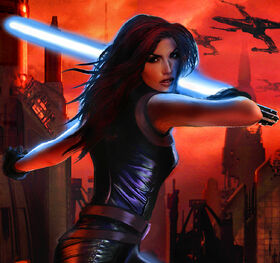
And of course, this is where we learn there is another Jedi master out there, an insane man named Joruus C'baoth, long thought dead. He wants Leia and Luke and her twins, and he's willing to bargain with Thrawn to get them. Along the way, they all get mixed up with Lando again, as well as the smuggler Talon Karrde, and his angry and intense second in command, Mara Jade, whose hatred for Luke Skywalker is as intense as it is surprising.
There's a lot going on.
What's great about these books is that even though a lot is going on, and there's surprises and strategizing and characters with complicated loyalties and emotions, it all makes perfect sense. Because this is only the first book in the series, it's a lot of set-up, and the main conflict is more of an opening salvo than a showstopper. It sets up the stakes: how good Thrawn is, how he's changing the game, and how all the pieces in the game (including surprise ones like Mara Jade and Thrawn's mysterious alien assassins) fit together.
My favorite thing about these books is by far the Luke/Mara Jade relationship. Mara Jade is a great character, and her fervid hatred of Luke makes for great drama, especially when she finds herself obliged to help him rather than kill him as she wishes she could do, and especially after we learn just exactly why it is she hates him so much. Zahn writes great Luke, and really understands why the Jedi are so interesting as a conceit. He dives into the more sci-fi moral conundrum stuff that sci-fi novels have time to cover and that a movie really doesn't. My only complaint about Zahn's version of all these characters is that his Han has always fallen a bit flat for me.
Heir to the Empire is a great opening novel to the series, and I'd even say that non-Star Wars fans might enjoy it as a stand-alone sci-fi novel. It's fun popcorn sci-fi space opera at its best, and it makes me feel like I'm sixteen and falling in love with this universe again for the first time.
[4.5 stars]