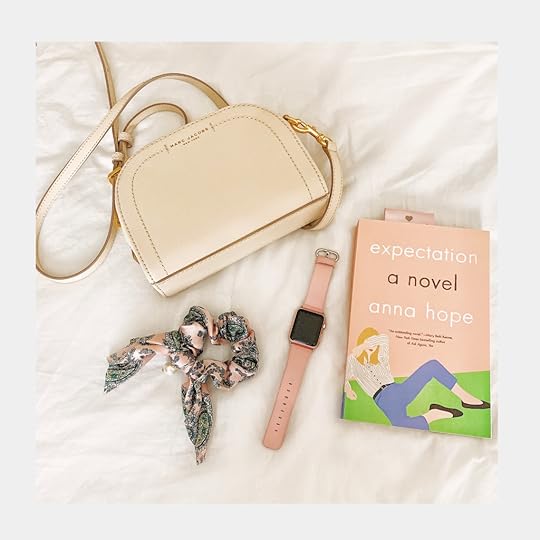
I’ve read two other books by Anna Hope, “Wake”, and “Ballroom”.....( both WWII stories) and now “Expectation”, (contemporary women’s fiction), which explores the dynamics of women’s friendships.
Add extended families, ( flashback memories), marriages, careers, infertility struggles, cheating & betrayal, loss and love.
Where as Elena Ferrante’s Neapolitan series revolves are two friends: Elena and Lila -
Anna Hope’s novel revolves around three friends: Cate, Hannah, and Lissa.
“Much of their lives is still before them. They have made mistakes, but they are not fatal. They are no longer young, but they do not feel old. They still have time, time to look backwards and time to look forwards. Life is still malleable and full of potential. The openings to the road not taken have not yet sealed up”.
“They still have time to become who they are going to be”.
Hannah, Cate, and Lissa are 29 years old. None of them have children.
The year is 2004 and they are living in a three-story Victorian townhouse on the edge of the best park in London fields.
The linoleum is peeling and the carpets are stained, but these things don’t matter when a house is so loved.
They work hard. They go to the theater. They go to galleries. They go to the gigs a friends’ bands. They eat in Vietnamese restaurants. They drink free beer and wine The bike everywhere all the time and rarely wear helmets. They go to the flower market everything morning on Sundays.
They worry. The worry about climate change— they worry about knife crime and gun crime— they were about their own relative privilege.
They worry about the guy who sits begging outside the liquor store, you only ever ask for a twenty pence.
“Sometimes they feel they should worry even more about these things, but at this moment in their lives they are happy, and so they do not”.
“They do not worry about nuclear war, or interest rates, or their fertility, or the welfare state, or aging parents, or student debt”.
Six years later: 2010....
Cate is married to Sam. They have a new baby boy.
Motherhood is exhausting to Cate. She is also depressed.
She tells Hannah:
“I think I was irresponsible having a child at all”.
The carelessness of Hannah’s statement...a luxury gift that came so easily to Cate, made Hannah furious, but she’d said nothing. Hannah is the Godmother to Cate and Sam’s baby
—but it’s killing Hannah that she doesn’t have her own.
Hannah is married to Nathan.
They had been trying to have a baby for three years before they started IVF.
Hannah got pregnant. She lost the baby. They tried again. Then many rounds of IVF.
The IVF rounds become exhausting - but Hannah was obsessed.
Nathan and Hannah had a fight. Nathan said the doctors were making thousands, millions out of peoples desperation. They’re quacks—fu#king faith healers.
Nathan reached a breaking point and told Hannah that he loved her but he just couldn’t do the IVF treatments any longer.
Lissa is beautiful, single, an actress. She was beginning to reevaluate her career choice.
It wasn’t as though she was dying to be married or have a child, but she was lonely.
Hannah asked Lissa to speak to Nathan.....thinking Lissa could influence Nathan to change his mind about the IVF treatments.
Instead.... sexual energy was passed between them. Seems Nathan was the one who did the influencing—
and Lissa didn’t push his fingers- or mouth away.
Time passes...we continue to follow the fragments of Cate, Hannah and Lisa.
Lissa’s mother, Sarah, had been an activist when she was younger.
There had been some mother/daughter friction.
Sarah tells Lissa:
“You’ve had everything. The fruits of our labor. The fruits of our activism. Good god, we got out there and we changed the world for you. For our daughters. And what have you done with it?”
“The question hangs, heavy in the summer air”.
Now, years later, Sarah is sick... dying of cancer. Lissa wants nothing more than to feel close to her mother again.
“While Sarah sleeps, they gather round the kitchen table. They take over. They make Lissa sit and drink wine, or tea. They take Lissa’s face in their hands and cry and kiss her cheeks and tell her how much she looks like her mother, and when they hug Lissa to their chests in their embrace, Lissa knows that they have lived through illnesses and lived through children and lived through no children and that they are a tribe, these women, with their battered bodies and their scars”.
“They worry about the future, about their children, about the world they will inherit, a world that seems so fractured and fast and even more splintered”.
I especially liked Anne Hope’s writing. Her vision and wisdom.
It wasn’t as though the topics and themes were inventive - but the writing was so seamless-readable - engaging - and real... that I’m glad I spent time with these characters.
Great women friendships are vital to most women.
Anna Hope examines these friendships and all their complexities - highs and lows...
through competitiveness, envy, jealousy, transgression, guilt, genuine emotional intimacy, and love.