

What do you think?

The Names
Set against the backdrop of a lush and exotic Greece, The Names is considered the book which began to drive "sharply upward the size of his readership" (Los Angeles Times Book Review). Among the cast of DeLillo's bizarre yet fully realized characters in The Names are Kathryn, the narrator's estranged wife; their son, the six-year-old novelist; Owen, the scientist; and the neurotic narrator obsessed with his own neuroses. A thriller, a mystery, and still a moving examination of family, loss, and the amorphous and magical potential of language itself, The Names stands with any of DeLillo's more recent and highly acclaimed works.
"The Names not only accurately reflects a portion of our contemporary world but, more importantly, an original world of its own is created."--Chicago Sun-Times
"DeLillo sifts experience through simultaneous grids of science and poetry, analysis and clear sight, to make a high-wire prose that is voluptuously stark."--Village Voice Literary Supplement
"DeLillo verbally examines every state of consciousness from eroticism to tourism, from the idea of America as conceived by the rest of the world, to the idea of the rest of the world as conceived by America, from mysticism to fanaticism."--New York Times
"The Names not only accurately reflects a portion of our contemporary world but, more importantly, an original world of its own is created."--Chicago Sun-Times
"DeLillo sifts experience through simultaneous grids of science and poetry, analysis and clear sight, to make a high-wire prose that is voluptuously stark."--Village Voice Literary Supplement
"DeLillo verbally examines every state of consciousness from eroticism to tourism, from the idea of America as conceived by the rest of the world, to the idea of the rest of the world as conceived by America, from mysticism to fanaticism."--New York Times
339 pages, Paperback
First published January 1, 1982
About the author
Don DeLillo
82 books6,777 followersDonald Richard DeLillo is an American novelist, short story writer, playwright, screenwriter and essayist. His works have covered subjects as diverse as television, nuclear war, the complexities of language, art, the advent of the Digital Age, mathematics, politics, economics, and sports.
DeLillo was already a well-regarded cult writer in 1985, when the publication of White Noise brought him widespread recognition and the National Book Award for fiction. He followed this in 1988 with Libra, a novel about the Kennedy assassination. DeLillo won the PEN/Faulkner Award for Mao II, about terrorism and the media's scrutiny of writers' private lives, and the William Dean Howells Medal for Underworld, a historical novel that ranges in time from the dawn of the Cold War to the birth of the Internet. He was awarded the 1999 Jerusalem Prize, the 2010 PEN/Saul Bellow Award for Achievement in American Fiction in 2010, and the 2013 Library of Congress Prize for American Fiction.
DeLillo has described his themes as "living in dangerous times" and "the inner life of the culture." In a 2005 interview, he said that writers "must oppose systems. It's important to write against power, corporations, the state, and the whole system of consumption and of debilitating entertainments... I think writers, by nature, must oppose things, oppose whatever power tries to impose on us."
DeLillo was already a well-regarded cult writer in 1985, when the publication of White Noise brought him widespread recognition and the National Book Award for fiction. He followed this in 1988 with Libra, a novel about the Kennedy assassination. DeLillo won the PEN/Faulkner Award for Mao II, about terrorism and the media's scrutiny of writers' private lives, and the William Dean Howells Medal for Underworld, a historical novel that ranges in time from the dawn of the Cold War to the birth of the Internet. He was awarded the 1999 Jerusalem Prize, the 2010 PEN/Saul Bellow Award for Achievement in American Fiction in 2010, and the 2013 Library of Congress Prize for American Fiction.
DeLillo has described his themes as "living in dangerous times" and "the inner life of the culture." In a 2005 interview, he said that writers "must oppose systems. It's important to write against power, corporations, the state, and the whole system of consumption and of debilitating entertainments... I think writers, by nature, must oppose things, oppose whatever power tries to impose on us."
Ratings & Reviews
Friends & Following
Create a free account to discover what your friends think of this book!
Community Reviews
Displaying 1 - 30 of 476 reviews

January 15, 2016
Citizens of the globe, expatriates, failed marriages, mismatched unions… The Names begins like a story by John Cheever…
Everyone becomes a perennial tourist, an inadvertent traveler and life goes on in continuous transition…
But gradually the story turns into a highbrow mystery, sort of The Adventure of the Dancing Men by Arthur Conan Doyle gone postmodernistic…
The mystery based on religion:
And the cabbalistic investigation based on semiotics:
Different people see the same signs and those signs have different meanings to them… This is the nature of signs.
Nothing sticks to us but smoke in our hair and clothes. It is dead time. It never happened until it happens again. Then it never happened.
Everyone becomes a perennial tourist, an inadvertent traveler and life goes on in continuous transition…
This is where I want to be. History. It’s in the air. Events are linking all these countries. What do we talk about over dinner, all of us? Politics basically. That’s what it comes down to. Money and politics. And that’s my job.
But gradually the story turns into a highbrow mystery, sort of The Adventure of the Dancing Men by Arthur Conan Doyle gone postmodernistic…
The mystery based on religion:
Was religion the point or language? Or was it costume? Nuns in white, in black, full habits, somber hoods, flamboyant winglike bonnets. Beggars folded in cloaks, sitting motionless. Radios played, walkie-talkies barked and hissed. The call to prayer was an amplified chant that I could separate from the other sounds only briefly. Then it was part of the tumult and pulse, the single living voice, as though fallen from the sky.
And the cabbalistic investigation based on semiotics:
The alphabet is male and female. If you will know the correct order of letters, you make a world, you make creation. This is why they will hide the order. If you will know the combinations, you make all life and death.
Different people see the same signs and those signs have different meanings to them… This is the nature of signs.

February 18, 2014
There were times in this novel when I wished DeLillo did plots. The Names is set up, brilliantly, like a thriller. An American in Athens with a shadowy job, a risk analyst for a company that insures multinational companies against the hazards of political upheaval, and part of an international subculture of equally shadowy executive figures benefiting from middle eastern turmoil hears about the existence of a death cult in the region of Greece where his separated wife and son are temporarily living. She is a volunteer at an archaeological dig. The opening hundred pages of The Names is dazzling, especially there’s some of the best travel writing you’ll find anywhere in literature.
Everyone in the novel is about to fly somewhere else. Teheran, India, Beirut, Cairo, Cyprus, Turkey, Kuwait, Pakistan, Jordan, Zaire. Places that aren’t safe, places where there’s money to be made. There’s the sense most of these people are parasites. They are people who pride themselves on their sophistication. "This is where I want to be. History. It’s in the air. Events are linking all these countries. What do we talk about over dinner, all of us? Politics basically. That’s what it comes down to. Money and politics. And that’s my job." And yet, ironically, the novel begins to backslide more and more towards the primitive. It drops any aspiration towards plot and becomes more and more esoteric. It becomes a novel about language. About the roots of language and the darkness language seeks to edge us away from. A narrative about narrative itself. And almost everything narrated is second-hand, a distillation of the original experience. We learn about people and things twice, “the second time in memory and language”.
If you’ve tried DeLillo before and haven’t warmed to him then probably you won’t like this much either. Reasons? Firstly all the characters talk in the same voice and are all without exception, a child included, more eloquent and intelligent than anyone we’re generally likely to meet. They are all at one with the general cadence and fabric of the text itself. Secondly, DeLillo is very much an impressionist; he’s not a realist. And this is among his most impressionist novels. Libra and White Noise are probably as close as he gets to realism. And thirdly DeLillo is one of the all time great stylists; he can write sentences which take your breath away; but he doesn't really do storytelling in any accepted form. And this is even more true of The Names than most of his other books.
It’s astonishing this novel was published in 1986 because it predicts much that has happened in the Middle East so far this century. The death cult can even be seen as an eerie forerunner of ISIS- not Islamic or political in nature but backward looking, primitive and punitive in its simplistic dichotomies, its adherence to misrepresented ancient texts.
I can’t say I understood exactly what The Names was getting at. As a novel it remains a bit of a blur in my mind. But the writing at times is absolutely stellar.
Everyone in the novel is about to fly somewhere else. Teheran, India, Beirut, Cairo, Cyprus, Turkey, Kuwait, Pakistan, Jordan, Zaire. Places that aren’t safe, places where there’s money to be made. There’s the sense most of these people are parasites. They are people who pride themselves on their sophistication. "This is where I want to be. History. It’s in the air. Events are linking all these countries. What do we talk about over dinner, all of us? Politics basically. That’s what it comes down to. Money and politics. And that’s my job." And yet, ironically, the novel begins to backslide more and more towards the primitive. It drops any aspiration towards plot and becomes more and more esoteric. It becomes a novel about language. About the roots of language and the darkness language seeks to edge us away from. A narrative about narrative itself. And almost everything narrated is second-hand, a distillation of the original experience. We learn about people and things twice, “the second time in memory and language”.
If you’ve tried DeLillo before and haven’t warmed to him then probably you won’t like this much either. Reasons? Firstly all the characters talk in the same voice and are all without exception, a child included, more eloquent and intelligent than anyone we’re generally likely to meet. They are all at one with the general cadence and fabric of the text itself. Secondly, DeLillo is very much an impressionist; he’s not a realist. And this is among his most impressionist novels. Libra and White Noise are probably as close as he gets to realism. And thirdly DeLillo is one of the all time great stylists; he can write sentences which take your breath away; but he doesn't really do storytelling in any accepted form. And this is even more true of The Names than most of his other books.
It’s astonishing this novel was published in 1986 because it predicts much that has happened in the Middle East so far this century. The death cult can even be seen as an eerie forerunner of ISIS- not Islamic or political in nature but backward looking, primitive and punitive in its simplistic dichotomies, its adherence to misrepresented ancient texts.
I can’t say I understood exactly what The Names was getting at. As a novel it remains a bit of a blur in my mind. But the writing at times is absolutely stellar.

June 29, 2022
L’ASSOLUTO MISTERIOSO

Anche se, forse, più che di misterioso, dovrei parlare di enigmatico.
A un certo punto (p.43) sembra che il ragionamento di Owen sia condiviso anche da Delillo. Owen racconta a James che ha cominciato a interessarsi di iscrizioni, lingue morte, pietre e tavolette per una questione di storia e filologia: le pietre parlavano, gli sembrava di conversare con i popoli antichi, era, in un certo senso, anche come risolvere un rebus: decifrare, scoprire segreti, tracciare la geografia del linguaggio. Se non che a un certo punto il suo interesse è piuttosto slittato nelle lettere in quanto tali, nei caratteri presi a blocchi, nella forma delle lettere, nell’alfabeto in sé.
Sembra quasi che a DeLillo prema soprattutto una bella parola, una buona frase, un concetto che rimanga: l’estetica dell’alfabeto, più che il senso di quello che può comporre.
Il compimento di una frase.

Enigmatico rimane l’io narrante, James, così come sua moglie Kathryn tuttologa prestata archeologa – nel senso che all’inizio la conosciamo impegnata in uno scavo archeologico su un’isoletta delle Cicladi, e poi apprendiamo che ha fatto tutto, nonostante sia a stento quarantenne, incluso insegnare a Stanford qualcosa legato alla scienza dei computer (la cosa giusta nel posto ideale nel momento perfetto). Ed enigmatico rimane il loro figlioletto di nove anni che sta già scrivendo un romanzo basato sui racconti-memorie di Owen, loro enigmatico amico.
Altrettanto enigmatici sono gli amici-colleghi, europei globe trotter ospiti di Atene impegnati in vari settori della finanza, dello spionaggio, della difesa internazionali.
In parecchie conversazioni mi sono perso – nel modo più tradizionale, e cioè: chi è che dice cosa. E fino all’ultimo mi è rimasta la domanda: è DeLillo che volutamente evita di andare a fondo, di completare il percorso di 360°, o i 360° ci sono tutti, ma io non li ho colti?

Incartato in un falso thriller – un misterioso (enigmatico?) omicidio sembrerebbe collegarsi ad altri, che dalle Cicladi porterebbe alla Giordania, forse dietro c’è una setta, un culto di qualche tipo, individui che Owen ha conosciuto mentre albergavano in una grotta dell’isoletta – reso ancora più misterioso dalla situazione geopolitica: gli ostaggi americani a Teheran stanno per essere liberati ma non lo sanno, la crisi energetica persiste, gli americani sono i bersagli preferiti di sequestratori e attentatori
Eppure è considerato uno dei romanzi migliori di DeLillo. E Karl Ove Knausgård lo mette al top insieme a Rumore bianco, l’opera successiva di DeLillo, e dice che a seguire l’americano non ha scritto nulla di buono.
Rumore bianco mi è piaciuto molto, l’ho letto due volte. Questo, invece, ho fatto molta fatica ad arrivare in fondo.
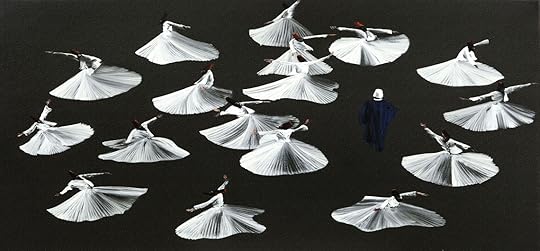
Nel nostro secolo, lo scrittore ha portato avanti una conversazione con la follia. Si potrebbe quasi dire, dello scrittore del ventesimo secolo, che aspiri alla follia. Alcuni ci sono riusciti, e occupano dei posti particolari nella nostra considerazione. Per uno scrittore la follia è come una distillazione ultima di se stesso, una revisione finale. È l’affogamento delle false voci.

Aldo Mondino e i suoi “Dervisci Konya”.
Anche se, forse, più che di misterioso, dovrei parlare di enigmatico.
A un certo punto (p.43) sembra che il ragionamento di Owen sia condiviso anche da Delillo. Owen racconta a James che ha cominciato a interessarsi di iscrizioni, lingue morte, pietre e tavolette per una questione di storia e filologia: le pietre parlavano, gli sembrava di conversare con i popoli antichi, era, in un certo senso, anche come risolvere un rebus: decifrare, scoprire segreti, tracciare la geografia del linguaggio. Se non che a un certo punto il suo interesse è piuttosto slittato nelle lettere in quanto tali, nei caratteri presi a blocchi, nella forma delle lettere, nell’alfabeto in sé.
Sembra quasi che a DeLillo prema soprattutto una bella parola, una buona frase, un concetto che rimanga: l’estetica dell’alfabeto, più che il senso di quello che può comporre.
Il compimento di una frase.
Enigmatico rimane l’io narrante, James, così come sua moglie Kathryn tuttologa prestata archeologa – nel senso che all’inizio la conosciamo impegnata in uno scavo archeologico su un’isoletta delle Cicladi, e poi apprendiamo che ha fatto tutto, nonostante sia a stento quarantenne, incluso insegnare a Stanford qualcosa legato alla scienza dei computer (la cosa giusta nel posto ideale nel momento perfetto). Ed enigmatico rimane il loro figlioletto di nove anni che sta già scrivendo un romanzo basato sui racconti-memorie di Owen, loro enigmatico amico.
Altrettanto enigmatici sono gli amici-colleghi, europei globe trotter ospiti di Atene impegnati in vari settori della finanza, dello spionaggio, della difesa internazionali.
In parecchie conversazioni mi sono perso – nel modo più tradizionale, e cioè: chi è che dice cosa. E fino all’ultimo mi è rimasta la domanda: è DeLillo che volutamente evita di andare a fondo, di completare il percorso di 360°, o i 360° ci sono tutti, ma io non li ho colti?
Incartato in un falso thriller – un misterioso (enigmatico?) omicidio sembrerebbe collegarsi ad altri, che dalle Cicladi porterebbe alla Giordania, forse dietro c’è una setta, un culto di qualche tipo, individui che Owen ha conosciuto mentre albergavano in una grotta dell’isoletta – reso ancora più misterioso dalla situazione geopolitica: gli ostaggi americani a Teheran stanno per essere liberati ma non lo sanno, la crisi energetica persiste, gli americani sono i bersagli preferiti di sequestratori e attentatori
Eppure è considerato uno dei romanzi migliori di DeLillo. E Karl Ove Knausgård lo mette al top insieme a Rumore bianco, l’opera successiva di DeLillo, e dice che a seguire l’americano non ha scritto nulla di buono.
Rumore bianco mi è piaciuto molto, l’ho letto due volte. Questo, invece, ho fatto molta fatica ad arrivare in fondo.
Nel nostro secolo, lo scrittore ha portato avanti una conversazione con la follia. Si potrebbe quasi dire, dello scrittore del ventesimo secolo, che aspiri alla follia. Alcuni ci sono riusciti, e occupano dei posti particolari nella nostra considerazione. Per uno scrittore la follia è come una distillazione ultima di se stesso, una revisione finale. È l’affogamento delle false voci.
Aldo Mondino e i suoi “Dervisci Konya”.

August 5, 2017
Vaulting into eternity ... well perhaps not that high
Pushing the logic of hippiedom to its extreme, The Names suggests an end point - a nihilistic cult whose reason for being is to murder people whose initials correspond to the names of their locations. Bizarre, senseless, and intentionally without benefit to anyone. Helter Skelter played out in the regions that produced Western civilization, Greece and the Middle East.
This cult fascinates James, a member of the international financial gang whose roles are just about as rational as those of the cultists; and Frank, a film-maker, who wants to exploit as much irrationality as he can; and Owen, an academic who is unaccountably swept into the spiritual maelstrom of the Indian branch of the cult. Who can blame any of them? Their lives are an empty wandering without any conscious intention. Only the bizarre and senseless seems to make any sense. They obsessively move toward the cult but with nothing as directive as desire. The cult is a kind of tar baby, an inert web, that traps the protagonists for no point whatsoever.
Everyone sounds the same in The Names, men, women, children, adults, bankers and archaeologists. Without 'he saids, she saids' it is often difficult to follow conversations. And since DeLillo doesn't do reflective internal dialogue except to confuse, it's also difficult to decipher motivations. Why do couples stay together, or not? Why do the men persist in their questionable businesses and resist returning to America? What attracts his characters to the distributed cult? DeLillo's not saying.
Then there are the literary non-sequiturs. "It never happens until it happens again. Then it never happened." Does this phrase have meaning? "There was something artless and trusting in the place despite the street meanders, the narrow turns and ravens." I should think artlessness was implied by such a scene, which has no obvious connection to trust or distrust. Or "In this century, the writer has carried on a conversation with madness. We might almost say of the twentieth century writer that he aspires to madness." This would certainly qualify for the Pseuds Corner section of Private Eye.
My problem is that I think I share much of DeLillo's experience of the world and his gripes about corporate life, American interference in the world and the casual destructiveness of global finance. But I can't place myself anywhere in his writing. I get lost, as if I've become one of his rootless, bored, superficial characters who is "vaulting into eternity." I suppose this is his intention. If so I'm left with the question 'Why?'.
Pushing the logic of hippiedom to its extreme, The Names suggests an end point - a nihilistic cult whose reason for being is to murder people whose initials correspond to the names of their locations. Bizarre, senseless, and intentionally without benefit to anyone. Helter Skelter played out in the regions that produced Western civilization, Greece and the Middle East.
This cult fascinates James, a member of the international financial gang whose roles are just about as rational as those of the cultists; and Frank, a film-maker, who wants to exploit as much irrationality as he can; and Owen, an academic who is unaccountably swept into the spiritual maelstrom of the Indian branch of the cult. Who can blame any of them? Their lives are an empty wandering without any conscious intention. Only the bizarre and senseless seems to make any sense. They obsessively move toward the cult but with nothing as directive as desire. The cult is a kind of tar baby, an inert web, that traps the protagonists for no point whatsoever.
Everyone sounds the same in The Names, men, women, children, adults, bankers and archaeologists. Without 'he saids, she saids' it is often difficult to follow conversations. And since DeLillo doesn't do reflective internal dialogue except to confuse, it's also difficult to decipher motivations. Why do couples stay together, or not? Why do the men persist in their questionable businesses and resist returning to America? What attracts his characters to the distributed cult? DeLillo's not saying.
Then there are the literary non-sequiturs. "It never happens until it happens again. Then it never happened." Does this phrase have meaning? "There was something artless and trusting in the place despite the street meanders, the narrow turns and ravens." I should think artlessness was implied by such a scene, which has no obvious connection to trust or distrust. Or "In this century, the writer has carried on a conversation with madness. We might almost say of the twentieth century writer that he aspires to madness." This would certainly qualify for the Pseuds Corner section of Private Eye.
My problem is that I think I share much of DeLillo's experience of the world and his gripes about corporate life, American interference in the world and the casual destructiveness of global finance. But I can't place myself anywhere in his writing. I get lost, as if I've become one of his rootless, bored, superficial characters who is "vaulting into eternity." I suppose this is his intention. If so I'm left with the question 'Why?'.

February 26, 2011
Designated Driver
Have you ever got the impression that, when an author started a book, they had no idea where it would go or how it would end?
That they would just slide into the front seat and let the book take over?
This is not such a book.
Instead, I got the impression that DeLillo was so firmly ensconced in the driver’s seat here that he wouldn’t have got out if a crew of firemen arrived to rescue him from his burning vehicle.
It was win or die, so he had to pull out all stops.
When he started, he had the finish line in sight, and when he arrived at the finish line, he made sure that he had come full circle back to where he had started.
Seventh Heaven
“The Names” was DeLillo’s seventh novel.
His previous works had enjoyed modest critical success, but hadn’t really made any commercial impact.
This book is generally regarded as the one that launched his career.
Originally published in 1982, I first read it in 1987, when it was repackaged after the relative success of his next novel, “White Noise”.
It is still the DeLillo book by which I judge all others, but it’s also the one that I recommend as an entry point for anyone who hasn’t read him yet.
While it deals with later concerns like cults, terrorism, modernity, security and the plight of America in the world, it does so in a more overtly humanist manner.
These issues are the backdrop for the very personal frailties and stories of the protagonists.
First Among Protagonists
The narrator is an American, James Axton, who is based in Athens at the beginning of the 1980’s.
Someone who is quite capable of writing fiction and screenplays, he makes a living writing reports and memos about the economic, social and political situation in the Middle East for the North East Group, a corporation that issues insurance policies against the risk of terrorist activities.
He has to identify and assess the risk of terrorist activity, which brings him and his employer to the attention of the CIA.
At heart, he is a lonely sad expatriate, a man living apart.
He isn’t writing the works he is capable of.
He is estranged from his wife and nine year old son, his native America and the Greek society around him.
He survives in a world of similarly jaded expatriates who have made Athens a European base for business sorties into the Middle East.
Like his own, the other expatriate marriages are stressed and vulnerable to adulterous affairs.
This is very much a late twentieth century European version of “The Quiet American”.
The Poor Norseman and the Acropolis
At the beginning, James defines himself in relation to the Acropolis.
He is overawed and daunted by this renowned, exalted building perched on a somber rock and surrounded by tourists.
He rationalises that he prefers to wander in a modern city, even though it might be imperfect and blaring compared with the beauty, dignity, order and proportion of the Acropolis.
He personalises it as a monument to doomed expectations, as if its existence will confront him with his own inadequacy and the madness of the society around him.
Like his peers, James constructs an elaborate sense of self-importance around him that he uses to conceal his loneliness and unhappiness.
He is not the stuff of a typical fictional American hero, yet bit by bit he pulls down the construct around him and by the end seems to have seized control of his life.
In order to do so, he has to learn from the tumultuous people and events around him.
The Women in His Life
“The Names” is not a sexually explicit novel, but it does bounce around in a slyly erotic manner.
Over the course of the novel, James negotiates comfort from many of the women in his community, whether married or not.
Of the women he flirts with, some appear to be good long term friends, some appear to be content with a Platonic attraction and one, Janet Ruffing, a banker’s wife and freelance belly dancer, he imposes himself on so insistently that I can’t think of any better word for it than rape.
It is strange that this last relationship almost goes unremarked upon.
If it had occurred in a Romansbildung of a much younger character, perhaps his conduct would have been excusable in the name of fiction.
However, it is almost as if this rape is intended to symbolize a growing capacity to assert himself within his overall getting of wisdom.
This, for me, is the one major, but inexplicable, failure of tone and sensitivity in the novel.
Owen Brademas, Epigraphic Detective
Perhaps the most important mentor for James is his wife, Kathryn’s, employer, an archeologist and epigrapher.
In the twilight of his professional life, he is fascinated by language and its origins in marks, inscriptions, symbols, characters, letters and alphabets.
He examines how these systems developed, almost as attempts to make a mark or impression on life, then as a method of recording details of grain, livestock, possessions and wealth.
So language wasn’t just concerned with communication within a tribe, but was a major tool, a lingua franca, designed to facilitate trade and commerce between tribes.
The Significance of Language
To enable communication, alphabets and words had to have commonly accepted meanings and significance.
A sign must have a signifier and a signified.
An image must have a connection that is commonly recognised.
This recognition passes from person to person, but also from generation to generation.
Images and words convey the memories of one generation to another generation.
Language keeps alive memories and experiences and wisdom.
Therefore, language became an important repository for social and cultural meaning.
The Language of Power
Language has always been more than a vehicle for individual or personal expression.
Like the Acropolis, language is a social construct that has its own beauty, dignity, order and proportion.
Unlike the Acropolis, it is a vehicle for a dynamic relationship between people.
Just as language connects people and things or people and other people, it defines, manages and controls the relationship between the two.
It allows people to discover the world and, having done so, it allows them to relate to it.
However, inevitably, the relationship involves elements of power, control and persuasion.
Thus, it is the fundamental mechanism through which politics operates.
Which means that it can be abused.
Within mass society, language becomes an instrument of oppression.
The Language of Religion
This abuse extends beyond the civil sphere.
Starting with the crucible of the Middle East, there is inevitably a role for language within spirituality and religion.
It connects people and God. However, it also defines Good and Evil, and defines our relationship with them.
We cannot engage with Good and Evil, except though the vehicle of language.
It shapes and moulds our responses to moral issues, especially in emotional terms.
Owen tells Kathryn:
"Masses of people scare me. Religion. People driven by the same powerful emotion. All that reverence, awe and dread."
And, as if by explanation, he states:
"I’m a boy from the prairie."
Like James in awe of the Acropolis, he believes he has a simple worldview.
He’s self-contained and not given to surrendering his independence to the powers that be.
He believes that you can lose your individuality in a crowd:
"Was it a grace to be there, to lose oneself in the mortal crowd, surrendering, giving oneself over to mass awe, to disappearance in others?"
Later on, Frank Volterra, a filmmaker who is captivated by and interested in filming Owen’s story, says:
"It is religion that carries a language. The river of language is God."
Language is a facility granted to us by God.
By the same token, language is a container that holds and transmits that reverence, awe and dread.
So, ultimately, language has positive and negative aspects.
And “The Names” is DeLillo’s chosen vehicle for exploring them.
Reducing Language to Writing
Spoken language is just sounds. In order to speak or communicate, we must make a noise:
"I liked the noise, the need to talk loud, to lean into people’s faces and enunciate."
Yet, too much noise, too little order, too much randomness, and the noise becomes a cacophony of incomprehension.
Language must be “subdued and codified” (again, the concept uses the language of power and control).
DeLillo first uses this term when he reveals that Owen has been thinking of the English archaeologist Rawlinson, who wanted to copy and analyse the inscriptions on the Behistun Rock, which contained three separate languages, Old Persian, Elamite and Babylonian.
This enterprise allows him to work at the level of meta-language.
Until the stone is deciphered, until the code is broken, it is just a riddle.
Rawlinson must apply intelligence to the task, in order to discover the intelligence within or at least on the surface of the rock.
He cannot establish a connection with the past, he cannot create a community, until he has managed to decipher the code.
Ironically, DeLillo ensures that all the time Owen is being watched by an intelligence community of one description or another, whether it is James or the CIA or the local security forces.
"All the noise and babble and spit of three spoken languages had been subdued and codified, broken down to these wedge-shaped marks. With his grids and lists the decipherer searches out relationships, parallel structures. What are the sign frequencies, the phonetic values? He wants a design that will make this array of characters speak to him."
An Array of Characters
Earlier, Owen mentions that the word “character” comes from a Greek word, which means “to brand or to sharpen” or in the case of the noun “an engraving or branding instrument”.
In English, he points out that the same word is used not just for a mark or symbol (like a letter in the alphabet), but a person in a story.
You could extrapolate that those original marks or symbols might actually have represented real people.
Interestingly, the same English word is used to describe the quality or characteristics of a person, their “character” and the “mark” they will make on the world.
So language is a tool that enables us to tell stories, to create our own worlds and to populate them with people.
In more advanced societies, story-telling takes the form of novels and film.
Just as Rawlinson and Owen are trying to decipher riddles, the challenge for an author like DeLillo is to create “a design that will make this array of characters speak to him”.
Frank Volterra follows in Owen’s footsteps, trying to make a film that will capture and describe the story.
Fiction and film are designed to make a lasting impression, they are the wedge-shaped marks scratched out by this generation that future generations will examine to learn about us and themselves.
Naming Names
At the simplest level, the concept of the “Names” is that language consists of giving “names” to things or images or signs.
But we need codes to understand the allocation of a name to a sign.
Many of these codes were carved in stone, intended to last a thousand years.
Just as these codes, when broken, reveal their meaning, we also learn that many of the inscriptions were codifications or codes of law and usage that were intended to regulate and manage trade and commerce.
They supply guidance, directions and commandments as to how things should and must be done.
Originally, they were primarily intended to work for the benefit of merchants and consumers.
However, language took on a life of its own as a tool of power and control.
You could even speculate that language is the power and control and that people are the vehicle it uses to achieve its purpose.
The risk in all codes and laws is that they become too prescriptive and inflexible.
They can ossify or, ironically given their origin, turn to stone.
So there comes a point when the code attracts not awe, but resistance.
A Cult Defying Language
In DeLillo’s hands, the resistance comes from a cult of fundamentalists.
They see language as an instrument of oppression and they begin to attack it by killing people.
Obviously, most people are the carriers of language, so if you murder someone you destroy their capacity to use language.
Yet, this seems so arbitrary. It makes an enemy of everyone.
Owen sets out to find “a pattern, order, some sort of unifying light” to explain their conduct.
Owen and James discover that all of the victims are old and infirm, (almost) ready to die, some having lost their memory and therefore their connection with the past, themselves and those around them.
Kathryn even speculates that the cult is sacrificing these people to God as a plea for divine intercession in a world that they believe has gone wrong.
Perhaps, they are a doomsday cult trying to forestall doomsday?
Occult Practices
Owen questions it, because he has met them and doubts whether they worship a divine being:
"They weren’t a god-haunted people."
They are interested in “letters, written symbols, fixed in sequence”.
He suspects that they want to return to a simpler world, where symbols are purely derived from nature, where letters are mere pictographs representing only “everyday objects, animals, parts of the body”.
Frank learns that they oppose the order of language, the way it has become both law and order:
"The alphabet is male and female. If you know the correct order of letters, you make a world, you make creation. This is why they will hide the order. If you will know the combinations, you make all life and death."
Take Your Name and Place
James learns that the cult chooses victims whose initials match the first letter of each word in a place-name.
"The letters match...Name. Place-name."
They are placing people in the real world. Then killing them.
The act of murder silences the victim.
Owen learns from a former cult member:
"When we came into the Mani [peninsula], we knew we would stay. What is here? This is the strength of the Mani. It does not suggest things to us. No gods, no history. The rest of the Peloponnese is full of associations. The Deep Mani, no. Only what is here. The rocks, the towers. A dead silence. A place where it is possible for men to stop making history. We are inventing a way out."
A Cult with No Names
The cult appears to be a genuine cult with no name. They will not reveal it to anyone.
Ironically, James finds one incidence of where they have created their own marking.
It’s a rock inscribed with the words “Ta Onomata”, which he suspects might be the name of the cult.
"Do you know what it means? “The Names”."
They define themselves by the name of their enemy.
By marking the name of the enemy on pottery and smashing it, they will bring about their enemy’s death. And perhaps their own.
"You...want to hurt your enemy, it is in history to destroy his name…the same harm [as if] you cut his throat."
The Politics of Empire
DeLillo treats language as a symbol of a process that subdues and codifies people.
It can also have a special place in the subjugation of peoples, the politics of empire:
"We can say of the Persians that they were enlightened conquerors…they preserved the language of the subjugated people. Is this the scientific face of imperialism? The humane face? Subdue and codify?"
In the contemporary world, DeLillo’s subjects include “money, politics and force”, the topics of James’ reports and memos.
"For a long time, [Greek] politics have been determined by the interest of great powers. Now it is just the Americans who determine."
Americans “learn comparative religion, economics of the Third World, the politics of oil, the politics of race and hunger”.
They have learned that “power works best when it doesn’t distinguish friends from enemies.”
Like language, this imperial approach is destined to attract resistance, in the form of terrorism.
“The Names” was written at the time of the Iran hostage crisis in 1980.
Terrorism has become more powerful and refined since then, but there is much in DeLillo’s novel that preempts both real world politics and the concerns of his future novels.
Even James realises that, "If America is the world’s living myth, then the CIA is America’s myth."
Ultimately, "The final enemy is government."
The Coded Matters of Intimacy
If the novel was just concerned with global politics, it would be enough.
However, DeLillo extends his gaze to personal and family relationships.
James is no hero, but he does embark on a hero’s journey, learning from others and his own discoveries.
It’s a collective effort that reconnects him to his family.
When we first meet him, he is alienated, although nowadays we would probably diagnose him as depressed.
Deep down he seems like quite a charmer, but he is a “reluctant adulterer” who has “an eye for his friends’ wives and his wife’s friends”, just two of “27 Depravities” he lists about himself.
He has failed to pay attention, failed to concentrate, failed to focus, failed to treat his family seriously, he has lost the words needed to make a family life happen.
Ultimately, as he learns about language, he rediscovers the language of love.
But first he must acknowledge that he has made a mistake.
Kathryn’s “every dissatisfaction, mild complaint, bitter grievance” was right, although it is amusing that he can only see this retrospectively.
He can only acknowledge that Kathryn was “retroactively correct” (i.e., “she is right now, but I was right at the time.” I must try this out on my wife, F.M. Sushi, next time I apologise).
Memorising the Future
This retroactivity involves memory.
Once again, James is influenced by Owen, who believes that memory is:
"... the faculty of absolution. Men developed memories to ease their disquiet over things they did as men. The deep past is the only innocence and therefore necessary to retain."
It is a reminder that we have been good and that we can be good again.
Language is the beginning of doing good:
"This is what love comes down to, things that happen and what we say about them."
It’s not enough to be awestruck by the wonders of the world, because we will sometimes encounter what his nine-year old son, Tap, describes as something “worse than a retched nightmare. It was the nightmare of real things, the fallen wonder of the world.”
James finds Tap’s mangled words exhilarating:
"He made me see them new again, made me see how they worked, what they really were. They were ancient things, secret", [but most importantly] "reshapable".
We have to add some love, some light, some colour of our own.
Acropoliptic Vision
When James finally conquers his fear of the Acropolis, this is what he has come to realise.
There are crowds, tourists, families, none of them alone, making a noise, all speaking their own language, "one language after another, rich, harsh, mysterious, strong".
"This is what we bring to the temple, not prayer or chant or slaughtered rams. Our offering is language."
Ultimately, this is DeLillo's offering to us: language that is rich, harsh, mysterious, strong.
Have you ever got the impression that, when an author started a book, they had no idea where it would go or how it would end?
That they would just slide into the front seat and let the book take over?
This is not such a book.
Instead, I got the impression that DeLillo was so firmly ensconced in the driver’s seat here that he wouldn’t have got out if a crew of firemen arrived to rescue him from his burning vehicle.
It was win or die, so he had to pull out all stops.
When he started, he had the finish line in sight, and when he arrived at the finish line, he made sure that he had come full circle back to where he had started.
Seventh Heaven
“The Names” was DeLillo’s seventh novel.
His previous works had enjoyed modest critical success, but hadn’t really made any commercial impact.
This book is generally regarded as the one that launched his career.
Originally published in 1982, I first read it in 1987, when it was repackaged after the relative success of his next novel, “White Noise”.
It is still the DeLillo book by which I judge all others, but it’s also the one that I recommend as an entry point for anyone who hasn’t read him yet.
While it deals with later concerns like cults, terrorism, modernity, security and the plight of America in the world, it does so in a more overtly humanist manner.
These issues are the backdrop for the very personal frailties and stories of the protagonists.
First Among Protagonists
The narrator is an American, James Axton, who is based in Athens at the beginning of the 1980’s.
Someone who is quite capable of writing fiction and screenplays, he makes a living writing reports and memos about the economic, social and political situation in the Middle East for the North East Group, a corporation that issues insurance policies against the risk of terrorist activities.
He has to identify and assess the risk of terrorist activity, which brings him and his employer to the attention of the CIA.
At heart, he is a lonely sad expatriate, a man living apart.
He isn’t writing the works he is capable of.
He is estranged from his wife and nine year old son, his native America and the Greek society around him.
He survives in a world of similarly jaded expatriates who have made Athens a European base for business sorties into the Middle East.
Like his own, the other expatriate marriages are stressed and vulnerable to adulterous affairs.
This is very much a late twentieth century European version of “The Quiet American”.
The Poor Norseman and the Acropolis
At the beginning, James defines himself in relation to the Acropolis.
He is overawed and daunted by this renowned, exalted building perched on a somber rock and surrounded by tourists.
He rationalises that he prefers to wander in a modern city, even though it might be imperfect and blaring compared with the beauty, dignity, order and proportion of the Acropolis.
He personalises it as a monument to doomed expectations, as if its existence will confront him with his own inadequacy and the madness of the society around him.
Like his peers, James constructs an elaborate sense of self-importance around him that he uses to conceal his loneliness and unhappiness.
He is not the stuff of a typical fictional American hero, yet bit by bit he pulls down the construct around him and by the end seems to have seized control of his life.
In order to do so, he has to learn from the tumultuous people and events around him.
The Women in His Life
“The Names” is not a sexually explicit novel, but it does bounce around in a slyly erotic manner.
Over the course of the novel, James negotiates comfort from many of the women in his community, whether married or not.
Of the women he flirts with, some appear to be good long term friends, some appear to be content with a Platonic attraction and one, Janet Ruffing, a banker’s wife and freelance belly dancer, he imposes himself on so insistently that I can’t think of any better word for it than rape.
It is strange that this last relationship almost goes unremarked upon.
If it had occurred in a Romansbildung of a much younger character, perhaps his conduct would have been excusable in the name of fiction.
However, it is almost as if this rape is intended to symbolize a growing capacity to assert himself within his overall getting of wisdom.
This, for me, is the one major, but inexplicable, failure of tone and sensitivity in the novel.
Owen Brademas, Epigraphic Detective
Perhaps the most important mentor for James is his wife, Kathryn’s, employer, an archeologist and epigrapher.
In the twilight of his professional life, he is fascinated by language and its origins in marks, inscriptions, symbols, characters, letters and alphabets.
He examines how these systems developed, almost as attempts to make a mark or impression on life, then as a method of recording details of grain, livestock, possessions and wealth.
So language wasn’t just concerned with communication within a tribe, but was a major tool, a lingua franca, designed to facilitate trade and commerce between tribes.
The Significance of Language
To enable communication, alphabets and words had to have commonly accepted meanings and significance.
A sign must have a signifier and a signified.
An image must have a connection that is commonly recognised.
This recognition passes from person to person, but also from generation to generation.
Images and words convey the memories of one generation to another generation.
Language keeps alive memories and experiences and wisdom.
Therefore, language became an important repository for social and cultural meaning.
The Language of Power
Language has always been more than a vehicle for individual or personal expression.
Like the Acropolis, language is a social construct that has its own beauty, dignity, order and proportion.
Unlike the Acropolis, it is a vehicle for a dynamic relationship between people.
Just as language connects people and things or people and other people, it defines, manages and controls the relationship between the two.
It allows people to discover the world and, having done so, it allows them to relate to it.
However, inevitably, the relationship involves elements of power, control and persuasion.
Thus, it is the fundamental mechanism through which politics operates.
Which means that it can be abused.
Within mass society, language becomes an instrument of oppression.
The Language of Religion
This abuse extends beyond the civil sphere.
Starting with the crucible of the Middle East, there is inevitably a role for language within spirituality and religion.
It connects people and God. However, it also defines Good and Evil, and defines our relationship with them.
We cannot engage with Good and Evil, except though the vehicle of language.
It shapes and moulds our responses to moral issues, especially in emotional terms.
Owen tells Kathryn:
"Masses of people scare me. Religion. People driven by the same powerful emotion. All that reverence, awe and dread."
And, as if by explanation, he states:
"I’m a boy from the prairie."
Like James in awe of the Acropolis, he believes he has a simple worldview.
He’s self-contained and not given to surrendering his independence to the powers that be.
He believes that you can lose your individuality in a crowd:
"Was it a grace to be there, to lose oneself in the mortal crowd, surrendering, giving oneself over to mass awe, to disappearance in others?"
Later on, Frank Volterra, a filmmaker who is captivated by and interested in filming Owen’s story, says:
"It is religion that carries a language. The river of language is God."
Language is a facility granted to us by God.
By the same token, language is a container that holds and transmits that reverence, awe and dread.
So, ultimately, language has positive and negative aspects.
And “The Names” is DeLillo’s chosen vehicle for exploring them.
Reducing Language to Writing
Spoken language is just sounds. In order to speak or communicate, we must make a noise:
"I liked the noise, the need to talk loud, to lean into people’s faces and enunciate."
Yet, too much noise, too little order, too much randomness, and the noise becomes a cacophony of incomprehension.
Language must be “subdued and codified” (again, the concept uses the language of power and control).
DeLillo first uses this term when he reveals that Owen has been thinking of the English archaeologist Rawlinson, who wanted to copy and analyse the inscriptions on the Behistun Rock, which contained three separate languages, Old Persian, Elamite and Babylonian.
This enterprise allows him to work at the level of meta-language.
Until the stone is deciphered, until the code is broken, it is just a riddle.
Rawlinson must apply intelligence to the task, in order to discover the intelligence within or at least on the surface of the rock.
He cannot establish a connection with the past, he cannot create a community, until he has managed to decipher the code.
Ironically, DeLillo ensures that all the time Owen is being watched by an intelligence community of one description or another, whether it is James or the CIA or the local security forces.
"All the noise and babble and spit of three spoken languages had been subdued and codified, broken down to these wedge-shaped marks. With his grids and lists the decipherer searches out relationships, parallel structures. What are the sign frequencies, the phonetic values? He wants a design that will make this array of characters speak to him."
An Array of Characters
Earlier, Owen mentions that the word “character” comes from a Greek word, which means “to brand or to sharpen” or in the case of the noun “an engraving or branding instrument”.
In English, he points out that the same word is used not just for a mark or symbol (like a letter in the alphabet), but a person in a story.
You could extrapolate that those original marks or symbols might actually have represented real people.
Interestingly, the same English word is used to describe the quality or characteristics of a person, their “character” and the “mark” they will make on the world.
So language is a tool that enables us to tell stories, to create our own worlds and to populate them with people.
In more advanced societies, story-telling takes the form of novels and film.
Just as Rawlinson and Owen are trying to decipher riddles, the challenge for an author like DeLillo is to create “a design that will make this array of characters speak to him”.
Frank Volterra follows in Owen’s footsteps, trying to make a film that will capture and describe the story.
Fiction and film are designed to make a lasting impression, they are the wedge-shaped marks scratched out by this generation that future generations will examine to learn about us and themselves.
Naming Names
At the simplest level, the concept of the “Names” is that language consists of giving “names” to things or images or signs.
But we need codes to understand the allocation of a name to a sign.
Many of these codes were carved in stone, intended to last a thousand years.
Just as these codes, when broken, reveal their meaning, we also learn that many of the inscriptions were codifications or codes of law and usage that were intended to regulate and manage trade and commerce.
They supply guidance, directions and commandments as to how things should and must be done.
Originally, they were primarily intended to work for the benefit of merchants and consumers.
However, language took on a life of its own as a tool of power and control.
You could even speculate that language is the power and control and that people are the vehicle it uses to achieve its purpose.
The risk in all codes and laws is that they become too prescriptive and inflexible.
They can ossify or, ironically given their origin, turn to stone.
So there comes a point when the code attracts not awe, but resistance.
A Cult Defying Language
In DeLillo’s hands, the resistance comes from a cult of fundamentalists.
They see language as an instrument of oppression and they begin to attack it by killing people.
Obviously, most people are the carriers of language, so if you murder someone you destroy their capacity to use language.
Yet, this seems so arbitrary. It makes an enemy of everyone.
Owen sets out to find “a pattern, order, some sort of unifying light” to explain their conduct.
Owen and James discover that all of the victims are old and infirm, (almost) ready to die, some having lost their memory and therefore their connection with the past, themselves and those around them.
Kathryn even speculates that the cult is sacrificing these people to God as a plea for divine intercession in a world that they believe has gone wrong.
Perhaps, they are a doomsday cult trying to forestall doomsday?
Occult Practices
Owen questions it, because he has met them and doubts whether they worship a divine being:
"They weren’t a god-haunted people."
They are interested in “letters, written symbols, fixed in sequence”.
He suspects that they want to return to a simpler world, where symbols are purely derived from nature, where letters are mere pictographs representing only “everyday objects, animals, parts of the body”.
Frank learns that they oppose the order of language, the way it has become both law and order:
"The alphabet is male and female. If you know the correct order of letters, you make a world, you make creation. This is why they will hide the order. If you will know the combinations, you make all life and death."
Take Your Name and Place
James learns that the cult chooses victims whose initials match the first letter of each word in a place-name.
"The letters match...Name. Place-name."
They are placing people in the real world. Then killing them.
The act of murder silences the victim.
Owen learns from a former cult member:
"When we came into the Mani [peninsula], we knew we would stay. What is here? This is the strength of the Mani. It does not suggest things to us. No gods, no history. The rest of the Peloponnese is full of associations. The Deep Mani, no. Only what is here. The rocks, the towers. A dead silence. A place where it is possible for men to stop making history. We are inventing a way out."
A Cult with No Names
The cult appears to be a genuine cult with no name. They will not reveal it to anyone.
Ironically, James finds one incidence of where they have created their own marking.
It’s a rock inscribed with the words “Ta Onomata”, which he suspects might be the name of the cult.
"Do you know what it means? “The Names”."
They define themselves by the name of their enemy.
By marking the name of the enemy on pottery and smashing it, they will bring about their enemy’s death. And perhaps their own.
"You...want to hurt your enemy, it is in history to destroy his name…the same harm [as if] you cut his throat."
The Politics of Empire
DeLillo treats language as a symbol of a process that subdues and codifies people.
It can also have a special place in the subjugation of peoples, the politics of empire:
"We can say of the Persians that they were enlightened conquerors…they preserved the language of the subjugated people. Is this the scientific face of imperialism? The humane face? Subdue and codify?"
In the contemporary world, DeLillo’s subjects include “money, politics and force”, the topics of James’ reports and memos.
"For a long time, [Greek] politics have been determined by the interest of great powers. Now it is just the Americans who determine."
Americans “learn comparative religion, economics of the Third World, the politics of oil, the politics of race and hunger”.
They have learned that “power works best when it doesn’t distinguish friends from enemies.”
Like language, this imperial approach is destined to attract resistance, in the form of terrorism.
“The Names” was written at the time of the Iran hostage crisis in 1980.
Terrorism has become more powerful and refined since then, but there is much in DeLillo’s novel that preempts both real world politics and the concerns of his future novels.
Even James realises that, "If America is the world’s living myth, then the CIA is America’s myth."
Ultimately, "The final enemy is government."
The Coded Matters of Intimacy
If the novel was just concerned with global politics, it would be enough.
However, DeLillo extends his gaze to personal and family relationships.
James is no hero, but he does embark on a hero’s journey, learning from others and his own discoveries.
It’s a collective effort that reconnects him to his family.
When we first meet him, he is alienated, although nowadays we would probably diagnose him as depressed.
Deep down he seems like quite a charmer, but he is a “reluctant adulterer” who has “an eye for his friends’ wives and his wife’s friends”, just two of “27 Depravities” he lists about himself.
He has failed to pay attention, failed to concentrate, failed to focus, failed to treat his family seriously, he has lost the words needed to make a family life happen.
Ultimately, as he learns about language, he rediscovers the language of love.
But first he must acknowledge that he has made a mistake.
Kathryn’s “every dissatisfaction, mild complaint, bitter grievance” was right, although it is amusing that he can only see this retrospectively.
He can only acknowledge that Kathryn was “retroactively correct” (i.e., “she is right now, but I was right at the time.” I must try this out on my wife, F.M. Sushi, next time I apologise).
Memorising the Future
This retroactivity involves memory.
Once again, James is influenced by Owen, who believes that memory is:
"... the faculty of absolution. Men developed memories to ease their disquiet over things they did as men. The deep past is the only innocence and therefore necessary to retain."
It is a reminder that we have been good and that we can be good again.
Language is the beginning of doing good:
"This is what love comes down to, things that happen and what we say about them."
It’s not enough to be awestruck by the wonders of the world, because we will sometimes encounter what his nine-year old son, Tap, describes as something “worse than a retched nightmare. It was the nightmare of real things, the fallen wonder of the world.”
James finds Tap’s mangled words exhilarating:
"He made me see them new again, made me see how they worked, what they really were. They were ancient things, secret", [but most importantly] "reshapable".
We have to add some love, some light, some colour of our own.
Acropoliptic Vision
When James finally conquers his fear of the Acropolis, this is what he has come to realise.
There are crowds, tourists, families, none of them alone, making a noise, all speaking their own language, "one language after another, rich, harsh, mysterious, strong".
"This is what we bring to the temple, not prayer or chant or slaughtered rams. Our offering is language."
Ultimately, this is DeLillo's offering to us: language that is rich, harsh, mysterious, strong.
April 9, 2016
An intelligent and often quite complexing work from DeLillo, who I am a big fan. This is set mostly in Greece which centres on an American risk analyst staying in Athens who is slowly drawn to the workings of a mysterious 'language cult' who are obsessed with ancient alphabets and seem to be behind a number of unexplained murders. While described as an exotic thriller it's so much more than that, and tends to sway away from any conventional plot to focus more on deep and precise character studies where issues of politics, cultural differences, loyalty, mythology, history and religion are bought into question. The observation throughout is of a very high standard but this tends to be both it's strength and weakness as there are many long winded conversations rich in detail which seem to go on forever and can get slightly frustrating leaving a feeling of just where everything is going. There is an eerie menace hanging in the air at times which I give credit for and on the whole he creates a strangely perplexing work that is intriguing rather than exciting. It's not really a thriller per se, when you think of a thriller, but it's probably the closest you'll get from DeLillo's body of work.

May 24, 2012
“I move past the scaffolding and walk down the steps, hearing one language after another, rich, harsh, mysterious, strong. This is what we bring to the temple, not prayer or chant or slaughtered rams. Our offering is language.”
― Don DeLillo, The Names

For 4/5 of this book Don DeLillo was surfing in Mao II, White Noise, Underworld, and Libra territory. I was jamming. Words. Names. Cults. Terrorism. It was fantastic. But there was 1/5 (yup, math works) of this book right before the last few pages where DeLillo just let go of the narrative kite. It was like I was meditating and almost ready to escape the wheel with this book Don, and at the very end your chanting just put me to sleep. Still, 4/5 of this book rocked. And maybe it was me and not you Don. Maybe. I'll review tomorrow some more. Maybe I'll even re-read the last 60+ pages. See if I can detect God or meaning in those words. Maybe I'm just tired. Maybe I'm not thinking right. Tomorrow, I'll look at this again with fresh eyes.
[Post Rest] I'm still not ready to make it five stars. It doesn't quite belong to the same orbit as those DeLillo novels listed above. HOWEVER, there was something visceral about this novel that grabbed me (and yes lost me for a bit). I remember going to high school in Turkey in the late 80s. Hell, Kurdish Marxist terrorists inadvertently saved my life (long, but true story). DeLillo's novel is an archeology of words, a history of terror, a hunt for God and the economics of understanding. It is at times a frustrating prose poem and at times glorious burp in a cave. It gives serious echoes of MAO II. It is infinitely quotable. It whirls like a dusty dervish on the sacred Name of God, reducing memory and history to the initials of the Great unknown.
― Don DeLillo, The Names
For 4/5 of this book Don DeLillo was surfing in Mao II, White Noise, Underworld, and Libra territory. I was jamming. Words. Names. Cults. Terrorism. It was fantastic. But there was 1/5 (yup, math works) of this book right before the last few pages where DeLillo just let go of the narrative kite. It was like I was meditating and almost ready to escape the wheel with this book Don, and at the very end your chanting just put me to sleep. Still, 4/5 of this book rocked. And maybe it was me and not you Don. Maybe. I'll review tomorrow some more. Maybe I'll even re-read the last 60+ pages. See if I can detect God or meaning in those words. Maybe I'm just tired. Maybe I'm not thinking right. Tomorrow, I'll look at this again with fresh eyes.
[Post Rest] I'm still not ready to make it five stars. It doesn't quite belong to the same orbit as those DeLillo novels listed above. HOWEVER, there was something visceral about this novel that grabbed me (and yes lost me for a bit). I remember going to high school in Turkey in the late 80s. Hell, Kurdish Marxist terrorists inadvertently saved my life (long, but true story). DeLillo's novel is an archeology of words, a history of terror, a hunt for God and the economics of understanding. It is at times a frustrating prose poem and at times glorious burp in a cave. It gives serious echoes of MAO II. It is infinitely quotable. It whirls like a dusty dervish on the sacred Name of God, reducing memory and history to the initials of the Great unknown.

November 7, 2020
There are books where we don't understand much, get lost in the characters, eras, places, and all possible layers, and where the often brilliant writing fails us, blinds us, perhaps. Thick books, in every sense of the word. So, I don't know, no doubt, like some of the works of Virginia Woolf or perhaps Joyce, you have to let them mature, mature yourself, to grasp the enormous mass, entire of life, better, madness, and meaning that this book conceals.
Non-courageous readers, give up right away; the others, arm yourself with all you can.
In any case, I say wow, and if I don't give five stars, it's because I'm not yet focused enough.
Non-courageous readers, give up right away; the others, arm yourself with all you can.
In any case, I say wow, and if I don't give five stars, it's because I'm not yet focused enough.

December 30, 2010
Don DeLillo gets major points for style. Seriously, he's one of the all-time greatest American prose stylists; his knack for catching the rhythms of (educated, disaffected) speech is uncanny, as is his always-apt use of the interrogative-with-no-question-mark, which I've not seen effectively used in most writing but hear in speech every day. And he always picks good themes, if you want to call them that: technology, language, consumerism, intellectualism, violence, etc.
So why is it that he so rarely manages to write a compelling novel? I loved White Noise, but was very let down by The Body Artist and later Cosmopolis. And now this. The plot drags, or there is no plot, or the plot is ambiguous, or it's ambiguous whether or not there's a plot. Resolutions are promised, promises broken.
But then, why the four stars? Well, I would say this was notably better than the other two I mentioned, if only because it's set in Greece, but also I think because it was written BEFORE White Noise and his other really good stuff, though I couldn't exactly say why that helps. As I said before, the prose style is near-perfect, which is nice. And the novel does raise some interesting questions, although I won't mention them here. Ultimately it comes down to this:
"A man finishing a peach tossed the pit into the sidecar of a motorcycle as it turned the corner where he happened to be standing. The timing was perfect, the toss deceptively casual. What rounded out the simple beauty of the thing was the fact that he did not look around to see who noticed."
There's a lot of that. If you like it, you'll probably like The Names. If not, skip it.
So why is it that he so rarely manages to write a compelling novel? I loved White Noise, but was very let down by The Body Artist and later Cosmopolis. And now this. The plot drags, or there is no plot, or the plot is ambiguous, or it's ambiguous whether or not there's a plot. Resolutions are promised, promises broken.
But then, why the four stars? Well, I would say this was notably better than the other two I mentioned, if only because it's set in Greece, but also I think because it was written BEFORE White Noise and his other really good stuff, though I couldn't exactly say why that helps. As I said before, the prose style is near-perfect, which is nice. And the novel does raise some interesting questions, although I won't mention them here. Ultimately it comes down to this:
"A man finishing a peach tossed the pit into the sidecar of a motorcycle as it turned the corner where he happened to be standing. The timing was perfect, the toss deceptively casual. What rounded out the simple beauty of the thing was the fact that he did not look around to see who noticed."
There's a lot of that. If you like it, you'll probably like The Names. If not, skip it.

July 24, 2022
A deeply enigmatic novel about roots. Most of the characters are rootless, travelling from one country to another monthly in the name of largely incomprehensible work. The narrator's wife is an archaeologist, his son has invented a language. Behind everything is a mysterious cult who carry out a chain of murders, always choosing victims whose initials match the place they are killed in. The writing is often exalted.

August 6, 2025
"It's your government, not ours."
"I am not so sure…how the Americans choose strategy over principle every time and yet keep believing in their own innocence…The Americans learned to live with the colonels very well. Investments flourished under the dictatorship. The bases stayed open. Small arms shipments continued. Crowd control, you know?"
"They were your colonels, Andreas.”
"Are you sure of that…Does your boss tell you that power must be blind in both eyes? You don't see us. This is the final humiliation. The occupiers fail to see the people they control."
"Come on, Andreas."
"Bloody hell, nothing happens without the approval of the Americans. And they don't even know there is a grievance. They don't know we are tired of the situation, the relationship."
"I am not so sure…how the Americans choose strategy over principle every time and yet keep believing in their own innocence…The Americans learned to live with the colonels very well. Investments flourished under the dictatorship. The bases stayed open. Small arms shipments continued. Crowd control, you know?"
"They were your colonels, Andreas.”
"Are you sure of that…Does your boss tell you that power must be blind in both eyes? You don't see us. This is the final humiliation. The occupiers fail to see the people they control."
"Come on, Andreas."
"Bloody hell, nothing happens without the approval of the Americans. And they don't even know there is a grievance. They don't know we are tired of the situation, the relationship."

January 21, 2026
La meraviglia caduta del mondo
Forse la cosa migliore è leggerlo senza troppo pensare. Leggerlo come: un libro di viaggio tra Grecia (Atene, l'isola immaginaria di Kouros, l'inquietante Mani), Medio Oriente, India e Pakistan; una storia sentimentale (Delillo inaspettato), tra un matrimonio non del tutto risolto e tradimenti vari; il ritratto di una comunità di espatriati, gli scambi, il supporto reciproco, le cene, le bevute, ovvero sentirsi meno soli in un paese straniero; uno spaccato del funzionamento delle corporations e una visione geo-politica e geo-economica del mondo, valida ancora oggi; una spy story; un thriller.
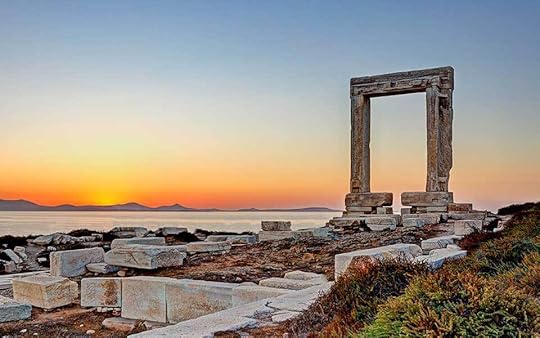
Naxos - Portara
Poi godere della scrittura di Delillo. Che non è fatta di frasi spettacolari e avvolgenti e non punta sulle emozioni. E' fredda e secca. E però capace di descrivere magnificamente eventi, luoghi, situazioni. Di portarti dentro ai dialoghi. Di caratterizzare benissimo i personaggi: James, il narratore in prima persona, in crisi esistenziale; Owen Brademas, che, sfinito e svuotato in quell'appartamento di Lahore mi ha ricordato Kurtz: Frank Volterra, l'incazzoso regista indie hollywoodiano.
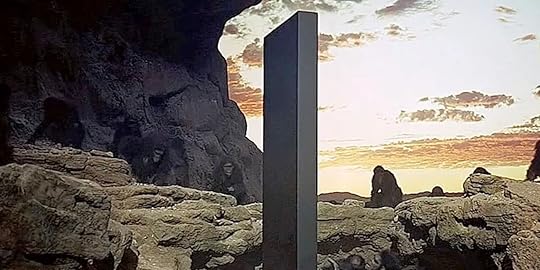
2001 Odissea nello spazio - Il monolite
Infine, se volete, si può godere, di una goduria cerebrale, cercando di intuire il senso filosofico che Delillo ci vuole trasmettere. Che è (mio misero tentativo): la realtà è un caos che non riusciamo a prevedere e governare; con l'uso dei segni e del linguaggio ci creiamo degli schemi per cercare di ordinare, mettere ordine, interpretare e quindi sconfiggere l'ansia, la paura, il terrore della morte; questo meccanismo rischia però di portarci a formule e riti vuoti, meccanici, un culto, un fanatismo, una dittatura che invece di sconfiggere la paura sono essi stessi paura e morte; e invece il segno, il nome, il linguaggio, deve essere quella cosa che crea connessioni con la nostra memoria - collettiva (l'Acropoli) o individuale (quello che abbiamo fatto, che siamo stati, che ci ha portato dove siamo) - e con gli altri - in senso collettivo (fondiamoci nel vortice dell'Hajj attorno alla Kaaba, abbandoniamoci alla tranche di un rito pentecostale) e sul piano individuale (con James, torniamo alla scrittura e torniamo da Kathryn e nostro figlio, là, lontani, nel freddo del Canada).
****
Devo ringraziare l'autore di questo podcast per avermi portato a fare una lettura notevole.
Forse la cosa migliore è leggerlo senza troppo pensare. Leggerlo come: un libro di viaggio tra Grecia (Atene, l'isola immaginaria di Kouros, l'inquietante Mani), Medio Oriente, India e Pakistan; una storia sentimentale (Delillo inaspettato), tra un matrimonio non del tutto risolto e tradimenti vari; il ritratto di una comunità di espatriati, gli scambi, il supporto reciproco, le cene, le bevute, ovvero sentirsi meno soli in un paese straniero; uno spaccato del funzionamento delle corporations e una visione geo-politica e geo-economica del mondo, valida ancora oggi; una spy story; un thriller.
Naxos - Portara
Poi godere della scrittura di Delillo. Che non è fatta di frasi spettacolari e avvolgenti e non punta sulle emozioni. E' fredda e secca. E però capace di descrivere magnificamente eventi, luoghi, situazioni. Di portarti dentro ai dialoghi. Di caratterizzare benissimo i personaggi: James, il narratore in prima persona, in crisi esistenziale; Owen Brademas, che, sfinito e svuotato in quell'appartamento di Lahore mi ha ricordato Kurtz: Frank Volterra, l'incazzoso regista indie hollywoodiano.
2001 Odissea nello spazio - Il monolite
Infine, se volete, si può godere, di una goduria cerebrale, cercando di intuire il senso filosofico che Delillo ci vuole trasmettere. Che è (mio misero tentativo): la realtà è un caos che non riusciamo a prevedere e governare; con l'uso dei segni e del linguaggio ci creiamo degli schemi per cercare di ordinare, mettere ordine, interpretare e quindi sconfiggere l'ansia, la paura, il terrore della morte; questo meccanismo rischia però di portarci a formule e riti vuoti, meccanici, un culto, un fanatismo, una dittatura che invece di sconfiggere la paura sono essi stessi paura e morte; e invece il segno, il nome, il linguaggio, deve essere quella cosa che crea connessioni con la nostra memoria - collettiva (l'Acropoli) o individuale (quello che abbiamo fatto, che siamo stati, che ci ha portato dove siamo) - e con gli altri - in senso collettivo (fondiamoci nel vortice dell'Hajj attorno alla Kaaba, abbandoniamoci alla tranche di un rito pentecostale) e sul piano individuale (con James, torniamo alla scrittura e torniamo da Kathryn e nostro figlio, là, lontani, nel freddo del Canada).
****
Devo ringraziare l'autore di questo podcast per avermi portato a fare una lettura notevole.

May 21, 2023
62nd book of 2023.
2.5. One of the books that accompanied me to Greece, but I'll save my holiday writing for my Henry Miller review, which I'll write in the next few days around the dreaded post-holiday return to work.
Like with White Noise, I find DeLillo frustrating. This one even more so, actually. The first 50 or so pages, maybe even 100, I read before my flight to Athens and reading it put me in that sort of luminous mood a good book can put you in. I got to work elated by my commute-reading. It was gentle, there were ruminations on fatherhood, estranged marriages, language, history, and, of course, Athens. I thought, Finally, I can see the DeLillo love.
But then it got more and more DeLillo and I remembered why I didn't like him before. His dialogue became odd, unnatural, at times, seemingly built of non-sequiturs. The family stuff faded and instead the cult stuff intensified: murder, old languages. It became more abstract but didn't keep me in its hold. Once again DeLillo let go of me (reader) and went on his (writer) own journey. I was hoping to get to Underworld at some point this year, but this doesn't bode well. I'm not one to give up on a writer though, even after numerous misses. It took me a long time to like a McEwan book. A long time.
2.5. One of the books that accompanied me to Greece, but I'll save my holiday writing for my Henry Miller review, which I'll write in the next few days around the dreaded post-holiday return to work.
Like with White Noise, I find DeLillo frustrating. This one even more so, actually. The first 50 or so pages, maybe even 100, I read before my flight to Athens and reading it put me in that sort of luminous mood a good book can put you in. I got to work elated by my commute-reading. It was gentle, there were ruminations on fatherhood, estranged marriages, language, history, and, of course, Athens. I thought, Finally, I can see the DeLillo love.
But then it got more and more DeLillo and I remembered why I didn't like him before. His dialogue became odd, unnatural, at times, seemingly built of non-sequiturs. The family stuff faded and instead the cult stuff intensified: murder, old languages. It became more abstract but didn't keep me in its hold. Once again DeLillo let go of me (reader) and went on his (writer) own journey. I was hoping to get to Underworld at some point this year, but this doesn't bode well. I'm not one to give up on a writer though, even after numerous misses. It took me a long time to like a McEwan book. A long time.

August 22, 2020
This is what we bring to the temple, not prayer or chant or slaughtered rams. Our offering is language.
It is shocking that this novel is almost forty years old. Beyond, prescient, this dark survey of the global soul ennui's hangover. Their is an arc across its pages which illuminates that United States is the world's myth and somehow within this mythic people the CIA predominates as a glandular surveillance system.
Air travel reminds us who we are. It’s the means by which we recognize ourselves as modern. The process removes us from the world and sets us apart from each other.
A risk assessor living in Athens contemplates his life: he is separated from his wife, who is pursuing a career in archeology. His son is a an aspiring novelist while still in elementary school. His work takes him regularly across the Middle East, a trove of hotspots. Then there are a rash of cultish killings and the intrigue while remaining vague is intact. The deaths could be the incense of an ecstatic ritual of epistemology or it could be a misunderstanding based on a poor translation? Who's the wiser?
It is shocking that this novel is almost forty years old. Beyond, prescient, this dark survey of the global soul ennui's hangover. Their is an arc across its pages which illuminates that United States is the world's myth and somehow within this mythic people the CIA predominates as a glandular surveillance system.
Air travel reminds us who we are. It’s the means by which we recognize ourselves as modern. The process removes us from the world and sets us apart from each other.
A risk assessor living in Athens contemplates his life: he is separated from his wife, who is pursuing a career in archeology. His son is a an aspiring novelist while still in elementary school. His work takes him regularly across the Middle East, a trove of hotspots. Then there are a rash of cultish killings and the intrigue while remaining vague is intact. The deaths could be the incense of an ecstatic ritual of epistemology or it could be a misunderstanding based on a poor translation? Who's the wiser?

December 19, 2016
I approached this re-read of The Names (my third time through the book) with a little bit of trepidation: as mentioned in my review below (there is no review for my first time through because that was in 1980-something), I was aware that the second half of the book is quite confusing and I wasn’t sure what I would make of it this time.
It’s also interesting to see that this book generates some very different views. In my review below I mentioned that Geoff Dyer argues in a review that it would have won the Booker if the decision to allow American entries had been made a few decades earlier. In the same vein, Graham Foster (grahamfoster.org) writes a strong review that ends like this:
”The Names is a complex novel, but necessarily so. It is, after all, about the consequences of when the structures we use to apply meaning to the world fall apart. It’s a novel that invites the reader to think about the efficacy of our language in describing the complicated and messy experience of the world. But it’s also about how we need that language, the system that allows us to rationalise immediate dangers such as terrorism and war, the system that convinces us we are safe. With The Names, DeLillo gives us a glimpse of the alternative.”
(The complexity of the second half that I have mentioned is generated largely by the way Delillo chooses to reflect this falling apart of structures in his language).
But then, at dactylreview.com, V. N. Alexander argues that the book is a complete failure and ends a review like this:
”Sure, the book is probably better than commercial fiction. But that’s not its genre and there is a higher standard against which it must be compared. DeLillo is usually regarded as a literary figure. In general, I did not find his technique artful, interesting, or well-considered. It is true that he has more than a few nice paragraphs and does a good job characterizing the narrator’s son, but most of this novel is not worth the effort of turning the pages.”
Of course, everyone has to make up their own mind. In my case, I tend towards the view that it is a great book. It is full of quotable sentences (although some of them sound great as your read them but less so when you think about them) and observations about America (”I’ve come to think of Europe as a hardcover book, America as the paperback version.”) and the lack of a coherent plot is actually a positive thing from my perspective although I appreciate it might not be everyone’s cup of tea.
The really good news about this third reading of the novel is that I didn’t get lost in the second half! In previous readings, I’ve sort of abandoned any attempts to make sense of it and just let it wash over me. That was fine and I still rather enjoyed the experience (it is not uncommon for me to enjoy a book that I don’t really understand). But this time I kept waiting for the part where I lost any sense of comprehension and it never arrived. It’s true that the book goes to some strange places where it becomes more difficult to make a consistent whole out of the different parts, but if you stick with Owen Brademas in mind through the book, most of it hangs together a lot better than concentrating just on James Axton.
The fundamental theme of the book is the collapse of language. And this is reflected in the language in which the book is written, even to the point where the final few pages are written in the mis-spelled, ungrammatical almost invented language of Axton’s son, Tap.
I think I appreciate this novel a lot more for a third reading. It is part of my re-read of all Delillo’s works in publication order. It remains true that I see this as this first of his “fantastic five”. For a series of 5 books in a row, starting here and followed by White Noise, Libra, Mao II and Underworld, Delillo elevated himself above what he had done before (and what he would do afterwards, I think) and wrote some of my favourite books (for the record, Libra is my favourite Delillo novel, so I look forward to getting to that one for a re-read soon).
---------------
ORIGINAL REVIEW
---------------
There is a quote from the New York Times on the back cover of my edition of this book: "Delillo verbally examines every state of consciousness from eroticism to tourism, from the idea of America as conceived by the rest of the world to the idea of the rest of the world as conceived by America, from mysticism to fanaticism."
The book focuses on a group of Americans. They are not in America. They are in Greece and make frequent trips to other parts of the world. The only pre-requisite for where they go seems to be that there should be the threat of violence - against Americans. They are part of the "risk community" insuring large American corporations against the risks of travel. At least, that’s probably what they are: there is some ambiguity and there might be some CIA involvement.
"Americans used to come to places like this to write and paint and study, to find deeper textures. Now we do business."
It’s funny how choosing books from my TBR list at random often produces consecutive books that connect. The book previous to this was New Finnish Grammar and that is about language and so is this. Delillo is not really concerned with plot. He isn’t worried about distinct voices for his characters (they all, including the child - who is 9 not 6 as the blurb here says - a 6-year old novelist would be ridiculous, after all - talk in Delillo-speak which is unlike any dialogue you will read anywhere else). But he is, as in nearly all of his books, concerned with style and with language. Even sex is about words: "'Say heat. Say wet between my legs. Say legs. Seriously I want you to. Stockings. Whisper it. The word is meant to be whispered … Use names,' I said."
If there’s a plot, it is largely about the possible existence of a "death cult" about which the main character sets about trying to discover the truth. But, in truth, it is really about character studies and commentary on America. The second half of the book becomes less and less concerned with plot and more and more concerned with style and language. I am not 100% confident I understood it all, especially the final 50 pages or so. But it contains some beautifully crafted sentences and though-provoking comments. It is perhaps one of those books where the best plan is to let it wash over you - enjoy the craft of the writing and worry less about the plot.
In his review in The Guardian (written in 2014), Geoff Dyer argues that Delillo would have won The Man Booker prize 3 times if Americans had been allowed to enter earlier, firstly for this book and then later for White Noise and Underworld. It’s hard to disagree. Dyer ends his review with this comment about The Names: "'Are they killing Americans?' – gets asked with increasing rhetorical anxiety. The Names is a prophetic, pre-9/11 masterpiece: a 21st-century novel published in 1982." (https://www.theguardian.com/books/201...).
It’s also interesting to see that this book generates some very different views. In my review below I mentioned that Geoff Dyer argues in a review that it would have won the Booker if the decision to allow American entries had been made a few decades earlier. In the same vein, Graham Foster (grahamfoster.org) writes a strong review that ends like this:
”The Names is a complex novel, but necessarily so. It is, after all, about the consequences of when the structures we use to apply meaning to the world fall apart. It’s a novel that invites the reader to think about the efficacy of our language in describing the complicated and messy experience of the world. But it’s also about how we need that language, the system that allows us to rationalise immediate dangers such as terrorism and war, the system that convinces us we are safe. With The Names, DeLillo gives us a glimpse of the alternative.”
(The complexity of the second half that I have mentioned is generated largely by the way Delillo chooses to reflect this falling apart of structures in his language).
But then, at dactylreview.com, V. N. Alexander argues that the book is a complete failure and ends a review like this:
”Sure, the book is probably better than commercial fiction. But that’s not its genre and there is a higher standard against which it must be compared. DeLillo is usually regarded as a literary figure. In general, I did not find his technique artful, interesting, or well-considered. It is true that he has more than a few nice paragraphs and does a good job characterizing the narrator’s son, but most of this novel is not worth the effort of turning the pages.”
Of course, everyone has to make up their own mind. In my case, I tend towards the view that it is a great book. It is full of quotable sentences (although some of them sound great as your read them but less so when you think about them) and observations about America (”I’ve come to think of Europe as a hardcover book, America as the paperback version.”) and the lack of a coherent plot is actually a positive thing from my perspective although I appreciate it might not be everyone’s cup of tea.
The really good news about this third reading of the novel is that I didn’t get lost in the second half! In previous readings, I’ve sort of abandoned any attempts to make sense of it and just let it wash over me. That was fine and I still rather enjoyed the experience (it is not uncommon for me to enjoy a book that I don’t really understand). But this time I kept waiting for the part where I lost any sense of comprehension and it never arrived. It’s true that the book goes to some strange places where it becomes more difficult to make a consistent whole out of the different parts, but if you stick with Owen Brademas in mind through the book, most of it hangs together a lot better than concentrating just on James Axton.
The fundamental theme of the book is the collapse of language. And this is reflected in the language in which the book is written, even to the point where the final few pages are written in the mis-spelled, ungrammatical almost invented language of Axton’s son, Tap.
I think I appreciate this novel a lot more for a third reading. It is part of my re-read of all Delillo’s works in publication order. It remains true that I see this as this first of his “fantastic five”. For a series of 5 books in a row, starting here and followed by White Noise, Libra, Mao II and Underworld, Delillo elevated himself above what he had done before (and what he would do afterwards, I think) and wrote some of my favourite books (for the record, Libra is my favourite Delillo novel, so I look forward to getting to that one for a re-read soon).
---------------
ORIGINAL REVIEW
---------------
There is a quote from the New York Times on the back cover of my edition of this book: "Delillo verbally examines every state of consciousness from eroticism to tourism, from the idea of America as conceived by the rest of the world to the idea of the rest of the world as conceived by America, from mysticism to fanaticism."
The book focuses on a group of Americans. They are not in America. They are in Greece and make frequent trips to other parts of the world. The only pre-requisite for where they go seems to be that there should be the threat of violence - against Americans. They are part of the "risk community" insuring large American corporations against the risks of travel. At least, that’s probably what they are: there is some ambiguity and there might be some CIA involvement.
"Americans used to come to places like this to write and paint and study, to find deeper textures. Now we do business."
It’s funny how choosing books from my TBR list at random often produces consecutive books that connect. The book previous to this was New Finnish Grammar and that is about language and so is this. Delillo is not really concerned with plot. He isn’t worried about distinct voices for his characters (they all, including the child - who is 9 not 6 as the blurb here says - a 6-year old novelist would be ridiculous, after all - talk in Delillo-speak which is unlike any dialogue you will read anywhere else). But he is, as in nearly all of his books, concerned with style and with language. Even sex is about words: "'Say heat. Say wet between my legs. Say legs. Seriously I want you to. Stockings. Whisper it. The word is meant to be whispered … Use names,' I said."
If there’s a plot, it is largely about the possible existence of a "death cult" about which the main character sets about trying to discover the truth. But, in truth, it is really about character studies and commentary on America. The second half of the book becomes less and less concerned with plot and more and more concerned with style and language. I am not 100% confident I understood it all, especially the final 50 pages or so. But it contains some beautifully crafted sentences and though-provoking comments. It is perhaps one of those books where the best plan is to let it wash over you - enjoy the craft of the writing and worry less about the plot.
In his review in The Guardian (written in 2014), Geoff Dyer argues that Delillo would have won The Man Booker prize 3 times if Americans had been allowed to enter earlier, firstly for this book and then later for White Noise and Underworld. It’s hard to disagree. Dyer ends his review with this comment about The Names: "'Are they killing Americans?' – gets asked with increasing rhetorical anxiety. The Names is a prophetic, pre-9/11 masterpiece: a 21st-century novel published in 1982." (https://www.theguardian.com/books/201...).

September 24, 2025
Pros: exotic settings, wonderful writing, contemplative approach to relationships and human desires.
Cons: meandering story that doesn’t go anywhere of note. It’s like an art film that is aesthetically beautiful but with no adherence to narrative structure that pulls the audience in to keep them engaged.
Having said that I’m curious to read other books of his as his writing is rather beautiful. Hopefully the next one is a little easier to connect with.
Cons: meandering story that doesn’t go anywhere of note. It’s like an art film that is aesthetically beautiful but with no adherence to narrative structure that pulls the audience in to keep them engaged.
Having said that I’m curious to read other books of his as his writing is rather beautiful. Hopefully the next one is a little easier to connect with.

December 7, 2008
This man's got all sorts of work to celebrate. Start w/ GREAT JONES STREET, DeLillo's vision of the banality that suffocates the famous, more pertinently American rock royalty, & continue right through to FALLING MAN, his fable of 9/11 & an America in which every tower is a deck of cards. Too long, my Goodreads space has languished w/out him, & I've got to go w/ this early-80s novel, a well-night flawless performance, the initial breakthrough to his creative peak. THE NAMES astounds & scarifies even w/out the crowd scenes that tend to define DeLillo at his most breathtaking. This one's a divorce story, to begin w/, & the writer fires up hurting-love dialog of scorching rarity. There's an illicit seduction scene, on the downtown sidewalks of midnight Athens. More moving, though wildly different, is the phone conversation between the protagonist James, committed to Athens because of his cutting-edge work in "corporate risk-assessment," & his former wife, the evening she commits to divorce & to taking their preteen son to live with her in Seattle. DeLillo weeps! He pleads for love! Yet elsewhere we've got busy & cold-eyed passages, in a alacritous poetry bordered w/ concrete & ranking w/ his very best, full-throat oratorios of overwhelming humanity, of threat & its hair's-breadth escape. James becomes an homicide investigator malgré lui, drawn into making sense of a series of cult murders, & so this Italian-American's version of the return to the Old Country (most immigrant cultures have such stories, but this ethnic group especially) -- anyway, DeLillo's version avoids all sentiment as it excavates the axial lines of one family's collapse & what it has to do w/ the larger cultural moment. It swims the Greek Aegean rather than the Neapolitan Tyrhennian, & more significantly, it never fails to suss out the close allegiances between affection & murder, love & madness, transcendence & depravity. THE NAMES reminds us that, for the most honest "risk-assessment," we need to go into the wilderness & ask the howler in his cave.

May 3, 2012
I tried with this one, I really did. I think I dove into DeLillo with the wrong book.
The premise is intriguing. An estranged American/Canadian couple raising their son in Greece. There's mysterious murders. There's "cultured world travelling" friends who pop in and out to have wine fuelled discussions about world events and political upheaval. The protagonist is removed, detached, sad, always thinking, thinking... The descriptions of Athens and the Greek Islands are spot on, it really captures the feeling of those places. Any book set in Greece automatically draws me in. The way it smells there, the way the sky looks on the islands, the people.
All the elements were there for me to like this book. But it just didn't work. I found the characters pretentious and preachy. And tiresome. I couldn't connect with the story at all. I kept waiting to start enjoying the book but it never came. Lovely writing in parts and DeLillo manages to create an impending sense of doom, a creepy undertone of unease, which I loved. But then....nothing.
The premise is intriguing. An estranged American/Canadian couple raising their son in Greece. There's mysterious murders. There's "cultured world travelling" friends who pop in and out to have wine fuelled discussions about world events and political upheaval. The protagonist is removed, detached, sad, always thinking, thinking... The descriptions of Athens and the Greek Islands are spot on, it really captures the feeling of those places. Any book set in Greece automatically draws me in. The way it smells there, the way the sky looks on the islands, the people.
All the elements were there for me to like this book. But it just didn't work. I found the characters pretentious and preachy. And tiresome. I couldn't connect with the story at all. I kept waiting to start enjoying the book but it never came. Lovely writing in parts and DeLillo manages to create an impending sense of doom, a creepy undertone of unease, which I loved. But then....nothing.

October 15, 2022
I liked the expat portions of the book. James and his friends/colleagues make for interesting banter, and Delillo has plenty to say regarding geopolitics. The problem is the cult aspect of the book is really the main focus, and I just did not care for it. Is something real before it has been named? Sure, I guess. Kind of an interesting theme, but not enough for me to enjoy reading those pages.
There are some instances of Delillo landmark writing here, such as the immensely quotable but slightly unrealistic dialogue, but I do not understand why so many Delillo fans think this is one of his major works. For Delillo completionists only, in my mind. It's okay. Two stars.
There are some instances of Delillo landmark writing here, such as the immensely quotable but slightly unrealistic dialogue, but I do not understand why so many Delillo fans think this is one of his major works. For Delillo completionists only, in my mind. It's okay. Two stars.

March 30, 2012
I can't figure out what to write about this book. This review does have a soundtrack though, it's a Leonard Cohen song, listen to it here.
With the exception of The Players, I feel like I'm through with what I think of as the 'early Delillo'. Next up is White Noise, which I feel is vastly overrated but which I'm going to give another try, and then there is Libra, a departure from what I normally think of Delillo but a pretty awesome historical novel and then his novel about a Pynchon-like author, Mao II which leads to his novel that probably begs comparison to Pynchon just for it's sheer size, Underworld. So, being done with the 'early' period and moving into his 'major' period (after Underworld I think there is another period, but I'm not sure how to classify it yet), I think it's safe to say that his early novels (with the exception of Ratner's Star, and maybe The Players (since I haven't read it yet)) are pretty damn satisfying. A definite highlight of American Literature written roughly during my lifetime.
I don't really know what to write about this particular book. On the sentence level is is stunning. Delillo writes sentences and dialogue like John Woo filmed violence (in his Hong Kong films, ignore that American shit). Overly stylized and very artificial but so beautiful that the lack of realism is an afterthought to the enjoyment.
On the bigger level, I'm not sure if this novel is successful. I never quite got what Delillo was doing in the novel, I could make out the various themes, but I'm not sure exactly where he was going sometimes with their development. But, even if the total narrative wasn't entirely successful (to me) or if I thought he could have done more with some of the threads, and maybe been more explicit about other things in the novel, on the whole I really enjoyed it. Each page was great, it's just sometimes thinking about how all the pages went together that I would start to scratch my head and wonder if I really was getting what I was supposed to get.
The song I linked to above really doesn't have anything to do with this particular novel of Delillo's but it started to play on my Spotify thing tonight and I was struck by how similar it was to many of the reoccurring themes that pop-up in Delillo's books. New York. The Desert. The longing for place. It's not a direct, oh my god this is just like Delillo novels, but more like wow, I never noticed this before but this song sort of catches the feeling I get from quite a few of these novels.
DFW update? I didn't get any feeling of there being connections between Infinite Jest and this book. Maybe there were some loose thematic connections, but they are all things that are fairly common Delillo things and nothing in particular stood out in this book. Maybe my theory is starting to run out of steam, but I think there are some interesting connections between the first few Delillo novels and DFW. Maybe sometime later this year I'll commit myself to giving Infinite Jest a third read and try to incorporate some of them into how I approach the book (the first time would have been not knowing what to expect, the second time was knowing what to expect and being given the obvious (to me it wasn't because I'm stupid) Hamlet parallels by Karen, and this third time will of course be read through the lens of the great big awful thing that would happen, and with whatever other bits and pieces I'm brining to the novel that I didn't have last time. I don't know if I'll be able to bring myself to read it over again yet though, I still can't quite deal with the great big awful thing).
Blah, sorry this wasn't much of a review. Should I review a bit? Ok, this is sort of turning the American expatriate novel on it's head. Instead of some artistic bohemians we get economic 'hitmen' sorts living in Greece and traveling through African and MIddle East countries in the late 1970's in the interest of banks, insurance and oil companies while violence and terrorism are on the rise. While Beirut and Tehran become hotspots with hostages and killing in the streets a mysterious cult is going about Greece, the Mideast and India killing ritualistically killing old men with hammers. Language, alphabets, corporate communications, ruins, a nine year old novelist and violence make up this novel, that (to me) is a great example of a novel where the parts are greater than the whole.
With the exception of The Players, I feel like I'm through with what I think of as the 'early Delillo'. Next up is White Noise, which I feel is vastly overrated but which I'm going to give another try, and then there is Libra, a departure from what I normally think of Delillo but a pretty awesome historical novel and then his novel about a Pynchon-like author, Mao II which leads to his novel that probably begs comparison to Pynchon just for it's sheer size, Underworld. So, being done with the 'early' period and moving into his 'major' period (after Underworld I think there is another period, but I'm not sure how to classify it yet), I think it's safe to say that his early novels (with the exception of Ratner's Star, and maybe The Players (since I haven't read it yet)) are pretty damn satisfying. A definite highlight of American Literature written roughly during my lifetime.
I don't really know what to write about this particular book. On the sentence level is is stunning. Delillo writes sentences and dialogue like John Woo filmed violence (in his Hong Kong films, ignore that American shit). Overly stylized and very artificial but so beautiful that the lack of realism is an afterthought to the enjoyment.
On the bigger level, I'm not sure if this novel is successful. I never quite got what Delillo was doing in the novel, I could make out the various themes, but I'm not sure exactly where he was going sometimes with their development. But, even if the total narrative wasn't entirely successful (to me) or if I thought he could have done more with some of the threads, and maybe been more explicit about other things in the novel, on the whole I really enjoyed it. Each page was great, it's just sometimes thinking about how all the pages went together that I would start to scratch my head and wonder if I really was getting what I was supposed to get.
The song I linked to above really doesn't have anything to do with this particular novel of Delillo's but it started to play on my Spotify thing tonight and I was struck by how similar it was to many of the reoccurring themes that pop-up in Delillo's books. New York. The Desert. The longing for place. It's not a direct, oh my god this is just like Delillo novels, but more like wow, I never noticed this before but this song sort of catches the feeling I get from quite a few of these novels.
DFW update? I didn't get any feeling of there being connections between Infinite Jest and this book. Maybe there were some loose thematic connections, but they are all things that are fairly common Delillo things and nothing in particular stood out in this book. Maybe my theory is starting to run out of steam, but I think there are some interesting connections between the first few Delillo novels and DFW. Maybe sometime later this year I'll commit myself to giving Infinite Jest a third read and try to incorporate some of them into how I approach the book (the first time would have been not knowing what to expect, the second time was knowing what to expect and being given the obvious (to me it wasn't because I'm stupid) Hamlet parallels by Karen, and this third time will of course be read through the lens of the great big awful thing that would happen, and with whatever other bits and pieces I'm brining to the novel that I didn't have last time. I don't know if I'll be able to bring myself to read it over again yet though, I still can't quite deal with the great big awful thing).
Blah, sorry this wasn't much of a review. Should I review a bit? Ok, this is sort of turning the American expatriate novel on it's head. Instead of some artistic bohemians we get economic 'hitmen' sorts living in Greece and traveling through African and MIddle East countries in the late 1970's in the interest of banks, insurance and oil companies while violence and terrorism are on the rise. While Beirut and Tehran become hotspots with hostages and killing in the streets a mysterious cult is going about Greece, the Mideast and India killing ritualistically killing old men with hammers. Language, alphabets, corporate communications, ruins, a nine year old novelist and violence make up this novel, that (to me) is a great example of a novel where the parts are greater than the whole.

January 18, 2026
"Cosa c’era mai nelle forme delle lettere che gli andava diritto all’anima con la forza di un mistero tribale?"
Ne "I nomi" DeLillo costruisce una riflessione sottile e inquietante sul rapporto tra l’uomo, il linguaggio e il significato. Il romanzo sembra mettere in scena una critica – talvolta ironica, talvolta tragica – dell’intellettuale occidentale che crede di poter dominare il mondo attraverso i segni che egli stesso ha inventato: l’alfabeto, i numeri, i sistemi simbolici.
Il significato che i personaggi cercano di attribuire al reale non emerge dalle cose, ma è proiettato su di esse. In questo senso, la setta che compie omicidi rituali venerando l’alfabeto non appare come una deviazione assoluta, bensì come una versione estremizzata dello stesso impulso che muove gli studiosi, gli analisti e gli osservatori del mondo: la necessità di imporre un ordine al caos, di leggere il reale come testo.
Gli omicidi della setta, fondati sulla coincidenza tra le iniziali delle vittime e i luoghi della morte, sono atti formalmente coerenti ma sostanzialmente vuoti: producono un significato che vale solo all’interno del sistema che li ha generati. È una violenza che nasce dal linguaggio stesso, dalla sua trasformazione in feticcio, in strumento di dominio piuttosto che di comprensione.
DeLillo suggerisce così che il pericolo non risiede nell’assenza di senso, ma nell’eccesso di significato: nella volontà umana di forzare il mondo entro strutture simboliche che finiscono per essere autoreferenziali. I nomi diventa allora un romanzo sul fallimento della pretesa interpretativa, sull’illusione che il linguaggio possa garantire un accesso privilegiato alla verità, quando in realtà non fa che riflettere le nostre ossessioni.
"È qui che ci troviamo. Il ventesimo secolo è su pellicola. È il secolo filmato. C’è da chiedersi se esista qualcosa su di noi di più importante del fatto che siamo costantemente filmati, costantemente ci osserviamo."
Un libro freddo, enigmatico, e proprio per questo profondamente disturbante.
(P.S. La traduzione è tremenda)
Ne "I nomi" DeLillo costruisce una riflessione sottile e inquietante sul rapporto tra l’uomo, il linguaggio e il significato. Il romanzo sembra mettere in scena una critica – talvolta ironica, talvolta tragica – dell’intellettuale occidentale che crede di poter dominare il mondo attraverso i segni che egli stesso ha inventato: l’alfabeto, i numeri, i sistemi simbolici.
Il significato che i personaggi cercano di attribuire al reale non emerge dalle cose, ma è proiettato su di esse. In questo senso, la setta che compie omicidi rituali venerando l’alfabeto non appare come una deviazione assoluta, bensì come una versione estremizzata dello stesso impulso che muove gli studiosi, gli analisti e gli osservatori del mondo: la necessità di imporre un ordine al caos, di leggere il reale come testo.
Gli omicidi della setta, fondati sulla coincidenza tra le iniziali delle vittime e i luoghi della morte, sono atti formalmente coerenti ma sostanzialmente vuoti: producono un significato che vale solo all’interno del sistema che li ha generati. È una violenza che nasce dal linguaggio stesso, dalla sua trasformazione in feticcio, in strumento di dominio piuttosto che di comprensione.
DeLillo suggerisce così che il pericolo non risiede nell’assenza di senso, ma nell’eccesso di significato: nella volontà umana di forzare il mondo entro strutture simboliche che finiscono per essere autoreferenziali. I nomi diventa allora un romanzo sul fallimento della pretesa interpretativa, sull’illusione che il linguaggio possa garantire un accesso privilegiato alla verità, quando in realtà non fa che riflettere le nostre ossessioni.
"È qui che ci troviamo. Il ventesimo secolo è su pellicola. È il secolo filmato. C’è da chiedersi se esista qualcosa su di noi di più importante del fatto che siamo costantemente filmati, costantemente ci osserviamo."
Un libro freddo, enigmatico, e proprio per questo profondamente disturbante.
(P.S. La traduzione è tremenda)

February 26, 2024
رمان «نامها» اثر دون دلیلو، رمانی تفکربرانگیز و محرک فکری است که به درون مایههای زبان، هویت و قدرت کلمات میپردازد. داستان در یونان و خاورمیانه اتفاق میافتد، و داستان جیمز آکس، قهرمان داستان را دنبال میکند که در دنیایی از مرگهای مرموز و فرقههای مرموز با محوریت اهمیت نامها حرکت میکند.
نثر دلیلو استادانه است، مملو از توصیفهای غنی و بینشهای عمیقی است که خوانندگان را به پرسش در مورد ماهیت واقعیت و روشهایی که زبان درک ما از جهان را شکل میدهد، به چالش میکشد. کاوش رمان در رابطه بین زبان و خشونت به ویژه قانع کننده است و دیدگاه منحصر به فردی را در مورد پیچیدگی های ارتباط و ارتباط انسانی ارائه می دهد.
شخصیتهای «نامها» پیچیده و جذاب هستند، هر کدام با دوراهیهای وجودی خود دست و پنجه نرم میکنند و در دنیایی که اغلب احساس آشفتگی و نامطمئن میکند به دنبال معنا هستند. سفر خودیابی جیمز آکس هم گیرا و هم تکان دهنده است، زیرا او با مرگ و میر خود روبرو می شود و تلاش می کند تا نیروهای مرموز موجود در اطرافش را درک کند.
"نام ها"نیاز به توجه دقیق به جزئیات و تمایل به درگیر شدن با تفکرات فلسفی خود دارد، اما به خوانندگان یک تجربه خواندنی عمیقا رضایت بخش و از نظر فکری تحریک کننده پاداش می دهد.
نثر دلیلو استادانه است، مملو از توصیفهای غنی و بینشهای عمیقی است که خوانندگان را به پرسش در مورد ماهیت واقعیت و روشهایی که زبان درک ما از جهان را شکل میدهد، به چالش میکشد. کاوش رمان در رابطه بین زبان و خشونت به ویژه قانع کننده است و دیدگاه منحصر به فردی را در مورد پیچیدگی های ارتباط و ارتباط انسانی ارائه می دهد.
شخصیتهای «نامها» پیچیده و جذاب هستند، هر کدام با دوراهیهای وجودی خود دست و پنجه نرم میکنند و در دنیایی که اغلب احساس آشفتگی و نامطمئن میکند به دنبال معنا هستند. سفر خودیابی جیمز آکس هم گیرا و هم تکان دهنده است، زیرا او با مرگ و میر خود روبرو می شود و تلاش می کند تا نیروهای مرموز موجود در اطرافش را درک کند.
"نام ها"نیاز به توجه دقیق به جزئیات و تمایل به درگیر شدن با تفکرات فلسفی خود دارد، اما به خوانندگان یک تجربه خواندنی عمیقا رضایت بخش و از نظر فکری تحریک کننده پاداش می دهد.

August 6, 2022
A refreshingly different approach to fiction.
I guess there is a storyline and it matters when we read any book. But in this case it pales into insignificance. It’s a travelogue plus a character analysis plus a day in the life plus…. many more.
The book covers diverse topics like political risk insurance CIA and many others.
Of real significance is how Delillo creates each conversation - makes it sound so real and relaxed in the context of the characters. The 27 depravities - look for it - a statement of contradictions.
Really enjoyed the ride. Look forward to reading more of his works.
I guess there is a storyline and it matters when we read any book. But in this case it pales into insignificance. It’s a travelogue plus a character analysis plus a day in the life plus…. many more.
The book covers diverse topics like political risk insurance CIA and many others.
Of real significance is how Delillo creates each conversation - makes it sound so real and relaxed in the context of the characters. The 27 depravities - look for it - a statement of contradictions.
Really enjoyed the ride. Look forward to reading more of his works.

September 19, 2017
"En cierto modo, apenas existimos. Se trata de una vida difícil. Hay numerosos inconvenientes. Las células pierden contacto unas con otras. Surgen diferencias en torno a la teoría y a la práctica. Durante meses, no ocurre nada. Perdemos tesón, enfermamos. Algunos han muerto. Otros han decidido marcharse. ¿Quiénes somos, qué hacemos aquí? Ni siquiera hay peligro de que la policía nos identifique como criminales. Nadie sabe que existimos. Nadie nos busca".

August 23, 2025
Μυθιστόρημα που γράφτηκε στην Αθήνα, επιχειρώντας μεταξύ άλλων να ενσωματώσει την ελληνική εμπειρία του Ντελίλλο. Τρία μόλις χρόνια πριν τον "Λευκό θόρυβο" που τον απογείωσε, ο δημιουργός των “ονομάτων είναι ένας άνθρωπος ανοικτόμυαλος, σαρκαστικός, ευρυμαθής, αλλά κι ένας μέτριος συγγραφέας. Ακόμη.
Στο προσκήνιο βρίσκεται μια παρέα μελών της διεθνούς ελίτ που, ζώντας σε μια φούσκα, περιφέρεται ανά τον πλανήτη και τον ανασκάπτει, οργανώνει πλάνα συνταξιοδότησης και διαζυγίων. Σε απόσταση ασφαλείας από το ακατανόητο, από "φυσιογνωμίες που σέρνουν στο διάβα τους τετρακόσια θαρρείς χρόνια". Και ανάμεσα τους ένας αρχαιολόγος που οδηγείται απ' την επιθυμία μιας μαγείας πάνω από όλα τα πράγματα, το μαύρο πρόβατο που ξεστρατίζει προς το δάσος.
Το εκλεπτυσμένο συναντά εδώ το παράλογο, το υπαρξιακό άγχος του σύγχρονου δυτικού σε αντίστιξη με το "πανάρχαιο, παράξενο, απόμακρο, διαφορετικό, μα και σχεδόν γνώριμο".
Με όλα αυτά τα στοιχεία στη διάθεση του, ο Ντον θα μπορούσε ίσως να είχε γράψει ένα αριστούργημα, όμως δεν το έγραψε. Δεν καταφέρνει να ενοποιήσει το υλικό του, νικήθηκε από αυτό και πλατειάζει. Επιπλέον, όλοι οι χαρακτήρες του μιλούν λες και βρίσκονται σε κανένα στέκι υπαρξιστών, ξέρω 'γω.
Δεν είναι ότι απουσιάζει ο λυρισμός ή οι σαρκαστικές παρατηρήσεις για την χαοτική κατάσταση της εποχής ( τέλος 70's), αλλά..
Με δυσκόλεψε αυτό το μυθιστόρημα. Στην πραγματικότητα ήταν μια πορεία από 453 σισύφεια αναγνωστικά βήματα, πάνω σε βρεγμένη άμμο.. Αν είχε έναν αδυσώπητο, ψαλιδοχέρη επιμελητή, τότε θα ήταν καλύτερα για όλους. Κι ο ίδιος θα συμφωνούσε, νομίζω.
Η μετάφραση δεν βοηθάει πολύ την κατάσταση. Δεν τη βοηθάει καθόλου, δηλαδή. Ας μην γράψω περισσότερα, έχω κι ένα κάρμα να νταντέψω.
Τα τριάμισι αστέρια είναι για το ταξίδεμα στην Πελοπόννησο και στην Ινδία, τις σποραδικές, αλλά πολύ όμορφες ποιητικές του εκλάμψεις και γιατί.. Ο Ντελίλλο είναι ένας αγαπημένος συγγραφέας, γμτ μου. Άντε, τέσσερα.
The Rolling Stones - You Can’t Always Get What You Want (Official Lyric Video) - YouTube
Στο προσκήνιο βρίσκεται μια παρέα μελών της διεθνούς ελίτ που, ζώντας σε μια φούσκα, περιφέρεται ανά τον πλανήτη και τον ανασκάπτει, οργανώνει πλάνα συνταξιοδότησης και διαζυγίων. Σε απόσταση ασφαλείας από το ακατανόητο, από "φυσιογνωμίες που σέρνουν στο διάβα τους τετρακόσια θαρρείς χρόνια". Και ανάμεσα τους ένας αρχαιολόγος που οδηγείται απ' την επιθυμία μιας μαγείας πάνω από όλα τα πράγματα, το μαύρο πρόβατο που ξεστρατίζει προς το δάσος.
Το εκλεπτυσμένο συναντά εδώ το παράλογο, το υπαρξιακό άγχος του σύγχρονου δυτικού σε αντίστιξη με το "πανάρχαιο, παράξενο, απόμακρο, διαφορετικό, μα και σχεδόν γνώριμο".
Με όλα αυτά τα στοιχεία στη διάθεση του, ο Ντον θα μπορούσε ίσως να είχε γράψει ένα αριστούργημα, όμως δεν το έγραψε. Δεν καταφέρνει να ενοποιήσει το υλικό του, νικήθηκε από αυτό και πλατειάζει. Επιπλέον, όλοι οι χαρακτήρες του μιλούν λες και βρίσκονται σε κανένα στέκι υπαρξιστών, ξέρω 'γω.
Δεν είναι ότι απουσιάζει ο λυρισμός ή οι σαρκαστικές παρατηρήσεις για την χαοτική κατάσταση της εποχής ( τέλος 70's), αλλά..
Με δυσκόλεψε αυτό το μυθιστόρημα. Στην πραγματικότητα ήταν μια πορεία από 453 σισύφεια αναγνωστικά βήματα, πάνω σε βρεγμένη άμμο.. Αν είχε έναν αδυσώπητο, ψαλιδοχέρη επιμελητή, τότε θα ήταν καλύτερα για όλους. Κι ο ίδιος θα συμφωνούσε, νομίζω.
Η μετάφραση δεν βοηθάει πολύ την κατάσταση. Δεν τη βοηθάει καθόλου, δηλαδή. Ας μην γράψω περισσότερα, έχω κι ένα κάρμα να νταντέψω.
Τα τριάμισι αστέρια είναι για το ταξίδεμα στην Πελοπόννησο και στην Ινδία, τις σποραδικές, αλλά πολύ όμορφες ποιητικές του εκλάμψεις και γιατί.. Ο Ντελίλλο είναι ένας αγαπημένος συγγραφέας, γμτ μου. Άντε, τέσσερα.
The Rolling Stones - You Can’t Always Get What You Want (Official Lyric Video) - YouTube

January 24, 2026
Inside me there are two wolves: an American working class lug and a Romantic European poet. The latter digs Don Delillo but the former cringes somewhat frequently at his artsy sentences, frequent use of non sequiturs, and general coy circling around communicating to the reader what the hell he's talking about.
History: My first DeLillo was Libra read a few years before I discovered Goodreads, but there would surely be a blown-away five star review from me here if the website had existed at the time. As a follow-up I read White Noise some time later and found it meh and remember almost nothing about it--the definition of the opposite of memorable, I suppose. When I first began Underworld, I was pretty convinced and have never been wholly dissuaded that its first chapter wasn't maybe the single greatest piece of writing ever written by an American author, and I really love the writing of many of my fellow countrypersons, from Herman Melville to Chris Kraus. Sadly, the novel as a whole didn't really pan out as for me as it's so sprawling and episodic I felt it only really shone in fits and starts. There were long passages that bored me, felt like filler.
Then a long pause of years in which I read no DeLillo. A few months back I picked up Mao II for the big return and my Hemingwayesque bullshit detector must have been oversensitive as the tone/style/sentences of that novel really, really irked my first wolf. I still gave it three stars--a decent novel--but I did a LOT of eye-rolling as I read. Precious precious precious.
Still, oddly I suppose given my impatience with Mao II, I grabbed this one off the shelf and gave the old guy another chance and found that the artsy tone, non-sequiturs, and context-less passages annoyed less here. I'm not sure if it's the big business/CIA/upscale US expat milieu of this novel that made these tactics feel more appropriate or if DeLillo uses them better here or if somehow my two wolves alternate slightly in terms of how I receive literature and the European wolf held sway just as I read this one. At any rate, I found DeLillo's style still a tad irksome but much less annoying than in Mao II and even enjoyed much of this, although, in the end, it's a novel of unsolvable mysteries and therefore the only thing it ultimately says is that there are words and alphabets and, I guess, coincidence. We live in the words, die, and work for companies without ever really knowing what we're doing. Legit, but not all that stunning or important a point to make in a 300+ page book--but a notch above no point at all I guess.
I did very much enjoy, particularly nearer the beginning, DeLillo's (I imagine first) impressions of Europe. My own first novel has many such descriptions of places I was seeing for the first time in France and Italy, which I, too, having written them in situ, inserted characters and worked them into a narrative. Beyond that, however, most of the characters and situations hover just this side of parody and are often hard to take totally seriously.
History: My first DeLillo was Libra read a few years before I discovered Goodreads, but there would surely be a blown-away five star review from me here if the website had existed at the time. As a follow-up I read White Noise some time later and found it meh and remember almost nothing about it--the definition of the opposite of memorable, I suppose. When I first began Underworld, I was pretty convinced and have never been wholly dissuaded that its first chapter wasn't maybe the single greatest piece of writing ever written by an American author, and I really love the writing of many of my fellow countrypersons, from Herman Melville to Chris Kraus. Sadly, the novel as a whole didn't really pan out as for me as it's so sprawling and episodic I felt it only really shone in fits and starts. There were long passages that bored me, felt like filler.
Then a long pause of years in which I read no DeLillo. A few months back I picked up Mao II for the big return and my Hemingwayesque bullshit detector must have been oversensitive as the tone/style/sentences of that novel really, really irked my first wolf. I still gave it three stars--a decent novel--but I did a LOT of eye-rolling as I read. Precious precious precious.
Still, oddly I suppose given my impatience with Mao II, I grabbed this one off the shelf and gave the old guy another chance and found that the artsy tone, non-sequiturs, and context-less passages annoyed less here. I'm not sure if it's the big business/CIA/upscale US expat milieu of this novel that made these tactics feel more appropriate or if DeLillo uses them better here or if somehow my two wolves alternate slightly in terms of how I receive literature and the European wolf held sway just as I read this one. At any rate, I found DeLillo's style still a tad irksome but much less annoying than in Mao II and even enjoyed much of this, although, in the end, it's a novel of unsolvable mysteries and therefore the only thing it ultimately says is that there are words and alphabets and, I guess, coincidence. We live in the words, die, and work for companies without ever really knowing what we're doing. Legit, but not all that stunning or important a point to make in a 300+ page book--but a notch above no point at all I guess.
I did very much enjoy, particularly nearer the beginning, DeLillo's (I imagine first) impressions of Europe. My own first novel has many such descriptions of places I was seeing for the first time in France and Italy, which I, too, having written them in situ, inserted characters and worked them into a narrative. Beyond that, however, most of the characters and situations hover just this side of parody and are often hard to take totally seriously.

April 25, 2018
Έχουν περάσει 3-4 χρόνια από τότε που το διάβασα, αλλά δεν με είχε ενθουσιάσει, όπως ο ο αγαπημένος "Υπόγειος κόσμος".

December 31, 2023
A critic thought that readers who enjoyed Justine by Lawrence Durrell and The Magus by John Fowles would "want to read" this, with its similar "exotic atmospheres and settings." I did enjoy the first two. The Names was a different experience; not terrible, but its 339 pages felt like 539, it was neither especially intriguing, nor fully realized. It meanders the way Justine does but unfulfillingly. You have the sense you're supposed to find the characters fascinating, but they really aren't. Trigger warnings for gun violence, rapey sexual harassment, and precocious, novel-writing children.
---------------------
An excerpt from "A Talk with Don DeLillo", Oct. 10, 1982, New York Times:
Critic Diane Johnson has written that Mr. DeLillo's books have gone unread because ''they deal with deeply shocking things about America that people would rather not face.''
''I do try to confront realities,'' Mr. DeLillo responds. ''But people would rather read about their own marriages and separations and trips to Tanglewood. There's an entire school of American fiction which might be called around-the-house-and-in-the-yard. And I think people like to read this kind of work because it adds a certain luster, a certain significance to their own lives.''
THE writer to whom Mr. DeLillo has most often been likened and for whom he has great respect is Thomas Pynchon. ''Somebody quoted Norman Mailer as saying that he wasn't a better writer because his contemporaries weren't better,'' he says. ''I don't know whether he really said that or not, but the point I want to make is that no one in Pynchon's generation can make that statement. If we're not as good as we should be it's not because there isn't a standard. And I think Pynchon, more than any other writer, has set the standard. He's raised the stakes.''
Mr. DeLillo also praises William Gaddis for extending the possibilities of the novel by taking huge risks and making great demands on his readers. Yet many readers complain about the abstruseness of much contemporary writing.
''A lot of characters,'' Mr. DeLillo says, ''have become pure act. The whole point in certain kinds of modern writing is that characters simply do what they do. There isn't a great deal of thought or sentiment or literary history tied up in the actions of characters. Randomness is always hard to absorb.''
Mr. DeLillo believes that it is vital that readers make the effort. ''The best reader,'' he says, ''is one who is most open to human possibility, to understanding the great range of plausibility in human actions. It's not true that modern life is too fantastic to be written about successfully. It's that the most successful work is so demanding.'' It is, he adds, as though our better writers ''feel that the novel's vitality requires risks not only by them but by readers as well. Maybe it's not writers alone who keep the novel alive but a more serious kind of reader.''

Read
March 18, 2024This is one of those novels it took me ages to get into – I was put in mind of John Fowles' Daniel Martin, or Somerset Maugham's The Razor's Edge, both of which failed to grab my attention at first, but left me spellbound at the end when their characters had gone on their long, strange journeys into ancient lands. I was less gobsmacked by The Names, although it did turn on for me eventually, especially in those long strange journey bits. It helps that the whole novel is written in that gorgeous DeLillo prose that keeps me coming back even when – as is unfortunately often the case with Donny D – the plot and characters are kind of duds. And he is at the peak of his prose craftsmanship here.

October 10, 2014
There you are sitting with your handful of friends and acquaintances you managed to scavenge in a foreign country, drinking local wine and talking about the politics of your own country. You experience alienation from your country after being away for so long and still feel foreign where you have currently planted your roots in. Its a weird limbo to be in. Add traveling to the mix, you are living out of suitcases and hotel rooms, dangling conversations in airport bars, flirting while changing lanes and expanding your obsession with random encounters. You notice the decay in conversations with your spouse, the fragility with which you hold yourselves together. The arguments seem like an abstract painting: open to interpretations and discoveries.
Words don't mean a thing, contexts do, she says. The offense is so great that you simply snarl a "fuck you" and slam the bathroom door. Your son sits in his room and writes your friend's biography. The alienation spreads from your country to your family and you find yourself attracted to women who speak foreign tongue and share your love for politics. They talk about your country in a way that makes you uncomfortable with a perspective not really foreign or out of place but is that of a victim. You steer the conversation towards language and culture and let the woman's narration seem like a phantasmagoria.
Death doesn't shake you but the context around it does. Her yell about context and words slam you in the worst way, making you stumble your words. The conversations are chunky and clunky, embarrassing and scaring you in a way you didn't think was possible. You take the next flight back to a country you've been trying call your home and strike up a conversation with a fellow frequent flyer. Death, like context, needs words.
Words change with time. Words change with culture. Over the years, culture permeates the language and changes its flavor. Contexts add color. The names however kind of both mutate and manage to stay the same.
Words don't mean a thing, contexts do, she says. The offense is so great that you simply snarl a "fuck you" and slam the bathroom door. Your son sits in his room and writes your friend's biography. The alienation spreads from your country to your family and you find yourself attracted to women who speak foreign tongue and share your love for politics. They talk about your country in a way that makes you uncomfortable with a perspective not really foreign or out of place but is that of a victim. You steer the conversation towards language and culture and let the woman's narration seem like a phantasmagoria.
Death doesn't shake you but the context around it does. Her yell about context and words slam you in the worst way, making you stumble your words. The conversations are chunky and clunky, embarrassing and scaring you in a way you didn't think was possible. You take the next flight back to a country you've been trying call your home and strike up a conversation with a fellow frequent flyer. Death, like context, needs words.
Words change with time. Words change with culture. Over the years, culture permeates the language and changes its flavor. Contexts add color. The names however kind of both mutate and manage to stay the same.
Displaying 1 - 30 of 476 reviews