

What do you think?
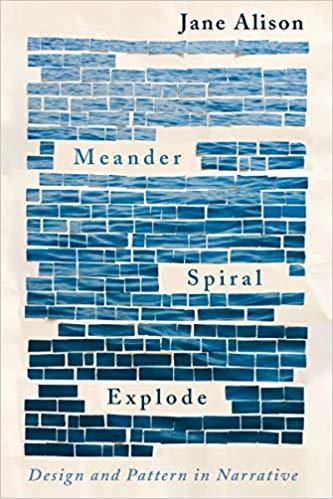
Meander, Spiral, Explode: Design and Pattern in Narrative
"Doctors don't imitate Galen. Why should writers follow Aristotle? Jane Alison in her fresh, original book about narrative is our new Aristotle." ―Edmund White, author of The Unpunished Vice: A Life of Reading
As Jane Alison writes in the introduction to her insightful and appealing book about the craft of writing: "For centuries there's been one path through fiction we're most likely to travel―one we're actually told to follow―and that's the dramatic arc: a situation arises, grows tense, reaches a peak, subsides...But something that swells and tautens until climax, then collapses? Bit masculo-sexual, no? So many other patterns run through nature, tracing other deep motions in life. Why not draw on them, too?"
W. G. Sebald's Emigrants was the first novel to show Alison how forward momentum can be created by way of pattern, rather than the traditional arc―or, in nature, wave. Other writers of nonlinear prose considered in her "museum of specimens" include Nicholson Baker, Anne Carson, Marguerite Duras, Gabriel Garc�a M�rquez, Jamaica Kincaid, Clarice Lispector, Susan Minot, David Mitchell, Caryl Phillips, and Mary Robison.
Meander, Spiral, Explode is a singular and brilliant elucidation of literary strategies that also brings high spirits and wit to its original conclusions. It is a liberating manifesto that says, Let's leave the outdated modes behind and, in thinking of new modes, bring feeling back to experimentation. It will appeal to serious readers and writers alike.
Runtime: 5. 84 hours
As Jane Alison writes in the introduction to her insightful and appealing book about the craft of writing: "For centuries there's been one path through fiction we're most likely to travel―one we're actually told to follow―and that's the dramatic arc: a situation arises, grows tense, reaches a peak, subsides...But something that swells and tautens until climax, then collapses? Bit masculo-sexual, no? So many other patterns run through nature, tracing other deep motions in life. Why not draw on them, too?"
W. G. Sebald's Emigrants was the first novel to show Alison how forward momentum can be created by way of pattern, rather than the traditional arc―or, in nature, wave. Other writers of nonlinear prose considered in her "museum of specimens" include Nicholson Baker, Anne Carson, Marguerite Duras, Gabriel Garc�a M�rquez, Jamaica Kincaid, Clarice Lispector, Susan Minot, David Mitchell, Caryl Phillips, and Mary Robison.
Meander, Spiral, Explode is a singular and brilliant elucidation of literary strategies that also brings high spirits and wit to its original conclusions. It is a liberating manifesto that says, Let's leave the outdated modes behind and, in thinking of new modes, bring feeling back to experimentation. It will appeal to serious readers and writers alike.
Runtime: 5. 84 hours
272 pages, Paperback
First published April 1, 2019
Ratings & Reviews
Friends & Following
Create a free account to discover what your friends think of this book!
Community Reviews
Displaying 1 - 30 of 447 reviews

January 11, 2020
Interesting book length study of shapes in literature- as interesting for readers as writers (which is not always true of craft works), with insightful looks at structures other than Freytag’s trusty old triangle. Alison is an excellent writer, and the glimmers of her personality and humor kept me reading. As is often the case with books like this, it’s best when you have already read the literature she breaks down (leaning heavily on the same few pieces throughout).

Read
May 19, 2019A thrilling work of literary criticism from a writer who very clearly loves to read. "Literary Criticism" sounds wrong, actually. Meander, Spiral, Explode isn't criticism per se. More, it's the "how to be a better reader of contemporary lit" book I've been waiting and searching for. Alison observes and categorizes the many ways fiction writers structure their work, from word choice, to sentence, to paragraph, to chapter, to finished structure. She excerpts many works of recent fiction. She observes the way the words behave on the page and shows me patterns I was only dimly aware of before. It reminds me of the best art criticism: it allows me to see/read better, with greater appreciation for what I'm experiencing as I read.
I'm sure this book will make me a better reader, more willing to let a story tell itself even when it doesn't take the expected aristotelian storytelling shape. Anyone who loves reading contemporary literature will find it enlightening.
I'm sure this book will make me a better reader, more willing to let a story tell itself even when it doesn't take the expected aristotelian storytelling shape. Anyone who loves reading contemporary literature will find it enlightening.

November 9, 2020
169th book of 2020.
This was recommended to me by a good friend I have met on my MA course, J., who is considerably older than me, but we have a good relationship all the same. In fact, my entire group on the MA was made up of entirely middle-aged women, which they were apologetic about, but I didn’t mind it at all. J. and I are particularly close. A few weeks ago we were chatting on the phone for an hour or so and she mentioned this in passing and I ordered it without much hesitation. When it arrived I realised one of the novels Alison deconstructs is Sebald’s The Emigrants, which moved it into my immediate to-read pile. I am not going to talk about my own writing project here or J.’s, but we are both attempting something somewhat experimental, so, personally, this book was very helpful.
Firstly, Alison’s tone is perfect. She is not didactic in the slightest: her tone is informing, or guiding, at best. Throughout the book Alison uses several novels to illustrate her points, and uses quotes from them as supplements. (I’ll list every story Alison refers to at the end of this review.) Part One, titled “Primary Elements”, is only short, and takes us through three chapters: “Point, Line, Texture”, “Movement and Flow” and “Colour”. Part Two, the rest of the book, discusses “Patterns” as narrative structures, connecting them with novels and stories and exploring how they add extra layers and emotion. She presents these patterns as structures: “Waves”, “Wavelets”, “Meanders”, “Spirals”, “Radials or Explosions”, “Networks and Cells”, “Fractals” and “Tsunami?”, with the added question-mark. Some books and stories fall into multiple Patterns, but many only one.
Rather than breakdown all Alison’s theories and Patterns, which one must read and reflect upon themselves, I want to quote and comment on a few of the novels and stories she addresses and how they, in turn, relate to a Pattern or two. The rest will remain in mystery.
As suggested in the opening paragraph, I am a big Sebald fan and read this book solely to see Alison’s thoughts on it, which did not disappoint: it was a 5-star commentary on The Emigrants alone. The other most realised parts were her reflections on Carver, Carson, Roth, Duras, Mitchell, Oates and a few others. But first—Sebald. The Emigrants is first called upon in the chapter “Colour” in Part One. She opens the commentary with something I have said and heard many times before: When I’ve asked people (many) what “colour” this quartet of narratives is, everyone has said grey, sepia, or brown. Readers of Sebald, I imagine, would agree, as I do. Alison only dedicates a quick 3 pages to the novel and the idea of colour before moving on, but what she does say is pertinent:
Alison returns to Sebald later in the book, in the Pattern “Networks and Cells”—suitably. She begins by capturing the novel as a whole brilliantly:
Alison ultimately attempts to unlock why we keep reading Sebald, which is a question I have often asked myself, while reading The Emigrants and others.
In all four parts of the novel Nabokov appears in one way or the other, which is one bizarre feature that I felt, when I read it, must have a deeper and more concentrated meaning, if only one could discern it. And, the mysterious, Butterfly Man; Alison discovers the answer seemed pinned to the Butterfly Man—and she uses clever use of the word “pinned” there.
I was going to lay it all out, but I’ve decided I won’t. It’s the most brilliant thing about this book, I think, and I don’t want to spoil it, by giving it away or spoil it by distilling it too briefly. But, the secret of Sebald’s novel is in Nabokov/The Butterfly Man.
I won’t delve fully into Alison’s thoughts on Nox, but I will drop in Alison’s description on it, for I had never heard of the novel before, and it is… Well, it is certainly different:
Lastly, for now, I want to mention her brilliant dissection of Carver’s “Where I’m Calling From”, and the technique used, flitting between “wet” and “dry” images and sensations, through the setting and characters. I’ll draw up some quotes for it soon and perhaps discuss one more of Alison’s commentaries.
(As ever, I have italicised novels and put short story titles in inverted commas to differentiate between them):
Alexie, Sherman—"Captivity” & “Superman and Me”
Bail, Murray—Eucalyptus
Baker, Nicholson—The Mezzanine
Carson, Anne—Nox
Carver, Raymond—"Why Don’t You Dance” & “Where I’m Calling From”
Chandra, Vikram—"Shakti”
Cisneros, Sandra—The House on Mango Street
Duras, Marguerite—The Lover
Dybek, Stuart—“Pet Milk”
Johnson, B.S.— The Unfortunates
Kincaid, Jamaica—Mr Potter
Lin, Tao—Shoplifting from American Apparel
Lispector, Clarice—“The Fifth Story”
Markson, David—Wittgenstein’s Mistress
Marquez, Gabriel Garcia—Chronicle of a Death Foretold
Minot, Susan—“Lust”
Mitchell, David—Cloud Atlas
Nabokov, Vladimir—Lolita & Speak, Memory
Nors, Dorthe—“Days”
Oates, Joyce Carol—Black Water
Phillips, Caryl—Crossing the River
Redonnet, Marie—Hôtel Splendid
Robbe-Grillet, Alain—Jealousy
Robison, Mary—Why Did I Ever
Roth, Philip—Goodbye Columbus
Salarrué—“We Bad”
Sebald, W.G.— The Emigrants
Torres, Justin—“Reverting to a Wild State”
Wallace, David Foster—“Forever Overhead”
Wolff, Tobias—“Bullet in the Brain” & The Barracks Thief
This was recommended to me by a good friend I have met on my MA course, J., who is considerably older than me, but we have a good relationship all the same. In fact, my entire group on the MA was made up of entirely middle-aged women, which they were apologetic about, but I didn’t mind it at all. J. and I are particularly close. A few weeks ago we were chatting on the phone for an hour or so and she mentioned this in passing and I ordered it without much hesitation. When it arrived I realised one of the novels Alison deconstructs is Sebald’s The Emigrants, which moved it into my immediate to-read pile. I am not going to talk about my own writing project here or J.’s, but we are both attempting something somewhat experimental, so, personally, this book was very helpful.
Firstly, Alison’s tone is perfect. She is not didactic in the slightest: her tone is informing, or guiding, at best. Throughout the book Alison uses several novels to illustrate her points, and uses quotes from them as supplements. (I’ll list every story Alison refers to at the end of this review.) Part One, titled “Primary Elements”, is only short, and takes us through three chapters: “Point, Line, Texture”, “Movement and Flow” and “Colour”. Part Two, the rest of the book, discusses “Patterns” as narrative structures, connecting them with novels and stories and exploring how they add extra layers and emotion. She presents these patterns as structures: “Waves”, “Wavelets”, “Meanders”, “Spirals”, “Radials or Explosions”, “Networks and Cells”, “Fractals” and “Tsunami?”, with the added question-mark. Some books and stories fall into multiple Patterns, but many only one.
Rather than breakdown all Alison’s theories and Patterns, which one must read and reflect upon themselves, I want to quote and comment on a few of the novels and stories she addresses and how they, in turn, relate to a Pattern or two. The rest will remain in mystery.
As suggested in the opening paragraph, I am a big Sebald fan and read this book solely to see Alison’s thoughts on it, which did not disappoint: it was a 5-star commentary on The Emigrants alone. The other most realised parts were her reflections on Carver, Carson, Roth, Duras, Mitchell, Oates and a few others. But first—Sebald. The Emigrants is first called upon in the chapter “Colour” in Part One. She opens the commentary with something I have said and heard many times before: When I’ve asked people (many) what “colour” this quartet of narratives is, everyone has said grey, sepia, or brown. Readers of Sebald, I imagine, would agree, as I do. Alison only dedicates a quick 3 pages to the novel and the idea of colour before moving on, but what she does say is pertinent:
Dust. Even in this passage, you sense the grey? [I’ve omitted the slightly-long passage she quotes before this comment] When Sebald names colours—as he does a few lines earlier—the brief flares of carmine or blue soon die beneath the dust. The same cindery, silty, dusty feel in each of the four narratives is one way he joins them, one of their alchemical meldings.
Alison returns to Sebald later in the book, in the Pattern “Networks and Cells”—suitably. She begins by capturing the novel as a whole brilliantly:
If “The Emigrants” were a painting, it would be a quadriptych with charcoal or sepia conte strokes forming oily, smoky labyrinths, each canvas different but sharing texture and tone. Ghosts of names might be scratched into the charcoal, or the hinted shapes of shuddering trees, possibly a train track. But on each canvas, too, would be something tiny and bright: a gleam of glass, an insect wing.
Alison ultimately attempts to unlock why we keep reading Sebald, which is a question I have often asked myself, while reading The Emigrants and others.
[T]he narratives are unified, yes; but what pushes you forward as you read from one to the next? How do the parts become more? The feel in reading is of a novel, not a collection of stories. But without a plot, what exactly advances us? The questions a spatial narrative asks are not “what happens next?” but “why did this happen?” and, more complexly, “what grows in my mind as I read?”
In all four parts of the novel Nabokov appears in one way or the other, which is one bizarre feature that I felt, when I read it, must have a deeper and more concentrated meaning, if only one could discern it. And, the mysterious, Butterfly Man; Alison discovers the answer seemed pinned to the Butterfly Man—and she uses clever use of the word “pinned” there.
I was going to lay it all out, but I’ve decided I won’t. It’s the most brilliant thing about this book, I think, and I don’t want to spoil it, by giving it away or spoil it by distilling it too briefly. But, the secret of Sebald’s novel is in Nabokov/The Butterfly Man.
I won’t delve fully into Alison’s thoughts on Nox, but I will drop in Alison’s description on it, for I had never heard of the novel before, and it is… Well, it is certainly different:
It's about the loss of Carson's brother, Michael, and comes in a sombre grey box whose lid you gingerly lift to find a paper accordion: a twenty-seven-yard strip of paper folded one-hundred times. At the beginning is a smudged xerox of the Latin poet Catullus' poem 101, an elegy to his own lost brother. Then you turn fold after fold to find the poem's Latin words one by one, each with a (partly made-up) lexical entry. Each entry in turn triggers fragments of memoir, photos, envelopes, letters, stamps, drawings, paintings, blank pages, lines of poetry...
Lastly, for now, I want to mention her brilliant dissection of Carver’s “Where I’m Calling From”, and the technique used, flitting between “wet” and “dry” images and sensations, through the setting and characters. I’ll draw up some quotes for it soon and perhaps discuss one more of Alison’s commentaries.
(As ever, I have italicised novels and put short story titles in inverted commas to differentiate between them):
Alexie, Sherman—"Captivity” & “Superman and Me”
Bail, Murray—Eucalyptus
Baker, Nicholson—The Mezzanine
Carson, Anne—Nox
Carver, Raymond—"Why Don’t You Dance” & “Where I’m Calling From”
Chandra, Vikram—"Shakti”
Cisneros, Sandra—The House on Mango Street
Duras, Marguerite—The Lover
Dybek, Stuart—“Pet Milk”
Johnson, B.S.— The Unfortunates
Kincaid, Jamaica—Mr Potter
Lin, Tao—Shoplifting from American Apparel
Lispector, Clarice—“The Fifth Story”
Markson, David—Wittgenstein’s Mistress
Marquez, Gabriel Garcia—Chronicle of a Death Foretold
Minot, Susan—“Lust”
Mitchell, David—Cloud Atlas
Nabokov, Vladimir—Lolita & Speak, Memory
Nors, Dorthe—“Days”
Oates, Joyce Carol—Black Water
Phillips, Caryl—Crossing the River
Redonnet, Marie—Hôtel Splendid
Robbe-Grillet, Alain—Jealousy
Robison, Mary—Why Did I Ever
Roth, Philip—Goodbye Columbus
Salarrué—“We Bad”
Sebald, W.G.— The Emigrants
Torres, Justin—“Reverting to a Wild State”
Wallace, David Foster—“Forever Overhead”
Wolff, Tobias—“Bullet in the Brain” & The Barracks Thief

July 10, 2022
I was blown away by how readable Jane Alison’s book was. I often sense a bit of pretension with books that are breaking down text – reaching for corners that they have no right to reach, attempting to bridge unconnected texts with a flimsy theory thought up in a passing reverie. If not that, there is a “gate-keepy” sense of “I am taking time out of my day to attempt to teach this to you, but just know that you will never learn any of this. MMMMmmmm, yes, ART.” Safe to say that this book was not that, and Alison came across as nothing but enthusiastic about the topic.
My mind was blown (my repeated use of this metaphor would flag something for her, maybe) with her modern breakdown of books and short stories that didn’t follow the exposition, rising action, climax, falling action, and resolution cycle/arc – one that, she argued, was Aristotelean and had been the only form of analysis due to Aristotle’s lack of access to other narratives. Indeed, as the quote on the back of the back says, “Doctors don’t imitate Galen. Why should writers follow Aristotle?”
I particularly enjoyed her chapters that broke down the structure of stories that were similar to waves, wavelets, networks and cells, and fractals. I picked up a few of the books that she mentioned, hoping to read them soon, and I became resolved, for the 100th time this year, to pick up Sebald’s The Emigrants. I will soon.
My mind was blown (my repeated use of this metaphor would flag something for her, maybe) with her modern breakdown of books and short stories that didn’t follow the exposition, rising action, climax, falling action, and resolution cycle/arc – one that, she argued, was Aristotelean and had been the only form of analysis due to Aristotle’s lack of access to other narratives. Indeed, as the quote on the back of the back says, “Doctors don’t imitate Galen. Why should writers follow Aristotle?”
I particularly enjoyed her chapters that broke down the structure of stories that were similar to waves, wavelets, networks and cells, and fractals. I picked up a few of the books that she mentioned, hoping to read them soon, and I became resolved, for the 100th time this year, to pick up Sebald’s The Emigrants. I will soon.
January 6, 2024
Jane Alison's inventive and insightful exploration of non-traditional ways to expand story narrative can be appreciated by readers and writers alike. I was drawn to it as a craft resource, wanting to juice my writer's brain at the start of a new year, but soon realized I was enjoying it at least as much from the perspective of an avid reader.
Alison's thesis is that the traditional story arc, which follows a triangle pattern of Beginning, Middle, End (Complication, Change, Dénouement), denies the very nature of the human experience, which is an organic pattern that rarely moves along an expected path. She encourages writers to look for other possibilities in narrative arc by presenting myriad ways of rethinking how we experience text and story. The first section of the book, Primary Elements is concerned with visual elements of story: how we experience a text in our mind's eye ("seeing comes before words"). As a visual writer, I was fascinated by these essays on texture, color, symmetry- the dimensionality text takes on through a writer's use of space, how sentences and paragraphs flow, how words of color elicit emotion in the reader.
The second, and much longer, section is Patterns. Here, Alison uses geometric shapes and patterns such as waves, spirals, cells, and fractals, among others, to show how story arcs move a reader through time, space, thought, and emotion. In each instance, she dives deep into a text to demonstrate an author's brilliance at creating energy and tension and drama that subverts the dominant paradigm.
This is all heady stuff and the texts that Alison uses to illustrate her point are literary classics that I would argue are outside of many readers' personal canons, including Marguerite Duras's The Lover, W.G. Sebald's The Emigrants, Chronicle of a Death Foretold by Gabriel Garcia Marquez, Goodbye Columbus by Philip Roth, and several novels published in the 1980s and 1990s by writers I've never heard of. More recognizable examples are David Mitchell's 2004 Cloud Atlas, a mind-blowing matryoshka doll of a novel that has seen recent imitators (Anthony Doerr, Emily St John Mandel) but none that match his artistry, and Raymond Carver, whose spare short stories evoked layers of meaning.
I bristle at the notion that the conventional arc is somehow lesser than or more boring in comparison to the esoteric texts that Jane Alison presents. A review of Meander, Spiral, Explode in The New Yorker rightly identifies this contention as a straw man. Generations of readers and millions of books would belie the notion that readers are even asking for or somehow missing something by reading books that flow along according to storytelling tradition (which has been present for millenia).
But perhaps that's at the heart of her point. She challenges us to (re)explore writers who took chances and expanded our understanding of what literature can do. I came away refreshed and curious, determined to be more alert to patterns as I read and as I write.
Alison's thesis is that the traditional story arc, which follows a triangle pattern of Beginning, Middle, End (Complication, Change, Dénouement), denies the very nature of the human experience, which is an organic pattern that rarely moves along an expected path. She encourages writers to look for other possibilities in narrative arc by presenting myriad ways of rethinking how we experience text and story. The first section of the book, Primary Elements is concerned with visual elements of story: how we experience a text in our mind's eye ("seeing comes before words"). As a visual writer, I was fascinated by these essays on texture, color, symmetry- the dimensionality text takes on through a writer's use of space, how sentences and paragraphs flow, how words of color elicit emotion in the reader.
The second, and much longer, section is Patterns. Here, Alison uses geometric shapes and patterns such as waves, spirals, cells, and fractals, among others, to show how story arcs move a reader through time, space, thought, and emotion. In each instance, she dives deep into a text to demonstrate an author's brilliance at creating energy and tension and drama that subverts the dominant paradigm.
This is all heady stuff and the texts that Alison uses to illustrate her point are literary classics that I would argue are outside of many readers' personal canons, including Marguerite Duras's The Lover, W.G. Sebald's The Emigrants, Chronicle of a Death Foretold by Gabriel Garcia Marquez, Goodbye Columbus by Philip Roth, and several novels published in the 1980s and 1990s by writers I've never heard of. More recognizable examples are David Mitchell's 2004 Cloud Atlas, a mind-blowing matryoshka doll of a novel that has seen recent imitators (Anthony Doerr, Emily St John Mandel) but none that match his artistry, and Raymond Carver, whose spare short stories evoked layers of meaning.
I bristle at the notion that the conventional arc is somehow lesser than or more boring in comparison to the esoteric texts that Jane Alison presents. A review of Meander, Spiral, Explode in The New Yorker rightly identifies this contention as a straw man. Generations of readers and millions of books would belie the notion that readers are even asking for or somehow missing something by reading books that flow along according to storytelling tradition (which has been present for millenia).
But perhaps that's at the heart of her point. She challenges us to (re)explore writers who took chances and expanded our understanding of what literature can do. I came away refreshed and curious, determined to be more alert to patterns as I read and as I write.

November 28, 2019
The most original book on writing I have read yet. This is not a Save-the-Cat sort of guide to story structure; Alison is not looking to define a list of story beats and tell you how to distribute them through your narrative. Rather the opposite; she invites you to look beyond such linear models of narrative.
Alison notes that the expansiveness of the novel gives one the opportunity to leave linear structures behind and instead use varied structures that themselves carry meaning or enhance or amplify the meaning in the narrative. She looks to the Modernists and to post-modern novels in their experimentations with structure, and draws in structural concepts from nature and from architecture—waves, spirals, cells, fractals. It’s a refreshing and stimulating way to think about structure.
If you don’t like close readings and detailed textual analysis, this might not be the book for you — but then, if you don’t like that sort of thing, why would you pick up a book on narrative structure?
Alison notes that the expansiveness of the novel gives one the opportunity to leave linear structures behind and instead use varied structures that themselves carry meaning or enhance or amplify the meaning in the narrative. She looks to the Modernists and to post-modern novels in their experimentations with structure, and draws in structural concepts from nature and from architecture—waves, spirals, cells, fractals. It’s a refreshing and stimulating way to think about structure.
If you don’t like close readings and detailed textual analysis, this might not be the book for you — but then, if you don’t like that sort of thing, why would you pick up a book on narrative structure?

Read
May 31, 2020Sometimes a book comes along that radically alters your perception. I was hoping this would be one of those books, but alas, for me, it was not. It’s a very academic book that connects its main theses to a lot of very serious philosophies. As much as I want to be a thoughtful, intellectual writer, I’m still just a glum 17 year old who wants magic & mystery & emotion out of my fictional narratives. I do not think of narrative arcs in sexual terms, but have always seen in their shapes the structural echoes of my own moods (and the way my mental health guides those moods.) So for me, the arc appeals because of how it mimics the rise and fall of my hopes, my obstacles, my failures, my successes. (And that traditional arc is not inherently proscriptive, but is primarily a result of describing the narratives that humanity has frequently been attracted to.) If you are more intellectual than me & want to think of alternatives to a narrative arc, give it a go.

March 18, 2019
One of the best books about writing.

September 26, 2023
dit boek geeft me zoveel zin om meer te lezen en nieuwe narratieve structuren te ontdekken en proberen!

April 2, 2019
What a wonderful companion. Alison acts not only as a guide of narrative form but in the spiritual sense also. The way she embodies the art of anecdote, exploring it in all its varying, uncharted trajectories is quite beautiful and inspiring. I'm surprised my edition has remained so clean with all the notes I've taken in it — but it'll make nice for my nightstand, and yours too.
Thank you once again for sending me this wonderful book, Catapult! <3
Thank you once again for sending me this wonderful book, Catapult! <3

December 2, 2022
Learning about craft makes one a better reader.

Read
December 17, 2025DNF @ 21%. I liked the concepts a lot and was very excited to dig into this, but it quickly became an opportunity to show off long excerpts from authors this author happens to like, with minimal analysis or insight beyond “wasn’t that great.” And unfortunately they’re mostly generic 20th century litfic authors whose writing doesn’t exactly move me. I don’t have the emotional stamina to pick through all this!
Maybe best read as a physical book so it’s easier to flip past the boring parts.
Maybe best read as a physical book so it’s easier to flip past the boring parts.

May 6, 2019
I took three of Alison's classes in college, and this book is like a distillation of one semester's worth in 250 pp. I mean that in the best way possible. The analysis of Nicholson Baker's MEZZANINE alone is worth the price of admission.

Read
November 6, 2020Re-read:
I'm teaching a writing course now on plotting novels, and a surprising lot of my students hold MFAs, so I thought I'd better go back and reread this MFA-friendly book to make sure there wasn't something I could learn from it about narrative structure. I have once again concluded that its main contribution is to make writers of self-consciously literary fiction feel more comfortable with the idea of plot.
Because I'm teaching right now, I feel particularly strongly that the fundamental job of a teacher is to communicate concepts clearly, in the most useful way possible. Otherwise what on earth is the point? What's the point of calling a sense of forward momentum created at the sentence level a "micro-profluence", other than to throw up a shitty little wall (a micro-impediment??) between those who know what the hell she's talking about and those who don't? Torturing language in this way doesn't help anyone learn, or if it does so, that's just a side benefit; you do it to create distinctions, model professionalization, and signal in-group status. It communicates a kind of value that is totally outside of the text.
After combing the opening paragraph of Philip Roth's Goodbye, Columbus for micro-profluence and micro-frictions and whatnot, Allison goes on to admit (in a move she does again and again) that the story follows a completely standard narrative arc. But don't worry, that doesn't matter! "What interests me... is how transparently Roth works with symmetries to articulate the waves tension and shape. Is this hyperstructuring paint-by-numbers? Or Hard-Edge painting?"
Leaving aside the question of what those last two questions EVEN MEAN, that's a lot of table-setting just to identify scenes drawn from the beginning and end of a story that mirror each other in order to show what has changed between the two. These are just the building blocks of standard three-act structure. You can call it hyperstructuring or Hard-Edge painting if you want, but at the end of the day, if Save the Cat! says the exact same thing, it isn't breaking news. "Wavelets," which is what she calls the smaller rises and falls in narrative tension within the overarching dramatic arc, are just action and reaction beats with a glamorous new name. I am 100% sure that Allison is smarter than Blake Snyder, but her observations in this book are not.
The thing that really got me, though, was the analysis of "Where I'm Calling From," a story about alcoholism. After noting Carver's repetition of the words drink, beer, and gin-and-tonic, she crows, "Carver reifies!"* Could we not? First of all, reifying requires a direct object and doesn't really make sense here. What about just calling it emphasis, or talking about what it does--drills in the sheer, repetitive boredom of addiction? What she calls "ripples" (an alternation between wet and dry imagery) are definitely there, but her argument that this sentence-level pattern is more important than the main arc of the story because the change the protagonist undergoes by the end of the story is "small and psychological" is just ARGGGHHH. If it's an arc, it's an arc. The stakes define the scale, not the structure. Psychological realism and the family drama have their own clearly defined stakes, and the stakes of an addiction/recovery story are rather high, actually. The fact that the prose enhances the overall effect does not invalidate it.
It just feels like the whole point of this book is to argue that "real" fiction--Roth, Carver, Wallace, Oates, Duras, Nicholson Baker (lol), Marquez--doesn't use the same type of narrative structure as that other kind of fiction, you know, the kind with werewolves and romance and space ships. But in fact, what this book winds up demonstrating is just how accommodating three-act structure is, and how much it can accomplish even in stories that are committed to doing a lot more. One of the nicest things about 3-act structure is that it provides a canvas or a stage to showcase these other techniques, while giving the reader a way into and through the text, and a sense of meaning at the end of it. Learning how to do this in a deft, subtle way is a lot easier to do when someone just, you know, tells you how. Ultimately, the only reason to reinvent the wheel is to sell it to someone new.
*Okay, I admit, I went to grad school in the humanities and this word straight-up triggers me.
* * *
Well . . . this is not a craft book. Still less is it really about the novel form. (My bad, since it doesn't claim to be. But then again, as an implicit critique of 3-act structure, it kind of does.) This is literary criticism for a general audience, heavily slanted toward narratology, which I find sort of interesting but also limited and reductive. I wanted to get meandered and spiraled and exploded into a new way of thinking about narrative, which craft books almost always do, even if I dislike them. Unfortunately this one didn't.
A good half of the book is devoted to renaming the standard 3-act narrative structure a "wave" (or series of wavelets) rather than an arc. Except acts are never mentioned, because we're getting away from Aristotle, okay sure. But all this seems to do is substitute a vague notion (look, vague is French for "wave"! This is the sort of self-congratulatory parenthetical the book is full of!) for a crisp, analytical, and most of all useful one. Alison's granular textual analysis, while functional on the sentence level, rarely serves to illuminate the overarching structure of longer works. Indeed most of her examples are drawn from short stories and novellas.
I had high hopes for the meandering and spiraling and exploding chapters, but as it turned out I did not really need a new name for what The Mezzanine is like. It, like many late 20th-century texts, wears its form on its face. Anyway I was too busy being annoyed that no pre-20th-century texts were mentioned, not even Tristram Shandy.
Of all the structures the author explores, the spiral seemed the most useful to me. Even so, I kept thinking as I read that all of these newly named forms and movements are common in more traditionally plotted novels, where they are frequently overlaid in interesting ways to add texture and rhythm. That's certainly the purpose for which I'll consciously use them, even if I don't end up writing my next novel in footnotes. (And I might!) So I guess it did give me something, just not what I was looking for. Meandered!
I'm teaching a writing course now on plotting novels, and a surprising lot of my students hold MFAs, so I thought I'd better go back and reread this MFA-friendly book to make sure there wasn't something I could learn from it about narrative structure. I have once again concluded that its main contribution is to make writers of self-consciously literary fiction feel more comfortable with the idea of plot.
Because I'm teaching right now, I feel particularly strongly that the fundamental job of a teacher is to communicate concepts clearly, in the most useful way possible. Otherwise what on earth is the point? What's the point of calling a sense of forward momentum created at the sentence level a "micro-profluence", other than to throw up a shitty little wall (a micro-impediment??) between those who know what the hell she's talking about and those who don't? Torturing language in this way doesn't help anyone learn, or if it does so, that's just a side benefit; you do it to create distinctions, model professionalization, and signal in-group status. It communicates a kind of value that is totally outside of the text.
After combing the opening paragraph of Philip Roth's Goodbye, Columbus for micro-profluence and micro-frictions and whatnot, Allison goes on to admit (in a move she does again and again) that the story follows a completely standard narrative arc. But don't worry, that doesn't matter! "What interests me... is how transparently Roth works with symmetries to articulate the waves tension and shape. Is this hyperstructuring paint-by-numbers? Or Hard-Edge painting?"
Leaving aside the question of what those last two questions EVEN MEAN, that's a lot of table-setting just to identify scenes drawn from the beginning and end of a story that mirror each other in order to show what has changed between the two. These are just the building blocks of standard three-act structure. You can call it hyperstructuring or Hard-Edge painting if you want, but at the end of the day, if Save the Cat! says the exact same thing, it isn't breaking news. "Wavelets," which is what she calls the smaller rises and falls in narrative tension within the overarching dramatic arc, are just action and reaction beats with a glamorous new name. I am 100% sure that Allison is smarter than Blake Snyder, but her observations in this book are not.
The thing that really got me, though, was the analysis of "Where I'm Calling From," a story about alcoholism. After noting Carver's repetition of the words drink, beer, and gin-and-tonic, she crows, "Carver reifies!"* Could we not? First of all, reifying requires a direct object and doesn't really make sense here. What about just calling it emphasis, or talking about what it does--drills in the sheer, repetitive boredom of addiction? What she calls "ripples" (an alternation between wet and dry imagery) are definitely there, but her argument that this sentence-level pattern is more important than the main arc of the story because the change the protagonist undergoes by the end of the story is "small and psychological" is just ARGGGHHH. If it's an arc, it's an arc. The stakes define the scale, not the structure. Psychological realism and the family drama have their own clearly defined stakes, and the stakes of an addiction/recovery story are rather high, actually. The fact that the prose enhances the overall effect does not invalidate it.
It just feels like the whole point of this book is to argue that "real" fiction--Roth, Carver, Wallace, Oates, Duras, Nicholson Baker (lol), Marquez--doesn't use the same type of narrative structure as that other kind of fiction, you know, the kind with werewolves and romance and space ships. But in fact, what this book winds up demonstrating is just how accommodating three-act structure is, and how much it can accomplish even in stories that are committed to doing a lot more. One of the nicest things about 3-act structure is that it provides a canvas or a stage to showcase these other techniques, while giving the reader a way into and through the text, and a sense of meaning at the end of it. Learning how to do this in a deft, subtle way is a lot easier to do when someone just, you know, tells you how. Ultimately, the only reason to reinvent the wheel is to sell it to someone new.
*Okay, I admit, I went to grad school in the humanities and this word straight-up triggers me.
* * *
Well . . . this is not a craft book. Still less is it really about the novel form. (My bad, since it doesn't claim to be. But then again, as an implicit critique of 3-act structure, it kind of does.) This is literary criticism for a general audience, heavily slanted toward narratology, which I find sort of interesting but also limited and reductive. I wanted to get meandered and spiraled and exploded into a new way of thinking about narrative, which craft books almost always do, even if I dislike them. Unfortunately this one didn't.
A good half of the book is devoted to renaming the standard 3-act narrative structure a "wave" (or series of wavelets) rather than an arc. Except acts are never mentioned, because we're getting away from Aristotle, okay sure. But all this seems to do is substitute a vague notion (look, vague is French for "wave"! This is the sort of self-congratulatory parenthetical the book is full of!) for a crisp, analytical, and most of all useful one. Alison's granular textual analysis, while functional on the sentence level, rarely serves to illuminate the overarching structure of longer works. Indeed most of her examples are drawn from short stories and novellas.
I had high hopes for the meandering and spiraling and exploding chapters, but as it turned out I did not really need a new name for what The Mezzanine is like. It, like many late 20th-century texts, wears its form on its face. Anyway I was too busy being annoyed that no pre-20th-century texts were mentioned, not even Tristram Shandy.
Of all the structures the author explores, the spiral seemed the most useful to me. Even so, I kept thinking as I read that all of these newly named forms and movements are common in more traditionally plotted novels, where they are frequently overlaid in interesting ways to add texture and rhythm. That's certainly the purpose for which I'll consciously use them, even if I don't end up writing my next novel in footnotes. (And I might!) So I guess it did give me something, just not what I was looking for. Meandered!

December 20, 2020
O livro "Meander, Spiral, Explode: Design and Pattern in Narrative" (2019) de Jane Alison é um trabalho de análise literária incomum. Foge aos cânones estabelecidos, para abraçar um conjunto de ideias mais próximas da análise estética das artes visuais, e por isso realiza um avanço na área que hoje definimos como Narrative Design. A autora resolveu encetar um trabalho de análise de estruturas narrativas, procurando histórias que se demarcam do arco dramático — princípio, meio e fim —, no fundo da linearidade narrativa. A sua proposta pode ser ligada a uma anterior apresentada por Madison Smartt Bell, “Narrative Design” (1997), indo além, aliás oferecendo parte daquilo que tinha sido a minha crítica a Bell, com um conjunto de modelos para o desenvolvimento do design de narrativa.
Não vou aqui aprofundar mais este trabalho, uma vez que estou neste momento a escrever um texto maior sobre todas estas questões, no qual espero depois dar conta do trabalho de Alison.
Atualização: o artigo maior sobre este livro foi agora publicado no journal JDMI, pode ler online aqui: https://proa.ua.pt/index.php/jdmi/art...
Não vou aqui aprofundar mais este trabalho, uma vez que estou neste momento a escrever um texto maior sobre todas estas questões, no qual espero depois dar conta do trabalho de Alison.
Atualização: o artigo maior sobre este livro foi agora publicado no journal JDMI, pode ler online aqui: https://proa.ua.pt/index.php/jdmi/art...

February 4, 2020
Instagram | review on youtube
5/5 stars
"Next time you cross a bridge over a fast-flowing river, look down at the water as it streams past one of the bridge's feet. You might see the current split into a liquid ravine, water streaming either side, sending out eddies one way and the other."
Two words: Beyond brilliant.
This book is exactly what its title says; an exploration of all the different form of narrative, starting from writing style then moving to a bigger form of narratives. We're way too often contained in the comfortable 'wave' Aristotle narrative and Jane Alison masterfully takes us into her class, projecting vividly different ways we could write. More engaging way.
I highly recommend this book to those who write or are interested in reviewing books alike. A necessary read, much more important than the constrained 'kill the cat' or the likes of it.
Jane Alison never tells us how to write, but rather softly directs us through different ways stories have been written, and invites us to find our own.
"There is so often about the standard novel something terribly contrived, which somewhere along the line tends to falter... The business of having bits of dialogue to move the plot along, that's fine for an 18th century - or 19th-century novel, but that becomes in our day a bit trying, where you always see the wheels of the novel grinding and going on."
Instagram | youtube
5/5 stars
"Next time you cross a bridge over a fast-flowing river, look down at the water as it streams past one of the bridge's feet. You might see the current split into a liquid ravine, water streaming either side, sending out eddies one way and the other."
Two words: Beyond brilliant.
This book is exactly what its title says; an exploration of all the different form of narrative, starting from writing style then moving to a bigger form of narratives. We're way too often contained in the comfortable 'wave' Aristotle narrative and Jane Alison masterfully takes us into her class, projecting vividly different ways we could write. More engaging way.
I highly recommend this book to those who write or are interested in reviewing books alike. A necessary read, much more important than the constrained 'kill the cat' or the likes of it.
Jane Alison never tells us how to write, but rather softly directs us through different ways stories have been written, and invites us to find our own.
"There is so often about the standard novel something terribly contrived, which somewhere along the line tends to falter... The business of having bits of dialogue to move the plot along, that's fine for an 18th century - or 19th-century novel, but that becomes in our day a bit trying, where you always see the wheels of the novel grinding and going on."
Instagram | youtube

Read
March 18, 2023My writing instructor once recommended this book to me, so here we are.
It was worth a read. Alison emphasized that there are narrative patterns other than the dramatic arc—a very Western way of storytelling—most people know so well. She categorizes these as waves, wavelets, meanders, spirals, radials, cells, fractals, etc. The examples she provided in the book demonstrated the power of these different types of narrative patterns.
Reading Meander, Spiral, Explode had led me to think more about how to tell a story.
It was worth a read. Alison emphasized that there are narrative patterns other than the dramatic arc—a very Western way of storytelling—most people know so well. She categorizes these as waves, wavelets, meanders, spirals, radials, cells, fractals, etc. The examples she provided in the book demonstrated the power of these different types of narrative patterns.
Reading Meander, Spiral, Explode had led me to think more about how to tell a story.
June 24, 2019
Sometimes I'll read a 5 star novel, and can't put my finger on what made it great. I look for books like this to lead me beyond character, plot and 'ideas' and towards other ways of looking at a novel.

February 8, 2024
Na Save the Cat! Writes a Novel, dat de standaardformule aanbiedt voor romans (en films), wou ik ook een boek met alternatieve formules. En dat biedt dit boek helemaal. Meer bepaald verzamelt het bewegingen uit de natuur – de golf, de draaikolk, het meanderen, de netwerken, de ontploffing, de fractalen – en toont het hoe die ook bestaande verhalen en romans onderliggend structureren.
Wat Save the Cat nog altijd aantrekkelijker maakt (voor een schrijfleerkracht, moet ik er wellicht bij zetten), is de hands-on aanpak. Het toont niet alleen een structuur, maar begeleidt een onzekere schrijver er ook in om die structuur te gaan toepassen, met een stap-per-stap uitleg en gerichte vragen. Dit boek zet vooral tot nadenken over de werken die besproken worden en helpt om patronen te herkennen en is op dat vlak ook erg boeiend, maar de vertaalslag naar het eigen schrijven moet je zelf nog zetten. Je leest er vooral boeiende, vlot geschreven analyses van werken.
Wat Save the Cat nog altijd aantrekkelijker maakt (voor een schrijfleerkracht, moet ik er wellicht bij zetten), is de hands-on aanpak. Het toont niet alleen een structuur, maar begeleidt een onzekere schrijver er ook in om die structuur te gaan toepassen, met een stap-per-stap uitleg en gerichte vragen. Dit boek zet vooral tot nadenken over de werken die besproken worden en helpt om patronen te herkennen en is op dat vlak ook erg boeiend, maar de vertaalslag naar het eigen schrijven moet je zelf nog zetten. Je leest er vooral boeiende, vlot geschreven analyses van werken.

October 6, 2025
Like sitting in a technical workshop for creative writing: explicating the structure of fiction and its inherent patterns. Alison shares some favorite novels and stories and explains how their syntax uncovers deeper meaning. Very enjoyable if that sounds like something that will float your boat (as it did mine).

February 25, 2025
Well, that was different
November 28, 2024
Mycket bra exempel på hur man kan skapa och förstå andra strukturer i berättelser än den klassiska dramaturgiska kurvan. Indelat i former, med flera exempel på hur det gjorts i romaner och noveller främst. Uppfriskande att kliva ut ur det konventionella, nästan som en hyllning till vad skrivandet kan göra om man vågar gå utanför den boxen. Det blir ju så mycket mera intressant! Nog för att det är "skönt" med en enkel struktur som man känner till, men jag känner att jag verkligen uppskattar litteratur som vill göra något mer.
Tog lång tid att läsa, mest för att jag haft för lite tid för fortbildning på jobbet, och trots att skrivandet också är mitt eget uttryck, känns det lite för mycket som jobb för att jag ska vilja läsa den på fritiden. Kommer att ha god nytta av begreppen och formerna både i mitt eget skrivande och i undervisningen.
Läsprojekt: skrivhandböcker och litteraturvetenskap
Tog lång tid att läsa, mest för att jag haft för lite tid för fortbildning på jobbet, och trots att skrivandet också är mitt eget uttryck, känns det lite för mycket som jobb för att jag ska vilja läsa den på fritiden. Kommer att ha god nytta av begreppen och formerna både i mitt eget skrivande och i undervisningen.
Läsprojekt: skrivhandböcker och litteraturvetenskap

February 15, 2021
As a reader this text is a lot more useful than as a writer. In the main, it's a literary analysis of various texts and how they don't follow the typical arc structure, to provide examples of ways people can write without following the three act/arc structure the Western literature world has come to hold as gospel. While I agree that it is entirely possible to tell stories in ways other than the arc, this book is not a book that tells you how to do so. If you've never considered or been aware of the possibility, it might be a good starting point, but as a reader and writer who knows about alternate ways of telling stories I didn't find it all that helpful or enlightening.
The idea of the "wave" is just a nature-term way of saying arc. The structure of the wave is identical when it comes to literature. The other forms mentioned, like spirals and fractals, are the ones that defy arc structure. Many examples are given of each, but I found them to be very obvious and explanatory. Each story used as an example essentially references its own structure at one point or another, spiral stories mentioning spiraling out of control and fractals mentioning breaking into pieces, etc. The explanation of the form and how it works is not so much an analysis of the form itself as it is a literary analysis of how the content works with the structure. Good for an English essay, not so much as a writing help guide. The subtitle of the book is actually the more accurate descriptor: design and pattern in narrative, as in examples of design and pattern other than the arc in already existing stories.
This is a good book to read if you're looking to read non-arc stories or examine texts that may make little sense if analyzed in an arc-centered way. But I am coming at this book as a writer, and it didn't feel useable for me. It analyzes already existing texts instead of demonstrating ways to create them (reading those stories may help in creation but is still different than being given actual tips and techniques). And other than the example of the mammoth sized Cloud Atlas, every text used as an example were novellas/short novels, and all of them were literary. As a writer of longer novels and of genre, where does that leave me? Can you write genre using non-arc story forms? Can longer works survive using a non-arc story form? Literary and shorter-work writers may find this book helpful but as I am neither, and have already read non-arc stories previously, it didn't show me anything new.
The idea of the "wave" is just a nature-term way of saying arc. The structure of the wave is identical when it comes to literature. The other forms mentioned, like spirals and fractals, are the ones that defy arc structure. Many examples are given of each, but I found them to be very obvious and explanatory. Each story used as an example essentially references its own structure at one point or another, spiral stories mentioning spiraling out of control and fractals mentioning breaking into pieces, etc. The explanation of the form and how it works is not so much an analysis of the form itself as it is a literary analysis of how the content works with the structure. Good for an English essay, not so much as a writing help guide. The subtitle of the book is actually the more accurate descriptor: design and pattern in narrative, as in examples of design and pattern other than the arc in already existing stories.
This is a good book to read if you're looking to read non-arc stories or examine texts that may make little sense if analyzed in an arc-centered way. But I am coming at this book as a writer, and it didn't feel useable for me. It analyzes already existing texts instead of demonstrating ways to create them (reading those stories may help in creation but is still different than being given actual tips and techniques). And other than the example of the mammoth sized Cloud Atlas, every text used as an example were novellas/short novels, and all of them were literary. As a writer of longer novels and of genre, where does that leave me? Can you write genre using non-arc story forms? Can longer works survive using a non-arc story form? Literary and shorter-work writers may find this book helpful but as I am neither, and have already read non-arc stories previously, it didn't show me anything new.

October 8, 2020
Attempts to describe the works of fiction through geometrical shapes are as old as Aristotle's "Poetics": A good story, we are told, is like an arc with a beginning, a development, a climax and a solution that leads to a silence.
Jane Alison picks up from there and improves: The nature has given us many shapes and forms which could be sources of fresh inspiration for the writers. So why this obsession with arcs alone? There are meanders, spirals, waves, radials, explosions, networks and cell structures that could very well serve as the formal frame of our stories. Then she proceeds to give some examples from works of fiction, though I must say most of them were totally unknown for me.
The book also introduced Joseph Frank's idea of Spatial Form to me and I finally felt somewhat relieved because it is one of those concepts which specifies something you intuitively knew existed but couldn't tell exatly what.
Recommended reading for those who want to expand their writer's toolbox. Could be an interesting undertaking to analyse the forms of famous works of social science through Alison's geometrical shapes. Which geometrical shape does Marx's Capital resemble? Or Bourdieu's works?
Jane Alison picks up from there and improves: The nature has given us many shapes and forms which could be sources of fresh inspiration for the writers. So why this obsession with arcs alone? There are meanders, spirals, waves, radials, explosions, networks and cell structures that could very well serve as the formal frame of our stories. Then she proceeds to give some examples from works of fiction, though I must say most of them were totally unknown for me.
The book also introduced Joseph Frank's idea of Spatial Form to me and I finally felt somewhat relieved because it is one of those concepts which specifies something you intuitively knew existed but couldn't tell exatly what.
Recommended reading for those who want to expand their writer's toolbox. Could be an interesting undertaking to analyse the forms of famous works of social science through Alison's geometrical shapes. Which geometrical shape does Marx's Capital resemble? Or Bourdieu's works?

January 12, 2021
This is a book looking at alternatives to Aristotle, which I'm always in favor of. (Aristotle, in this case, being the Poetics and the rising action-climax-falling action pattern that we're taught to expect our narratives to take.) Alison looks at narratives in the traditional wave form to start with, but spends most of the book looking at other ways of putting a text together.
I enjoy reading people analyzing books they love (and Alison's enthusiasm for her examples is very clear), so I found this book pleasant to read, even though the books she's discussing are probably not books I myself will ever want to read. And it is interesting to get away from Aristotelian precepts and see other ways to do things.
I enjoy reading people analyzing books they love (and Alison's enthusiasm for her examples is very clear), so I found this book pleasant to read, even though the books she's discussing are probably not books I myself will ever want to read. And it is interesting to get away from Aristotelian precepts and see other ways to do things.

Read
August 3, 2024I’m not sure what I was expecting, but it wasn’t this. I guess I was looking for either (a) an exploration of structure and how it influences reading, or (b) a sort of memoiristic account of how, she, Jane Alison, came to appreciate work that meandered and spiraled and exploded. What I got was neither, it was something closer to Joseph Campbell talking about thousand-faced heroes, except instead of talking about classic stories, she's talking about a selection of 20th Century European avant garde novels that I already have pretty developed opinions about... and those opinions seem more nuanced, as arrogant as it is to say. Or what’s worse, it feels like a college fiction writing workshop. Well I did those over a decade ago, and I feel no need to participate in another.

October 11, 2023
Stellar book for students of creative writing, teachers, and those who'd like to give themselves a little thinking room. Generous and well laid out, like a sequence of rooms, yes.
I wrote a little more about my thoughts here: https://laughterfromthenextroom.subst...
I wrote a little more about my thoughts here: https://laughterfromthenextroom.subst...

October 22, 2021
Highly recommended for any reader or writer who is fascinated by narrative structure. I can't remember the last time I was this inspired by a book about writing. It's phenomenal.

August 6, 2021
This is a fascinating take on the structure of prose that questions why today authors are pushed into one specific structure of writing: the "arc," "wave," or "mountain." In general, I think I enjoyed Alison's overall ideas more than her specific examples. It's just interesting to think of expanding beyond the traditional story structure.
Alison mostly focuses on literary fiction, which I found interesting, maybe because she reads more of it, or because nontraditional plotlines are more easily found there. As someone to tends to read and write primarily SciFi and Fantasy, I'd be interested to see how these theories can be applied to other genres. She only referenced one work I'd read, Chronicle of a Death Foretold, but I think that was when it finally really clicked what she was talking about, so it definitely helps to have read the works she mentions.
As a writer and a reader I've always been resistant to such tightly-structured and formulaic commercial writing ("beats" and the like), but I also tend toward stories that are more compulsively readable and still contain increasing tension. So I wonder about how we achieve that kind of tension (which isn't as present in many of the stories she mentions) without using the traditional "wave" structure. I wonder how these structures can be combined without sticking strictly to one or another.
I'd definitely recommend this to writers, and maybe some people who are just readers, if you're interested in expanding your understanding of plot and theme. I've certainly been given a lot to think about, and I always appreciate that.
Alison mostly focuses on literary fiction, which I found interesting, maybe because she reads more of it, or because nontraditional plotlines are more easily found there. As someone to tends to read and write primarily SciFi and Fantasy, I'd be interested to see how these theories can be applied to other genres. She only referenced one work I'd read, Chronicle of a Death Foretold, but I think that was when it finally really clicked what she was talking about, so it definitely helps to have read the works she mentions.
As a writer and a reader I've always been resistant to such tightly-structured and formulaic commercial writing ("beats" and the like), but I also tend toward stories that are more compulsively readable and still contain increasing tension. So I wonder about how we achieve that kind of tension (which isn't as present in many of the stories she mentions) without using the traditional "wave" structure. I wonder how these structures can be combined without sticking strictly to one or another.
I'd definitely recommend this to writers, and maybe some people who are just readers, if you're interested in expanding your understanding of plot and theme. I've certainly been given a lot to think about, and I always appreciate that.
Displaying 1 - 30 of 447 reviews