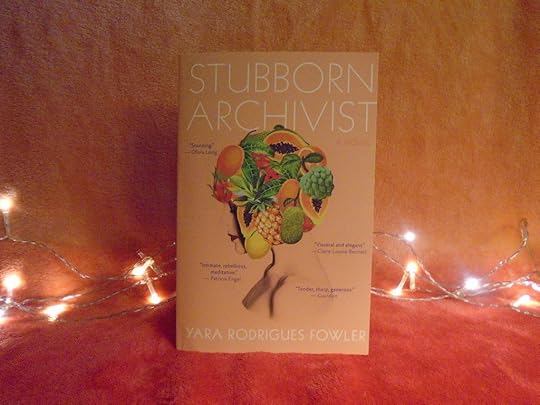
When your mother considers another country home, it's hard to know where you belong. When the people you live among can't pronounce your name, it's hard to know exactly who you are. And when your body no longer feels like your own, it's hard to understand your place in the world. This is a novel of growing up between cultures, of finding your space within them and of learning to live in a traumatized body. Our stubborn archivist tells her story through history, through family conversations, through the eyes of her mother, her grandmother and her aunt and slowly she begins to emerge into the world, defining her own sense of identity. An exciting, bold, witty debut, Stubborn Archivist is unlike any book you've read, and one you won't forget.
Yara Rodrigues Fowler is a British-Brazilian novelist who grew up in South London. Her first novel Stubborn Archivist was published in the UK in February 2019 (Fleet, Little Brown) and July 2019 (HMH). Yara was shortlisted for the Sunday Times Young Writer of the Year 2019, longlisted for the Desmond Elliott Prize and named one of The Observer’s ‘hottest-tipped’ debut novelists of 2019. She was recently longlisted for the Dylan Thomas Prize 2020. Yara’s a trustee of Latin American Women’s Aid, an organisation that runs the only two refuges in Europe for and by Latin American women. Her writing and essays have appeared in Vogue, LitHub, Electric Literature, The Guardian, BBC Brasil, Skin Deep, Litro, and other publications.
I would have loved to see this debut novel on the Women’s Prize longlist the other week. It’s such a hip, fresh approach to fiction – the last book to have struck me as truly ‘novel’ in the same way was Lincoln in the Bardo.
Broadly speaking, this is autofiction: like the author, the protagonist was born in London to a Brazilian mother and an English father. In the tradition of Karl Ove Knausgaard, Yara Rodrigues Fowler audaciously includes the mundane details of everyday life – things like a friend coming for Sunday roast, struggling with IBS, packing for a trip to Brazil, and trying to be grateful for having half-decent work and a place to live with her parents in Tooting. She also recounts lots of conversations, some momentous – as when she confronts an ex about a non-consensual sexual encounter – but most pretty inane; all conveyed with no speech marks.
The book opens with fragmentary, titled pieces that look almost like poems in stanzas. That experimentation with how the words are set out on the page continues throughout the book. Some pages contain just a few lines, or a single short paragraph that reads like a prose poem. Even where there are more conventional sections of a few pages, Fowler deliberately eschews commas and hyphens to create a sort of breathless, run-on pace. This makes the text feel artless, like a pure stream of memory and experience has been channeled directly onto the page, and yet you can be sure that a lot of hard work was involved.
The perspective moves smoothly between the third and the second person, referring to the protagonist by turns as “she” and “you.” Sometimes she’s “the baby,” going grocery shopping with Vovó (Grandmother) Cecília in Brazil and asking for bedtime stories, or observing Aunt Ana Paula’s relationship with a classmate when she comes to live with them in London for a time. This stubborn archivist is equally convinced of the value of her family history and of her twentysomething life of relationships, parties, and a good-enough job.
Navigating two cultures (and languages), being young and adrift, and sometimes seeing her mother in herself: there’s a lot to sympathize with in the main character. If you’re a fan of Sally Rooney’s work (especially Conversations with Friends), you’ll want to pick this up as soon as you can, even if you don’t expect to relate to someone of Fowler’s generation. Stubborn Archivist impressed me enough to earn the first entry on my “Best of 2019” shelf.
Originally published, with images, on my blog, Bookish Beck.
Like the author the main character of this freewheeling, unconventional novel was born and lived in South London to a English father and Brazilian mother; and the sense of liminality, of being between, of being neither/nor and of being other (perceived exotic foreigner in England, as privileged and Westernised in Brazil) but also a sense of being both (able to navigate two languages, two extended families, two climates and cultures) permeates the novel – both in its subject matter and in its stylising.
The unnamed main character, we piece together over time, had a several year relationship from around 15-16 with Leo (who was a few years above her at school) – a relationship which had an uneasy start (at least for us as reader) as she responds to his request to grow her hair long and speak Portuguese in bed and which eventually resulted in non-consensual sexual activity. The narrator suffers from IBS (possibly connected to the aftermath of the assault on her) and now works in media researching programmes and writing articles about Brazil.
Her story is told (or perhaps more accurately is pieced together) in a very non-chronological style, with copious blank space, in a mix of first, second and third persons; a combination of conventional prose and fragmentary prose poetry; even in a combination of English and occasional Portuguese - the two flowing naturally and unconsciously into each other; from her viewpoint but also from that of her Doctor mother (who fled Brazil partly due to a normal as well as political family breach and partly due to her own safety being under threat due to her actions) and her Aunt (her mother’s younger sister) who joins the family in London after the narrator’s birth and who later forms a relationship there.
The author spoke in a Review31 interview about the “oppressive weight of the [linear, realist] British novel” in terms of “imperial domination” and “gender” – and deliberately aimed for a very different approach here of conscious textuality, interrupted stories, silence and missing parts.
If anything I felt the book veered a little too much towards lightness, a TLS review in the cover praises the novel’s “ability to show something momentous ……….without seeming to say anything at all” and I am perhaps less convinced that this trade off was entirely successfully navigated. Many of the observations (on for example English and Brazilian class and race interactions) seemed a little basic to me.
Perhaps I can most easily contrast the book with another I read recently – Maddie Mortimer’s “Maps of Our Spectacular Bodies” where I (and many I know who read the book) remarked on how astonishing it was for a debut novel by a young (mid 20s) writer. With this book by contrast I felt like I was always aware that it was a debut novel and a young writer – one whose search for a narrative voice echoes the protagonists search for a way to bring her different identities and relationships together.
So overall a promising debut – but very much a debut – and I look forward to the author’s next novel.
Stubborn Archivist is the sort of book that manages to feel both brilliant and incomplete - that's the impression that I'm left with upon finishing it. Debut novelist Yara Rodrigues Fowler comes out of the gate strong with this book, which is an offbeat piece of auto-fiction that blends poetry and prose (think Eimear McBride, but more accessible) to tell the story of a young British-Brazilian woman growing up in South London.
This is one of the more 'fresh' and stylistically interesting things I've read in while; its challenge of structure feels authentic rather than arbitrary and the overall effect serves to put you in the head of the nameless protagonist. The one theme that is executed to perfection in this book is the exploration of what it's like to grow up between two cultures, which Rodrigues Fowler portrays with heart-rending authenticity on both micro- and macro-cosmic levels.
But I do wonder if Rodrigues Fowler was maybe a bit too ambitious; there were a number of other themes that were introduced without ample exploration (and it's to her credit that I do have to wonder if this was the point - after all, what woman in her early 20s has sex and sexuality completely figured out; but there were still a few scenes whose inclusion I do have to wonder at). I also was less enamored with the passages that left our protagonist and focused on her parents and her aunt; I think the idea was to give a more complete picture of this family's history, but again, I don't think these scenes were developed as well as they could have been in order to justify their inclusion.
Ultimately though I did think this was an incredibly striking debut. Highly recommended to anyone who enjoys 'millennial fiction' and contemporary literary fiction that features young women trying to find their place in the world.
Thank you to Mariner Books for the advanced copy provided in exchange for an honest review.
My understanding is that Yara's heritage reflects the heritage of her unnamed heroine in this novel. They are both 20-something londoners with a Brazilian mum and English dad. I am not sure to which extent this novel is auto-fiction, but i suspect it could categorised as such. It is also the one of those novels which could be considered "the voice of the millennials". After reading this, I could confirm that the comparison with "Conversations with friends" by S Rooney is totally justified (unfortunately in my case, as I am not a fan). In both novels we are witnessing the young women navigating their first relationships, work experiences and their bodies (including the effects of certain chronic conditions such as endometriosis (Rooney) and IBS (Rodrigues Fowler)).
I liked this book more than the Rooney's as it contained more of the context and background of this girl compared to Rooney's self-obsessed heroine with her slightly naive social convictions. Quit a big part of this novel is devoted to navigating multiple identities of being both Brazilian and English and growing to understand who she really is. The girl introduces the colourful cast of 2 older generations of her family. And the background stories of her Brazilian grandparents are told in a way of a vivid fable. They are contrasted with the snippets of her everyday life in London and her childhood.
I was attracted to this book by the praise by Claire Louise-Bennett. And on that ground, i expected a bit more from the language. Unfortunately, I was not totally blown off. Some parts of the story-telling was solid, but quite traditional. And the bits which were supposed to be experimental and poetic looked to me more like the snippets from a twitter feed.
I do not regret I've read this book. It is a pleasant enough first novel. But it did not strike me as something totally ground-breaking as I made to believe by the blurb and the reviews in the press.
I’ve read a good number of immigrant narratives.I’ve also read some books about children who have a parent from another country. Yara Rodriques Fowler’s debut novel, Stubborn Archivist takes this idea and plays around with it.
The unnamed narrator (all we know is that her name is difficult to pronounce)is the child of a Brazilian mother and British father. Throughout the book she encounters the trials that are usually encountered, wrong pronunciation of name, eating different food, having Portuguese words thrown at her. Really the book is about someone struggling to find an identity.
However this is not a normal teen novel. For starters the book jumps back and forth in time from the early 90’s to the mid 10’s so we see the main character struggling with her identity as an adult. Secondly Rodrigues Fowler also tackles the roots of the character’s family. We readers find out about the character’s grandparents, how they struggled and how their children rebelled against their own culture, which is the reason why the narrator’s mother moved to Britain.
As such the plot seems normal but then Rodrigues dresses the whole novel in an experimental cloak. There are snippets of conversations, pages with one sentence, some pages in Portuguese. Sometimes the narration changes and the story shifts to the main protagonist’s aunt. With this approach it’s up to the reader to piece everything together.
Despite the experimental nature of the novel, Stubborn Archivist is readable. What I liked is the treatment of cultural identity, which is original. Not only that but the book also has a great beating heart situated in the midst of it, there are many tender moments. As debut novels go Stubborn Archivist is quite an achievement.
Named by the Guardian as one of the hottest-tipped debut novelists of 2019 and I totally agree. 'Stubborn Archivist' is a novel about identity, belonging and living between two cultures. As Yara Rodriques Fowler herself has British father and a Brazilian mother, she knows what she is talking about. It's written in short chapters, mostly prose, some poetry, and occasionally a bit experimental. Excellent debut!
Stubborn Archivist is a fractured, inventive patchwork of a novel. It tells the story of the unnamed protagonist – a young woman in London with a Brazilian mother and British father – and her family. It flips back and forth in time, switches perspective, and frequently changes form. A sense of organic storytelling emerges, with pages of poetry, lists, and dialogue without names adding to the effect. There are chunks of prose too, but check the small details and these are often just as innovative as the rest: deliberately incorrect punctuation to alter the flow of your reading/understanding; brand names without capitalisation, indicating their absorption into everyday speech and thought; untranslated Portuguese words and phrases.
Lurking beneath the surface are rumours of deep distress. The protagonist keeps returning to thoughts of her first boyfriend; she revisits her memories of meeting him, she looks him up online, she types and deletes first lines of a message. It's obvious throughout that the ex-boyfriend is a bad person and that the protagonist is holding something back – the narrative dances around this in much the way her memories do. When she meets up with him and vocalises her trauma, it's cathartic for the reader as well as the character, finally clearing space for the narrative to progress. You almost want to let out a sigh of relief on her behalf. At the same time, this thread is never properly concluded, as we don't find out what went on between the couple.
Another particularly memorable sequence involves the protagonist taking a university friend to São Paulo. The girl, nicknamed Goldilocks for her yellow-blonde hair, proves herself the worst caricature of a middle-class Brit abroad – 'after two days of driving up the coast, she looks pouting sad because nowhere is cheap enough'.
The protagonist's namelessness could be taken as an indication that this story is partly autobiographical, and from what I gather, the protagonist and the author have similar backgrounds. I think there's more to it than that, though: so much of the book is about the protagonist holding back and hiding; the title is taken from one of many passages about the ex-boyfriend, in which she refuses to let her memory revisit 'other things'. By withholding her name and constantly reinforcing her status as a 'stubborn [i.e. biased, imperfect] archivist', the author refuses to allow full access to her protagonist. What you see in the empty spaces is what shapes your experience of the book. It often made me question my own reactions to the gaps in information. (Why did it matter whether or not I knew precisely what the ex-boyfriend had done?)
I sometimes found myself frustrated with Stubborn Archivist: the parts about the protagonist's family are so much less interesting than the parts about the protagonist, and at points it can be too obscure, lacking clarity around who or what is being described. I also felt one recurring reference (the protagonist being called 'the baby' even when depicted as an older child) crossed the line from authentic detail into annoying gimmick. But it's such an interesting, multilayered novel, the sort of story that truly deserves to be called 'thought-provoking'. I don't agree with the comparisons to Conversations with Friends – this was way better.
Blurbs on the cover by Claire-Louise Bennett and Olivia Laing piqued my curiosity, but for me the novel failed to deliver, partly because I felt I was the wrong audience. At times it’s funny, perceptive, and I like that it plays with form (mixing poetry with prose), but, even at the age of 28, I felt so old. The Sally Rooney effect? I don’t know, I really enjoyed Normal People. 2 stars, alas, as a reading experience + 1 support star for a young debut novelist.
Something about the Stubborn Archivist feels incomplete. Like it’s work in progress. Like the narrator is still coming to terms with her life, discovering hidden aspects while actively penning down her story. It’s an interesting choice, one that both works and doesn’t. The fragmentary nature of her writing lends a kind of active urgency but is also a little too premature and lacking in depth. It’s a story of belonging to two cultures, two very different cultures. Brazilian. British.
The story is told through the lens of a young woman, Isadora. And it mainly focuses on the matriarchal side: her grandmother, mother, aunt and herself, often simply referred to as ‘baby’. The narration shuttles between the two continents and cultures and you often get snippets of mundane daily occurrences and conversations. You see the narrator coming to grips with her dual heritage, a tug of war between two identities, two histories, two sides of the same coin. By the end, however, you do get the overall trajectory of the narrator’s life till that point. Stylistically speaking, it’s quite daring and inventive in its sparseness. Dialogues that don’t heed to punctuation or names, where you’re simply dropped into a conversation already midway. The prose is playful and poetic at times, abstract and removed at others. It took me a while to warm up to the style, and for that reason, I personally felt the second half was stronger. I can’t quite decide how much I liked or disliked this book, but it was certainly an interesting, experimental, easy read.
Maybe I've read too many immigration experience, too many multi-generational treatments, but this one just didn't work for me. I chose it in the hope that the combination of Brazil and UK would prove interesting, and it may be a case of bad timing.
I read Somebody Loves You by Mona Arshi just before reading Stubborn Archivist and the two novels share similarities - set in London, narrators that have duality - in Somebody Loves You, Pakistani-British, here, the narrator, a young woman, is Brazilian-British, mother is Brazilian and father is British, and she is London-born. Both are non-linear, deal with dual identity, identities, exploring one's personal identity, family, sexual trauma, otherness, politics to a degree, etc., both use white space on the page, have poetic elements, but for me, despite their similarities, Stubborn Archivist is a slighter novel, or perhaps it was that I was less engaged by the narrator here. Still, an interesting novel I am glad to have read.
3.5⭐️ “And there was a pause as each of you ask yourselves _ Are these the words that circle in every mother's mouth? I will leave this family I am leaving this family”
The name attracted me immediately. I would say the comparisons to Sally Rooney’s Conversation with Friends and Weike Wang’s Chemistry (two novels I adore) are valid, all three novels have very straightforward and frank narrators who are women in their 20s sorting through their identities by better articulating their relationships to the people around them. Yara Rodrigues Fowler’s novel distinguishes itself by diving deep into familiar relationships and the complex relationship bicultural individuals have to their identities. Stubborn Archivist is sharp, witty, painful, and soothing.
What I immediately noted, I love LOVE how the Portuguese is not translated. Those who know the language of the narrator’s mother’s family understand and for those who don’t, they don’t. Readers hear her pronounce her name slowly for her first boyfriend, but we never know her name to mispronounce it or recognize it. This was my favorite narrative decision, similar to Wang’s Chemistry I inhabited the experiences of the narrator to such a point that I didn’t realize I didn’t know her name until I attempted to talk about her to someone else. Saturated with a deep fondness for her family, their memories, their lives in Brazil and in England, the narrator learns who the person she is through them, not despite them. This is a book I would like to return to as soon as I can get a hold of a physical copy, so much of the narrator’s life between these two cultures resonated with me and my own life experiences. Particularly how the narrator describes her mother, the relationship between mother and daughter is gorgeous. I am still working on my feelings on the structure of the novel, it’s a reason I feel like I need to revisit the book. Because the experiences seem very rich I felt like I was missing something by not understanding the novel's structure.
I am grateful to Mariner Books for the advanced digital copy but I cannot wait to read this in print, I think a lot of the form is lost when the physical book is translated to the digital.
Stubborn Archivist is an interesting book – and that description in itself is a double-edged sword.
On one hand, it’s sui generis, an entirely new way of addressing dual citizenship (our narrator is half Brazilian, half British, belonging everywhere and nowhere). Stylistically daring, it combines poetry and prose, an unpunctuated few words on one page followed by exposition on the next. Despite the experimentation, it doesn’t obscure language; in fact, the book is highly readable.
On the other hand, the book borders on precious and self-indulgent. There are many passages such as this:
“Are you?” No. She nods. I was. I did. For a while. But not anymore. I’m sorry.
The novel, at its core, is about belonging and it focuses on a matriarchy – a grandmother, a mother, an aunt, and our narrator, the unnamed daughter (often referred to as “baby.”) We get snippets of their lives and like a stubborn archivist, it is up to us to put the pieces together. (And eventually, it all coalesces and we get a sense of the trajectory of the narrator’s life.) We get insights into a girl/woman who straddles two worlds – two climates, two languages, two cultures, two roads to take.
For those who admire new forms and new ways of using linguistic form to capture the fractured hybridity of a one person’s life, this is your book. I can’t say I loved it but I certainly admired it.
This book was... interesting. The writing style is certainly experimental and it takes a while to get used to how it's written. I wasn't particularly fond of the stream of consciousness narration, particularly in the second person POV, but there were moments that were described beautifully. I can see why some may call it poetic, but I don't think it works that well as a novel. I was expecting to learn more about the cultures and while I did get some of that, it didn't completely immerse me in its world. I get that it's supposed to be impressionistic, but when I don't like it when you can't even tell who the speaker is when dialogues are being thrown around. I did like it for the novelty, but whatever is beyond was lost for me because of the way that it's written.
I really enjoyed this debut novel, the non-linear, fragmentary narrative is refreshing and hypnotic. Oblique storytelling can sometimes feel a little ‘artful’ and contrived but this feels entirely natural. I also found the novel quietly moving. Highly recommend.
A mix of poetry and prose, fragmented ideas and unfinished thoughts … all helped shine a light on the inner life of this 20-something main character. I especially liked the latter half of the book, but I do wish certain things could have been explored more.
*I received this book from NetGalley in return for a honest review*
This book is beautiful, the words sweep you into their story and I got caught up into this Brazilian-British family with their intricacies, history, and present. This story looks at who people are and whether it matters more where you were born, where you feel most at home, or where your family is. It looks at the shared history of a family through good and bad times, and for discovering who you are. The writing of this novel was really beautiful and I loved the addition of Portuguese and culture infused into the chapters, but sadly I just couldn't connect to the characters as much as I wish I could which is why it is not getting a higher rating.
This is very much a book for those who love the poetry of words and the beauty of culture.
The mixture of writing styles is a nice way of conveying the main theme of the book, growing up with a mixed identity. It can however get a little confusing at times... but maybe that's the point
Yara Rodrigues Fowler’s The Stubborn Archivist is not strictly speaking a novel. It has much more in common with a piece of poetic prose – and in fact, the first few pages seem almost to be toying with the idea of straightforward poetry – with bold headings and lots of white space surrounding many line breaks. But it manages to engage one’s attention much as if one were reading a far more straightforward and linear novel. We never learn the name of the main protagonist: she is half British, half Brazilian and raised in South London. Her age is also constantly in flux: she starts as a teenager, reaches her early twenties and then the perspective continuously chops between her early childhood, adolescence and early adult years. The book is mostly written in third person, but occasionally drifts into first and second person. The prose has a beautiful lyrical flow, despite the “chop and change” nature of the book’s structure: it has three parts with many miniature subsections, skipping between two countries and various characters, chronologies and narration styles. One may well wonder whether the book might have benefited from a slightly tighter structure. The themes that interconnect those varying styles are those of identity, isolation and femininity. The English is frequently interrupted by Portuguese, as the characters travel frequently between the England and Brazil, both literally (one of the most striking passages in the book describes a flight over the Atlantic Ocean) and metaphorically. The protagonist of the book grows up struggling to think of which country she feels she belongs to: her fatherland or her motherland. She is disgusted by a British girl with blonde hair who comes to visit Brazil in what is described as “colonial chic” – “ in thin beige three-quarter lengths, birkenstocks, a loose white blouse and a khaki-coloured explorer hat that looks like is should have corks hanging off it.” Yet when she was thirteen, she was completely capable of stating to her mother “But you are foreign… – Coming here and stealing all our jobs.” The narrator is always caught in between her two worlds, never quite feeling she belongs to either one of them. If you’re looking for a traditional novel with a recognisable plot, this will not be your cup of tea, but for those more literarily minded, Yara is very skilled in her feeling for language. This book is a fantastic debut, and I enjoyed reading it very much. I look forward to seeing what Yara will write next.
I'm reviewing this book as part of shadow judging the The Sunday Times / University of Warwick Young Writer of the Year Award. I am part of the Shadow Panel which will make its own choice from the shortlist for the award.
Stubborn Archivist is a novel exploring the experiences and identity of a young woman of Brazilian-English heritage. Born in London to a Brazilian mother and an English father, she, the archivist of the title (which is I think an allusion to her role in observing her family) narrates her early life (borrowing from family stories) and her memories of travelling to Brazil for family reunions at Christmas. We see her growing up in early 00s London, leaving for university, making and falling out of friendships and always, always, returning to Brazil.
It's all beautifully, even poetically portrayed but it's impossible to convey that with a carefully selected quote or two because - and this is the first thing I need to say about Stubborn Archivist - the book is (for me) very experimental in its structure (or perhaps, rather, in its form?) Rodrigues Fowler delights in space, allowing her text almost to dance against the blankness - a handful of worlds will be emphasised by being printed alone at the top of a page, or bleeding down the side
one
by
one
She enthusiastically jumbles her sentences in places or runs words together, creating something much more like the patterns and rhythms of thoughts and feelings than conventional text.
There are pages with a block of text at the top and nothing after. There are words which morph into one another down the page, stretching meanings into sounds and sounds into meaning and playing to the rhythms of language (something very important in this book where there is a running point about people not being able to pronounce the Archivist's name: 'What's your name? He repeated the syl-la-bles.').
Now I thought I couldn't do with this sort of thing (trying to describe it, I realise I've probably made it seem very pretentious) and I worried, when I opened Stubborn Archivist, that it would be a barrier for me. But I found it all actually worked very well and far from being a barrier, it opened up the world of the Archivist and her family, removing the sense of distance that can be created by prose (however polished, perhaps especially if polished) and giving the book a much less formal air that complements its subjects and themes very well.
The book works on you at a different level than plot, sentences and logic, whispering through its convolved text to tell you about its themes - growing up, origins, belonging, not belonging. We are given scenes in the Archivist's life. There are events in her childhood both from her own perspective and as passed on to her by her family, for example the first visit of her Brazilian grandparents - her beloved Vovô and Vovó - to her parents' small London flat when she's a baby. We see the little surprises, the accommodations, as English and Brazilian cultures encounter one another and the ways in which they merge, jostle and accept each other, lubricated, as it were, by familial love (and with some effort, at times).
That basic picture endures as the Archivist grows up, the story taking in joyous, illicit teenage evenings out in London with her friend Jade, experiences with boys, and her exploration of her family's past. There is both acceptance and rejection of those different underlying cultures (the latter when a friendship founders as the friend wants to visit Brazil but can't shed her preconceptions), a romance that peters out, symbolised by the boyfriend wanting to impose his views over hairstyle, and, a recurring theme, the question (from both Brazilans and English) "But when did you move to London?"
It's perhaps symbolised most by the layered descriptions of the flight between England and Brazil. As a child (the first being beyond memory). As a teenager, doing it alone for the first time. As a seasoned traveller, who knows just what to pack and how, where to sit, how to make the flight work for her. And I haste, for a funeral. These layers build up, both distinct and, somehow, existing together, illuminating each other so that it's almost as if several different women are making the trip together.
In the same way, events bleed out of one context and into another and some of those more poetic renderings intercut, playing with worlds, morphing them from English to Portuguese, almost singing names and phrases. There are the different challenges laid down to the reality of this Anglo-Brazilian woman - not only the "When did you move...?" but the assumptions about her and the two sides of her family. An employer (a media organisation) seems to see her as "their Brazilian" and sets her to researching cosmetic surgery or gang violence. But at the same time, working in the staff restaurant, is Tiago, a much more interesting subject of research...
This is a book that's impossible to summarise. There are so many threads. It looks back to Brazilian politics in the 90s, with police brutality and disappearances. It takes in something that happened to the protagonist, which has left her, at some level, traumatised and uneasy, possibly with physical consequences - whatever happened is hinted at and explored here but rarely confronted, although it does seem to come to a resolution. And that stands for much of this book in a way - all those layers, those different version of the same woman, lend the story a sense of completion so that the story isn't happening in front of us, as it were, more being documented - a kind of coolness in the perspective which contrasts with the closeness from the textual style.
It was a book I found easy to read, easy to take big gulps of, so to speak, a story and a life that really grabbed attention, told with great verve and compelling attention tuition from the reader. Truly a magnificent read and I book that I think I'll go back to, one with a great deal more to give on rereading.
Is this poetry? Is it a book of essays? Is it a series of awkward conversations? It could be one or all 3, you be the judge. Not a book you read on the go. There is a rhythm that gets lost if you stop in the middle of a chapter. I found it hard to pick up again and would have to backtrack to find the pace.