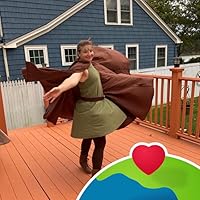
Norma Kassirer, a native of Buffalo, NY, is best known for her classic children's book Magic Elizabeth, a chapter book for middle-grade children that is featured in Eden Ross Lipson's New York Times Parents Guide to the Best Books for Children (Revised and Updated Edition). It was first published by The Viking Press in 1966 and subsequently by Scholastic, Random House, and Harper Collins in paperback editions. Generations of children continue to enjoy this timeless story, which has garnered 78 ratings on Amazon.com and 50 five-star rave reviews. Another chapter book, The Doll Snatchers, was also published by The Viking Press a couple of years later.
And now, a previously unpublished beginning chapter book of hers, The Knitting Witch, will be published in Fall 2024 by The Collective Book Studio and distributed by Simon & Schuster. It will be available wherever books are sold. Recently discovered by her daughter Sue and remembered vividly from childhood, this magical tale has been taken to new, unimagined heights by master illustrator Mark Richardson.
Norma is also the author of numerous books and short stories for adults including The Hidden Wife (Shuffaloff Press),illustrated by Willyum Rowe, Katzenjammered, a novella (BlazeVOX [books], Minnows as Small as Sixteenth Notes: The Collected Poems of Norma Kassirer, edited by Ann Goldsmith and Edric Mesmer, and Milly (Buffalo Ochre Press). Other stories and poems have appeared in various journals and collections, including Blatant Artifice, Sow's Ear, and Yellow Edenwald Field. Two chapbooks were published posthumously, Three Poems (The Poetry Collections, University of Buffalo) and a collection of asemic writing, The 1985 Notebook (Buffalo Ochre Papers). In 1991, author John Barth described Kassirer's stories as "sly, wry and fanciful, fairy-tale realistic."
Also a painter and book artist, examples of Norma's handmade books can be found in the collection of the Albright Knox Art Gallery and in The Poetry Collection of the University Libraries, University of Buffalo, the State University of New York. Paintings of hers are held by The Poetry Collection and The Burchfield Art Center, both in Buffalo, NY, and many others can be viewed at the Brighton Place library in Tonawanda, NY. Norma was also an avid member of Hallwalls, the renowned art gallery, where she gave readings, organized the archives, and in the early days painted the ceiling of the original space.
Norma came from a long line of writers: her father wrote articles for Canadian magazines about his experience in World War I; her brother was a prize-winning poet; a great-great aunt wrote poetry for Harper's Magazine in the 1800s; and a great-great-great uncle founded a literary journal in New York City with Edgar Allen Poe and, under a pseudonym (Harry Franco), produced a number of best-selling sea-faring novels. Her daughter Karen was actively engaged in writing and publishing, as is her daughter Sue.
Norma vividly remembered the last words of her first poem, written at a very early age, alone at the table in the family dining room in Buffalo, New York. The words were, "and in its place stood a golden rose!" She did not remember what the poem was about, but vividly recalled the thrill that ran through her as she read that resonant last line. Where had it come from? She had no idea, but she knew that, in search of another . . . and another . . . thrill of such dimension, she would never stop writing. And she didn't.
At the time of her passing in 2013, The Buffalo News called Norma an "author, poet and artist who influenced generations of local writers and artists." Indeed, she did.
This was a favorite of mine as a child. It is a beautiful magical story and a pure delight to reread.
I love rereading books from my past. You never know how you will feel about them in present day. Will they still retain that sense of wonder?
Magic Elizabeth can and does. It is such a sweet and wonderful story that I'd urge adults to read it, especially t hose who never discovered this wonderful piece of literature in their childhood.
Sally goes to stay with an old Aunt in an old house. Sally is lonely and scared of her Aunt but realises her Aunt is lonely too. They become friends and Sally discovers a girl in a painting who looks just like herself. The girl is also called Sally and is holding a beautiful doll. Who is the other Sally ? Where is the doll now ? A mystery is solved as Sally uncovers the past.
I haven't read this book since I was about eight, but I loved it so much then! My strongest memory is the author's incredible job of creating a setting. I still can completely picture the old house the book was set in, and the attic, and I can see the doll. The overall magic feeling of the book was so well done. I'm going to seek this out to re-read!
I still have my Scholastic paperback, and the other day I found another copy. Which, naturally, I picked up because there are still people who have not read this book and I will help them with their plight.
No surprises here, just delightful time travel/dreams, dolls, cats and crochety old aunties. Any book that starts with a woebegone little girl being dropped off by her sweet caretaker because of an emergency is going to be wonderful- or so it has always proven.
The events of this book unfold in just a few short days, though it seemed longer when I read it as a kid. There an old diary, some old-fashioned clothes, and a mystery. Plus a melodeon! And a tea set. This is where I first ran into the gas plant, as well.
Another favorite from childhood, and another inspiration for my favorite hobby of putting together the pieces of true stories from the past through research. I always wanted a house like Aunt Sarah had in the story. My grandfather's house came close, including an old attic with generations of heirlooms. Reading childhood books like this one for the first time when you are older might be fun, but I believe something will be missing if you can't look at the story through the eyes of a child.
I found this book in my Grandma's attic when I was ~9 years old and exploring one afternoon. I opened the book and saw my mom's name scribbled inside in child-like handwriting. I took it home with me and began reading immediately. I was so proud to be reading something that once belonged to my mom (even though she didn't even remember it) and it felt extra special because I stumbled upon this book just like Sally stumbled across Elizabeth. To this day it remains one of my all-time favorites.
Book Review: Magic Elizabeth by Norma Kassirer, with new illustrations by Mark Richardson
Rating: ⭐⭐⭐⭐
Magic Elizabeth by Norma Kassirer, with new illustrations by Mark Richardson, is a charming middle-grade fantasy that feels like stepping into a warm, old-fashioned storybook.
Eight-year-old Sally arrives at her elderly Aunt Sarah’s creaky house expecting a dull and lonely summer, especially with an unfriendly cat keeping her company. Instead, she becomes intrigued by an old painting of a girl holding a doll—and by the mystery of the doll, Elizabeth, who disappeared years ago. Sally’s investigation leads her into the attic, where a mysterious mirror seems to connect her world with the past. As she searches for answers, she uncovers a touching tale about friendship, compassion, and love that stretches across generations.
I was immediately drawn to the beautiful cover, and the watercolor-style artwork throughout the book adds so much atmosphere and appeal. The new full-color illustrations make the house, attic, mirror, and characters feel especially magical without taking away from the story’s gentle, nostalgic mood.
This was one of my childhood favorites, so rereading it was a particularly wonderful experience. The story is sweet, comforting, and full of quiet wonder, with a mystery that keeps things moving while still leaving plenty of room for emotion and imagination. Sally’s journey is a lovely reminder that kindness can reach farther than we realize—even across time.
I’m giving Magic Elizabeth four stars. It’s a delightful classic for young readers, but I also think adults should seek it out, especially anyone who missed it when they were growing up. Whether read independently or shared aloud, this beautifully restored edition offers a tender and memorable piece of children’s literature.
⚠️This review was written based on personal opinions and experiences with the book. Individual preferences may vary⚠️
Though I have not read it before, I have had this book a long time. You may have noticed, it is called, Magic Elizabeth, so, that is really enough reason to have a copy right there, say I. (I first saw a copy at the Niantic Book Barn in 2005, and bought it on Half.com later.)
Anyway, cute book! It is nice, a story about connecting to the past, which actually is a little hard to connect to because it's almost a 50-year-old story. And it does a lot of the usual story things: a beautiful old house that isn't scary after all, a very old relative who isn't scary after all, a prized possession that you totally believe is magic. Super sweet.
And the plot revolves around a whole bunch of kitties! That's great! Unfortunately the plot also revolves around an anthropomorphized doll, which is my greatest fear. (Not a lot, just that she is slightly "magic" and sort of has some sort of intent or something maybe.) But! The doll and one of the kittens are friends! I guess it is ok. I guess.
The story's sweetness actually made me feel warped, because I think I have spent too much time with sci-fi in the last several years and I kept making things more oogey than they were. What is Aunt Sarah hiding? What power is keeping her alive so long? Why does Emily (!) seem to know so much about Elizabeth? Is she the doll come to life? Does she even exist? When Sally time-travels through her dreams, can she get back?
2026: I decided to reread this for my Spring Into Classics challenge and the Read Happy challenge for April. As I read it this time, I realized how much of my nostalgia of this book is infused with memories of my own childhood. The doll, Elizabeth, is Debbie Baby with black hair; Sally's hollyhock dolls remind me of the day my grandmother showed me how to make a hollyhock doll at my great-grandmother's house; Sally's miniature tea sets were just like the ones my mom bought me; the names Sarah and Elizabeth are my own names...
I also thought about some of the details of this story... the furnishings of the home, for example. The stair-post angel is one of those unique things you’d have to have your own memory of in order to include in the story. Same with some of the furniture illustrations. The author and illustrator of this book likely had their own Victorian family member memories to pull from. What a great historical time capsule.
My slightly cynical adult brain did find it a bit hard to believe that a grumpy old lady would give her newly met 10 year old grandniece free reign of her home full of antiques and even invite her to rummage around in the attic without supervision. But, I suppose she was planning to sell everything so she didn't care as much.
Lovely story --- I'm so glad I reread!
2021: Just finished reading this with my youngest daughter who is now also 8. She got her own copy, as well. Such a sweet and special story!
2020: This was one of my very favorite books as a child---given to me by my mom who owned it as a child. I just finished reading it with my 8 year old daughter and gave her her own copy---which prompted hysterical tears of joy. Ha!
The story is still as magical as ever. Reading it, I was reminded that this book is what made it so special when my Dad came home with an angel dolly for the top of our tree. I was just like Sally (my name is Sarah, too!) putting my angel dolly on top the tree...and I still do every year, with the help of my husband!
This is among my favorite children’s and young adult books. There’s some historical time travel within the same house and a mystery about a missing doll. The story is not scary for a young reader, but it’s very engaging and imaginative. I read it multiple times as a child and a couple times as an adult. I would read it again today if I could find my copy! An adult or teenager is likely to guess the resolution early, but still enjoy the story as it unfolds. There’s a positive resolution on a couple of different levels, and a positive but not preachy lesson about trying to understand other people. I highly recommend this!
I read this book many years when I was a little girl, and now my daughter is reading the same book. I re-read it to myself, and fell in love with the story all over again. This book has everything a little girl could want--a spooky old house and a strange great-aunt, a mysterious painting and a missing doll, and of course, a black cat named Shadow! A nice mystery story for the younger crowd!
When it comes to books, I’ve never grown up. I still enjoy children’s books just as much and possibly more than I did when I was young. My favorites are the magical – like E. Nesbit’s Enchanted Castle or C.S. Lewis’s Narnia series. Magic Elizabeth is about Sally, an 8-year-old, who goes to stay with her Great Aunt Sarah for a few days while her parents are traveling. Aunt Sarah lived in California and had only recently come to town to sell her parent’s old home. Aunt Sarah and her cat Shadow are unused to children and are not very welcoming to Sally. Sally magically transports to the past when looking into an old mirror and helps solve the mystery of a missing doll. The descriptions of the house, antiques and landscape were beautiful. I quickly figured out the mystery and where this story was headed. As an adult, this was a 3-star book for me. But my younger self would have probably given it 4 or 5 stars.
Well, I would have liked this a lot as a kid probably, but too slight to really enjoy so much as an adult. I was also preoccupied wondering why this is illustrated by Joe Krush alone. Was Beth busy? Not interested? Did she die? What differences in the illustrations could I attribute to her absence?
This is just a precious classic children's book that will warm your heart. Sally has to visit her Aunt while her parents are away. She comes across a picture of another little girl from a long time ago that looks just like her and she is holding a doll. Her Aunt tells her about how the doll disappeared on Christmas Eve one year and Sally decides to solve the mystery. This book is charming and beautifully illustrated.
The last time I read Magic Elizabeth, I was 10 years old, but it still holds a charm and even though I roughly remembered the plot, I still found myself anticipating every scene as if reading it for the first time. I wonder if I noticed the foreshadowing so many years ago; if I had figured out the mysteries before the final chapters I do know that I stayed up past my bedtime last night to finish the last two chapters. I can't wait to share this with Lily, and maybe Amberle.
I read this book over 35 years ago and like the Laura Ingles Wilder and Narnia books and it was read over and over again by me. I don't know if the author ever wrote anything else but she captured the imagination of this girl and fueled my passion for reading.
Thanks to NetGalley and The Collective Book Studio for my ARC in exchange for my honest review. This book will be published October 4, 2026.
This is the fourth reprinted of this book, which was originally published in 1966. This version has new illustrations.
The plot is pretty simple: 8 year old Sally goes to stay with her aunt. She sees a portrait of a similar-looking girl holding a doll. She learns that the doll, named Elizabeth, got lost many years ago during Christmas. Sally is determined to find her, with the help of the cat Shadow.
Very atmospheric writing in this children's story. Beyond the main characters (Sally and her aunt Sarah) the supporting cast were all cardboard cutouts, particularly Mrs Chipley with her annoying habit of speaking of herself in the third person! But a good story for 5-8 yr old girls. Another reviewer has called the plot "predictable" but at the age this book is written for, that is what kids often want: reassurance that things will work out for the best. The "magic doll/timetravel" theme was common in books at this time (mid60s) but this one manages not to be too eerie for the younger set. Was it just her imagination, or did the transference happen? Each reader can come to her own conclusions. I thought the timescale was a little off in the "past time" episodes (Mr Washington? Really? I think there's a generation or three missing there), and a clock's pendulum would not be placed above the mechanism, as in the church tower clock, but kids probably wouldn't notice or care.
ETA: I discovered there are "gas plants" in my own city like the one that "past Sally" lights for a moment or two, but I didn't step up to the one in the park and try to light it because I could get fined.
I recently unearthed a handwritten list I made when I was 11 or 12 of "Good books about Magic, and/or Going Back Into Time, and/or Old Dolls." Naturally enough, Magic Elizabeth was the first entry on the list, since it encompasses--after a fashion--all of those narrative aspects: 10-year-old Sally goes to stay with her scary Great-Aunt Sarah, who lives in a big old house full of interesting objects. There she discovers an old portrait of a girl her own age. The portrait-girl--who also is named Sally, and who looks just like her--is holding a doll named Elizabeth. Modern-day Sally tries to solve the mystery of Elizabeth's disappearance, while getting to know her aunt and dream-visiting the past world of the girl in the picture.
I'm happy to say that the book ages quite well; the writing and story are lovely. Sadly, my old Scholastic Book paperback edition cracked into pieces as I read. But somehow that seems fitting.
(My list is 7 double-spaced notebook pages long, although halfway through I just started enumerating the Oz, Narnia, Edward Eager, Joan Aiken, and Madeleine L'Engle series books. I still own a number of the books, so I may revisit more of my own reading past. Now I can just list them on Goodreads, my affection for which seems to have been preordained.)
This is one of those books that's just fun to read and then re-read.
You start with a little girl who has to stay in a creepy house with an elderly relative that's witchy as they come while her parents are away. Add to that a portrait with a little girl that looks exactly like her and a mystery about a missing doll and you have a light paranormal tale that delights and engages as the story unravels.
I loved this book as a child and was happily surprised to see that it still holds up today, so many years later. Yes, the references are a little dated, but read it with the time period of when it was written in mind and I think you'll find that it's still a wonderful story that can easily be enjoyed by children of today.
Many years ago this was one of those magical stories that I read outside on lazy summer days. I'm sure I have this book somewhere; I should find it so I can share it with a child.
I needed to revisit an old childhood favorite after my last, heavy read, and this fit the bill exactly! Set in the late 1960s, young Sally is staying with a family friend while her parents are out of town, but when that chaperone has an emergency, she must go stay with her great-aunt Sarah. She's never met Aunt Sarah, and the old house where she arrives during a thunderstorm is almost as scary and unfriendly as her grim aunt. Things look different in the light of a new day, and when Sally explores the house, she finds a portrait of a girl who looks exactly like her, but wearing old fashioned clothes and holding a sweet doll. Aunt Sarah explains that the little girl, also named Sally, lived there many years ago, but her things were in the attic--all except the doll, Elizabeth, who disappeared one Christmas Eve and was never found again. Sally is excited by this mystery and vows to solve it while she is visiting. Sweet story with a bit of mystery and magic.
4/6 Magic Elizabeth is one of those stories that I didn’t read as a child, but I know had I found it, I would have enjoyed it immensely! A strange and scary old relative, a spooky old house, and magic doll and mirror, and a little girl who learns that not everything is as it seems and works to solve the decades old mystery. Being an adult now, it was kind of obvious what had happened to the missing doll, but, I think it was hidden enough that I would’ve been excited to solve the mystery as a kid right along with Sally. It was very predictable, but isn’t that what a children’s book is supposed to be for an adult? Especially a children’s book as old as this one. I’m sure many subsequent books/authors read Magic Elizabeth and borrowed from it. I would definitely recommend this book to children who like the secret garden, a little princess, and (my favorite lol) Mandy. Nothing groundbreaking/earthshattering happens in the story, but you don’t NEED that to tell a sweet little story. It really did seem magical, though whether the magic is in the mirror or the doll is debatable lol.