

What do you think?

Gender: A Graphic Guide
Join the creators of Queer: A Graphic History (‘Could totally change the way you think about sex and gender’ VICE) on an illustrated journey of gender exploration.
We’ll look at how gender has been ‘done’ differently – from patriarchal societies to trans communities – and how it has been viewed differently – from biological arguments for sex difference to cultural arguments about received gender norms. We’ll dive into complex and shifting ideas about masculinity and femininity, look at non-binary, trans and fluid genders, and examine the intersection of experiences of gender with people’s race, sexuality, class, disability and more.
Tackling current debates and tensions, which can divide communities and even cost lives, we’ll look to the past and the future to ask how might we approach gender differently, in more socially constructive, caring ways.
We’ll look at how gender has been ‘done’ differently – from patriarchal societies to trans communities – and how it has been viewed differently – from biological arguments for sex difference to cultural arguments about received gender norms. We’ll dive into complex and shifting ideas about masculinity and femininity, look at non-binary, trans and fluid genders, and examine the intersection of experiences of gender with people’s race, sexuality, class, disability and more.
Tackling current debates and tensions, which can divide communities and even cost lives, we’ll look to the past and the future to ask how might we approach gender differently, in more socially constructive, caring ways.
176 pages, Paperback
First published November 7, 2019
About the author
Meg-John Barker
36 books342 followersDr. Meg-John Barker is a writer, therapist, and activist-academic specialising in sex, gender and relationships. Their popular books include the (anti-)self-help relationship book Rewriting the Rules, The Secrets of Enduring Love (with Jacqui Gabb), Queer: A Graphic History (with Julia Scheele), and Enjoy Sex, How, When and If You Want To (with Justin Hancock). Meg-John is a senior lecturer in psychology at the Open University and has published many academic books and papers on topics including non-monogamous relationships, sadomasochism, counselling, and mindfulness, as well as co-founding the journal Psychology & Sexuality and the activist-research organisation BiUK. They were the lead author of The Bisexuality Report – which has informed UK policy and practice around bisexuality – and are currently co-editing a book on non-binary gender with similar aims in that area. They are involved in running many public events on sexuality and relationships, including Sense about Sex and Critical Sexology. Meg-John is a UKCP accredited psychotherapist working with gender, sexually, and relationship diverse (GSRD) clients.
Ratings & Reviews
Friends & Following
Create a free account to discover what your friends think of this book!
Community Reviews
Displaying 1 - 30 of 252 reviews

December 17, 2020
I think of myself as a male. I have got a penis and two testicles to prove it; also, no breasts, and plenty of facial hair... a hairy body... a deep voice....
Er, wait.
Apart from the penis/ testicles part (and the absence of breasts), are any of the other things biologically essential to "maleness"?
There was a time that I was convinced of it. I used to feel sorry for men who didn't have to shave daily, or who had squeaky voices like Mickey Mouse. I was also secretly ashamed of my flabby, soft, "feminine" body (though I was too lazy to go to the gym and develop muscle!). In fact, I was so convinced of the male/ female binary as a part of life.
Also, I used to regard the Hijras of India (transgender people - in my youth, we considered them eunuchs) as freaks. I used to feel uncomfortable in the presence of these people.
Well, those were the days when I considered homosexuality as a "deviant" practice, against nature. Even when I came reluctantly to accept homosexuals later on, I considered them to be abnormal, measured against the approved "normal" of heterosexual society.
We live and learn. In this aspect, I would consider my life as a huge learning curve - that of shedding ingrained prejudices one by one and constantly reevaluating myself and my position in the universe. And most importantly, making that reevaluation a daily habit.
I must confess that the idea of race and gender as social, rather than biological concepts was the most difficult thing to accept. Especially gender. The biological differences are there for all to see, aren't they? So why are people saying they are created by society?
It's only with great difficulty that the concept entered my head - biological differences does not necessarily create categories. Categorisation is an entirely human process. And once we do that, we start attaching societal baggage to each and every one of them.
***
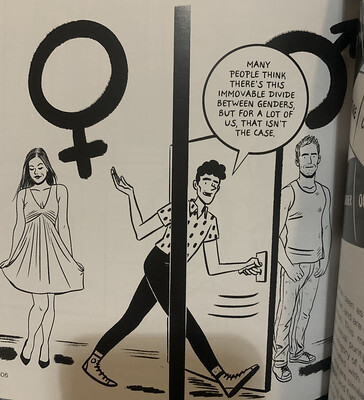
This series of graphic guides are pretty much hit and miss for me: some are excellent, while many others are only average. (They are all fun to read, however.) This particular one is excellent - it covers the vast entirety of the subject in a few pages, with very interesting cartoons to complement the text. Moreover, it introduces a very complicated subject with a disarming simplicity of approach, avoiding all jargon and heavy-handed philosophical references, in easily digestible chunks. This is one book I would be going back to again and again.
According to the author, gender is a social construct which needs to be critically reevaluated. Apart from dismantling the male/ female binary, and introducing new genders (transgender, intersex et al), we also need to see gender as fluid. The characteristics which we associate with certain categories are only indicative and not definitive. We also need to figure out where homosexuals, bisexuals and asexuals fit within this spectrum.
Why should we do this? Because rigid categorisation of humanity is the beginning of bigotry. We have seen it with race: we are seeing it with caste in India: and we are seeing it with religion all over the world. The only problem is, gender has been ingrained into our psyches so deeply, we would find it a tad difficult see it for what it really is.
Er, wait.
Apart from the penis/ testicles part (and the absence of breasts), are any of the other things biologically essential to "maleness"?
There was a time that I was convinced of it. I used to feel sorry for men who didn't have to shave daily, or who had squeaky voices like Mickey Mouse. I was also secretly ashamed of my flabby, soft, "feminine" body (though I was too lazy to go to the gym and develop muscle!). In fact, I was so convinced of the male/ female binary as a part of life.
Also, I used to regard the Hijras of India (transgender people - in my youth, we considered them eunuchs) as freaks. I used to feel uncomfortable in the presence of these people.
Well, those were the days when I considered homosexuality as a "deviant" practice, against nature. Even when I came reluctantly to accept homosexuals later on, I considered them to be abnormal, measured against the approved "normal" of heterosexual society.
We live and learn. In this aspect, I would consider my life as a huge learning curve - that of shedding ingrained prejudices one by one and constantly reevaluating myself and my position in the universe. And most importantly, making that reevaluation a daily habit.
I must confess that the idea of race and gender as social, rather than biological concepts was the most difficult thing to accept. Especially gender. The biological differences are there for all to see, aren't they? So why are people saying they are created by society?
It's only with great difficulty that the concept entered my head - biological differences does not necessarily create categories. Categorisation is an entirely human process. And once we do that, we start attaching societal baggage to each and every one of them.
***
This series of graphic guides are pretty much hit and miss for me: some are excellent, while many others are only average. (They are all fun to read, however.) This particular one is excellent - it covers the vast entirety of the subject in a few pages, with very interesting cartoons to complement the text. Moreover, it introduces a very complicated subject with a disarming simplicity of approach, avoiding all jargon and heavy-handed philosophical references, in easily digestible chunks. This is one book I would be going back to again and again.
According to the author, gender is a social construct which needs to be critically reevaluated. Apart from dismantling the male/ female binary, and introducing new genders (transgender, intersex et al), we also need to see gender as fluid. The characteristics which we associate with certain categories are only indicative and not definitive. We also need to figure out where homosexuals, bisexuals and asexuals fit within this spectrum.
Why should we do this? Because rigid categorisation of humanity is the beginning of bigotry. We have seen it with race: we are seeing it with caste in India: and we are seeing it with religion all over the world. The only problem is, gender has been ingrained into our psyches so deeply, we would find it a tad difficult see it for what it really is.
![Profile Image for s.penkevich [hiatus-will return-miss you all].](https://i.gr-assets.com/images/S/compressed.photo.goodreads.com/users/1735525095i/6431467._UX200_CR0,11,200,200_.jpg)
February 24, 2022
Introductory guides tend to fight a losing battle for never covering enough or being as insightful as people want, but this graphic guide is as good as any first step as I’ve found. This illustrated guide uses accessible language to discuss complex topics and breaks ideas down fairly effectively, which is wonderful seeing as this is a very important issue and this would make an excellent addition to any public or school library as well as personal use. The author does an good job at explaining topics such as gender fluidity, non-binary, trans identities as well as examining concepts of both gender and sexuality, being an informative guide that pulls in concepts from science, psychology and philosophy in ways that give you the valuable talking points and opportunities for further reading. Something I really appreciate with this guide is the focus on gender as both personal and political, and the later sections of the book highlight how discussions on gender figure into prominent movements, such as breaking down each wave of feminism and discussing key points as well as feminist criticism on former theory. It is important to note that the conversation on gender is always changing and updating, which I find to be a huge positive, and while this guide may feel outdated at some point it still seems a valuable starting point. As Maya Angelou said, ‘do the best you can until you know better. Then when you know better, do better.’ I think this certainly applies to understanding and empathy with topics such as this. Having a good understanding of these topics is important to help protect the wellbeing of those who don’t fit into the rigid and outdated gender binaries. While not perfect, this is a good first guide to investigate.

April 5, 2020
A kind of illustrated introductory gender and sexuality course, that would also be very useful to the general public, those of us who see new and continuously exploding conceptions and may be sort of stunned into silence. So what's the basic point? That gender is fluid, not binary, biopsychosocial, personal, political, intersectional--so not the only thing to focus on. The authors leave you with the point that since our understandings are shifting and complicated, that kindness with each other might be called for as we are all learning, and it can be scary. And beautiful, too, why not?

June 1, 2020
Ano passado, "Queer: a graphic guide" foi um dos melhores e mais relevantes livros que li. Esse ano, "Gender: a graphic guide" veio para me ensinar muito sobre dinâmicas de gênero.
Esse livro fala sobre gênero através do tempo e espaço, sempre de maneira interseccional, apontando como o colonialismo, imperialismo e capitalismo estão relacionados com o patriarcado e com as formas dominantes de poder.
Com certeza, uma das leituras mais importantes que já fiz! Uma aula sobre como deixar de lado o pensamento binário de gênero e valorizar mais ainda pesquisadores e filósofos que consideram o mundo plural como ele é.
Excelente. Recomendado!
Esse livro fala sobre gênero através do tempo e espaço, sempre de maneira interseccional, apontando como o colonialismo, imperialismo e capitalismo estão relacionados com o patriarcado e com as formas dominantes de poder.
Com certeza, uma das leituras mais importantes que já fiz! Uma aula sobre como deixar de lado o pensamento binário de gênero e valorizar mais ainda pesquisadores e filósofos que consideram o mundo plural como ele é.
Excelente. Recomendado!

November 10, 2022
[4.5]
Un libro di non fiction illustrato che approfondisce la tematica del genere rispondendo a domande, spiegando, illustrando la situazione sociopolitica passata e odierna. Perché sebbene il genere possa sembrare una cosa molto semplice da spiegare, la realtà è ben diversa da come siamo stat* abituat* a percepirla.
Il fatto che nelle società contemporanee certi corpi siano considerati troppo o troppo poco maschili/femminili è proprio figlio dell’idea che la categoria di genere sia inseparabile dai concetti di razza, classe e disabilità.
È una sorta di manuale che affronta tematiche come mascolinità e femminilità, generi non binari, trans, fluidi e l’intersezionalità tra genere, razza, classe sociale, sessualità e disabilità, grazie anche alle riflessioni e i pensieri di studios*, pensator*, filosof*, attivist*.
[…] un’altra persona […] potrebbe riconoscersi come donna ma non sentirsi a proprio agio con le aspettative sociali con cui altre persone vincolano le donne, e potrebbe non rivedersi nell’estetica e nei ruoli stereotipicamente femminili.
Se avete bisogno di un’infarinatura sul genere e tutto quello che ruota attorno a questo complicato costrutto, Gender Una storia per immagini è un libro assolutamente consigliato. È tutto spiegato molto bene, anche con esempi concreti che fanno riferimento non solo alla vita quotidiana, ma anche a libri e serie tv. Pur sapendo molte delle cose affrontate in questo volume, devo ammettere che mi ha schiarito le idee su alcuni punti e mi ha illuminato su elementi a cui non avevo – ahimè – mai pensato, innescando diverse riflessioni.
Il fatto che i bagni accessibili alle persone disabili vengano raramente distinti per genere ci ricorda poi come a queste persone sia spesso negata una sessualità, e come siano percepite come meno “uomini” o “donne” rispetto a individui abili.
Ora voglio assolutamente recuperare Queer Una storia per immagini (sempre di Meg-John Barker e Jules Scheele, già edito in Italia da Fandango), ma anche Enjoy Sex (How, When and If You Want To) di Barker e Hancock. Ah, quanto amo quando la lettura di un libro mi porta poi a scoprire e voler leggere altri libri!
Un libro di non fiction illustrato che approfondisce la tematica del genere rispondendo a domande, spiegando, illustrando la situazione sociopolitica passata e odierna. Perché sebbene il genere possa sembrare una cosa molto semplice da spiegare, la realtà è ben diversa da come siamo stat* abituat* a percepirla.
Il fatto che nelle società contemporanee certi corpi siano considerati troppo o troppo poco maschili/femminili è proprio figlio dell’idea che la categoria di genere sia inseparabile dai concetti di razza, classe e disabilità.
È una sorta di manuale che affronta tematiche come mascolinità e femminilità, generi non binari, trans, fluidi e l’intersezionalità tra genere, razza, classe sociale, sessualità e disabilità, grazie anche alle riflessioni e i pensieri di studios*, pensator*, filosof*, attivist*.
[…] un’altra persona […] potrebbe riconoscersi come donna ma non sentirsi a proprio agio con le aspettative sociali con cui altre persone vincolano le donne, e potrebbe non rivedersi nell’estetica e nei ruoli stereotipicamente femminili.
Se avete bisogno di un’infarinatura sul genere e tutto quello che ruota attorno a questo complicato costrutto, Gender Una storia per immagini è un libro assolutamente consigliato. È tutto spiegato molto bene, anche con esempi concreti che fanno riferimento non solo alla vita quotidiana, ma anche a libri e serie tv. Pur sapendo molte delle cose affrontate in questo volume, devo ammettere che mi ha schiarito le idee su alcuni punti e mi ha illuminato su elementi a cui non avevo – ahimè – mai pensato, innescando diverse riflessioni.
Il fatto che i bagni accessibili alle persone disabili vengano raramente distinti per genere ci ricorda poi come a queste persone sia spesso negata una sessualità, e come siano percepite come meno “uomini” o “donne” rispetto a individui abili.
Ora voglio assolutamente recuperare Queer Una storia per immagini (sempre di Meg-John Barker e Jules Scheele, già edito in Italia da Fandango), ma anche Enjoy Sex (How, When and If You Want To) di Barker e Hancock. Ah, quanto amo quando la lettura di un libro mi porta poi a scoprire e voler leggere altri libri!

January 26, 2021
don't write this book off because of its graphic/informal style- this is an incredibly informative, beautifully illustrated introductory course into gender and sexuality that pulls quotes from key activists, and it packs a serious punch! I learned so much and the language is plain enough that my younger brother was also able to enjoy the book.
Two of my favorite quotes "we're all always performing our genders. gender can feel real or natural because we've repeated them so often and had that performance affirmed by others" and also "we don't exist in a vacuum. my body, my ideas, and my stories are the expression of the imperialist, white supremacist, capitalist patriarchy because those are the building blocks of everything i've ever known"
This will be the book I guide people to when they're looking for a place to start to learn more about gender
Two of my favorite quotes "we're all always performing our genders. gender can feel real or natural because we've repeated them so often and had that performance affirmed by others" and also "we don't exist in a vacuum. my body, my ideas, and my stories are the expression of the imperialist, white supremacist, capitalist patriarchy because those are the building blocks of everything i've ever known"
This will be the book I guide people to when they're looking for a place to start to learn more about gender

May 8, 2020
I wish this was on the National Curriculum - what an amazing straightforward accessible overview of gender. It manages to include quotes from gender theorists yet be on a level that anyone can understand without finding patronising. Meg-John Barker is calm, reasoned and understanding. I especially enjoyed the discussion of different masculinities, the trans/cis binary and how that can be harmful and how heading towards a worldview where gender is far less rigid and structured could benefit everyone.
March 15, 2022
"Perhaps we could all aspire to gendered intelligence: aiming for a world where people are no longer constrained by narrow perceptions and expectations of gender, and where diverse gender expressions are visible and valued."
Really good resource for someone interested in getting to know more about gender and how it shapes our lives. I don’t have a problem with introductory guides, but people usually claim they often miss important topics due to its brevity, but this one manages to explain complex concepts in a simple, engaging way, referencing authors, scholars, activists, going through history and proposing many further reading resourses, non-fiction, as well as fiction, which is always fun.
It explains gender as more than just the binary spectrum and the importance to look at it intersectionally, so as not to miss many specific experiences that has been silent through the years when gender was being discussed; as well as taking a personal and sociopolitical approach. "Sociopolitical issues can’t be seen through an individual perspective"
The general point is that people should be able to define themselves as the unique individuals they are and free of (mistaken) assumptions made because of rigid gender expectations.
It really left me with a lot to think about, and a lot of book recommendations too. Gosh I love it when books do that!
Really good resource for someone interested in getting to know more about gender and how it shapes our lives. I don’t have a problem with introductory guides, but people usually claim they often miss important topics due to its brevity, but this one manages to explain complex concepts in a simple, engaging way, referencing authors, scholars, activists, going through history and proposing many further reading resourses, non-fiction, as well as fiction, which is always fun.
It explains gender as more than just the binary spectrum and the importance to look at it intersectionally, so as not to miss many specific experiences that has been silent through the years when gender was being discussed; as well as taking a personal and sociopolitical approach. "Sociopolitical issues can’t be seen through an individual perspective"
The general point is that people should be able to define themselves as the unique individuals they are and free of (mistaken) assumptions made because of rigid gender expectations.
It really left me with a lot to think about, and a lot of book recommendations too. Gosh I love it when books do that!

December 9, 2019
This book provides a great overview of gender theory. It is really helpful to understand the current discourse. Ok, this sounds really boring, but it isn't! It is nice to feel validated by a book :). As an nb trans person I often feel like I sort of exist outside of the lines, which can feel quite lonely and also make me doubt myself. Turns out there's a whole scientific discourse that provides space for all gender expressions (and they've been on this for decades). Of course you know that on an intellectual level, but being shown current thinking and being able to place myself in that framework instead of 'outside' is really nice.
As for the illustrations etc, I feel that they really brought it to the next level - this book didn't feel like the bulleted lists of the one on queer theory, the images really added another layer to the narrative.
As for the illustrations etc, I feel that they really brought it to the next level - this book didn't feel like the bulleted lists of the one on queer theory, the images really added another layer to the narrative.
November 13, 2023
The sections where they talk about how the history of gender is intertwined with capitalism and colonialism were veeeery eye opening.

April 10, 2023
This was a light introduction to gender and its complexity. It doesn't delve into a lot of detail, which is fine given the introductory feel. It was a little repetitive, and while I did find out a little more information about non binary people, I already knew the majority of everything else covered. Still, a nice little introduction to gender.
July 17, 2025
This is a great book for beginner Gender studies, and is a book I’d like to purchase for my daughter to have as she grows.

July 16, 2024
I was familiar with most of the content in this graphic guide, but I still learned some new, valuable, information. I also discovered authors I'm interested in exploring and studying further.

May 9, 2024
This graphic guide explores many ideas about gender with fun and useful references to (pop) culture. It is a very helpful guide to look back on gender studies, whenever you need a pick me up in terms of theory. I loved this!

January 11, 2022
Great introduction to the topic. They thought about everything and the chapters are building on each other nicely. Now I understand it.

March 6, 2021
I'm not sure why this book didn't grab me. I agree with almost everything in it, and it has a nice tone, serious but often humorous. Since most reviewers seem to love it, I will say what I didn't love.
There was no information that was new to me. And that's fine. I'm sure a lot of it was new to many readers. And in any case, it was all very affirming.
It was academic, which again is fine, but not to my taste. To me (college dropout partly for this reason), the academic culture has a bunch of unnecessarily convoluted thinking/writing. On the other hand, in this book, I did like many of the places that thinking took me. And I liked how the book was permeated with intersectionality and anticolonialism.
The art was great in places. In other places, it didn't seem to necessarily go with the text, and sometimes I just didn't understand it. I was not enamored of the four characters that were our guides. Especially the very-little old lady; I am old and short and didn't want to identify with her. Then again, the book is from England and I'm in the USA, so maybe some of all that is cultural.
I did like the science fiction references (and where we're at with gender these days could only have been imagined just a few decades ago, so it's apropos). And the drawings of people with their quotes, some new to me and some I already love - yay, Kate Bornstein! She is there at the beginning of the book, and on the last page, she is quoted as saying, "Do whatever it takes to make your life more worth living. Just don't be mean." Simple and sweet.
There was no information that was new to me. And that's fine. I'm sure a lot of it was new to many readers. And in any case, it was all very affirming.
It was academic, which again is fine, but not to my taste. To me (college dropout partly for this reason), the academic culture has a bunch of unnecessarily convoluted thinking/writing. On the other hand, in this book, I did like many of the places that thinking took me. And I liked how the book was permeated with intersectionality and anticolonialism.
The art was great in places. In other places, it didn't seem to necessarily go with the text, and sometimes I just didn't understand it. I was not enamored of the four characters that were our guides. Especially the very-little old lady; I am old and short and didn't want to identify with her. Then again, the book is from England and I'm in the USA, so maybe some of all that is cultural.
I did like the science fiction references (and where we're at with gender these days could only have been imagined just a few decades ago, so it's apropos). And the drawings of people with their quotes, some new to me and some I already love - yay, Kate Bornstein! She is there at the beginning of the book, and on the last page, she is quoted as saying, "Do whatever it takes to make your life more worth living. Just don't be mean." Simple and sweet.

September 10, 2022
This book changed my mind about gender. It’s a very readable graphic story about quite complex concepts. Gender is all about intersectionality so you have to understand how other socials concepts such as race, privilege and feminism fit into it. After every page I sat and digested it for a bit, it’s not an easy book, but one that will definitely challenge your ideas about what gender is and isn’t.
You can definitely stop at every page go deeper at each topic mentioned, for example, into a short history of feminism. Kudos to the authors for going through so much material in such a short book, in a coherent way, and with illustrations! It’s also quite a sensitive topic, so it’s really well articulated in a kind, nonjudgmental language.
My only criticism, hence the 4 stars, is the lack of precise referencing in this book. The authors often make quite strong statements as conclusions without backing up with evidence (where exactly we can cross reference their point). Based on their premises, there could be other conclusions too, so references would be very useful. There is a list of books at the end they drew from, but the reader cannot be asked to read all of them just to find out if what’s claimed in the book is true. In the end I am still not sure if everything written in the book is true as I didn’t check, for example, whether the relationship with race and gender is really what the authors claim it to be.
You can definitely stop at every page go deeper at each topic mentioned, for example, into a short history of feminism. Kudos to the authors for going through so much material in such a short book, in a coherent way, and with illustrations! It’s also quite a sensitive topic, so it’s really well articulated in a kind, nonjudgmental language.
My only criticism, hence the 4 stars, is the lack of precise referencing in this book. The authors often make quite strong statements as conclusions without backing up with evidence (where exactly we can cross reference their point). Based on their premises, there could be other conclusions too, so references would be very useful. There is a list of books at the end they drew from, but the reader cannot be asked to read all of them just to find out if what’s claimed in the book is true. In the end I am still not sure if everything written in the book is true as I didn’t check, for example, whether the relationship with race and gender is really what the authors claim it to be.

September 19, 2023
So in depth, I was expecting an easy read, and it really wasn't, my brain hurt, but in a good way. Definitely made me think, and I thought when it came to gender there were no surprises left.

March 31, 2024
an amazing, well-written and beautifully drawn study into gender and its fluidity through space and time

January 23, 2021
More required reading!
Also,thank you to these authors for also writing Queer: a Graphic History!
Also,thank you to these authors for also writing Queer: a Graphic History!

December 12, 2022
A fantastic, accessible, guide to gender 101. Would definitely recommend this to anyone who wants to better understand the role gender plays in virtually every aspect of our lives.

December 29, 2021
The Doctor Who references are everything!
(Theres also a small reference to Captain Jack Harkness!!!)
Anygays, hopefully this graphic novel will help people who are new to the concept of gender and non-binary gender identities to get a good insight and feeling for what gender really means to each individual. The way the book presents the information and tries to raise consciousness for an intersectional approach won’t leave any readers behind since it quite accessible but also wholesome.
(Theres also a small reference to Captain Jack Harkness!!!)
Anygays, hopefully this graphic novel will help people who are new to the concept of gender and non-binary gender identities to get a good insight and feeling for what gender really means to each individual. The way the book presents the information and tries to raise consciousness for an intersectional approach won’t leave any readers behind since it quite accessible but also wholesome.

July 8, 2020
Obviously gender is a focus for this book, and I agree with it so it's all good. I guess it would have been nice to have more new information, but as I pointed out just now these are pretty introductory works and as someone who has had to do much re-thinking about gender I'm a bit past the 101. Sexuality was touched on a bit, although Queer a Graphic History is by the same creative team and tackles more of those delightful things.
As a pro-intersectionality work race and class were integrated very well into this Graphic Guide. Highlighting some of the Black people who are highlighted include Bell Hooks, Kimberlé Crenshaw, Dr Ornette D Clennon, Ijeoma Oluo, Sojourner Truth, Alice Walker, Audre Lord, Alicia Garza, Reni Eddo-Lodge, Tarana Burke, Serena Williams, Marsha P. Johnson, Laverne Cox, Marai Larasi, N.K. Jemison, and Travis Alabanza. They also dig into the way colonization and decolonisation have effected different BIPOC people and their background does include fairly diverse NPC people.
Not very surprisingly, my impression at this point is that disability vs ability was the weakest link There are a couple graphic that highlight people sitting in wheelchairs, but there feels like a lot more could have been done in topics covered.
As a pro-intersectionality work race and class were integrated very well into this Graphic Guide. Highlighting some of the Black people who are highlighted include Bell Hooks, Kimberlé Crenshaw, Dr Ornette D Clennon, Ijeoma Oluo, Sojourner Truth, Alice Walker, Audre Lord, Alicia Garza, Reni Eddo-Lodge, Tarana Burke, Serena Williams, Marsha P. Johnson, Laverne Cox, Marai Larasi, N.K. Jemison, and Travis Alabanza. They also dig into the way colonization and decolonisation have effected different BIPOC people and their background does include fairly diverse NPC people.
Not very surprisingly, my impression at this point is that disability vs ability was the weakest link There are a couple graphic that highlight people sitting in wheelchairs, but there feels like a lot more could have been done in topics covered.

June 23, 2020
An excellent introduction to gender theory and the role gender plays in our society.
I really appreciated the recognition and exploration that gender cannot be separated from other systemic issues such as capitalism, white supremacy, patriarchy, racism, classicism, ableism, heteronormativity and homophobia (and transphobia), etc.
The artwork was phenomenal and really added another layer to the text. We had representations of everyday people exploring these issues alongside the reader, but also depictions of various gender theorists, activists, authors, famous LGBT+ people, among others.
The guide covers the history of Western gender (recognizing that there are many more examples of gender through other lenses throughout history), various femininities and masculinities, non-binary and trans people, and the future of gender.
For me, the consistent reinforcement that gender is performed and fluid was really important and one of the main takeaways from my personal reading experience.
Highly recommend this text as a primer and I'm looking forward to reading more gender studies texts in the future.
I really appreciated the recognition and exploration that gender cannot be separated from other systemic issues such as capitalism, white supremacy, patriarchy, racism, classicism, ableism, heteronormativity and homophobia (and transphobia), etc.
The artwork was phenomenal and really added another layer to the text. We had representations of everyday people exploring these issues alongside the reader, but also depictions of various gender theorists, activists, authors, famous LGBT+ people, among others.
The guide covers the history of Western gender (recognizing that there are many more examples of gender through other lenses throughout history), various femininities and masculinities, non-binary and trans people, and the future of gender.
For me, the consistent reinforcement that gender is performed and fluid was really important and one of the main takeaways from my personal reading experience.
Highly recommend this text as a primer and I'm looking forward to reading more gender studies texts in the future.

July 31, 2024
I'm hesitant to assign a rating to his because I didn't necessarily think it was bad so much as I felt it was incomplete, even for an introductory work on the topic of gender. It felt like a lot of things were briefly touched upon with no real follow-up or explanation, and while I appreciate that the purpose of this book is to act as a primer rather than an all-encompassing guide to something as nuanced and complex as gender, I still found myself wanting a bit more from it. If you're newer to and less knowledgeable about the subject matter, you might feel differently.
Less importantly, but perhaps still worth noting, I was a bit disappointed by the graphics. The artwork is charming, but there's no color, and I went into it assuming a book labeled as "a graphic guide" would be a little more heavy-handed in its use of artwork.
Less importantly, but perhaps still worth noting, I was a bit disappointed by the graphics. The artwork is charming, but there's no color, and I went into it assuming a book labeled as "a graphic guide" would be a little more heavy-handed in its use of artwork.

November 27, 2022
Long story short:
Very disappointing. Extremely low quality with very short descriptions that barely touch the surface of any theme. Mostly things are just said and a lot of terms tossed around with no real explanation or further mention (I was familiar with pretty much everything in here so it just felt useless to read but if someone genuinely doesn't know them then unfortunately there's 0 to no explanation). Reads like a Wikipedia paragraph or an illustrated dictionary at times. This is not what a graphic novel is, so it's also misplaced in category. A lot of important writers and works on gender and feminism were mentioned here and I kept thinking I definitely should have picked up any of them instead of this.
Very disappointing. Extremely low quality with very short descriptions that barely touch the surface of any theme. Mostly things are just said and a lot of terms tossed around with no real explanation or further mention (I was familiar with pretty much everything in here so it just felt useless to read but if someone genuinely doesn't know them then unfortunately there's 0 to no explanation). Reads like a Wikipedia paragraph or an illustrated dictionary at times. This is not what a graphic novel is, so it's also misplaced in category. A lot of important writers and works on gender and feminism were mentioned here and I kept thinking I definitely should have picked up any of them instead of this.

January 12, 2023
While bashing the patriarchal, colonial, capitalist, white, heteronormative (western) views of gender and tossing around jargon and quoting (context-less) single sentences from vaguely expert pundits, authors present approaches and goals that are SO first world specific and probably inconsequential or at best tangential to the real lives of 3/4 of the people on the planet. Ignoring Eastern and Middle Eastern cultures, and paying bare lip service to native and African experiences, the authors seem to be preaching to their own choir. Was hoping to learn something myself but found book too soap boxy and not clear enough to add substantially to my readings of scholarly and memoir coverage of the subject. Could have been a hit; was a miss.

May 30, 2021
Text and graphic together are a great combination to explain complex issues, which is why this book is definitely a very good starting point if you are interested in gender issues. Although I would have loved a little bit more explanation above and below the graphics in some moments, the book is nevertheless great, since even the short text snippets in the pictures are so clear and well done. 5 out of 5 stars.

September 22, 2021
I'm still overwhelmed with how informative comic/graphic book format can be! Expected this book to be a light read and instead could go through only a few pages a day as each page is a condensed chapter on different gender related topic. It could be a great introductory book, as it probably covers most (if not all) current viewpoints on gender and inspires to read more.

May 31, 2020
This is a great introduction to gender, personal and political.
I liked very much the way the authors ended with how intersectionality is key and kindness the way forward.
There’s more text than I’m accustomed to in a graphic novel, but I think that worked well.
I liked very much the way the authors ended with how intersectionality is key and kindness the way forward.
There’s more text than I’m accustomed to in a graphic novel, but I think that worked well.
Displaying 1 - 30 of 252 reviews