

What do you think?
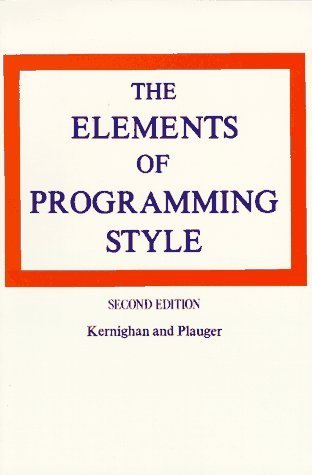
The Elements of Programming Style
This rounds out a collection of works by Kernighan. Each book of his covers a different aspect of software, in clear form with logical concepts. This book covers the look and feel of the code itself. As with the other works, some concepts have evolved as languages have evolved and the normal size of software projects has continued to expand. But the book still has many relevant points and is an interesting read for those wanting to delve into how software development as a process has been growing and evolving over time.
168 pages, Paperback
First published January 1, 1974
About the author
Brian W. Kernighan
31 books342 followersBrian Wilson Kernighan is a computer scientist who worked at Bell Labs alongside Unix creators Ken Thompson and Dennis Ritchie and contributed greatly to Unix and its school of thought.
Ratings & Reviews
Friends & Following
Create a free account to discover what your friends think of this book!
Community Reviews
Displaying 1 - 26 of 26 reviews

August 9, 2013
This is almost a must-read for computer scientists, computer engineers, software engineers, and anyone who will code for a living. Almost. I was very tempted to give this book a four, but the content is too good and not replicated in aggregate in any other source of which I'm aware.
The problem is that the FORTRAN and PL/I examples are going to be virtually unreadable by a modern programmer. Many of the examples and their lessons were still very clear, but others were almost impossible to parse. By the end, I probably learned enough FORTRAN in PL/I that I could go back and "decompile" most of the example programs. Additionally, many of the problems the authors describe at length were solved in C or C++, and more are absent in higher-level languages, and therefore inaccessible to newer students and more novice programmers. If someone were to write a "third edition" in C or C++ and swap some of the antiquated FORTRAN issues for modern C-and-C-like-language issues or even object-oriented issues, it could serve as a valuable, accessible guide for the current generation.
Despite these issues, I am inclined to give the book five stars, given my limited choices on a five-point scale. It is incredibly valuable, and will likely be one of the few I use for reference in the years to follow.
The problem is that the FORTRAN and PL/I examples are going to be virtually unreadable by a modern programmer. Many of the examples and their lessons were still very clear, but others were almost impossible to parse. By the end, I probably learned enough FORTRAN in PL/I that I could go back and "decompile" most of the example programs. Additionally, many of the problems the authors describe at length were solved in C or C++, and more are absent in higher-level languages, and therefore inaccessible to newer students and more novice programmers. If someone were to write a "third edition" in C or C++ and swap some of the antiquated FORTRAN issues for modern C-and-C-like-language issues or even object-oriented issues, it could serve as a valuable, accessible guide for the current generation.
Despite these issues, I am inclined to give the book five stars, given my limited choices on a five-point scale. It is incredibly valuable, and will likely be one of the few I use for reference in the years to follow.

January 31, 2009
An old classic--clear, enjoyable, and full of good common sense, nearly all of which still applies (an example of what doesn't: "Avoid Fortran's arithmetic IF").
I wavered between three and four stars for this title; the use of what are now antiquated programming languages (PL/I and Fortran IV) marred my enjoyment a little bit, only because I had to stop and gasp at infelicities of syntax or catch my breath at the absence of features which are now considered mandatory for any serious programming language.
Still, that's a minor defect, and not in any way the fault of the authors, but of my perverse decision to read this title thirty years after its publication. Most of the advice is still sound, and you will still see most of it violated by your colleagues.
Were I generation older and reading this a generation ago, I would likely have found this a five-star title. It's held up pretty well given its field.
Those seeking an updated version of this title should consult Kernighan and Pike's The Practice of Programming .
I wavered between three and four stars for this title; the use of what are now antiquated programming languages (PL/I and Fortran IV) marred my enjoyment a little bit, only because I had to stop and gasp at infelicities of syntax or catch my breath at the absence of features which are now considered mandatory for any serious programming language.
Still, that's a minor defect, and not in any way the fault of the authors, but of my perverse decision to read this title thirty years after its publication. Most of the advice is still sound, and you will still see most of it violated by your colleagues.
Were I generation older and reading this a generation ago, I would likely have found this a five-star title. It's held up pretty well given its field.
Those seeking an updated version of this title should consult Kernighan and Pike's The Practice of Programming .

August 2, 2018
Brian Kernighan is the co-author of THE book on THE most important programming language and also an OG contributor to Unix. The dude is a freaking legend. I wanted to read this because I watched the interview where Brian Kernighan explains the origin of grep. During the interview, he just struck me as such a kind, smart dude that I wanted to get inside his brain a little bit.
The book looks at several small code samples, improves them and explains the simple principle behind the improvement. The suggestions are clean, simple and always made the code noticeably more usable. Another thing I loved about this book was the tone. I read a lot of code for work, and it gets pretty easy to be unhelpfully snarky when code is written poorly. Kernighan provides thoughtful, actionable advice for how to make bad code better. The tone isn't angry at how bad people are at programming, but more understanding about how these mistakes can be made and avoided.
My (and everyone's) one big gripe is how outdated the FORTRAN examples are. I don't know any FORTRAN, so some of the code examples weren't easy to follow unless I googled a lot of FORTRAN syntax. It was a little frustrating to get advice like, "Avoid GOTO statements" when most programmers don't even know what that language construct is nowadays. This book is dying for a re-boot. And if it ever does get re-written in a modern language, I'm gonna read the hell out of it.
The book looks at several small code samples, improves them and explains the simple principle behind the improvement. The suggestions are clean, simple and always made the code noticeably more usable. Another thing I loved about this book was the tone. I read a lot of code for work, and it gets pretty easy to be unhelpfully snarky when code is written poorly. Kernighan provides thoughtful, actionable advice for how to make bad code better. The tone isn't angry at how bad people are at programming, but more understanding about how these mistakes can be made and avoided.
My (and everyone's) one big gripe is how outdated the FORTRAN examples are. I don't know any FORTRAN, so some of the code examples weren't easy to follow unless I googled a lot of FORTRAN syntax. It was a little frustrating to get advice like, "Avoid GOTO statements" when most programmers don't even know what that language construct is nowadays. This book is dying for a re-boot. And if it ever does get re-written in a modern language, I'm gonna read the hell out of it.

October 5, 2010
It was good, but pretty old. Limited. Some of the problems they point out have been solved by newer programming languages (like C; this is an *old* book). It's focused on small, self-contained programs, such as you would find in textbooks, and doesn't do much to extend their prescriptions to apply to larger programs.

November 26, 2012
It's ridiculous that this book was written 35 years ago and programmers still struggle with simple common sense. The software industry constantly reminds how young it is.
All the advice in the books is great and thoughtful.
Why 4 stars? The examples are so outdated that the levels of abstractions changed and it looks like the authors are mixing them.
All the advice in the books is great and thoughtful.
Why 4 stars? The examples are so outdated that the levels of abstractions changed and it looks like the authors are mixing them.

May 13, 2012
It is worth noting that the examples are in Fortran IV and PL/I.

May 28, 2015
Some of the advice is outdated now, but the motivations for those advice can still be applied to modern languages and techniques.

May 3, 2008
First read it a few years ago, worth rereading on a regular basis for any programmer. The examples are, unfortunately, in a very ancient Fortran dialect and PL/I, and a few of their recommendations are specific to those languages, but much of it applies just as well today as it did in the 70s. The Strunk & White of programming.

June 20, 2012
Almost 40 years since this book was published and still so many of its great practices are being violated, hurting readability, clarity and correctness of code. I wish every computer programmer would read this book and follow its advice.

December 23, 2010
A classic, in a well-populated genre. Humorous, insightful, memorable.
April 24, 2020
I remain amazed that a programming book published in 1974, whose examples are entirely in PL/I and Fortran, can remain so relevant to the modern day.

September 11, 2026
*The Elements of Programming Style* by Brian W. Kernighan and P. J. Plauger is one of those books that makes some excellent points that every software engineer should know and bear in mind every day. The central message is simple: **write clearly and don’t be too clever**. Say what you mean, use the language’s good features, choose names that won’t be confused, and structure your code so that its intent is obvious. There is plenty here that still feels completely relevant, including modularisation, encapsulation, keeping modules focused on one thing, making coupling visible, defensive programming and, perhaps most importantly, not stopping with your first draft. The advice to revise and refactor rather than being satisfied with code that merely works is something that could be written today.
The chapters on **efficiency and documentation** particularly stood out to me. The authors make the point that if a program doesn’t work, it doesn’t matter how fast it runs, and that you should make it right before you make it faster. Fundamental performance improvements are more likely to come from choosing a better algorithm than from fiddling with the code, and you should measure before making assumptions about where the time is being spent. There is a similar pragmatism in the documentation chapter. The best documentation for a clear program is its structure, and comments are only useful when they add something that the code itself cannot communicate. A wrong comment is worse than no comment, so don’t just echo the code with comments. Make every comment count.
The biggest problem with the book is that all of the examples are in **Fortran or PL/I**, which makes some of it hard work to apply directly to modern software development. That is understandable given when the book was written, but it does make the examples feel rather dated. What is interesting, though, is how much of the underlying advice has survived the intervening decades. Avoid clever code. Keep things simple. Choose good abstractions. Test boundary values. Don’t patch bad code when rewriting it would make more sense. Measure rather than guess. These are not really Fortran lessons. They are lessons about writing software, and that is why *The Elements of Programming Style* is still worth reading.
The chapters on **efficiency and documentation** particularly stood out to me. The authors make the point that if a program doesn’t work, it doesn’t matter how fast it runs, and that you should make it right before you make it faster. Fundamental performance improvements are more likely to come from choosing a better algorithm than from fiddling with the code, and you should measure before making assumptions about where the time is being spent. There is a similar pragmatism in the documentation chapter. The best documentation for a clear program is its structure, and comments are only useful when they add something that the code itself cannot communicate. A wrong comment is worse than no comment, so don’t just echo the code with comments. Make every comment count.
The biggest problem with the book is that all of the examples are in **Fortran or PL/I**, which makes some of it hard work to apply directly to modern software development. That is understandable given when the book was written, but it does make the examples feel rather dated. What is interesting, though, is how much of the underlying advice has survived the intervening decades. Avoid clever code. Keep things simple. Choose good abstractions. Test boundary values. Don’t patch bad code when rewriting it would make more sense. Measure rather than guess. These are not really Fortran lessons. They are lessons about writing software, and that is why *The Elements of Programming Style* is still worth reading.

January 30, 2022
This book will turn 50 soon. And some parts of it haven't aged that well. It uses Fortran (the one where arithmetic if was the norm, and logic if was the new thing) and PL/I. But that doesn't matter for the most part. What matters is the approach and the rules. The approach is to take a piece of code, analyse its failings, improve it, and derive a general rule. And for the most part the rules are still valid today. Let that sink in. The half life of technical books these day is a few years. This book's rules are mostly applicable after half a century. And that is remarkable in itself.
There are other notable things about it though. If you've read any other book by Kernighan ("Software Tools" and its Pascal version, "The Practice of Programming") you'll recognise his later style in incipient form. It's a rare view into how a programmer's views evolve and mature. And much the same for Plauger, though I've only read "Programming on Purpose" from his later work.
And for computing history or language geeks this is a glimpse into what computing looked like back then. What programmers had to work with (and mind you the book uses high level languages, not assembly). We've come a long way.
This was well worth reading.
There are other notable things about it though. If you've read any other book by Kernighan ("Software Tools" and its Pascal version, "The Practice of Programming") you'll recognise his later style in incipient form. It's a rare view into how a programmer's views evolve and mature. And much the same for Plauger, though I've only read "Programming on Purpose" from his later work.
And for computing history or language geeks this is a glimpse into what computing looked like back then. What programmers had to work with (and mind you the book uses high level languages, not assembly). We've come a long way.
This was well worth reading.

February 10, 2022
Until page 58 the "elements of programming style" rules mostly deal with outdated language-specific issues (`goto`s anyone?). So while I truly wanted to like this book (I love UNIX: A History and a Memoir by Brian W. Kernighan of K&R fame), this could use an update. And maybe after updating, it gets smaller. From its current 168 pages to the 105 pages (in the edition I own) of the one-and-only The Elements of Style.
June 15, 2020
I am sad that this book, written in 1974, is still so relevant today. Apparently in the last five decades we did not improve programming all that much.
The book is dated in the sense that the code fragments guiding the discussion are in PL/I and Fortran. Those that complain about this minor detail apparently fail to see the value and universality of the advice given and how well it translates to programming today.
The book is dated in the sense that the code fragments guiding the discussion are in PL/I and Fortran. Those that complain about this minor detail apparently fail to see the value and universality of the advice given and how well it translates to programming today.
July 4, 2020
I read this at university, I think in 1984, which means the publication is more likely 1978, as reported on Amazon. In hindsight it's the foundation stone for my entire career - considering programs as works of literature, notes to the future to be appreciated by other developers (including my future self), rather than just executable instructions.
Not as much use for todays programming languages, but a seminal work in my view.
Not as much use for todays programming languages, but a seminal work in my view.

January 2, 2021
3 stars because it’s quite dated, full of FORTRAN and PL/I examples. Nonetheless it has a great collection of programming principles, akin to Effective Java by Joshua Bloch, and How to Solve it by George Pólya. TL;DR: Keep it readable and simple.
> Don’t comment / document bad code, rewrite it instead.
> Don’t comment / document bad code, rewrite it instead.

February 28, 2021
Good small book but with a bit outdated advises. If you are an adventures type - go and read it, you will not regret it, but keep in mind that all of the examples are in FORTRAN or PL/1 (which for me that was an issue when trying to understand the examples).

April 3, 2023
El libro es increíble. Publicado en 1974 tiene comentarios, notas e ideas sumamente actuales. Mucho se habla en estos años de Clean Code. Me sorprende que no se haya actualizado con ejemplos de otros lenguajes que no sea Fortran.

July 7, 2026
Kernighan's book is a masterpiece of programming craft. My copy is dated 1974.
A generation of programmers learned to write code CLEARLY. SO othrs could read their code. So the cost of maintenance could go down.
Amazing clarity.
A generation of programmers learned to write code CLEARLY. SO othrs could read their code. So the cost of maintenance could go down.
Amazing clarity.

July 7, 2008
This was a fascinating read (almost, but not quite, enough to make me go out and learn FORTRAN and PL/I...). As much as anything it codified and articulated clearly a set of good programming practices that I have intuited over the years. To be perfectly honest, I don't get why I was never assigned a reading like this earlier -- Kernighan does a great job articulating the complex rationale behind reasonable design and programming decisions.

September 2, 2013
The book is well written and clear. Unfortunately, the obsolete languages used and their inherent problems make the issues tackled by this book irrelevant.
May 16, 2014
Excellent guide to common sense, down to Earth style recommendations. That the programming languages used in this book are obsolete does not make the content outdated at all.

August 5, 2007
this mostly applies to C

March 9, 2013
Another great read.

October 4, 2013
those rules so helpful.
Displaying 1 - 26 of 26 reviews