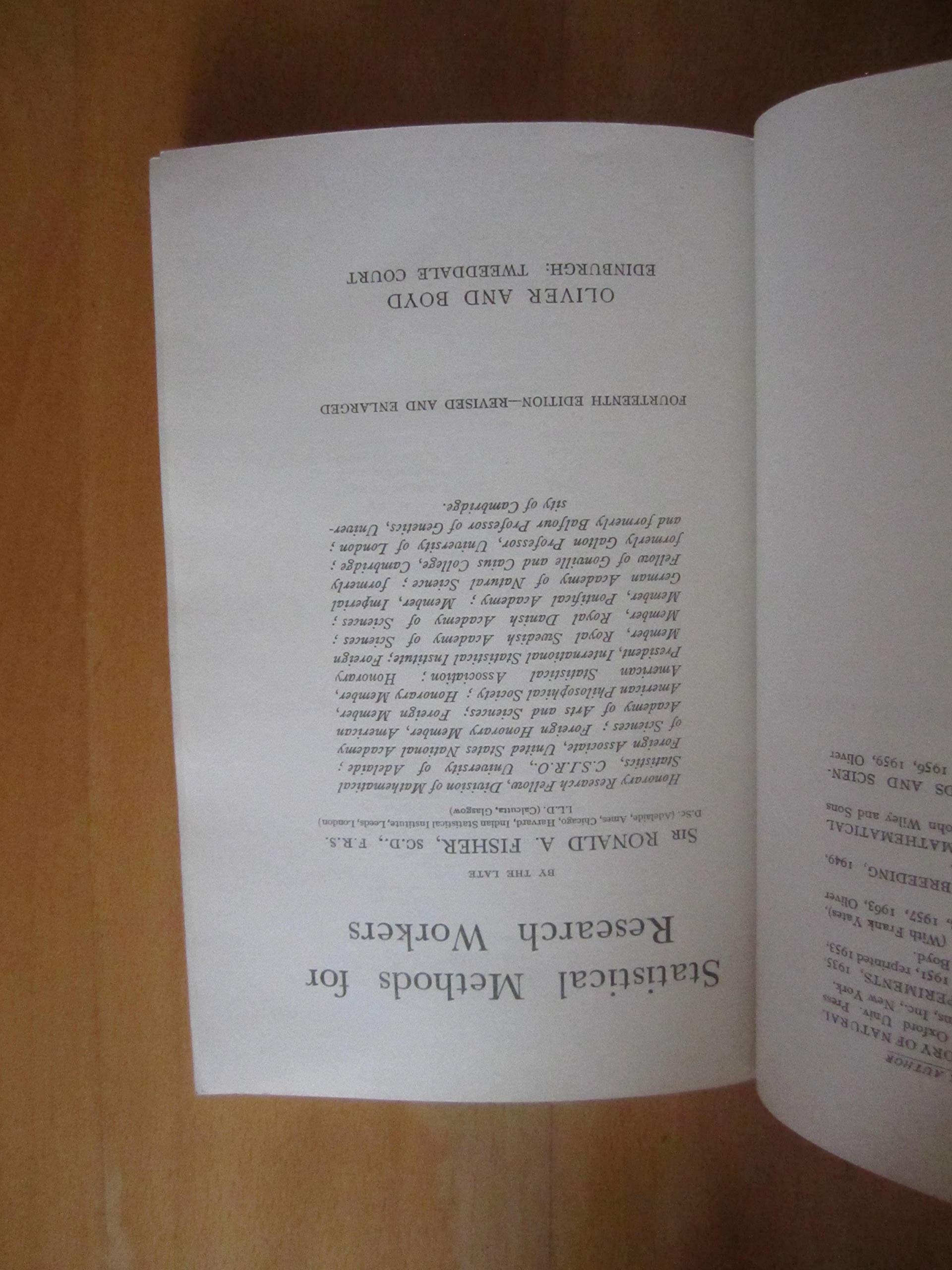
Fisher's work covers largely, what one would find in graduate level statistics coursework.
Most of them find its origin in Fisher's work, Pearson.
The First Chapter actually could be used in High-school, middle-school, for sharing basics of Statistics as applied mathematics.
Fisher says -- Statistics may be regarded as (i) the study of populations, (ii) as the study of variation, (iii) as the study of methods of the reduction of data.
These days, most methods are clearly described in Wiki, which is first place to start to understand any of the methods. Even Professor Nando De Freitas recommends going through Wiki for starting point.
And then, one looks at sources quoted under the Wiki page for understanding in depth.
I was specifically looking for, Logistic Regression, pondering it's limitations.
Outline
I. Introduction
II. Diagrams
III. Distributions
IV. Tests of Goodness of Fit and Homogeneity
Table of X²
Tables I and II: Normal Distribution
Table of X²
Table of t
Chapter 1: Tests of Significance
Means
Differences of Means
Regression Coefficients
Chapter 2: The Correlation Coefficient
Chapter 3: Intraclass Correlations and Analysis of Variance
Chapter 4: Further Applications of Analysis of Variance
Chapter 5: Principles of Statistical Estimation
Sources Used for Data and Methods
Bibliography
Index
Appendices:
A. Correlation Coefficient - Significant Values
B. Correlation Coefficient - Transformed Values
C. Table of Z (242-247)