Jump to ratings and reviews
Rate this book

Lorde

Rate this book
'Lorde' é a história de um escritor de cinqüenta anos, com sete livros publicados e com um único desejo - viver fora das páginas de suas obras e livrar-se de sua imagem de escritor. Ele desembarca na capital inglesa a convite de uma pessoa que não conhece e que o instala em um apartamento em Hackney, bairro habitado por imigrantes. O trajeto torna-se um fim em si, pontua o processo de mutação do viajante e se desenvolve em mistério até o clímax perturbador.

111 pages, Paperback

First published January 1, 2004

9 people are currently reading
260 people want to read

About the author

João Gilberto Noll

25 books37 followers
João Gilberto Noll was a Brazilian writer born in Porto Alegre, in the southern Brazilian state of Rio Grande do Sul.

His early years were spent studying at the Catholic Colégio São Pedro. In 1967 he began university coursework in literature at the UFRGS-Federal University of Rio Grande do Sul, but in 1969 he interrupted his studies to pursue a career as a journalist in Rio de Janeiro, working for the newspapers Folha da Manhã and Última Hora. In 1970 Noll spent a year in São Paulo working as a copyeditor at the publishing house Editora Nacional, but a year later he moved back to Rio and resumed both his work in journalism at Última Hora, writing on literature, theater and music, and his university studies in literature, first at the Faculdade Notre Dame and then at the PUC-Rio, where he received his degree in 1979.

Noll published his first short story as part of a 1970 Porto Alegre anthology entitled Roda de Fogo, but his more formal literary debut came in 1980 when his first book of short stories O cego e a dançarina (English title: The blind man and the dancer) was released, for which he received three literary prizes. One of Noll's short stories from O cego e a dançarina, Alguma coisa urgentemente (Something urgent), was the basis for the film Nunca fomos tão felizes (English title: We've Never Been So Happy) in 1983, directed by Murilo Salles and starring the actor Claudio Marzo.

Noll received early international attention as a participant in the Writer's Program at the University of Iowa in 1982, and when his work appeared in an anthology of new Brazilian writers published in Germany in 1983. After a short visit to the University of California, Berkeley in 1996, he was invited to teach Brazilian literature there in 1997. He was an invited scholar for a Rockefeller Foundation seminar in Bellagio, Italy, was the recipient of a Guggenheim Fellowship in 2002, and spent a two-month writing residency at the Centre for the Study of Brazilian Culture & Society at King's College London in 2004. All of these experiences were to shape the subject matter of later works.

His first collection of stories was followed by the novels A fúria do corpo (1981), Bandoleiros (1985) and Rastros do Verão (1986). Two of his subsequent and perhaps best-known works, the novels Hotel Atlantico (1989) and Harmada (1993), later came out in a 1997 English edition, translated by David Treece and published by Boulevard Books in London. Another novel, entitled O quieto animal da esquina, appeared in 1991.

From 1998 to 2001 Noll published a twice-weekly series of short stories in the major São Paulo daily Folha de São Paulo, and in 2004 he began to publish longer stories every two weeks in the daily Correio Braziliense published in the federal capital Brasília.


Ratings & Reviews

What do you think?
Rate this book

Friends & Following

Create a free account to discover what your friends think of this book!

Community Reviews

5 stars
22 (10%)
4 stars
55 (26%)
3 stars
80 (38%)
2 stars
40 (19%)
1 star
13 (6%)
Displaying 1 - 30 of 34 reviews
Profile Image for Glenn Russell.
1,511 reviews13.3k followers
Read
January 20, 2023


Alienation plays a critical role in existential novels by writers such as Albert Camus and Jean-Paul Sartre. Well, hang on tight, João Gilberto Noll's unnamed main character in Lord experiences alienation in the extreme. Most of his memory is slipping and he's lost any firm grounding for his sense of identity. Sure, he's an older author from Brazil with a string of books to his credit but once he arrives at Heathrow Airport – complete disorientation.

Where's the Englishman who invited him to London? What are these Brits expecting? From first page to last: dreaminess, hallucinations, novel as Salvador Dali art, novel as David Lynch film. Here's a batch of Lord direct quotes along with my comments -

“All of a sudden I felt amazingly calm. If he didn't show up, I'd go to a cheap little hotel and return to Brazil the following day.”

The Englishman does show up and the narrator need not return to Brazil but we're given the feeling the narrator can switch identities as easily as switching hats, or should I say, now that he's in England, switching bowlers with all the associations to Samuel Beckett.

“My old language, with which I had been so intimate already seemed to be deserting me – except of course the general notion of it, or who knows, it might still provide me a little help in some extreme cases, like if I were about to die I might still be able to pronounce a dear old word from my childhood, one of those words you don't even know you have inside of you until it comes out when all the useless words of now drift away to the point where the hard edge of that sharp longing can reemerge in but one or two syllables.”

As a writer himself, one would think the narrator could at least take refuge in his native tongue. However, what happens if even all those words abandon him and all that's left are a few stray, half remembered words from childhood? Sidebar: I also included the above quote to underscore the poetic voice in Lord pulling us along, page by page, almost as if a counterforce to all the chaos.

“Where had I been all day? Looking for a mirror because I need evidence that I'm still the same, that another has not taken my place.”

In addition to language, what better benchmark can there be in establishing one's identity than peering into a mirror to make sure one's face has remained the same? Of course the irony: we change moment by moment. Whatever continuity we experience in our idea of self amounts to little more than a conceptual construct.

"I needed to attach myself blindly to the Englishman who had called me to London; I needed to reinvent him within me, allowing me to lose myself; I needed to allow the other to be born inside me, inside this very person whom I used to call "I," but who seemed so dissolved lately, ready and willing to receive the crude essence of the Englishman."

Do you hear a note of desperation? The narrator appears to have a frantic need to ground his identity - if not by subsuming the identity of another then by changing his hair color, by grasping at sex both in the body and in fantasy, by developing a friendship, by taking on a role, by seeking employment within a university.

What's so curious about this novel - we can question each and every turn of event, all the bizarre observations and moves of the narrator. Is what's happening real or is it all imagined?

Lord surely counts as one of the more unique first-person novels. Among other things, a tale with a startling ending.


Brazilian author João Gilberto Noll, 1946-2017
Profile Image for ♑︎♑︎♑︎ ♑︎♑︎♑︎.
Author 1 book3,800 followers
February 18, 2019
I'm only slightly embarrassed at recent my string of novels i'm rating 5 unabashed stars, and here is another, and I'm rating these novels so highly because it seems to me that they are filled with love, every one of them. And love is what I need to read right now.

So here is Lord, the latest novel I've read; a novel that defies every possibility of a literal interpretation, and whose sentences spring off the page and fly away from any representational reality. And yet. How fundamentally human these happenings seem to me, however surreal. Each sentence leads me forward to a bright new possibility of human vulnerability, and to a bright new possibility of human connection. Each scene as it comes along (and the scenes come along, over and over and over again, intertwining and pouring forth, from one sentence to the next) is filled with the possibility that life, however fragile, and however filled with obstacles, and fear, and pain, is without question worth living. It seems that this novel is about how our gift of life is worth trying to live in the fullest way we can muster, even in those times when we feel most alone and without purpose. I don't know for sure it that is what this book means. But I do know it held me captive with each sentence, and brought me with each sentence closer to the edge of something unexpectedly human and alive.
Profile Image for Paul Fulcher.
Author 2 books1,953 followers
February 23, 2019
What I knew was that I was here in England, in its capital, having been called upon by an Englishman who seems to need my services badly enough that without them his own endeavours could not progress. This I would never forget, because I still had the hope that if I carefully guarded the nucleus around which my story formed at that moment, I might one day recover the memory of what sustained that nucleus, its entanglements and consequences, it’s rhymes even.

The award-winning Brazilian author João Gilberto Noll, five-time recipient of the Prêmio Jabuti, spent time around the turn of the millennium as a visiting scholar in UCL, Berkeley in the US, Bellagio in Italy and at the Centre for the Study of Brazilian Culture & Society at King's College London, as a guest of the Rockefeller Foundation.

He turned his experiences into two novels - this Lorde (2004) and an earlier 2002 work Berkeley em Bellagio - albeit ones with a entirely not-literal treatment of thos experiences. See https://www.academia.edu/9490485/A_Lo... for a discussion of both works and particularly the earlier novel.

Lorde has been translated into English, as Lord, by Edgar Garbelotto and published by the consistently excellent Two Lines Press.

Set in London, the novel's epigraph is taken from Iain Sinclair's London Orbital, based on a walk around the M25:

The secret interiors of these post-human fortresses solicit conspiracy, acts of sexual transgression. Illicit exchanges between dealers.

That post-human fortresses are, in fact, multistory carparks in Watford, and the words inspired by JG Ballard and his novels Crash andThe Atrocity Exhibition, gives a sense of the surreal nature of Lord.

The novel itself opens with our narrator, a Brazilian who wrote books that were mostly well received by critics but not the public, arriving at Heathrow from Porto Alegre in Brazil, rather disorientated, his trip a result of an invitation from a rather shadow Englishman, his purposes rather unclear.

The narrator is taken by his English sponsor to Hackney - That distant neighborhood in the north of London, full of Vietnamese and Turkish immigrants, outside of what the travel brochures usually showed on the city maps where he is installed in a flat above one of the many Vietnamese restaurants on Mare Street:

description

(as an interesting aside, Mare Street is also now home to a Brazilian centre, opened since 2004. Whether that is a coincidence, if the reason the author was familiar with the area was that there was, in reality although unmentioned in the novel, already a Brazilian community there, or indeed if somehow the novel itself has attracted a Brazilian community to the area, I can't say)

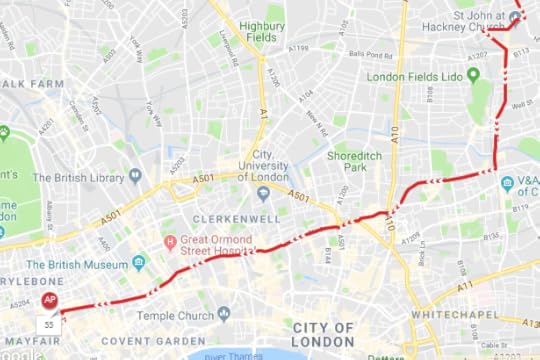
His initial journey there from central London was on the 55 bus - and for a long while, his travels centre on that bus route, particularly Hackney, the Oxford Circus terminus of the line, and the Bloomsbury area through which it passes, and where he can walk to from those bus stops:

It was a long walk to Oxford Street, where the 55 came and went, but I didn’t know any other means of transportation, other routes. When I’d gotten down to Oxford (sic) I could walk to countless places in the city, no matter how far they were.

Even after a diversion to London Bridge at Borough Market he walks to Oxford Circus and takes the bus back, a journey that makes little logical sense as this bus route map shows:

description

In some respects, Lord belongs to a series of excellent novel dealing with the disorientation of an artist finding himself in a strange (at least to them) city - the linguist in Ferenc Karinthy's Metropole, the musician in Kazuo Ishiguro's masterpiece The Unconsoled and, perhaps most apposite, the writer in Budapest by Chico Buarque, a fellow Brazilian writer and a novel written around the same time. This paper compares Budapest and Lord and sets them in context: https://repository.brynmawr.edu/cgi/v...

But in Gilberto Noll's work, the strangeness is more around the mental disintegration of his narrator. After the Englishman comes to visit him he immediately rushes him to a hospital in Bloomsbury for treatment (for what is unclear, and perhaps hints that some of the narrator's adventures may have been imagined while, in reality, he was sick in bed). And at the hospital he literally splits in two - part of him remains there

At reception I filled out a form. We entered a ward. The Englishman seemed to be on the staff, so at ease was he inside the hospital. He asked me to sit on an unoccupied bed. I sat. Until the person who seemed to be the doctor arrived. He started to examine me. “It is,” he said with a certain harshness. And he asked me to lie down. He called a nurse. She passed some instruments to him. And the doctor inserted a needle in my vein. I don’t remember ever having felt such satisfaction in my whole life. Not because the medication being introduced had a numbing effect that left me out of it. In the following hours I wouldn’t need to do anything to attribute continuity to things. And was, what’s more, without any fear of my destiny from here on, which would be the normal response in a patient about to undergo a medical procedure in any hospital ward. I just didn’t believe that anything worse could happen, that’s all! I trusted the opposite would be true: that during that whole stay in the hospital the man who was starting to throb inside me and who I still didn’t really know would have a better chance to surface. That when I woke from the anaesthetic I would start to live with another hypothesis about myself and that I would work on it in secret, so that not even my own English friend would be able to notice any change in my character or on the surface of my body. They had kept me there for a reason that I didn’t know. I would use it to be born.

I died for the time I was sedated. Waking up, I saw a nurse with a sour face. She just said that everything was fine and that I could go. They had cleared up some question about my health. What test did they do? I asked. She didn’t understand me or preferred to keep quiet. I exited onto a square in Bloomsbury. I didn’t live in the area, as I would have liked to, but that was where they put me to bed, for how long I didn’t know. Maybe to see if I showed any sign of health problems that would affect whether or not I stayed on the official programme of a Brazilian outside his country. Or would there be an unofficial reason, some by-product of minds with parallel powers? I was stuck in some pulpy spy novel, now inoculated with some substance which would make me even more submissive to them—I, my mind clouded, for that reason in particular, would provide them with a key that I was in no position to predict. I was the idiot in the global citadel. I would serve for every job whose sense was beyond me. But I was not going to cry, to bemoan my lot. Catching a plane back to Brazil wasn’t an option.
...
tomorrow none of this will matter, when I’ll be able to live the life of that man who is still lying in the Bloomsbury hospital bed, who stayed there as I made this little escape, motivated by the nurse’s bad intentions. There lies a part of me that has stopped, without any thought of controlling the world or what goes on inside itself, a waiting stone. I’ll go back in the dead of night, I’ll lift up the sheet and lie down. And when the Englishman comes back, I’ll see that the experiment has worked. I’ll be that man again, ready to hold forth in public spaces on the questions that afflict his students who stubbornly refuse to show themselves.

(from https://www.catranslation.org/online-...)

The novel, particularly from that point on, becomes increasingly fevered and surreal, with an increasingly strong sexual angle. The book seems to be about, if anything the effects of globalisation - the narrator says: I had come to this end of the world for that, to occupy an intermission without end but this isn't a novel to read searching too closely for analogies.

Overall, a powerful and disturbing work, one I appreciated more than the same author's Atlantic Hotel as it seemed relatively more focused, but still one where the reader really has to simply go with the narration rather than trying to rationalise what is happening.

3.5 stars - rounded up to 4.
Profile Image for Jenny (Reading Envy).
3,876 reviews3,709 followers
March 29, 2019
I finished this book as unsettled as I felt when I finished Fever Dream, the same kind of surreal doom on every page, compounded by the characters not being able to navigate their own realities. The man wandering London makes attempts to grab hold at times through contact with others but his identity seems to be shifting out of his control.
.
I subscribed to Two Lines Press this year and this was the first book they sent me! I'm trying to be more quick to read selections sent my way. It looks like Lord has two other novels translated into English so I may need to check them out.
Profile Image for Rita.
904 reviews186 followers
October 10, 2022
Não sei bem o que dizer deste livro! Como diriam os ingleses it is not my cup of tea , mas a verdade é que não descansei até o acabar, e o pior é que no fim senti-me mais perdida que cachorro em procissão.

A personagem de Noll é um autor brasileiro, gaúcho, de meia-idade, que escreveu sete livros e é convidado por motivos que não consegue compreender - nem nós - a uma estadia em Londres. O inglês que o convida fica responsável pelo pagamento do apartamento e das despesas, e não lhe pede nada em troca. Desde o princípio ele desconfia da motivação dos que lhe deram o convite. Haveria uma conspiração por trás? O Exército britânico estaria envolvido? E por quê?
Uma história cheia de mistérios, e a personagem deambula pelas ruas, pelos locais icónicos, pelos museus e bares de Londres sempre num estado de angústia, de delírio, em constante busca de identidade.
É um romance com uma forte toada intimista, sobre uma não-identidade, um não-lugar. Senti uma angústia progressiva, um mal-estar constante e uma ânsia de vómito em algumas partes.

Surpreendeu-me e desafiou-me.
Profile Image for 〰️Beth〰️.
815 reviews62 followers
December 13, 2021
This book made me question my sanity while reading. Rambling, surreal, interesting yet also annoying. For such a short novel at times it felt bloated with haphazard descriptions.
Profile Image for João Carlos.
670 reviews315 followers
March 21, 2020

Oxford Street - Londres - Inglaterra

Nunca tive nenhuma referência sobre o escritor brasileiro João Gilberto Noll (n. 1946). Autor com uma vasta obra literária publicada no seu país de origem, ”Lorde” tem a sua primeira edição em Portugal em 2015.
João Gilberto Noll situa o seu narrador a desembarcar em Londres após receber um misterioso convite de emprego numa universidade britânica.
O enredo desde romance é linear, o protagonista é um escritor brasileiro de cinquenta anos, autor de sete livros reconhecidos e premiados.
A vertente autobiográfica é por demais evidente, acentuada no contexto dos contrastes de que a cidade de Londres possui.
Como leitores passamos a testemunhar o processo auto-reflexivo do escritor; no essencial pretende ver a sua imagem reflectida no espelho assumindo uma nova compreensão de si mesmo e do outro “eu”.
”Onde eu estive o dia inteiro? Procurando um espelho, pois preciso constatar que ainda sou o mesmo, que outro não tomou o meu lugar. Se o posto de fato não me pertencer e tudo que vivi até aqui não passar de um equívoco, avalio que a Embaixada brasileira saberá medir o drama e me dar a passagem de volta para o Brasil. O homem certo, eficaz, translúcido, é este que aparecerá no espelho que ainda não usei.” (Pág. 25)
Independentemente da componente reflexiva e da simbologia associada à deambulação física e mental do escritor a narrativa demasiado fragmentada e os seus fluxos de consciência foram insuficientes para me fixarem a este romance, manifestamente medíocre na análise introspectiva do retrato que pretende publicar.
Profile Image for George Ilsley.
Author 12 books314 followers
June 21, 2024
"So I had to keep on going alone—which was already my addiction; I was like someone who doesn't realize he has an addiction because it has become his natural state."

I want to say this short novel was like a fun-house mirror, one that twists and distorts the reflection; except that the protagonist, an aging writer from Brazil who has been invited to London, avoids mirrors, because he is afraid to see who he might be. He glimpses fragments of himself in others, in who he imagines them to be, in what he thinks they want. A young man on the train is something whole but fleeting. Everything is slippery: identity, desire, security—it is all illusory. He sees a new life in a new city and the possibility of never going back. He senses something unfolding, and it scares him, intrigues him, repulses and animates him.

This book is like some kind of magic mirror—every reader who peeks into it will see something different. I have no idea what I just saw.
Profile Image for Joseph Schreiber.
586 reviews182 followers
July 11, 2019
Having loved Noll's earlier novellas, especially Atlantic Hotel, I found this an arduous read. Had it been half the length it might have been quite good. I really enjoyed the early part. But then it went on and on. The narrator, a writer from Brazil invited to England for some reason unknown to him, is not unlikable so much self-indulgent and boring. The circumstances are odd, but not odd or surreal enough. He wanders around London, strange things happen, he fantasizes about men without intention and masturbates a lot. Very disappointing. Obviously I missed something.
Profile Image for mippers.
110 reviews1 follower
February 14, 2025
primeiro livro em português do ano!!

nothing quite makes you feel Illiterate as Surreal Literary Fiction in another language ….. disquieting, stinky tale about the universal experience of Gay Man Losing His Mind Abroad; very beautiful prose (i think,,,? who could say…)
Profile Image for Erik.
331 reviews278 followers
April 2, 2020
The biggest problem with "Lord," a finalist for Lambda Literary's best gay fiction this year, is that it was clearly written while João Gilberto Noll was under the influence of drugs. While such a authorial position would have been groundbreaking in the 1970s and 80s, in 2004, when it was written, and in 2019, when it was translated into English, this sort of writing technique is outdated, tired, and ineffective.

"Lord" is told from the perspective of an unnamed narrator - a Doestoyevskian-ish Brazilian writer invited to live and work in England. The problem, of course, is for what reason and by whom he is unsure. As a result, he tells his story of wondering around Hackney, having sex and masturbating, and trying to trace out who he is and how he ends up in Liverpool. At the end of the day, each event in this story is without meaning but somehow oddly connected to the story as whole. What that story is, I must confess, is totally unclear.

What a strange book. What an outdated book. So many good, gay stories this year; how did Lamba land on this one?
Profile Image for DRugh.
446 reviews
February 19, 2023
An amazing hallucinatory stream of consciousness tale of a Brazilian man losing his mind in London.
Profile Image for Sofia Teixeira.
606 reviews132 followers
July 1, 2015
screver sobre este livro provoca alguma inquietação. Também desassossegada foi a leitura. Embora curta, esta é uma obra que nas pouco mais de cem páginas que tem consegue deixar o leitor ofegante, um misto de pele arrepiada, algum asco e perplexidade, mas também uma enorme admiração. Não é uma escrita convencional, mas antes romanesca em que a realidade e a fantasia se entrelaçam em processos metamórficos e de alguma dissociação. Existe a urgência do desapego, de nada significar nada, mas tão somente o que for ali, naquele momento. Noll é um escritor premiado e no que toca a Lord tem sido associado a outros escritores como Kafka ou Lispector.

Quem pegar neste livro, antes de o ler, penso que deve ter em conta duas coisas: a língua impressa é a original, português do Brasil, e a narrativa presa o movimento e acção, sendo corrida e contendo poucos parágrafos. Daí a sensação ofegante e sôfrega em alguns momentos. Combinando o processo de procura de um sentido às experiências empíricas e oníricas com um forte teor sexual, esta experiência do escritor brasileiro em terras de sua majestade revela-se tão curiosa como perturbadora. Aceitar um emprego, por umas míseras milagres, num país estrangeiro, em que o passado se tenta apagar e o futuro parece depender de alguém que desconhece... Dá pano para mangas.

Propósito, solidão, motivação, (des)contentamento e frustração - tudo aspectos que assolam o ser humano nas mais diversas fases da vida. Entre os subúrbios de Londres e o derradeiro desfecho em Liverpool, testemunhamos o perdido, o vagabundo, o prostituto e o ladrão. Acabamos com a transfiguração imprevista, mas não imprevisível e o fim deixa-nos todo um turbilhão nas nossas mentes.

Esta aposta da nova chancela da editora 20|20 - Elsinore - tem a particularidade de adicionar ao nosso mercado uma alternativa em português, do Brasil é certo, de um género que é pouco desenvolvido por cá e que mesmo pelo mundo poucos têm a capacidade de o fazer. O mais curioso é que o escritor diz partir de uma residência sua em Londres, mas não assume a autobiografia do mesmo. Numa entrevista ele diz: "Fiquei quatro meses lá, escrevendo esse livro, da manhã até as entranhas da madrugada. E foram os dias mais felizes da minha vida, não tenho a menor dúvida disso. Porque eu vivia, ali, o princípio do prazer freudiano o tempo todo. Eu não estava exatamente na realidade. Eu estava ficcionalizando uma série de coisas que eu vivia. Claro que Lorde não é um livro autobiográfico. Nem tenho jeito para fazer coisas autobiográficas, para fazer um documentário sobre o meu eu. Mas, realmente, se eu não tivesse ido a Londres, eu não teria escrito esse livro." Apesar destas afirmações, o leitor não deixa de especular até que ponto é que a ficção aqui apresentada não terá tido o seu lugar no mundo real.
Profile Image for G.
Author 35 books197 followers
August 1, 2016
Una novella brillante. Noll desciende una vez más a las profundidades de la subjetividad. Allí todo se confunde, se desliza, se deja ver en su pura condición ficcional. El presente, el pasado, el futuro, la memoria, el olvido, la identidad, la diferencia, todo existe en simultáneo. También la vida y la muerte. En esta novela en particular, Noll potencia estas perplejidades mediante una situación que es desconcertante en sí misma: la estadía inglesa de un escritor brasilero. La ocasión desencadena una tremenda metamorfosis del protagonista. El manejo del tiempo narrativo en Noll es magistral. A la voz lúcida en ideas se agrega una fuerza poética inusual en estilo. Creo que este libro es una gran obra de arte. Su lectura me parece muy recomendable junto con el resto de la obra de Noll, en particular, A Cielo Abierto.
Profile Image for Andy Weston.
3,197 reviews225 followers
June 11, 2024
I sense shades of César Aira here in Noll’s novella, not so much autobiographical, as a direction that his own life may go, in the future.
Strapped for cash, an aging Brazilian author has travelled to London, promised some sort of paid work. As he roams Heathrow looking for his contact, he questions himself, his own irrelevance, not just his work, but his sexuality and purpose also, and seeks to reinvent himself. There is a hint though that leads to question his sanity.
Though it may have that sense of Aira it is largely without humour, and a bit serious and depressing to enjoy on any level more than intrigue.
Profile Image for Jim.
Author 10 books83 followers
December 5, 2019
It’s odd, I’m a big fan of surrealism in art but struggle to enjoy surrealist literature. I can look at a Magritte or a sunset and appreciate them both equally—I really don’t need my art to mean anything—but I can’t do that with books. Magic Realism I get, it’s as if the writer’s forgotten he’s writing prose for a minute, but even there I want the fantastic to make some sort of sense.

A fifty-five-year-old Brazilian writer is invited to London by an Englishman “for some kind of mission.” We’re not out of the book’s first paragraph and we find ourselves firmly in the land of the vague. We don’t know who this Englishman is or what he wants from the author. Neither it seems does the author—
I didn’t know exactly what kind of job; any improbably task could be waiting me
—but nothing was keeping him in Brazil so he was happy enough to swap “loneliness in Porto Alegre for … loneliness in London.” Maybe it’ll all work out for the best or if not he can always fly back home.

Some things are clarified: he gets installed in a flat in Hackney and promised a regular (not especially generous) stipend but as to what’s expected of him that isn’t made clear because most of his time he finds himself at a loose end wandering round London and blathering away inside his own head. (If you don’t like stream of consciousness writing this is not the book for you.) He’s a writer as I’ve said but he’s little like the protagonist in Knut Hamsum’s Hunger although that’s the book Lord reminded me of the most and there are similarities; they each waste away, one physically, the other mentally, and both find escape at the very end, Hamsun’s writer on a ship leaving the city, Noll’s on a train to Liverpool.

We never discover what’s up with the writer. Twice the Englishman take him to see a medical professional but neither time are we made aware of what the diagnosis was let alone the prognosis. At one point the Englishman has to take care of the bedridden writer in his flat but, again, the whys and wherefores are unclear and, unusual for any kind of writer, his patient, even when he’s feeling better, shows very little interest in what might have been/still be wrong with him.

After a while I stopped expecting answers and simply went along for the ride. And an increasingly fevered ride it becomes although there are times, especially in his interactions with others, where the writer comes across as surprisingly clear-headed. Several reviews suggest dementia as the problem here but I think labelling his condition unhelpful. He is delirious—that no one would argue with—but that’s a symptom and not a cause.

The writer is a fish out of water. He was a writer but in London that’s no longer how he thinks of himself and he increasingly occupies himself with the kind of things non-writers do to get them through the day. If I’m not going to be a fish what am I going to be then? That’s me talking but it could easily be the narrator. In the end—Christ! what can I say about the last few pages?—he “becomes” something else entirely, someone else entirely. It’s a very strange ending.
Profile Image for Simon Howard.
711 reviews17 followers
September 25, 2021
I read Edgar Garbelotto’s 2008 translation of this short and very strange 2004 novel about a Brazilian writer who comes to the UK at the invitation of a Londoner. The protagonist is confused from the start, and descends into further confusion as the novel progresses. It’s always dangerous to diagnose a fictional character, but this seems to be a portrait of some sort of dementia.

In essence, this is a very readable study of what it is like to lose your sense of person, place and time—involving a surprising number of casual sexual encounters which it is hard not to see as disturbing, even if the protagonist reports that he enjoys them. There are a number of points where it is unclear whether the narrated events are simply confections of the protagonist’s confused mind, or whether they have some basis in the novel’s reality.

This is exactly the right length, in that it can easily be consumed in a single sitting and doesn’t drag to the point that the confusion just begets reader frustration. Instead, the novel proves to be rather reflective and thought-provoking.
Profile Image for Dustin Kurtz.
67 reviews26 followers
February 1, 2019
This one made me feel insane in the best way. The folks at Two Lines mention a fugue state in the jacket copy, and that’s right. LORD is like swimming under ice, you’re panicked and trying desperately to emerge. The ice warps what you see of the world but it’s hard to know how much is distorted, how removed you are from air, from consensual reality.
This is a lot like like Noll’s Quiet Creature on the Corner but winnowed down to his exploration of obsessive Hilstian voice. A very fun read.
Profile Image for John O'Neill.
22 reviews2 followers
January 29, 2020
pretty torn between a four-star attitude (moved by the fugue) and a two-star attitude (unconvinced by the fugue) but there’s enough here to make me like it in spite of my misgivings
182 reviews
October 25, 2021
This was a book of rambling and disjointed thoughts that left a lot of questions. Definitely not something I would recommend
Profile Image for Charlie.
732 reviews51 followers
April 7, 2022
4.5 stars. Intense, crushing alienation, foreigner blues, queer fantasy.
Profile Image for Gustavo Behr.
Author 1 book25 followers
August 13, 2022
Vamos atrás dos devaneios londrinos da personagem. A viagem pelos seus pensamentos é interminável.
Profile Image for KendraLee.
70 reviews2 followers
August 7, 2022
This book was a little disorienting, but I found that when I just gave in and let the strange and crazy pull me along it was very enjoyable!
Displaying 1 - 30 of 34 reviews

Can't find what you're looking for?

Get help and learn more about the design.