Jump to ratings and reviews
Rate this book

Krabat

Rate this book
Krabat - das ist ein 14jähriger Waisenjunge, im Großraum Lausitz/Dresden, im 17.Jahrhundert, der ein Bettlerleben führt. Eines Tages sucht er sein Glück bei einem Müllermeister, der ihn zu sich lockt und als Geselle anstellt. Sofort stellt sich heraus, dass mehr hinter dem "Meister" stecken muss. Dunkle Magie, Intrigen, Täuschungen, Vertrauen, Freundschaft, Rache und ja, auch die Liebe zeichnen die folgende Geschichte aus. Dies alles bildet eine zauberhafte Erzählung, die märchenhaft und spannend beschrieben wird.

296 pages, Paperback

First published November 10, 1971

408 people are currently reading
8452 people want to read

About the author

Otfried Preußler

175 books290 followers
Otfried Preußler (sometimes spelled as Otfried Preussler) was a German children's books author. His best-known works are The Robber Hotzenplotz and The Satanic Mill (Krabat).

He won the Deutscher Jugendliteraturpreis in 1972 for Krabat.
He has sold roughly 50 million copies worldwide.

He was born in Liberec (German: Reichenberg), Czechoslovakia. His forefathers had lived in this area since the 15th century, working in the glass industry. His parents were teachers. After he graduated school in 1942, in the midst of World War II, he was drafted into the Wehrmacht Heer. Although he survived the military action on the Eastern Front, he was taken prisoner as a 21-year-old lieutenant in 1944. He spent the next five years in various POW camps in the Tatar Republic.

After his release in June 1949, he was lucky to find his displaced relatives and his fiancée, Annelies Kind in the Bavarian town of Rosenheim. They celebrated their wedding that same year.

Between 1953 and 1970 he was initially a primary school teacher, then a school principal in Rosenheim. There his talents as a storyteller and illustrator were put to good use, and often the stories he told the children would later be written down and published.

Preußler died on February 18, 2013 in Prien, Chiemsee.

Ratings & Reviews

What do you think?
Rate this book

Friends & Following

Create a free account to discover what your friends think of this book!

Community Reviews

5 stars
8,663 (34%)
4 stars
8,888 (35%)
3 stars
5,179 (20%)
2 stars
1,701 (6%)
1 star
762 (3%)
Displaying 1 - 30 of 1,212 reviews
Profile Image for Manny.
Author 48 books16.1k followers
July 4, 2015
Excuse me for sounding smug, but I have managed to read a book in German. A real book, 250 pages long with no pictures. And, unlike earlier attempts, I did not cheat in any way: there was no accompanying parallel text, I didn't look anything up in a dictionary and I hadn't previously read it in another language. There is, to say the least, ample room left for improvement; but based on previous experience with learning languages, I think I've now reached the point where I can continue to progress by just reading more books.

I have been using my habitual method of exploiting the closest language I already know as a stepping stone. In this case it's Swedish, but it's taken a bit of work; even though Swedish and German are very similar once you know enough about both of them, it takes a while to work out the connections. I finally seem to have got enough of the key though that I can most of the time read the German as though it were sorta-Swedish. Here's an example of what it looks like in practice:
Er weiß, dass es högste Zeit ist, an Feuer 
Han vet, att det högsta tid är, till fyr

zurückzukehren. Aber die Augen des Mädchens,
tillbaka-att-åka. Men de ögon av flickan,

die heller Augen im Kranz der Wimpern
de blanka ögon i-den krans av ?

halten ihn fest, er kommt nicht mehr
håller honom fast, han kommer inte mer

los davon.
loss därifrån.
As you can see, many of the words are similar. But some are only a bit similar, and I've had to learn to recognize various common correspondences, e.g. z/t as in Zeit/tid or au/ö as in Augen/ögon. The thing that's taken most time is the particles, many of which are quite different: davon and därifrån are really the same word ("there-from", i.e. "from there"), but they don't immediately look the same! Once you've got the particles, though, you can pick apart verbs like zurückzukehren ("back-to-go"), which at first look weird and difficult. I hope this is encouraging German-speakers to try their hand at the reverse process: I'm pretty sure it should be easier, since Swedish grammar is rather less complicated than German. Also, once you've got Swedish you've almost got Norwegian too.

An essential part of the process is having a book that you really want to continue reading despite the fact that it's challenging and painful at the beginning. Thank you Kerstin for lending me this wonderful classic children's novel! It is one of the best examples of the young-magician genre I have ever come across, and the frequent comparisons with J.K. Rowling are downright insulting; even with my very limited German, it is obvious that Preußler is a far better writer. I would in fact rank Krabat as only slightly inferior to A Wizard of Earthsea.

And now, I must make sure I keep on consolidating my gains. My next adventure will be Emil und die Detektive.
Profile Image for Shelby *trains flying monkeys*.
1,748 reviews6,569 followers
November 18, 2014
Krabat has dreams of a near-by mill. The pull is too strong and he ends up going there. The Master takes him in and he becomes that needed twelfth to keep the mill going. That mill is not just a mill though. On Fridays they are taught the black arts by the master.

I love folk/fairy tales and expected to be crazy over this book. I don't know if it was my mood at the time of reading or something for me being lost in the translation, but it was just an okay book.

I finished it last night and it's already started to fade from my memory.


I received a copy of this book from Netgalley in exchange for an honest review.
Profile Image for Martin.
807 reviews598 followers
August 15, 2021
I'm not sure in how far this book is known outside of the German speaking countries, but I decided to give it a rather detailed review, since I believe it might be a valuable read in any case.

I've just re-read this childhood classic of mine which is a must read of German young adult literature. The first time I got in contact with it was at school where it was part of my German curriculum. Otfried Preußler was mainly known (by me) as an author of German children's books, many of which have been read to me by my parents. Back in my early teens I was very surprised to find an adult themed dark mystery novel written by the same author.

Something that also connected me deeply to this book is the Christian 'environment' which is so typical for the central European culture in the rural regions (where I grew up) that I immediately recognized myself in it, having been an altar boy myself who had to pose as one of the three wise men in the Epiphanytide tradition at the beginning of January each year.

And looking back on the book as an adult (I am 37 years now), I realized that there was an important aspect of the story that spoke to me as a teen which I certainly wasn't aware of at the time. I should also be clear that the story doesn't intend to be homoerotic in any way, but the strong bond between Krabat and his friend and 'big brother figure' Tonda meant a lot to me at the time.

So all the blame is on me if I pictured Tonda like this:
description

But first things first: The plot.

Krabat is a 14 year old beggar boy who travels the German countryside of the early 18th century, when he hears a voice inside his head calling him to an old mill in the woods near the village of Schwarzkollm.

Following the strange call, he finds a dilapidated dark mill that clearly has seen better days. Entering the scary building, he meets the old miller sitting in front of a candle reading in a book that is secured by a chain. The miller welcomes him as the new apprentice and gives him a place to sleep. During the night, the other apprentice boys return to their beds as well and Krabat realizes that there are twelve of them in total.

Tonda, the oldest apprentice who has completed his education with the old miller is the only one who treats Krabat kindly and offers him a helping hand whenever the miller's impossible tasks are too much for the scared boy.

Krabat, however, slowly realizes that milling is not the only thing that happens at the mill. The old miller is actually a sorcerer who formed a pact with the devil and must sacrifice one of the apprentices each year in order to stay in the devil's good graces and keep his enormous magical powers.

Tonda whose hair has turned white after he witnessed the death of his girlfriend when the girl tried to intervene with the old miller to free her beloved from the devil's spell, tries to warn Krabat against the miller's hellish intentions.

But it is too late. Krabat enjoys using the magical powers that the old miller teaches them and tries to master them in the hopes of becoming more powerful than their mentor, but before any of his plans come to fruition, the first year is up and the devil is coming in on his black horse to collect his due.

The next morning, Krabat finds Tonda dead, and a young boy sleeping in Tonda's bed. The mill's hellish cycle is continuing and Krabat is more determined than ever to take on the old miller and even the devil himself to revenge his friend and find his own freedom.


The story is derived from a German legend about a sorcerer named Krabat, but the plot does not follow the legend in every detail.

It's a multi-award winning book that is turning 50 this year. In 2008, it was even made into a movie.

description

Definitely an awesome read with strong characters and a mystical background that is derived from German folklore.

5 stars!
Profile Image for Manny.
Author 48 books16.1k followers
August 17, 2016
My German has improved, and I felt compelled to reread this beautiful and poetic novel. First time round, I had to guess too many words; now I appreciated it properly.

The simple and powerful story is divided into three books, one for each year of the action. The first book starts in midwinter. Krabat, a fourteen year old boy at the time of the Swedish war, is making a precarious living as a beggar when he has a series of strange dreams. They direct him to the mill at Koselbruch, where he finds he is expected as the new apprentice. He soon discovers that it is no ordinary mill. The grim Master is in reality a black magician. The mill's only client is der Gevatter, a terrifying figure who arrives once a month, on the night of the new moon, with a new load to grind. His cart leaves no marks on the ground.

At first, Krabat is not unduly worried by his ominous surroundings. The food is good, and he is also being instructed in the Black Arts; he enjoys both the feeling of acquiring knowledge and the power it grants him. But as the end of the first year approaches, Tonda, the senior apprentice whom has become Krabat's best friend, becomes increasingly despondent. He will not say what he fears, but tells Krabat he will know soon enough. On New Year's Eve, the apprentices are woken by a terrible cry in the middle of the night. The next morning, they find Tonda dead. Only Krabat is surprised; the others are relieved. In the second year, the cycle is repeated. This time, Michal, the new senior apprentice, is the one found dead on New Year's Eve.

As the third year starts, it appears that the fugue-like pattern will unfold once more. Now Krabat has become older. He looks after the new apprentices who have been recruited to fill the vacancies left by the dead. Over and over again, he finds he is repeating Tonda's and Michal's lines, while the young boys ask the naive questions he once asked. But as the book progresses, the theme of inevitable repetition is countered by another one, which gradually becomes stronger. Krabat has fallen in love with a girl, a beautiful young singer from the nearby village. He can hardly ever meet her, but he has acquired the power of projecting his thoughts into the minds of others. He dreams, and she dreams with him. On the last day of the third year, when Krabat's time is up, the singer comes to the mill and fearlessly demands that he be released. She and Krabat face the Miller together, and their love defeats him.

Having read a little about him, I think this fable, under a fanciful surface, tells the story of the author. He was inducted into the Third Reich's war machine as a young man and sent to the Eastern Front. He fought the Russians, was captured, and spent five years in the hell of the Soviet PoW camps. He was finally released and made his way home, to find that his sweetheart had miraculously waited for him. They were married that year.

Stranger than fiction.
This entire review has been hidden because of spoilers.
Profile Image for mark monday.
1,874 reviews6,305 followers
April 24, 2024
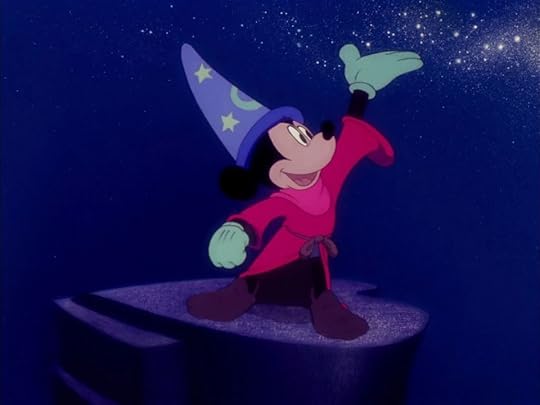
Fantasia-disneyscreencaps.com-2363

the mill is a strange place. the mill is a strange place. no one but the Master can leave it. no one but the Master can leave it. time works oddly. time works oddly.

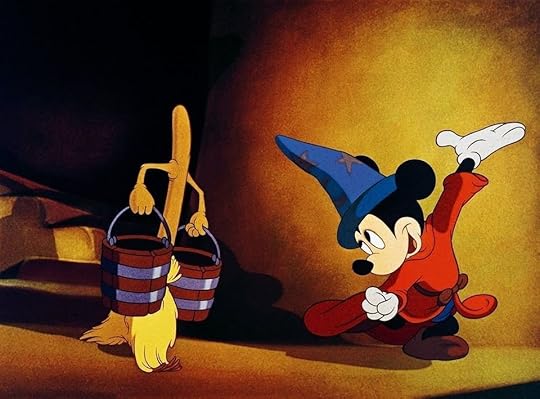
Heigh-ho, heigh-ho, off to work he goes, the Sorcerer's Apprentice!

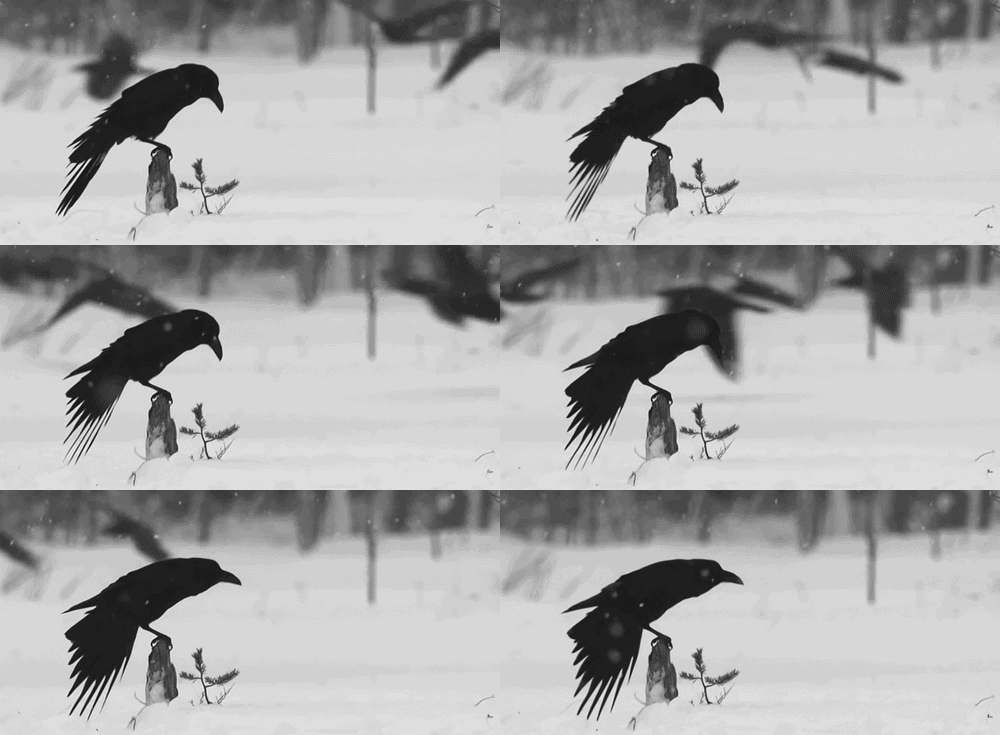
Preussler takes the timeless tale of naïve boy versus sinister master and keeps it dark, makes it stranger, keeps it kid-sized, makes it a fable for adults and kids alike. 'Tis an often dull adventure indeed that has young Krabat always drudging away with his (mainly) friendly fellows in a mill, the same-ol' same-ol' day-in & day-out. Plus magic lessons! Magic is enough, for a little while, to keep a boy's attention focused on the good times rather than on the dreary drudgery. Magic is like a bright & shiny bauble that allows boy to turn into raven, to work without tiring, to project his astral self to spy, to send his shy thoughts to the girl he loves. Magic is fun! But crack open the glittering bauble and inside is Satanism; Satan himself is a featured guest in this tale. Fortunately for all, except for the Master, except for the Master's master Satan, there is a power at least as strong as Evil. Let's all say it together: the power of love . Ah yes. Should have been a too-sentimental way to fight Evil but in the case of this classic book, the sentiment is perfect. Fits just right. There is a place that comes before an idea becomes cliché, a place that exists as an original template rather than a tired trope, and this book lives comfortably in that place. Krabat & the Sorcerer's Mill is a re-telling but not a reconstruction. What was the original source code for this book, published in 1972? One would have to consult the long-dead folklorists who once told this tale to their children, hoping to fable them into goodness.

As noted in the WSJ article I linked to above, of particular interest to adult readers is this book's take on the surveillance state. The Master sees all, including into your head. Best not to think, if you come to live at his mill. Best to just enjoy your little rewards, then get back to work!

73f7b8-20141201-fantasia
Profile Image for Anka.
1,115 reviews65 followers
March 9, 2018
Das Buch ist atmosphärisch und zuweilen sehr gruselig. Hätte ich es mit 10 gelesen, ich hätte sicherlich nachts nicht schlafen können. Auch die Freundschaften in dem Buch konnten mich überzeugen.

Allerdings kann ich dem Ende immer noch nichts abgewinnen. Was hat Otfried Preußler nur dazu bewegt, den finalen Showdown innerhalb von 2 mickrigen Seiten abzuhandeln? Der Rest der Geschichte ist so genial, aber der Schluss ist und bleibt die krasseste Enttäuschung. Als ich "Krabat" vor zehn Jahren zum ersten Mal las, hat mich dieses letzte Kapitel sogar richtig wütend gemacht. Diesmal war ich natürlich relativ gefasst, hatte aber zugegebenermaßen auch echt vergessen, wie kurz das Ende tatsächlich ist.

Wer zu diesem Buch greift, bekommt also einiges geboten, aber ein anständiger Schluss gehört leider nicht dazu.
Profile Image for Suzanne.
91 reviews
January 5, 2009
As I'm rereading my favorite books from childhood, I find myself having to reset my rating system. After reading The Satanic Mill, for instance, I see that some other books I noted as 5 stars are really 4, and some 4 stars are really 3.

This book is flat out good. For a book about good and evil it's free of saccahrine and moralizing. Economically written and tightly plotted, there aren't anvils falling on your head indicating where the story is going.

And somehow the lack of flowery description makes the book more vivid and compelling. I remembered scenes from when I read 25 or 30 years ago. They were so clear in my head that I was surprised to reread them as an adult and see that they were written very sparingly.
Profile Image for BJ Lillis.
329 reviews278 followers
May 11, 2022
My second novel in German! Atmospheric and otherworldly, Krabat is also very dark, with a coldness that creeps up on you as you read, despite many funny and delightful moments. (Otfried Preußler spent five years in a Soviet POW camp, and suffice to say, it shows.) I love the way the book handles time—the changing seasons, the way days and months blur together and then stand suddenly apart. (It is also a great book to read around Easter!) There is a certain ambivalence to the story as a whole, an unwillingness to nail itself down. The kind of book that takes up residence in the back of your mind.
Profile Image for Maren.
273 reviews6 followers
June 8, 2025
Nachtrag

Hab's geliebt, darum kann ich aus dem Gedächtnis das Lesehighlight ausrufen.
Profile Image for Elena.
1,030 reviews408 followers
October 22, 2023
Oberlausitz, Ende des 17. Jahrhunderts: In einer Winternacht erscheinen dem elternlosen Krabat elf Raben, eine Stimme ruft nach ihm, er kann ihr nicht widerstehen - und macht sich auf zur unheimlichen Mühle im Koselbruch. Dort angekommen verspricht ihm der Müllermeister Arbeit, Essen und ein Dach über dem Kopf, sollte Krabat sich in seine Lehre begeben. Krabat willigt ein und erkennt zu spät, dass in der Mühle die Schwarze Kunst gelehrt wird - und der skrupellose Müllermeister vor nichts zurückschreckt.

Otfried Preußlers Jugendroman "Krabat" ist an die sorbische Krabat-Saga angelehnt und überzeugt vor allem durch seine düstere Atmosphäre, die das Buch zu einer passenden Lektüre für den Herbst und Winter macht. 1971 erschien die erste Auflage des Romans, seither sind viele gefolgt, "Krabat" wurde Schullektüre und unzählige Male besprochen. Auch ich habe den Roman bereits in meiner Kindheit gelesen und ihn damals mit gewisser Spannung verfolgt. Umso schöner finde ich, dass der Thienemann-Esslinger Verlag zum 100. Geburtstag Otfried Preußlers eine neue Schmuckausgabe herausgebracht hat, beeindruckend illustriert von Mehrdad Zaeri. Die Illustrationen veranschaulichen die spannende Geschichte perfekt, sie sind ganz in schwarz-weiß gehalten und fangen die unheimliche Stimmung, die in der Mühle herrscht, sehr gut ein, lassen aber auch genug Spielraum für die eigene Vorstellungskraft. Die Geschichte an sich hat mich gar nicht so sehr gefesselt, ich denke, es gibt durchaus besser durchdachte und originellere Jugendromane. Durch Mehrdad Zaeris Kunst hatte ich aber einige sehr schöne Lesestunden mit dieser Geschichte vom verzauberten Spiel um Gut und Böse, die Freiheit des Menschen und die Kraft der Liebe.

Hinweis: Im Buch wird das M-Wort verwendet.
Profile Image for Max.
275 reviews520 followers
May 9, 2021
Krabat oder: Die fantastischen Lebensabenteuer auf einer verwunschenen Mühle am Anfang des 18. Jahrhunderts, als böhmische Wölfe noch über neblige Wiesen liefen und im Rabengekrächz mit Drachen rangen.
Zahlreiche sympathische und klar fassbare Nebenfiguren erheitern, verschärfen aber auch den Konflikt mit dem bösen Müller-Meister der vielgestaltigen Einäugigkeit.

Im Müllerburschen-Abenteuer steckt freilich auch eine Entwicklungsgeschichte, die uns den Wert von Freundschaften ebenso nahelegen kann wie den der Liebe, die zur magischen Alternativ-Macht wird; die moralische Bewertung der Figuren ist klar erkennbar, das passt ja gut zu einem Jugendbuch. Im diabolischen Meister, gegen den sich Krabat und seine Freunde auflehnen müssen, haben hoffentlich nicht allzu viele Schüler ihre Lehrer erkannt ;-)

Besonders gut gefallen haben mir die innewohnenden Legenden und lustigen Schalkereien. Der Roman baut um Krabat und die Jungs eine reiche Kulturwelt auf, von der sie zunächst durch Erzählungen erfahren und die sie dann bald auch hautnah erleben. Die Kraft von Geschichten erlebt Krabat somit parallel zum Leser. Doch auch Tod und Unterdrückung sind ein wesentlicher Bestandteil des Romans, kein Buch also für schwache Nerven.
7 Punkte
Profile Image for Manybooks.
3,813 reviews101 followers
April 24, 2025
Otfried Preußler's 1971 young adult novel Krabat (which in the English translation by Anthea Bell is called The Satanic Mill, and yes, I do think that the book title for the English language edition for one does tend to give away a pretty major and problematic spoiler and for two also would sadly and likely immediately put The Satanic Mill on the hit list of puritanical, of religiously fanatical mentally deranged book banners simply due to the inclusion of the word satanic in the heading) takes place in 17th century Germany (or rather in what is now Germany, as in the 17th century there was of course no Germany yet but rather a number of independent principalities and kingdoms) during the Thirty Years War. And considering how much general hardship, starvation and horror were both the direct and the indirect result of the Thirty Years War, the back story of Krabat, of the main protagonist being a fourteen year old Wendish teenager alone, desperately poor and needing to find a profitable manner of employment to make ends meet certainly makes very much historical sense, with the poverty stricken orphan of the book title shown by Preußler as thus almost immediately hugely enticed by those dreams he keeps having, by a rough voice telling Krabat to make his way to a mysterious water mill to work as an apprentice, but which actually and massively creepily turns out to be not a traditional mill at all but instead a school entirely committed to black magic. So yes, I guess Anthea Bell calling her translation The Satanic Mill is kind of correct in and of itself, although personally, I really do wish Bell would just leave the title as it is, as Krabat, since I certainly find it considerably more textually interesting slowly and not right away realising that the mill where Krabat will be working is something horrifying and infernal, that the Devil himself is at play and must be overcome (and that this is also and therefore a matter of life and death for Krabat himself).

And indeed, in the three years of his traineeship at the mill, Krabat (and the other eleven apprentices), they are meticulously and with much textual detail shown as being instructed by their teacher, by their master (described by Otfried Preußler as white faced, wearing a black eye-patch and using a book of necromancy that is chained to a table) how to turn themselves into ravens, how to make wells run dry, how to read minds. But while at first, Krabat (who figures that necromancy could be a profitable trade, and that above all, he desires and also needs to learn something that will make money) willingly changes into a raven for his Friday evening lessons and also becomes pretty much a star pupil, he gradually realises that no one is really ever free to actually leave the mill except as one of the yearly fatalities which pay the the master's debt to Lucifer, that what the mill is grinding up in Krabat are in fact human beings, are the corpses of the apprentices selected to be sacrificed to Satan, and while yes, the key to Krabat's successful escape, to his salvation (namely the love of a pure woman) may be rather disappointingly simple (and also rather a bit like a deus ex machina on Otfried Preussler's part) and in particular when compared to Krabat's foreboding dreams of his likely demise and the wit of the lessons he learns during his time of indentureship at the mill, well, the ending for Krabat is still nicely and folklorically satisfying (although that the woman to save Krabat's life must be pure, must be virginal, this does make me personally a bit annoyed, although I doubt that I would have noticed and been all that frustrated by this had I encountered and read Krabat as a younger reader).

Now with Krabat, Otfried Preußler's descriptions of the mysterious rituals and events of the occult are richly nuanced and impressively detailed (as is his knowledge of the machinery of a water mill for that matter). However, the combination of realism and fantasy in Krabat kind of often seem to exist as two rather separate entities, and for me, in a school of magic where things are accomplished with the power of incantations and pupils can turn into ravens at any moment, Preußler's countless details about the mechanism of a real mill and the drab life of the trainees do tend to become increasingly tedious, not always all that smoothly incorporated into the fantasy elements and vice versa, and not to mention that the reader of Krabat also never really learns why the evil master keeps up this school and why he has chosen Krabat or the other boys for his disciples in the first place. And since in the supernatural as in the natural world, some motivation is of course necessary, this lack of external and internal drive, while this does not make Krabat unreadable for me and therefore still a sufficiently interesting story, still a decently readable account, it ultimately also shows Krabat as being a tale that kind of feels as though there are two entirely disconnected narrative threads present and which never really do seem to mesh into one and as such leave me personally feeling a bit textually frustrated (because yes indeed, the realistic parts of Otfried Preußler's text for Krabat and the fantasy elements are really not mingling all that well for me, and to make Krabat into a truly memorable fantasy or fairy tale like story, this would definitely need to occur more thoroughly).
Profile Image for Rebecca.
716 reviews48 followers
March 21, 2024
Ratet, wer endlich Krabat gelesen hat!!

Ich fand’s sogar echt gut, auch als Erwachsene. Als Kind hätte ich mich vermutlich sehr gegruselt, aber jetzt ging es wirklich gut. Bin danach in ein richtiges Krabat-Rabbithole abgetaucht, da mir auch die zugehörige Sage nicht bekannt war. Gerade das hat mir Spaß gemacht: in die Sagenwelt einer mir fremden, aber dennoch deutschen Region reinzuschnuppern. Diese Namen, diese Ortschaften. Ist auf jeden Fall eine Lektüre wert, auch wenn man nicht zur Zielgruppe gehört.
145 reviews
June 17, 2025
Mit Krabat erzählt Preußler eine Geschichte mit einer langen Tradition aus dem sorbischen Sagenkreis. Es ist bisschen wie mit Faust, den Märchen oder den Mythen - Preußler bedient sich hier eines Stoffs, um daraus eine eigene Geschichte zu spinnen.

Krabat ist ein Betteljunge, der wiederholt von einer Mühle träumt. Sie ruft ihn und er folgt dem Ruf. Dort wird er überrumpelt und spricht Worte, die nicht seine eigenen sind, dass er dort in die Lehre gehen wolle. Es ist dann allerdings der Handschlag, den er wahrscheinlich selbst, aber verwirrt und unter Druck gibt, der den Pakt besiegelt.

Dort lernt er das Müllershandwerk, muss schuften und lernt regelmäßig Lektionen in schwarzer Magie. Doch langsam begreift Krabat, wozu er sich hier hat verführen lassen ...

Preußler kürzt die Krabat-Geschichte auf die Zeit in der Mühle ein und lagert Krabats spätere Episoden teilweise in Erlebnisse des dunklen Meisters aus - so scheint es fast, als sei der Meister eine ältere Version Krabats, mit ihrer eigenen, angedeuteten Tragik.
Es wird zu einer Geschichte über Verführung und der Erkenntnis der Verführung. Es ist die Geschichte eines Jungen, der erwachsen wird und Verantwortung übernimmt. Es ist eine Geschichte mit Nebenschauplätzen und Geschichten in Geschichten. Es ist ein kurzes, pralles, lebensfrohes Buch in einer unheilvollen Atmosphäre. In dieser Dichte und schlichten Lesbarkeit soll es Preußler mal einer nachmachen.

Ein Meisterwerk aus Deutschland über einen winzigen Schauplatz einer fast vergessenen Sagenwelt. Für alle von 9 bis 99.
Profile Image for Gordon Ambos.
Author 4 books79 followers
September 3, 2022
Ich hätte wirklich nicht erwartet, dass mir diese Geschichte so gut gefällt! Juro war der heimliche Star, das steht auf jeden Fall fest.
Einziges Manko war für mich die (für Märchen typische) Liebesgeschichte. Beide Charaktere kennen sich kaum, sind aber sofort bereit, ihr Leben füreinander herzugeben? Ich weiß nicht. Das Buch wäre auch sehr gut ohne diesen Aspekt ausgekommen.
Trotzdem fand ich es super!

CW: Suizidversuch, Misshandlung, Tierleid
Profile Image for Ana | The Phoenix Flight.
242 reviews184 followers
March 4, 2020
Se me dissessem que esta história vem do mesmo tempo que as histórias dos irmãos Grimm, eu acreditava! Como é que uma história com 40 anos pode ser tão intemporal e com laivos de história tradicional, daquelas que vêm do tempo em que as histórias ainda passavam de boca em boca? Não sei, mas é. Fico muito feliz por ter tido oportunidade de a ler.
Profile Image for Bine.
802 reviews111 followers
December 7, 2014
Hach, es war noch viel, viel besser als in meiner Erinnerung. So spannend erzählt, so tolle Charaktere, eine so wahnsinnige STimmung. Einfach ein geniales Jugendbuch. Berechtigt ein absoluter Klassiker.
Profile Image for Rain.
720 reviews120 followers
May 30, 2016
Jetzt verstehe ich zumindest, wieso so viele Leute nicht gerne lesen. xD
Profile Image for Andris.
382 reviews89 followers
October 20, 2020
Šī nu gan nebija veiksmīga izvēle, ko lasīt bērniem - traki garlaicīgi. No otras puses - lieliskas miega zāles.
Profile Image for Kathrin.
867 reviews57 followers
July 5, 2018
'Krabat' as a story is very dear to me although I never read the book. But I am familiar with the movie based on the book and I've seen numerous theatrical adaptions in the last years.

Supposedly, a children's book 'Krabat' is the rather dark story of a young boy with said name. Krabat is an orphan facing a dire faith in 17th century Germany. One day he feels the pull of a nearby mill and joins the master as an apprentice. In addition to learning the trade of the mill, the master also teaches his 12 apprentices the dark arts. At first, Krabat enjoys his newfound freedom immensely until he learns that it comes with a high price.

This story always fascinated me because it's actually set in a region not that far away from where I grew up. The author has a way of showing the dire environment those boys grew up in which makes it easy to understand why they would follow the pull of the mill. I loved to read about the magic they learned and how far away their life seemed to be from the normal people in the nearby villages.

Throughout the story you accompany Krabat as he grows up and tries to find out what is important in his life. Is it the freedom and power that comes with using dark magic? And what kind of price is too high to pay for this?

I am glad that I finally managed to read the book as it offers more scenes and insights. Unfortunately, as with every other adaption that I know, the ending is a buzzkill. It just happens. Endless pages of build-up which makes you hope for more. Personally, I am still disappointed with the ending despite loving the rest of the book - thus settling for four stars.
Profile Image for Mina.
190 reviews22 followers
March 10, 2023
Ich habe das Gefühl, ein paar Kinder- und Jugendbuchklassiker nachholen zu müssen und Krabat war einer davon. Wir begleiten den 14-jährigen Bettler Krabat, der auf mystische Weise zur abgelegenen Mühle gerufen wird und dort vom Müller als Lehrling aufgenommen wird. Das Setting, in dem sich eine Gut-gegen-Böse-Geschichte entspinnt, ist von vornherein düster ausgestaltet und hat für Kinder sicher den gewissen Gruselfaktor. Recht schnell wird klar, dass Krabat und die anderen Lehrlinge der Mühle nicht nur hart arbeiten müssen, sondern auch in die dunklen Künste des Müllers eingeweiht werden. Die Mühle steht hier bildhaft für einen grausamen Kreislauf, der jedes Jahr einen blutigen Preis fordert.

Die Geschichte hat mich, Ü 30, tatsächlich noch fasziniert und ist nicht nur wunderbar stimmungsvoll geschrieben, sondern auch vom Autor selbst im Hörbuch eingesprochen. Der historische Hintergrund des Zauberers Krabat, um den sich in der Gegend um Hoyerswerda Mythen ranken, gibt der Geschichte noch einen extra Glanz.
Otfried Preußler schafft hier ein Setting, das mich sehr fasziniert hat und webt ergreifende Güte ein, wo ansonsten nur Dunkelheit herrscht. Passt wunderbar in den Januar und ist für einen Reread nächstes Jahr um diese Zeit bereits vorgemerkt :-)
Profile Image for Milda.
246 reviews53 followers
April 17, 2020
Šią knygą pirmą kartą perskaičiau 7-oje klasėje. Ši knyga man primena labai gerus laikus kai kiekvieną penktadienį, pasibaigus pamokoms, su klasiokėmis važiuodavome į P. Višinskio biblioteką rinktis knygų #nerdsquad :) Iš visų knygų, kurias pasiimdavau tais penktadieniais, šią atsimenu geriausiai. Jau tada ji buvo išskirtinė.
Paslaptingas Kozelio raisto malūnas, magija ir burtai, nelaimingi nutikimai Naujųjų metų naktį, svečias, apsilankantis per kiekvieną jaunatį. Vis tas pats užburtas ratas ir Krabatas, norintis pagaliau išsiaiškinti malūno paslaptis. Knyga ne tik apie burtus ir paslaptis, bet ir apie draugystę, ištikimybę, siekius ir vertybes.
Profile Image for Natalya Misyuk.
Author 8 books26 followers
October 23, 2025
Атмосфера “Кра-кра-кра…”

Ні за що б не взялася читати цю книжку у підліткові роки, якби мені не сунули її у руки і не сказали, що ось, на, ця дуже крута.
Ніяк вона не виглядала на круту і цікаву. Просто текст у збірці. Жодних ілюстрацій. Назва ні про що мені не говорила. Але я прочитала, і потім поверталась до книжки вже дорослою і перечитувала ще і ще. Один з найбільш атмосферних творів у жанрі темного фентезі, які я прочитала за все життя.

“Крабат”, написав Отфрід Пройслер.

Крабат — це ім’я хлопчика. Його придумав не автор. Крабат — це фольклорний персонаж, автор написав свій твір на основі фольклорних історій. Зараз у цьому імені я чую щось таке темне і вороняче: “Кра-кра-кра…” — і вся книжка теж така. Старий млин. Школа магії. Учні. Перетворення у чорних птахів. Старий цвинтар, ночівля біля могили…

Ні, книжка не страшна. Просто темна і атмосферна. Про темряву і промінь світла у ній.
Зараз “Крабат” є українською у дуже гарному виданні. Якщо ви не знаєте, яку книжку підсунути підлітку, щоб розсмакував задоволення від читання, то ось можна спробувати зайти з цієї.

Якщо ви дорослий і любите читати, то собі теж беріть цю книжку. Отримаєте насолоду від занурення в атмосферу і сюжету.

За цим твором багато чого є. Фільми, вистави... Я нічого того не дивилась. Відверто кажучи, боюсь зруйнувати ті образи, які у мене в уяві живуть після прочитання. А вони гарні, я їх ціную.
Profile Image for Michelle Curie.
1,082 reviews458 followers
December 26, 2016
A wonderfully spooky read! Krabat tells the story of a fourteen-year-old orphan, who begins his apprenticeship as a miller's man. Soon he finds out that the mill is actually a school for black magic and the journeymen prisoners to a cruel and cunning master. When he realises that dark secrets are kept, Krabat tries to find a way to escape and defeat the master.


I've never read this as a child, but was still aware of many now grown-ups calling this their favourite, which is why I bought a copy for myself. For years and years it stood in my bookshelf, unnoticed and unread and only now did I finally give myself that push to pick it up! This novel was first published in 1971 and I struggled with the language quite a bit, which felt stiff and distant to me (I read this in German), but I was to find myself getting used to Preußler's way of telling the story after a while and even finding that his prosaic style of writing suited the story very well.

The book is split into three parts and three years and it's interesting to see how Krabat grows and slowly turns from a young boy to a grown man. There are subtle shifts and changes in his character, he makes wiser decisions and doesn't let himself fool as easily as he used to.

I found out that this story is a re-telling of the original Sorbian tale of Krabat that dates back to the 18th century. It's full of black magic, haunting dreams and the lure of evil and can definitely be enjoyed by people not part of the target group.
Profile Image for Outis.
392 reviews68 followers
October 12, 2024
L’etichetta fiaba dark gli si addice perfettamente. Il suo andamento ciclico e lo stile di scrittura lineare ma allo stesso tempo martellante e scorrevole ricordano le antiche fiabe. Originale nel suo richiamarsi alle fiabe tradizionali del folklore europeo. E con tradizionali non intendo certo le versioni annacquate e innocue alla Disney. Inquietante e soffocante al punto giusto. Si legge tutto di un fiato e secondo me va iniziato senza sapere troppo di cosa parlerà. Tutto ottimo. Peccato per il finale tirato via: 10, 20 pagine in più alla fine avrebbero fatto la differenza. Tra le 4 e le 5 stelline. Per il finale si meriterebbe 4 stelle ma ignorerò quest’unico difetto. Va iniziato però senza aspettarsi un fantasy perché non lo è.
Profile Image for librari.
46 reviews
July 20, 2023
harry potter, aber du lernst magie nicht an einem elite–internat, sondern in einem ranzigen ausbildungsbetrieb* in der oberlausitz.
(*ohne krankenversicherung, urlaubstage oder … lohn.)

es gibt auch keinen patronus, dafür verwandelt dich dein chef hin und wieder in ein tier seiner wahl. na ja, das ist ja mindestens genau so schön!
Profile Image for Caren.
493 reviews116 followers
October 6, 2014
When I read that this book had been an inspiration for the likes of writers Cornelia Funke and Neil Gaiman, my curiosity was piqued. The book appeared in German in 1971 and was translated into English soon after. It was re-released this year by New York Review of Books in their collection of classic children's titles.
The author grew up in a Bohemian town that was annexed, as part of the Sudetenland, by Hitler. He was drafted into the German military in 1944 and sent to fight on the Eastern front, where he was captured and spent five years as a prisoner of war in the Tatar Republic. After the war, most Germans were expelled from his hometown, so he went to Bavaria, where he reunited with his fiancee and married. He worked as a primary school teacher and later as a principal, from the early 1950s until 1970, when he began to write full-time. This story is based on the old Wendish (or Sorbian) tale of the sorcerer's apprentice (a tale known in the area of Bohemia where he grew up).
This story has a sort of folk tale feel, with the stark juxtaposition of good and evil, dark and light. It takes place in old Bohemia just after the 30 Years War , when plague ravaged the land. The main character, Krabat, was left orphaned and was forced to go begging with some other boys. After three vivid dreams during which a voice commanded him to leave his friends and go to a nearby mill, he awakened one morning and did as the voice had instructed. When he arrived, the creepy atmosphere was palpable, but the master miller gave him plenty of food and a warm place to sleep, along with the promise of learning a trade. So Krabat settled into the routine at the mill---a routine made up of hard work, but a relatively comfortable place to live and the companionship of eleven other apprentice and journeymen millers. From the start, there were unsettling occurrences, but he only began to understand his situation gradually. The miller was really a sorcerer; the boys were given instruction in black magic, which they often used just for merry entertainment. The instruction was given to them once a week, as they perched, in the form of ravens, in the master's study. They were free to learn or not, as they wished. Krabat soon saw that it would be to his advantage to learn as much as possible, since the black magic gave him the strength to endure their hard work, as well as possible protections against other normal humans. Krabat matured more quickly than normal while there, looking three years older after just one year there. After Krabat discovered some of the evils of the place, evils to which the other young men had become resigned, he tried to escape, but to no avail. The miller now held him fast in his magic.
As Krabat matures, you will struggle along with him, searching for a way out of a seeming inescapable situation. There are some big questions here: Does wielding enormous supernatural power over other humans make being a party to great evil acceptable? If not, what tools can best fight this sort of all encompassing evil? Would you be willing to put someone you loved into danger in order to fight evil?
The young apprentices and journeymen exhibit varied personalities and different reactions to their situation, so it is interesting to see many possible ways of dealing with a snare in which the small and powerless must decide whether to risk fighting the dark forces.
Knowing the author's own background in the Nazi war machine, you can extend the underlying meaning of his plot beyond a long-ago folk tale. These are human struggles in a world fraught with evil, but always with the hope that love brings.
[There is a quite good German film, "Krabat"(made in 2008), dubbed in English, but it is only available in region 2 format. If you have the equipment to play European DVDs, it is worth watching.]
Displaying 1 - 30 of 1,212 reviews

Can't find what you're looking for?

Get help and learn more about the design.