

What do you think?

Inverted Frontier #2
Silver
A Lost Ship – A New World
Urban is no longer master of the fearsome starship Dragon. Driven out by the hostile, godlike entity, Lezuri, he has taken refuge aboard the most distant vessel in his outrider fleet.
Though Lezuri remains formidable, he is a broken god, commanding only a fragment of the knowledge that once was his. He is desperate to return home to the ring-shaped artificial world he created at the height of his power, where he can recover the memory of forgotten technologies.
Urban is desperate to stop him. He races to reach the ring-shaped world first, only to find himself stranded in a remote desert, imperiled by a strange flood of glowing “silver” that rises in the night like fog—a lethal fog that randomly rewrites the austere, Earthlike landscape. He has only a little time to decipher the mystery of the silver and to master its secrets. Lezuri is coming—and Urban must level up before he can hope to vanquish the broken god.
Urban is no longer master of the fearsome starship Dragon. Driven out by the hostile, godlike entity, Lezuri, he has taken refuge aboard the most distant vessel in his outrider fleet.
Though Lezuri remains formidable, he is a broken god, commanding only a fragment of the knowledge that once was his. He is desperate to return home to the ring-shaped artificial world he created at the height of his power, where he can recover the memory of forgotten technologies.
Urban is desperate to stop him. He races to reach the ring-shaped world first, only to find himself stranded in a remote desert, imperiled by a strange flood of glowing “silver” that rises in the night like fog—a lethal fog that randomly rewrites the austere, Earthlike landscape. He has only a little time to decipher the mystery of the silver and to master its secrets. Lezuri is coming—and Urban must level up before he can hope to vanquish the broken god.
478 pages, Kindle Edition
First published November 18, 2019
About the author
Linda Nagata
99 books669 followersI'm a writer from Hawaii best known for my high-tech science fiction, including the near-future thriller,
The Last Good Man
, and the far-future adventure series, INVERTED FRONTIER.
Though I don't review books on Goodreads, I do talk about some of my favorite books on my blog and those posts are echoed here. So I invite you to follow me for news of books and many other things. You can also visit my website to learn more about my work, and to sign up for my newsletter.
Though I don't review books on Goodreads, I do talk about some of my favorite books on my blog and those posts are echoed here. So I invite you to follow me for news of books and many other things. You can also visit my website to learn more about my work, and to sign up for my newsletter.
Ratings & Reviews
Friends & Following
Create a free account to discover what your friends think of this book!
Community Reviews
Displaying 1 - 30 of 71 reviews

March 29, 2022
The majority of this outing by one of my most favorite authors in Hard Sci-Fi (sixth only to Alastair Reynolds, Arthur C. Clarke, Peter F. Hamilton, A.A. Attanasio and the esteemed John C. Wright), the second book of the Inverted Frontier trilogy, continues the overarching and intricately weaved tapestry of a universe introduced within the Nanotech Succession series that takes place on a torus shaped megastructure (spanning an area over six hundred fifty thousand of a kilometers' squared area) mysteriously refered to as Verilotus and it's very reminiscent of Larry Niven's Ringworld with a lovely ode to Leonardo da Vinci's flying contraptions.
We follow Urban's adventures after his battle with the fallen god, Lezuri that arose due to the behavioral virus that initiated the communion of minds within the Hallowed Vasties; the region comprising of the old Earth system and nearby stellar systems colonized several millennia ago that later evolved into a swarm/hive mind society enshrouded within huge megastructure cordons akin to Dyson Swarms, that later disintegrated for haunting and mysterious reasons visible to the farthest colonies only recently due to light speed lag from frontier telescopes.
A weird society of ancestral humans with events riding on a frenetic and extremely fast paced clip, on this mysterious artificial world created by Lezuri and his goddess at the height of their powers:
This was done utilizing a multiversal space-time anomaly, intruding from an incompatible universe as a luminous one-dimensional oval blade akin to an artifact called a vibrating cosmic superstring in order to dice up the solar system and harvest all component debris, remnant planets, planetoids and other Oort cloud detritus into their creation in which the time elapsed within runs faster than normal space-time by a factor of 10.
All this happens on Verilotus, rife with ha, the mysterious nano-technological remnants of the fallen goddess, located a hundred light years from the edge of the systems comprising the Hallowed Vasties.
I absolutely highly recommended to all Hard Sci-Fi, Post-humanism, Philosophy of Mind and Ethics (as related to sci-fi), & Space Opera enthusiasts.
Read I: 2023
Read II: 2025
We follow Urban's adventures after his battle with the fallen god, Lezuri that arose due to the behavioral virus that initiated the communion of minds within the Hallowed Vasties; the region comprising of the old Earth system and nearby stellar systems colonized several millennia ago that later evolved into a swarm/hive mind society enshrouded within huge megastructure cordons akin to Dyson Swarms, that later disintegrated for haunting and mysterious reasons visible to the farthest colonies only recently due to light speed lag from frontier telescopes.
You are formidable.It also embarks the reader for a ride on the ship of the imagination, to Urban's subsequent quests to level up and evolve on a horrendously short time span in a very hostile and strange ecosystem with mysterious and advanced technologies.
You willed yourself into existence within the Swarm. You arose from that communal intellect, though not on your own. Even then, she was entangled with you, your other half. Her existence strengthened yours; your existence bolstered hers. You grew together, and together you consumed the computational substrate supporting billions of other, lesser, minds. Together, you learned to take without hesitation, and together, you broke free.
And then she broke you; she broke herself. Only whispers remain. So be it. You will not grieve.
An aphorism: Life goes on.
Here before you stands another. Urban is not your peer, but he has the makings of a companion. Sharp-edged, quick to master the silver, adaptable. You don’t know exactly when he reached Verilotus, but a logical estimate leads you to conclude that he required far fewer than a million seconds to find his way into the core—a feat that fires your imagination.
In the form of your avatar, you seek to persuade: Why set yourself against me when you know we can help each other?
In a parallel timeline you engage in a more intimate confrontation. He is a virtual entity occupying the interface at the heart of the world. He seeks to hold that space against you, but alien dimensions bleed into the complex geometry of the interface, allowing more than one reality to exist.
You slide across him.
You slide within him.
He resists, but pushing back only pushes him deeper into shared dimensions, your definition and his, in ever closer proximity.
Yield, you tell him.
He argues.
Yield, you insist.
A weird society of ancestral humans with events riding on a frenetic and extremely fast paced clip, on this mysterious artificial world created by Lezuri and his goddess at the height of their powers:
This was done utilizing a multiversal space-time anomaly, intruding from an incompatible universe as a luminous one-dimensional oval blade akin to an artifact called a vibrating cosmic superstring in order to dice up the solar system and harvest all component debris, remnant planets, planetoids and other Oort cloud detritus into their creation in which the time elapsed within runs faster than normal space-time by a factor of 10.
All this happens on Verilotus, rife with ha, the mysterious nano-technological remnants of the fallen goddess, located a hundred light years from the edge of the systems comprising the Hallowed Vasties.
I absolutely highly recommended to all Hard Sci-Fi, Post-humanism, Philosophy of Mind and Ethics (as related to sci-fi), & Space Opera enthusiasts.
Read I: 2023
Read II: 2025
December 21, 2019
Direct sequel to her excellent EDGES, with many characters carried over. I found this to be a weaker book than EDGES. My WSOD was having trouble with the magic nanotech, some of the plot-twists seemed forced, and the ending seemed hasty, with no real resolution. I have the impression she is leaving the series open, with room for more sequels. It felt like a “middle book” to me. Mind, it’s still a good novel, and I don’t regret reading it. And other readers were happier with it than I was. YMMV! You definitely need to read EDGES first.
I thought that maybe I’d read this one too soon after EDGES — but I see in the afterword that it is a sequel to her 2003 novel MEMORY, which shares the same setting and some characters. That’s one of the few Nagata novels I haven’t cared for. My writeup for the earlier book is here: https://www.goodreads.com/review/show... This book shares some of the same problems I saw in that one.
I thought that maybe I’d read this one too soon after EDGES — but I see in the afterword that it is a sequel to her 2003 novel MEMORY, which shares the same setting and some characters. That’s one of the few Nagata novels I haven’t cared for. My writeup for the earlier book is here: https://www.goodreads.com/review/show... This book shares some of the same problems I saw in that one.

April 20, 2021
I'm sad to say that Silver didn't live up to the first book. I'm not sure why a nigh omnipotent demi-god post-human with the ability to tear whole solar systems apart would waste his talents to create a... uh... videogame world with a respawn mechanic. This created world is also a torus, which one might call a ringworld or even a halo of sorts and man this all seems pretty uninspired so far. It is definitely lacking the imagination of Edges.
Then throw in the fact that they ditch nearly the entire cast and you'll find a book just trapped by bad choices forced into an even worse story. The new characters they introduce are all flat and for all the time spent on it, barely anything interesting is told about the world and the people on it. This was a sadly dull sequel to a great book, which happens sometimes I guess.
Then throw in the fact that they ditch nearly the entire cast and you'll find a book just trapped by bad choices forced into an even worse story. The new characters they introduce are all flat and for all the time spent on it, barely anything interesting is told about the world and the people on it. This was a sadly dull sequel to a great book, which happens sometimes I guess.

December 1, 2019
Nagata continues her fresh and imaginative space opera series, Inverted Frontier, with Silver, a tight, mostly planet-bound adventure centered around Urban from Edges (the first book in this new series) and Jubilee and Jolly, characters from Memory, a prior stand-alone. They join forces to engage the artificial planet's interior structures in order to learn how to control its "silver"-- the constructive and destructive swarm-like nanotech that dissolves and remakes everything on the planet's surface. They must figure all this out before Lezuri, the god-like consciousness that almost killed Urban in book one returns and gathers his strength to realize his maliciously narcissistic plan to remake the world into a hostile crucible in which its inhabitants must battle for their lives and "level up" to become the best players possible, worthy of companionship with him. The whole book is compulsively readable, as was the first volume in this open-ended series, but the last 100 pages are particularly gripping. I made my family wait a few hours to decorate our Christmas tree while I finished it up. If you enjoy space opera and aren't reading Linda Nagata's new series yet, rectify that ASAP. Her work deserves more attention.

August 9, 2020
“And it was still raining . . . that astounding phenomenon of frigid water dripping uncontrolled out of the sky.”
Continues the superlative character and plot development started in Edges.
“All morning the wind had blown hard—a strange and frightening phenomenon, like a hull breach draining the atmosphere of the world.”
Turns classic science fiction on its head. Instead of projecting earth-bound into deep space, Silver brings humans who know nothing but deep space onto the earth-like surface of a very un-earth-like planet.
“Has the north-south rotation ceased?” The Astronomer responded with a look of distaste. “It is utterly impossible for the structure of any world to absorb such an abrupt change in momentum.”
If authors and publishers have a dream beyond starting a never-ending series (a la Robert Jordan’s Wheel of Time monstrosity) it is probably to mesh two independent series (a la Isaac Asimov Foundation and Robotic threads). Nagata manages the same trick in this book, weaving together her inverted frontier universe and her torus world from Memory. It works; very well.
“In all of human history, the greatest threats our people faced have always come from one another.” “That has not changed.”
Continues the superlative character and plot development started in Edges.
“All morning the wind had blown hard—a strange and frightening phenomenon, like a hull breach draining the atmosphere of the world.”
Turns classic science fiction on its head. Instead of projecting earth-bound into deep space, Silver brings humans who know nothing but deep space onto the earth-like surface of a very un-earth-like planet.
“Has the north-south rotation ceased?” The Astronomer responded with a look of distaste. “It is utterly impossible for the structure of any world to absorb such an abrupt change in momentum.”
If authors and publishers have a dream beyond starting a never-ending series (a la Robert Jordan’s Wheel of Time monstrosity) it is probably to mesh two independent series (a la Isaac Asimov Foundation and Robotic threads). Nagata manages the same trick in this book, weaving together her inverted frontier universe and her torus world from Memory. It works; very well.
“In all of human history, the greatest threats our people faced have always come from one another.” “That has not changed.”

April 11, 2021
This is far future trans/post-human story. This is the second volume of the duology, the first, Edges, I reviewed here. A noted before, it is more a single story in two parts.
After a battle with a post-human Lezuri, the crew of Dragon as well as the ship are heavily damaged, its master/captain Urban is away on one of the advance scouts without connection to the rest of the crew. They change their course and in time reach the artificial world made by the power they fought and his partner.
While the first book was mostly a space travel story, here most of the plot takes place on a world ring-shaped artificial world of Verilotus, where every night ‘silver’ (nanite mass) rises to consume things left above ground or to construct from ordinary to bizarre. Urban land there in order to fight Lezuri before the later can recapture his full might. In order to do this he needs help from locals.
A nice SF story of an underrated but talented author.
After a battle with a post-human Lezuri, the crew of Dragon as well as the ship are heavily damaged, its master/captain Urban is away on one of the advance scouts without connection to the rest of the crew. They change their course and in time reach the artificial world made by the power they fought and his partner.
While the first book was mostly a space travel story, here most of the plot takes place on a world ring-shaped artificial world of Verilotus, where every night ‘silver’ (nanite mass) rises to consume things left above ground or to construct from ordinary to bizarre. Urban land there in order to fight Lezuri before the later can recapture his full might. In order to do this he needs help from locals.
A nice SF story of an underrated but talented author.

March 16, 2021
This is a sequel to Edges that also links it to, and more-or-less fully explains, the world Nagata created back in 2003 in Memory. For that alone, I would have liked it a lot. Not only that, but not much time has passed in the Memory world, so we get to revisit the same characters, as well as the ones we met a couple of years ago in Edges. Which was kind of delightful.
So, the bad guy, Lezuri, that Urban, Clemantine and crew met in Edges, actually created the torus-shaped world where Jubilee, Jolly, and crew live, where the silver comes out at night and changes things. The story is set with Urban, un-backed-up and on his last copy, thus much more mortal than usual, on that world and working with that bunch to prevent Lezuri from using the silver to remake the world into a much rougher place and in the process kill everyone there. Both bunches learn about each other's technologies, and they use everything they can. Meanwhile, Urban is pretty sure that Clemantine, on his old ship, is coming, and they are also trying to warn her away, since Lezuri has some formidable weapons and would not let her get in the way of his plans.
So, there's a lot of action. I remembered the people from Memory for all those years, which is unusual for me and speaks to how much I liked that book. Edges also had some good characters, but Urban is the main one here, and his main personality trait is that he's driven, determined. And he loves Clemantine, but it's still not a lot to go on, so he didn't really come alive for me. At times, the action on the book felt like formula to move things from one place to another. I guess that's what happens in books, but this one was slightly lacking in, um, soul?
I love Linda Nagata's writing, and how she brought two of her universes together, and that brings the book up to four stars for me.
So, the bad guy, Lezuri, that Urban, Clemantine and crew met in Edges, actually created the torus-shaped world where Jubilee, Jolly, and crew live, where the silver comes out at night and changes things. The story is set with Urban, un-backed-up and on his last copy, thus much more mortal than usual, on that world and working with that bunch to prevent Lezuri from using the silver to remake the world into a much rougher place and in the process kill everyone there. Both bunches learn about each other's technologies, and they use everything they can. Meanwhile, Urban is pretty sure that Clemantine, on his old ship, is coming, and they are also trying to warn her away, since Lezuri has some formidable weapons and would not let her get in the way of his plans.
So, there's a lot of action. I remembered the people from Memory for all those years, which is unusual for me and speaks to how much I liked that book. Edges also had some good characters, but Urban is the main one here, and his main personality trait is that he's driven, determined. And he loves Clemantine, but it's still not a lot to go on, so he didn't really come alive for me. At times, the action on the book felt like formula to move things from one place to another. I guess that's what happens in books, but this one was slightly lacking in, um, soul?
I love Linda Nagata's writing, and how she brought two of her universes together, and that brings the book up to four stars for me.

April 12, 2026
meh...

November 15, 2019
This second novel in Linda Nagata's new Inverted Frontier series takes the characters and ideas in an exciting new direction. It skillfully blends the world of Vast and Edges with the world of her 2003 novel, Memory. Nagata continues her exploration of human identity and its enhancement through integration with alien states of being in an exciting way. I'll have a review up soon on my new blog, scifimind.com. I strongly recommend Silver and this new series as a great space epic.

February 8, 2025
Silver is a sequel to two books, the obvious one being Edges, the previous book in the series, and also Memory (2003) which wasn't even in this setting's universe until this book was written. I haven't read the latter, and don't have any plans to do so, though apparently the protagonist of Memory is a viewpoint character in this one. As such, I'm unable to say how much it matters other than to say that relative to the wider story, it can't matter all that much. Still, it's an unusual choice and it's very much different for that. It feels like a crossover novel and arguably that is what it is.
The most obvious difference is that this book takes place entirely on a planet rather than traveling through space. It's very unlike the previous book, a risky move to be sure, though it's one that worked out well enough for me. The first book was more enjoyable, but this one was some very interesting ideas, which unfortunately aren't fully utilized. The Dragon barely has any presence, and it's crew even less. If it weren't for that the primary viewpoint is a character from the previous book, then this book would indeed be a highly questionable inclusion in the series.
On this planet, a thick fog-like substance called Silver has mysterious properties that defy logic and common sense. Anything it touches is transmuted in some inexplicable way and biological material is integrated into it. Only a few thousand remain as the silver floods of recent years have reduced the population from being in the millions. Perhaps its strangest property is that all are caught in a cycle of rebirth, where death is only a end, not the the end. People are reborn and eventually regain much of what they knew and who they were, despite that genetically not making the slightest sense.
This is all powered by the Blade, an artifact created by a godlike posthuman that siphons energy from other universes to power the planet. That same posthuman, a sliver of him anyway, is on his way back to reclaim what he has created. All that stands in his way are the citizens of that world and a main character of the previous book who must find out the secrets of the Silver to thwart his plans. Which is to say, not much happens for most of the book aside from talking and trying things out, which is fine despite lacking excitement.
It's all very strange and definitely odd for a sequel, certainly nothing I'd advise, but again, it works out. I'm not quite sure how it did, but it did. It only kept me moderately engaged, so I'm not saying it's a good book, but it's not a bad one by any means. It should've been its own thing rather than part of this series though. It feels too much like characters being dropped in from one book to another where they don't really belong. Hopefully the next book does things differently. If it doesn't, it'll be a fine series, but also won't be notable in almost any way. Not everything has to be though.
Rating: 3.5/5
The most obvious difference is that this book takes place entirely on a planet rather than traveling through space. It's very unlike the previous book, a risky move to be sure, though it's one that worked out well enough for me. The first book was more enjoyable, but this one was some very interesting ideas, which unfortunately aren't fully utilized. The Dragon barely has any presence, and it's crew even less. If it weren't for that the primary viewpoint is a character from the previous book, then this book would indeed be a highly questionable inclusion in the series.
On this planet, a thick fog-like substance called Silver has mysterious properties that defy logic and common sense. Anything it touches is transmuted in some inexplicable way and biological material is integrated into it. Only a few thousand remain as the silver floods of recent years have reduced the population from being in the millions. Perhaps its strangest property is that all are caught in a cycle of rebirth, where death is only a end, not the the end. People are reborn and eventually regain much of what they knew and who they were, despite that genetically not making the slightest sense.
This is all powered by the Blade, an artifact created by a godlike posthuman that siphons energy from other universes to power the planet. That same posthuman, a sliver of him anyway, is on his way back to reclaim what he has created. All that stands in his way are the citizens of that world and a main character of the previous book who must find out the secrets of the Silver to thwart his plans. Which is to say, not much happens for most of the book aside from talking and trying things out, which is fine despite lacking excitement.
It's all very strange and definitely odd for a sequel, certainly nothing I'd advise, but again, it works out. I'm not quite sure how it did, but it did. It only kept me moderately engaged, so I'm not saying it's a good book, but it's not a bad one by any means. It should've been its own thing rather than part of this series though. It feels too much like characters being dropped in from one book to another where they don't really belong. Hopefully the next book does things differently. If it doesn't, it'll be a fine series, but also won't be notable in almost any way. Not everything has to be though.
Rating: 3.5/5
December 15, 2019
I have been a fan of Linda's work since there were large bookstores filled with F/SF. 'Silver' and its companion 'Edges' relate back to earlier works 'Vast' and 'Memory' and stitches together a rather neat patchwork of old and new. I bought 'Vast' and 'Memory' long ago at bookstores now but a memory.
This is interesting SF/Space Opera with good characters and definitely not run of the mill ideas. 'Silver' is a bit more single world oriented, since much of the action takes place on one uniquely design world.
Well worth reading this open ended series and picking up the earlier books and finding a short story based in the same narrative.
This is interesting SF/Space Opera with good characters and definitely not run of the mill ideas. 'Silver' is a bit more single world oriented, since much of the action takes place on one uniquely design world.
Well worth reading this open ended series and picking up the earlier books and finding a short story based in the same narrative.

October 23, 2024
Silver is a complex story, but very satisfying narrative. It’s really the integration of 2 story lines, a loose follow up from Memory, a stand alone novel originally, and Edges, from the first Inverted Frontier book. The characters are believable, the science is weirdly believable (since it’s never explained), and much of the story takes place virtually (or in many virtual places simultaneously). It may sound incredibly confusing, and it should be, but Ms. Nagata has a story telling skill that’s rarely seen. Very impressive work.

November 14, 2022
Another great episode in the Inverted Frontier space opera. Urban gets his opportunity to confront the mad god on his home world. The wonder is still there and once the story gets rolling, the tension is just as present and the stakes just as high as in Edge. Another wonder-driven novel by a writer who keeps me enthralled with her ability to create complex worlds and characters.

December 4, 2019
Nagata returns to Space Opera with a serious one-two punch with EDGES and now SILVER. The action moves from deep space to planetside, which forces Urban into unfamiliar and challenging territory as he desperately tries to prepare to confront the god-like Lezuri.
I initially thought that the addition of new characters, who are literally "players" in the planetary game, slowed the narrative a bit. In retrospect, I absolutely appreciated the breather because the physical and emotional stakes are raised to page-turning levels in the last third of the novel.
This was a tricky balancing act of high concepts, well-drawn and believable characters, and some serious set pieces that would be right at home in modern tent-pole blockbuster film. Nagata manages all of that with deceptive ease.
Highly recommended.
I initially thought that the addition of new characters, who are literally "players" in the planetary game, slowed the narrative a bit. In retrospect, I absolutely appreciated the breather because the physical and emotional stakes are raised to page-turning levels in the last third of the novel.
This was a tricky balancing act of high concepts, well-drawn and believable characters, and some serious set pieces that would be right at home in modern tent-pole blockbuster film. Nagata manages all of that with deceptive ease.
Highly recommended.
December 4, 2019
I was stunned recently by the news that there are now two sequels to Linda Nagata's 1998 novel, Vast. Vast is one of my three favorite novels. (The other two are Vernor Vinge's A Fire Upon the Deep and Arthur C. Clarke's The City and the Stars.) Nagata's new books, Edges and Silver, are not in the same exalted class as those three. But they are very good.
Vast is set in a far-future world when the original Earth has been lost in the mists of time and might no longer exist. We are very far from there in both space and time. (We are thousands of light years in the direction Nagata calls swan, that is, toward the constellation Cygnus, and thus toward the galactic center.) In this world, computers can be sentient, and human consciousness can be uploaded into a machine. People save backup copies of themselves. (One character, Lot, is unable to do this, and so when he is in peril, people are terrified for him, because he has no backup.) Also in this world there are enormous, semi-sentient starships that prowl the galaxy looking for civilizations and destroying them. The characters in our story are hunting for a way to fight those killer ships, or at least to find out where the hell they came from. The "brains" of the killer ships are not like the computers humans make, but the principle is similar enough (something like a dense network of artificial neurons) that over the course of the story some progress is made in transferring human consciousness into them. (To say how much progress would spoil the plot.) But I want to emphasize that this is not a book about "cool technology," it's about people. They're not quite human anymore, but they are people. This book is about how it would feel to be a person living and exploring and trying to stay alive in this kind of a universe.
It's hard for me to tell, but I think the sequels might be pretty hard to follow if you haven't read Vast. So you should read that first. And then read the sequels. They are quite wonderful. Enjoy!
Vast is set in a far-future world when the original Earth has been lost in the mists of time and might no longer exist. We are very far from there in both space and time. (We are thousands of light years in the direction Nagata calls swan, that is, toward the constellation Cygnus, and thus toward the galactic center.) In this world, computers can be sentient, and human consciousness can be uploaded into a machine. People save backup copies of themselves. (One character, Lot, is unable to do this, and so when he is in peril, people are terrified for him, because he has no backup.) Also in this world there are enormous, semi-sentient starships that prowl the galaxy looking for civilizations and destroying them. The characters in our story are hunting for a way to fight those killer ships, or at least to find out where the hell they came from. The "brains" of the killer ships are not like the computers humans make, but the principle is similar enough (something like a dense network of artificial neurons) that over the course of the story some progress is made in transferring human consciousness into them. (To say how much progress would spoil the plot.) But I want to emphasize that this is not a book about "cool technology," it's about people. They're not quite human anymore, but they are people. This book is about how it would feel to be a person living and exploring and trying to stay alive in this kind of a universe.
It's hard for me to tell, but I think the sequels might be pretty hard to follow if you haven't read Vast. So you should read that first. And then read the sequels. They are quite wonderful. Enjoy!

August 11, 2023
The post-humans of the Deception Well Expedition to the “Hallowed Vasties” chase the, disembodied consciousness, Lezuri, who almost destroyed them, back to ‘his’ ancient habitation, the ringworld Verilotus for a showdown. Second book in the Inverted Frontiers series.
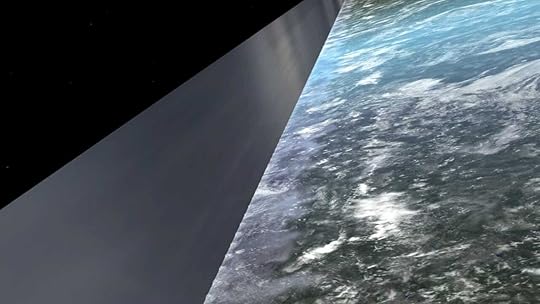
Lezuri’s original home the ringworld, megastructure Verilotus.
My audiobook version was 12.5-hours long. It had a US 2020 copyright. A dead tree copy would be 408-pages. Original US copyright was 2019.
Linda Nagata is an American author of science fiction, fantasy novels, and short stories. She has written more than twenty novels in several series. This was the second book in her Inverted Frontier series, which is set in her The Nanotech Succession series universe. I have read several of the author’s books. The last book I read by her was Edges (Inverted Frontier, #1) (my review).
Nicole Poole was the book’s narrator. She did an OK job. Although, her range of character voices was limited. In particular, she had a limited number of male voices, for a story with mostly male characters. A male narrator with a larger number of voices would have been a better choice.
It is strongly recommended to have read Edges (Inverted Frontier, #1) before attempting this book. Otherwise this book would be incomprehensible. For additional context, readers may want to read Vast (The Nanotech Succession #3) before beginning the series. Although, it’s not essential for beginning this series. Finally, having read Memory , by the author would be helpful for further 'additional context'.
Nagata is a skilled author. This book was well written. In particular, her descriptive and action sequences were very good. Plotting was intricate with concealment of this ‘Middle Book’s’ direction being well handled.
This series was hard-ish science fiction. It eschews the TV-grade Standard Science Fiction Setting trope many current science fiction authors crutch-on in lieu of rolling their own World Building. That is, the laws of physics applied. Both realistic space science and a sophisticated model of computer-based systems, AI, and nanotech was used. In places the tech was so advanced, particularly the nanotech, that this story might appear to fantasy readers as a Slipstream genre series. I also thought there was a particularly good use of the Brain Uploading trope in several of its guises.
However, this story was weak with its dependence on the re-cycling of characters and world building from both the parent Nanotech Succession series’ books and the author's almost 20-years older book Memory. (I unfortunately, had not read Memory.) I frankly have a low opinion of authors who attempt to converge all their writings after decades of writing different stories. into a single universe. Creating a single property may have commercial benefits, but I don't find there are any artistic benefits in the homogeneity.
This blending of characters from two different, albeit related World Buildings, adversely effects character development and World Building. The imported characters may or may not have any significant development. They arrive whole in the story. Sometimes their arrival consumes a significant number of pages of backstory, which bloats the current book. For example, I now realize the Lezuri-character, originated in Memory. However, I still thought the Deities of Human Origin introduced from that book (an element of its World Building) into this series were too anthropomorphized. In addition to their not being Disabled Deities at all.
I did find interesting the parallel between the Jubilee character, and her One True Love, Yaphet both from the Memory book and on Verilotus, and the Urban character and his One True Love and shipmate, Clementine from the Nanotech Succession books. I'm not a fan of the trope, but that’s what made this story a Planetary Romance.
A problem I continued to have, was that the uploads from Deception Well were hundreds of years old, if not Millenia years old. This was despite being 'turned-off' for long periods. I would assume they would all be Old Souls after all those centuries of experience? (They weren't.) I also suspect that there would be deleterious mental health issues resulting from an extended life like that? Which is to say that Nagata’s post-humans were not Post Human enough.
While I liked the Space Opera aspect of this series, at heart this book within the series was a Planetary Romance. Space Opera is a closely related genre to Planetary Romances, but the action and adventure take place planet-side. In this case, the ringworld, megastructure Verilotus. Verilotus was too close to the trope. There was the Lost Technology at work (The Silver); overall it was a world with the Look ‘n Feel of Low Fantasy — a semi-feudal society with small-scale, magic and the Big Bad being a mad female, human derived from tech deity.
Thankfully, Nagata took the series into a HFN soft-landing with this book. The worst part of the first book in this series, was it ended in a Cliff Hanger. Cliff Hangers are the lowest-form of serial fiction to my mind. Interestingly, inspecting the copyrights for these first two books, Edges (March 2019), Silver (November 2019), the difference in publication was seven and a half (7.5) months. That’s a particularly short time for Nagata to have written and have published Silver's 400+ pages, immediately after 400+ pages were published first as Edges? I think more judicious editing could have improved the series’ partitioning and publication into separate books? That would have spared the readers a bogus Cliff Hanger in Edges?
Middle books are hard. This book had a lot going for it at the start. However, I experienced a different sort of dissatisfaction with the story than with Edges. I liked Edges as a Space Opera, but didn’t like it for its Cliff Hanger ending. (Which I now think was a publishing/editorial screw-up?) I liked Silver for its ending, but didn’t like its Planetary Romance switch in genre. The Verilotus world building derived from Memory was too Magical for me, despite Nagata’s best Hand Waving to merge it with the Nanotech Succession series’ books more scientific world building. I suspect I might have liked this book more, if I’d known reading Memory was a hidden prerequisite for it?
However, I'll likely read the next in the series, Needle (Inverted Frontier #3). I’m hoping the series will be reverting back into a Space Opera?
Readers interested in stories similar to this, would enjoy reading, Ken Egan’s, Diaspora . This was likewise hardish science fiction, with a sophisticated use of the Brain Uploading trope.
Lezuri’s original home the ringworld, megastructure Verilotus.
My audiobook version was 12.5-hours long. It had a US 2020 copyright. A dead tree copy would be 408-pages. Original US copyright was 2019.
Linda Nagata is an American author of science fiction, fantasy novels, and short stories. She has written more than twenty novels in several series. This was the second book in her Inverted Frontier series, which is set in her The Nanotech Succession series universe. I have read several of the author’s books. The last book I read by her was Edges (Inverted Frontier, #1) (my review).
Nicole Poole was the book’s narrator. She did an OK job. Although, her range of character voices was limited. In particular, she had a limited number of male voices, for a story with mostly male characters. A male narrator with a larger number of voices would have been a better choice.
It is strongly recommended to have read Edges (Inverted Frontier, #1) before attempting this book. Otherwise this book would be incomprehensible. For additional context, readers may want to read Vast (The Nanotech Succession #3) before beginning the series. Although, it’s not essential for beginning this series. Finally, having read Memory , by the author would be helpful for further 'additional context'.
Nagata is a skilled author. This book was well written. In particular, her descriptive and action sequences were very good. Plotting was intricate with concealment of this ‘Middle Book’s’ direction being well handled.
This series was hard-ish science fiction. It eschews the TV-grade Standard Science Fiction Setting trope many current science fiction authors crutch-on in lieu of rolling their own World Building. That is, the laws of physics applied. Both realistic space science and a sophisticated model of computer-based systems, AI, and nanotech was used. In places the tech was so advanced, particularly the nanotech, that this story might appear to fantasy readers as a Slipstream genre series. I also thought there was a particularly good use of the Brain Uploading trope in several of its guises.
However, this story was weak with its dependence on the re-cycling of characters and world building from both the parent Nanotech Succession series’ books and the author's almost 20-years older book Memory. (I unfortunately, had not read Memory.) I frankly have a low opinion of authors who attempt to converge all their writings after decades of writing different stories. into a single universe. Creating a single property may have commercial benefits, but I don't find there are any artistic benefits in the homogeneity.
This blending of characters from two different, albeit related World Buildings, adversely effects character development and World Building. The imported characters may or may not have any significant development. They arrive whole in the story. Sometimes their arrival consumes a significant number of pages of backstory, which bloats the current book. For example, I now realize the Lezuri-character, originated in Memory. However, I still thought the Deities of Human Origin introduced from that book (an element of its World Building) into this series were too anthropomorphized. In addition to their not being Disabled Deities at all.
I did find interesting the parallel between the Jubilee character, and her One True Love, Yaphet both from the Memory book and on Verilotus, and the Urban character and his One True Love and shipmate, Clementine from the Nanotech Succession books. I'm not a fan of the trope, but that’s what made this story a Planetary Romance.
A problem I continued to have, was that the uploads from Deception Well were hundreds of years old, if not Millenia years old. This was despite being 'turned-off' for long periods. I would assume they would all be Old Souls after all those centuries of experience? (They weren't.) I also suspect that there would be deleterious mental health issues resulting from an extended life like that? Which is to say that Nagata’s post-humans were not Post Human enough.
While I liked the Space Opera aspect of this series, at heart this book within the series was a Planetary Romance. Space Opera is a closely related genre to Planetary Romances, but the action and adventure take place planet-side. In this case, the ringworld, megastructure Verilotus. Verilotus was too close to the trope. There was the Lost Technology at work (The Silver); overall it was a world with the Look ‘n Feel of Low Fantasy — a semi-feudal society with small-scale, magic and the Big Bad being a mad female, human derived from tech deity.
Thankfully, Nagata took the series into a HFN soft-landing with this book. The worst part of the first book in this series, was it ended in a Cliff Hanger. Cliff Hangers are the lowest-form of serial fiction to my mind. Interestingly, inspecting the copyrights for these first two books, Edges (March 2019), Silver (November 2019), the difference in publication was seven and a half (7.5) months. That’s a particularly short time for Nagata to have written and have published Silver's 400+ pages, immediately after 400+ pages were published first as Edges? I think more judicious editing could have improved the series’ partitioning and publication into separate books? That would have spared the readers a bogus Cliff Hanger in Edges?
Middle books are hard. This book had a lot going for it at the start. However, I experienced a different sort of dissatisfaction with the story than with Edges. I liked Edges as a Space Opera, but didn’t like it for its Cliff Hanger ending. (Which I now think was a publishing/editorial screw-up?) I liked Silver for its ending, but didn’t like its Planetary Romance switch in genre. The Verilotus world building derived from Memory was too Magical for me, despite Nagata’s best Hand Waving to merge it with the Nanotech Succession series’ books more scientific world building. I suspect I might have liked this book more, if I’d known reading Memory was a hidden prerequisite for it?
However, I'll likely read the next in the series, Needle (Inverted Frontier #3). I’m hoping the series will be reverting back into a Space Opera?
Readers interested in stories similar to this, would enjoy reading, Ken Egan’s, Diaspora . This was likewise hardish science fiction, with a sophisticated use of the Brain Uploading trope.

November 26, 2019
A strong continuation of the story started in Edges. The consequences of the encounter with the powerful post-human being known as Lezuri carry on into a new system, with a classic Big Object to explore and a set of people - and a new viewpoint character - who views Lezuri and this world very differently. This closes out the story from Edges to some extent, and Nagata says there isn't an immediate third book planned, I imagine further stories will depend on how well these two do. I certainly hope she writes more, I really want to see more of the crew of the Dragon voyaging among the post-human weird that Nagata has posited. (Edit : books 3 and 4 in the series did finally appear)
(Interestingly this turns out to *also* be a continuation of sorts of Nagata's earlier novel Memory. I don't think not having read Memory will affect your enjoyment of this book, because I've not read it myself. I'd not recommend starting this without having read Edges though)
(Interestingly this turns out to *also* be a continuation of sorts of Nagata's earlier novel Memory. I don't think not having read Memory will affect your enjoyment of this book, because I've not read it myself. I'd not recommend starting this without having read Edges though)

January 1, 2020
Damn good read. Linda Nagata is a good storyteller and has an incredible imagination.
Though the characters in this book mostly consider themselves to be human, they are what I would call post-human entities. They control enormous energies and very advanced technologies, and they can manifest as both digital "ghosts" and physical "avatars".
This book is a sequel to two of Nagata's earlier books (Edges and Memory), merging the two story lines. You will get more out of this book if you read those first.
Though the characters in this book mostly consider themselves to be human, they are what I would call post-human entities. They control enormous energies and very advanced technologies, and they can manifest as both digital "ghosts" and physical "avatars".
This book is a sequel to two of Nagata's earlier books (Edges and Memory), merging the two story lines. You will get more out of this book if you read those first.

February 6, 2021
Silver Linda Nagata
This was an enjoyable sequel to Edges (Book 1); in fact, I liked it better than Edges. (I see Silver as a solid 4, Edges as more like a 3.7.) Although I really enjoyed the richness of the ship in Edges, it was nice to be off-ship in Silver (Book 2), to experience a new world and all its magic. It was great to hear new voices with a different set of motivations, fears and hope. The world was an intriguing place, an artificially created place that allowed for extraordinary and unexpected feats. Because of the plasticity of the world, I think it gave the author some latitude in terms of readers’ suspension of disbelief… there were definitely fantastical elements in there that would otherwise be hard to justify in a world that had a different provenance, that wasn’t crafted in a “game” format and wasn’t created by certain living deities.
I think there still is a bit too much of the emotional temperature taking after each event, but not quite as much as in Edges. Certainly the pacing was a bit more palatable to me; more going on and interesting predicaments and resolutions. One of the strong points of this emotional emphasis and character interiority is that you get a very keen sense of what the character is thinking and feeling—the character comes alive in richness. But, it does slow the speed of the plot of events unraveling. If you enjoy lingering in characters’ heads and reveling in the emotional turmoil and connection, then this series is certainly worth reading!
Some of the best parts were the intricate details of the world-building. I think Nagata really has a way of setting a scene, some of them are quite breathtaking.
Some quotes and remarks:
“the presence of weapons suggested these were primitive people, but their bikes with quiet engines and wheels that changed shape in response to the rough terrain were evidence of a sophisticated technology”
—very intriguing set of diverging characteristics
“… and he shivered as drops struck his scalp. His boots splashed in puddles. It was all so strange. On a ship or a habitat, this excess of water would mean an environmental system run amok. But it was natural here, never mind the artificial origin of this world.”
—This is beautiful world-building and character discovery. The internal processing of someone who’s always lived on a ship processing the quirks of living in an outdoor terrestrial environment.
“Urban gave no obvious command to the fabricator. But, very shortly, he opened the lid and lifted out the same thin metal tray that he used to carry our teacups on the day we met him. Now the tray was covered in flat cakes, each a few inches across, round and golden and steaming hot, with a wonderful sweet scent.”
(6:19)
—Yay for future food tech!
This was an enjoyable sequel to Edges (Book 1); in fact, I liked it better than Edges. (I see Silver as a solid 4, Edges as more like a 3.7.) Although I really enjoyed the richness of the ship in Edges, it was nice to be off-ship in Silver (Book 2), to experience a new world and all its magic. It was great to hear new voices with a different set of motivations, fears and hope. The world was an intriguing place, an artificially created place that allowed for extraordinary and unexpected feats. Because of the plasticity of the world, I think it gave the author some latitude in terms of readers’ suspension of disbelief… there were definitely fantastical elements in there that would otherwise be hard to justify in a world that had a different provenance, that wasn’t crafted in a “game” format and wasn’t created by certain living deities.
I think there still is a bit too much of the emotional temperature taking after each event, but not quite as much as in Edges. Certainly the pacing was a bit more palatable to me; more going on and interesting predicaments and resolutions. One of the strong points of this emotional emphasis and character interiority is that you get a very keen sense of what the character is thinking and feeling—the character comes alive in richness. But, it does slow the speed of the plot of events unraveling. If you enjoy lingering in characters’ heads and reveling in the emotional turmoil and connection, then this series is certainly worth reading!
Some of the best parts were the intricate details of the world-building. I think Nagata really has a way of setting a scene, some of them are quite breathtaking.
Some quotes and remarks:
“the presence of weapons suggested these were primitive people, but their bikes with quiet engines and wheels that changed shape in response to the rough terrain were evidence of a sophisticated technology”
—very intriguing set of diverging characteristics
“… and he shivered as drops struck his scalp. His boots splashed in puddles. It was all so strange. On a ship or a habitat, this excess of water would mean an environmental system run amok. But it was natural here, never mind the artificial origin of this world.”
—This is beautiful world-building and character discovery. The internal processing of someone who’s always lived on a ship processing the quirks of living in an outdoor terrestrial environment.
“Urban gave no obvious command to the fabricator. But, very shortly, he opened the lid and lifted out the same thin metal tray that he used to carry our teacups on the day we met him. Now the tray was covered in flat cakes, each a few inches across, round and golden and steaming hot, with a wonderful sweet scent.”
(6:19)
—Yay for future food tech!

January 14, 2020
Linda Nagata's sf seems to be flying under the radar much of the time. Given her decision to self-publish her novels, she doesn't benefit from having a publishing house provide all the promotions (such as they may be), book tours and the like. Which is really unfortunate, because she is unquestionably one of the most creative and significant talents in the field of science fiction. Her near-future stories like The Last Good Man and the Red Trilogy provides some of the best military and hard-sf I've ever read.
Her far-future novels are really far-future, thousands of years and thousands of light years away and it's in these novels, like The Nanotech Succession series and the two books of the Inverted Frontier that Nagata's imagination really soars. They completely engage the fabled Sense of Wonder built on her fascination with nanotechnology but unlike the founding Space Operas of writers like E. E. "Doc" Smith (also far into the future and far across the galaxy) Nagata not only includes actual people but those people are in relationships with others and those relationships are just as critical as the science.
Silver is unusual because it's a sequel to two seemingly-unrelated novels, Memory (2003) and Edges (2019). Memory sets up the story of Verilotus, a constructed planet with more-or-less-normal humans living in a very strange world dominated by Silver (which is a thing I'm not going to explain) and introduces us to several characters that appear again in Silver. At the same time, the book is a sequel to last year's Edges (confusingly part of The Nanotech Succession) where we meet an entirely different group of humans with a unique relationship to technology.
As Edges unfolded, that group of humans interrupts one mission in space to travel to Verilotus and attempt to avoid a disaster of galactic proportions. Whew. So much happening.
And, again, relationships between real people drive the story as much as the amazing tech. Keep your minds open because it's a strange trip indeed.
Her far-future novels are really far-future, thousands of years and thousands of light years away and it's in these novels, like The Nanotech Succession series and the two books of the Inverted Frontier that Nagata's imagination really soars. They completely engage the fabled Sense of Wonder built on her fascination with nanotechnology but unlike the founding Space Operas of writers like E. E. "Doc" Smith (also far into the future and far across the galaxy) Nagata not only includes actual people but those people are in relationships with others and those relationships are just as critical as the science.
Silver is unusual because it's a sequel to two seemingly-unrelated novels, Memory (2003) and Edges (2019). Memory sets up the story of Verilotus, a constructed planet with more-or-less-normal humans living in a very strange world dominated by Silver (which is a thing I'm not going to explain) and introduces us to several characters that appear again in Silver. At the same time, the book is a sequel to last year's Edges (confusingly part of The Nanotech Succession) where we meet an entirely different group of humans with a unique relationship to technology.
As Edges unfolded, that group of humans interrupts one mission in space to travel to Verilotus and attempt to avoid a disaster of galactic proportions. Whew. So much happening.
And, again, relationships between real people drive the story as much as the amazing tech. Keep your minds open because it's a strange trip indeed.

January 29, 2023
Silver picks up directly from the last book in the series "Vast" and is the latest book in her millenia-spanning series. The theme of this book really is about what is "life" and what is "death". Do you really die if you are reincarnated to play a game? Do you really live if you can back yourself up? Death has a purpose, unless you remove it. Nagata removes Urban's safety net by making him truly human - by giving him impetus to survive as a physical form solely. He truly experiences humanity. And for the residents of a world where they are reincarnated after death, their final days come as an old evil threatens their world. Can Urban and his new friends defeat the threat together, before they all experience the true finality of death itself?
And what a brilliant book this is. Nagata has really fleshed out her characters and world-building. Each of the characters feel real, with motivation, history, and a weight of thousands of years behind them. I cannot get my head around the timescales involved, so it is impressive that Nagata has done without problem.
Each chapter had me hooked on the story, driving me further to continue reading. The variation in narration, from the POV of Urban, Jubilee, and Lezuri (the big bad) heightening the sense of reality. Plus I love the interaction between Jubilee (who are close to baseline humans) and Urban, to whom his expanded semi-digital brain is curious to them. Unlike previous books in her series, this one is tightly-written, well-paced, and contains very little slack in the story that could have been cut out. It was a real treat to read. The story is so hauntingly beautiful, making you think about morality and the self for longer that it took me to read the book.
I honestly think Nagata could end the series here, but there is ample room for the story to continue on. Definitely a hard 5/5.
And what a brilliant book this is. Nagata has really fleshed out her characters and world-building. Each of the characters feel real, with motivation, history, and a weight of thousands of years behind them. I cannot get my head around the timescales involved, so it is impressive that Nagata has done without problem.
Each chapter had me hooked on the story, driving me further to continue reading. The variation in narration, from the POV of Urban, Jubilee, and Lezuri (the big bad) heightening the sense of reality. Plus I love the interaction between Jubilee (who are close to baseline humans) and Urban, to whom his expanded semi-digital brain is curious to them. Unlike previous books in her series, this one is tightly-written, well-paced, and contains very little slack in the story that could have been cut out. It was a real treat to read. The story is so hauntingly beautiful, making you think about morality and the self for longer that it took me to read the book.
I honestly think Nagata could end the series here, but there is ample room for the story to continue on. Definitely a hard 5/5.

September 1, 2026
Silver is the direct sequel to Edges and follows the conflict begun in that book focussing initially on the character of Urban who has landed on the manufactured world of Verilotus hoping to find the tools to defeat the creator of this world Lezuri who he battled in the previous novel. After a few chapters he meets the characters from Nagata's early 2003 novel Memory and whilst initial I felt dropped into their story I soon caught up enough of their details to follow. Most of the story focuses on the battles between Urban and Lezuri in a race against Lezuri recovering his god like powers and Urban learning to enough about the world to defeat him. This world of Verilotus is dominated by a strange flowing medium, known as the silver, that rises during the night, absorbing living things into its fatal fluid and chaotically tossing up remnant structures and fragments of past ages. Two of the cast for Memory Jubilee and Yaphet, like other players on the planet have been taken by the silver, then reborn into successive lives over thousands of years. Yet the memories and knowledge of those earlier lives only emerges gradually and incompletely in their present consciousness. The silver itself is a repository of human memory and civilization, and individuals keep re-emerging from it in new lives but have little understanding of their past. Contrast this to the people from the world of Edges who retain a clear sense of self and identity no matter how many times they shift between physical and electronic forms.
A satisfying climax that sees the defeat of Lezuri and the reuniting of a ghost of Urban and the spaceships from Edges and so turning their attention to the original quest of reaching the fabled “Hallowed Vasties,” the immense structures that appeared where the original worlds of humanity once were.
A satisfying climax that sees the defeat of Lezuri and the reuniting of a ghost of Urban and the spaceships from Edges and so turning their attention to the original quest of reaching the fabled “Hallowed Vasties,” the immense structures that appeared where the original worlds of humanity once were.

September 1, 2024
*Contains spoilers for Linda Nagata's other book, Memory*
I started the Inverted Frontier series purely because I loved Memory's setting, and I have to say, I was not disappointed. When I realized just how the two worlds were going to crash, I was feeling a little nervous, but Linda Nagata did it perfectly! In Memory, we were offered 3 explanations to the existence of the silver, and the one that turns out to be true in the end, the Goddess and God story, was to me the least interesting. This series, however, fills in all the missing gaps! It actually verifies the other 2 explanations to also be simultaneously true, it shows the "Goddess" and "God" as non-celestial higher beings, but rather entities with their own motivations and weaknesses and stories, making it, in my opinion, a lot more exciting. And of course, it only continues to build on the setting, which as I stated, I absolutely love and find original and inspiring.
I still stand by what I said in Memory's review, that I struggle to really understand or connect with any of the characters in Linda Nagata's stories, a lot of the time they feel very robotic, even when described as temperamental, with the apparatchiks seemingly conveying the same level of emotions as other characters. That being said, I did feel a stronger connection with the characters in this book, especially to Riffan, Jolly, Lezuri, and a sometimes Urban. And I'm most definitely continuing the rest of the series to see where this journey goes!
Also, small detail, Diaphanous is one of my favourite words and I just LOVE the way Nagata uses it in this book to describe the Silver.
I started the Inverted Frontier series purely because I loved Memory's setting, and I have to say, I was not disappointed. When I realized just how the two worlds were going to crash, I was feeling a little nervous, but Linda Nagata did it perfectly! In Memory, we were offered 3 explanations to the existence of the silver, and the one that turns out to be true in the end, the Goddess and God story, was to me the least interesting. This series, however, fills in all the missing gaps! It actually verifies the other 2 explanations to also be simultaneously true, it shows the "Goddess" and "God" as non-celestial higher beings, but rather entities with their own motivations and weaknesses and stories, making it, in my opinion, a lot more exciting. And of course, it only continues to build on the setting, which as I stated, I absolutely love and find original and inspiring.
I still stand by what I said in Memory's review, that I struggle to really understand or connect with any of the characters in Linda Nagata's stories, a lot of the time they feel very robotic, even when described as temperamental, with the apparatchiks seemingly conveying the same level of emotions as other characters. That being said, I did feel a stronger connection with the characters in this book, especially to Riffan, Jolly, Lezuri, and a sometimes Urban. And I'm most definitely continuing the rest of the series to see where this journey goes!
Also, small detail, Diaphanous is one of my favourite words and I just LOVE the way Nagata uses it in this book to describe the Silver.
July 17, 2020
This is a direct sequel to both Edges and Memory. Edges itself is a sequel to an earlier trilogy, and I jumped in without worrying much, and while I could tell there was context I'd understand better if I'd read the earlier books, I don't think I missed too much. For this one though, I was very glad I went back and read Memory before starting it. I really like the world it's set on, but because the book jumps right into the action and also switches POV a lot, it didn't get a lot of time to shine. If I hadn't already read Memory, I'm not sure I'd have much of a sense of Jubilee and Jolly as people, and definitely wouldn't have known what was up with Yaphet and the way people are paired off on Verilotus. And since a big part of the conflict revolves around potentially destroying Verilotus (a possible threat from both Lezuri and Urban!) I think I was more invested in it having read Memory first, than this book had room to develop on its own.
On the whole I think I liked Edges a little better, though mostly because this book is a tense race against time from the beginning, while Edges spend a lot of time on plot-light competence porn that I find very comforting. I expected the difference, and I do think it's well done--it's the kind of book where the protagonists don't lose outright, but there was still a lot of room for stakes that mattered and just how much everyone might lose in the fight to defeat Lezuri was unclear up until the very end.
On the whole I think I liked Edges a little better, though mostly because this book is a tense race against time from the beginning, while Edges spend a lot of time on plot-light competence porn that I find very comforting. I expected the difference, and I do think it's well done--it's the kind of book where the protagonists don't lose outright, but there was still a lot of room for stakes that mattered and just how much everyone might lose in the fight to defeat Lezuri was unclear up until the very end.

September 14, 2020
Didn't have high hopes for this one, as what happens in this book is pretty much set in motion by the second half of the previous volume, Edges.
"Silver" marks a departure from the deep space astrophysics of the previous volume; it becomes more of a fantasy setting, although there is a thin veneer of nanotech to keep it grounded in the existing framework.
There's "silver", and "kobolds", and god-like beings and hyper advanced nanotech which puts midichlorians to shame, only the exact same effort is put into explaining it all - almost none, that is. It's advanced nanotech stuff, the author just wants us to accept this and move on.
Once we get past that, it's a decent novel. But it's still a detour from what was promised in the first half of Edges. Imagine if Dragon and Griffin continued their original mission in the second volume, and the events of Silver were published as a separate, filler "Inverted Frontier 1.5" volume. Just send an outrider with the cloned minds of the crew to Verilotus while the A-team continues to the Hallowed Vasties - this is what it should have been.
Let's hope the third volume will return to the original mission.
"Silver" marks a departure from the deep space astrophysics of the previous volume; it becomes more of a fantasy setting, although there is a thin veneer of nanotech to keep it grounded in the existing framework.
There's "silver", and "kobolds", and god-like beings and hyper advanced nanotech which puts midichlorians to shame, only the exact same effort is put into explaining it all - almost none, that is. It's advanced nanotech stuff, the author just wants us to accept this and move on.
Once we get past that, it's a decent novel. But it's still a detour from what was promised in the first half of Edges. Imagine if Dragon and Griffin continued their original mission in the second volume, and the events of Silver were published as a separate, filler "Inverted Frontier 1.5" volume. Just send an outrider with the cloned minds of the crew to Verilotus while the A-team continues to the Hallowed Vasties - this is what it should have been.
Let's hope the third volume will return to the original mission.
This entire review has been hidden because of spoilers.

October 14, 2020
The story is somewhat analogous to The Matrix, but more original and subtle. It's easier to approach the sequel than the first in the series now that the pervasive transhumanism (digital, uploadable, transmissible human consciousness) and alien technologies are merely the setting for the story. Cut off from backups of their digital selves, the characters face real risks and endure real adventures. The quest to defeat a would-be god from far-future humanity's past is exciting and well told. The idea of an artificial world populated by reincarnating players seeking to level up is not actually all that far fetched. I can easily imagine modern gaming heading that way if technology allowed.
Hard sci-fi is often left to appeal to things like inscrutable alien technologies and alternate dimensions to make the more "magical" aspects of the story work. Nagata does it well enough that the implausibility of it all never catches up with you.
Hard sci-fi is often left to appeal to things like inscrutable alien technologies and alternate dimensions to make the more "magical" aspects of the story work. Nagata does it well enough that the implausibility of it all never catches up with you.

February 11, 2020
As an important note for readers, this is *not* just a sequel to Linda Nagata's book Edges, and the Nanotech Succession books that preceded it; it is also a sequel to her earlier novel Memory, and I would recommend reading at least Vast, Edges, and Memory prior to reading this one.
In the end, I didn't like this one as much as I had hoped. It wasn't bad by any means, but after all the interesting set-up in Edges, this one ended up being a bit of a slog in parts as it all played out. Too much depended on coincidental timing, Riffan continues to be an annoying character (albeit a minor one), and the book could have used a lot more of Clemantine.
Nonetheless, Linda Nagata has written some of the best far-future SF there is, and if this one isn't up to her best, her best is a very high bar.
In the end, I didn't like this one as much as I had hoped. It wasn't bad by any means, but after all the interesting set-up in Edges, this one ended up being a bit of a slog in parts as it all played out. Too much depended on coincidental timing, Riffan continues to be an annoying character (albeit a minor one), and the book could have used a lot more of Clemantine.
Nonetheless, Linda Nagata has written some of the best far-future SF there is, and if this one isn't up to her best, her best is a very high bar.

November 25, 2019
Silver (Inverted Frontier #2) by Linda Nagata
This particular universe is one in which many, many stories can be held.
And happily, Linda Nagata can tell those stories very well! This would be the sequel to Edges, but is also set in the Deception Well universe. I enjoy this author as she does a great job with letting the story unfold naturally, and not in a hurried, or rushed, manner.
Her characters are similarly developing as well, and you never are really sure what direction, much less dimension, they will take next.
Add in the torus shaped world, and yes, ben a touch of fantasy, and this is a quite compelling read!
This particular universe is one in which many, many stories can be held.
And happily, Linda Nagata can tell those stories very well! This would be the sequel to Edges, but is also set in the Deception Well universe. I enjoy this author as she does a great job with letting the story unfold naturally, and not in a hurried, or rushed, manner.
Her characters are similarly developing as well, and you never are really sure what direction, much less dimension, they will take next.
Add in the torus shaped world, and yes, ben a touch of fantasy, and this is a quite compelling read!

June 7, 2021
Doesn’t pay off the interesting story setup in the first book, and follows characters that are mostly uninteresting. It really feels like a side story in a lot of ways, rather than the main event.
The plot isn’t just glacially slow to get where it’s going, it’s also going to a dull destination. Characters are generally shallow, with Lezuri being particularly thin. He’s one cackle away from being a cartoon villain, and the plot requires that he be at turns a near-god, but also a complete moron. The titular silver is pervasive, and is basically just magic gas.
Overall, it feels like a young adult novel that just doesn’t have much going on.
The plot isn’t just glacially slow to get where it’s going, it’s also going to a dull destination. Characters are generally shallow, with Lezuri being particularly thin. He’s one cackle away from being a cartoon villain, and the plot requires that he be at turns a near-god, but also a complete moron. The titular silver is pervasive, and is basically just magic gas.
Overall, it feels like a young adult novel that just doesn’t have much going on.
October 30, 2023
Normally I'd review a series like this by rating all the books the same since I sort of see them as one continuous story. But in this case they all feel a bit different.
Edges (book 1): Fascinating, interesting premise, well executed. The molecular tech and the exploration of ghosts and cloning is fantastic.
Silver (book 2): Great continuation, high stakes, lots of new stuff, exciting.
Needle (book 3): Disappointing, the story felt... smaller. Not as much happened, this was a little more boring. And the needle itself was so unsatisfying I felt ripped off.
I'll still read book 4 when it's released, though. But I hope it's better than book 3.
Edges (book 1): Fascinating, interesting premise, well executed. The molecular tech and the exploration of ghosts and cloning is fantastic.
Silver (book 2): Great continuation, high stakes, lots of new stuff, exciting.
Needle (book 3): Disappointing, the story felt... smaller. Not as much happened, this was a little more boring. And the needle itself was so unsatisfying I felt ripped off.
I'll still read book 4 when it's released, though. But I hope it's better than book 3.
Displaying 1 - 30 of 71 reviews