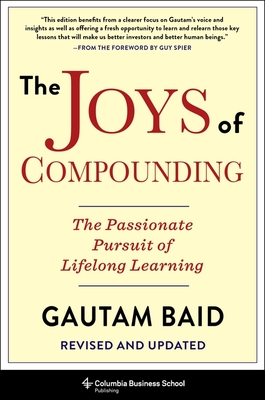
Value investing is not just a system for success in the market. It is also an intellectual toolkit for achieving a deeper understanding of the world. In The Joys of Compounding, the value investor Gautam Baid builds a holistic approach to value investing and philosophy from his wide-ranging reading, combining practical approaches, self-cultivation, and business wisdom.
Distilling investment and life lessons into a comprehensive guide, Baid integrates the strategies and wisdom of preeminent figures whose teachings have stood the test of time. Drawing on the work of investing greats like Warren Buffett, Charlie Munger, and Ben Graham, as well as philosophers and scholars, he artfully interweaves the lessons learned from his many teachers. Baid demonstrates their practical applications in the areas of business, investing, and decision making and also shows that these ideas can be applied to one’s own life with just as much reward.
A celebration of the value investing discipline, this book also recounts Baid’s personal experiences, testifying to his belief that the best investment you can make is an investment in yourself. The Joys of Compounding offers curated reflections on life and learning for all investors, investment enthusiasts, and readers seeking a dose of practical wisdom.
This revised and updated edition highlights Baid’s distinctive voice.
In the Joy of Compounding, Gautam Baid synthesizes the best learnings of investors and other people. I don't think he says anything new but the way he explains what he has learned over the years about investing and life is quite remarkable. The influence of Warren Buffett and Charlie Munger among others on the thinking process is quite evident. The contents of the chapters on investing and portfolio management were something any serious investor should already be familiar with. An investor should approach life with humility and try to expand his knowledge about different subjects (mental models) in order to grow his wealth and seek wisdom. One also needs to follow a process and know his circle of competence. I enjoyed the parts where he talks about learning, work and ethics. “Many people achieve success, but to sustain the same (and potentially build on it) over an entire lifetime requires humility, gratitude, and a constant learning mindset.”
***There is one annoying thing about this book. This book is full of quotes and the author keeps emphasizing parts of the quote. So after every quote it is mentioned (emphasis added). I wonder if the book was edited properly.***
“The Joys of Compounding” by Gautam Baid is a fantastic and valuable read. He takes huge and far-flung concepts, practices and data and funnels them into digestible, understandable chapters spanning philanthropy, market efficiency, diversification, history and beyond. Baid is a master “distiller,” and he puts a fine point on topics that seem too complex to get to the heart of – but he does get to the heart of them. Over the last 15 years I have read close to 90% of the sources Baid cites (books, journals, papers, etc.) and I was astounded by how well he parsed those sources and really dug down to explain the subjects. He took a very intelligent and focused approach, which has a great pay-off for the reader. I would recommend not only “The Joys of Compounding,” but also the works Baid references throughout; taken as a whole, it’s a masterclass in value investing and beyond.
I gave up half way. Its basically a collection of quotes from Buffet and Munger. Book starts out fine with some motivational advice to keep learning, but as you start hitting the investing sections its just poorly written. He contradicts himself several times, discussion doesn't keep to title of chapter; tangents. The buffet quotes get old, as you want some variety. I wanted to finish this book, but 200 pages in the book is getting irritating.
The book has mainly all the quotes from Buffet , Munger , Taleb etc. Very commercily written to satisfy all types of investor and trader community. It doesn't add any value and doesn't give any perspective. Lots of contradiction.
Just finished reading The Joys of Compounding: The Passionate Pursuit of Lifelong Learning by Gautam Baid
Why do we need to pursue lifelong learning? Imagine that you are buying a car and that it is the only car you will have in your lifetime. You will put all your efforts into choosing the right car and eventually take care of it in a way that shows you value it for life. The same is true for our body and mind. We have one body and one mind, and that's all we are going to carry with us in this lifetime. Would we be okay with ruining them, or will we choose to hone, improvise, and take care of them? Like how buying that one car is a conscious choice we make with utmost care and devotion, we need lifelong learning to make life choices that will leave an everlasting imprint in our legacy that we will leave behind.
In thirty-one chapters, Gautam Baid talks about the necessity of having a tunnel vision, an attitude of a long-term view, the importance of habits, discipline, and delayed gratification, the need for optimizing our actions and mind with the changing world order and interlinking the importance of all the above with value investing.
If you want to be successful in personal finance and investing, there is only one person whom you need to look up to, and that is Warren Buffet. Rightly so, all the chapters in the book capture the wisdom Munger and Buffett have learned, lived by, and propagated throughout their ninety-odd years. It starts with reading anything and everything to make informed decisions. The first two sections of the book deal with how to inculcate the habit of reading, implementing what we read into our daily actions and routines, filtering signal from noise (that is, taking information that is important and ignoring the majority of unusable information), writing as a mental exercise to be conscious and coherent in your thoughts, the commitment to incremental development by practicing delayed gratification, the role of humility in being a lifelong learner. the importance of patience as a virtue, the need for a role model, and the desire to learn from others' mistakes.
The last three sections of the book deal with the important components of value investing. The major takeaways from these sections are:
1. Build a snowball: The bedrock of successful investing lies in knowing your time frame. In this context, you need to know the rule of 72. To estimate the amount of time it will take for you to double your invested principle, use the below formula: t = 72/r. Incorporate the rate of interest in place of r and you will get your time frame to double the principle.
2. Quality over quantity: If you want to make sustained returns over a long time, do not get swayed away by one-year or two-year returns, as averages can be deceptive. Focus on the compounded growth since two years of high growth followed by one year of negative growth can hurt your portfolio. To choose quality stocks, analyze the intrinsic value of the business and buy them when they are undervalued. Intrinsic value is the value of an asset based on its actual worth, rather than its market price. A simplified way to analyze the intrinsic value of any business is to look for year-on-year growth above ten percent in profits, low P/E among peers, low debt-to-equity, return on capital employed (ROCE) above 15 percent, market cap above 100 crores, and competitive advantage compared to other businesses in the same sector, which can give an estimate of future cash flow.
3. Understand the market fluctuations: The market is similar to a swinging pendulum, and a historically high period of growth is always followed by a low period of slump. The goal is to control emotions and keep investing for dividends during the period of a slump while letting it compound during the period of growth.
4. Have a cushion: "Margin of Safety" are the three most important words in the field of investing. For example, if an investor determines that the intrinsic value of a stock is Rs. 100 per share, they would want to buy it at a price lower than that, say Rs. 80 per share, to ensure a margin of safety. This gives the investor a cushion in case the stock price drops due to market volatility, unforeseen events, or changes in the company's financial performance. The larger the margin of safety, the lower the risk for the investor.
5. Holy grail of investing: Diversification is the key to successful investing and also to peaceful sleep at night.
6. Trading Today for a Better Tomorrow: Opportunity cost is basically what you miss out on when you make a choice. Make sure you miss instant gratification for future wealth. If asked, “Why make all the money so you can save it?” make sure to reply, “Why spend all that money so you need to earn it again?”. Understanding opportunity cost is the first step to achieving financial freedom.
7. Understand mean-reversion: Past performance never guarantees future returns. Periods of above-average returns are usually followed by periods of below-average returns, and vice versa. This can indicate when an asset is overvalued or undervalued and help us make our buy and sell calls. Realize that time in the market is more important than timing the market.
Overall, this book provides a comprehensive guide to value investing. I would recommend it to anyone who needs help cultivating a long-term view of their financial planning. The first three sections of the book offer valuable insights into self-improvement, followed by a detailed explanation of the technicalities of value investing.
1. Importance of reading and making it a lifelong habit. If you read 25 pages a day, you will read 10,000 pages a year. Buffett and Munger read 500 pages on an average day. Reading helps identify patterns. 2. Importance of humility & simplicity. Character is how you treat others when you have the ultimate power 3. Importance of delayed gratification. Buffet's 90% wealth was made after he turned 50. Importance of Frugality - Wealth consists not in having great possessions, but in having few wants. 4. Intelligent investing is all about understanding the intrinsic value and the margin of safety. 5. Cyclicals and Spin-offs for value creation. The Graphite case example and how it fueled my entry My Tata steel / SAIL / Hindalco. Understanding the risks involved and how to play it safe. 6. Portfolio management. Always look at history and do not try to predict the future. Howard Marks example of a gambler who bet on a single horse thinking how he could lose? Horse jumps the fence. Learn from history. 7. Always be open to update your beliefs in the light of new evidence. 8. Assess the competitive edge/moats, pricing power, management efficiency, ROCE, and ROE of companies. 9. Acknowledge the role of luck, chance, serendipity, and randomness. 10. Compounding Wealth, Knowledge, Health, and positive thoughts.
This entire review has been hidden because of spoilers.
This book is a totally garbage nothing special . It's not a investing book . This book is nothing original just a copy paste of Charlie Munger & Warren Buffet quotes. The author has nothing special to offer you, he just picked Charlie Munger & Warren Buffet investing quotes . Some of the lines he copy paste from Internet -: All successful investor have a common habit they love reading books . Self-improvement is best way to spend time everyday. Read 500 pages everyday , that's how knowledge works. It builds up like compound interest. Then he uses Feynman Technique & he then uses Ikiagi diagram . Best investment you can make is in yourself. Learning is a lifelong journey. Becoming Rich vs Staying Rich. If you delete Charlie Munger & Warren Buffet from this book , there's nothing special that you can learn from this book.
Whole book is surrounded around Charlie Munger & Warren Buffet quotes & some other people's quotes . Their's nothing valuable you can learn from this book. There are much better books available on Investing & Personal Development you can read . The book is a totally waste of money and time . Nothing valuable & special . The book is a copy paste of Charlie Munger & Warren Buffet quotes . Author lacks his common sense and a thought process of his own writing. It's a totally waste of money book . Avoid wasting your valuable money on this book .
This is a remarkable examination of investing wisdom revealed by the best (and wealthiest) minds of our time. While investing writing and theories can be arcane, the writing of this book is neither ponderous, boring nor so complex it can only be understood by professionals. Gautam Baid condenses the worldly wisdom of Buffett, Munger, Graham and many other leading investors into an easily readable and informative collection of essential concepts investors need to understand if they are to survive and thrive while investing their money to improve their futures. The Joys of Compounding is a book for the rest of us, (although I suspect it will be a useful tool for professionals as well). It is a rich and understandable explanation of what is required to develop the discipline, flexibility and patience necessary to make the most of whatever store of wealth each of us has. This book is well worth reading. In fact, if you read only one book about investing in your lifetime, this is the book you should read -- over and over.
Mr Baid is one of the most well read person I have ever come across and the same is reflected into his writing style as well. ~40% of the book is quotes/summary from his favourite authors, investors - Buffet, Munger, Lynch, Fischer etc. One can find great book recommendations in every chapter. Mr Baid has briefly covered his own investing journey in Indian markets as well (really interesting if you follow Indian markets) Felt a little verbose at times but overall a good read.
A useful introduction to long-term investing, business quality, and the power of compounding. The book succeeds in simplifying important concepts and encourages patience, rationality, and owner-like thinking.
However, much of the content remains at an investor-education level rather than providing a deeper framework for capital allocation, risk management, competitive dynamics, or decision-making under uncertainty. Several ideas are repeated, and experienced readers may find limited incremental insight beyond well-known principles.
Worth reading for beginners and intermediates seeking a solid foundation, but less compelling for readers looking for advanced perspectives on markets, capital allocation, or business analysis.
This book is a well-researched book on lifelong learning and investing. After reading this book anyone can become well informed on the topics like value investing, compounding, stock market, and can be better in decision making.
This book contains everything, from the most important quotes to the checklist before making an investment. 📈
It contains the work of investing greats like Warren Buffett, Charlie Munger, and Ben Graham, as well as philosophers and scholars, he artfully interweaves the lessons learned from his many teachers. 🧠
A great investing read overall. Could be viewed as a cocktail of all the wisdom available in other investing books around in this one book. A major part of the book is driven by learnings from the lives of Buffett and Munger and their approach to investing. The author makes his affection and the lessons he has learnt from them very obvious throughout the text.
Personally felt that there was definitely a potential to reduce the number of pages in the book but I guess in “The Joys of Compounding” the author also ended up compounding the number of pages in the book. :D
Not a page turner. Take your time to finish it. Should be in your bucket list of books to read if you are interested in the value investing world.
There is a reason why this book is sold only as a hardcover copy and that becomes evident on nearly every page. The breadth, width and depth of knowledge in this book is immense and is transferred to the reader effortlessly. This book is a collection of knowledge from the giants of value investing such as Warren Buffett, Charlie Munger, Benjamin Graham and many more. Like true value investing it explains how to live a genuine and fulfilled life. After having read many value investing books the information becomes repetitive from one book to another, but that is not the case for this book. Even though the underlying information is the same, Gautam tells us which companies he invested in and the reason for his decision. It's a great genuine book built from years of experience.
One of the best books I read and Gautam has inspired me to take a path of becoming a lifelong learner. I am very much inspired by his journey and I want to thank him for sharing this wonderful masterpiece. This book will open many doors for its readers, and I will be forever grateful to Gautam. I have read this book just before my 20th birthday. I hope this knowledge that I have gained throigh the pages of this book and wisdom in its quotes, help me in my future.
One of the best investment books I've read lately. At the end from around page 300 to 350 it was a bit repetitive which is why it doesn't get a 5/5 but a solid book which I will re-read several times. Highly recommend this book by Gautam Baid.
I picked this up thinking it's a book on investing and it turned out to be a philosophical journey of not just about how to invest money but also investing in the most important thing of all - investing in ourselves
One of my new favorite books of all time. Gautam has assimilated knowledge from the world’s greatest minds (Buffett, Munger, Feynman, Einstein + more) on top of his own insights. Quite an adventure.
Gautam Baid writes broadly about his learnings as a value investor thus far and deals with everything from compound interest to position sizing. It is very broad, and it is difficult to discern a clear structure throughout the book. Most of the content is unoriginal in the sense that he discusses other people’s ideas within his own framework. Where he does add original content from his own experience, it piques interest, but for my taste it does not go deep enough to extract proper value with regard to the points he is trying to make.
I view this book as a good introduction to a collection of valuable ideas that originate elsewhere, or as a collection of sources and concepts worth relearning for those interested in value investing or lifelong learning.
The main mental model worth extracting from this book is the principle of compound interest. It applies far more broadly than most people realize and has utility in learning, relationships, health (with reservations regarding the point where compounding meets diminishing returns), and most areas where runway and continuity offer rewards that can be reinvested for even greater returns. The returns themselves become heavily back-end loaded relative to the initial investment.
There are three factors that determine your results with regard to compounding. The first is the starting point (starting capital, knowledge, health, status, etc.). Small variations in the starting point will yield huge differences if you have either a high compounding rate or a long runway.
The second is the potency of the equation — your compounding rate. Compounding at 5 percent versus 15 percent annually, or reading 50 rather than 200 pages a day, will yield enormous differences in outcomes over a lifetime. This is due to the growth of the underlying base, which magnifies the consequences during the later years of the compounding runway.
The third factor is the runway itself. The longer it is, the more extraordinary the back end of the compounding curve becomes — even if the compounding rate itself is not exceptionally high.
Implicit in all three factors is the importance of protecting the process itself. A huge negative return of 80 percent in a single year will severely impact the end result. Protecting principal and avoiding catastrophic losses therefore matter greatly.
The same applies outside finance. Implementing faulty mental models — such as radicalized dogmas — may undo years of valuable learning. Serious lifestyle diseases caused by unhealthy habits may destroy physiological health built through years of continuous exercise.
Protecting the process from major setbacks, ruin, or interruption may ultimately matter more than optimizing the compounding rate during the remainder of the runway. Optimization of the compounding rate must therefore be balanced against defensive measures that preserve the integrity of the process underlying the equation as a whole.
That forms the base structure. The next level is understanding how to structure your life in order to maximize the variables in the compounding equation. This requires frugality (either in monetary cost or allocation of time), optimization of the compounding rate (finding worthwhile long-term investments or lessons worth learning), and the patience and discipline to persist — especially in the beginning, when the visible yield appears nominally low.
It is a simple idea, but difficult to execute consistently, which means it must be taken seriously over long periods of time in order to work. That is probably why so few people succeed in fully harnessing it across a lifetime.
The book is a good primer on both the underlying equation, where it applies, and the behavioral framework necessary to adhere to it, human nature being what it is.
“The best thing i did was choose the right heroes” - Warren Buffet.
The book is a mandatory read for everyone who has just started earning, or aims to start earning money soon. The book is a brilliant collation of ideas and quotes from several famous, successful people and the lessons that the author of this book has drawn from them. It covers not just compounding money but also knowledge, happiness, health and gratitude. From an investment point of view, the book lays several simple principles that one must follow to maximise from the effect of compounding.
“It is simple, but not easy.”
For a beginner stock market investor, this book has been an eye opener for me. I took my sweet time to read the book - approx 4 months! I did not realise that I had unconsciously incorporated various principles stressed upon in the book until i had reached the conclusion of the book. This only makes me more hopeful in achieving my goals. This book gives you just the right type of positivity that you need in life and the author’s journey towards financial freedom is really motivating. The quotations from prominent works referred in the book gives you interesting material for further reading too.
If you're new to personal development, finance or investing, I'd highly recommend. If you're well read on finance, habits, mindset and health, this book will be a bit of a review for you. There are LOTS of references to other authors and leaders, sometimes making it hard to understand what the authors original thought is. That being said, it's a nice condensed combination of a lot of valuable pieces of information and principles to live by. The beginning and end are great frameworks for life, the middle is a bit more technical on investing. If you're committed to lifelong learning and long term compounding, it's worth a read.
This is an amazing book - I picked it up at the Berkshire Hathaway AGM this year - it’s one of the best books on investing out there - a true gift to the world
This is not a core finance book. It is a self help book with its theme based on finance. The author is well read and has an understanding of how the connect the numerous ideas he has.
This was a fantastic book but man it was not an easy read. There is so much good knowledge in this book that you likely need to read it more than once to actually get use of everything. Some chapters were quite boring to me but all in all a great book which covers so many different concepts.
Well that was a good one. I had a mixed feelings at the start because of philosopical part and all the “lifelong learning” part. But I really enjoyed it. It was one of the best books about investing. The research which was made was crazy. All the quotes from smart guys, a lot of ideology of W. Buffet and Ch. Munger. Thank you for this one!