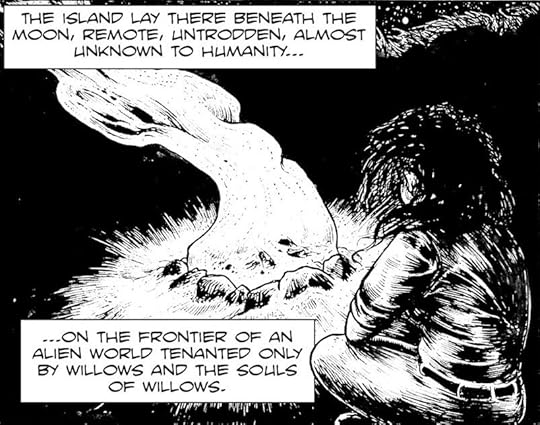
This immortal novella of extra-dimensional weirdness on the Danube comes to vivid life in graphic comic form thanks to the incredibly detailed black-and-white linework of talented newcomer, Sam Ford. Writer Nathan Carson’s thoughtful retelling reverently preserves the plot while breathing character-driven depth into this all-time classic. Two adventurous women, one British, one Swedish, encounter strange horrors in the Hungarian wilderness of 1907. What they discover on that crumbling sandbar makes them question their sanity, fear for their lives, and revel in otherworldly strangeness. Readers familiar with the story will delight in seeing it depicted in such painstaking, quality illustrations. And those for whom it is new will want to leave a light on for many nights after.
Nathan Carson is a musician, writer, and Moth StorySlam Champion from Portland, OR. He is widely known as co-founder and drummer of the internationally touring doom metal band Witch Mountain, host of the FM radio show The Heavy Metal Sewïng Cïrcle, and the owner of the boutique music booking agency, Nanotear.
Carson's byline can be found on hundreds of music and film-related articles in outlets such as the Willamette Week, Rue Morgue, Nightmare Magazine, SF Weekly, Orbitz, Noisey, Terrorizer, Metal Edge, etc.
In recent years, Carson has turned his sights toward weird fiction, earning immediate accolades and publication. He is regularly a panelist and reader on the convention circuit.
This graphic novel adaptation of “The Willows” by Algernon Blackwood was an absolute treat and should be enjoyed by anyone who loves early horror. I love how Nathan Carson (the Adapter) extracted powerful phrases from within the original 1907 story, and Sam Ford (Illustrator) built the scenes visually to enhance the impact.
I loved the way Carson summarized the story into the graphic novel frames and moments that mattered, but the technique and impact of the illustrations Ford brought to the story utterly floored me. Watching the willows come to life on the page, in all the contorted horror of the unseen, the fear and the self-doubt packed into the characters’ expressions, and the overall rendering of monstrosity out of imagining was an experience beyond comparison.
I cannot possibly do more than insist that anyone who has the opportunity should absolutely experience this interpretation.
I have read the original story by Algernon Blackwood. I decided to read this because I wanted to see how the story felt in graphic form. I really enjoyed the illustrations, and the decision to make the two protagonists female. The black and white drawings made me want to color them in, which in turn made me wish they were in color. This story reminds me of H.P. Lovecraft, but really it should be the other way around, because this was written before Lovecraft's Cthuhlu mythos. I feel that the graphic novel format makes this story more accessible to readers.
I received a free review copy from Edelweiss in exchange for my honest review.
When I heard the reputation the original story has in being something that actually scares Lovecraft and praise it at the same time; I had to see what it was all about. While the vivid illustrations and themes of how there is a world alongside the common one. But it's not hidden by magic, it's by how little people actually know about their world. Try as they might with rationality or Occam's Razor, just because you won't try to satisfy your curiosity like in Lovecraft work, that doesn't mean that the dreadful reality doesn't exist. Nature is something people still can't seem to understand. This catches me. Unfortunately, the wordy nature kind of bored me too.
Honestly, only thing I liked about it was that feel of that old fashion “lost in the dark forest” Hansel and Gretel kind of thing that European storytellers know how to invoke in the reader.
Sense haver llegit prèviament l'obra d'Algernon Blackwood en què es basa, em vaig llençar de cap a comprar aquesta adaptació. La temàtica i les il·lustracions prometien una bona dosi de gaudi i la veritat és que el còmic no m'ha decebut gens. Si mireu amb atenció l'extraordinària coberta, segur que us venen ganes d'endinsar-vos-hi.
He llegit prou Lovecraft per a fer-me una idea de què és l'horror còsmic, i les il·lustracions de Sam Ford m'han provocat l'angoixa i el terror que el mestre de Providence transmetia amb els seus textos. Pel que fa a paisatges, escenaris i monstres lovecraftians, aquesta obra és espectacular; el blanc i negre funciona de meravella i moltes vinyetes ajuden a embolcallar el lector amb aquest vel finíssim que amaga el món sobrenatural. Val a dir, però, que el dibuix de les dues protagonistes sovint no m'ha semblat l'adequat, com si el seu to no concordés amb la terrorífica solemnitat del que s'hi narra.
La part del text la trobo correcta, tot i que sovint és massa llarga o resulta redundant amb les rotundes sensacions que transmeten les il·lustracions per si mateixes; funciona bé en les escenes introspectives que se centren en un personatge, però quan miren de descriure l'entorn que plasma el dibuix és quan he trobat aquesta repetició innecessària. Crec que en aquest cas menys és més, i potser hauria reduït una mica els textos. El que sí que m'ha agradat força és el capítol adjunt al final que narra com es van conèixer la Hala i l'Òpal: sense perdre de vista els referents lovecraftians, aquest text és un afegitó amable que ens ajuda a entendre la relació de les dues dones.
He quedat totalment satisfet amb aquest còmic i estic segur que hi tornaré sovint, tant per gaudir de nou de les il·lustracions com per captar l'essència d'un text que, pel meu baix nivell d'anglès, a vegades se m'ha escapat. El que sí que faré abans, però, és llegir la novel·la de Blackwood, que gràcies a la fantàstica tasca de Laertes tenim en català amb el títol d'Els salzes. Aquesta lectura en la llengua materna m'ajudarà a crear un imaginari propi que em serveixi de guia en futures relectures d'aquest fantàstic volum de Nathan Carson i Sam Ford.
I know the original story was supposed to have even frightened Lovecraft but I find the writing very dry. It's about two people on a canoe trapped on an island in the middle of a river. Most of it is just imagined and still told through the words. While the art was interesting, a lot of it was still so nameless that made it hard to make out details. It's only 60 pages long and I was still looking to see how much was left.
loved the cosmic illustrations and the decision to change the original male characters to women with more backstory and personality. the adaptor and illustrator bios at the end were funny and quirky af
Algernon Blackwood's stories very much prefigured the work of H. P. Lovecraft, whose style is so well known than we use the adjective "Lovecraftian" all the time, and with a clear meaning. So, how do you draw "Willows", the most "Lovecraftian" of Blackwood's stories, and which Lovecraft famously, and unsurprisingly, revered? After all, "Willows" depends heavily on narrative tension, gothic atmosphere, eldritch threats, fevered dialogue, hints of ineffable evil, and the danger of the boiling void beyond worlds. That isn't something you can illustrate like a Classic Comics version of "Moby Dick".
Well, there are at least two notable things going on. First, the author has chosen wisely in terms of lifting bits of description and bits of dialogue from the original Blackwood novella. This work doesn't read merely like a "condensed" and abridged version of the story; rather, it has the authentic and often literal flavor and style of Blackwood's prose. The original narrative is presented in overlays lettered in and around individual panels. The dialogue has been selected and abbreviated to get across the characters' essences. This is delicate work, and the author has reduced and concentrated the original seamlessly and quite effectively.
The second remarkable achievement is the successful balancing, in the actual drawings, of enough reality to make the action clear and yet enough of the fantastic to give shape to what the characters are seeing and experiencing. The choice of a simple black and white scheme struck me as a good choice, because I'm not sure what color you use for horror. As the horror mounts, the artist's reliance on a frantic, sketchy, exaggerated, impressionistic style also works. The characters experience a disorienting swirl of emotions and their senses are overwhelmed by evil, and that comes across with force and clarity. (It's very much Hieronymus Bosch without the fire and brimstone and naked bits.)
My bottom line was that I admire the original tale, and I'm not sure it needed to be adapted for the graphic medium, but this certainly was an admirable and entertaining effort. An interesting and unusual find.
(This book is available as two separate issues, but also now as a single volume).
(Please note that I received a free advance will-self-destruct-in-x-days Adobe Digital copy of this book without a review requirement, or any influence regarding review content should I choose to post a review. Apart from that I have no connection at all to either the author or the publisher of this book.)
Algernon Blackwood's The Willows by Nathan Carson and Sam Ford is an excellent adaptation of Blackwood's story.
I'm not going to go into the history of the story or the author, it is well known and I don't feel the need to demonstrate any mastery of the obvious. If you're familiar with the original, I think you will enjoy this graphic adaptation in much the same way you would enjoy a good film adaptation of a story or book. Some things have been omitted or combined to help with the new medium. In this case, the artwork is key to how well this works. If you're unfamiliar with the original, I think you'll enjoy this if you like graphic novels that rely as much on the atmosphere created by the artwork as on the words themselves.
In other words, I recommend this to most readers who like atmospheric and dark graphic works, regardless of your familiarity with the original.
Reviewed from a copy made available by the publisher via Edelweiss.
The first part of this two-part adaptation of Algernon Blackwood’s The Willows is a thing of beauty. It’s expertly rewritten and drawn to capture the feel of the original and deliver it to a modern audience that appreciates a literary comic book experience.
By the end of this issue, the tension and fear is palpable. Although I’m familiar with the original story, I still fell completely under the spell woven by Carson and Ford. So much so, in fact, that I noticed my heartbeat speeding up during the last few pages.
Any fans of horror and literary fiction should definitely give this series a try.
Algernon Blackwood’s The Willows is a good example of the atmospheric horror of the 1800s despite being published in 1907. Think of the books (not the movies) Dracula and Frankenstein.
I thought the pen and ink drawings were effective in depicting the plot. However, a bit of color would have emphasized the important points of a busy tableau.
If you are a fan of Lovecraftian horror or atmospheric tales in general, you will enjoy this tale. 3 stars.
Thanks to Floating World Comics and Edelweiss+ for a copy in exchange for my honest review.
Tremendous adaptation ! Nathan Carson and Sam Ford managed to retain the chilling, claustrophobic feeling from the original story. I was optimistic that I would dig this before opening to page one as I enjoy Nathan’s writing and Sam’s art but it exceeded expectations. I hope this team gives us more in the future !!!
THE WILLOWS by Algernon Blackwood is beautifully adapted to graphic form (Issues #1 and #2) by the writer, Nathan Carson, and illustrator, San Ford. Weird fiction at its finest, via psychological (and demonic!) descent into madness.
A rare instance where the art didn’t enrich my experience, it merely confused me. Maybe I’m more of a fan of an “immense amount of descriptive detail,” as the author of the comic describes Algernon Blackwood’s original novella. In short, a disappointment.
Excellent adaptation and fantastic art! Great to see some Old Weird coming back into the now. If it had been in color I think it would have accentuated its cosmic psych-horror aspects, and I'd have given it 5 stars, but that omission is through no fault of this fine work's creators.
Always a great piece of cosmic horror, whether in prose or graphic novel. Sam Ford's illustrations only enhance the concept of the malicious nature of the Danube River valley