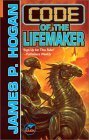
After a twenty-first-century colony ship is mysteriously rerouted from its original destination, its crew becomes increasingly alarmed when their leaders, who know the truth, are unwilling to discuss the matter. Reissue.
James Patrick Hogan was a British science fiction author.
Hogan was was raised in the Portobello Road area on the west side of London. After leaving school at the age of sixteen, he worked various odd jobs until, after receiving a scholarship, he began a five-year program at the Royal Aircraft Establishment at Farnborough covering the practical and theoretical sides of electrical, electronic, and mechanical engineering. He first married at the age of twenty, and he has had three other subsequent marriages and fathered six children.
Hogan worked as a design engineer for several companies and eventually moved into sales in the 1960s, travelling around Europe as a sales engineer for Honeywell. In the 1970s he joined the Digital Equipment Corporation's Laboratory Data Processing Group and in 1977 moved to Boston, Massachusetts to run its sales training program. He published his first novel, Inherit the Stars, in the same year to win an office bet. He quit DEC in 1979 and began writing full time, moving to Orlando, Florida, for a year where he met his third wife Jackie. They then moved to Sonora, California.
Hogan's style of science fiction is usually hard science fiction. In his earlier works he conveyed a sense of what science and scientists were about. His philosophical view on how science should be done comes through in many of his novels; theories should be formulated based on empirical research, not the other way around. If a theory does not match the facts, it is theory that should be discarded, not the facts. This is very evident in the Giants series, which begins with the discovery of a 50,000 year-old human body on the Moon. This discovery leads to a series of investigations, and as facts are discovered, theories on how the astronaut's body arrived on the Moon 50,000 years ago are elaborated, discarded, and replaced.
Hogan's fiction also reflects anti-authoritarian social views. Many of his novels have strong anarchist or libertarian themes, often promoting the idea that new technological advances render certain social conventions obsolete. For example, the effectively limitless availability of energy that would result from the development of controlled nuclear fusion would make it unnecessary to limit access to energy resources. In essence, energy would become free. This melding of scientific and social speculation is clearly present in the novel Voyage from Yesteryear (strongly influenced by Eric Frank Russell's famous story "And Then There Were None"), which describes the contact between a high-tech anarchist society on a planet in the Alpha Centauri system, with a starship sent from Earth by a dictatorial government. The story uses many elements of civil disobedience.
James Hogan died unexpectedly from a heart attack at his home in Ireland.
The best TV show, hands down, currently showing on any network, cable, or pay-per-view platform is a show called “The Expanse”. The first four seasons are available on Amazon Prime. Based on a great series of novels by James S.A. Corey (the pseudonym of writing team Daniel Abraham and Ty Franck), “The Expanse” is an epic science fiction series that extrapolates life in the distant future, a future that is vastly different than our own time and yet, strangely, eerily similar. While billed as a “space opera”, the show is as far from the familiar space operas, like “Star Wars”, as one can get. It is more akin to shows like “The West Wing” and “Band of Brothers” than “Star Trek” or “Firefly”, the two shows to which it is most often compared.
I understand that there are a lot of good to great TV shows out there. We are living in a time where TV viewers have an amazing selection of choices, and the quality of those choices is outstanding, so I realize that my singling out of one show among thousands is a bit subjective. That said, if you call yourself a real fan of science fiction, and you haven’t seen “The Expanse” (or read the books), you are definitely doing yourself a disservice. It is, in my opinion, up there with “The X-Files”, “Lost”, and “Fringe”.
What does this have anything to do with my review of James P. Hogan’s 1983 novel “Code of the Lifemaker”? Nothing, actually. Other than, perhaps, the recognition of excellence in a genre that is often dismissed as infantile, silly, or mediocre. Based on the myriad of books, movies, and TV shows calling themselves “science fiction” or “sci-fi”, the dismissal is occasionally, sadly, justifiable.
It reminds me of Theodore Sturgeon’s famous law: “Ninety percent of science fiction is crud.” This is true, and yet people almost invariably forget---or never knew that there ever was---an addendum to that law. Sturgeon went on to say, “But then ninety percent of everything is crud, and it’s the ten percent that isn’t crud that is important.”
Hogan’s “Code of the Lifemaker” is nothing like “The Expanse”. At least, in terms of story, themes, tone, and attitude. If the two have anything in common, it is the sense that talking about metaphysical and spiritual topics as it relates to science and technology is not only perfectly okay but actually necessary.
In “CotL”, an alien race sends a robotically-controlled spaceship into deep space, billions of years ago. It finds an acceptable home on one of Saturn’s moons, and the robots onboard form a landing party that immediately sets up cities of factories designed to reproduce more robots and other machines. At some point in the billions of years between landing and the evolution of humans on a nearby planet called Earth, something has gone wrong with the robots. Humans would say that it was a malfunction or a computer software virus, but to the robots, it is evolution. Over time, these robots become self-aware, individualized, thinking, feeling beings. Despite the fact that they are made of metal with microchip processors instead of organic brains, these beings are, technically, alive. They have families, live in communities, argue with each other about God, the afterlife, and what exists beyond the gas-filled skies.
Enter Earthlings: who have reached the technological stage of traveling to planets within their own solar system. Responding to anomalous readings emanating from Titan, Saturn’s moon, a small group of terran scientists are sent to the surface to investigate.
Hogan’s novel could have gone in so many different directions, and the joy in reading it is figuring out where he goes next. There is a pleasure in reading science fiction that is not suffocated under common tropes or genre cliches. Not that Hogan doesn’t employ some (he loves ridiculous tech-speak, the kind that Geordi LaForge always babbled on “Star Trek: The Next Generation”, the kind that my pre-adolescent virgin-nerd brain got hard-ons listening to but that I find completely useless and distracting now), but, for the most part, Hogan spends a good chunk of the novel philosophizing. Intelligently.
He is also not afraid to incorporate issues of spirituality, religion, and theology in a non-judgmental, non-dismissive way. Hogan clearly follows the Arthur C. Clarke playbook, and “CotL” is reminiscent of some of Clarke’s best work, such as “Childhood’s End” and “2001: A Space Odyssey”. It is also reminiscent of Mary Doria Russell’s superb 1996 novel “The Sparrow”, which also overtly dealt with spiritual and theological issues.
Hogan’s novel is a reminder that science fiction isn’t just about space battles, ray guns, and alien invasions. It’s actually about ideas, big ideas that simply aren’t talked about in other genres. For this reason, alone, Hogan’s novel is important.
Hogan published a sequel to this in 1996 entitled “The Immortality Option”.
*post-script: A heavy dark cloud of controversy hovers over Hogan, who died in 2010. Besides being an early climate change denier, Hogan was also a strong Holocaust denier. Admittedly, that is awful, and I certainly don’t condone or endorse such views in the least. It is unfortunate that I discovered all of this after reading this book, but it doesn’t necessarily change my opinion of the book’s value and significance. I didn’t get any hint of anti-Semitism in the book. This is one of those weird situations in which a good book was written by a man who held abominable worldviews. I am, however, of the (now seemingly looked-down-upon) belief that appreciation of art is, or should be, separate from the artist. I’m pretty sure that if I refused to read books by authors who personally believe horrifyingly awful things or hold political views that run counter to mine or have committed stultifyingly immoral acts, then I would have very few authors to read. I’m also a big believer in the idea of “Let he who is without sin cast the first stone”. Some crazy dude said that 2,000 years ago.
Code of the Lifemaker is one of Hogan's early big idea novels. It has a fascinating premise, but bogs down in the middle with too much musing on the nature of evolution of intelligence and religion and politics and corporate greed and colonialism. The main characters are pretty well-drawn, though he was more interested in the setting than the people, but the story suffers from too many digressions in the pacing. I enjoyed his Giants novels a lot more, but did find this one quite thought-provoking. He seemed to be arguing both for and against space exploration via remote mechanisms simultaneously.
I really liked this beyond expectation. Those expectations were set by 8 other Hogan books on my shelves I'd been rereading deciding whether or not they'd keep a slot on my precious shelf space--I was finding the answer up to this had been no. They'd tended either to be too heavy-handed and preachy (especially Mirror Maze) or technobabble infodump (almost all, especially Thrice Upon a Time and Two Faces of Tomorrow), took too long to get going--and in the case of Cradle of Saturn too crackpot--that one was dedicated to Immanuel Velikovsky of Worlds in Collision infamy. According to the Wiki, late in life Hogan became attracted to a host of "fringe" views--one critic claimed he had encountered a "brain-eater."
So this was an unexpected delight on several levels I wouldn't have expected from the author of those other books. In fact, ironically, the theme of this one is science as a candle in the dark, reason as a way to ward off superstition--notably against pseudoscience as embodied in Karl Zambendorf, purported psychic. It's well-paced, not preachy or of any recognizably political flavor, has memorable characters, is free of eye-glazing overdetail--and has an original premise: On Titan, abandoned machines of a dead alien civilization have evolved a mechanical "biosphere" of robots. And I had to smile at the prologue introducing it all. After telling how a supernova destroyed the progenitors, the line after that is: Everybody has a bad day sometimes. *snerk* This novel had a sense of humor and light touch that was much appreciated. *pats book fondly and puts it back on my shelves where it belongs*
The prologue to this book was simply fascinating. The level of detail, logical processes, and work that was put into creating an evolutionary ecology that could arise in machine life that essentially mimics that of "organic" life is magnificent. However, beyond that, whilst the story is worth the read, it isn't really much more than the usual high-tech society meets low-tech society alien encounter. Albeit with the twist the the low-tech society is all robots. :)
And, of course, there are the usual late 20th-century political machinations with the Soviet Union as the often-mentioned background enemy...who have apparently reached technological and manufacturing parity - if not superiority with the USA and Europe.
Either a high 3 star, or a low 4 star. Can’t really decide at the moment.
Being James Hogan, I expected some very hard sci-fi, along with an interesting take on said sci-fi element, and likeable characters to back it up.
What I got instead was some… er, hard politics and philosophy. And, it actually worked!
The weirdest part about this book, was that, while published way back in the early 80s, it remains very very politically relevant today. Especially today. Especially 2026. It’s like a history of politics; specifically history of US politics, culminating in what we have today (a pile of shit).
Removing the head figure of a country, and replacing them with a truly horrible person.
Sound familiar?
Discovering a new land inhabited by comparatively primitive people, and wanting to relegate them to slave labor, while the conquerors reap the land for everything it’s worth.
Sound familiar? Something-something diamonds, I dunno…
Large conglomerates manipulating political figures to gain advantage over competitors at the cost of consumer well being.
Said conglomerates wanting to keep the populace dumb for easier manipulation.
All sounding pretty familiar, no?
How about crucifying someone just trying to just preach love, peace and acceptance, because it goes against your dogmatic religion and its beliefs, which would much rather “keep the masses in check”.
The message was clear and well written. Oh, and prescient! Eerily so.
The ending was a bit abrupt; it just kind of appeared and happened. So taking off a star for that, but otherwise, a good read!
If you’re politically charged at all, it may well be worth reading this, even if sci-fi isnt your thing.
Now here's a story. When I was in high school, my dad told me about a scifi book he vaguely remembered, in which self-replicating alien robots found their way to Titan and evolved there into a robot ecosystem, complete with kingdoms of metal humanoids. I was fascinated by the idea. I designed robot animals with friends, built up a menagerie, and finally wrote a novella about the pros and cons of environmental protection in an eco-system that thinks your spaceships and environment suits are delicious. Hogan wrote a very different, and much better story.
Hogan didn't get as creative with the native life of Titan as I did, but he did give some very sweet descriptions of the families of concrete-pourers wallowing in the methane stream under softly humming generators. And then of course there is the actual story, where a stage psychic, symbol of everything that's gone wrong with America's relationship with science, becomes the hero. There are deep and poignant meditations on truth and lies, right and wrong, and how they don't always match up. Also there are such delightful passages as "a hermit in a wheel-skin tunic has wandered into town on a steam-donkey with some new heretical claptrap about pacifism. Shall we boil him in acid until he confesses?" Fingers to lips. Mwah!
Hogan's story telling, combined with his writing style, is so marvelous that you almost don't care whether or not there is a plot. Only a few pages in, I found myself laughing out loud. But of course there is a plot and it will be revealed. Meanwhile, I'm just sinking into what promises to be a delightful tale. I mean, we've got computers, computerized factories, and robots run amok; an entire alien species wiped out, which is a shame, because these computers were their design; etc. My favorite bit is the vision of bureaucratic nightmare of these damaged computers trying to get their work done. And this is, again, only a few pages in. What a rich novel!
About 3/4 in and there clearly is a plot, complete with ruthless imperialism/colonialism to the nth degree, religion (fundamentalist variety and religious transformation), military strategy, [spoiler alert] a flim-flam psychic with a heart of gold, and more. [safe again] The book reads as if written decades before the publication date of 2002, in terms of issues such as gender. And Hogan goes off on lengthy technical explanations and descriptions that seem to be gratuitous to the story. But all of this is worth wading through because Hogan is that good a story-teller. I don't want to put down the book at the same time that I dread finishing it.
Damn! I finished the book! Now what will I do? This was an absolutely delightful read. Yes, there are weaknesses (from my perspective), but they pale in comparison to the strengths. In fact, they actually might be one of the strengths. Loved it!!
"Code of the Lifemaker" is well-regarded for its inventive and thought-provoking premise. James P. Hogan creates a rich and intricate world filled with diverse robotic characters that challenge the traditional understanding of intelligence and what it means to be alive. The novel delves into themes of sentience, individuality, and the potential repercussions of human intervention in alien technologies. BUT the pacing is slow that certain technical descriptions and scientific explanations were overly detailed, making the narrative drag at times.
The first chapter of this book, detailing the evolution of an alien automated manufacturing plant into a sentient machine society, is itself worth the price of the book.
After this chapter, however, leave the hard science fiction description behind and prepare yourself for a rather slow, but well written treatise on the values of a society based on reason instead of mindless subservience. Human culture on earth is curiously obsessed with psychic phenomena, and into this paranormal limelight steps Karl Zambendof and his team, masters of artifice and professional con men. You may ask what has this to do with thinking machines, and well, so did I. The middle of the book is devoid of tension and is hard to slog through, even after humanity makes contact with the machine lifeforms. However, the first chapter intrigued me enough to push on through to a fun and strangely humorous ending.
It's unfortunate Hogan went with the idea of machines evolving into an exact duplicate of a medieval human society (men, women, horses and all), and a stretch of the imagination for a hard science fiction book, but it works in comparing the machine civilization to his futuristic human one and in drawing historical parallels to similar cultural clashes. Is humanity going to take advantage of the more primitive machine civilization, or does it recognize thinking, feeling beings capable of art and learning and treat them as such?
This is an old school science fiction story, not as well written or as interesting as an Arthur C Clarke novel, that deals with themes that, in the twenty first century, seem dated. However, if you're looking an intelligent book that gently pokes fun at humanity's less than rational interests, this is it.
The book starts out pretty good by explaining the beginnings of evolution on this robot world, but then suddenly cuts over to some humans and it pretty much falls apart there.
The next time we cut back to the robots, they might as well be medieval humans from how completely identical they are to people. Why are they bipedal, with eyes and arms and everything in pretty much the same place as humans? Why do they even use the same gestures and body language as humans? Why do they wear clothing in similar styles to humans? None of this is explained in the slightest.
I also found the explanation for why they build everything out of organic compounds to be very tenuous. It feels like their society is "exactly like ours, but with this one thing reversed" for the sake of it, rather than having any logical reason behind it.
So many characters are thrown in that I was mostly just skimming the later chapters for events; I'd stopped trying to keep track of who was who past the top five or so characters. It really doesn't help that each character (and species, and planet, and country, and machine) has two different names, one used from the robot perspective, and one used from the human perspective, since communication between the two is sketchy. With how many other things in this book are hand-waved away, I feel this is one area that could have really been improved by hand-waving the ability to communicate names to each other.
Overall, I'm left thinking of that Futurama episode, A Clockwork Origin. I wonder if this book was inspiration for it?
Slowly evolving, but great book that gives a lot to think about. I Don't want to write any spoilers so will just mention that the story is very original and exciting in how it reverses the usual "aliens visited earth!" paradigm in more ways than one, making this book rather cliche-free.
Surprisingly for a book that's somewhat old, it goes way beyond the "usual" questions about artificial intelligence (the phrase isn't even used in the book I believe) and indirectly analyses challenges of an "artificial" being vs "organic" one and how these two can be easily interchanged. Also an interesting theory about artificial evolution is provided.
The book also concerns itself with critique of faith, however the circumstances in which it is being discussed makes the critique not as banal as it might be expected and is more about faith in politics and people than religious faith. The book is clearly influenced by science revolution's mentality of faith in the rational, calculating mind, though.
The only negative sides in the writing that I noticed were common ones in science fiction: overtechnicality and anthropocentrism. The latter is hard to escape and in this book appeared to be deliberate so it's entirely excused. Also considering the story facts of this book, if author wanted to write it anthropologically 'correct' the book would probably be thrice as long. Overtechnicality where it's a negative is as if the author felt like he just HAD to write down those particulars because he spent days thinking about them. Ironically here are many scenes where you'd be really interested in technical side of things but nothing is mentioned at all. Perhaps the author decided it'd simply take too much time off the reader. Either way, technicalities don't really ruin the book and might even provide a needed pause between difficult scenes.
The narrative itself is pretty slow and clunkily philosophical, but Hogan makes excellent points about the need for education, scientific reasoning, and basic human (or robot, as the case may be) rights.
Given these themes, it’s so wild that he later became a conspiracy theorist and holocaust denier. Maybe he should’ve re-read his own work?
While I did enjoy this one, I must say I preferred the "Giants" series. Although a bit dated in its "future" references (e.g. East Germany), the premise is an interesting one. Aliens have a probe scouring the universe for useful materials. When the probe finds one, it builds automated factories that build robots that process raw materials and refine then into products to be shipped back to the aliens. But supernova damages the probe . . .
The probe ends up in our solar system and sets up on Titan, one of the moons of Saturn. But the probe was damaged, including its software. It builds factories and such that are supposed to build self-replicating robots and machines, but the missing bits of its software make the process go haywire. Some robots and machines survive and replicate, some are unable to survive. Survival adaptations are replicated. A form of natural selection takes place . . . and Titan is covered by a mechanical "ecosystem" of "living" machines.
Enter the human race, coming to Titan to make contact with the primitive but intelligent inhabitants . . .
I have read this many times before joining Goodreads and have found an opportunity to add a review.
Hogan is one of my favorite authors. He rarely fails to ignite my imagination. I read his books due to the “what if” factor he includes in most of his work.
What if, due to a reasonable explanation (the prolog is awesome) life was silicon based? What if during the course of their special evolution they developed culture? What if their culture was antiquated compared to ours? What if they didn’t understand the advanced technology that existed in their own bodies? What technology are they likely to excel at? What effect would the psychology of humans have, when our race and their race got together?
This book gives one possible answer to those questions. The book may not be filled with beautiful pros, but if you are a dreamer, you will love the story.
The greedy want to minimalize and exploit the Taloids. The compassionate want to save them. The clever come up with a half-“expletive” plan.
The prologue was delightful, with its description of how life on Titan evolved. The story was pretty good. There were women characters that were actual characters. The writing was pretty good, although the medeival-esque rendering of Taloid dialogue got annoying.
The story is overtly and comprehensively anti-religion, though, in the usual paradigm that groups believers with gullible fools and dupes over against skeptics and enlightened scientists. Boring and annoying for me, though I can see how it would appeal to people who are in its target audience. I'll probably keep it but I doubt I'll reread it often.
Wow. This book reads like it was written by a college freshman who has just taken his first philosophy class. Preachy, ham-handed - I could barely stand to read more than a couple of pages at a time. I kept reading because I thought it had to get better - I was wrong.
God, this book was agony. It was a great premise, but it ended up being something I dreaded reading every night. That said, it taught me something about skepticism and how charlatans ply their trade, so despite the hamfisted writing style it was worth reading.
This is not a science fiction book so much as a political intrigue, manipulation of perception, and power dynamics story set on a moon and involving robots that evolved from machinery created by non-humans.
Alright so this is a throwback. I have very vivid memories of reading this book back freshman year of high school. That was a year where I spent quite a bit of time perusing the media center shelves at Gaither...and read lots of random books (some great, some...not as great??). This was one of them. And yes, I confess I'm vain enough that the main reason I picked this one up at the time was the author's name. How could I not? So I read it (again - vivid memories! Recall reading this in the back of Mrs. Bane's computer class...once I finished all my work, I usually had loads of time to spare...she never minded! Mrs. Bane was fantastic, just saying) and for some reason all these years later, I still from time to time thought about the plot of this book, just because the concept was so fascinating. Rather than talk about my own life story, let's discuss the book hm? This book honestly isn't one that I can say is amazing or has gorgeous prose. Rather, the characters are a bit flat and the prose is workmanlike. But...the concept - the hook, as it may be - is fantastic. An alien automated machine colony gone a bit haywire...and thousands of years later brings what? Well, your average medieval robot society, of course. So this book deals with the humans from earth(in all their glory - for reals, this author did not have a high opinion of the current trajectory of the human race. It is quite amusing reading his thinly veiled critique of the modern era. I think I didn't realise all this when I read it back when I was 14...) making first contact with the aforesaid medieval robots. The best part of this book by far is figuring out how this robotic society actually works...and it is fascinating! All the things that are "grown" and "cultivated" are actually mechanized and machine-like. All the things that are crafted and carefully produced are actually...organic! It's a fun switch and I enjoyed experiencing this machine world of Titan (yes, the moon of Saturn! Skipped that part, did I?). Anyways, like I said - the plot itself is fairly predictable and the characters are definitely nothing to write home about, but I enjoyed this book nonetheless. The author has some pretty strong views on modern society, the entertainment culture, religion, government...and honestly even though I didn't always agree with him, this was a good view into the mindset of a man in 1983. Old sci-fi books are always a treat for this very reason. A window into a different age. And sadly (or not), a lot of the things that the author bemoaned from back in the day really haven't changed that much now. There is nothing new under the sun. We humans so often seek to subjugate and dominate others. Our voracious appetites for pleasure and happiness often lead us to unthinking consumption of the worst sorts of filth and nonsense. We don't think as critically as we ought and the wisdom that we think we claim is often a thin veneer of shiny over a rotting corpse of emptiness. It is interesting how we as humans seek to find the meaning of life yet so often miss what is all around us.
Hogan in this book uses the guise of science fiction to get at what he thinks are some universal truths about human nature and what makes for the best in people (and here by people Hogan also means machine/robot as well as humans).
I read this book 40 years ago and chapter one had stayed with me ever since because the way he hypothesized the race of machines as people and the swapping of DNA through their CPU code was a brilliant way of seeing evolution leading to complex intelligent life.
Here are three quotes which get at the truths that Hogan wants to convey: 1) ‘For the first time he saw the reality of the savage mindlessness that could be engendered in a people who had been conditioned to believe without question, to accept without understanding, and to hate upon command’.
2) ‘What more dismal a prospect could be imagined than that all the universe’s knowledge could be contained in one ancient book?...How pathetic is the future that some would wish upon themselves’.
3) ‘They valued their minds and were willing to rely on themselves without need of magical powers or supernatural revelations as substitutes for thinking’.
He doesn’t really like religion and thinks interference within the natural order of being is fraught with disaster and in this story some of his conservative/libertarian beliefs sneaks through but not quite in an offensive way. If you check the wiki on Hogan, you’ll see that he really was an affront to sanity since he became a real nut by denying the holocaust, believing Aids was made by the pharmaceutical companies, and believed climate change is not real. From this book alone his insanity is not obvious except for some of his obvious libertarian non-sense.
That aside, and it’s possible to ignore the author’s beliefs since they are not really overtly presented in this book, this book offers a good sci-fi exploration that mixes philosophy with theology and entertains in the process, and shows that even if a prophet can perform what seems like a natural suspension of the laws of physics, perhaps one should not jump to the conclusion that they are the Lifemaker or the son-of-the-Lifemaker, because there could be a chance that there is another better explanation which can explain all the facts. Besides, this book is easily available in any good used book store for about a buck and makes for a good read.
Millions of years ago an alien race built von Neumann (self-replicating) machines to mine the surrounding rocks and planets for raw materials and manufactured goods. A random encounter with radiation from a supernova scrambles their instructions however and they careen away into space, eventually reaching our solar system, where they settle on Titan around Saturn. Machine evolution occurs and a kind of feudal silicon civilization emerges with the equivalent of city states. Now humanity has discovered the Taloids and two Orion spacecraft travel there secretly (originally touted as a Mars mission). Two factions are on board - the first and military one desires the machines to be diverted to manufacture stuff for Earth, the second, with an infamous ‘psychic’ and a renowned debunker wants to bring the civilization into humanity. But are the machines human? James P. Hogan delves into the philosophy of humanity and the vagaries and problems of organized religion in this odd novel. While entertaining enough I had real problems suspending belief. Alien machines riding mechanical horses and speaking 16th century English in translation for a start. As a vehicle for Hogan’s message it’s okay but I found the whole thing just like reading a Macchiavellian tale from the Middle Ages. However you may not find it intrusive. The use of two different names for each Taloid was a bit confusing too.
The introduction was remarkable! It sets the stage for an intriguing story. Although the subsequent chapters diverge from my expectations, it was nonetheless a very thought-provoking read.
Beware, this is not a Lem-type alien culture that is so foreign that it can barely be identified as an entity. These aliens are so anthropomorphic, and their evolutionary paths and social order are so similar to ours that you can get easily disappointed. I admit that I'd be happy to read a version of this book written by Kim Stanley Robinson, he could give it a "hard sci-fi" spin that I wanted.
Now, if you look beyond that - this book is still worth reading. It enables you to see how religion can get very powerful, given enough time, despite not being grounded in truth. Besides that, it raises important ethical questions and illustrates how individuals can make decisions that have major repercussions. In other words, this book is more about humans, than about aliens.
It is worth noting that the author places an emphasis on education, or lack of it. Some sections of the book give the impression that it was written by someone who traveled in time [to the early 21st century] and described exactly what they saw - a society where the lack of critical thinking is the norm, and people are just looking for new things to consume.
Interesting, but utterly naive book. The way Karl Zambendorf changes in the middle of the novel is unreal. Even the victory which the characters achieve is highly unrealistic, especially over the background of "fake news" that are spread on Earth, a brief view of which we get in one of the chapters.
Also, the way the robot civilization is reduced to humanity's clone (after the long and elaborate set up in the first chapters) is disappointing. Titan civilization should be very different, if only because you can't really damage a metallic robot creature with a sword! At the very least, warfare methods should be different, which means composition of armies should be different, which, in turn, might lead to a completely different political system. But no, Hogan wanted a clone of Middle Ages Earth to prove his point, so that's what we get.
Not a really bad book, but not a really good one, even if I agree with the author on many ideological points.
A mission from Earth goes to explore a robot civilization on Titan, and factions among the explorers diverge on how to treat the robots. The prologue, which tells how darwinian evolution could arise among manufactured machines, is reason enough to pick up the book. The larger story, set mostly among the mediaeval-like robot world, has plenty of twists. The characters, often, begin looking like stereotypes but then shatter expectations; this applies to both humans and robots. The book has its slow parts, especially before the mission takes off from Earth, but the latter parts make up for them. The technical details seem to be thought out but not expounded to interfere with telling the story. The broad themes of open-mindedness instead of fear-based superstition are just as relevant today as when the book was written.
The premise was really clever and I really enjoyed a view of humankind from the perspective of these sentient machines. Interesting parallels to human societies that is in some ways reflective of (and limited by) the time in which this book was written. There were some dated elements including some of the expected biases of the time - the long shadow of the Soviets, huge lack of representation, gender biases (no women robots??). But it made me think how humans could be viewed as gods by such a society and how would we view an alien civilization if they could build machines out of biological parts?
This entire review has been hidden because of spoilers.
I got this at a library book sale so I'm only out 50 cents but what a waste of potential. Like another review said, it starts with this cool idea of alien robots probes malfunctioning and evolving and you think wow what cool things will happen!?!? Well they become medieval humans with an oppressive religion of priests who forbin learning about science and junk like every generic fantasy novel ever. HOW BORING. Why even bother with any cool worldbuilding in a methane ecosystem and specialized robot species?
Nice mix of philosophy and alien arrival. Does the humans are technologically superior to aliens thing I always wanted to see. Some views of free will and people being dumb that align. Aliens are medieval. Power struggle with the mission’s leaders that is resolved through religious trickery. Some twists, but not a lot. A good book but a little heavy with the religious undertones.
A book that tackles a lot of different technological and philosophical themes, Code of the Lifemaker pulls it off pretty well. While not surpassing Arthur C Clarke, who he's been compared to, Hogan creates some good characters, settings, and themes that mesh together pretty well.