Al, a janitor, and his faithful dog, Eddie, live in a single room on the West Side. They eat together, they work together, they do everything together. So what's the problem?
You name it. Their room is crowded and cramped; their life is an endless struggle. Al and Eddie are totally miserable until a large and mysterious bird offers them a change of fortune.
Transported to a gorgeous island in the sky, Al and Eddie are soon living a life of ease and comfort. But sometimes, they discover, the grass can be a little too green on the other side. After a dramatic, nearly tragic escape from their "paradise," both man and dog agree: there really is no place like home.
Arthur Yorinks is a playwright, director, and author of more than thirty-five picture books for children, including the Caldecott Medal–winning Hey, Al, illustrated by Richard Egielski. His most recent picture book is Presto and Zesto in Limboland, illustrated by Maurice Sendak. Arthur Yorinks lives in Cambridge, New York.
I love all the birds in this book. This was an unexpected story. A Janitor and his dog live in a very small 1 room apartment. Tiny. They are looking to upgrade when a huge bird sticks its head in the window and offers to take them to a new and better place.
That page, the kids were like, wow, that’s a big bird. “Are there birds that big?” “No” Anyway,
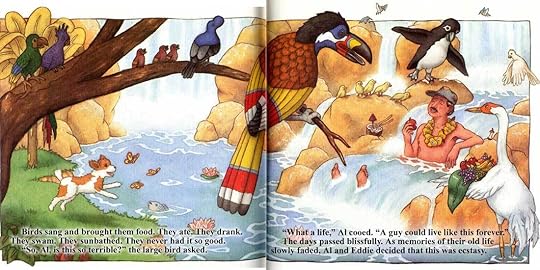
The man is taken to an island in the sky which the kids thought was very cool. It was like a bird paradise. This book was a complete surprise to me and I won’t spoil it here so go and read it. It’s a short and quick book to read.
The kids loved the surprise on the island and the conclusion. The nephew gave this 5 stars and the niece gave it 4 stars. They couldn’t figure out if the birds were evil or good and I said that maybe they are just birds and not evil or good. Anyway. This was fun and our house enjoyed it.
After reading many Caldecott Medal award winning books, I stumbled upon this rare gem called “Hey, Al” which won a Caldecott Medal and was written by Arthur Yorinks along with illustrations by Richard Egielski. Get prepared for one surreal yet adventurous journey!
Meet Al, the janitor and his faithful dog, Eddie. They live in a single room on the West Side and they do everything together. So, every thing is fine, right?
WRONG!
Al and Eddie’s life is miserable as they live in a small and cramped apartment and they are barely making it in life. One day, however, a large bird comes to their apartment and tells them about a place where things are so much better than the life they are currently living in. Al and Eddie then decided to let the large bird take them to this mysterious place and it turns out to be a beautiful island located up in the sky. Everything was going great for Al and Eddie as they were living the perfect paradise that they dreamed of, but it turns out that their “paradise” comes with a price…
Wow! I cannot believe that I had never read this book before! I had heard so many good things about this book and how popular it was, but I never had the chance to read about it until now! Arthur Yorinks had done an excellent job at writing this story as this story is extremely imaginative and surreal at the same time! I loved the fact that Arthur Yorinks approached the theme of “the grass is greener on the other side” and gave it a more fantasy spin on it as it has both Al and Eddie traveling to a magical island to gain a better life from the one they have, only to realize that it does come with a price. Richard Egielski’s illustrations are what truly sold this book to me. I loved how gorgeous Richard Egielski’s illustrations are, especially of the scenes of Al and Eddie going to the island in the sky as there are many images of luscious trees and different types of birds inhabiting the island. I also loved how realistic and colorful the illustrations are as they bring a sense of tranquility and beauty to the story.
Overall, “Hey, Al” is a fantastic book that teaches children about how sometimes the “grass is not always greener on the other side” and that being satisfied with what you have is important. I would recommend this book to children ages five and up since the scenes of Al and Eddie transforming might frighten some children.
I absolutely visually adore the expressively drawn birds of Arthur Yorkins' Hey, Al (and can indeed both understand and totally appreciate why the illustrations won the 1987 Caldecott Medal for Richard Egielski, as his pictures are descriptive, lush and considering how much I have always loved birds as animals, visually fun and engaging).
However, while I have quite massively enjoyed (and am still enjoying) Richard Eglielski's pictorial descriptions for Arthur Yorinks' narrative (and as explained above in particular all those lovely birds), I cannot say that I have all that much enjoyed the latter's text, his printed words, the general storyline of Hey, Al. For honestly, what is so very wrong with wishing to change one's life, what is so uncanny and problematic about being or wanting to be a bird? Sure, the concept of being happy with one's lot in life might indeed and in fact not be all that negative in and of itself, but why are the birds and the tropical paradise like island of Hey, Al almost described by Arthur Yorinks as being dangerously strange and perhaps even potentially evil in some manner? For personally, and because I do happen to so very much love and appreciate birds, the main messages presented by the author's narrative, presented by the text of Hey Al kind of chafes more than a bit and rubs me the wrong proverbial way, and I am also rather annoyed and disappointed that escapism and wishing to change one's existence, desiring a different kind of lifestyle would (and sadly should) be so unilaterally condemned and criticised by Yorinks. Three stars for Hey Al (five stars for Richard Eglieski's brilliant and lush illustrations, but only two stars for Arthur Yorinks' more than somewhat personally problematic accompanying text).
Al the janitor doesn't mind working hard all day, even though he hardly makes enough to pay for a tiny studio and keep food in his and his dog's mouths. But Eddie, the little dog, wishes for space to run around. When a giant toucan pokes his head in the bathroom window one day and offers to take them on a tropical vacation, it seems like a wonderful opportunity. But as the two buddies lounge around in paradise, they find themselves turning into birds! Can they escape?
And this is where the story kind of broke down for me. What's so terrible about being a bird? And why do the birds want to bring strangers to be transformed into birds? That's not explained at all. Since Al and Eddie's home is portrayed as gray and cramped, and they seem to have no friends or activities besides work and tv, why do they want to go back? Personally, being a bird sounds fun and eating fruit on a lush tropical island sounds better than mopping floors all day. But I guess we're not allowed to give that sort of escapist message to impressionable children. Kids, work hard and be content with what life dishes out to you!
I did very much like the illustrations, especially the way Al's tiny room forms a frame that is always liminal; even before the fantastic elements are introduced, we always see details outside the border, hinting at the permeability of the space.
I adore Eddie, the dog in this book, especially the illustrations of the dog!!! I love all the illustrations. The birds are amazing, Almost every page is amazing. My favorite two page illustration is probably the one where Al is lying in a small waterfall and Eddie is on shore chasing butterflies.
The story is funny and cute and I really liked it, although had I not known it was a children’s picture book for young kids, I would have experienced a couple of pages worth of terror at one point in the story. The story is about Al the janitor and his talking dog Eddie, and an adventure they have, thanks to a bird. The love Al feels for Eddie seems so genuine and touching. I felt a bit melancholy reading this and feel a great need for a “dog fix” which for me means petting a dog. I like that the main human character is a struggling janitor and how the story shows that the green grass on the other side isn’t always what’s most desired.
Much thanks to Izzy, who really enjoyed this book, as reported by Chandra. It’s why I borrowed and read this quirky book, and I’m so glad that I did.
Arthur Yorinks and Richard Egielski - who had previously teamed up on Sid and Sol, Louis the Fish and It Happened in Pinsk - here deliver a fascinating (and very entertaining!) picture-book examination of the idea that sometimes the grass isn't greener on the other side, and that the things for which we long - things that seem to make life easier - aren't all they're cracked up to be. When janitor Al and his dog Eddie, fed up with living in a tiny one-room apartment on New York City's West Side, are offered the opportunity to live on a tropical island in the sky, they jump at the chance. Well, mostly it's Eddie who jumps. What the colorful bird who makes the offer doesn't mention, however, is that this paradise comes with a rather high price-tag, in the form of a fundamental change in who Al and Eddie are...
Like Louis the Fish, the only other book by this team that I have (thus far!) read, Hey, Al is surreally entertaining, with plenty of Kafkaesque transformation occurring or almost occurring. The illustrations won Egielski a Caldecott Medal, and its not difficult to see why! Simply gorgeous, they vividly capture the reality of both Al and Eddie's dingy apartment, and the floating island. I enjoyed the story here, I loved the artwork, and I really appreciated the fact that Al is a janitor (just as Louis was a butcher). Think about it... how many children's books really portray people working in everyday, non-glamorous jobs? How many show these everyday working people having rich inner lives, full of beauty and mystery? Not too many these days, I'm afraid. For that alone, Hey, Al would be worth picking up. Happily, it also has a great story, and fabulous artwork!
Such a bizarre tale. I'm not sure I really liked it, though I appreciate the moral of the story -- it's more than just being content with what you have, it's about being proactive, appreciating what you have and finding a way to be joyous with it (love the yellow paint!). Besides, Eddie is just adorable. The illustrations are certainly memorable and I can see why they won the Caldecott though, again, I personally wasn't a huge fan.
A janitor and his dog escape the confines of their shabby and tiny room to visit a tropical world inhabited by magical birds, only to discover that paradise has a price.
I like this book very much. A wonderful and imaginative story to show that one can find happiness with what they've got. If you could be in paradise, but the cost was loosing yourself, would you stay?
I love the rhythm of the language, too.
I also enjoy that this book can create an interesting discussion about personal values.
On the other hand, as someone who does not like settling and strives for "more", I'm not sure I like the message that Al and Eddie should be happy in conditions that make them miserable to begin with. I like seeing that Al and Eddie are working to improve their living space by painting their tiny home. However, I would prefer to see Al and Eddie find some initiative to change their circumstances altogether. We have but one life to live, why shouldn't we strive for more?
Illustrations by Richard Egielski are nice, though somewhat stiff. I like the blocking of the scene to show the smallness of their living space. I also love the contrast of the full-page spread once Al and Eddie go on their adventure.
This book seemed like a rather random story to be telling to kids, I thought it had a nice message, but was a little too weird to correctly get its point across. The illustrations were pretty nice, but I found one illustration especially disturbing, and that picture was of the dodo bird having hands underneath it's feathers, that was just a tad bit too odd. This book wrapped up its point rather quickly and had some weird elements, so I don't think I'd recommend it.
This is a strange one. It's basically about being happy with what you have, but, I think there are quite a few kids who would draw a different conclusion. Basically, an unhappy guy and his dog get transported to bird island, which is some kind of paradise of waterfalls and fresh fruit, but, they panic when they realize they are turning into birds and head back to their one room apartment.
My child would have chosen to turn into a bird. I think I would have too.. lol
Book Description- Al and his dog, Eddie, live in a small, one room apartment in the West Side. Al is a janitor and they live, work, and eat together. However, the room is very cramped and their life is a struggle. Living in such close quarters, they are often at each others throats, but Al doesn't have the money to move to a bigger apartment. Then one day, a mysterious bird shows up and offers them a new life in paradise. Soon Al and Eddie are flying with the bird to a beautiful island in the sky and start their life in the lap of paradise. However, it isn't long before that they realize that the grass can be a little too green on the other side. After a dramatic, nearly tragic escape from their paradise prison, both man and dog agree: there really is no place like home.
I love the both the illustrations and the moral of the story. This was a class favorite when I was teaching 3rd grade. The illustrations are very realistic and colorful that drew the students to the book in the first place. The author was able to add a fantasy theme using illustration in the scenes when Al and Eddie were flying with the bird to the island and when they were on the island itself.
The moral of the story is "the grass isn't always greener on the other side", which was depicted in the story line and in the pictures of the island itself. This book is also a social statement that even though Al and Eddie lived in a small, cramped apartment in the city and often fought, but that was their home. The characters realized that paradise wasn't for them and just wanted to go home. This book was always a fun read aloud when we had extra time. If a book is a class favorite, then I will honor the students' rating, which would definitely be a 5!
If you were a janitor named Al living in one room on the West Side, and if you lived with your faithful dog named Eddie who desperately wanted a little room to run around, and if a talking bird appeared in your window and offered you a one-way ticket to paradise, well, what would you do?
Probably the same thing Al and Eddie did, unless you'd happened to finish this book first. Let's just say there is trouble in paradise, and when our janitor and his dog make it back home they are poorer and wiser. But they resolve to enjoy life with a much better attitude, so there is a happy ending, after all.
Once you realize that the author and illustrator were protégés of Maurice Sendak this odd book might start to make more sense. Or not. There was some controversy surrounding Hey, Al winning the fiftieth Caldecott medal. It's easy to see why. Paul Zelinsky's Rumpelstiltskin was up that year, and it was passed over to win the honor medal instead.
Besides that fact, Hey, Al is simply a strange picture book. What is the story trying to say, for one thing? Don't aspire beyond your station, or be content with what you have? The literal interpretation, perhaps, is that it's better to be a janitor in a one room apartment than a bird in paradise. Like the Odyssey's Lotus-Eaters we're asked to take for granted that staying on the island is a bad thing.
Hey, AL By Arthur Yorinks The art working this book is very creative, and realistically drawn. With sold lines and colors. The birds in the book are highly detailed and exaggerated while the dog was not. Al a Janitor living in the big city. Al works so hard and struggling to reach end meat for him and his dog. One day a large bird came in to AL bathroom and ask him if he wants to go the a new land. The next day he took AL to a new land. The Land of Birds and AL had a Vacation. He and his dog wanted stay forever. One morning AL and his go started to turn into a bird. With their new wings Al tried to fly home back to the City. As was flying away from that island he became more human. He made it happily home just before his wings gave out and was human again. I really like this book it is creative gives a little bit of a moral and I can see kids liking this story. To use this book in the classroom by using the students creative of creating a new ending that could answer the question the book left off.
1987 Caldecott Medal; Favorite Illustration: The first page when Eddie and Al are walking into their apartment and Eddie is carrying a Chinese takeout box in his mouth. Super cute!
A cautionary tale about being grateful for the life you have, even if you have to work hard and you don't get everything you dream of. I enjoyed this tale, but I also felt that it was a bit dated. Especially with phrases such as "they never had it so good," sprinkled throughout the story, the prose became a bit choppy in places. K(6) was frustrated when she was reading it because she felt that the storyline didn't make sense (especially in a few places where questions were worded as statements). When Al and Eddie find a perfect paradise, they feel like giving up their hard work and small apartment are totally worth it. Shortly, however, they come to learn that life is what you make of it. And sometimes paradise is not all that it's cracked up to be.
Al is a janitor who longs for a more exciting life. He and his dog Eddie live in a tiny room on the West Side of New York City.
Barely eeking out a living, he dreams of a better life.
When a large multicolored parrot sticks his head in the window and tells him he is working too hard and to fly away with him to a place with no worries, Al and his steadfast dog, fly along.
Living a life of leasure, Al and Eddie are fine for awhile, until one day they discover that they have stayed so long they are not becoming birds.
Begging the bird to take him back, Al and Eddie fly rapidly. When Eddie falls into the ocean, Al is heartbroken.
Transported back to his single room, without Eddie, life is lonely.
When Eddie magically returns, Al realizes that his life is just fine.
Moral: Be careful what you wish for, in joining the crowd, you just might become something you don't want to be.
This story is about a janitor named Al and his dog, Eddie. They live in a tiny cramped house and Al feels like his life is terrible. One day a random bird comes by and tells him he can take him to paradise. Al and Eddie go but they realized that “the grass is greener on the other side.” Once they returned home they appreciated everything that they had. This is an unusual story, although I think children would enjoy it. This story allows you to be imaginative, which would be great for kids. The illustrations had a soft tone to them which also made the book look old. The bird that picks Al and Eddie up is huge and vibrant. The island is filled with different colors, which makes the island look luxurious. The illustrations are heavily detailed and creative. I thought the illustrations and text coordinated very well.
Al is a struggling janitor in New York City, living with his talking dog, Eddie, who likes to complain. When a bird offers a chance to escape from it all, Al and Eddie jump at the chance, but soon find that living with the birds might require more than they're willing to give. This is such a surreal book, and I can't even begin to imagine how Arthur Yorinks began to imagine it, but it's bizarre plotline is exactly what makes it so good. Yorinks's decision to depict Al's apartment in small boxes with lots of white around them, and the land of the birds on larger two-page spreads creates wonderful contrast between the two worlds, and I love the subtlety of the final image where Al and Eddie repaint the apartment to reflect some of their newfound happiness.
Richard Egielski uses a cartoon-like detail to enhance the bright, full colors in the book. The pictures bring out a life-like feel to the imaginary story. This book is definitely an entertaining story. The pictures are colorful and very detailed. I think Hey, Al is very easy to understand that what you have is usually better than what you lust for. This book is a great reality check for us, giving a serious message in a kid's book. The story follows the general theme of many children's stories where the reality of experiencing something more that has been yearned for makes the characters realize the greater value of what they already have had.
1987 Caldecott winner. The drawings start as busy, but not colorful yet. Birds get added and the beauty here for the reader and for Al (guy in the story with his dog Eddie) increases. But Al and Eddie start to bizarrely turn into birds themselves. A little strange, and scary kind-of - yet Colorful! There is a lesson here about asking for too much. But it made me wonder about all the other birds that must have come from people that never 'escaped' from the island in the sky. I'm not so sure a kid will exclaim "again, again" when this ends...
4* art, 3* story. Net 3 per the 'again, again' test-fail
Gosh, this was a weird one. I don't think I would read it too super young kids, even though the writing is quite basic.
A janitor and his dog get invited to a lush island. So they escape their dismal apartment. But they find out that there is a price to pay for paradise! This is definitely a story with a moral.
I thought the ending was a little too pat, but it is a kids' book so I guess I wouldn't want anything tragic to happen.
Al, a janitor who lives with his very opinionated dog Eddie, isn't very happy with his life. Mostly due to Eddie's complaints I think. Anyway, fantasy happens, change happens, and we all learn the valuable lesson to appreciate what we have. Didn't like this one all that much for whatever reason. The birds were interesting, story itself kind of blah.
Hey, Al is A Caldecott Medal winning picture written by Arthur Yorinks. Al is a quiet Janitor who lives with his talking dog, Eddie in a messy one-bedroom apartment. One day, a large bird pitched an idea to Al and Eddie to leave their messy lifestyle and take an adventure to a beautiful land. However, this paradise does not turn out like it seemed it would and Al and Eddie are forced to escape. The book is wonderfully illustrated with earthy tones throughout the whole book. The illustrators use Realism throughout in each picture. In the beginning of the book, the pictures are limited to a small box that does not take up the whole page, and later on the whole page is used for the illustrations. This book is wonderfully written and definitely deserves the Caldecott Medal. • The problem in the book is almost immediately made known. On page 2 the dog does like where they live, and he wants a nice background to run around in. ““the moon? The moon? Eddie Howled. “Pigeons live better than us!”” • The author uses italics to put emphasis on words; this draws the reader’s attention to the importance of that word in the sentence. For example, “Al, Al, Al! You need a change. Tomorrow, come and be my guest. Eddie, too. You’ll see, you’ll love.” (pg3) • The theme in this book can easily be that the grass is not always greener on the other side. “But ripe fruit soon spoils” (page 9). The book almost reads off what the theme is to be. • The mood in the book starts off very melancholy at first. The characters do not have much to be happy about, and they dream of a better life. However, at the end of the book they are very thankful for the things they have and would never wish for something different again. • There was not an overwhelming amount of didacticism in this book, however, there was an underlying message to be noticed. The book was strangely put together, but the moral of the story wasn’t made overly cheesy. • The author was setting the tone for a very thoughtful book. This book would be very silly if the author had not previously brought in the issue of the characters not having enough money. • The author develops the characters throughout the book to become more thankful for each other and the simple life that they lead. The author does this through dialogue between the characters describing what they think about the experience. “Paradise lost is sometimes heaven found” (page 28). The author uses this to show the new meaning of what the characters have in their home. • The text is very realistic and there are not many figurative language devices used throughout the book. This offers a more realistic and relational feel to the reader. • When reading this to kids, they can relate by learning to be grateful for what they have. • It is sort of ironic when on Al says “a guy could live like this forever”, because eventually Al and Eddie are trying their hardest to break out of the fake paradise.
Arthur Yorinks was born in New York and grew to love art through watching his mother as he grew up. Yorinks writing style is very unique and realistic. He tends to bring in very normal issues through a very odd story. He mostly uses italics to emphasize words throughout book, but does not use any other figurative language or other type of writing style. When discussing the book as far as writing goes some editors say, “This story helps to teach children that the green is not always greener on the other side. This story has a strong plot that shows the difficult decision that Al needs to make whether he should stay on the island or if he wants to go back to his old life. The plot style that is used is person vs self. By using this plot style Yorinks is able to show how Al is able to make a decision and how it betters his life”. However, not everyone is fond of this book, and think that “Did not like this random, disconnected book that seemed like the authors chopped up their original story and gave us the bits and pieces”. The best parts about this book were the illustrations and realistic in which they were presented: • The style throughout this book was definitely realism. There were no weirdly shaped animals, and the colors matched really well with what was being depicted. • The author uses painting as its form of media throughout the whole book. • The lines throughout the whole book are rather smooth and are not very sharp. There is very inviting to the readers eyes and gives the book a softer feel. • On page 13, on the left hand side there is a bird with a human hand. This is ironic, because the characters will soon be changing into birds themselves. • The flowers the birds are giving them are yellow (page 13) which is meant to be a sign of caution or happiness. • The text is almost not needed for the illustrations to make a story. However, they both play work together very well. One does over power the other. • It was interesting that each picture in the apartment was also drawn a little bit from the outside. This gave a 3D look to the illustrations • When Al and Eddie were in “paradise” the lines appeared to be a little smoother than normal and when they were back in their apartment the lines had more edges and heaviness to them. This was meant to emphasize that paradise was more relaxing and safe. • The overall mood of the illustrations was very welcoming and engaging. The illustrations scream to be looked over and studied for longer than a few seconds. • The colors are lighter and more earth toned, this gives a lighthearted feel to throughout, and is more welcoming and appealing to the reader’s eyes.
Richard Egielski was born in New York as well. He grew up always loving art, which led him to attend New York High School for Art and Design. For many years his artwork was considered strange and out of the ordinary until he met Arthur, who though his work was incredible. The two paired together to make the award book Hey, Al. Overall, the editors online loved the illustrations in this book. Some thought that, “the facial emotions that were illustrated on Al’s character because it was easy to tell how he was feeling despite the narrators commentary of the situation.” While other readers felt that “The illustrations of the birds are amazing! The use of two-page spreads for paradise and the confined look of Al's apartment work well. One of my favorite quirky picture books”. The illustrations really won over many of the readers. I was able to read this book with my 2-year-old nephew, and he was not able to sit through it. The book is more suitable for children older than 5 years. Although, my nephew really did enjoy pointing all the birds and asking them to say, “tweet tweet”. I really thought this book was different and had a lot of great things within. The illustrations were definitely my favorite part. I did think the story was a little quirky, but it was nice reading a different typed of children’s book.
TEXT-TO-TEACHING "Hey, Al" was a real-life daydream. Reading it was a sweet little reminder of how easily your mind can wander in the day-to-day things you are doing. I think I would use this resource as a fiction, storytelling element but also critical thinking. I would read this, and then have the kids draw a picture and describe their perfect place. Where would the tropical bird take them on an adventure? Kids can become bored and complacent with the schedules at school, and often daydream about themselves. I would love to explore those abstract thoughts and relate them to what they go through but use this story to tell of Al's daydreams and far-off place.
Hey, Al was an amazing book. This book was chosen because it reminded me so much of myself. Being that I come from a hardworking background I tend to take the harder way of doing things just for a better outcome. Hey Al is a fantastic book that can teach anyone how sometimes the grass is not always greener on the other side with that being said you have to be satisfied with what you already have. It's like no matter how hard you think life is keep going because their is always an easier route up ahead. Great read I felt connected in a way because growing up I was always the one who would try to take the easiest path, and once I chose my side I had to deal with the outcome instead of just being grateful for the things I had already had. It's just life lessons.