Jump to ratings and reviews
Rate this book

One Left: A Novel

Rate this book

215 pages, Kindle Edition

First published August 5, 2016

24 people are currently reading
1168 people want to read

About the author

Kim Soom

19 books5 followers
김숨 (Kim Soom) was born in 1974, and debuted as a writer when her stories were selected for publications by Daejeon Ilbo in 1997 and Munhakdongne in 1998. A prolific writer, she has published numerous short story collections and novels to date, including the most recent collection Your Saviour, and the novels One Person, L's Sneakers, and The Flowing Letter. She is the recipient of the Hyundae Munhak Prize, the Daesan Literature Prize, Yi Sang Prize, and Dongri Literature Prize.

Ratings & Reviews

What do you think?
Rate this book

Friends & Following

Create a free account to discover what your friends think of this book!

Community Reviews

5 stars
169 (55%)
4 stars
103 (33%)
3 stars
29 (9%)
2 stars
3 (<1%)
1 star
3 (<1%)
Displaying 1 - 30 of 57 reviews
Profile Image for Paul Fulcher.
Author 2 books1,951 followers
October 31, 2025
Should she let the world know, before the last one departs, that there is another one?
She has a mind to do so, to be a witness. But how? And why now? She’d never said a word, hiding the truth this way, covering it up that way, she’d grown helplessly old, and soon she herself will be at death’s door.


그녀는 한 명이 세상을 떠나기 전에, 여기 한 명이 더 있다는 걸 세상에 알려야 하는 게 아닌가 싶다.
증언이라는 걸 하고 싶은 마음도 생긴다. 그러나 그녀는 그것을 어떻게 해야 하는지 모르겠다. 자신이 왜 이러나 싶기도 하다. 여태 아무 소리도 못하고 있다가, 이리 숨겨놓고 저리 숨겨놓고 있다가. 이렇게 늙어가지고. 죽을 때가 돼가지고.

One Left is the English translation by Bruce and Ju-Chan Fulton of the 2016 novel 한명 (one person) by 김숨 (Kim Soom). It's the first novel by the author in translation, although her novella Divorce featured in last year's Yeoyu series of chapbooks from Strangers Press.

The novel is narrated from the perspective of a 93 year-old Korean woman who, while 13 (and in around 1938), was abducted by Japanese soldiers and taken to Manchuria to be used by soldiers there as a 'comfort woman,' one of an estimated 200,000 girls used in this way, of which only 20,000 are believed to have survived the war. She estimates she was forced to sleep with 30,000 soldiers in the 7 years she spent in captivity.

description

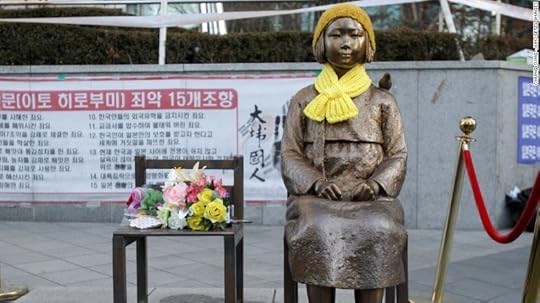
(Statue of Peace outside the Japanese embassy in Seoul https://en.wikipedia.org/wiki/Statue_...)

This was apparently the first Korean novel to deal with the topic, one not openly discussed until the testimony of 김학순 (Kim Hak-sun) on August 14, 1991: https://en.wikipedia.org/wiki/Kim_Hak... after which a number of other elderly women were formally recognised as survivors.

The narrator has never publicly acknowledged what happened to her, even to her family, but as the novel opens one of the last publicly acknowledged survivors has died, leaving just one known survivor.

This causes our narrator to revisit her memories as well as deciding to visit the 'one left', who herself is dying. The story also covers her current situation, her life blighted by what was done to her, living in an increasingly deserted housing development, scheduled for demolition. Her interaction with her neighbours and some of the animals in the area (a stray cat, and the magpie depicted on the cover) make for both a revealing insight into life in the more deprived end of the social spectrum of an increasingly modern and rich country, but also effective parallels to her wartime horrors.

In a constraint both Oulipan in literary terms, and very powerful emotionally, the narrator's story and even her present day thoughts are assembled from over 300 references to actual testimonies of survivors.

A necessary and moving novel - and credit to Bruce and Ju-Chan Fulton for not only translating it and providing a helpful afterword but on finding an English-language publisher, which was apparently not easy.

A strong 4 stars.
Profile Image for Queralt✨.
792 reviews285 followers
February 15, 2021
I have to be honest, I wish I hadn't read this at all.

It's a very important book and I had never read about comfort women (not this graphically and not with such exact depictions of what their lives were like during and after - upon a bit of digging, turns out this is one of the first books about comfort woman every written in fiction and translated), but, damn, I sleep easy at night knowing that the monsters in horror books are not real. I had to stop reading a few times because I was horrified and nauseous, and I just couldn't continue. The thought that this is someone's reality - someone's past, sickens me to the core.

I'm glad this has been written, published, and translated to English. I hope it will be translated to Japanese as well.
Profile Image for yelenska.
683 reviews173 followers
June 5, 2021
this book honestly destroyed me and im glad that I got to the end because I don't know how much more I could take. so heartbreaking to read this, both as a human being and (especially) as a woman. my head and my heart hurt from thinking of the constant abuse these girls went through.

Kim Soom was the first person to write a book about this touchy subject and she did with a lot of sensitivity. clearly, she documented herself very well so that she could give an accurate testimony of what comfort women (girls!) went through. however, before going into this, you must know that she doesn't beat around the bush: descriptions are very vivid. just like you would expect from Korean literature, violence is everywhere and the author does not try to hide it. not at all.

here's to hoping that their next lives will be filled with less horror and more joy. 💕
Profile Image for Nadirah.
810 reviews38 followers
February 7, 2023
This is such a hard book to read, and the courage it took for these women to come forward with the truth about their hard lives makes it even more of an urgent read. As more and more of the 'comfort women' during the WW2 are aging and dying due to old age, more stories of the atrocities & war crimes committed by the Japanese during the world war come to light in order for truth and reconciliation to take place.

What's more enraging is the fact that Japan continues to deny their wrongdoings and war crimes instead of apologizing to the Asian countries it had pillaged and desecrated during WW2, which makes it even harder for everyone to move on. (A 'good' example is German actually acknowledging and apologizing for their part of the WW2, which makes it easier for others to forgive and move forwards in order to survive.)

It's always sad to read about the burden women had to bear when it comes to war between pigheaded men (because the people who start the wars are, inevitably, almost always men, but it's the women who are always victimized when men wants to start a pissing contest between themselves). While this is labelled as 'fiction', whatever happened in between this book is based on real things that occurred to many women across Asia during the past war. If you do plan to read this, please take note of the trigger warnings involved in this read.
Profile Image for Susan.
639 reviews36 followers
September 17, 2020
This is such an important novel. I’ll be reviewing it in the Asian Review of Books in the weeks to come.
Profile Image for Amelia.
590 reviews22 followers
June 22, 2022
"She knows that snails have an incredible life force. Worthless-looking creatures they may be, but they can hold out forever outside the water that sustains them."

One Left follows an older woman between her past as a comfort woman for Japanese soldiers and her present as a woman suffering from PTSD and Alzheimer's. As she struggles to maintain her living situation, she is thrust back in time to remember the horrors she and others girls experienced: cotton balls pushed up against their cervixes while they were menstruating, mercury pills, arsenic injections, the visitations of tens of soldiers per day and night, the freezing cold, the sweltering heat, the lies she must weave about all of this in order to keep soldiers and her family happy.

Littered with footnotes to angle this novel as a fictionalized biography, Soom does a fantastic job at opening the narrative about these forgotten women. Beautiful, heartbreaking, and utterly gut-wrenching. Even more so, for me, when her Alzheimer's comes into the narrative. How worried she is about forgetting--but how grateful she would be, too. But how could she leave the world to forget about women like her? Especially when the last known comfort woman is dying?

Our main character finally admits to herself: I am a victim. She has never said this to anybody, much less herself. Can she see this last known comfort woman, and let her know that there will be someone else to carry the story?

Her narrative is interspersed with snails, beginning from the quotation above. Viewing herself as worthless and small, she is nothing if not a survivor.
Profile Image for anchi.
483 reviews103 followers
July 12, 2022
4/5

I wish I hadn't read this book, but I am also glad that I did. This is fiction based on the stories of comfort women during the Pacific War, and the main character is a 93-year-old survivor who does not publicly disclose her past as a comfort woman.

It's estimated that more than 200,000 Korean girls were forced into sex slavery during that time, and only approximately 20,000 survived. There are details of the lives at the comfort stations back at that time, and it is truly heartbreaking to read the book even after so many decades.

Comfort women happened not only in Korea, but also in Taiwan, where it is mentioned in textbooks briefly. Despite the protests and social movements in the region, some survivors passed away before receiving an apology from the Japanese government.

I am glad that 'One Left' is going to raise awareness of the issue in more countries despite the cruel reality mentioned throughout the book. It is definitely not an easy book to put down my thoughts, but I would recommend this book to anyone who is interested in this particular historical event.

Disclosure: I read the book in Chinese titled '最後一個人', but write this review in English.
3 reviews4 followers
October 10, 2020
“One Left” is a chilling literary work describing the horrific abuses of “comfort women” in World War II. The protagonist, a fictional Korean survivor of seven years in Japanese military brothels, is now in her 90’s, living in present day South Korea. The structure of the novel takes the reader back and forth from the protagonist’s vivid memories of her captivity, to her current isolated life of fear that her past will be discovered. Throughout the novel, the atrocities are expressed through the voices of dozens of “comfort women” survivor testimonies, with extensive references to the primary sources. This important novel brings to attention the lesser known stories of a generation of marginalized Korean women, and is a valuable contribution to Korean literature in translation.
Profile Image for Tia.
26 reviews
September 14, 2025
十三歲的女孩某一天被逼著一夜長大,近距離接觸世界最醜陋的人性,年紀小小、身體瘦弱卻住進了一個經歷滄桑的老靈魂;女孩二十多歲時日軍戰敗,少女們被解放,過去一直在黑暗房間中生活,只懂得洗保險套和血跡,一個字都看不懂,歸家的路都不知道,等待著的是社會的不接納,没有求生技能,自我的厭惡,既熟悉又陌生的家人,經歷千錘百煉原來這個靈魂還只是當年的十三歲少女,而人生的渴望也只是再見一次已經逝去的母親,好好在懷𥚃撒嬌。

這書看得我要憂鬱好幾天,我一定不會再重看,就好像小時候看宮崎駿的再見螢火蟲、錢鋼的唐山大地震一樣的衝擊,心臟承受不了,手顫抖得厲害。令我想起在毛特豪森集中營中,刻在牆上的字「如果這世上真的有神的存在,那麼祂必須向我請求原諒。」神啊,你都有看到嗎?書中寫到據統計慰安婦人數約20萬人(不知道只是韓國,或是包含其他地區)存活的約2萬人,願意站出來講述歷史的有20人嗎?我覺得没有,每一段回憶都是噁心的,她講述的一言一語都是對自己的二次傷害,她們不忍說出口,我不忍聽入耳,但面對日本政府對歷史的否定,令這僅餘的一两名倖存者鼓起勇氣站出來指證,更令人無法別過臉去,必須好好去回應這份勇氣,這書是絕對有存在的必要,我們不是要去怨恨,不是要活在過去,而是歷史不能就這樣被泯滅。
Profile Image for &#x1f425; Ori Nana &#x1f425;.
175 reviews3 followers
April 26, 2024
As a foreigner living in Korea, this felt very, very important to read.
It was.
I’m so heartbroken, angry, and helpless.
This needs to be read, this needs to be understood, and there needs to be peace.
We don’t know if any comfort women are left, but their souls can’t rest knowing their history of pain is denied.
Profile Image for Nika.
250 reviews38 followers
January 20, 2024
"One Left" must have been the most devastating novel I have read in my entire life so far… Having read it for a book club discussion, I have never heard about the story and the concept of "comfort women" before. While wars are probably one of the worst things that humans can inflict on each other, everything that takes place around them usually also shows the worst of humanity. The latter was the focus of this story, taking the reader into the world of what it was like to be for women, to describe it in more explicit words, sex slaves to Japanese soldiers during World War II.

The term comfort women is a euphemism for sex slaves of the Imperial Japanese military during World War II, or the Pacific War, in Asia from 1931 to 1945. An estimated two hundred thousand 2 young women and girls were "recruited" in a variety of ways—deception, coercion, and abduction—and confined in "comfort stations" in China, Manchuria, and other Pacific-region countries, including Australia. The ages of the kidnapped girls ranged from as young as 11 to 25 or older.
Foreword

As a child she believed the most frightening things were natural disasters that involved darkness, drought, or flooding. But after she turned 13 she learned the most frightening things are human beings.
p. 134


The story was told in a captivating way, focusing on one main character and alternating between memories from her past and her current life in the present. The book demonstrated how a "normal" life after living through what these women had to live through is simply not possible anymore. The impact of the events were shared in such nuanced ways, ranging from hallucinations, to physical symptoms and internal emotional turmoil. The reading experience reminded me a bit of the one I had with Hanya Yanagihara’s "A Little Life" . While I was often uncontrollably sobbing while reading that novel, with "One Left" I was just in a constant stupor and a state of shock from the very beginning on, constantly feeling horrified about the fact that everything that was described really happened.

For seventy years now there hasn’t been a single night that she’s slept soundly. For when her body sleeps her soul is awake, and when her soul sleeps her body is awake.
Chapter 1

She never imposed on her family but could never bring herself to spill the truth even to her younger sisters, who considered her a burden and an eyesore: that she hated men; the mere sight of them made her shudder, made her wish she had a gun with a silencer so she could exterminate them.”
p. 31


I wished that all the blame could have been put on the men, taking advantage of the women but in reality both sides collaborated. Women that were the leaders of such "comfort stations" were just another confirmation that there is no end to human cruelty. I won’t go into much of the events that happened at those stations, I feel like they need to be understood in their totality and in context of the whole story but the next phrase below describes the totality of the horrors, as well as how the girls reacted to the events:

Fifteen men a day was normal, but on Sundays fifty men or more might come and go from a girl.
p. 63

And so the girls would cut themselves and bleed to death while high on opium. Knowing that if they cut a finger and sucked long enough to get the blood flowing, the opium would put them to sleep and they’d never wake up. Kisuk ŏnni had died like that, her blood-caked teeth looking like pomegranate kernels.
p. 40

She herself couldn’t endure, no way could she endure, and so she had herself injected too. Which got rid of the pain down below, no matter how she bled, and left her oblivious to the number of soldiers who came and went from her. The high left her feeling life was worth living, but when the drug wore off, she felt a crushing pain all over and couldn’t focus. At first one shot a day would tide her over, but then she’d have to add a second, and on Saturdays and Sundays when the soldiers swarmed in like fire ants, she would need five.
Chapter 5


The only reason why I reduced a star in the rating was a point that was briefly touched upon in the afterword of the book. I understood why the choice of presenting this story in the shape of a novel was important, in order to also portray the feelings of the survivors instead of just the facts. There was just a little something missing, a bit more of a narrative constructed around the main character in order for the reader to be able to make a deeper connection with her as a person. The book exists on the border between fiction and non-fiction, which made it feel a bit off balance for me at times.

We soon found, though, that our sense of urgency was not shared by publishers (and we ultimately approached thirty-two of them)—in spite of their knowledge that One Left, our translation of Han myŏng, had been awarded a 2018 PEN/Heim Translation Fund grant—only the second Korean project to be thus recognized since the endowment of this fund in 2003. "How are we to market this book?" they asked. As a historical study or as a work of literature? One publisher [...] found it more of a history book and, citing unnamed "stakeholders", suggested we find an academic publisher.
Afterword


I consider it an extremely important piece of writing, especially considering the way this topic is dealt with by the Japanese society up until this day. The fact that history is being twisted in Japanese media or that it is said that there is a lack of evidence to confirm whether such events ever happened, makes it an even more pressing issue for as many people as possible to be aware of the topic. The voices of the women concerned need to be preserved and amplified while there are still some of them alive. Considering how hard it is to decide to come forward, tell one’s story in order for such moments not to be forgotten in the history of humankind, the book did a great job in portraying the divided opinions on why we don’t have more witnesses or survivors speaking out.

She herself was a comfort woman for the Japanese soldiers, but she’s unknown to the world at large because she never went public and reported herself as such.
It occurs to her that there have to be others out there like her, former comfort women who out of shame or embarrassment have never gone public. What did they ever do wrong?
p. 19

After registering, I felt lonelier. My sister tried to persuade me not to register, she didn’t want her kids’ marriage prospects affected, and sure enough, once I registered they stopped coming to see me.
p. 107


This book comes with a long list of trigger warnings and I would only suggest you to read it if you feel like you’re in a stable state of mind yourself. It’s a book that I can’t directly recommend, as it’s filled with such horrific accounts but I find that it needs to be read, so that truthful stories prevail in our world. When governments, politicians and the media try to twist and turn stories to their advantage, "One Left" can be seen as a symbol of resistance and the continuing desire for the truth to be told.
Profile Image for Katie Coren.
211 reviews
May 9, 2021
As a child she believed the most frightening things were natural disasters that involved darkness, draught, or flooding. But after she turned 13 she learned the most frightening things are human beings.

This is not a book for the faint of heart. But this is an important book.

Kim Soon tells the story of an unnamed woman, the "one left", who at age 13 was kidnapped while collecting snails by the river. Forced into sexual slavery as a "comfort woman" for Japanese soldiers, she was just one of hundreds of thousands of young women and children, many of whom died in the most horrific ways imaginable. If a woman was lucky enough to survive, she was left with the after effects of the decade-ish long physical and mental abuses, many unable to lead normal lives, whether from shame or complications from things like syphilis.

Is it a sin if you're the only one who survives? Even if the place survived is hell?

The story's protagonist is now in her 90s living alone and undocumented in her nephew's dilapidated house. When a news segment runs a story on the last comfort woman who is finally coming forward with the grim details of what happened to her and the countless others like her during WWII, our lead realizes she, too, must come forward. After 70 years of silence, she must also give voice to what happened - to the atrocities that occurred - to say, "I'm a victim too".

One Left held nothing back. Nothing. It was a d i f f i c u l t book to read. Even at less than 200 pages I found that I had to put it down a few times to let what I read settle. This both is and is not a work of fiction, and having known little to nothing about the subjugation and trafficking of Korean women during the Japanese colonization of Korea during WWII, I was left completely mortified. I say this is an important book for many reasons, least of all due to the fact that to this day there is strong denial regarding these atrocities. Even today, in our "me too" age, victims of abuse have a hard time coming forward due to things like backlash, painful interrogations etc.; it was even harder in the latter half of the 20th century for these comfort woman to come forward. They had no voice then. It is well past time they did.

4/5 ⭐
There were times this felt more like an academic text rather than a novel: at best it read like a mash-up of the two. This was actually addressed in the Afterword - they had a difficult time finding a publisher in part to this. I think the story could have been more immersive if it had swayed more towards a "novel" side rather than fictionalized rendition of the true story of comfort women.
This is not a book I want to read again, but I'm glad I did. There's some big-time trigger warnings for this one, but if you can manage it, I recommend you add it to your TBR.

"From a distance it is all too easy to consign awareness of historical outrages to a dim corner of our consciousness. Not until we are confronted with direct evidence of a disaster... are we forced to acknowledge the magnitude of the trauma and the urgency of the need for healing."

📚For more, check out my Instagram📚
Profile Image for Holly.
40 reviews2 followers
December 30, 2024
Heartwrenchingly devastating and violently graphic, but beautifully written. One Left by Kim Soom is a Korean novel that grapples with a shameful segment of World War II history that is often forgotten in our historical consciousness—that is, when over 200,000 Korean girls were forced into sexual slavery for Japanese soldiers. These girls came to be known as comfort women.

Though fictional, this is an extensively researched novel constructed from the testimonies of dozens of comfort women. Notably, the first Korean novel devoted to this subject, it rekindled conversations about comfort women, as well as the violent legacies of the Japanese colonial period.

We have long since entered a time period in which there are few remaining comfort women who are still living today. Despite coming forward with their testimonies, these women’s lived experiences of sexual slavery and trauma have never been properly acknowledged or redressed by the Japanese government.

How do we confront these histories—not just on an individual level but as a collective? How do we hold perpetrators of crimes against humanity accountable to what has long since taken place in the past? How do we ensure that we never forget what these girls experienced? Is it possible to work towards building a world where this never happens again?

I’m left with these questions after reading this book and have little optimism for the future of humanity. But I’m grateful to Soom for bringing to light again a piece of history that cannot be forgotten.
Profile Image for Saran Dafydd.
6 reviews
February 22, 2023
This is really not an easy read. Even though it wasn’t easy, it’s definitely a must-read.
It was so beautifully translated, and the comfort women’s story was well written. I would recommend anybody who’s interested in the Comfort Women, to give this book.

Written by Kim Soon (김 순), this book tells the tale of a woman who was kidnapped by the Japanese soldiers and was forced to work at a ‘comfort station’.
The book travels back and forth, from past to future, and we get to see how her past has affected her life. After returning from the ‘comfort station’ she eventually lives by herself, where the horrors of her life as a sex slave follow her back to Korea.

It is such a heartbreaking, yet eye opening book. The descriptions of certain scenes were gruesome. The use of quotations from the survivors really documented the history aspect of this book, while also creating a fictional survivor.
This entire review has been hidden because of spoilers.
Profile Image for Miriam.
174 reviews
July 29, 2021
This novel uses the testimony of actual "comfort women" to create a horrifyingly accurate "fictional" picture of the experiences of the young girls (children as young as 12 or 13) who served as sex slaves for the Japanese military personnel during WWII. While this book was hard to read, it was well-written (even through translation), and gave witness to an important historical tragedy.
Profile Image for Alex.
418 reviews20 followers
November 9, 2021

Horrifying, gripping, and significant.

It's honestly a necessary read for anyone who believes themselves to be conscious of the modern era's enlightened moral values... I'm only giving it a 4 because it's not actually an enjoyable read, it's a necessary and exquisitely crafted one, but not a pleasant one...
Profile Image for Ali G.
687 reviews20 followers
January 1, 2024
This book is horrific and highly disturbing, but important.
This is based on real and graphic testimony from “comfort women” survivors, and there are things you will read that are so horrible it’s almost incomprehensible.
Profile Image for Cin.
85 reviews
June 30, 2025
The world needs to know the stories of these women…

3 stars because I didn’t enjoy the disjointed writing. Then again, those were not memories one would like to have a recollection of…

I would also recommend anyone who see this review to read the wiki page of “comfort women”.
Profile Image for Nancy Jorgensen.
Author 4 books6 followers
October 29, 2021
A Crucial Reckoning

Some stories are too terrible to be told. Perhaps that is why it took seventy-five years for One Left, by Kim Soom, to be written. Hers is the first Korean novel about Korean women captured as sex slaves during the Pacific War. Of 200,000 women and girls, stolen and enslaved, only 20,000 returned alive. It took decades for the cruelties to be acknowledged and the victims remembered. And, as is often true in sexual abuse, the sufferers’ own guilt and shame also perpetuated the silence.

As One Left begins, the 93-year-old protagonist hears a story on television introducing the only remaining comfort woman in Korea. The protagonist, called simply “she”, has never revealed her own survivor status. But now, if the woman on television dies, she will be the only one left.

She lives with her cat Nabi in a house that belongs to her nephew. The house, with an outdoor faucet and latrine, sits on a mere fifty-nine square yards of land. In an opening scene, she discovers a dead magpie lying next to her shoes—two Korean symbols that reappear throughout the story. As she wanders the streets, interacting in her neighborhood, we meet a beauty parlour woman; convenience shop owners; and an old man who cares for his disabled son by selling copper junk and captured kittens.

The kittens reappear too, serving as one of the story’s metaphors: “Just like the girls became the property of a haha, okusan, obason, or otosan after they were snatched and taken away while weeding the field, picking cotton, fetching water from the village well, returning home from washing laundry in the stream, heading to school or tending to their ailing father.”

Each of the protagonist’s present-day interactions sparks a flashback to Manchuria, where she was forced to work. In these interludes, we meet her friends—other girls taken, as young as thirteen, to service Japanese soldiers. In the 1930s and 1940s, these Korean girls were promised factory jobs, or simply kidnapped. Transported via truck or train, once in Manchuria they were forced to have sex with soldiers, physically abused for breaking the rules, induced into opium addiction, surgically maimed, and required to wash and reuse condoms. Their superiors charged them for food, menstrual pads, hot water, and heat, until, buried in debt, the girls could never buy their way out.

As a reader, I search novels for comparisons to my own life. In this case, my privileged circumstances bear no resemblance to the horrors exposed in the book. So, instead, I read to learn and empathize. There was much here to absorb about misogyny, cruelty, and hegemony.

The novel unearths a litany of atrocities, documented by Kim Soom’s extensive research. Chapter by chapter, graphic details come directly from testimonies of real-life comfort women. Information is identified by a footnote with sources listed at the end of the book.

Without melodrama, using the straightforward power of truth, Kim Soom reveals the barbarities. Yes, it is fiction, but corroborated by facts. “He told her to swallow his semen.”—“The bullet passed through her uterus. It didn’t kill her, but it left her like a rotten pumpkin down there.”—“To keep them from escaping, he had strung electric wire around the compound.”

One Left, translated by Bruce and Ju-chan Fulton, employs artful and evocative language, creating striking visual images: “As soon as she saw the girls emerging from the cargo bin, she started counting heads, like a rancher taking inventory of his livestock.”—“The sun was setting and the afterglow was blood red.”

Woven in and around wartime flashbacks and modern present-day, the woman on television reappears. Her story spurs the protagonist to consider. Was she right to remain silent? Is it time to speak up? Or is she still afraid of stigmatization and social exile?

How can she divulge the truth? And what would be the consequences? No one knows she was captured at thirteen to be a sex slave. No one knows that every day, men visited her by the dozen. Fifty on Sundays.

With her end-of-life looming, she faces decisions and dilemmas. How long will her money last? Will a proposed demolition destroy her home? Will her nephew move her to a nursing home? Will she die alone with her secret? Or decide to share the truth?

Twenty-first-century newspapers report on human trafficking. There is an international #MeToo movement. Women and girls account for 99% of sex industry victims. The statistics are shocking, but they can seem removed from daily life. But, in One Left, I experienced these abominations in my gut—the broken bones, ripped vaginas, and perpetual hunger—through Kim Soom’s compelling character.

This story is strewn with themes of memory and guilt, domination and abuse, the human instinct toward self-preservation, and faith in gods and humanity. Through this fictionalized account of true events, readers gain insight about those who committed crimes, those who abetted the criminals, and the long-lasting effects of sex crimes. I read the 224 pages in just a few days, but weeks later, its images haunt me.
Profile Image for Kate.
9 reviews
September 5, 2025
The ultimate horror story for all women. Every few pages I had to pause, gasping for breath, trying to steady myself. As someone who can barely handle the anxiety of a routine gynecological exam, I cannot begin to fathom the hellish life of the 200,000!!! comfort women. The term "comfort woman" itself sounds almost neutral, even gentle on the surface, yet it has become synonymous with one of humanity’s darkest atrocities in the history. They walked through hell on behalf of us all
Profile Image for John.
147 reviews86 followers
April 5, 2024
During World War II, over 200,000 Korean girls were forced into sexual slavery. They were incarcerated in ‘comfort stations’ across Japanese-occupied territories and subject to torture and humiliation. When the war ended, less than 10% of these girls survived and returned to Korea. One Left reimagines this historical moment and relates the story of one of these survivors.

When she was thirteen, the protagonist was kidnapped all the way to a ‘comfort station’ in Manchuria. There, she met plenty of Korean girls who were either forcibly taken away from their homes or tricked into sexual slavery (the latter group was promised factory or nursing jobs by the Japanese authority). Upon her arrival at the ‘comfort station,’ with a new Japanese name thrust upon her and her inability to fathom the perilous situation she was in, the protagonist was forced to ‘sleep’ with countless Japanese soldiers so as to ‘motivate’ them to fight the war valiantly. Her innocence was robbed before she knew it.

The atrocities committed by the Japanese and the violations done to the girls’ bodies were at times hard to read. They were exposed to sexual diseases. If contracted, their allocated supplies would be confiscated as punishment. Instances of physical and mental abuse inflicted on them by both soldiers and ‘comfort station’ managers are observed throughout the book, such as tattooing the girls on different parts of their bodies. The girls were also ordered to wash used condoms in the morning before the first batch of soldiers came. Due to starvation and incessant rape, the girls tend to fall sick. However, they were forced to work in spite of their frailty. When a girl became pregnant, forced abortion or sterilization was performed. The girl’s womb was taken out of her body so that she could ‘serve’ more soldiers. Her chance at motherhood was gone. When a girl succumbed to illness or committed suicide, her body was disposed of using incineration, and the managers would replace her with a new girl. These girls were nothing but disposable to the Japanese.

Apart from the instances above of Japanese atrocities, another noteworthy one is the staggering juxtaposition between the inhumane living conditions of the girls and the comfortable ones of the managers and their children, which reminded me of the movie The Zone of Interest.
The protagonist eventually escaped the ‘comfort station’ and made her long way home. Since the end of the war, she has been living a life of seclusion without telling a soul about what happened in Manchuria. She is now in her 90s. Upon finding out from the news that the last known Korean ‘comfort woman’ is dying, the protagonist cannot help but assert that there is still one left here. In fact, all these years, the past has never failed to haunt her. Living in a society which is governed by Confucian principles, sexual slavery victims are/were without the courage to tell their stories for fear of being ostracized. Thus, the protagonist’s reluctance to tell her family about her plight. As time passes by and death approaches, she gets more anxious than ever, for she is well aware that when she is gone, so are all her stories and the girls’. Despite her fear and indecisiveness, she knows that she needs to do something before time runs out.

The significance of One Left lies in the fact that the text is incorporated with testimonies by Korean ‘comfort women,’ making it the first of its kind. At one point, the protagonist writes down the words, “I am not a comfort woman.” The scene points to the derogatory quality of the term itself. Thus, it is necessary to include quotation marks when writing it. Going against ‘comfort women’ denial powered by the Japanese government as well as the shaming culture in Korean society, One Left is not a solitary longing and demand for long-awaited justice as it appears to be. On the contrary, it can be seen as the victims’ collective shout for proper acknowledgment of all they have been through. They have been to hell and back, and they do not want to be forgotten in history. Each of them has a story to tell. Needless to say, Kim Soom has done her part as a writer to promote awareness of the issue. One Left is, without a doubt, a testament to the possibility and necessity of literature in our times where remembering seems to be a difficult thing to do.

Profile Image for Doreen.
1,248 reviews48 followers
March 19, 2022
3.5 Stars
This is the translation of the first Korean novel about comfort women. The original was published in 2016; the translation, in 2020.

The protagonist is a 93-year-old woman known simply as She. Though she had “a dozen Japanese names and more than one Korean name,” she doesn’t remember her real name. When she was 13, she was kidnapped and taken to Manchuria where she was forced to become a comfort woman for Japanese soldiers. “During her seven years at the comfort station, thirty thousand Japanese soldiers came and went from her body.” Now she lives a largely invisible life in a dilapidated house in a neighbourhood with few inhabitants, always fearful that her past will be exposed. She sees a newscast that a comfort woman, believed to be the last survivor, is dying; this news triggers her flashbacks to her time in Manchuria.

This novel uses an interesting technique. Though the protagonist is fictional, her descriptions of events and even bits of dialogue are footnoted to documented testimonies of actual survivors. So though the book is classified as fiction, it is based on non-fiction accounts.

More than 200,000 women were forced into sexual slavery, but only 10% survived. The conditions at the comfort station were horrific. Besides being sexually exploited, the girls were physically abused and induced into opium addiction. They suffered from sexually transmitted diseases (washing and reusing condoms) and trauma that often left them physically maimed, unable to bear children, and psychologically scarred.

Those women who survived and made it home kept quiet. It was not until 1991 that a woman spoke up and then others also came forward with their stories. Those who registered did receive some government compensation, but were still stigmatized. One woman who is able to build a house with government assistance is still an outcast; “the neighbor had called her a dirty cunt and said she sold her pussy to have that house built.” The protagonist has told no one about what happened to her; “Her wish is to live and die quietly without troubling anyone and without being treated with disrespect.”

The protagonist’s emotional and psychological scars are obvious: “Whenever she thinks about herself, shame fires up first. It’s humiliating and painful to remember who she is. In the process of trying not to examine and reveal herself, she has forgotten who she is.” Marriage was not a possibility for her: she hated men; the mere sight of them made her shudder.” Because of her secrecy, “she’s long since lost all sense of attachment or kinship to anyone.”

The comfort women were shamed, marginalized, and silenced in Korea. And the Japanese government was reluctant to admit that women were coerced into becoming comfort women. In the Foreword, it is stated that “Emperor Hirohito had been directly involved in all military activities, including establishment of the comfort women system.” Also Kishi Nobusuke, the maternal grandfather of Japanese Prime Minister Shinzo Abe, is identified as a war criminal.

The book’s subject matter is relevant today. Uighur camp detainees in China have made allegations of systematic rape. Conflict-related sexual violence has been reported in a number of African countries; in fact, the protagonist watches a television program which discusses rebel forces assaulting women to assert their power. Muslim women in southeastern Bosnia and Herzegovina were subjected to systematic and widespread gang rape, torture, and sexual enslavement by Bosnian Serb soldiers in the 1990s. And sex trafficking is a problem in many countries, including Canada.

The book is not an easy read because of its subject matter. The writing style doesn’t help either; it is often chunky and disjointed. Nonetheless, I think it is an important book.

Please check out my reader's blog (https://schatjesshelves.blogspot.com/) and follow me on Twitter (@DCYakabuski).
5 reviews1 follower
October 11, 2020
“One Left” is a powerful Korean novel written by author Kim Soom. It tells the stories of a number of young Korean girls - some as young as 11 or 12 years old - who were pressed into sexual slavery by the Japanese military during the Pacific War. The girls were either forcibly kidnapped or their parents were lied to about where their girls would be taken and what they would be doing when they got there. After being transported to a “comfort station” in Manchuria, the girls suffered a hellish life of brutality, disease and degradation at the hands of the Japanese “comfort station” owners and the Japanese soldiers whom they were compelled to sexually service. Some of the girls died. Only a few managed to return to Korea after the war ended.

The novel is told through the eyes of an old woman living in Seoul who was kidnapped as a young girl from her village in Korea and taken to the “comfort station” in Manchuria. She is one of the lucky ones who was able to make it back to Korea after the war. The novel is divided into two parts: her kidnapping and life at the comfort station, and her return to Korea. The latter part relates the shame she felt as a former “comfort woman” and her refusal to admit to her family and neighbors what she had been. After seeing on television that another former “comfort woman”, whom the media referred to as the “One Left,” was dying, she felt the need to “come-out” and admit her past life as a victim through no fault of her own. She desired to visit the dying woman in the hospital and to tell the world that after that woman died, she would be the “One Left.”

“One Left” is Kim Soom’s first work translated into English. The book’s translators, Bruce and Ju-Chan Fulton, have masterfully brought it to life for English readers. No words are minced or euphemisms used in describing what the girls experienced. I commend this book to anyone who desires to look into this horrid chapter in Korean history.
220 reviews3 followers
June 7, 2021
Incorporating endnotes throughout that reference real-life accounts, Kim's novel offers one of the first South Korean retellings of the "comfort women" atrocity, where 200,000 young girls were forcibly removed from cities and villages and taken to Japanese military locations, and then forced into 40-70 acts of sexual servitude each day. Only 20,000 survived that bondage, and most were mute as to the violence when they returned home, choosing easier stories that glossed the infertility and syphilis that they now carried in them.
While the first half minutely tracks this horrific legacy, Kim's book also tracks the psychological devastation that lingers, where South Korean narratives of shame led to a consistent act of silence until the 1990s, and where even women's testifying to the brutality that they suffered led to friends and families retreating from them. Here, the main character realizes that the final survivors are all dying and soon there will be none (unless she speaks up) left. It doesn't go where you expect, but recommended to anyone who also considers the work of Tadeusz Borowski, Han Kang, or Anna Akhmatova.

In its willingness to have multiple
Profile Image for Lauren.
14 reviews
August 4, 2023
This book is guy wrenching and real.

I picked up this book for a book report for my leaving certificate 2 years ago, in which I never got to fully read it and used it as a reference for my book report.

This book focuses around a surviving halmoni from the era of world war 2 where many young women from countries under Japanese countries were forced into sex slavery under a false pretense.

Reading about how women were forced to have abortions the gory depictions of how a seven month fetus looked, made me lose feeling in my hand from the raw emotion I experienced. I had to put the book down for a few minutes just to get that sense of feeling back in my own hands.

Id recommend this book whether it’s casual reading or for a book report the raw emotion that this book conveys is strong.
This entire review has been hidden because of spoilers.
Profile Image for Ananya.
192 reviews
Read
March 8, 2025
how do you ever rate such a book? how do you read a book full of the horrors committed against women in history and write something about it that can ever explain what it feels like to read about it? nothing I say here can summarize or explain this book. Just know that it is essential in every way to read and know as much as you can about this, and other such atrocities committed against women. Reading this book was extremely difficult at times but I didn't cry once. Reading this book has changed me in a way I can't begin to explain. You need to read this so that there are always people in the world who remember. So that these incidents don't just become that one "tragic part" of history. Read, remember and talk about it. We need to remember so that their stories are never forgotten.
Profile Image for Noah Gampe.
44 reviews
May 22, 2022
Just an absolutely brutal look into some of the horrors that occurred during the war. At times it was almost difficult to continue on with the amount of detail used in some of the graphic scenes (of which there are many). It's such a heartbreaking look into the lives of the young girls that were forced into arguably some of the worst conditions imaginable. It definitely helped me understand exactly why their continues to be bitterness, frustration, and anger between the Korean and Japanese peoples.

I personally was very moved by this novel, though it was a bit difficult to stomach at certain times.
36 reviews
May 22, 2022
Just an absolutely brutal look into some of the horrors that occurred during the war. At times it was almost difficult to continue on with the amount of detail used in some of the graphic scenes (of which there are many). It's such a heartbreaking look into the lives of the young girls that were forced into arguably some of the worst conditions imaginable. It definitely helped me understand exactly why their continues to be bitterness, frustration, and anger between the Korean and Japanese peoples.

I personally was very moved by this novel, though it was a bit difficult to stomach at certain times.
Profile Image for hana .
172 reviews
September 19, 2022
I don't have the capacity to describe the effect this book had on me. It left me reeling with anger and sadness and hopelessness and utter sorrow as I tried to imagine the living hell the hundreds of thousands of comfort women had gone through. We need this book, especially since this part of history is very much erased (thanks to efforts by the japanese govt) This book was incredibly hard to get through, and left me battling tears. This book broke me in the worst way possible. Undeniably, it is a very, very essential book to be read, so that we can respect history and those who suffered from it, and still continue to do so today.
Displaying 1 - 30 of 57 reviews

Can't find what you're looking for?

Get help and learn more about the design.