Jump to ratings and reviews
Rate this book

Cathedral

Rate this book
A thoroughly immersive read and a remarkable feat of imagination, Cathedral tells a sweeping story about obsession, mysticism, art, and earthly desire in gripping prose. It deftly combines historical fiction and a tale of adventure and intrigue.

At the center of this story is the Cathedral. Its design and construction in the 12th and 13th centuries in the town of Hagenburg unites a vast array of unforgettable characters whose fortunes are inseparable from the shifting political factions and economic interests vying for supremacy. Around this narrative center, Ben Hopkins has constructed his own monumental edifice, a novel that is rich with the vicissitudes of mercantilism, politics, religion, and human enterprise.

Fans of Umberto Eco, Hilary Mantel, and Ken Follett will delight at the atmosphere, the beautiful prose, and the vivid characters of Ben Hopkins’s Cathedral.

622 pages, Hardcover

First published January 21, 2021

568 people are currently reading
4862 people want to read

About the author

Ben Hopkins

6 books32 followers

Ratings & Reviews

What do you think?
Rate this book

Friends & Following

Create a free account to discover what your friends think of this book!

Community Reviews

5 stars
502 (30%)
4 stars
633 (38%)
3 stars
379 (22%)
2 stars
115 (6%)
1 star
29 (1%)
Displaying 1 - 30 of 264 reviews
Profile Image for Beata .
903 reviews1,385 followers
June 13, 2021
Sometimes I see a title and cannot resist not reading it. Cathedral was such a book. I plunged into it and spent many hours together with the medieval community of the town of Hagenburg and the cathedral in the foreground. Chapers are tales of the inhabitants of all walks of life and denominations and span almost across the whole 13th century. This is an epic novel at its best, focusing on character development and history rather than romance, which I found most appealing. There is nothing that I might call sweet or romanticized plot with knights, ladies in the tower and masons. Quite the opposite, life revolves around hardships, ambitions, luck, bad luck, good choices, bad choices, persecution vices and many more fragments. The plethora of characters may be a little too wide for some readers but if you follow them carefully, the whole beautiful medieval tapestry is formed with time. A special bonus for me was the mention of the Dutchy of Kalisz, one of the oldest towns in Poland. The duke welcomed the Jews and passed favourable laws for them to settle down and prosper, and a big diaspora came into being, consisting mainly of the Jews fleeing Germany.
A truly remarkable novel!
Profile Image for Kalliope.
738 reviews22 followers
March 29, 2021


This was a triple surprise. First because I received at Christmas an unexpected and wonderful gift: a year subscription to a monthly book from a London bookstore. Second because when I received this first book in my subscription, I was thrilled that I had not heard of it nor of the author. And third because it was been one of the best books I have read lately.

The quotes from published reviews quickly compare it to Ken Follett. I have not read Follett, but something told me that this uninviting comparison was a publisher’s trick. And now I believe it most probably is – but I will leave this comparison as hypothetical for I do not plan to read Follett.

The title can also be slightly misleading. This is not a eulogy to those marvellous buildings of intricate beauty and defying impossibility. The quote in the back cover is a good indication that what this novel offers is not a run-of-the-mill medievalist historical novel.

There are many things I detest in the is world, and not many things I love. But I think it is clear that the thing I detest the most of all is that Bottomless Hole that gapes not fifty paces from my Counting Table: The Cathedral.


In fact, although the Cathedral – or rather the project of it – does stand in the middle of Hagenburg, the town that Hopkins has chosen as the centre stage of his story, I kept thinking more of a tapestry rather than a stone construction. There are so many threads tangled and weaved, for the novel jumps from one character to another and we follow about fifteen lives, that once I finished it l did for myself a chart tracing the scheme of how these characters, all splendid creations with a voice of their own, interacted with each other along their time, drawing their individual lives while creating altogether a mesh that seems a slice of history. Some of these characters disappear halfway through while new ones break in, just like it happens in life, for the book spans a period of close to fifty years, starting in 1229 (that is, a couple of years into the papacy under Gregory IX who instituted the Inquisition), with a sort of Epilogue in the following century. The overall picture that emerges out of this textual tapestry is a medieval version of Snakes and Ladders in which many Wheels-of-Fortune are interspersed.

The book is rich in themes too. Obviously, there is the construction of a cathedral, at a time when the Gothic style was still insinuating, or rather, imposing its way into the sturdier architecture of yore eventually dissolving any opposition. But we are also presented with these other: life in a Germanic town, the precarious presence of Jewish communities; commerce and transport during that time; orthodoxy versus heresy; Church and the bourgeois citizens; Church and the nobility; the Pope and the Staufen Emperor; the nobility and the nobility; the Papacy versus its Dioceses.

Although Hopkins does not spell out the historical headlines of the period, they can be read in between his fiction. Apart from coinciding with the establishment of the Inquisition, these are the times of the frontal opposition between Pope Gregory and Emperor Frederick II (1195-1250), the rivalries amongst Frederick’s various sons with the consequent problematic succession after Frederick’s death, the renewed confrontation between Frederick and the succeeding Pope, Innocent IV, the problematic succession after Frederick’s death. But Hopkins devotes attention to the dynamics of a historical process of ‘longue durée’ that permeates under these factual headlines: the emergence of the bourgeoisie, with its merchants and craftsmen, and the way it stole social prominence from the nobility, as Baron Volmar von Kronthal utters:

The real war isn't the Staufen against the Pope. It is We against Them. Them with their Guilds and their fat Purses, buying up noble land. Upstarts. Mark my words, if we don't cut off they head, they will eat us alive.


I was sorry I finished this book after I reached its 618th page and maybe it was my feeling of unsatiety that led me to investigate the writer. He wrote this book during seven years, on the side, since his main professional and artistic activity is film/documentaries and script writing, and this other kind of writing certainly transpires in Cathedral, since he has a gift in the way he shifts viewpoints, creates vivid dialogues, perceptively selects characterizing details, and as a polyglot he has a gift for capturing striking turns of phrases.

It seems he is planning another novel. I very much hope so.
Profile Image for Eric Anderson.
716 reviews3,919 followers
July 8, 2021
When going on holidays to foreign European cities I'll sometimes visit cathedrals as this seems like the thing tourists should do. I remember walking through a cathedral in Portugal and passing an Irishman who impatiently sighed to his friend “I don't wanna visit another feckin church.” I too wander around their cool-aired interiors staring up in befuddled wonder, gazing at the majesty of it all but uncertain why I'm visiting a centuries-old monument. Even if I'm impressed by its beauty and stature I can't help thinking how such solemn grandeur must have demanded considerable sacrifice and been built with untold backbreaking labour.

The impetus for Ben Hopkins' novel “Cathedral” is the construction of a principle church for the diocese in the fictional German town of Hagenburg. Taking place over the 1200s & 1300s, it follows the lives of several characters from many different levels of society whose fortunes rise and fall over time. Even after a century as bishops and popes come and go, the cathedral still hasn't been completed because of frequent societal tumult, a lack of funds and the complexity of building such a structure. Its place at the centre of the novel is more symbolic because the real focus of this impressive and immersive historical novel is a shift in society as capitalist opportunities disrupt the feudal system which governed Europe during that time. Enterprising peasants ascend in power to challenge the nobility and feckless noblemen find themselves ousted by opportunists. However, religious and political instability means that no one's status is secure and it's thrilling to follow the fates of the many fascinating characters who we encounter.

Read my full review of Cathedral by Ben Hopkins on LonesomeReader
Profile Image for Marc Lamot.
3,461 reviews1,970 followers
January 24, 2023
3.5 stars. One of the best historical novels I've read, these last few years. Normally, historical novels aren't my thing, but this really is one to enjoy. Hopkins takes us back to the Middle Ages, to the Alsace, the border area between the Vosges (now France) and the Black Forest (now Germany). He chronicles life in and around the fictional town of Hagenburg, where a Gothic cathedral is under construction in the 13th century. Contrary to what the title suggests, that cathedral is not the central focus of this novel, but a motley crew of characters is. Hopkins presents different perspectives, and he varies the form through an alternation of 3rd person narrators, personal testimonials, diaries and letters, with the chronological line shifting each time, spread over a period of 40 years.

To my surprise, Ben Hopkins turns out not to be a professional author at all (this is his first book), but a film director. That may explain the very smooth, scene-bound storytelling style that – at least for me – never drowns in historical details. And yet he brings a very rich, and above all correct evocation of that medieval period: the poverty of most people, the bustling chaos of town life, the cynical power game between various authorities, the rise of the bourgeoisie in the cities, the special place of Jews in medieval society , and on a more political level the Investiture Controversy between Pope and Emperor, and the rise of the Habsburg dynasty.

Don't expect a complete story: the characters come and go, a few happy events alternate with a lot of doom and gloom. What is striking is that almost every character, rich or poor, voiceless or powerful, sooner or later has to deal with his or her share of misery. Hopkins' message is clear: it is an illusion to achieve permanent happiness in this earthly existence; there are no constants nor certainties in this vale of tears, and existence is embedded in a vortex of ever-changing circumstances. Hopkins illustrates this in a story that is absolutely worth reading, even for 600 pages.
Profile Image for Left Coast Justin.
612 reviews199 followers
December 15, 2025
The lessons of this page-turning epic seem to be: If you happen to be a twelfth-century European, then for God’s sake:

-Do not be Jewish
-Do not be female

What made this book great was the sense of normal day-to-day life. People back then didn’t have dental insurance or Gore-Tex or Minecraft, but they most certainly had deadlines and annoying neighbors and intense soul-destroying crushes on unavailable men or women. The one part of the book that made me choke up was the modesty of an eighteen-year-old girl’s regrets shortly before she was executed as a heretic:
I am sorry for many things. I am sorry I have not tasted mulled wine and meat. I am sorry I have not tasted the spiced Christmas candied fruit that they make into round cakes in the winter markets. I am sorry I did not take the invitation from the girls at Speyer when they asked me to come out and play. I am sorry I have not tasted love. It was offered me by gentle Master Achim but I could not take it. Achim, I did love you, forgive me. I thank you for my only taste of honey cake.
Hopkins, who is a screenwriter and who has, as far as I know, only written this single novel, makes his people very real to us. And there is a very large cast; I probably would have enjoyed this more with fewer generations, narrower reach and more detail. Hopkins’ goal of helping us truly understand the conflicts in a feudal system, in which life is hellish for people at the top of the system and even worse for those at the bottom, was fully achieved. The bishops, knights and wealthy merchants who control so many people’s fates are no less tormented than the servants and stonecutters; they live in greater comfort, but that’s about all. Wealth does not buy security, nor medical care, nor love (though it does afford sex for those who can manage it.)

It's a grim story, for most of the characters, but I took comfort in realizing the things that make me unhappy are the exact same things that have been making people unhappy forever.
Profile Image for Randal White.
1,036 reviews94 followers
November 17, 2020
This was an amazing book! A Ken Follett novel meets the Game Of Thrones series. It's the story of a cathedral being built in the 1200's. An amazing cast of interesting characters. Royalty, religious people, an emerging merchant class, peasants, knights, and on and on. The political maneuvering between, and amongst, these folk makes for great reading. And the treachery! My goodness, you could not predict who was going to betray who from chapter to chapter.
This is a long read. Not something you're going to start and finish in one sitting. However, at the end I found myself wishing that it would go on longer!
Give this one try, I think you'll enjoy it!
Thank you to Net Galley for giving me an advance copy. And to the author, for writing such an interesting novel!
Profile Image for Boudewijn.
846 reviews205 followers
August 10, 2023
Whenever I visit an old medieval town, one of the first things I do is visiting the local church or - even better - the local cathedral. I remember myself wandering through the great cathedral of Cologne, in awe of the craftsmanship and the sacrifice that it must have taken to build these monuments of solemn beauty. So when I noticed one of my fellow Goodreads friends (thanks Marc!) noting that this was the best historical novel he had ever read, I immediatley put this book on top of my TBR list. While scanning the cover, my thoughts immediately went to Cologne cathedral and - expecting a book about the building of a cathedral, perhaps in the same line as Ken Follet's Pillars of the Earth about Kingsbridge's cathedral.

Yes ... and no. Yes, this book is about a cathedral, but the cathedral, despite its symbolic centrality, serves as a backdrop to a more significant transformation: the societal shift from feudalism to capitalism. The narrative unfolds through the lives of diverse characters from various societal strata, tracing their fortunes as they ebb and flow. We see a nobleman who struggles to maintain his family's position in the face of the emergence of a powerful bourgeoisie. A bishop's treasurer with a shrewd understanding of politics and finance. Members of a peasant family who rise through the ranks of society by leveraging wit and determination. And did I mention the Jews? A Jewish moneylender who becomes entangled in the changing economic landscape and at the same time has to endure rabid antisemitism.

The novel is primarily set in the (not fictional!) German town of Hagenburg during the 13th and 14th centuries, a society teeming with bargains, betrayals, and conflicts and engaging the reader in the intricate dance between religion, politics, and commerce. Characters are followed during these times, often fall on hardships or even die, but all are driven by ambition and growth for their families. There is no plot, but this absence is more than compensated by its intricate narrative. As a reader, I found myself submerged in a dynamic medieval world filled with shifting power dynamics, religious tensions, and evolving social structures, which only strengthened the power of Hopkins's storytelling.

So who is Ben Hopkins? I had never heard from him. Apparently, Ben Hopkins is a British filmmaker and screenwriter and "Cathedral" is his first novel. I can see how he has used his talents to his advantage - the characters burst forth from the pages with an extraordinary vitality. The scenery leaps to life with a cinematic vividness that beckons the reader to step into the world he crafts. Just one example where Eugenius von Zabern, the bishop's treasurer and one of my favorite characters, explains the difficulties arising concerning the succession of the bishop:
His grace bishop Bertold is still dying. But his body, bruised and bloated, seems in no hast to give up the ghost and so the question of his succession, which a few years past seemed to be a smooth transition neither to me or the arch deacon, gradually becomes a tiresome political struggle. Factions emerge, make their requests, join with other factions, silent pacts are made between individuals and parties, plots are whispered in the chapter house corridors and the two candidates are forced to woo the support of men like the count Von Schwanenstein who, by quirk of tradition, is indeed canon of the cathedral despite living a life of sin and disillusion.
The quote showcases his ability to intertwine multiple elements within a single paragraph, from the physical state of Bishop Bertold's body to the evolving political landscape surrounding his succession. Hopkins carefully constructs his sentences, layering information and insight seamlessly, drawing the reader into a world where every element contributes to the larger tapestry of the story.
“Cathedral” helped me to reassess the historical cathedrals and churches I still hope to encounter. From now on, for me these buildings will not only embody the architectural marvel, but thanks to this novel they have become repositories of stories, each stone bearing witness to the intricate tapestry of lives and ambitions. And needless to say, I will be eagerly awaiting his next novel. Perhaps he can focus on writing from now on, as I am sure a lot of readers can only anticipate with excitement the prospect of him continuing to write another novel.


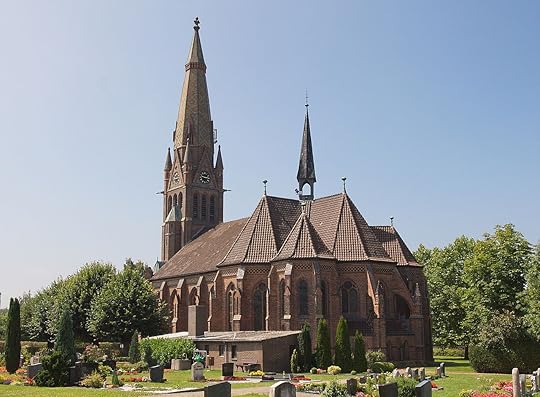
Not exactly a cathedral, but the evangelical lutherian St. Nicolaaschurch in Hagenburg, Germany
(Source: wikipedia)
Profile Image for Judy.
386 reviews14 followers
March 29, 2021
I really loved this through the end of Book Two, but I just couldn’t get through Book Three. This is really a great book for anyone who enjoyed the Pillars of the Earth series, but unlike the Ken Follett books this one just seems a bit too long.. So many similarities between the two, but primarily that main characters are killed off when you least expect it and the conflict between church,, wealthy and poor. I wish this had ended with Book Two and tied up a few more loose ends. It is definitely worth reading but be prepared to make the commitment.
Profile Image for Daniel Shindler.
319 reviews206 followers
July 1, 2021
“ Cathedral” is an epic novel with a title that is both apt and deceiving.Ostensibly, the book chronicles the construction of a magnificent cathedral in a fictional German town, Hagenburg. The narrative begins in 1229 and concludes in the early fourteenth century.By the novel’s conclusion, the cathedral still has not been completed and it becomes apparent that this magnificent edifice symbolizes the political,religious and personal struggles during the medieval period.

The mosaic of the novel is carried forward by a broad array of characters.They represent all levels of society, including serfs, craftsmen, moneylenders,minor officials and high ranking clergymen.Ben Hopkins is a screenwriter and he employs his artistry to portray vignettes of each character, tracing their fortunes over time.We witness their struggles for survival, their aspirations for success and their failures.

Each person’s well being can be advanced or thwarted by the vicissitudes of the shifting political,economic and religious conflicts of the era.Through these personal portrayals, the author underscores the struggle between feudalism and emerging capitalism.The reader is swept up in the panorama of people bartering, investing and gambling on their individual visions to survive, advance and possibly create a lasting legacy.

Witnessing this mosaic, we come to realize that the slow construction of the cathedral serves as a metaphor for the gradual evolution of medieval society.The author blends sharp characterization and vividly described settings to create an arresting portrait of this historical period.
Profile Image for Emma.
2,677 reviews1,085 followers
June 30, 2021
This was a rich and rewarding piece of literature. The first half was really excellent but I felt the second half was too much, too many new characters, too many familiar ones killed off- it diluted the impact on me. Nevertheless, a worthwhile and interesting read about a time and place I knew little about.
Profile Image for Liviu.
2,518 reviews706 followers
January 5, 2021
Epic and with memorable characters, different voices and style, difficult to put down; a literary novel that was a joy to read and will be one of my top 2021 reads as it will be difficult to surpass.

Highly, highly recomended
Profile Image for Tom M.
195 reviews
April 20, 2021
Granted, this book was written with a deep understanding of the Church at that time. However, I found myself lost and somewhat uninterested due to the volume of characters and history that was being told. There was not a good flow of character building which added to my uninterested state of mind.
I was deeply disappointed that the Cathedral construction was almost a second thought of Ben Hopkins objective in this book. The only part it played was the cost which seemed to bring the construction to a standstill from one ruling family until the next.
Interesting in the fact that there was so much corruption in the Church, but not as good as my past experience with novels of that time period and the building of Cathedrals.
Profile Image for Sarah-Hope.
1,469 reviews208 followers
June 21, 2020
Ben Hopkins' Cathedral is a wonderful, long read—wonderful in that it keeps going, letting readers linger in the world it creates and among the characters populating it. It's one of those books that leaves you wishing that you could just take a day off once you've finished it to gradually ease yourself out of that world, arranging vignettes from it in different patterns, thinking about the ways its components fit together and inform one another. Bottom line: I loved it.

Set in the 13th Century, Cathedral has a cathedral at its heart. A dozen or more characters are pulled together through the cathedral's (never finished) construction—stone masons, a Bishop's treasurer, an architect determined to invent a world rather than copying the world G-d made, residents of the Jewish ghetto in the cathedral's shadow, members of the rising merchant class. The book's third person narration moves among these characters, giving voice to their differing agendas and perspectives. And none of these characters is static. They change in profound ways as the novel progresses.

Cathedral is a book I'll be carrying inside myself far into the future—and one I'll be giving as a gift to friends who love sinking into the rich, captivating world of a book the way I do. I received a free electronic review copy of this title from the publisher via EdelweissPlus. The opinions are my own.

Profile Image for Amanda.
251 reviews2 followers
March 20, 2021
This is honestly the best thing I’ve read in a long while. I’ve always had a weakness for historical fiction - particularly set in medieval Europe- and this IS that BUT it has a super dark wit to it. It’s not just the rehash of Ken Follett I was sort of expecting. When I had about a hundred pages left, I found myself rationing because I didn’t want it to end. Highly recommend to all my fellow COOL FRIENDS that are into this type of thing.
Profile Image for jrendocrine at least reading is good.
705 reviews54 followers
September 16, 2022
This is a good book, a slightly elevated version of the Follet Pillars of the Earth -

It's very cinematic - characters over a century from all walks of life live through the 11th/12th century - merchants, barons, churchmen and Jews. There is a LOT of cruelty, and plague at the end - but likely true to the times. The Jews are continuously disenfranchised, which never has an end, but so are others - the Wandering Weavers who are thought to be heretics are taken to an early burning, and pilgrims in general are raped and murdered by brigands on the river.

The cathedral has very little to do with the stories, except for an early stonemason, which was a bit of a loss for me (I was hoping to learn about building!). Strangely my favorite character was a numbers-bound cleric from the noble class, cynical and isolated, who managed, despite himself, to do some good things. Overall, the people of Hagenburg are terrible, and no one comes off looking noble in this telling.

Took me a little while to realize that the Hagenburg cathedral wasn't real, but a stand in for any building in a mercantile city hoping to elevate their souls with spires/art reaching toward the heavens.

And ... ps... I listened to it on my commute to work over a month plus. It's a long book. Works pretty well at 1.3X once you get the characters down.
Profile Image for Colin.
1,317 reviews31 followers
January 22, 2023
Some reviewers have felt short-changed by this remarkable book; expecting a sweeping medieval epic about the building of a great cathedral along the lines of Ken Follett’s The Pillars of the Earth, they were disappointed to discover the story of a thirteenth century Alsatian community where the construction of the cathedral is often incidental to the multi-stranded narrative. Ben Hopkins’ novel is definitely epic in scale though, tracing the fortunes of the citizens and clergy of Hagenburg for over a century in more than 600 pages. The medieval concept of the wheel of fate is central to the plot of Cathedral, as large-scale economic, political and religious battles play out against the background of the slow progress of the cathedral, and the fortunes of the multiple characters rise and fall subject to the historical forces against which their lives unfold. This is historical fiction of a high order: rich, complex, subtle and true to the place and period in which it is set.
Profile Image for Kate.
1,632 reviews396 followers
January 26, 2021
A beautifully written and ambitious novel that on one level chronicles the construction of the cathedral in the Germany city of Hagenburg but, on another, presents the lives of Hagenburg's people through the 13th century, a time of unrest, war, river piracy, heresy and suspicion. We meet the masons, the merchants, the local churchmen and nobles, the mystics, the soldiers, the Jews, their wives and children, their husbands and lovers. It's engrossing and compelling, especially during the first two thirds of the novel. I did find it a dark and troubling read (this is not an 'easy' period of history) but it is a memorable one. Review to follow shortly on For Winter Nights.
Profile Image for Gianna.
92 reviews13 followers
February 1, 2021
3.5 stars.
I picked this up because I’m studying history and art history. I found the sections about the cathedral itself incredibly fascinating, along with the first book. Somewhere in the second book, I must have missed some small crucial detail, because I was incredibly lost throughout the end of the second and third books. The characters, minus a few, were impossible to remember, and especially being that the perspective is not consistent. Also, it’s just SO long.
Profile Image for Tom Mooney.
917 reviews398 followers
February 3, 2021
I lost momentum with this half way through (it's not you, it's me), which is a shame as it's a good book. It just needs the right reader and I don't often manage to get to the end of tomes this large.

It's like Ken Follett meets Tyll.
Profile Image for Melisende.
1,220 reviews144 followers
October 27, 2025
This is definitely one for readers of The Pillars of the Earth and Cathedral of the Sea, both of which I have and love, so it's a no-brainer that this tome will be joining them on my book shelves.

Cathedral taps into the psyche of the people associated with its construction - the masters, the guilds, the merchants, the Church, whilst exploring the complexity of the mores and prejudices, the political and religious discord of the time. The carefully constructed and engaging narrative, a mix of first and third person, of the citizens of Hagenberg is told against the backdrop of the construction of the Cathedral, as their lives intersect across the pages as the years progress.

Immense, immersive, imaginative, indelible, impressive.


Read more here @ Melisende's Library
Profile Image for Mark Davis.
95 reviews
March 5, 2022
A wide, sweeping and very well researched novel. Hopkins created numerous well drawn characters and plays out the hardships, injustices and often the plain horrors of life in the 13th and 14th centuries. The iron grip of the church, the naked sadism of the burning of heretics, the poverty, the social injustices, the plotting, the scheming, the murdering and all kind of other niceties of human (or more specifically man's) behaviour. But this novel has one - for me - enormous and significant omission which is what reduced my enjoyment of it, and my rating to 3 stars. It desperately needs a list of characters with a brief description of them and their immediate relationships. As mentioned at the start of this review, the novel is sweeping - covering a lot of characters over a long period of time - and it jumps around significantly. So very often, by the time it returns to person A or person B, I'm thinking, "hang on, who's this guy again? What's his significance? What's his relationship here?" A simple reference list would have overcome this so easily and made this book significantly more enjoyable. For this reader at least.
Profile Image for Tan Clare.
743 reviews10 followers
January 12, 2022
Most historical fiction focus on particular person(s) and incident(s), but this ensemble epic spanning multiple generations, takes things up to the next level, by subtly incorporating the difficult theme of "the divine invisible hand of God" through time, making this a riveting read.
The author's background of screenwriting, helps in making the prose very digestible for readers, though the underlying style and tone of "serial television writing" does seep in, and may not appeal as much with literature purists. A shout out of 4 ½ stars rating rounded up!
Profile Image for Aellirenn Czyta.
1,631 reviews55 followers
July 10, 2023
Pierwsza połowa XIII wieku. W Hagenburgu trwa wielka przebudowa katedry, a w jej cieniu tętni życie.

„Katedrę” Hopkinsa przeczytałam z nadzieją, że będzie przeciwwagą dla „Filarów ziemi” Folleta, do których jest notorycznie porównywana. I powiem tak - „Katedra” jest tym, czym „Filary ziemi” chciały być, ale im się nie udało 😉

Najbardziej zachwycił mnie sposób pisania autora. Jeju, jakie to było dobre i takie świeże. Hopkins bowiem pisze w czasie teraźniejszym, raz w pierwszej osobie, a innym razem w trzeciej. Często najpierw opisuje skutki wydarzenia, a dopiero potem samo wydarzenie. Czasem czyni to w czasie przeszłym. Brzmi chaotycznie? Może tak, ale w jego wykonaniu to jest uporządkowane i ma sens.

Sama fabuła jest interesująca, a przy tym wyważona i poprowadzona dość spokojnie. Czasem jednak autor kończy rozdział mocnym momentem. To są krótkie uderzenia, jednozdaniowe i później do tego nie wracamy. Za to opad szczęki pozostaje na długo.

Bardzo też podoba mi się pomysł na szarą eminencję tej powieści. Ciekawa jestem czy dobrze byście obstawili, bo mnie się nie udało i na koniec niemałe zaskoczenie mnie dopadło.

Tytułowa katedra jest w tej powieści klamrą. Idealnie wręcz otwiera i zamyka tę historię. Taki zabieg bardzo doceniam, bo to wcale nie jest ani łatwe, ani oczywiste.

Ogromną zaletą tej powieści jest podejście do religii. Tutaj żadna nie jest lepsza czy gorsza. One po prostu są i rządzą się swoimi prawami.

To jest naprawdę świetna powieść historyczna i z całego serducha ją polecam.
Profile Image for Candace.
670 reviews86 followers
December 18, 2020
"It's a story he likes to tell, how he first came to Hagenburg, how he bought his freedom, how he started as a stonecutters' apprentice, working at the Cathedral." I loved the first line of this novel, which not only fills you in on who is building this cathedral in 1229 Germany, but how they did it. Being involved in cathedral construction was a boon to the workers involved because it would take centuries and could guarantee employment for several generations.

"Cathedral" will make you grateful that you did not live in the 13th century, where life was "nasty, brutish, and short," to quote Thomas Hobbes. But people didn't realize that, as they find amazement in the soaring arches of the growing building, joy in the glory of God, happiness in some good grog and warmth with loved ones. If they are very very lucky, they will avoid getting tangled in the many political plots and dark plans of their betters.

I find Ben Hopkins a better writer than Ken Follett and his characters seem more genuine to their period. But Cathedral is a lot of book and requires attention and patience. If you are in a medieval frame of mind, this novel is perfect.

Thanks to the publisher and Netgalley for digital access to this compelling title.
Profile Image for Todd Hogan.
Author 7 books6 followers
April 5, 2021
What a disappointment! A big, honking, long book covering over a century in the middle ages and yet so poorly developed! It read as though the author, a screenwriter himself, was writing a treatment for a new "Game of Thrones" on HBO, but without the depth of character or the commitment to the characters that George RR Martin pulled off.

The book had the advice of a couple of medieval experts, and yet it did not ring true. The squabbling was about money and the rise of the merchant class, interrupted by pograms and religious inquisitions. So, the bloody side of the story was evident, but the victims were largely faceless and nameless. I had nothing invested in their survival of the characters. As the years piled on, I was even less interested in the characters.

The novel is called Cathedral, and yet the story had little to do with the edifice or the erection.

I couldn't finish this awkward novel quickly enough.
Profile Image for Wanda.
648 reviews
August 7, 2021
7 AUG 2021 - well-written, very good dramatization, and well-developed characters make for a great read. This book is not The Pillars of the Earth not The Cathedral of the Sea; rather, this is The Cathedral, a Cathedral whose creation of takes center stage. Enjoy!
Profile Image for AngelaC.
502 reviews2 followers
April 3, 2022
The writing style of this novel cleverly recreates a mediaeval atmosphere while retaining a certain fluency. However, this is not an easy read. Each sub-chapter is narrated by a different character and, occasionally, the storyline jumps from the 13th to the 15th century, which makes it difficult to retain links between people and places.
This was especially so in the second half of the book, which deals with the gradual rise of the town's merchants and traders and the corresponding fall in the influence of the nobility. In this portion of the book, the cathedral is little more than a faint leitmotif and it remains so to the very end.
I have seen this book compared to Ken Follett's "Pillars of the Earth" but, though of a similar length, it has none of Follett's ability to draw the reader in by fleshing out the main characters, restricting their number and providing quite intricate details of the building of the cathedral.
I felt Ben Hopkins' book was rather too long and I felt myself getting slightly bored towards the end. Would I recommend it? I find that impossible to answer, other than to say that it will not be to everybody's liking.
Displaying 1 - 30 of 264 reviews

Join the discussion

Can't find what you're looking for?

Get help and learn more about the design.