"Robert Zubrin is a true engineering genius like the heroic engineers of the past." -- Frederick Turner, American Enterprise Using nuts-and-bolts engineering and a unique grasp of human history, Robert Zubrin takes us to the not-very-distant future, when our global society will branch out into the universe. From the current-day prospect of lunar bases and Mars settlements to the outer reaches of other galaxies, Zubrin delivers the most important and forward-looking work on space and the true possibilities of human exploration since Carl Sagan's Cosmos. Sagan himself said of Zubrin's humans-to-Mars plan, " Bob Zubrin really, nearly alone, changed our thinking on this issue." With Entering Space , he takes us further, into the prospect of human expansion to the outer planets of our own solar system--and beyond.
Robert M. Zubrin is an American aerospace engineer and author, best known for his advocacy of human exploration of Mars. He and his colleague at Martin Marietta, David Baker, were the driving force behind Mars Direct, a proposal in a 1990 research paper intended to produce significant reductions in the cost and complexity of such a mission.
I saw an interview where Alan Moore called Zubrin basically some kind of nut, probably because Newt Gingritch said something nice about him. I thought to myself, " self, if Alan Moore thinks this guy is nuts, you have got to get this book." after reading the book, I have to say Zubrin is not at all crazy, he was disappointingly sane in fact. He is certainly a glass half full guy, a bit pollyanna-ish, but sane just the same. His theories are very well thought out but thourougly optimistic. I just wish we had the stones to give some of it a try. I truly don't believe we will anytime soon and that is to our detriment. This was a pretty good read. Recommended for those who have an interest in near future space exploration.
This is the future of human civilization; and it is astounding.
Zubrin blew my mind a number of times, and in later chapters it appears that Zubrin is blowing his own mind, based on the prevalence of conclusions he makes accentuated with exclamation marks in ellipses (!!!). All of which are warranted, as Zubrin is clearly the most visionary, optimistic, and forward thinking aeronautical engineer around. Having read his previous book 'The Case For Mars', I was expecting optimism and brilliance, and this more than delivered. (Also, I plan on going to this year's Space Development Conference in Florida, where Zubrin will speak).
The book begins with the current state of space exploration: capabilities, missions, goals, technologies, etc., It then begins to discuss the near future, including missions to mars, returning to the moon, and then progressing along a logical path into the future of space exploration. I recommend this book to all who are interested in knowing what their children, grandchildren and more distant offspring will be doing in the centuries to come.
Carefully researched, masterfully written, passionate and clearly on our (human) side. The only reason it's 4 stars rather than 5 is the omission of the topic of (IMHO) overarching importance: mechanics of human decision-making. Selling the idea of spacefaring civilization to the humans who will end up either paying for creating it (and sharing in the benefits of doing so if it works), - or refusing to.
This book reads less like science fiction and more like a manifesto for civilizational expansion. Zubrin doesn’t treat space as spectacle, he treats it as destiny, economics, and engineering.
What stands out most for me is how forcefully he rejects the pejorative narrative that space exploration is a billionaire hobby or a Cold War relic. For Zubrin, that framing isn’t just wrong, it’s small-minded. He argues that space development is the logical continuation of industrial civilization, comparable to the opening of the American West or the age of sail.
The structure mirrors The Case for Mars: it opens accessibly, grounded in big-picture arguments about economics, energy, and human progress. Early chapters are persuasive and readable even for non-engineers. But as the book progresses, the tone shifts. The back half dives deep into propulsion systems, launch economics, orbital mechanics, and heavy engineering detail. It becomes dense. At times, it reads like a technical white paper rather than popular science.
That shift is both the book’s strength and its weakness. If you’re looking for inspiration alone, the technical sections can feel overwhelming. But if you want proof that expansion into space is physically and economically feasible, not fantasy, the engineering depth is precisely what gives the argument weight.
Overall, Entering Space isn’t written to entertain. It’s written to persuade serious people. Zubrin’s core message is clear: a civilization that stops expanding stagnates. Whether one agrees with him or not, the book makes it very difficult to dismiss the space frontier as frivolous.
Entering Space is a must-read for anyone in the space industry and perhaps even if you are a science fiction enthusiast. One might think it being from the year 2000 would make most concepts dated, but I can assure, as someone who’s read myriad space science non-fiction and fiction books, that this masterpiece is the best I’ve come across. Robert Zubrin brilliantly delineates the complexities behind the real adoption of revolutionary space technologies, from spaceplanes (then called rocketplanes) to antimatter photon rockets for interstellar drivers. Beyond the technical aspects of the tech, such as Deuterium-Tritium fusion chemical reactions or the mathematics of swing-bys in the Jovian system, Zubrin does a stellar job with putting it all in perspective economically. Therefore, for the space entrepreneur or investor, there’s no better way to get a grasp of how the technology works while understanding what trends are currently infeasible (such as solar power systems) and which ones are viable alternatives (power relay systems).
After I read it I was like if I had a choice to make the world better, it would be along the lines of what was proposed in the book. Forward the human civilization into space.
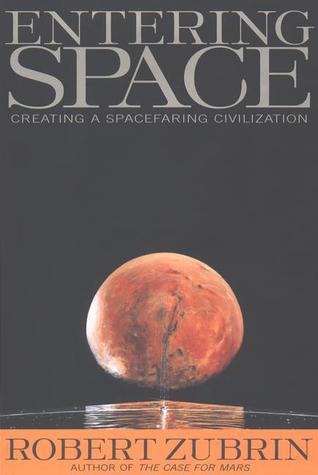
Entering Space: Creating a Spacefaring Civilization (2000) by Robert Zubrin is a remarkable book the gives a remarkable view of how humanity can actually go into space. Both in the solar system and outside it.
Robert Zubrin has a masters in Aeronautics and a PhD in nuclear engineering and has worked as an aeronautical engineer so he has the ideal training to speculate seriously about what is possible in space flight in the next few decades and beyond. He has proposed numerous plausible propulsion systems for exploring space.
The book is broken up into the Kardashev system for classifying civilizations, as Type 1 or world spanning, type 2 or solar system spanning and type 3 or galactic civilization.
The world spanning looks at what more can be done in orbit. The solar system spanning as looking at how and why mars and other worlds can be colonized and the type 3 part looking at how with really plausibly technology the galaxy could be explored.
The solar system sections covers similar ground to Zubrin's book on why and how Mars should be colonized and extends it to how the asteroids and other worlds could be used. He also addresses the ideas of Gerard K O'Neil in The High Frontier and also Mining the Sky by John Lewis. The details and ideas presented are remarkable.
The section on how the galaxy could be colonised is also fascinating. Zubrin looks at various propulsion systems including Project Orion style nuclear explosive drives and various fusion propulsion systems that have been seriously proposed. It is very optimistic, but it is remarkably all physically plausible.
Entering Space is the best single book I've read on how serious space exploration and colonisation could be attempted. It's a really inspiring book for anyone interested in humanities possible ventures in space.
The first part was mostly an abridged history of NASA, including mission details, politics, and historical causes for dormancy of the space program. It was enlightening because I’m so poorly versed in history, but not really what I was hoping for out of a section that claimed it would “describe how humans could fully become a type I civilization” though some scientific details were interspersed and the conclusion of part 1 nicely wrapped up the ideas of 1.) improve global transportation, 2.) lunar base, and 3.) research and commerce in space, which served as benchmarks for type 1. I do wish it talked more about the importance of and how to navigate global politics in pursuit of type 1, as well as highlighting potential for research collaboration and subsidization, but those topics were omitted. Part II, on Type II civs was somewhat similar, but towards its end and well into part III there were some great high-level suggestions and descriptions of ideas for sci-fi tech, benchmarks, and mission plans that could push humanity further along. Those ideas while less detailed were more interesting to me because he provided the pitfalls, difficulties and possibilities without blanketly telling the reader what had to be done and how- he provided some brainstorming and left the application up to the readers- which I think was more impactful. Sadly, I found the ending of the book somewhat lacking- Zubrin talked about the likelihood of alien species which I agree with in premise, but he really highlighted his habit of making a calculation (in some cases, a relatively baseless one with lots of assumptions) and then claiming that there are no other ways of looking at the problem except for his way and that one bad way that he (successfully and thoroughly in most cases) debunked. Overall the book was encouraging and well researched, (which I’ve come to expect from Zubrin) and I learned a lot.
This book was written twenty years ago, so it’s a little bit out of date. But only in the sense that all the change since it was written makes it more compelling.
The boom begins by motivating humanity’s need, individually and collectively, to expand and settle other planets. Then it describes how we could do this. Necessarily high level, the analysis is nonetheless insightful and grounded. Finally it spans to the far future and considers how we might actually travel to other stars and what this means for life, the universe and the Fermi paradox.
There aren’t many books they change the way I think and what I care about but this one does.
I really didn’t like this book. Zubrin came off as a mansplainer at a party who corners you and starts telling you about his genius business idea. Except you’re not at a party, you spent money on his book. And instead of an business plan, it’s his plan for space travel. Also I found some parts to be irrelevant just since it’s an older book in a field that’s quickly growing.
Good book on what a spacefaring civilisation might look like, and a potential realistic pathway to achieving it.
Resource gathering throughout the solar system could have been more in depth, about the size of economies required to sustain them.
Discussion of potential aliens in the galaxy was informative but a little narrow minded / opinionated: - drake equation discussion concluded there must be many aliens in our galaxy, discounted the possibility of it being rare (<1 civilisation per galaxy) - made the assumption that civilisations not growing must stagnate (that's a human observation, not necessarily a universal truth). - assumption that all civilisations even ones in growth must collapse
Overall quite interesting and covered a wide range of technology and topics
Inspired me to my mechanical/aerospace major, Zubrin sets a game plan for the development of humanity through each stage of "energy" existence- from planetary, to solar, to galactic- without relying on magical warp drives, but rather conventional high school physics and chemistry that we can all understand.
It explains how things should work without being like those bothersome, "Science of StarTrek/HarryPotter/XMen" books.
I have never read a science or engineering book of such sweeping vision. Not only does it give insight about the next steps for the culture and technology of this planet, but it is an intelligent discussion of what's going on in the rest of the galaxy and the universe. This is better than The Starflight Handbook or Prospects for Interstellar Travel. Highly, highly recommended
Zubrin made the case for Mars. This is his ultimate manifesto for mankind conquering space. He manages to slay a number of dragons in this work and points out a number of potential "goldmine" industries that could emerge as humanity enters space.
This is one of the best books I've read in a long time. It's a little dated in parts (published 2000), but still a gem. Zubrin's writing is both insprirational and informative. He argued a better case for the space program than any author I've ever read.
Zubrin offers his take on the various reasons for going into space, and shows that many of the often-cited ones are economically unfeasible. If you are interested in space, check this book out for sure.
Essential reading for anyone who wants to see the ideological necessity and practical feasibility of space colonization. An exciting and compelling narrative on the immediacy with which we can embrace the human destiny of interstellar travel.
Really excellent compilation of ideas for making us a space faring species. Not for people who like sports or Kim Kardasian. I thought it was super awesome and will refer back to it in the future(pun intented)


![Profile Image for Ed [Redacted].](https://i.gr-assets.com/images/S/compressed.photo.goodreads.com/users/1429513592i/3968676.jpg)