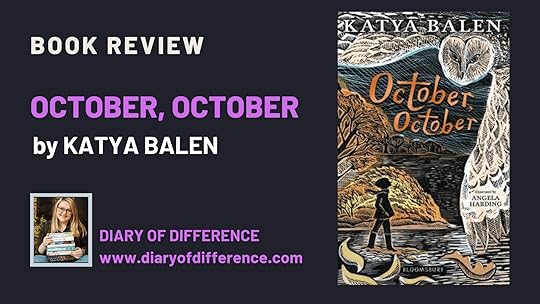
A classic in the making for anyone who ever longed to be WILD.
October and her dad live in the woods. They sleep in the house Dad built for them and eat the food they grow in the vegetable patches. They know the trees and the rocks and the lake and stars like best friends. They read the books they buy in town again and again until the pages are soft and yellow - until next year's town visit. They live in the woods and they are wild.
And that's the way it is.
Until the year October turns eleven. That's the year October rescues a baby owl. It's the year Dad falls out of the biggest tree in their woods. The year the woman who calls herself October's mother comes back. The year everything changes.
Written in Katya Balen's heart-stoppingly beautiful style, this book is a feast for the senses, filled with the woodsmoke smell of crisp autumn mornings and the sound of wellies squelching in river mud. And, as October fights to find the space to be wild in the whirling chaos of the world beyond the woods, it is also a feast for the soul
Katya Balen is a British author of children's literature. She was born in 1989, in London. Her novel October, October won the 2022 Carnegie Medal. Her work has also been nominated for the Branford Boase Award and the Wainwright Prize for Children's Writing on Nature and Conservation.
Autumn is by far my favourite season and every single element about this novel exuded exactly what I so adore about it. The colour scheme and natural imagery adorning the cover, the wild and free-spirited protagonist, and the forest setting all immediately spoke to me and, mere pages into the story, I knew it was going to be a new favourite. I was not wrong.
This was the wildest, most whimsical, and wondrous of middle grade stories. I found the prose lyrical and evocative, the setting dazzling and magical, and the story-line both heart-wrenching and hopeful. Absolute perfection!
I received a copy of this book in exchange for an honest review. Thank you to the author, Katya Balen, and the publisher, Bloomsbury, for this opportunity,
I am so glad I read October, October by Katya Balen and illustrated by Angela Harding. It is a perfect middle grade book that not only brings us to a beautiful wild adventure, but also teaches us that it’s okay to be different. Thank you to Bloomsbury and LoveReading 4 Kids, for sending me a copy of this book in exchange for my review.
Synopsis:
October and her dad live in the woods. They live in a house that her dad built and enjoy the nature and the animals and the trees. They love the river and they love looking at the stars at night. It’s always been just the two of them, and that’s how it is.
And then October turns eleven. That’s the year she rescues a baby owl. That’s the year her dad fell from the tallest tree and was taken to hospital. The year when the woman who calls herself mother came back.
That’s when everything changes.
My Thoughts:
Through October’s passionate and, at the same time, innocent thoughts, we enter her world surrounded by wilderness and freedom. A child raised in the wild, whose life changes in a way she never deemed possible. She now has a new life that she needs to adjust to. But October doesn’t understand this. She doesn’t feel the need to adjust, because the wilderness is her home. Together with her dad. And now she lives in the city with this woman who calls herself mother, who tells her she needs to go to school, and who doesn’t approve of the baby owl.
“A pocket of people in a pocket of a world that’s small as a marble. We are tiny and we are everything and we are wild. We live in the woods.”
“Being wild and free is different for every person and every thing and it can be folded into the woods or whirling through the city streets. I know not everything has a perfect ending and I know that some things have a perfect place and that some things don’t and that all this can change anyway.”
With each paragraph and each chapter, I could feel October’s frustration. How her life is very unfair, and her questioning everything, trying to figure out why people want her to behave differently.
“What feels best isn’t always right, you know.”
This book resonated with me so much.
Perhaps because I was once in a similar situation to October as a child. I loved exploring the world from her point of view and I loved her wild personality. The relationship she has with her father was so precious. He understands her the most, and they get along together very well.
The story developed in a very nice way, and the ending was quite satisfying. Without giving anything away, I will just say that many characters realised many things by the end of the book. The learning journey they all went thought was very prominent and it left me with a melancholy, but also happy feeling. The ending felt very bittersweet.
“Sometimes it’s a kindness to let something go even when you love it very much.”
October, October is a beautifully written book about wilderness, happiness and freedom. The beautiful illustrations just add up to the writing and give a life to the story. I recommend it to both children and adults. A gem worth discovering!
I’ll admit it: it was Angela Harding’s gorgeous cover illustration that drew me to this one. But I found a story that lived up to it, too. October, who has just turned 11 and is named after her birth month, lives in the woods with her father. Their shelter and their ways are fairly primitive, but it’s what October knows and loves. When her father has an accident and she’s forced into joining her mother’s London life, her only consolations are her rescued barn owl chick, Stig, and the mudlarking hobby she takes up with her new friend, Yusuf.
The child’s perspective is well rendered through artful run-on sentences. Balen is careful to show the consequences of October’s decisions and to present advantages as well as disadvantages so it’s not just countryside = good, city = bad. I thought the father’s recovery a bit too quick, but overall, this middle grade novel was a great read for any age, as well as one to get kids thinking about illness and loss. And how about these heart-tugging last lines? “There are stories everywhere and I want to tell them all. And all the world is wild and waiting for me.”
October, October is the definitive Autumnal story that I’ve been looking for. It’s equal parts heartwarming and heart-wrenching. It could be a fast-read, but I was taking my time with it because I didn’t want the magical feeling of reading this book to end. There is honestly some great middle-grade fiction, especially based around woodlands and with a darker edge. If you have ever craved to live around in, or around, a gorgeous woods… then this most certainly is the story for you!
How will an eleven year old girl, named October, adjust to life in the city with her Mother, after growing up living in the woods with her Father? She is a wild girl at heart, and feels so lost within the concrete jungle. Her main reminder of home is a baby owl that she rescued called Stig.
A tender and beautifully written story of family, nature, imagination and the fear that comes with change. I wouldn’t hesitate to recommend this to children and adults alike. A truly perfect October read. Gorgeous.
In Katya Balen's and 2022 Carnegie Medal winning middle grade novel October, October main protagonist October and her father are shown and described by Balen (through October's narrative voice) as living a mostly self-sustaining life in the woods (somewhere in England), growing their own food (some of which they trade with a local farmer for milk), swimming the lake, taking care of the trees (just father and daughter living in harmony with nature and off the so-called grid, since October's mother is basically at the beginning of the Katya Balen's featured text completely absent, completely uninvolved, having abandoned the family years ago as she could not handle life in the woods and also did not seemingly even really want to try, that not even her daughter was obviously enough for October's mother to remain, and yes, that at the beginning of October, October, Balen thus shows October's thoughts of and feelings regarding her mother as realistically and acceptably negative and even filled with quite a bit of legitimate and understandable rage, hatred and anger). However on October's eleventh birthday, everything changes in October, October, as when October's father falls out of a tree and is rushed to hospital, October is pulled from her treasured and beloved woods, from the only home she has ever known and is placed into her mother's care in London, where trapped in a tiny house in a busy and frenetic metropolis and with a woman that October has not seen in years, has no interest in meeting and getting to know, October struggles to understand this new world, often lashing out, often reacting with anger and frustration, but also slowly learning to adjust and to even finally be able to a least somewhat appreciate both her mother and that there might indeed be some positives after all outside of the woods.
Now considering October, October with regard to the novel's featured thematics and contents, Katya Balen in my humble opinion provides a both thought-provoking and insightful reading experience, with in particular my inner child absolutely and totally textually adoring how October is allowed by Balen to react extremely and massively negatively towards the mother she has not seen since she was a toddler, to repeatedly lash out with frustration, with anger, with rage and with no implied or obvious author based criticism and condemnation for and of Ocober's behaviour either, but with total, with absolute understanding and that October's reactions and her feelings for and about her mother and her suddenly changed life situation are not only acceptable, natural but even something to be applauded and in fact cheered a bit.
And yes, that by the end of October, October, while October might now have a more positive attitude towards both her mother and also city living in general, that she is not made by Katya Balen as having to apologise for her outbursts, for her anger, that from the beginning to the end of October, October there is a clear textual thread of demonstrating that October's mother has very much deserved her daughter's frustration, annoyance and fury, I am indeed and definitely so so so textually appreciative and even majorly grateful for this (as well as constantly smiling). For since it is clearly shown in October, October that it was the mother who abandoned her daughter, her family (and left), it is really textually wonderful that Katya Balen does not ever attempt to textually show October's mother as someone who automatically deserves respect simply because of her being October's mother (that October must learn to appreciate and tolerate both city living and her mother as a person, and that October's original negativity is not only something natural but also something for which October should never have to apologise and ask forgiveness, and in fact, that October, October would be a lot less relatable and really majorly thematically ridiculous and problematic for me, had Katya Balen shown to her readers a text where October immediately accepts being cast out of a quasi Eden-like existence of freedom and delightful solitude and with her automatically loving and respecting her erstwhile absent and seemingly all uncaring, unconcerned mother).
But with the above having been said and with my rating for October, October, thematically thus being solidly five stars, sorry, but in particular my adult reading self does tend to find Katya Balen's writing style in October, October both a trifle frustrating and sometimes annoyingly and pretty horribly distracting.
Because while I do (as an adult reader) majorly understand and even hugely appreciate that much of October, October is stylistically speaking obviously meant to be stream of consciousness, portraying October's thoughts, musings, that she, that October often seems to think the way that Balen is penning her presented text (and indeed, that the nature descriptions found in October, October are delightful, beautiful and lyrically engaging, poetically evocative), well and truthfully, the lack of punctuation in October, October and that much of Katya Balen's text shows long and annoyingly complicated run on sentences, yes, that does textually frustrate me and also makes it rather difficult for me to remain focused on the story, and not to mention that if Katya Balen wants to use some of the nature terminology of German Romanticism in October, October such as for example forest solitude, she should either provide the German noun for this (Waldeinsamkeit) within the text proper of October, October or as a footnote (and to also explain that Waldeinsamkeit as a term is actually something both positive and negative, as it does not only describe the solitude of the woods, of the forest, but also that this can become something not just quiet but in fact creepily oppressive and depressingly lonely).
And thus, while I do highly, while I do very warmly recommend October, October, I do personally find a pretty major caesura and break between what Katya Balen has penned and how she has chosen to present and depict her story (and that for me, a five star rating for themes and contents but only a two star rating for writing style leaves an average rating of three stars for October, October).
Me lo habréis leído en varias reseñas a lo largo del tiempo, pero no me considero una lectora muy estacional, aunque es verdad que a veces (muchas) elijo los libros que voy a leer dependiendo de la estación en la que nos encontremos. De todas maneras, hay que reconocer que si hay una época del año para leer“Octubre, Octubre” es en el mes que da nombre a la protagonista, no solo porque sea lo que pide el título y, me atrevería decir, el cuerpo, hay también otros muchos motivos. Los cuales eran los que buscaba a la hora de empezar esta entrañable obra, y que encontrado con creces.
Erase una vez una niña de nombre otoñal que vive en un bosque junto a su padre. Sin más contacto humano que ese, Octubre lleva una vida tranquila entre hojas y árboles, creando historias a partir de los objetos que encuentra en el bosque y colecciona; ayudando a su padre y ocupándose de Sting, la pequeña lechuza que encontró y salvó. Sin embargo, la tranquilidad se romperá en mil pedazos el mismo día de su cumpleaños, cuando un accidente obligue a su padre a permanecer en el hospital por mucho tiempo. Y Octubre deberá quedarse en casa de la mujer que dice que es su madre, en el enorme y agobiante Londres…
Si lo que buscas es una novela absolutamente entrañable, cozy, tierna y que te haga sentir muchas emociones, muchas de ellas no necesariamente agradables, estás de suerte. Siempre en la literatura, aunque parezca imposible, una de las cosas más difíciles a las que se puede enfrentar un autor es escribir un relato o una obra enfocada en el público juvenil. Todos sabemos que los libros son un puente que nos iban a conectar con situaciones diferentes a las nuestras, con otras culturas y con historias ficticias, que te ayudan a enfrentarte a la realidad .Hay una fina línea entre demostrar a los más jóvenes como es la vida de una manera que no tenga que ser necesariamente dura pero sin perder su verosimilitud, de exponer al joven lector, a situaciones duras, pero con un toque de ternura y amabilidad, que haga más digerible el trago sín que pierda su importe su enfoque o sea excesivamente edulcorado. Y Katia Balen con sobresaliente este complejo examen. La suya es una obra de trama, increíblemente sencilla, narrada desde el punto de vista de una niña de 11 años, que se ve obligada a dejar el el único hogar que siempre ha conocido y donde es tan feliz para conocer en sus propias carnes la opresiva enormidad y fría colectividad de la vida en la gran ciudad. Si en el imaginario popular, el bosque siempre ha sido ese sitio lleno de misterios, peligros, escondidos y huecos oscuros, poblados por animales, salvajes y árboles amenazantes, para Octubre la gran ciudad de Londres y todos los retos a los que se tienen que enfrentarse para meterse de lleno en lo que es la normalidad para cualquier niño, tiene un deje de fábula oscura o de pesadilla opresora. Si en algo se luce, la autora es la manera tan atmosférica en que nos lleva a los distintos entornos en los que tiene lugar el libro. Se luce especialmente a la obra de describir de una manera parca en palabras, pero enorme en cuanto a calidad emotiva del bosque Y de la belleza de la estación otoñal, el tiempo en el que empieza la historia. Logra que el lector se Transpol gracias a Octubre a un lugar que es amado y conocido, pero a la vez está lleno de promesas y esperanzas; al encanto de las hojas doradas, naranjas y marrones; la belleza que cada uno de los muchos árboles que lo forman tienen, a lo que se siente al pasear por ese entorno, con el olor a naturaleza y el crujir de las hojas como canción. Pero Balen también se luce a la hora de representarnos la ciudad como un ente cruel y asfixiante, que ahoga y asusta, donde todo es raro y amenazante, huele mal y hay demasiadas personas que no entiende ni ellos a ella. Y lo mismo se puede aplicar a la manera que tiene de llevarnos y mostrarnos las orillas del río Támesis y mostrarnos todos los secretos interesantes y la personalidad e historia propias que pueda tener lugar que la literatura dedicada a la ciudad de Londres tampoco se maneja mucho (o yo por lo menos no he leído muchas obras que tengan escenas en ese lugar)
La novela esta narrada en primera persona desde su punto de vista con una prosa inocente, tierna y directa, pero a la vez increíble y profundamente atmosférica y lírica. El mundo de Octubre es como ella, único y especial, y logra trasladarlo a su manera de narrar de una forma que atrapa irremediablemente al lector. Realmente, la novela se asienta en la narración de octubre, y en cómo va tejiendo las palabras y enseñarnos como vive y ve todo lo que le sucede; ya que como se he dicho antes, el argumento es increíblemente aséptico. Balen escribe de una forma sencilla pero preciosista, musical y te metes totalmente en la historia y en la mente de Octubre. Recrea muy bien la mentalidad de una niña , y como se ve obligada a enfrentarse a un mundo que no le gusta y a cambiar radicalmente de escenario y dejar todo lo que conoce atras, a pasar situaciones difíciles, a aceptar sentimientos que nunca antes había sufrido, a enfrentarse a los miedos, los remordimientos y los cambios. Octubre es una protagonista que se lleva un pedacito de ti cuando cierras la novela, por lo bien descrita que está y por lo humano que resulta, al ser tan imaginativa e inocente como llena de defectos; y por la manera en que sufre y aprende a lo largo de la historia. Las escenas en las cuales se siente sola y perdida de producen punzadas en el corazón mientras lees, a la vez que cuando se abre y nos muestra su mundo personal e imaginativo enternece. Es imposible no comprenderla en todo momento, a la vez que percibes que muchas de las cosas por las que tiene que pasar son inhabitables y que no le queda otra que tragar con ellas. Son un proceso necesario y que va construyendo una evolución que resulta deliciosa de ver.
La autora representa de una manera orgánica e increíblemente bien llevada todo lo que la protagonista va sintiendo a lo largo de la historia y como poco a poco va aceptando su nueva realidad y evolucionando. Y este cambio se enfatiza por lo coral que es la historia, aunque no lo parezca a primera vista. Octubre está rodeada, incluso en sus momentos de mayor soledad, de un grupo de personajes que de una manera u otra participan en su evolución y la acompañan en el proceso. De ahí que se sienta una novela increíblemente plural aunque tenga su eje en la niña protagonista, mostrándonos la importancia que tienen los lazos humanos y la necesidad que todos tenemos de tener una red de apoyo con la que compartir experiencias, aprender o simplemente pasar el tiempo . Balen recrea con pocos, pero bien ejecutados trazos, personalidades muy realistas y sencillas, tan naturales, que es imposible que ninguno de nosotros hayamos conocido en nuestro día día a personas parecidas. Y es que, la grandeza de “Octubre Octubre” reside en que no es una obra ambiciosa, sino un puro canto a la sencillez, la inocencia, la amabilidad y la empatía, hacia lo mejor que tenemos los humanos que es la familia, el amor, la amistad y la posibilidad de cambiar y conocer nuevos horizontes y experiencias. Incluso, aunque al principio pensemos que todo va a ser un desastre o que no necesitamos esos cambios. Y todo ello hecho de una manera amable y exenta de toda pretensión de grandilocuencia o de la fabulación moral.
Imposible no mencionar la edición al español de la novela que nos trae la editorial Errata Nature que, por suerte ha respetado la portada al inglés, una auténtica delicia para los amantes y no amantes de la autumm aesthetic. Conocía este editorial hasta ahora, pero ya voy a estar muy pendiente de sus libros, ya que me ha parecido una editorial que pone mucho mimo y detallismo en cada uno de sus trabajos. El texto viene acompañado de ilustraciones de Angela Harding que representan en diferentes momentos a Sting, la lechuza de Octubre. Estos detalles son absolutamente encantadores, y sirven para subrayar, la personalidad que ya tiene de por sí el libro de Katya Balen junto a diferentes decisiones tipográficas que ayudan a enfocar mejor los sentimientos de la protagonista a la hora de hablar. y sí, en estos dibujos, las lechuzas pequeñas salen monísimas, y eso es todo un logro. Porque en la realidad las pobres son bastante feillas…
Pero ¿para que os voy a contar más? “Octubre, Octubre” es un una obra que merece la pena ser leída, porque de una manera humilde y tierna, se hace un huequito en tu corazón. Es un canto a pleno pulmón a la infancia, a la libertad, al cambio, al perdón (hacia los demás y hacia uno mismo), a las relaciones humanas, a la naturaleza y al ser único y diferente. Cierras el libro con una sensación cálida en el pecho, con un confort parecido al que se siente cuando estás al alrededor de una chimenea con gente a la que quieres, y una manta calentita te envuelve el cuerpo.
A lovely gentle story of October, a little girl growing up off grid in a house in the woods with her dad, all is good until her dad is injured and her life changes. I would've been enchanted with this book as a child, and as an adult I was completely charmed by it too, recommended for middle grade readers and soft hearted adults alike. The cover alone deserves 5 stars.
A cute middle grade about an 11 year old girl who lives off the grid with her dad in the woods.
When her dad has a fall and is admitted into hospital, October is forced to live with her mother in London.
It was interesting to read how overwhelming this was for October and to view the crowds and tubes from a different perspective. Watching her navigate school for the first time all with the guilt about her father’s accident in the background.
This book covers an awful lot and I found the whole thing very moving and interesting.
Well I'm a cynical cow and it takes a lot to move me but whew, I shed a little tear at the end of this fabulous tale.
Katya Balen, you have restored my belief in humanity with this beautifully written book of amazing characters and an owl!!! I bloody love owls! I love everything about this story, the trajectory of the protagonist, her innocence and awkwardness, the environment, the history and background. It all just works to produce something truly wonderful.
Hats off to you for melting the heart of an old cynic!
“Being wild and free is different for every person and every thing and it can be folded into the woods or whirling through the city streets” . . . I read this Middlegrade fiction book in one sitting this weekend, turning the pages into the wee small hours of Sunday morning
October lives in a wood with her Dad and has done since her Mum left when she was four. They rarely go into the local village and October doesn’t go to school but she reads voraciously and can 🍂Coppice trees 🍂Spot a nimbostratus cloud 🍂Smell snow before it arrives On her eleventh birthday, everything changes and October has to learn to navigate the world beyond her
I loved this one As in life, tragedy and hope sit alongside one another and whilst hope wins out in the end, my hope broke for October and her parents along the way. Written from October’s POV, the writing swirls across the page, often unfettered by punctuation. Far from annoying me, it worked in the same way that the structure of Lanny by Max Porter fitted the narrative perfectly. If you loved Kestrel for a Knave, Lanny or Stig of the Dump, then this is one for you
October, October is nothing short of exquisite from beginning to end.
The story follows October and her Father who live in the woods, They are wild, living a life of pleasure and simplicity they really are self sufficient. They revel in the nature and the seasons, they take care of their environment and the woods take care of them. Just as October is turning eleven a tragedy happens and her life changes unexpectedly. Life outside the woods is something October has never had to experience but can she adapt when she has to?
This is one of those books that make me love being a reader. Those books that bring you so much joy. Katya Balen's writing and the language she uses is stunning. The way the woods are brought alive made me so nostalgic. I was transported back to being a little girl and spending so much time with my Dad in the woods. It was such a peaceful time in my life and I think this book really puts great emphasis on the importance of nature. Of being free. Its so important to switch off and just be.
The relationship between October and her Father is such a beautiful part of the story. You really get that they are a partnership and I loved this. The character development and familiar relationships has really been thought out well. I felt so much empathy for all of the characters and wanted them all to unite.
I can't recommend this beautiful book highly enough. Its as beautifully written as the cover is beautiful. Katya weaves such a captivating story. She made me long to pack my house up and go live in the woods. This can be read as an older children's book but is such a great book for adults too. I literally finished the last page and started reading it to my 11 year old. I hope she falls in love with this book as much as I did. Its firmly earned a place on my forever shelf.
This is a book that show how satisfying books written for middle readers can be for adult readers. October lives off the grid with her father in the woods, somewhere north of London. Her mother left them when she was four years old. October is home schooled, and the woods and nature are her classroom.
As October gets closer to her eleventh birthday, which is on October 11th, her mother starts to reach out. October is too angry at her mother to let her near. On her birthday, things chase drastically. Her life will not be the same. This is a story fo people who live off the grid and close to nature. And people who live in cities. Can the two ways of being reconcile? A beautiful story of the love of nature, and families.
I would be interested to know what the author’s definition of wild is and why it is something to be valued. I enjoyed the first third of this book. The author describes nature in a poetic way. However, the girl’s attitude throughout the book is ugly. When she’s faced with hardship, she falls apart and treats everyone around her horribly. She never seeks forgiveness for her actions, but in the end, fellowship is somehow seemingly restored. I read this after reading A Place To Hang The Moon, and it’s interesting how both characters are pulled from their homes and placed in another world different from theirs, but APTHTM has clear pictures of repentance and redemption — this book does not.
A charming story for anyone who feels the call of the wild. What I really liked about this one is the fact that the author made the voice feel so child-like and yet still really beautiful and lyrical. The settings are sumptuous, the beautiful autumn forest, the cold mud flats of the Thames - the world here is fully realised and a joy to delve into.
There's nothing supernatural, or magical in this book, other than the magic of a fine story well told.
A young girl is forced to leave the only world she has ever known to live in a new, strange environment. Over the course of two birthdays, we watch October grow, and learn that broken things can be mended. Heartwarming, without being overly sentimental.
From the gorgeous cover on the front, to the beautiful writing inside, this is an extraordinary book about a young girl raised in the forest by her father. One of my favourites of this year. Suitable for children and adults. Definitely recommended.
This book is both wholesome and beautifully written. I relished every page, experiencing the warmth it exudes—a comforting hug in literary form. I loved every page.
Un racconto profumato d’autunno, di boschi e di libertà 🍂🦉
𝘖𝘵𝘵𝘰𝘣𝘳𝘦, 𝘖𝘵𝘵𝘰𝘣𝘳𝘦 è la coccola autunnale di cui tuttə abbiamo bisogno - anche se forse non lo sappiamo ancora 🧶🧦 Una lettura dai tratti delicati e poetici, dalle atmosfere suggestive e selvagge. Evocativo e confortante, pur essendo middle grade questo racconto nella sua semplicità sa toccare il cuore anche degli adulti, sa far nascere riflessioni e accendere la speranza per attraversare i momenti bui 🕯️ Quando ho scoperto questo titolo sapevo di dover fare il possibile per riservarlo ad ottobre, il mese che più mi sta a cuore, ed è stata davvero la lettura perfetta 🍁🪵
Qui vi lascio un accenno della trama:
«Viviamo nella foresta e siamo selvaggi.» 🦉
Ottobre vive con suo padre nella foresta: una vita semplice, in armonia con la natura, rispettando le sue creature e i suoi equilibri. Ottobre ha un modo tutto suo di comunicare con la foresta, così come con il piccolo barbagianni salvato da poco. Per uno sfortunato incidente è costretta a riunirsi con la madre a Londra; nel grigiore della città non può che sentirsi in gabbia. Eppure questa nuova vita le riserva possibilità di crescita e di insegnamenti, permettendole di riscoprire la bellezza e l’amicizia anche lontano da casa, accettando che lasciare andare qualcuno che ami è anch’esso un atto d’amore.
«Essere liberi e selvaggi è diverso per ogni persona e ogni cosa, ognuno può sentirsi tale nella foresta o sfrecciando per le strade di una città. So che non tutte le storie hanno un finale perfetto e so che alcune cose hanno un luogo perfetto, altre no, e che tutto può comunque cambiare. Sono selvaggia nella foresta e selvaggia in città e ho un piede in ognuno di questi due mondi, ed è meraviglioso.»
A lovely heartwarming story. October is my favourite month and the references to nature and it’s beauty gave a cosy feeling inside. This story is for young and old alike- a tale of innocence, change and the beauty, magic and wonder found in the wild. This would make a lovely Autumn read.
A lyrical and moving story of a girl who lives in the woods with her father, ignoring the world and creating stories to tell by firelight. She has pushed her mother away all her life, however when she climbs away from her on a birthday visit, October's Dad follows her up the tree and falls. While he recovers in hospital she has to live in the city with her Mum. October is overwhelmed, scared and guilty for what happened. What is worse, she is forced to 'abandon' her owl chick to a rescue centre and she herself is sent to school. October shuts down and holds ferociously to a ring that she found buried in the woods, believing that if only she can find the matching ring of the pair, she can complete its story for her father and bring him and their old life back to her.
Bit by bit, October finds friendship, her voice and understanding from the new faces in her life. She makes pals with fun Yusuf, begins mudlarking, does well at school and begins to accept her Mother's gifts and kindnesses.
The story leads to a mudlarking-project assembly that she and Yusuf present to the school, sharing the stories attached to the treasured items that can be found. At the end, October looks up to see her Mother AND Father standing together in the audience hearing her tell her ring's tale.
She learns from her storytelling that that letting something be wild and free is a kindness. Like her. Like her owl... cue tears.
This entire review has been hidden because of spoilers.
October has always lived in the woods with her father. On her birthday, her mother comes to try to talk to her and an accident happens that sends October's father into hospital and October has to stay with her mom - who she doesn't really know and hates. Life in London is a lot different from the world that she used to live in with school and a mother that tries to make October to love her.
October, October is definitely one of the most atmospheric middle grade novels I have read in a while. You can feel the bleakness of autumn and winter and the intricate world October lives in her head. Balen's writing is experimental and the voice she has created for October feels very much real despite the whimsical feel of her writing. I expected to absolutely love this but I never really could get emotionally invested with the story. I loved the writing but never felt anything else - which left me feeling a bit disappointed with the book overall.