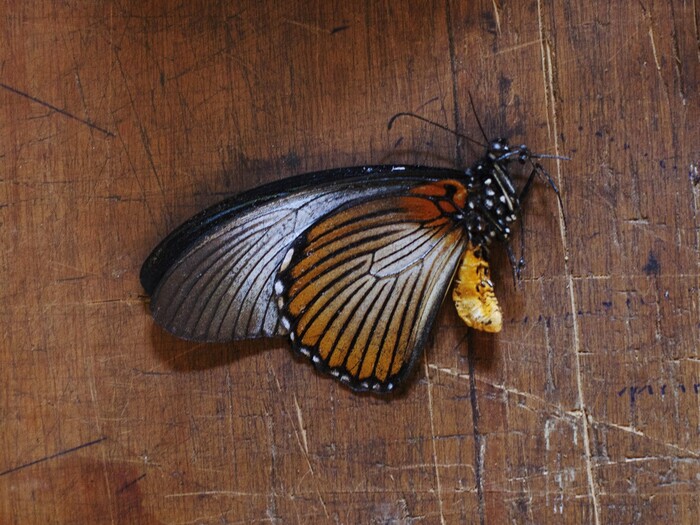
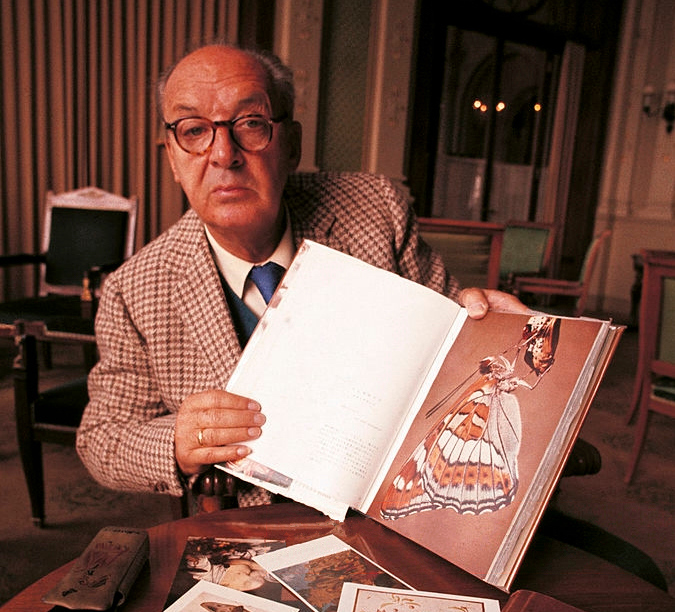
Vladimir Nabokov (Russian: Владимир Набоков) was a writer defined by a life of forced movement and extraordinary linguistic transformation. Born into a wealthy, liberal aristocratic family in St. Petersburg, Russia, he grew up trilingual, speaking Russian, English, and French in a household that nurtured his intellectual curiosities, including a lifelong passion for butterflies. This seemingly idyllic, privileged existence was abruptly shattered by the Bolshevik Revolution, which forced the family into permanent exile in 1919. This early, profound experience of displacement and the loss of a homeland became a central, enduring theme in his subsequent work, fueling his exploration of memory, nostalgia, and the irretrievable past. The first phase of his literary life began in Europe, primarily in Berlin, where he established himself as a leading voice among the Russian émigré community under the pseudonym "Vladimir Sirin". During this prolific period, he penned nine novels in his native tongue, showcasing a precocious talent for intricate plotting and character study. Works like The Defense explored obsession through the extended metaphor of chess, while Invitation to a Beheading served as a potent, surreal critique of totalitarian absurdity. In 1925, he married Véra Slonim, an intellectual force in her own right, who would become his indispensable partner, editor, translator, and lifelong anchor. The escalating shadow of Nazism necessitated another, urgent relocation in 1940, this time to the United States. It was here that Nabokov undertook an extraordinary linguistic metamorphosis, making the challenging yet resolute shift from Russian to English as his primary language of expression. He became a U.S. citizen in 1945, solidifying his new life in North America. To support his family, he took on academic positions, first founding the Russian department at Wellesley College, and later serving as a highly regarded professor of Russian and European literature at Cornell University from 1948 to 1959. During this academic tenure, he also dedicated significant time to his other great passion: lepidoptery. He worked as an unpaid curator of butterflies at Harvard University's Museum of Comparative Zoology. His scientific work was far from amateurish; he developed novel taxonomic methods and a groundbreaking, highly debated theory on the migration patterns and phylogeny of the Polyommatus blue butterflies, a hypothesis that modern DNA analysis confirmed decades later. Nabokov achieved widespread international fame and financial independence with the publication of Lolita in 1955, a novel that was initially met with controversy and censorship battles due to its provocative subject matter concerning a middle-aged literature professor and his obsession with a twelve-year-old girl. The novel's critical and commercial success finally allowed him to leave teaching and academia behind. In 1959, he and Véra moved permanently to the quiet luxury of the Montreux Palace Hotel in Switzerland, where he focused solely on writing, translating his earlier Russian works into meticulous English, and studying local butterflies. His later English novels, such as Pale Fire (1962), a complex, postmodern narrative structured around a 999-line poem and its delusional commentator, cemented his reputation as a master stylist and a technical genius. His literary style is characterized by intricate wordplay, a profound use of allusion, structural complexity, and an insistence on the artist's total, almost tyrannical, control over their created world. Nabokov often expressed disdain for what he termed "topical trash" and the simplistic interpretations of Freudian psychoanalysis, preferring instead to focus on the power of individual consciousness, the mechanics of memory, and the intricate, often deceptive, interplay between art and perceived "reality". His unique body of work, straddling multiple cultures and languages, continues to
Man burns with fire of passions at times fails to understand when those passions become his obsessions. Could these obsessions be deadly but what could be deadly than death for what could be an obsession than death. And if there are obsessions deadly than death they would certainly take away our breath. That sinister obsession the dark fire of it may turn us into something we afraid to look at something too dark to emanate anything or too divine too dazzling for human understanding.
Pilgram had always thought that children would be merely a hindrance to the realization of what had been in his youth a delightfully exciting plan but had now gradually become a dark, passionate obsession.
There are a few characteristics that make us different from other species on this planet and our passions are one of those. Human beings have been known to follow their passions with vigor and intensity but these passions of us sometimes betray our conscience and become our obsessions. Mankind has been seen to be caught with the phantoms of obsessions which turn us into something we are essentially not but more often than not we see ourselves succumbing to these infatuations.
Death has been one of the most enigmatic obsessions for humankind, even so, because it behaves in an ambiguous way, for we never know when it may strike us. Though it sometimes gives us hints of the imminent outcome but we tend to avoid those hints due to being occupied with daily chores. Nevertheless, the uncertain nature of death can’t be refuted, it strikes you when expecting it least, it may be the situation of profound grief as well as it may be the condition of extreme joy since our heart is too sensitive to bear both. We have done a lot of research over death but still, it remains an enigma as mystifying to us, as it was in the preliminary days of humanity. And what lies beyond that? Is it is the gateway to some other world or a parallel universe? These questions have been haunting us since the dawn of humanity.
We have our religions too at our disposal, which have been trying to solve the mystery of death in their own way but these are more ‘logical’ explanations created by mankind to keep himself sane or more importantly to evade the absurd condition of ambiguity. Having said so, we have to admit that there is one thing which is certain about death and that is its inevitability. We could say that there is one thing inevitable about Nabokov too and that is his ability to surprise his readers with his range and literary tricks. And that does not mean that Nabokov necessarily deals with the theme of death (for he deals with something more sinister than death) here though he touches upon its inevitability and sudden arrival.
Vladimir Nabokov is known for his love for moths and butterflies as he had a deep interest in entomology, so the protagonist of the story, Paul Pilgram, has a deep interest in lepidoptery. He inherits a humble shop of butterflies from his father though whatever little he earns he does by selling stationery items. The passion of Pilgram for these beautiful insects could not be matched by his travels to the optimal locations for their collections, for his meager income could not allow him to realize his dream. But being a great fan of these amazing fluttering emblems of vibrant colors and textures, he devises his own methods of his advances, for he has been a dreamer of vivid details in which he fulfills his desires of laying hands on these little wonders of nature in their natural habitats.
In these impossible dreams of his he visited the Islands of the Blessed, where in the hot ravines that cut the lower slopes of the chestnut- and laurel-clad mountains there occurs a weird local race of the cabbage white; and also that other island, those railway banks near Vizzavona and the pine woods farther up, which are the haunts of the squat and dusky Corsican swallowtail.
The title of the story refers to an archaic meaning of aurelia as the collector of insects which ostensibly indicates the protagonist of the story. His love for butterflies gets transformed from a delightful hobby to gradually a dark, passionate obsession. The cataclysmic obsession of Pilgram holds his mental facility so much so that there is hardly any space for anything else in life. We know that human beings could be insanely obsessed about their passions in life when they unconsciously cross the thin line between passion and obsession so that they become oblivious and blind to all other things which define our lives. The dark, ardent and vehement passion of the protagonist definitely earns him a reputation for his lepidoptery without visiting any of the collection sites but it remolds him into an unpleasant and rude character who may do anything to fulfill his secret desire to see the moths and butterflies in their exotic environments.
What follows is a dark tragic story about an ignominious man who stubbornly holds on to his obsession as a symbolic link between his dull and insipid existence and a ghost of idealism. His vivid dreams provide him some sort of solace from his bland existence but only to realize after opening eyes, with a tinge of pain, that his love for his most desired beings remains an unrequited one. Suddenly, one day he sees an opportunity to make fortune through a typical salesman’s trick so that his unrealized dreams, his unrequited love of the years could finally be put into realization. Of course, he grabs the opportunity nonchalantly with both hands but would he be able to actually realize his lifelong dream, that’s the question though answered by the author but not without an unexpected (although not unanticipated) chain of events that may catch the reader off guard and breathless as is the case with a typical Nabokov’s story. Here also, the author leaves the reader with multiple possibilities, for one assigns meaning to its end as per one's own liking though the narrator gives a hidden clue to highlight the author's intentions.
While reading Nabokov you feel a strange sense of stillness and peace which would urge you to realize and appreciate the fact that the author must have composed his prose with careful selection of words as you neither feel the rush nor the halt, just the serene journey with beauty emanating from the text. What we see is a very dense typical Nabokovian text but with every word or adjective chosen with precision to move the narrative, though the detailed exploration of the world of lepidoptery might seem a bit impenetrable at the outset, only to be relished by an attentive reader gradually. We see the author gives a few clues about the ultimate outcome in the story to keep the readers on toes about the multiple possibilities of those clues, only to stumble across finally what they fear. The story is another example of the author crafting stories having many possibilities.
Nabokov has been able to craft an unique reading impression through his typical carefully arranged details. The prose of Nabokov is like a literary puzzle that provides you certain clues throughout the narrative but you realize these clues only in the aftermath, after being checkmated by the author. I am continuing my spree of Nabokov’s stories with this being his fifth story on the trot, I must say that each story is remarkably different from the others, and that underlines the range and the ability of the author.
Somewhere in your past there must have been an old shopkeeper, a man with a face made distinct by bulging eyes or bulbous nose or the thick lips of a trombone player, a man with perhaps thinning hair or a moustache of some variety, from pencil thin to bushy.
If you imagine a variation of this old shopkeeper, "a flabby elderly man with a florid face, lank hair, and a grayish moustache, carelessly clipped," you will have a clear picture of Paul Pilgram, main character in Vladimir Nabokov's The Aurelian.
An Aurelian as defined by the dictionary is a collector and breeder of insects, especially of butterflies and moths; a lepidopterist.
Vladimir Nabokov offers a more exact meaning as it pertains to his story: Paul Pilgram "dreamed of things that would have seemed utterly unintelligible to his wife or his neighbors; for Pilgram belonged, or rather was meant to belong (something—the place, the time, the man—had been ill-chosen), to a special breed of dreamers, such dreamers as used to be called in the old days 'Aurelians'—perhaps on account of those chrysalids, those 'jewels of Nature,' which they loved to find hanging on fences above the dusty nettles of country lanes."
We're given Pilgram's backstory: Paul was an only child of sailor, scallywag father and sallow-skinned, light-eyed Dutch mother; he was raised in Berlin where Dad opened a shop selling exotic curios like stuffed tropical birds until one curio, butterflies, nearly took over.
Even as a boy, young Paul eagerly traded butterflies with collectors and then, following the death of Mom and Dad, curio shop became butterfly shop. Little Paul, a hobbyist by nature, became Paul Pilgram, butterfly expert.
"Write what you know," is advice frequently given to aspiring writers. The Aurelian serves as glowing example - Vladimir Nabokov, himself a topnotch lepidopterist, includes titillating details of the insect work and, of course, his beloved butterflies.
Oh, yes, Paul Pilgram is a born hobbyist. We've all met this guy, more times than not he's the prototypical dork - pasty-skinned, flabby, coke-bottle glasses, timid, socially inept, clueless outside the sphere of his one passion, his hobby.
Vladimir Nabokov, master of the craft, gives Pilgram his ticks of individuality; however, scratch the surface and there he is - a nerd hobbyist one can see at any convention for enthusiastic coin or stamp or model airplane collectors.
In 1905, having reached his mid-forties, Pilgram marries Eleanor, one prime reason: inherit her father's money. But Pilgram's calculation misfire - when his father-in-law dies, he leaves no money, only debts. Meanwhile, Pilgram doesn't want kids since the little buggers would merely be "a hindrance to the realization of what had been in his youth a delightfully exciting plan but had now gradually become a dark, passionate obsession." And that's passionate obsession as in one day traveling with butterfly net in hand to distant lands, those butterfly collector's paradises, to capture his own specimens.
In all the many years of his adulthood, Pilgram never could manage to travel beyond a few fields surrounding Berlin. Alas, material circumstances forced Pilgram to live a double life: every day plodding back and forth to his butterfly shop (with those Sunday strolls around the city with Eleanor and occasional trips to the local bar for an evening glass of rum) and dreams, both sumptuous daydreams and blessed nightdreams, of hunting butterflies on the hills near Madrid, across the planes of Tibet, down in the deep valleys of Andalusia.
But then it happened - Pilgram is about to sell a secret collection he purchased from an amateur knowing it was worth fifty times the amount he paid for it. "Pilgram decided that the dream of his life was about to break at last from its old crinkly cocoon. He spent several hours examining a map, choosing a route, estimating the time of appearance of this or that species, and suddenly something black and blinding welled before his eyes, and he stumbled about his shop for quite a while before he felt better."
What happens next to Pilgram (great name, so close to those New England Pilgrims) is for every reader to discover. Enough to say the great author doesn't hold back on his searing portrayal of a certain type of man at the crossroads of Eros and Thanatos.
“For Pilgram belonged...to a special breed of dreamers, such dreamers as used to be called in the old days “Aurelians”….”. This is a very short, rather personal, story about a man, Paul Pilgram, who runs a shop that is dedicated to butterflies and insects. He and his wife are childless, and Pilgram seems to have dedicated his whole life to butterflies. Only he has never really been abroad and has always hoped to experience the thrill of butterfly-watching and -catching first hand in some exotic, distant land. Nabokov, who himself was an avid butterfly collector, had a way with words and his prose flows beautifully in this story. The story itself can be read through a lens of symbolism and philosophy, and its themes encompass the extremities of our dreams and our pursuits of them, and what it takes to bridge the ultimate gap between the man and his obsession.
it was SO GOOD he writes in a such clever and captivating way i was amazed by how well he captured the thin line between the passion and obsession!!!!!!!! it’s sweet that he wrote abt bugs and butterflies as well,,;, you can tell that he had an interest in them when reading this amazing