Jump to ratings and reviews
Rate this book

Checkout 19

Rate this book
'We read in order to come to life.'

With fierce imagination, a woman revisits the moments that shape her life; from crushes on teachers to navigating relationships in a fast-paced world; from overhearing her grandmothers' peculiar stories to nurturing her own personal freedom and a boundless love of literature.

Fusing fantasy with lived experience, Checkout 19 is a vivid and mesmerising journey through the small traumas and triumphs that define us - as readers, as writers, as human beings.

224 pages, Paperback

First published August 19, 2021

2496 people are currently reading
38639 people want to read

About the author

Claire-Louise Bennett

18 books734 followers
Claire-Louise Bennett grew up in Wiltshire and studied literature and drama at the University of Roehampton, before moving to Ireland where she worked in and studied theatre for several years. In 2013 she was awarded the inaugural White Review Short Story Prize and went on to complete her debut book, Pond, which was published by The Stinging Fly (Ireland) and Fitzcarraldo Editions (UK) in 2015, and by Riverhead (US) in 2016. Pond was shortlisted for the Dylan Thomas Prize in 2016.

Her second novel, Checkout 19, was published in 2021 and was selected as one of the ten best books of 2022 by the New York Times.

Ratings & Reviews

What do you think?
Rate this book

Friends & Following

Create a free account to discover what your friends think of this book!

Community Reviews

5 stars
1,484 (16%)
4 stars
2,319 (25%)
3 stars
2,676 (28%)
2 stars
1,751 (18%)
1 star
1,026 (11%)
Displaying 1 - 30 of 1,733 reviews
Profile Image for Susan.
4 reviews15 followers
April 22, 2022
Although a curious book and interestingly written, the story did not hold her attention, No. No. No, it did not. Since she was not long for this world and there are so many books waiting to be read, she bought herself a chocolate bar and exchanged the book for another one, already on hold for her at the library. Yes. Yes. Yes, she did.
Profile Image for ♑︎♑︎♑︎ ♑︎♑︎♑︎.
Author 1 book3,800 followers
July 12, 2023
As I read Checkout 19 I felt something like how I might feel if I'd happened upon an old photograph of my beloved mother in a drawer, a photograph I'd never seen before, and in that instant I saw my mother the way she had been before I was born, and before she had children, or met my father, where she was completely herself and knowable to me as my mother, but she was also beautiful in a way I didn't know. This book felt familiar, and yet completely strange to me, both at the same time.
Profile Image for Fionnuala.
886 reviews
Read
November 14, 2021
"There is a great line in A Room with a View about a book that has been abandoned in a garden: The garden was deserted except for a red book, which lay sunning itself upon the gravel path. The description of the book seems very innocent but the reader’s attention is immediately caught. What is the significance of this book within a book, we wonder, and why does it have a 'red' cover."
That's how I began my review of A Room with a View five years ago. The red book, which doesn't get much attention when people speak about Forster's novel, nevertheless seemed significant enough for me to use it as a frame for my review, and to recollect it now and reuse as a frame for this review of a book that is itself framed by A Room with a View. Yes, Claire-Louise Bennett's narrator speaks about Forster's book at length in an early section of Checkout 19 and digresses to the subject again near the end when she reveals that although Forster's main character, Lucy Honeychurch, interested her greatly when she first read his book (while sunning herself in a garden incidentally), it was Lucy's cousin, Charlotte Bartlett, who resonated with her on later reads. And although she never mentions it, I remember that Charlotte Bartlett was somehow connected to the red book that lay sunning itself on the garden path, and I also remember that the red-covered book featured a scene involving a lot of blood.*

What's interesting about all this is that Claire-Louise Bennett chose the colour red for the hardcover version of Checkout 19, which is the version I've been reading and rereading for the last couple of weeks, and because I removed the black-and-white dust jacket early on, the red-covered book has lain about sunning itself in my own garden on more than one occasion. Why did she choose red? Well, I'm pretty sure, though she doesn't say it outright, that it had to do with blood because one of the digressions in her narrative, of which there are many, concerns blood, menstrual blood, and specifically its exact colour depending on whether it's early in a menstrual cycle or later. Her book-cover is definitely the earlier and brighter version.

If I've been reading and rereading her book, and leaving it about indoors and outdoors, it's because I found myself digressing from its pages into other writers's pages frequently. The central core of Checkout 19 is a memoir of Bennett's narrator's reading life (and the narrator must be Bennett herself, I felt, at least in part), and I was quite thrilled when I discovered that it was about reading — I like nothing better than hearing about other readers's reading lives, especially when their reading overlaps with my own to the extent that hers does. I don't think there was a book title mentioned that wasn't somehow familiar to me though there were quite a few I haven't yet read. And that's how I became side-tracked so often. I was constantly being seduced to check out other books. One of the side tracks I went down happened on page 113 when Bennett was describing a trip to Brighton and mentioned Ann Quin's Berg. I downloaded that book immediately and read the entire thing before I turned over to page 114. Quin's book is set in Brighton, though the town wasn't mentioned, but I felt it must be Brighton, Bennett's Brighton, with its boarding houses and seafront, its seaweed-covered rocks and its inviting waves.

Bennett's narrator points out that Ann Quin was a working-class writer like herself, and she mentions two other working-class writers, Tove Ditlevson and Annie Ernaux, both of whose memoirs I've read recently. How pleased I was to find them referenced, and to find Bennett's words about memory (though not in the context of those authors) which echoed the thoughts I'd had — about odd unconnected images which my memory has retained — while reading Ernaux's very analytical memoir, Les Années: I understood that my memory had isolated and preserved several images in such a way that they were deprived of any interwoven meaning they might possess...

But to revert to the working-class theme, Bennet considers, as many of us do, that it is far more difficult for writers with such backgrounds, and if they are women in addition, to realise their talent. Incidentally, she mentions that Checkout 19 was written in a room she rented in someone else's house. 'A room of her own' is a long way off, it seems.

I got side-tracked from Bennett's narrative again on page 121 when I came across this passage about reading: Certain written words are alive, active, living — they are entirely in the present, the same present as you. In fact it feels as if they are being written as you read them, that your eyes upon the page are perhaps even making them appear...
Well, I had a real déja-vu moment when I read those words, and I remembered the experience I had when reading Bennett's earlier book, Pond, and which I mentioned in the review: An odd thing happened as I was reading Claire-Louise Bennett’s book, a paper and ink book, it is relevant to mention, because as I read, it was as if the words were appearing on a screen, each one being completed just slightly in advance of my eager eye (in fact exactly as is happening now while I’m typing), the thoughts rolling out, the punctuation slotting into place just where I expected it...

While I'm on the subject of recollecting former reading experiences, remember the red-covered book-within-a-book I mentioned in the first lines of this current review in connection with A Room with a View? Coincidently, in Bennett's red-covered book, there is also a book-within-a-book. It's something she says she wrote at an earlier time of her life, and it concerns, well, books. The way I understood it, it's really about the danger of the destruction of books — Bennett mentions this poweful sentence of Heinrich Heine's in relation to the subject: Where they burn books, they will in the end burn people. The curious thing about Bennett's (or her narrator's) book-within-a-book is that it is only the recollection of a book. The actual pages on which the book was written were destroyed by a man she was living with when she was writing it, the reason being that her writing took her away from him and his needs.

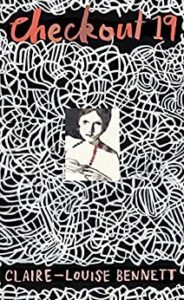
Bennett also gives us the recollection of another lost story, one that was written in the back of an exercise book in school. It was a story that grew out of a doodle and developed into a string of words about a girl who merges with the tangled wool she is knitting and is destroyed by fire. The doodle-like pattern on the dust jacket of Checkout 19 is like an echo of that story, which itself is an echo of the destroyed book-within-a-book story about the destruction of books.

Many things in this book echo each other, giving the book a distinct shape. Episodes that are mentioned at the beginning are returned to at the end. Bennett's Brighton echoes Ann Quin's Brighton, the traumatic piazza scene from A Room with a View referenced near the beginning, mirrors a traumatic forest scene near the end. The subject of women and madness echoes a scene about a painted duck appearing on a wall. An English teacher who sees writerly promise in the young narrator mirrors a Russian man who recognises another kind of promise in her while she works in a supermarket some years later at checkout desk number 19.

So yes, this book, full of digressions and odd echoes, nevertheless has a distinct shape. Bennett side-tracks in the middle of a thought in the middle of a paragraph, and then diverts back into the earlier thought in the middle of another paragraph, pages later perhaps. But it works, the narrative is fluid despite the breaks, and we follow on, admiring the neat inserts and the switchbacks to earlier themes, and even surviving the many lists, and the shifting between registers — the use of a child-like voice in some parts and the insistence on retaining word usage from her West Country origins. The book is like a series of nested boxes within a larger box that contains them all. Or you could say it's like the sea as described in this excerpt where Bennett talks of Ann Quin again, and her novel Passages: Again and again the sea is evoked as a majestic expression of powerful mutability, it flows, it surges – it's fluid, yes, yet at the same time it retains its shape, its currents, its integrity.
Bennett's book retains its integrity. It is a whole in spite of and because of its parts. It may be my top reading experience of 2021.

*It turns out that my memory is faulty on this— I initially recalled Charlotte Bartlett as the author of the red book in A Room with a View but in fact it was another character. However, Charlotte did tell the story of a bloody incident in the Piazza Signoria in Florence to the other character who then wrote about it. Coincidence: Claire-Louise Bennett writes that for years she (or her narrator) remembered a scene where Lucy Honeychurch, after witnessing the same bloody incident in the piazza, threw postcards into the Arno. Bennett later realised that it wasn't Lucy but George Emerson who threw the postcards into the Arno. Echoes and more echoes, and a reminder of the amount of fiction there may be in our memories.
Profile Image for David.
301 reviews1,436 followers
November 13, 2021
There are few writers I admire more than Claire-Louise Bennett. Her latest work is a wild genre-bending ride than fuses elements of fiction, memoir, and essay. Parts of this were utterly brilliant, while others just didn’t work for me. Ultimately, this is a work that I appreciated more than enjoyed.
Profile Image for Barbara .
1,841 reviews1,513 followers
March 17, 2022
I listened to “Checkout 19” by Claire-Louise Bennett and narrated by her. Again, I fell for the media hype. It’s one of those “stream-of-conscious” formatted stories. I found some of her ramblings to be of interest or clever. But mostly, it fell flat for me. Lots of repetition. Perhaps audio is the wrong format for this novel.
Profile Image for Orsodimondo.
2,458 reviews2,430 followers
October 30, 2025
LEGGERE PER PRENDERE VITA


Muovendosi senza sosta dall’io al noi, dal tu impersonale alla terza persona, la protagonista innominata di Cassa 19 racconta di sé, affidando allo stile ogni sua rivelazione.
Parole di uno che se ne intende, Luca Briasco, del tutto condivisibili. Nel suo pezzo uscito su Alias si dimentica solo di spiegare che il titolo è riferito alla cassa numero 19 di un supermercato, quella dove part time lavora la protagonista. Per il resto, faccio prima a riportare integralmente il suo articolo. A seguire, Luca Briasco.


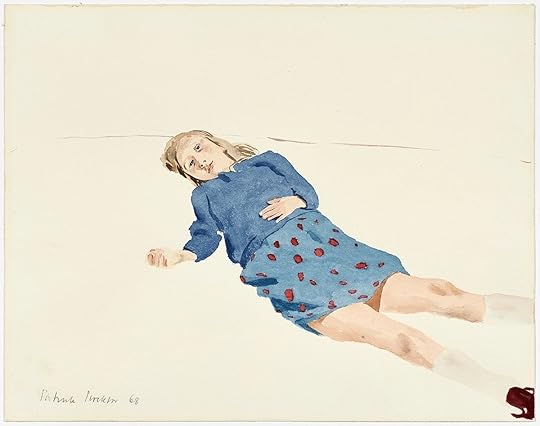
Patrick Procktor: Juliet Benson, 1968

Da alcuni anni, nel mondo anglosassone come in Francia e, di recente anche in Italia, si è registrato uno spostamento della narrativa verso il proprio sé, accompagnata troppo spesso da una sovrapposizione, da parte della critica meno avveduta e attenta, tra il genere del memoir e quella che, con prestito dalla lingua inglese, viene definita autofiction. La pubblicazione da parte di Bompiani di Cassa 19, secondo romanzo di Claire-Louise Bennett dopo il notevole Stagno, del 2019 (traduzione, eccellente, di Tommaso Pincio) può rappresentare un’occasione utile per fare il punto su un genere o una modalità narrativa che contiene al proprio interno diverse varianti, tutte però accomunate dalla volontà di tornare a far coincidere un complesso lavoro sulla lingua con una politicità dello sguardo che, per troppo tempo, è stata considerata prerogativa quasi esclusiva delle opere “di trama”.
La protagonista, nonché voce narrante, di Cassa 19 non ci dice mai il suo nome, e le informazioni che, nel corso del romanzo, ricaviamo sul suo conto sono frammentarie, a dir poco. Sappiamo che, proprio come l’autrice, è originaria dell’Inghilterra sudorientale e a un certo punto della sua vita si è trasferita in Irlanda; che ha lavorato come cassiera in un supermercato; che ha intrattenuto una serie di relazioni spesso distruttive con il mondo maschile; che sin dall’infanzia ha un rapporto potente ed esclusivo con la parola scritta; che la sua vita è scandita, prima ancora che dal lavoro e dal confronto diretto con il consorzio umano o con i luoghi abitati, da una costante immersione nella letteratura, letta e praticata.
L’incipit non lascia dubbi in proposito: ci troviamo davanti a una prima persona plurale, e occorrerà qualche pagina per comprendere che la protagonista senza nome ha la tendenza a parlare di sé muovendosi incessantemente dall’io, al noi, al tu impersonale, alla terza persona. All’inizio, dichiara, prendevamo in prestito quanti più libri potevamo, ovvio. Il massimo. Dunque otto libri probabilmente. Il massimo è sempre sei libri oppure otto libri o dodici libri. A meno che non si tratti di una collezione speciale, ovvio, perché in quel caso il massimo può essere di soli quattro libri.
Durante gli anni di scuola, la passione per la lettura si trasforma – o meglio, viene affiancata – dall’invenzione di storie: un giorno la protagonista – che stavolta parla di sé in terza persona – cerca di ricreare a memoria il volto dell’insegnante più amato dai suoi compagni di classe, ma deve fare i conti con la propria totale incapacità di disegnare. Il ritratto viene fuori tutto sbagliato: un occhio era molto più grande dell’altro, sarebbe stato benissimo in una creatura del tutto diversa, e i capelli, i suoi bei capelli ondulati, erano dappertutto, se ne andavano di qua e di là, un pasticcio che la faceva bruciare di vergogna.
Visto il risultato catastrofico, l’unica risoluzione da prendere sarebbe cancellare il ritratto, ed è proprio ciò che la protagonista cerca di fare: Ci scarabocchiò sopra, ci girò e rigirò intorno con la penna, forgiando strette spirali distruttive, una miriade di sgorbi. Davvero strano, mulinare il pugno a quel modo – non voleva saperne di smettere. Il pugno non si staccava dalla pagina e mulinava spingendo la punta della biro a tracciare sulla carta una linea ondulata che si librava in esuberanti circonvoluzioni, costringendo l’angustia delle strette spirali che erano una sorta di lana d’acciaio a obliterare lo sgraziato obbrobrio della faccia sottostante, e poi le circonvoluzioni si acquietarono, erano più calme adesso, sì, sembravano essersi calmate, erano di nuovo una linea, una linea regolare che si rilassò sulla pagina finché non si scisse dando vita a parole, poche parole soltanto, poi qualche altra parola, e le parole si misero a raccontare una storia che sembrava esser lì fin dall’inizio.
La scrittura è quindi evoluzione sotto forma di sequenza narrativa del ritratto, la cui immediatezza non è praticabile ed è «tutta sbagliata»: le cose si raccontano per via indiretta, la scrittura del sé nega a questo sé perfino il nome e il racconto ruota ossessivamente intorno ai libri degli altri. La parte più corposa del romanzo è dedicata per metà al racconto sul quale la protagonista lavora da anni, e per metà ai libri che legge – dai diari di Anaïs Nin a Camera con vista di Forster – e che utilizza per riflettere sulla propria stessa vita.
Il testo che la voce narrante sta scrivendo si svolge in un tempo oscillante tra l’Ottocento, il Rinascimento e una dimensione più contemporanea, e in uno spazio che, a seconda delle oscillazioni umorali del protagonista, un gentiluomo ricco e stravagante che si chiama Tarquinio Superbo, può essere Vienna o Venezia. Tarquinio acquista un’intera biblioteca di volumi dal dorso elegante, salvo scoprire che ognuno di essi contiene solo pagine bianche. Spetta al Dottore, il secondo, fantomatico protagonista della storia, svelare a Tarquinio l’arcano: in realtà in uno e uno solo dei volumi c’è una pagina non bianca, che contiene un’unica frase. Una frase, chiarisce il dottore, che però contiene tutto, al punto che chiunque ci si imbatta conosce un risveglio totale e immediato. La ricerca della frase che contiene tutto e nella quale la parola dispiega a pieno la propria potenza è del resto la vera missione della protagonista, che la spinge a indagare il mondo dei libri alla ricerca di una rivelazione altrettanto potente.
Nel raccontare una lunga sequenza di letture, Claire-Louise Bennett trasforma l’oggetto narrativo che sta costruendo di pagina in pagina in un saggio di storia e critica letteraria. Scorrono davanti ai nostri occhi pagine e pagine nelle quali la grande narrativa, inglese e internazionale, viene rivisitata alla ricerca di una lezione ultima e imprescindibile, di una voce nella quale la protagonista, epifanicamente, possa identificarsi. E la voce è quella di Ann Quin, scrittrice inglese morta suicida a soli trentasette anni dopo aver perseguito un corto circuito virtuoso tra lo sperimentalismo di Beckett e del nouveau roman e i temi sociali e politici che, negli anni Sessanta, erano proposti, in forma realistica, dalla generazione degli Angry Young Men.
Quando, parlando di Quin, la protagonista fa riferimento al «sospetto e al disprezzo snobistico di alcuni critici» e alla loro riluttanza a riconoscerle una radicata capacità di scrivere con naturalezza in uno stile frammentato e atomizzato che passa con disinvoltura da un registro all’altro» e sottolinea invece quanto questo stile frammentato, ben lungi dall’esaurirsi in uno sperimentalismo freddo, sia il perfetto correlativo dell’esperienza di vita di una donna della classe operaia negli anni Sessanta, è quasi impossibile non pensare che, in tralice, sia la stessa Bennett a parlare, e a offrirci un punto d’accesso privilegiato per comprendere la specificità del suo lavoro sull’autofiction, e la forza insieme stilistica e politica che le pagine più belle di Cassa 19 (come già di Stagno) riescono a evocare.

Profile Image for Lisa (NY).
2,139 reviews823 followers
January 2, 2023
I knew what I was getting into when I saw the blurb on the cover "An existential tour de force." Translation: stream of consciousness with no plot or character development. I flexed my reading muscles. After all this is a critics' favorite, I might like it too! I did try. I liked the book lists, they put me in a trance of reading memories. I made it to 180 of 207 but since I am in an existential mood, I'll skip the last 20 pages. What does it matter?
Profile Image for Adrian Dooley.
506 reviews156 followers
July 30, 2021
Oh dear this was just painful for me unfortunately.

A rambling unstructured narrative that waxes lyrical it seems for the sake of it.

You know the type of people that can talk til the cows come home without actually saying much but they won’t stop? This is what this felt like.

The closest I have ever come to a DNF. I just don’t see the appeal of this 200 plus page of self indulgent unedited feeling nothingness.


Obviously not for me, I would like to thank the publisher for the ARC.
Profile Image for Hugh.
1,293 reviews49 followers
October 6, 2021
Shortlisted for the Goldsmiths Prize 2021

This was one of the books I chose for myself as a birthday present - Pond showed what a talented writer Bennett is, and this book is just as impressive - a brave and intensely personal mixture of autofiction and literary criticism that largely focuses on her formative years as a writer and the books that inspired her, and her early stories.

The narrative voice begins and ends in the third person plural, something of a royal we, and in between other parts are narrated in the first and third person, and there are lengthy interludes that describe or improve on the stories the narrator recalls writing. Much of it feels like stream of consciousness, and is written in long dense paragraphs. The range of literary references is impressive (and could easily have led me to add hundreds of books to the to-read wishlist), and the criticism of those books she talks about in detail (notably Ann Quin and E.M. Forster) is perceptive. She also talks about some very traumatic personal experiences with great honesty.
Profile Image for Katia N.
710 reviews1,111 followers
October 7, 2021
This has now been shortlisted for Goldsmith prize. I hope it wins.

I finished reading this book and was thinking how to approach the review. I was helped by a coincidence. In an old bookshop, I came across Lions and Shadows: An Education in the Twenties by Christopher Isherwood. I opened the first page and read:

“I had better start by saying what this book is not: it is not, in ordinary journalistic sense of the word, an autobiography; it contains no “revelations”; it is never “indiscreet”; it is not even entirely “true”. Its subtitle explains its purposes: to describe the first stages a lifelong education - the education of a novelist.”

And it occurred to me that it could be easily said about “Checkout 19”. In spite of intricacies in style, Claire-Louise Bennett has written a Künstlerroman, the novel of the formation of a new artist. It has been done before by many famous men from Goethe to Joyce, and, evidently, Isherwood. But I have not seen many women trying to use this form and doing it so successfully.

It is a risky business as well: many people do not like to read about writers writing and writers reading other writers. But I am glad she took the risk and did it with style.

The book is an intricate structure itself - a Russian doll comprised of the nested texts: ( ( * ) ) * ).

And there are stories within the stories of course. The stories of her actual life are intermingled with the stories the protagonist creates there and then. And the books… She is the one who defines certain key events of her life through the books she reads. Or rather, the book by itself often would be that key event. There are many names. I counted 18 females writers mentioned as a list. But that is how she lives; that is what is important to her:

“Certain written words are alive, active, living- they are entirely in the present, the same as you. In fact it feels as if they are being written as you read them, that your eyes upon the page are perhaps even making them appear, in any case, certain sentences do not feel in the least bit separate from you or from the moment in time when you are reading them. You feel they would not exist without your seeing them. Like they would not exist without you. And isn’t the opposite true too - that the pages you read bring you to life?”

This idea “what brings you to life” is also conveyed in the other way. The one of the striking juxtapositions at the core of the book is the act of physical violation versus the destruction of a manuscript. Both acts happened to the protagonist. And she seems to be less perturbed by the former than the latter. She conveys this feeling so well that I felt the same. Only later I’ve started thinking why the shredding of a story written by someone affected me more that something pretty brutal done to that same person. The destruction of the written word echoes through the whole story, bounces against its walls, jumps from the real to the imagined and back.

And the language. Sometimes, it is boiling on the page: excessive, baroque; numerous words, repetitions, lists, exclamation marks. Something like this:

“Yes. The whole thing goes up in flames. Flames. Roaring. Yes. It all burns up quickly. Every inch of her included. Yes. Leaving behind an iridescent pile of the softest ash. The sort of ash you want stir. Softer than feathers. Run your fingers through. It tingles doesn’t it. Yes. Yes. Yes it does. We can feel it. Our fingers. Our fingers are tingling like mad aren’t they. Yes, they are. Tingling. We can feel it. Tingling like mad. Our fingers tingle, madly, madly, yes, just as if they are coming to life.”

It reminded me the last chapter of Ulysses told by Molly Bloom. Then the language would settle down to almost detached observational prose. But this never last long. It is like a piece of music with constant and irregular change in tempo.

It might sound familiar to people who've read her previous novel Pond. And it is. The comparison is probably inevitable. But the books are quite different in spite of the similarities of language. "Pond" is much tighter, but structurally less challenging book. Also the subject matter is quite different. "Pond" was all about things, the idea that the things are alive in essence. This idea is still present in this novel. But the main stage here is given to a human being, the one who needs to be surrounded by words, sentences and imagined human beings to feel alive:

“Sometimes all it takes is just one sentence. Just one sentence, there you are, part of something that has been part of you since the beginning, whenever that might rightly be. The source, yes, you can feel in thrumming and surging, and it’s such a relief, to feel you are made of much more that just yourself, that you are only a rind really, a rind you should take care of yet mustn’t get too attached to, that you mustn’t be afraid to let melt away now and then.”
Profile Image for Roman Clodia.
2,897 reviews4,651 followers
July 4, 2021
Sparky prose but some of the essays/sections feel too long and repetitive so a tighter edit would have worked better for me. But when Bennett is on form, she's excellent. Lots of feminist topics here that have become de rigeur though treated with some freshness: periods, boyfriends, female bodies, sex that is in that horrible liminal space of non-consent but not-resisted either. I like the politicised take on life but I expected something a bit edgier.

Thanks to the publisher for an ARC via NetGalley.
Profile Image for Paul Fulcher.
Author 2 books1,954 followers
October 26, 2021
Shortlisted for the 2021 Goldsmiths Prize

How did he go on living, how have I gone on living, it wasn’t at all clear to either of us then that we would go on living. I’m glad of course that I did go on living, not least because since then I’ve read lots and lots more books by writers such as Fleur Jaeggy and Ingeborg Bachmann and Diana Athill and Doris Lessing and Marlen Haushofer and Shirley Jackson and Tove Ditlevsen and Ágota Kristóf and Muriel Spark and Eudora Welty and Inger Christensen and Anna Kavan and Jane Bowles and Silvina Ocampo and Angela Carter and Leonora Carrington and Tove Jansson and Mercè Rodoreda.

There came a point I don’t know when exactly when I’d read enough books by men for the time being. It happened quite naturally–I don’t recall deciding I’d had enough and wasn’t going to read any more books by men for a while, it was just that I began reading more and more books by women and that didn’t leave me much time anymore to read any books by men.


Claire-Louise Bennett's debut novel Pond was my favourite novel of 2016 and one I'd rank in the top 10 of the decade, so I have her mentally filed alongside similarly brilliant wordsmiths under "I would happily read her shopping list," and here, via her narrative avatar, I had that pleasure:

We probably don’t have the kinds of things you like,’ said Dale’s mother, and I wondered what exactly Dale had told her about me. I felt uncomfortable with the idea of her buying things especially for me but she egged me on in such a gleeful sort of way that I was soon lobbing all sorts of stuff into the trolley that Dale was pushing up and down and around the corners so as not to be a great big spoilsport. Earl Grey tea–they didn’t have any lapsang souchong–strawberries, pineapple juice, grapefruit, minty chocolate, crackers, yoghurt, sardines, avocados, iced fingers, humous, cheddar, blue cheese, camembert, grapes, pickle, fig rolls, Jamaican ginger cake, tomatoes, pistachios, baked beans, wholemeal bread, vanilla ice cream. ‘Don’t you eat meat,’ she said, ‘oh yes’ I said, ‘I’m quite partial to a Peperami.’

I say "novel Pond" but the book is said to have missed out on the Goldsmiths Prize because it was considered a story collection. Bennett herself when asked what she has intended replied "I didn't want it to be anything really. Keeping it away from falling into a shape that already exists was very interesting, and challenging."

In Checkout 19 the narrator looks back on her formative influences and evolution as a writer. It continues the same deliberate blurring of form, here a novel in the form of auto-fictional (?) essays, ones which cohere as a novel by repetition of certain incidents and images, lapsang souchong being one example, another certain authors such as Ann Quin, and a third the tale of a Russian shopper at the supermarket where the narrator worked at the eponymous checkout 19:

When I was doing my A-levels in Philosophy, English Literature, and Psychology, I worked in a supermarket, mostly on the weekends, though occasionally weeknights too, and there was a large Russian man with long white hair who used to come in and he’d always have a basket, which he’d hold quite a way out in front of him, and he used to walk at such a terrific speed–it was just as if it was the basket in fact that was leading him up and down the aisles because actually he did always seem bewildered–as if he’d landed there in the supermarket quite by chance–and he’d be going up and down the aisles for a long time and the basket out in front of him would be empty and I never saw him stop anywhere and take anything from off a shelf, but somehow very quickly a few things would find their way into his basket and that was quite sufficient, he could leave now, but not before going to the checkout of course, and he’d always come to my checkout, even if the queue for the checkout in front or behind my checkout was shorter, he’d always come to mine, and I knew very well as he stood there waiting he was looking at me through his thin round glasses, and he’d look at me when I scanned his few things, tinned fish and pickles and so on, and he’d look at me when I took his money, and he’d look at me when I gave him his change, and I’d look just over his shoulder always and he didn’t ever say anything and it wasn’t at all as if we were in a supermarket, and one day I was not at a checkout, I was walking down an aisle towards the checkouts about to begin a nine-hour shift on checkout 19 wearing a horrible skirt that managed to swivel around and around my waist even as I sat still in it all day long, and his basket was very close to me then he caught up with it and there he was and he really was very large and he said ‘Here, it’s all yours’ and he thrust a book towards me. I was already holding a biro and then I was holding a book in one hand and a biro in the other since it seemed I should keep them apart and I continued making my way to the checkouts and when I got to checkout 19 I put the book on a shelf beneath the printer that printed out receipts all day long and the book was written by Friedrich Nietzsche and it was called Beyond Good and Evil and on the cover was a painting of a woman with large naked breasts and her hands are resting down, her hands are resting down because she is a sphinx, a sphinx as depicted by Franz von Stuck in 1895, and it was funny, the way her hands rested down like that, exactly like the way my hands rested down on top of the dark brown lid of the till when there was no one there and nothing for me to do, so even though my small breasts did not resemble her large dusky-looking ones at all, my hands were like hers, exactly like hers, and I couldn’t help but believe that the Russian man must have thought so too.

In Pond she also quite deliberately resisted a narrative arc, which "seems to override every other imaginative possibility", and to write about things more than people ("human beings and the stunts they pull were a minor constituent of my world view"). Here any narrative arc is again lacking, but the focus is rather more on people, the narrator in particular. The narrator has relationships (often with rather abusive men) but is at heart quite alone. As Bennett said, again discussing Pond:

I respond to atmosphere much more than plot, say, and it seems it gathers much more effectively around a lone voice, just like it does around a single candle flame perhaps. I’ve always been drawn to the misfit, the outcast, the exile, the hopeless case with the wicked sense of humor—I’m thinking of narrators in work by Samuel Beckett, Jean Rhys, Marlen Haushofer, Thomas Bernhard, Clarice Lispector, Renata Adler, Paul Bowles, Anais Nin, Fernando Pessoa. Basic life situations, such as marriage, work, procreation, don’t occur automatically for some people and it’s desirable that fiction reports upon the lives of so-called outsiders because actually when you spend so much time alone you are kind of starting from scratch, on your own terms more or less, every single day, and it’s nullifying and terrifying and occasionally glorious.


This is also a novel steeped in literature, including a number of literary shopping lists similar to that in the quotes above, or this on reading a book:

We have a tendency don’t we of reading the last few sentences on the right page hurriedly. We do actually. We enjoy turning the pages of a book and our anticipation of doing so is obviously fairly fervid and undermines our attention to such an extent that we can’t help but skim over the last couple of sentences on the right page probably without really taking in a single word. Quite often when we make a start on the left page it doesn’t make a great deal of sense to us. No. No. No it doesn’t. And it is only then, isn’t it, that we realise, somewhat reluctantly, that we didn’t read the last few lines of the previous page properly. Quite often, we are so reluctant to acknowledge that this makes any difference, we carry on reading. We carry on that’s right even though we can’t make head nor tail of what we are reading. We carry on regardless because we are vaguely convinced that, surely, if we keep going, the way these current sentences relate to all the sentences we’ve already read will, actually, sooner or later, make itself perfectly apparent. We don’t get very far. No, we don’t. We nearly always flick back. We do. And we are nearly always surprised by how much salient detail was in fact contained in the last few lines on the previous right page and we are surprised even further by a very unreasonable thought that comes to us from who knows where which proposes that the typesetter of the book is really quite irresponsible, that they should allow such important sentences to appear at the very end of the right page.

The novel consists of seven Parts, with the approximate length as a % of the book as follows:
I. A Silly Business (4%)
II. A Bright Spark (20%)
III. Won't You Bring in the Birds (42%)
IV. Until Forever (5%)
V. All Things Nice (5%)
VI. We Were the Drama (18%)
VII. Woman Out of Nowhere (6%)

Part III Won't You Bring in the Birds is then much the longest and also the most striking. At its heart this is based on the narrator's recollection, and elaboration, on a story she wrote many years previously, and it is striking how in recounting it she pinpoints the timing by the novels she had read by that time:

When I was in my early twenties I began to write a story about a man named Tarquin Superbus. Tarquin Superbus was a very elegant sort of man who lived in a very elegant European city sometime in a previous century. I didn’t mention in the story which century the unfolding events described took place in, I simply wrote ‘long ago’ at the beginning of the tale and left it at that because I wasn’t really sure myself when exactly or where exactly the story happened. In fact my sense of when and where swung back and forth, from one century to another, from one European country to the next. Sometimes as I wrote it seemed to me that my portrayal of this character Tarquin Superbus and the apartment and the city where he lived was very much in tune with the 1800s.

The pages of Superbus’s library were blank, and that was all there was to it. It seems in the retelling I have got carried away. But then I have read so much and written so much since then it is hardly to be wondered at that in the meantime some ideas pertaining to the potency of the written word, based upon direct and seismic experiences, have been developing inside of me and should find their way out–albeit somewhat hackneyed, with something vaguely remembered from Hermann Hesse hovering close by–through the Doctor’s mouth, now that I have opened it once again, some twenty or so years later, in order to impart to Tarquin that his whole library is filled with blank pages, but for one sentence. But for one sentence! No, I could not leave it there. Strange to think but when I first wrote the tale I hadn’t yet read a single word by Italo Calvino, Jean Rhys, Borges, or Thomas Bernhard, nor Clarice Lispector. I had read Of Mice and Men, and Lolita, and ‘Kubla Khan’, and The Diary of a Young Girl. I had not yet read The Go-Between or Wuthering Heights or ‘A Season in Hell’ or Orlando. I had read Jacob’s Room and Nausea and The Fall and Tess of the D’Urbervilles and ‘The Hollow Men’ and many Imagist poems, one of which had snow in it and a white leopard I think, or, more accurately, it was a leopard that had no outline–maybe it was penned by Ezra Pound, I don’t remember. I hadn’t yet read A Sport and a Pastime or Wittgenstein’s Mistress or Moon Tiger or ‘The Pedersen Kid’ or ‘A Girl of the Zeitgeist’ or ‘The Letter of Lord Chandos’ or ‘The Trouble With Following the Rules’.


The story that follows is Sebaldian in the sense that J.J. Long, writing on ‘The Ambulatory Narrative and the Poetics of Digression’ of WG Sebald’s Rings of Saturn, pipointed: that “digression is always constrained by the end-directed coherence that constitutes its very condition of possibility - as that from which it departs.” Bennett follows a similar approach,with her retelling of her own short story of Tarquin Superbus - one that at least in her later retelling most struck me as Borgesian - with various digressions into her own life and other topics, but with the narrative thread, or perhaps narrative elastic, eventually keeping the story on track. Although there is, deliberately, little sense of artifice or design in the meandering, with very sudden shifts in both register and topic as the narrator's thoughts take her in another direction, with even the chain of association not always clear to the reader. Again from interview on Pond: “Patterns, connections, associations, they occur quite naturally, don’t they? It’s not something you have to worry about or force or contrive.”

In comparison to Part III the other six Parts act rather more like accompanying movements to the central piece, containing echoes of the same riffs, themes, phrases and anecdotes, with variations of their own. Indeed I might recommend the reader begins with Part IV, as the easiest way in to the novel, although clearly this wasn’t the author’s intention.

Bennett acknowledges that some of the ideas began in her previous essays:

- I Am Love in the September 2014 edition of Gorse (http://gorse.ie/wp-content/uploads/20...)
- Suddenly a Duck in the Summer 2015 edition of Stinging Fly
(https://stingingfly.org/2015/06/01/su...)
- and her 2020 Fish Out of Water, in which she explores the self-portraiture of Dorothea Tanning.

The first two can again be seen as variations on the essays in the novel (or rather, vice versa, given they came first). I’m not familiar with the third to be able to trace the influence and Tanning herself does not appear in Checkout 19.

Reading back my review is clearly rambling, but I think that is appropriate for the style of this book which I found initially hard to fully appreciate as a whole but delightful at the paragraph level. An immediate re-read of the novel gave me more as a picture of the novel as a whole, although it is still an oddly difficult novel to fully grasp. That I wanted to re-read - as an inveterate non re-reader - is telling, but so is the fact I needed to.

And perhaps grasping the book as a whole isn't the point - as the narrator reminds us Sometimes all it takes is just one sentence. Just one sentence, and there you are, part of something that has been part of you since the beginning, whenever that might rightly be.

4.5 stars - rounded to 4 by comparison with Pond, but still highly worthwhile.

Thanks to the publisher via Netgalley for the ARC
Profile Image for Gumble's Yard - Golden Reviewer.
2,189 reviews1,796 followers
December 13, 2022
Now shortlisted for the 2021 Goldsmiths Prize.

Certain written words are alive, active, living – they are entirely in the present, the same present as you. In fact it feels as if they are being written as you read them, that your eyes upon the page are perhaps even making them appear, in any case, certain sentences do not feel in the least bit separate from you or from the moment in time when you are reading them. You feel they wouldn’t exist without your seeing them. Like they wouldn’t exist without you. And isn’t the opposite true too – that the pages you read bring you to life? Turning the pages, turning the pages. Yes, that is how I have gone on living. Living and dying and living and dying, left page, right page, and on it goes.


This is Claire-Louise Bennett’s long-awaited second long form publication after her debut “Pond” (published by the small Irish press Stinging Fly) which transversed the novel, short story and flash fiction forms into an ambitious and unique work.

This book is a series of seven (partly auto-fictional?) first person chapters (essays?) - the first written in a plural “we”.

The longest of these (the fourth) has as its centre a story the narrator first started many years previously – which starts life as a rather eccentric character study of an flamboyant Venice-based flaneur before evolving into more of a Borgesian fable about the power of literature – the evolution reflecting the narrator’s own evolving and expanding experience as a reader (the phrase “I hadn’t yet read ….” acting as a recurring motif). But even this centre is at best the starting point for various digression – digressions which seem often more at the non-sequitur than chain-of-association end of the spectrum.

The other chapters are in some ways riffs around the same ideas, linked by narrator and recurring ideas, themes and incidents – all underpinned by literature – writing and reading.

The writing is very much more people and relationship based than “Pond” (which set out to deliberately reject what Calvino called “anthropocentric parochialism”) but shares much of its emphasis on patterns, connections, impressions as well as ultimately on solitude, the individual and the outsider.

The narrator seems more alive in the world of her own writing, her drawing, her reading and identifications with the lives of fictional characters or their authors, and with her own reflections – than she ever is in any relationships (be it with schoolmates, boyfriends, fellow students, flat mates or parents). It is perhaps telling that the book’s title is taken from her time at working at a supermarket and a key recurring character a returning customer whose life she imagines vividly, almost feverishly, especially after he gifts her a book.

Sometimes the writing seems sharp and evocative - – an examination of the writing of Ann Quin and her “fidgeting forensic polyvocal style as a powerful and bona-fide expression of an unbearably tense and disorientating paradox that underscores everyday life in a working-class environment – on the one hand it’s an abrasive and in-your-face world, yet, at the same time, much of it seems extrinsic and is perpetually uninvolving” is both interesting and shows how the narrator is considering both Quin’s own life and how such a style is appropriate to her own writing.

I enjoyed also this description of Yorkshire “Even the mountains were unpleasant and begrudging. They did not soar upwards. They had no business with the sky. No, they were embroiled with the comings and goings below on that mile-long road. Huddled together like debt collectors blocking out the sun.” - and this description leads into perhaps the most sobering and shocking part of the novel.

Other times though I found the writing a little less original or redolent. A lengthy section on menstruation seemed to be something that would have been provocative twenty years ago. And this is buried in a second chapter set in the narrator’s school days which seems sprinkled with thesaurus -swallowing overwriting – for example repeated attempts to try chemistry explosions are: Such recursive hijinks were most often deployed in the science labs, where the pupils’ incendiary hands might easily alight upon and combine a spectrum of appliances and substances that could be counted on to interact with each other in a palpable and fairly predictable fashion – though the exact scale of the ensuing reaction could not be quite so reliably gauged.” – in retrospect though I wonder if this chapter represents the narrator’s early development as a writer.

At one stage in this book the narrator talks about her Swindon upbringing and the Yorkshire upbringing of her once boyfriend and how both were from areas where a relatively conventional life (job in a family trade, marriage, starter home, children, bigger home, annual holiday abroad) is the convention and expectation and yet “we couldn’t say why exactly but neither me nor Dale were cut out for that …………. the encroaching inevitability of that life path had been a source of anxiety to us”. The path the narrator instead follows seems though rather ambiguous and undefined – a yet unfulfilled but not unfulfilling search for a “different turn”, which is sometimes progressing but at other times frustrating.

And for me that is a metaphor for Claire-Louise Bennett’s writing – a sense that the conventional literary novel with plot, characters, linearity is not for her – a refusal to fit into pre-existing templates and a search for something new to do with literature. A search though that has perhaps not yet reached fulfilment and is still uneven in its results but still interesting for an observer.

My thanks to Penguin Random House, Jonathan Cape for an ARC via NetGalley
Profile Image for Meike.
Author 1 book4,945 followers
May 9, 2023
Shortlisted for the Goldsmiths Prize 2021
A Portrait of the Artist as a Young Man, but make it a feminist rendition with a female protagonist: In this Künstler- and Bildungsroman, an unnamed narrator ponders her development as a reader and a writer in an experimental style. She grows up in a working-class family in South West England, then moves to Ireland (like the author), always accompanied by the stories she constantly ingests. Yes, this is a book about the love of storytelling, but not in a moralistic, reading-is-good-for-you kind of way: Here, literature is an obsession, both a force of connection and separation.

The whole novel is told from a distinctly female perspective: From the child in a library to the student of literature who works weekends at the grocery store (hence the title), the protagonist is mainly defined by the books that influenced her, from Roald Dahl to Anaïs Nin), and her attempts at writing stories. Merging autofiction and essay, the reading journey becomes a psychological exploration, also regarding the perception of the people around her (e.g. boyfriend who only reads biographies of “very eminent men”, and a Russian customer at the supermarket who somehow has his Nietzsche handy). Peppered into the seven sections that make up the text, we also have fables the main character has crafted herself.

The narrative voice shifts between the third person plural, the first and the third person singular, providing the text with an airy, un-attached atmosphere, that is juxtaposed with injections of secondary orality. Some sentences are real gems for devoted readers, like this one: "“When we turn the page we are born again. Living and dying and living and dying and living and dying. Again and again. And really that’s the way it ought to be.”

While the plot itself is a minor concern to the author, the underlying philosophical question is how reading relates to life, and how it shapes us and our worldview. This is an utterly eccentric novel, and I respect the ambition and the smart ideas the text presents.
Profile Image for JimZ.
1,297 reviews759 followers
May 21, 2022
If it hadn’t been for one chapter in the middle of this book (Won’t You Bring in the Birds), I would have definitely given this book at least 3 stars and probably closer to 4.

The author certainly has a unique way of writing. See example below:
• It was a nice bed. It was a nice bed. It was a nice room. The ceiling sloped and there were rafters. There was plenty of room. There was. It was spacious but cozy. We had plenty to read. Of course we did. We’d brought books over with us. And of course we acquired lots more very quickly. Everywhere we went people gave us books didn’t they. They did. They did. Everywhere we went....

There were 7 chapters to this book. I don’t know if some of it was about the author’s life or not. It certainly seemed like that to me...but that’s not super-important. The chapters were interconnected but there was not a clear flow to it.

Most of the chapters were 15 pages long. The penultimate chapter (We Were the Drama) which was very good was 49 pages long. And I liked the first chapter well enough (Bright Spark). But the chapter I really did not like was about 1/3 of the book: 108 pages long. And it was about a story the author had made up and she was retelling it to us, her readership. Ugh. About some rich guy named Tarquin Superbus who collected books but did not read them, but when he opened up one of them, he saw that they were blank...every page was blank. And every book he had bought for his shelves were also blank. His doctor told him that actually there was one book that contained one single sentence, but it couldn’t be seen... By the time I got to this stage I was swearing at the book, so I don’t understand the point of that story or of the chapter. But I think I have had enough of this author. I read her book, ‘Pond’, and gave that 2 stars. I am sure she is a brilliant writer...I just do not connect with her style. 🙁 😐

On the back of the book were blurbs from people who were praising this book: Roddy Doyle and Karl Ove Knausgaard and Claire Vaye Watkins.

Reviews (yep...everybody loved it... I am the outlier):
https://www.npr.org/2022/03/02/108302...
https://www.theguardian.com/books/202...
https://newrepublic.com/article/16574...
https://www.vanityfair.com/london/202...
Profile Image for Joachim Stoop.
950 reviews865 followers
April 25, 2022
WAARSCHUWING: kan sporen van superlatieven bevatten.
TEASER: dit is in 4,5 jaar boeken bespreken voor Humo mijn meest enthousiaste recensie.

Claire-Louise Bennett
Kassa 19
*****

‘Autofiction for people who think they’re sick of it’ kopte The New York Times boven het stuk over ‘Checkout 19’. Daarmee smoort de recensent meteen de meewarige reacties in de kiem die een zoveelste navelstaarderig essayboek zou kunnen opwekken. De Britse Claire-Louise Bennett slaat in haar uitmuntend vertaalde (essayistische) roman ‘Kassa 19’ inderdaad een onontgonnen weg in die zigzagt tussen een gefictionaliseerde autobiografie, literaire kritiek en een (stout)moedige blik op schrijverschap.

Bennett geeft haar stem aan een naamloze vrouw die via herinneringen en verzinsels vertelt over hoe een leven vol boeken en verbeeldingskracht haar heeft gevormd als individu, lezer en schrijfster. Als het ware met de motorkap van het schrijfmetier wagenwijd open, sleutelt ze aan haar verhalen: over hoe ze een met menstruatiebloed doordrenkt slipje op de toonbank van Dior wou leggen en zeggen ‘dit is het volmaaktste rood ter wereld’; hoe die ene onvergetelijke leraar haar allereerste verhaaltjes wou lezen; hoe in de supermarkt waar ze werkte (aan kassa 19, inderdaad) een Rus twee vingers van zijn vrouw liefkozend in zijn mond stopt; hoe ze door haar eigen lief werd verkracht. Een simpele opsomming van thema’s en anekdotes schiet echter gegarandeerd tekort. Onverwachte wendingen, herhalingen en zijpaadjes die zomaar tien bladzijden innemen, geven meermaals het gevoel alsof je in een vijvertje duikt dat uiteindelijk een heus meer blijkt. De meeste episodes worden doorspekt met tientallen aangehaalde romans en collega-schrijvers, van E.M Forster tot Anaïs Nin, want ‘een goed boek sluit je niet echt. Dat blijft terugkeren en infiltreren met je leven.’ Voor de Britse dient literatuur het leven als gids en aanvulling, niet als afleiding. ‘We lezen om tot leven te komen.’

‘Wil je de vogels binnenbrengen?’ is de titel van het formidabele moederessay waarrond de andere stukken wentelen. Bennett gedenkt haar eerste, mislukte poging een roman te schrijven, over ene Tarquinius Superbus in een bewustzijnsstroom waarbij ze uit vage herinneringen een nieuw verhaal modelleert dat voortdurend wordt afgebroken en weer opgebouwd. Personages ontspringen uit fantasie, maar lijken ook hun eigen leven te leiden, los van de auteur. Het is (zal ik het woord gebruiken?) revolutionair hoe loepzuiver en daardoor quasi onmerkbaar Bennett heen-en-weerspringt tussen reflectie op het schrijfproces, de buigzaamheid van imaginatie en de impact van lezen. Sterker nog: ze geeft de impressie dat lezen de draad en schrijven de naald is waarmee ze haar verhalen weeft.

Met oog voor de muren waartegen een auteur kan botsen (de eigen achtergrond en sekse, de correctheid bij historische fictie), vraagt ze zich af hoe vrij ze werkelijk is. Juist deze zoektocht loodst haar naar een ongekende vrijheid, want boven elke regel en obstakel overheerst ‘dat constante verlangen om uit je eigen huid en naar een andere werkelijkheid te ontsnappen.’ Elke situatie – tot een wachtrij aan een saaie supermarktkassa toe - kan een aanleiding vormen voor een mentale vlucht waarbij zelfs een onderwerpend keurslijf de vleugels van creativiteit niet kan kortwieken.

Wie onderhand denkt dat dit boek geen hapklare brok is heeft geen ongelijk, maar de uitdaging wordt vergemakkelijkt door de verfijnde humor, de sympathieke zelfspot, de geveinsde nonchalance en een frasering die van alledaagse spreektaal tot afgemeten poëzie reikt. Bennett balanceert op een wankel koord tussen verschillende uitersten: ‘Kassa 19’ is helemaal verankerd in een zee van boeken en toch met geen daarvan te vergelijken; het staat bol van vrije associatie en referenties maar bevat desondanks genoeg zuurstof en leidt tot massa’s leesgenot. Net als in die andere fenomenale vertelmozaïek, ‘De jaren’ van Annie Ernaux, ontwaren we in het wirwarweefsel uiteindelijk de contouren van de schrijfster zelf.
Boekenliefhebbers en dagdromers aller landen, koop dit onovertroffen eerbetoon aan lezen en schrijven, in honderdvoud, en leg het overal te vondeling.
Profile Image for Eric Anderson.
716 reviews3,920 followers
October 15, 2021
We're accustomed to reading coming of age stories that attempt to faithfully reproduce the experience of growing up and the transition into adulthood, but “Checkout 19” by Claire-Louise Bennett takes a radical new approach. The narrative is an account of a young woman reflecting on her life thus far and roughly follows the linear trajectory of her development. Events such as period pains, moving to a rapidly-growing city, a tumultuous romantic relationship and a traumatic occurrence are recounted. However, her experiences have been refashioned by the process of memory till they feel like smoothed stones lodged in the gut: “I experience, every few years, an urge to recall this moment and the events that preceded it. Not only to recall it, but to write it down, again. Again.” We don't necessarily get a fully rounded picture of an event but an impression of the predominant feeling which remains because of certain encounters or experiences. Her account adheres to a different form of truth which is influenced as much by the imagination as it is by history. This is a life dominated by reading and writing which are just as real or more real than concrete experience. The story isn't so much a quest to know what is true, but a refreshingly honest account of this state of being.

The reading life permeates her experience to the degree that when thinking back to certain time periods they are more dominated by lists of what authors she'd read or not read at that point rather the particulars of her circumstances. As I was reading these sections I found it geekily pleasurable mentally ticking off which authors I've also read, which I still want to read and which I've not heard of before. Moreover, Bennett writes in such a compelling and sympathetic way about the process of reading: “Certain written words are alive, active, living – they are entirely in the present, the same present as you. In fact, it feels as if they are being written as you read them, that your eyes upon the page are perhaps even making them appear, in any case, certain sentences do not feel in the least bit separate from you or from the moment in time when you are reading them. You feel they wouldn't exist without your seeing them. Like they wouldn't exist without you. And isn't the opposite true too – that the pages you read bring you to life? Turning the pages, turning the pages. Yes, that is how I have gone on living. Living and dying and living and dying, left page, right page, and on it goes.” This is such a gorgeous description of the dynamic way we interact with the text of books and why we connect so strongly to certain literature.

Read my full review of Checkout 19 by Claire-Louise Bennett on LonesomeReader
Profile Image for John Mauro.
Author 7 books983 followers
May 8, 2023
Checkout 19 is a 272-page stream of consciousness from a young woman who rambles and rambles and rambles... I believe the rambling is supposed to be leading up to something profound, but the directionless narrative fails to deliver anything except a few scattered chuckles and a sense of bewilderment that this book was ever published.
Profile Image for Jeannot.
258 reviews2,234 followers
December 9, 2024
Il faut que j’arrête d’acheter des livres parce que la couverture est jolie
Profile Image for Elyse Walters.
4,010 reviews11.9k followers
December 13, 2022
Beyond good and evil …..
….there are books, writing, men, women, coming of age, imagination, stream-of-consciousness, auto-fiction, and our own reflective experience.
(and for me - authors mentioned I’m intrigued to read) > Alan Sillitoe, Clarice Lispector, Friedrich Nietzsche, Anna Kavan, Anais Nin.

“No matter what book we had in our hands, we found it simply impossible to refrain from wondering incessantly about what kinds of words exactly were inside the other books”.

“I wanted to know about men, about the world they lived in and the kind of things they got up to in the world…. I wanted to know the things they felt sad about, regretted, felt enlivened by, drawn towards, were obsessed with. I didn’t want to read about women. Women were sort of ghostly and they put me on edge”.
Profile Image for Sara Hughes.
283 reviews11 followers
November 4, 2022
Torture. Absolutely hated this. There was one paragraph she wrote about having your period for like 20 years and still leaking every month, and that was the only relatable and good part. Why did Knausgaard endorse this on the back cover?! Let me show you a little taste of the writing style, it seems like its written by Gollum:

"Yes, now that that monumental disappointment was done and dusted we felt quite optimistic. We did. We did. We felt light as a bird and fairly upbeat in fact. But we didn't have any money. No, we didn't - we owed money. We did actually. So what we felt and wanted was neither here nor there. We had to get real. That's right, we had to face up to reality. Get real. Get real. We didn't want to. No. No. No we didn't."

GOODBYE!
Profile Image for Ari Levine.
241 reviews242 followers
January 7, 2022
Sporadically brilliant, sometimes maddening, and occasionally collapses under the weight of Bennett's ambitions to hybridize fiction, autofiction, and personal essay. But it succeeds admirably in representing the sharp and hyper-focused subjectivity of her first-person narrator, a working-class young woman from the West Country slowly fashioning a self through her literary education, only some of which happened at school and university. Always raw-- emotionally, intellectually, formally, stylistically-- but with a strong underlying sense of structure.

Thanks to Goodreads and Riverhead Books for a free paperback ARC, the only time I've ever won a giveaway!.
Profile Image for S̶e̶a̶n̶.
978 reviews581 followers
October 21, 2023
Other GR friends have reviewed this book admirably and to a degree that I don’t feel capable of at the moment, but I have a few thoughts to share. I enjoyed this more than Bennett’s first book Pond, although I had my doubts at various points as I read (one immediate doubt was Bennett’s use of the first person plural 'we' to represent the single character narrating the first chapter, a usage which she then returns to in the final chapter—while in general I support the creative and subversive use of various points-of-view within a single work, this is one POV usage that tends to irk me, though for some reason when she returned to it in the final chapter I found it to be less of a distracting affectation). I also have similar reservations to those noted in my Pond review about the success of the book as a novel, which is how it’s been marketed. I suppose this is ultimately neither here nor there; a book must be marketed in some way, and this one does slightly evolve beyond a collection of connected essays, although to avoid distracting myself that is how I chose to think of it as I read it (with thanks to Jimmy for the tip going in).

By the end of this book, the bits and pieces Bennett has scattered throughout it have cohered into some amorphous form of a whole—kind of like a hornet’s nest of words that she has been incessantly masticating and then plastering onto the pages. But, imagine if you didn’t know what a hornet’s nest actually looks like, and so when you first saw one, you would think ‘what in the hell is that?’ That is kind of how I think of this book that Bennett has fashioned from the raw material of—presumably—certain events, thoughts, feelings, and persons that have left lasting impressions on her, particularly as a younger version of herself. I admire this, I really do. This is a form of writing that to me feels deeply—and I loathe to use this word, but it fits—authentic. I would be very curious to have a peek at her process for creating a work like this, especially as it definitely shows an advancement in structure from Pond.

I suppose that both the recursive nature of Bennett’s writing and the fact that, by the very end, it does engender a sense of having read a single work, as opposed to a collection of disparate works, do leave one at a loss as to what to call the book, no matter how one thinks of it while reading. Hence, the marketing of it as a novel, I suppose. I can think of reasons why not to call it a memoir, and I suspect Bennett would have reasons of her own not to do so. But whatever...I need not continue getting hung up on this question of form. My favorite chapter is probably 'We Were the Drama' and it is also the one where a lot of the percolating themes coalesce. In it, Bennett also expands upon previous references made in passing. By the time I’d finished that chapter, I knew I had fallen into the book in a way that I never managed to do with Pond. I still think she has an even greater work inside her, though.
Didn’t cross my mind to call Dale it didn’t really cross anyone’s mind to contact anyone then in the way it does every five minutes now. I probably went back to my B&B and on up the stairs all cosy and lay on the bed with a cigarette after all that disgruntlement with Billy. And that was all there was to it me on the bed no texting no emailing no one knew where I was it wasn’t as if I told my parents or my housemates, perhaps I’d told Dale. Probably I had but quite often people didn’t know where you were what you were doing nor how you felt about it either. You just had to lie there oftentimes, that was all there was to it. And I loved that feeling of no one knowing. And went on loving it. Treasuring it. I treasured it really. Privacy. Secrets. But it became more and more difficult to get that not-knowing and the deeply glamorous feeling that came with it and now it doesn’t exist at all the outcast minutes of the day gently claw at you, over here, over here, and it’s harder to know where you are or what you’re doing and how you really feel about any of it. One’s on tenterhooks nearly all the time and there’s nothing remotely glamorous about tenterhooks.
Profile Image for Jonathan.
1,009 reviews1,229 followers
October 20, 2021
Two novels from her so far, and both have knocked me sideways wonderfully. Without doubt one of the greats, and her textual control on both the level of the prose and more structurally is deeply impressive.
Profile Image for Olaf Gütte.
222 reviews76 followers
July 10, 2023
Was für ein Roman von Claire-Louise Bennett, sehr exzeptionell, polarisiert, in der Wertung von einem bis fünf Sterne alles möglich.
Profile Image for Nathália.
167 reviews37 followers
October 25, 2022
If you loved this book, maybe skip reading this review.

Worse than being mad at a book is feeling hollow after reading it.

I admire Claire-Louise Bennett and recognize she has an impressive vocabulary and can definitely write. That said, the first and last chapters made me cringe.
Yes. Yes. Yes, they did didn’t they? They sure did.

Don’t get me started on the wastefulness of adding blank pages. Did I think they were justified? No, I didn’t.

Furthermore, listing several books and authors without elaborating on them means absolutely nothing to me. Leave lists to Perec, who knew what to do with them. Sure, the very sparse moments where she talks about her reading experiences are great, but they don’t last long, do they?
No. No. No, they do not.

There were glimpses of brilliance here and there, but unfortunately they never had space to develop their full potential.

Her choice of epigraphs was on point, I’ll give her that. As were her literary references. I also appreciated the hints of humor in chapter 2.

Did I enjoy reading her story about Tarquin Superbus? Not really. It read like a children’s moral tale that parents read to their kids in order to convince them that books are important and can change your life. I get it, one line can change everything, I’ve felt that. I’ve seen it happen.
The sad part is, there were a few interesting bits and reflections that got completely lost in this overly long chapter that was more interested the back and forth of telling this mediocre story.

I’d love to see this be massively edited to see her beautiful writing gain some direction and meaning to shine through.
I wasn’t a big fan of Pond, but while reading this I found myself missing its focused crispness.

I have recently read several books about books and writing and the urgent fixation on the written word and this was by far the least evocative of all.

I see scattered potential and talent and will probably read whatever she writes next, but at some point I might just need to accept she is not for me.
Profile Image for Kansas.
813 reviews486 followers
August 14, 2025

https://kansasbooks.blogspot.com/2025...

“Ciertas palabras escritas están vivas, activas; están por completo en el presente, en el mismo presente que una. De hecho da la sensación de que se escriben a medida que se leen, de qué tal vez incluso son nuestros ojos sobre la pagina los que las hacen aparecer, en todo caso ciertas frases que parecen no separarse en lo más mínimo de una o del momento en que una las lee . Da la sensación de que no existirían si una no las viera. De que no existirían sin una.”


Caja 19 de Claire-Louise Bennett ha resultado una lectura inesperada. Hacía tiempo que tenía el libro en la estantería y sin embargo, y no sé por qué, lo subí arriba de la pila sin planearlo, sin tener la menor idea que de alguna forma estaba relacionado con ese estilo subjetivo tan parecido al de Virginia Woolf, a la que llevo medio verano leyendo (no creo en las casualidades así que prefiero pensar que todo está relacionado). Es cierto que no todos los libros son para todos los momentos pero en Caja 19 se da además la dificultad de que es una lectura muy introspectiva porque al mismo tiempo que el lector se va dejando envolver por la precisión de la prosa de la Bennett, también se va reconociendo a sí mismo. La autora se detiene en detalles que aparentemente no son evidentes y que convierten la vida en una experiencia muy subjetiva, pequeñísimos detalles, muy personales, incluso tan nimios se podría decir que puede que se dé el caso que el lector se reconozca antes que la propia autora, y que sin embargo, si conectas, serás capaz de identificarlos como los detalles de tu día a día. Cuando Claire Louise Bennett afirma de que hay palabras que conforman textos que pareciera que no cobren vida a menos que posemos los ojos en ellas, está comunicándose muy íntimamente con el lector porque antes de escribir ella ha leído obsesivamente y sabe de lo que está hablando. Ciertas palabras no existirían sin una (el lector) y de esta manera está creando un vínculo complejo pero al mismo tiempo muy íntimo entre ella y quien la está leyendo. Y este vínculo ya ha conseguido crearlo la Bennett desde el primer capítulo titulado "Una tontería", en el que conoceremos a la narradora anónima, una adolescente introvertida que se refugia en los libros y sobre todo en sus cuadernos creando historias. Desde un principio también puede quedar claro que esta novela es pura autoficción, y que la narradora anónima será la propia Bennett pero a lo largo de la novela esta linea entre ficción, ensayo, memorias y autoficción queda tan ensamblado que es imposible delimitar dónde empieza uno y termina otro.


“En cuestión de segundos, ahí estaba, una historia, pequeñita, completa, indestructible. Nadie podía saber lo que había dentro de su cuaderno con solo mirarlo, parecía de lo más normal y sin embargo ella sabia ahí sentada mientras lo miraba que contenía algo más, algo que no hacía falta que estuviera, algo voluntario. Inesperado, secreto, algo pequeñito que no obstante había revelado el acceso a un territorio seductor e inexplorado.”


La narradora relata sus experiencias narrando episodios de su vida relacionándolas con los libros y con las pequeñas historias que escribe en su cuaderno; pequeñas historias que se camuflan en los cuadernos aparentemente invisibles y que nunca llamarán la atención, a excepción por algún profesor avispado o el cliente ruso que pasará siempre por la caja 19, que es la caja que le tienen asignada a ella en el supermercado dónde trabaja a tiempo parcial para pagarse la universidad. Unos cuadernos secretos y pequeñitos que vienen a establecer un símil con la vida “¿Y acaso no opinaba su propia madre que que nada es lo que parece?” e incluso con los roles asignados a las mujeres en una sociedad siempre tendente a lo patriarcal. Cita en varios momentos a Janet Malcolm y su biografía sobre Sylvia Plath a la hora de establecer que esta rubia aparentemente insulsa no era lo que parecía en un principio, porque a través de sus textos quería salir de sí misma, “Cuando una mujer se siente y se comporta de maneras que no parecen concordar en absoluto con su aspecto exterior” y de esta forma Claire Louise Bennett está continuamente comparando no solo esta invisibilidad de quien escribe en silencio, sino al mismo tiempo exponiendo que para la mujer de clase trabajadora y además que escribe una literatura introspectiva, quizás lo tenga más difícil. En este aspecto intuyo que la autora está estableciendo esta similitud con Ann Quin a la que citará continuamente y que parece que se acabe convirtiendo en su alter ego literario: "Ann Quin era de clase trabajadora y una escritora de vanguardia. Ser una cosa o la otra además de mujer ya habría parecido bastante indecoroso, ser las dos cosas era directamente un descaro..." Realmente no se están abordando datos estrictamente autobiográficos ni detalles domésticos familiares, sino que Bennett se las arregla para convertir esta percepción de su infancia y adolescencia, y más tarde de su vida adulta, en una experiencia más subjetiva, como esa falda de lamé plateada, o el color rojo menstrual que buscará en un pintalabios y que no encontrará, metáforas, quizás, de la búsqueda de tu propia identidad. 


“A veces solo hace falta una frase. Una frase y ya está, ya somos parte de algo que ha sido parte de nosotras para siempre sea lo que sea que eso signifique.”


La narradora anónima está continuamente enumerando autores y libros y relacionándolos con su propia vida, y confieso que pocas veces me he encontrado con un amor por los libros que suene tan de verdad, tan auténtico. Claire-Louise Bennett no usa los libros como postureo sino que leyéndola estás reconstruyendo los libros de su vida a la par que ella, serán un soporte para su propia vida interior como escritora. No es una novela fácil en el sentido de que aunque fluya, sí que es cierto que la autora está continuamente estableciendo conexiones con su vida o con la vida de la narradora anónima, y a veces incluso deja la primera persona para pasar a la segunda y tercera, estableciendo quizás el límite entre ficción y memorias. La metáfora de la caja de supermercado en la que ella guarda su cuaderno y su bolígrafo mientras le roba tiempos muertos a ese trabajo rutinario y monótono para crear historias, es absolutamente fascinante. Escribir en los ratos libres mientras le robas el tiempo a un trabajo rutinario y aburrido me remite a "Noche y Día" de Virginia Woolf que estoy leyendo ahora mismo y que me viene a la mente citando a un personaje “!En los ratos libres! Esto demuestra su entrega a la literatura." Claire-Louise Bennett ha resultado una autora inesperada y entrar en la mente de su narradora anónima, la cajera-escritora, “con su deseo de salirse de sí misma para ver otra realidad”, ha resultado una experiencia más que reveladora. Una autora colosal 🖤


“Vida o muerte. Pasar las páginas. Cuando pasamos de página volvemos a nacer. Vivir y morir y vivir y morir y vivir y morir. Una y otra vez. Y la verdad es que así tiene que ser. Sí. Sí. Pasar las páginas. Pasar las páginas. Con alma y vida.”

♫♫♫ Losing Touch with My Mind - Spacemen 3 ">my link text ♫♫♫
Profile Image for Els Deveuster.
104 reviews31 followers
January 17, 2024
Kassa 19 van Claire-Louise Bennett is een boek dat niet iedereen zal overtuigen van zijn kwaliteiten. Deze plotloze, soort van coming of age roman bevat verhalen in verhalen en vormt een soort van collage, een mozaïek.
De rode draad is Literatuur. In een ongewone, unieke en originele schrijfstijl geeft de auteur stem aan een anonieme vrouw wiens gedachtengang, hersenspinsels, herinneringen, verzinsels we kunnen volgen.
Er worden zeer veel boeken aangehaald. We volgen de evolutie van de zeer belezen Ik-figuur in haar eigen schrijverschap. De jonge vrouw zoekt haar weg in het leven al lezend en schrijvend. Literatuur als gids bij het leven. Om je bij het leven te brengen en er niet van weg te duwen.
Niet alle gedachtengangen zijn boeiend genoeg maar er zitten werkelijk een aantal pareltjes tussen.
De stijl is verassend creatief. Er wordt "vanalles" bij elkaar gelegd, in verschillende soorten taal, soms makkelijk en eenvoudig soms moeilijker en dichterlijk en dat allemaal om rond een zelfde thema te gaan, Literatuur.
Apart.
Displaying 1 - 30 of 1,733 reviews

Can't find what you're looking for?

Get help and learn more about the design.