I'll preface this short review by saying that Blue Poles is my favourite painting. Seeing it in person is an experience. I'm confident that even if the narrative around its presence in Australia didn't exist that I'd still consider it my favourite.
So, discovering this book, this gem, this hidden footprint of a work of art, is a bit of a journey. Angela has invited readers into the perspective of Blue Poles itself. She asks us to consider how it saw its existence, how it saw its journey from Jackson to a home, and then from that home to Australia. Through Blue Poles 'voice', we're asked to see what it sees when strangers, or Gough Whitlam, or Paul Hogan, come to see its defiant stance in a room.
This invitation to see how a painting sees the world can feel a little bit like a trick, like a narrative construction that promises to collapse any moment. But when you feel it starting to collapse, Angela shifts the book into its second part, and in doing so, she presents what I can only assume is her surrogate, someone who is in awe of the painting, held captive by it, having their world changed by it.
This in turn is just as fascinating as the section from Blue Poles perspective, mostly because it reminds us that art can change the world, that it can cause an impact on a life that shifts it into something, somewhere new.
I first saw Blue Poles sometime in the second half of 1993. It didn't mean anything to me then, but it wasn't until I saw it again in 1998 that I felt something. I didn't really know what that something was, but like so much of Canberra, it had a pull to it. When I revisited it in 2019, I wept at its existence. I felt a little childish doing so too as a gallery guide sat next to it, motionless, just staring forward into the middle distance until their shift was over. Surely these kinds of emotional reactions to art must feel rather normal for gallery staff, right? They too must be moved by pieces they sit by.
I can only imagine what it feels like to sit next to Blue Poles all day long. Pulled to it, yet only so far.
I was pulled to it again on my 40th birthday when I visited it, watching it sit on the wall and play in its own space. I wept there too. As I moved around the gallery, I found myself on a landing, looking down at the painting. A school group was listening to a lecture on it, and I watched as some kids fidgeted, others yawned, but one leaned forward in a stance of intrigue, not boredom. This child from 1998 transported to 2024. No doubt they'll be pulled back to that spot in decades to come.
I shed a tear at the Museum which has constructed blue poles in its outside area. The stature of this painting lingering in the space of Canberra. Its shadow is larger than its footprint, making it almost impossible to not experience an idea of Blue Poles before you actually experience Blue Poles. The cost, the sacking of Whitlam, the disgust, the intrigue, and then, finally, *finally*, the admiration.
And that's what Night Blue does. It reminds us why we admire this painting. Instead of being a biography of Jackson Pollock, it's a biography of the painting itself, and that makes us admire, respect, and adore the painting as a singular entity. It allows us to remove Jackson from the painting, distancing the two so they can stand singular from each other.
I should note that Pollock's art doesn't always elicit this kind of reaction in me. Some is awfully performative and obvious - yes, slashing a canvas is art, well done - and others feel like works of aggression or confusion. Blue Poles feels distinct in a way that makes me feel clarity like few paintings have made me feel. Anguish is the same. Realisation of what it means to feel and be moved by art.
Angela O'Keefe may not be Jackson Pollock - nobody is - but Night Blue goes very, very far at making us realise why his work and Blue Poles is deserving of the accolades and acclaim.
This book is deserving of it too. What an experience.


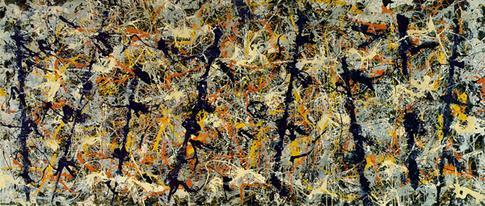 Blue Poles (Wikipedia)