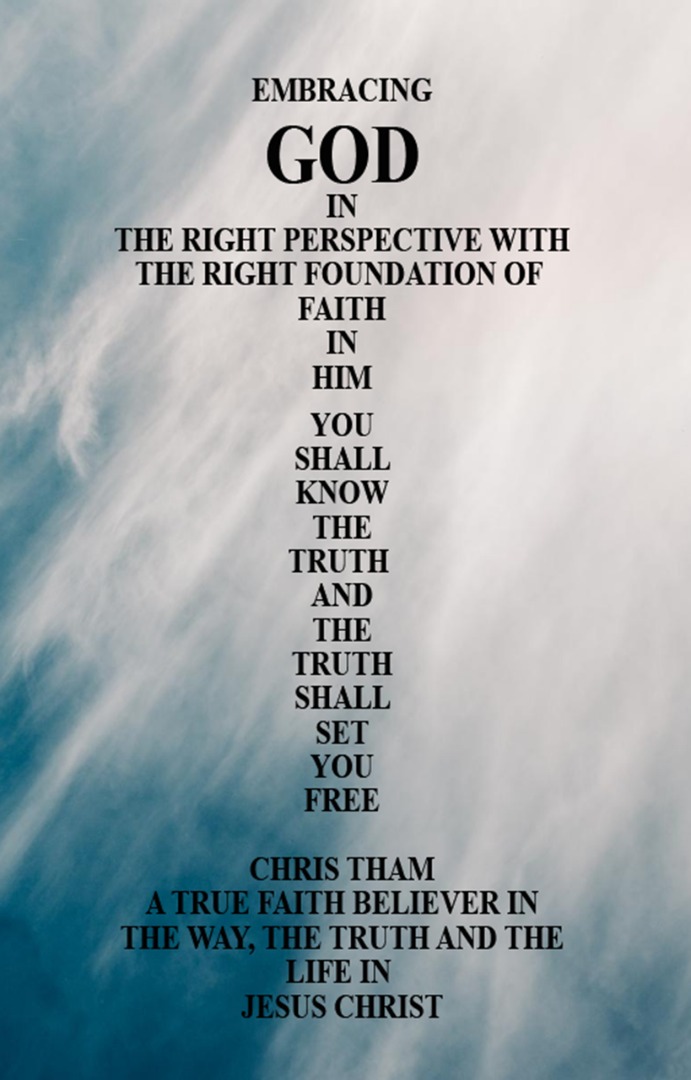
Knowledge without God's enlightenment is not the Truth. Only Truth leads us to the meaning of Life as the Power of Life is in God. God is The Everlasting Truth. Faith without Understanding of Faith is an Unfinished Work in Faith.
Each and every one of us needs to discover our true identity of who we are before we could truly inherit the fullness of Life as we desire to live a life filled with gifts in the fullest measure of Peace, Love, and Joy in our Hearts Now and Forevermore, with an Assured Destiny of Eternal Life!
The Objective of this Book is not to put down any religious beliefs, teachings, laws, and practices we embrace. Its intention is to discover our true identity of who we are in the spiritual realm and how our identity relates to God, who is our Creator and Master of this Universe, and how this Father and Child Relationship gives us Freedom of Peace, which is the ultimate goal in Humanity in The Kingdom of God.
I humbly express this Book as the priceless companion guide in studying the Word of God that shall bring forth healing to all souls throughout the nations on earth. All Glory be unto our Father God.
God loves you! Jesus loves you! Amen. Let all men on earth embrace God in the right perspective with the right foundation of faith in Him. Every living soul in the history of mankind is a child of God.
In Christ and through Christ, we shall all live again. Blood and flesh do not inherit the kingdom of God. Conquering Jerusalem is likened to men’s attempts to attain divinity and righteousness with the might and knowledge of the flesh. Such repeated feats as recorded throughout the history of mankind would never bring down the kingdom of God from heaven to earth. Our Heavenly Father is a God of Peace, Love and Harmony. He is not a God of War, Hatred and Division.
Misguided beliefs and biblical misinterpretations through religious laws of men in the flesh had inflicted countless and senseless innocent bloodsheds upon mankind. Walking with faith in the flesh is knowledge. Walking with faith in the spirit is truth. All men shall be born again of the Word of God which is full of truth and grace, to fully embrace God and live eternally in His divine Truth and Spirit. The Word of God is embedded in all men as each man is born with a given measure of faith in the Word of God.
The Word of God shall bring forth an abundance of insightful revelations and joyful enlightenment to your heart and soul. The return of Christ is a certainty with His millennial reign on earth! Jesus is the Alpha (the beginning of all) and Omega (the end of all). This Book contains end times prophecy. Pray that you keep your spiritual vigilance. The future middle eastern war is coming soon. The days and seasons are all numbered in the Word of God and the prophetic timeline in His Word has been predestined since the foundation of this world.
This Book shall serve as a good text material for interfaith dialogue involving mainly Christians, Moslems, Jews and Taoists, or even Buddhists and Hindus. In many Christian seminars, speakers have relentlessly bashed Islam and other religious beliefs. It is the preordained duty of believers in Christ to share the Gospel of Light with members of other beliefs with understanding and love.
You are glory pristine; therefore, you are glory destined. You shall know the truth and the truth shall set you free. God bless all of you! Amen.
A professional Accountant by education and training. Having spent almost the entire working life in the field of financial reporting, corporate finance, treasury management and tax planning in various organization set ups ranging from small medium sized enterprises to large public quoted companies.
Chris Tham's book, EMBRACING GOD IN THE RIGHT PERSPECTIVE WITH THE RIGHT FOUNDATION OF FAITH IN HIM: EVERY LIVING SOUL IN THE HISTORY OF MANKIND IS A CHILD OF GOD, presents a profound and introspective examination of one's relationship with God and the significance of faith in our lives. Tham's primary argument emphasizes the notion that each individual, regardless of their background or beliefs, is a child of God, and by embracing this idea, one can foster a solid foundation of faith to strengthen their connection with the divine.
Throughout the book, Tham skillfully interweaves different philosophical views and biblical references to find common truths across a diverse range of beliefs, creating a power packed and inspiring narrative. He encourages readers to cultivate a personal relationship with God and view themselves as part of a larger spiritual community.
One of the book's most notable strengths lies in its approachability. Tham writes in a clear and concise manner, effectively breaking down complex theological concepts and making them accessible to readers of all backgrounds. In addition to his own insights, he provides practical guidance for nurturing a stronger relationship with God, emphasizing the importance of prayer, contemplation, and community engagement.
Perhaps the most remarkable aspect of Tham's work is its focus on inclusivity. His message centers on the universal love and acceptance that God extends to all individuals, irrespective of their background or belief system. Tham makes a powerful case for the inherent value of every human being as a child of God, promoting unity, understanding, and empathy amongst readers.
In summary, EMBRACING GOD IN THE RIGHT PERSPECTIVE WITH THE RIGHT FOUNDATION OF FAITH IN HIM: EVERY LIVING SOUL IN THE HISTORY OF MANKIND IS A CHILD OF GOD serves as an inspirational and introspective guide for those seeking to deepen their faith and foster a greater connection with the divine. With its accessible prose, practical advice, and emphasis on inclusivity, Chris Tham's book is a must-read for anyone yearning to explore the true meaning of faith and spirituality in their lives. My rating of this book will be 5 out of 5 stars. (Joyce Nwaogazie - Professional reviewer at Amazon)
Everyone is born with a measure of faith in the word of God. But to fully embrace him in the right aspect, we have first to understand who he is and who we are to him. Embracing God in the Right Perspective with the Right Foundation of Faith in Him by Chris Tham is a faith-based work of non-fiction ready to delve you into the spiritual realm while taking a glimpse into the fundamental aspects of our present-day beliefs. The book is packed with insightful interpretations of the scriptures to trigger a transformation in both believers’ and non-believers’ hearts.
Chris incredibly distinguishes between knowledge and truth. He explains that truth leads us to the meaning of life and that it is knowledge with enlightenment from God. On the same note, he emphasizes that in as much as it is the will of God for man to be like him in deeds and thoughts, seeking knowledge without his divination would result in separation from his spirit in man. The author explains the application and meaning of this ideology in the modern world. This is just one of the many beautiful, well-thought basic arguments in this Christian text that takes you through a personal development journey with a well-laid technique.
The text is a fourteen-chapter work of art geared towards offering well-balanced arguments. Each topic is introduced with a thought-provoking subject. The chapters have insightful guiding questions that are comprehensively answered in the teachings, which are reinforced with significant Bible excerpts. These provided a definitive source for the answers and avoided confusion. Additionally, they encouraged my reading experience to have a more profound meaning. The text also provides wonderful guidance for personal development through fundamental growth tips on how one can confront their fears and failures.
I appreciate the author's choice of contemporary contexts, experiences, and examples in his authorship. He gives comprehensive answers and provides the reader with a clear glimpse of his take on the events surrounding us. The text also adopted an excellent strategy in its presentation. Each chapter launches with a bold, well-underlined title. Additionally, the scripture’s main ideas are highlighted in uppercase letters and the crucial topics in red. This allowed the reader to ponder the major indications before the author's explanation. The author breaks down the complex spiritual concepts into an easy, concise piece of writing. The fourth chapter was my favorite and appealed to my spiritual being. I enjoyed the vivid graphical descriptions of the dimensions of man. I pondered on the valuable lessons, such as how man loses his knowledge of his divine nature after becoming outward-driven instead of inward-led. I commend the author’s relevant choice and accuracy in aligning the scriptures that served perfectly to guide the plot and explain the arguments he made.
There is nothing I liked least in the text. The language used is simple enough for everyone to comprehend. In addition, the author remarkably gives inter-faith disclosure to all the major religions and provides an overview of where we are heading in life at the same time. I believe professional editing was applied in the production of this text since I came across zero errors. I wholeheartedly award the book five out of five stars for the reasons stated above. I recommend it to anyone searching for a new path to healing and anyone looking to have a closer relationship with God.
I have yet to read a book that more accurately, comprehensively, and gently portrays Christ's heart than Chris Tham's. I was impacted in different ways in different portions as if listening to a beautiful symphony, but I left each feeling enormously grateful to know that what was being depicted was the heart of my Savior, my Lord, my Friend, and my Redeemer. I can't imagine anyone in God's family who wouldn't benefit from spending time witnessing Jesus' heart through the eyes of such a wonderful guide. This book is a true gem among the many religious books available. Its goal is to give good text material for interfaith discourse amongst Christians, Moslems, Jews, Taoists, Buddhists, and Hindus, among others. It reminds us that it is believers' preordained duty to communicate the Gospel of Light with followers of other faiths with compassion and love. Chris Tham provided a study guide for modern folks to use when studying God's Word. Both believers and non-believers will find his fourteen-chapter book to be a gem. The book is more than any other ordinary or conventional religion book—it's a new presentation of the same truths in everyday language. In addition, there are four aspects of the book that I particularly enjoyed.
First and foremost, the book provides a wealth of amazing questions that we may utilize to assist ourselves and others uncover our actual identity in relation to God. For instance, it employs a lot of guiding questions in the first chapter, and all of the content in the subsequent chapters is geared toward answering these questions.
Second, this book could not have come at a better time at this point in my life. Finding myself dealing with many teenagers in youth ministry who struggle with their identities, this book helped me put a lot of things in the right perspective and also start to implement some practical changes in my life. For instance, the author put case studies in the form of options or use notable people in the world and examined it from the biblical perspectives to better illustrate what he wants to say and help us as readers on how to practically implement the ideas within the book which will hopefully help us to make the right decision in our everyday life.
Last but not least, this is a comprehensive book! It covers all important aspects that we have to understand, such as about God, ourselves, the devil, the afterlife, God’s chosen people, and our purpose in life. This book helps us to understand our origin, purpose of life, and where we are heading when we are facing death. Overall, this book is captivating for reading, not only for its intellectual rigor and exquisite writing but also for its honest, empathic humanity. Readers will be masterfully taken on a journey that entails their confronting not only Christianity but also themselves—their worldviews, hopes, fears, failures, and search for identity and satisfaction—and, finally, encountering Christ as the entirely trustworthy source of life as God intends it to be. This is a book that I enthusiastically recommend! In conclusion, it's a 5/5 stars book. This book's insights are a river of mercy pouring from God's throne, through biblical truth, and into priceless and effective ministry for today. All honor and glory to our heavenly Father!
Ryan Oktapratama Bachelor of Education, Corban Unversity (2014-2018) Christ Chapel Manado Manado, Indonesia
A spiritually and intellectually satisfying book whose lessons about God has quenched my thirst for knowing God more. The author explores diverse perspectives regarding God, faith, truth, trinity, evil spirits, judgement, salvation, and many more. The author does not just state the basic ideologies but rather goes deeper into their meaning and application in our world. I found it to be a great resource for understanding more about Christianity and our relationship with God.
Embracing God with the Right Perspective Foundation of Faith in Him is a book by Chris Tham that helps to simplify the Bible. The book was more analytical and broke down the Bible's teachings. It guides one through life with a better understanding of God through faith in him. It also acted as a medium through which the author preached salvation and good news to readers.
When I saw the book's title, I thought it would be like a regular Christian novel that preached salvation, but I marveled at the technicality of the book. Yes, it preached salvation, but technically and practically, you would have had no choice but to be convinced. The book was practical, using evidence from the Bible and other books for an explanation. It is very well evident how knowledgeable the author is about the Bible. The book was well-researched as it contained quotations from the Bible and other books such as the Torah and the Quran. The book also contained world history and tales of historical figures that were fascinating and educational. It exposed hidden truth and meaning in spiritual matters. The book was educational and eye-opening. I discovered lots of facts, such as the meaning of Adam and more details on the persecution and eventual death of the Apostles. It gives answers to questions that people have always argued about, such as the question of physical water baptism and circumcision and their relevance to salvation, as well as others like why God allows the devil to live on and evil continues to thrive. The book also mentioned issues that affect our society, like poverty, inequality, war, and biology. It made the book's content relatable.
However, there were a few things in the book that I saw as unnecessary. Most sentences were capitalized and used in different fonts and colors. I guess the author meant to emphasize these parts, but it was too much and made reading a bit stressful and confusing. The book also contained lots of Bible quotes and stories. I feel that some of these quotes and stories are very popular, and the author need not include them in detail.
However, I enjoyed reading this book. I found only one error in the book, which shows that it was professionally edited. One chapter I enjoyed the most was the last chapter, Alpha and Omega. This is because I have always been fascinated by countries like Egypt, Israel, and Syria and would always want to know more about them. Also, the book of Revelation has always been challenging to comprehend. That chapter explained better about these countries and explained Revelation in simpler ways. The book also revealed Bible prophecies so that a simple person would understand. I rate this book 4 out of 5 stars. It would have been perfect if not for the disturbing points noted above.
I recommend this book to lovers of Christian books and Bible stories. Historians, scholars, and academics are also welcome to read it.
''Embracing God In The Right Perspective With The Right Foundation of Faith In Him'' by Chris Tham is a non-fictional Christian book. The author made it clear, which is also reflected in the content of his book, that the aim of his writing was not to degrade other religious beliefs but to bring to our notice, as humans, the infinite mercy and love of God toward us. For me, I believe that making this clear is vital and can even encourage people with diverse religious perspectives to give it a try. In this book, the author walks readers through the spiritual realm and the intricacies of our spiritual beliefs in today's world. In a nutshell, I'd say that after reading this book, I got a new insight into God's eternal love for us.
It is necessary to state that Chris Tham wrote this book in such a way that even a person new to Christianity can get a grasp and proper understanding of the aforementioned religion. The exploration was comprehensive and the core concepts were properly analyzed therein. Also, the use of examples and biblical references further buttressed the narratives explored. Are you searching for a book that extensively explores the Christian faith? Do you wish to unravel the evidence of God's love so that you can create a personal relationship with him? Look no further, this book is just the perfect read.
I'd state that the chapter which resonated with me the most was chapter 14, titled "Alpha and Omega." This is more like leaving the best part of the book (of course, for me) at the end. This is because he answered the controversial and recurring question, "Does God exist?" in detail. He did this by extensively revealing the core existence of God in the physical and spiritual realms. As a Christian, I can now comfortably have meaningful conversations around shreds of evidence that emphasize that God created us and that he exists in full glory. I also came to realize that regardless of our religion, sexual orientation, or race, we are all children of God. The only thing that makes a difference is what personal relationship we eventually create with the Lord. I have thus accepted that indeed I need to let go of the shackles of sin and embrace Christ. In addition, due to the in-depth knowledge revealed in this book, I cannot help but have a deep reflection.
Like the author did throughout this book, I subscribe to the fact that the first alphabet of phrases such as "His Word," "Christ Jesus," etc. should be written in capital letters. A good rule of thumb is that when you are using a term that can only refer to God or Jesus Christ, it should be capitalized. In summary, this book will appeal to Christians and open-minded people who wish to unravel who our maker is and his eternal love for us. As such, I highly recommend it to them.
"Embracing God in the Right Perspective with the Right Foundation of Faith in Him" is at times a challenging book to read. At times, you have to think about a little more than some of the more contemporary books that are written to a slightly lower reading level. However, the reading for me was a little slow simply due to how much good "meat" is on these pages. It is a treasure trove of Biblical wisdom regarding who God is and our destiny in Christ. I guess one might even classify this almost as a textbook that you will want to read multiple times over the years. To me, it seems that the author's objective is to clearly point out the incorrect perspective of God that leads to ignorance of God which the author feels weakens the believers. Chris clearly understands who God is and does a fantastic job unpacking some of that knowledge to pass it along to us. The book explains the crucial step towards salvation and discovering your true purpose in this present world, which is one of the many elements unraveled in this book. As a Christian who has read many religious books, I must say this is the most comprehensive and analytical resource. The author does not just state what is written in the scriptures but rather goes deeper and synthesizes the information to give it more meaning and better understanding. I loved the use of many examples and references from the Bible as they helped to justify the discussion being made by the author while at the same time quenching my spiritual thirst. To be honest, the book is quite lengthy and comprehensive, but that becomes a non-issue when you start reading and realize how it sheds a lot of light about God and our relationship with Him. Whether you are a believer or non-believer, this is a blessing read that you should purpose to read. According to Chris, Christians pick up the misguided belief that God's salvation is time-bound, i.e., the non-believers who are yet to embrace Christ and who had passed away would perish in the lake of fire. Embracing God in the right perspective with the right foundation of faith in Him is the sure way to discover our true identity of who we are in the spiritual realm and how our identity relates to God. Each chapter is so specific in focus (covering topics such as who is God and who are you, who is the devil, knowledge versus truth, three (3) dimensions of man, laws, sin, judgement, and death, who are the evil spirits, the trinity of God, resurrection from death and salvation is eternal and is for all), that each succeeding chapter's theology seems to rival the next until one's mind is so expanded that one's entire view of God changes. Having rescued us from the individual hunches of our ultra-tolerant theological age, Chris points the reader to the true character of God with his theological competence and compassionate heart. For me, the part that I appreciated the most… well… there is so much, but one topic did rise above the rest in my mind – the fact that we need to focus on the actual character of God to know him in the correct perspective truly. Too often, the church focuses on the promises of wonderful gifts that God has bestowed upon us. This book helps to gain a proper perspective about God and his holy character. Truly, it is a book that, if you digest it, will be life-changing for you. OK, I have to throw in one more part as my favorite – Chapter 3: Knowledge Versus Truth. In this chapter, Chris does a fantastic job nailing down what the truth and knowledge are in relation to God's presence in the heart of man and the fruit of the spirit - superbly written! I'm not sure I can classify this as a "least favorite" part, but often I had to re-read some portions of the book to really let it sink in since there is so much "meat" in this book.
Recommendation While there were parts that were a little more challenging to read, I honestly can recommend this book. I will be using my copy for many years to come. If you want to know God better, especially his true nature, I would highly recommend this book. Some of you may have to be a little patient and/or diligent in reading but trust me, it will be worth the work, patience and perseverance. Here's the link for your reference: https://play.google.com/store/books/d...
Susan Christian Writer Flourish Christian Assembly United Kingdom
It is a book that educates on spirituality, especially as a Christian. In this book, Chris Tham makes us understand that knowledge without God is not the truth. It covers all the important aspects that we have to understand and answers questions such as, who is God? Who are you? Who is the devil? It also helps us understand what knowledge is and what truth is. The author also teaches us about sin, death, judgement, end time prophecy and so much more.
It is a book mixed with both intellectual and spiritual wisdom. It awakens the reader to a lot of things about our spirituality with references from the Bible. The author’s objective seems to be to clearly point out the incorrect perspective of God that leads to ignorance of God, which the author feels weakens the believers. The author clearly understands who God is and does a fantastic job of passing some of that knowledge along to us.
Chris Tham did an amazing job with this book. He did so well to put so much knowledge and wisdom on each page of the book that you have no option but to enjoy each sentence. It is written in simple English, which makes it easy to read and understand. I love and appreciate how the author answers and explains the questions in some of the chapters. I also love the biblical stories and references and how they bring more life to the book. Chapter 3 is my favourite. I got to learn the distinction between knowledge and truth and also the teachings of Lao Tzu. This book is, as the author stated at the beginning, a priceless companion guide to studying the Word of God.
Embracing God In The Right Perspective With The Right Foundation of Faith In Him is a beautiful work of art. There are no negative aspects to the book, and it was exceptionally well edited as I found no errors while reading it.I gladly rate this book 4 out of 4 stars because it is filled with information and the author did an excellent job of making it interesting to read and learn from. It was properly edited and the ideas flowed well. I totally enjoyed reading it.
I recommend this Book to all who enjoy books on spirituality as it explains a lot about God, who we are, the devil, and the crucial steps towards salvation and discovering one’s true purpose in this present world. I also recommend it to anyone who wants to learn what the Bible has to say about some important things. This book is best enjoyed when read with patience.
If you are looking for a book that really delves deep into the Christian faith and helps you to explore and examine your own relationship with God, then you really need look no further than this fantastic offering from Chris Tham. Extremely well written and packed full with numerous teachings, insights and interpretations to help you further your own understanding and beliefs, Tham has created here a truly impressive and comprehensive guide that will make a wonderful addition to your bookshelf.
I haven’t read many religious texts before, and those that I have unfortunately have felt too dry or ‘preachy’ in tone to hold my attention. Tham’s writing, however, suffers none of these faults – despite the great length of the book he manages to engage and capture the reader’s attention throughout thanks to his carefully considered and well-balanced arguments. Not only is the book filled with numerous Bible excerpts, but they are accompanied by thoughtful and detailed commentary that help to apply the teachings to our day-to-day lives, and in doing so really make you think deeper about your own faith and values. Chapter 13, which examines the meaning and purpose of life, really struck a chord with me, as I’m sure it will with many other readers - is this not the question that we ponder over the most? Tham’s explanations, tightly woven with philosophical arguments that really made me pause and reflect, break such a huge question down in a really considered way, and left me feeling far less adrift than I did before reading.
The breadth and depth of knowledge within the book is remarkable – from a history of religion to those really big questions, Tham covers it all, and there really is something here for everyone. This is not a book to be rushed through, but one to savour, to pour over and reflect upon, and I have no doubt that I will be returning to it many times in the future.
Chris Tham is clearly extremely passionate about his subject matter, a truth that really does shine through each and every page. The generosity of his words and teachings are commendable, and I’m sure will benefit and help all of those who read this book. A powerful, moving and important read for those seeking to expand their relationship with God and the scriptures, Tham provides us here with an excellent foundation on which to grow. Highly recommend!
Firstly, I should say that I received an ARC of this book from the author for my honest review. I’m not sure I was the best person to provide this, being an atheist, but then came to realize that, from a literary perspective, an impartial reader may be the very best reviewer, objective and without any preconceived notions of religion and the Bible.
That’s exactly what this book is: an interpretation of the scriptures and how it relates to every aspect of our day-to-day lives. More specifically, Chris Tham’s interpretation. Whilst there is a lot of verbatim quoting of the Bible, these quotes are broken down and analysed in significant depth – indeed, a good 500-odd pages of significant depth. The quotes are long and extensive, and Chris applies them to all aspects of the human condition; it is a hugely profound study of theology in humanity, with the Bible as its reference point.
Whilst I have no personal taste for the faith genre of books, and I admit become a little goggle-eyed when reading pages upon pages of religious sermon, even I simply cannot deny the sheer amount of work which the author has put into the book. It is an immense, holistic and comprehensive project, and for this alone Chris deserves a huge amount of praise. Clearly this is not just a book to him, but a calling and a mission. I am in no doubt that this book was a lifetime in the making, and frankly one has to admire such dedication by any author, whatever their subject or genre. I won’t lie, the subject matter itself, and indeed the verbatim prose, went totally over my head, and the message was probably wasted on me. Nor, either, was the proofing in the best condition, some of the language feeling a little broken, but that’s actually fine, because it only goes to show that the Christianity at the heart of this book is universal. Whether you are religious or not, it is difficult to deny the primary message in the Bible, or indeed that of any religion, even if summarily dismissing the parables and individual scriptures.
This book is one for the faithful; it is not coffee table reading for the layman, nor an entry level reference to the Bible. This is sermonizing and theological interpretation at its most intensive, and it may well be wasted on those who do not devote their lives to faith.
Many people who call themselves Christians do not have proper knowledge and understanding of what Christianity is all about. No wonder in today's world, the human populace that go to church are confused to the point that they cannot defend their beliefs. Their lifestyle, at times, is nothing to write home about. How can they then draw non-Christians closer to God by worshiping him in truth and spirit?
This book, titled "Embracing God in the Right Perspective with the Right Foundation of Faith in Him," is a priceless jewel. The wealth of knowledge embedded in this write-up cannot be equated with the tokens charged to purchase a copy of this booklet. Indeed, the author, Chris Tham, did a good job in packaging this book for the enlightenment of individuals to reduce or eliminate the confusion about their existence here on earth. All the chapters in this book are divided into their own specially packaged teachings for our spirit, soul, and body upliftment.
I selected Chapter 13 as the most loved. This is because the author elaborated on the subject matter "meaning and purpose of life!" I was richly blessed and my mind illuminated on that very topic. Examples of some men were given to buttress various points, such as Steve Jobs. On his sick bed, before his death, Steve said to the hearing people that "at this moment, lying on the sick bed and recalling my whole life, I realize that all the recognition and wealth that I took so much pride in, have paled and become meaningless in the face of impending death." This aligns with what Solomon said in the book of Ecclesiastes: vanity upon vanity, all is vanity. This is an eye-opener, encouraging us to acknowledge God in all our ways. Life becomes wasted if, at the end of our life, we don't understand the meaning and purpose of God in creating us! This book is professionally well edited, as I was not distracted by any errors.
I rate it 5 out of 5 stars because it is an inspiring book consisting of expository Bible teachings. Personally, this book is dear to me, and I encourage everyone out there that values their life here on earth to grab a copy of this book for the benefit of their spirit, soul, and body.
A beautifully written and informative look at the Christian faith, unlike any other that I have come across before. It is a knowledgeable and exploratory read, that not only takes you through the scriptures with personal development but delves into the depths of history and explores God’s influence and place in events across the globe. It is a book you can turn to time after time for guidance or direction on subjects as you should meet them. I really feel this is a book to not be just read once as the wealth of knowledge and devotion it expresses means that you will find something new each and every time you pick it up. I really liked that it explores other religions and their views in contrast to the authors, and he explains with evidence and explanation the thought process behind his take on events that surround us and situations you may find yourself in. The questions addressed are frequently asked, Chris provides broad and thorough detail on these common queries. It really is an insightful and considered read. The extracts that support the views are explained and supported very well and I feel that after reading I have a far better grasp on the subject than before I started and understand the reasoning behind the beliefs clearly. It is a brilliant for anyone; someone who may want to understand more, someone who may want to explore more, compare views, explain events and understand. The diagrams, in a flow chart style are a great visual to break down information. Every effort has been made to make this as informative and accessible as possible. A really inspiring and thought provoking book, that would prove invaluable to anyone exploring their links and relationship to God. Danni Williams, book blogger, editor, English literature critic - UK
Chris Tham’s book is a part theological and part religious and a relevant introduction to Christianity. I am aware that they have segments like Syrian, Catholic, Protestant and few more…but in the end they all pray to Jesus Christ, whom they consider a son of God. It affirmatively tries to re-instate that Jesus Christ was way larger than his glory. He sacrificed and accepted death for the lineage of Adam. He freed us from the death – after his crucifixion we are now all children of God in the realm of spirit.
EPHESIANS 5:8, “FOR YOU WERE FORMERLY DARKNESS, BUT NOW YOU ARE LIGHT IN THE LORD; WALK AS CHILDRED OF LIGHT.”
Since we are assigned to have a faith after we are born, being an educated person it’s absolutely an obligation to delve deep in our religion’s roots. Thus, Chris delves deep in the preaching of Bible and praises Lord Jesus, he doesn’t do it solely, he rather takes along with him Jesus’ apostles and excerpts from the versions of Bible. The book has a guiding perspective, all basic questions pertaining to faith and religion and Jesus are answered dutifully. I personally amassed a lot of information about Christianity and Jesus. Yeah…at some point of time, I had difficulty seeing the direct excerpts from apostles or Biblical books but a little bit Google search put me back in the reading tandem.
The best part of the book was knowledge with God’s enlightenment that is called truth. In another matter, the author posits that flesh is the cause of all sorrow and sins and death of us. Jesus came to the earth to set us free from the flesh and its allied proclivities. The expanse of the Christianity is lucidly summarized with the help of scriptures from the history.
Spiritual This Book is one of the most comprehensive books to get to lead us the right way of God. It is intended to remind humanity that God’s love for us is eternal. It is a good step towards salvation and finding one’s place in the world. The author transverses different verses, stories, and biblical figures to explain varying issues and how they relate to our spiritual lives. Unlike many other books, this is not a descriptive essay filled with direct quotations and paraphrased content; instead, it is one of the most analytical explorations I have ever encountered in the theological realm. The author is immensely knowledgeable in the topic and uses that knowledge to enrich us more about God, ourselves, and our world.
Every living soul in the history of humanity is a child of God. You shall know the truth, and the truth shall set you free. The glory of God shall be revealed, and all flesh shall see it together, for the mouth of God had spoken it. To be honest, this Book is rather long and detailed, but that quickly becomes irrelevant once you begin reading and realize how much it reveals about God and our relationship with Him. This is a blessing read that everyone should read, whether they believe in God or not. I humbly express this Book as an invaluable companion guide in studying the Word of God.
This Book talks about the religious beliefs and knowledge on the devil and evil spirits. I really like the way the Book explains everything going to the Book of Isaiah, and also the explanation talk about the divine truth going to the Book of John 1:1-5. God loves you. Jesus loves you. Amen.
Victor, St Martin In The Fields Trafalgar Square, London, England WC2N4
Embracing God in the Right Perspective with the Right Foundation of Faith in Him Volume I by Chris Tham explores basically two propositions: who is god and why Lord Jesus did come on earth. The lineage of these two questions dates back to thousands of years in B.C. era. While answering the basic questions of God and his spiritual realm, the author equally pinpoints the importance of Jesus Christ. Half of the book is dedicated to him. The author confidently asserts that Jesus came to earth and died for the sake of Adam and Eve under the perfect law to save humans from eternal death and sins. After his crucifixion, we are set free from the clutch of death. Now we all are going to be with God in his spiritual realm. The book focuses on the point that spiritual realm means God and physical realm means evil. Jesus set us free from flesh form, which is nothing but sinning and greed and death. The kingdom of God cannot be established in the flesh. The law has to be fulfilled. The flesh has to be judged and be put to death under the perfect law. All flesh are sinners. Jesus came to die for men, to save men from the wrath and fire of perfect law. The book's traverse is so enormous that I cannot even express it in my short review. Understanding God is not an easy task, I got it from this book. Yet, we have to have full faith on him and that is universal truth, otherwise a fake scenario of knowledge. The book mainly narrated in a dual way for instance the author puts his assumption/theory and then it is further explained with Biblical insights like or Romans, Mathews, John…many more apostles.
Embracing God in the Right Perspective with the Right Foundation of Faith in Him Volume I by Chris Tham is a religious book on Christianity faith and belief. However, other than Christian mass, it can also be read and revered by others. Tham knew he is dealing with a complicated and delicate subject, yet the book is simple to read, but the condition is that one has to have some knowledge about Bible books, Jesus Christ, Moses, and apostles.
The book commences with basic questions that grapple the minds of ignored people. It's a bit heavy book but one can go through it with patience. It throws optimum light on the prominent role God plays in our lives, with respect to spirituality. He is right that knowledge with faith in God is true, otherwise it is fake. The book has a rudimentary approach, it distinguishes between flesh and spirit, and how we are defined by dust and flesh and get involved in the sins. The best part is its explanation on various topics with the help of apostles, epistles, excerpts from renowned Bible versions. If a drastic change is not possible, for sure the book takes one step closer to God. I would like to also add that the book in its utmost capacity praises the Lord Jesus and sheds light in proving that he is the son of God.
Embracing God In The Right Perspective With The Right Foundation Of Faith In Him, by Chris Tham, is a thought provoking book that takes a deep dive into the Christian faith. The author has created an enlightening guide for people that want to study religion and gain a better insight into it. The author poses questions on multiple aspects of Christianity and answers them, explaining point by point his reasons and his beliefs, guiding the reader through his thoughts.
Tham writes in a descriptive and direct way, ranging from talking about the existence of the devil to the meaning of life, all while analyzing different characters present in the sacred scriptures and taking quotes directly from the Bible. The tone of the book is conversational and I felt like I was having a discussion with a professor.
Inspirational quotes are present throughout this book and I found all of them to be uplifting. The author provides the reader with great insight into the Bible and God. I appreciated both the summaries at the end of each chapter and the questions, which I think will keep readers engaged. This is an insightful book that will help the reader gain more information about their faith and also test their knowledge of what they’ve learned to help them retain the information. The author doesn’t try to convince readers to turn to Christianity, instead he aims to inform the reader about Christianity so that we are able to make our own choice.
Embracing God In The Right Perspective With The Right Foundation Of Faith In Him by Chris Tham carries and helps bring a greater understanding of faith and inspires unity and peace. This is the perfect read for anyone who wants to learn more about Christianity.
This Book is intended to remind mankind that God's love for us is eternal. It is a good step towards salvation, and finding one's place in the world. The book does not just include many Bible excerpts, but expands on them to help them be understood by the average person. A Man consists of three parts: spirit, soul and body (flesh). Put the spirit first and there is enlightenment in one's heart and mind. When one satisfies the gratifications of the flesh, the person is in trouble.
I don't know if I would call it my favorite chapter, but I enjoyed chapter 13. When life gets really hard, like during these Days of COVID, it can be hard to remember that God Loves You All The Time, especially for those who have lost a loved one to the disease.
The old saying goes: "When the student is ready, the teacher appears." I must not be "ready" because I had a very hard time "getting" this book. I do not mean to suggest that this is a bad book, because it isn't. For anyone who is looking for a closer relationship with God, or who just needs a spiritual "jumpstart", this book is truly amazing and enlightening, and well worth reading. (4 to 4 1/2 stars).
It is often difficult to understand God’s plan for us. The worst comes when we look at the society we live in today, where most of us do not wholly appreciate the scripture and cannot recognize the love of God for us despite our shortcomings. Embracing God In The Right Perspective With The Right Foundation of Faith In Him, by Chris Tham, is a reminder to us of the infinite and unconditional love God has for us. The author has not made this book like the conventional Christian nonfiction, which comprises scriptures and prophecies. Chris Tham has made the needed manual for interpreting the word of God.
The author wants us to acknowledge the difference between wisdom and verity. Through this book, he wants us to find ourselves, know who God is, and recognize moral living. Chris wants us to uncover our ultimate destiny and ascertain the alliance between faith, expectation, and devotion. The book made me understand that the ABC of life involves God + Yourself, while the XYZ of life involves you + your family.
Embracing God In The Right Perspective With The Right Foundation of Faith In Him is jammed with auspicious claims corroborated by biblical references. I learned how each of the twelve apostles of Christ died. I also learned the meaning of names like Ishbak, Zimran, and Shuah. Indeed, truth is knowledge with God's enlightenment.
I employ every reader of this book to not rush through the book. The author has successfully written a striking blueprint for the Bible. Hence, I would advise future readers to purchase a paperback version to accompany their study of the word of God.
Even though the book is from a Christian standpoint, it does not condemn other religions or faith. Instead, it draws a balance between all and shows the relation of one to the other. The book opened my mind to the gains of humility which many are blind to, as well as other forms of beliefs like pantheism, animism, and agnosticism that I didn't know existed. The book is a highly enlightening read.
Furthermore, I resonated with the ten teachings of Lao Tzu, especially number ten: health is the greatest possession, contentment is the biggest treasure, and confidence is an incredible friend. I will pen the teachings of Lao Tzu and own them.
Likewise, the language used is easy to comprehend. I enjoyed the diagrammatic illustrations used to elaborate on points. I have not read any Christian nonfiction that is as thorough as this. It merits a 5 out of 5 stars and the broadest readership.
Lydia Efobi, Pharmacy student, University of Nigeria (UNN), Cathedral of the Holy Trinity Church, Anglican Communion, Nigeria.
I received this Book from my good friend who often recommended good quality spiritual books. So I undoubtedly and excitedly started reading this Book. Just when I started reading it, he asked me to translate it into Indonesian Malay language. I agreed to it. Translating is not a new thing for me since I have translated many of Andrew Wommack's teachings. Like always, I read the whole thing first before translation, so that I understood the big picture of what the author was trying to say. I was in awe at how detailed and accurate the author was in expressing abstract, difficult concepts of spirituality into a simple yet easy to understand kind of writings. By translating this Book, I could enjoy and appreciate his writing more. I strongly recommend and encourage both Christians and non Christians to read this Book since there are lots of mind blowing facts and truths that will change people's perspectives about God. Words are not enough to express and explain how blessed I am by this Book. Every chapters connect and flow like a river that brings us to a correct understanding about God. Chris, I do not know if you are an experienced author or if this is your first time writing, but I believe this Book must be inspired and led by the Holy Spirit. And I strongly believe it will bless a lot of readers. Y. Endroe, Pastor of GKPB Masa Depan Cerah, Palembang-Indonesia
Comprehensively reading through this book "Embracing God In The Right Perspective With The Right Foundation of Faith In Him" I felt the strong relationship between the author and God. No doubt, readers will have a lot of questions in mind, but reading through to the end will eliminate those questions, with in-depth display and portray of divine knowledge on diverse topics.This powerful book contains not just scriptural insights but spiritual truth and information in being right with God. The author rightly aligned scriptures, from both the Old Testament and the New Testament, with the objective of the book, which is to assist readers discover their true identity of who they are in the spiritual realm and how their identity relates to God.The book began with two pertinent questions; who is God to you? And who are you to God? These questions show that each and everyone of us needs to discover our true identity before we can live a meaningful life expected of us. Bro Chris Tham in this book, corrected wrong biblical beliefs by showing more about true existences of God, the creation account, why we are here and how we can have a closer relationship with God. Reading through the story of devil (serpent) in chapter two shows the in-depth understanding of the author.The gain on having the Biblical truth on salient topics such as evil spirits, law, sin, life, judgment, salvation and resurrection, the divine nature of Godhead etc. I humbly recommend this masterpiece as the priceless companion guide in the study of the Word of God, because I was impacted with spiritualintelligence and understanding reading it. Finally, bro Chris discussed in-depth comparison of major bible characters and the meaning and purpose of life. This book is truly a treasure to desire for spiritual growth and challenge for all.
Felix Solotan Christian Writer Church of Christ Nigeria
Author Chris Tham guides and inspires, with his work in Embracing God in the Right Perspective with the Right Foundation of Faith in Him. Within the text of this work combining spiritual and intellectual wisdom, spiritual stimulation abounds as he imparts his heartfelt template for study and contemplation which leads to uncovering your true spiritual self-buried within. Purchase Here.
Moreover, he delves into our relationship with God, and his desire for us to be like him in thought and deed in addition to maintaining faith and understanding that we are all children of God, no matter your walk of life, and worthy of an abundant life and afterlife, which culminates into a solid spiritual foundation for surviving life. Additionally, the proceeds from the sale of the book go to charitable organizations which helps to further the nurturing intent towards his fellow men of author Tham’s work.
Immediately engaging, this comprehensive and scholarly tome waxes on transcendent truths, throughout, dutifully demonstrating the expansiveness of God’s love proven through biblical text. Also, within this work, author Tham offers the spiritually inclined a significantly insightful, inclusionary, and lucid approach to the spiritual realm as well as attending to the scriptural mindset.
Altogether, this work is fueled by deep dives into biblical interpretation using a variety of resources, not just the bible, including works like the Quran, wisdom from other well-known figures like Lao Tzu, as well references to other spiritually based works. He also includes juxtaposing, well-known biblical figures and their stories of connection, faith, and wisdom, including Abraham and Isaac, King David and King Solomon, Elijah and Elisha, Moses and Joshua.
Moreover, Chris Tham furthers his studious journey into fomenting a faith-filled relationship with God, with earnest exploration of existential topics delved into from his thoroughly researched perspective. He dives deeply into the heart of each pertinent subject necessary for soul growth and healing. His work garners the spiritual curiosity, by providing answers to questions and issues necessary for building the foundation for true spiritual growth. He includes topics such as Who is God? and Who are you? Who is the Devil? Knowledge vs Truth, The Three dimensions of Man, Who are the evil spirits?, Trinity of God and much more.
What truly stands out in this work is the author’s tangibly authentic intention to lead others to their true selves through his thorough exploration of each topic. Albeit while this is a large book filled with many great perspective-altering points, I found Chapter 4; The Three Dimensions of Man to be an outstanding exploration of the aspects of the multifaceted human, viewed as essentially composed of spirit, soul, and flesh. His work within this book emphasizes on the spirit aspect because, with attending to the spirit first brings enlightenment; while on the other hand attending to the flesh first, keeps one mired in struggle and fighting with darkness.
Overall, Embracing God in the Right Perspective with the Right Foundation of Faith in Him by Chris Tham made for a heartfelt read that I enjoyed. And while persistence is required for this read, because this is a large book that is expansive in its scope, it is well worth the effort because this is a spirit-based study guide that allows for the accessing of the deepest of spiritual levels. In fact, this is somewhat of a survival guide for the spirit affecting the mindset and speaking to the soul. With each well-written chapter, came a wealth of insight, which is sure to give hope and inspiration to all its readers and I do recommend this work for spiritual readers from all walks of life.
"EMBRACING GOD IN THE RIGHT PERSPECTIVE WITH THE RIGHT FOUNDATION OF FAITH IN HIM" written by the author Chris Tham is an insightful and spiritual read. Through this book, the author directs us to discover our true identity of who we are. Once we realize our true identity, faith, love, power, peace, etc comes to us on its own as per the will of God. To live as a child of God, man has to transform their perspective and this transformation starts by activating our faith willingly.
This book enhances the reader's understanding about who God is and who we are. The readers would also learn about the devil. The author has opened our eyes to the differences between truth and knowledge. Truth is knowledge with God's enlightenment. Seeking knowledge without the guidance and revelation of God would result in the alienation of God’s spirit in man.
I strongly recommend this book to all those who are seeking the truth. The author has undoubtedly done fantastic work in this book. It is a faith-based work of non-fiction. I am glad to read this book by Chris. This book is a wonderful guide and it gives a few answers to those who are in search of them. This book will improve your relationship with God. Add this to your tbr without any second thoughts.
This book is an immeasurable blessing. From the onset of the book, the love and passion the author has for the Gospel of Christ are evident. He shares that love abundantly with the reader and thus blesses them immensely.
Not only that, but this book also contains an incredible treasure trove of knowledge and wisdom regarding the Scriptures. This is the kind of material that transforms hearts for the cause of the Gospel. I feel incredibly grateful to have read this book and I recommend it without hesitation to anyone seeking further truth of evidence pertaining to God, His love for us, and His purposes for our lives.
Recently, I had the opportunity to read the book “Embracing God in the Right Perspective with the Right Foundation of Faith in Him” which is an interesting study of existential questions, faith, and spirituality, perfectly portrayed across several chapters that unravel different parts of religious and philosophical discussion. Chris Tham takes an in-depth look through humanity's diverse beliefs and perspectives on God. Throughout its well-structured chapters, we will learn much more about religion. It starts with a broad overview of the diverse religions and belief systems present in today’s world, ranging from Christianity and Islam to Judaism and more. It sets the stage for a profound examination of life's purpose and meaning, focused on a series of deep questions: “Who am I? Who created me, and where did I come from? What am I made of?” We've all asked ourselves these questions at some point in our lives. It encourages a deep questioning of beliefs, prompting readers to ponder their origins, and the complexities of their life, fostering a richer understanding of the spiritual connection between humanity, faith, and God. “Each and every living soul in the history of mankind is a child of God!”
The author searches deeper into the identity and nature of the Devil, utilizing biblical passages to unravel the origins and consequences of Adam and Eve's first sin. It also explores into the biblical story of Jesus' temptation by the Devil, focusing especially on Luke 4:1-13. “The truth is that we were all born blameless in the spiritual realm but we were given birth as sinners in the flesh – the physical realm.” This sets the scenario for the following chapter, which analyzes different religious beliefs and the coexistence of numerous faiths, raising intriguing questions about truth and the role of knowledge in one's spiritual path. It teaches us the difference between the meanings of these two words, particularly how Truth is knowledge with the presence of God in our hearts. And how to achieve it without distancing ourselves from God. The recurring topic of spiritual transformation through aligning one's spirit with God makes the book appealing to readers seeking discussions on faith, healing, and spiritual growth. “Knowledge without God could become a lie and a lie could mislead men into believing it, which then becomes a sin and when sin is translated into evil deed or action – it would bring forth “death” i.e. isolation of God in hearts of men.”
Additionally, it delves into theological topics within Christianity, exploring morality, justice, and the role of laws through an understanding of biblical scriptures. Prompting questions about faith and the transition from the era of the Law to the salvation brought by Christ. Reminding us that we are all predestined to be God's children, conforming to the image of Christ, regardless of our religious views, ethical or racial heritage. Continuing with some of the highlights of the book, it challenges traditional interpretations of biblical events, advocating for a deeper understanding of faith in Christ. It also criticizes mainstream beliefs about the end of the world urging readers to reconsider their perspectives in light of a more profound spiritual truth.
The author explores the intricate concept of the Trinity of God. A topic that especially draws a lot of attention, it's interesting how it weaves together verses from different parts of the Bible, building a compelling argument about the unity of God, the Son, and the Holy Spirit. It’s a short but meaningful chapter, one of my favorites. “ALL in one unitary entity or person. And God is above all and through all and in all of us.” It analyzes the concepts of salvation and resurrection, asserting the universal love of God for all people, regardless of their religious beliefs. It also explores the traditional interpretation of hell and considers the fate of those who have not heard the gospel, supporting the notion that God's salvation is for all.
The book contains a wealth of information, including an exploration of the life of Abraham and his son Isaac, unraveling key events foundational to Judaism, Christianity, and Islam. It provides an in-depth analysis of its characteristics and the importance of trusting in God’s promises. The subsequent chapters cover a wide range of topics, from the experiences of the Israelites to the lives of prophets Elijah and Elisha. It continues to explore themes related to faith, identity, and life’s purpose, emphasizing the transformative power of faith. It highlights the significance of prayer, aligned thoughts, spoken words, and purposeful actions in shaping a life in accordance with God’s Word.
The final chapter delves into historical moments, such as the conflicts of the past, including the Holy Wars of Crusades in the name of religion, the Israel-Palestine conflict, and more events. The author provides a complex blend of biblical interpretation, their potential implications for the future, and prophecies, especially the ones mentioned in the book of Revelation, and how the different events that are about to happen will take us to the day of the end - divine judgment. “First comes the earthly kingdom of Christ, then comes His everlasting divine and spiritual kingdom of God in the new earth.”
The book offers a complete experience of religious and spiritual information. Chris explains everything in a way that is easy to understand, allowing readers to familiarize themselves with the topic, and presenting an insightful and fascinating view on the timeless questions that have interested people for generations. Personally, I learned a lot from this book. The information is too valuable, and there is so much truth in its pages. There were moments that allowed me to reflect on what I am doing with my life and how we should get closer to God. Knowing all these analyses and interpretations undoubtedly opened my eyes in many ways. It is a reading that is definitely worth it, and everyone should read it at some point in their lives.
This is a Christian book to share the gospel of Christ with all men on earth, the truth, and grace in the Word of God.To be honest, the author really did an amazing job with this interesting Christian book, it really exposes me to many biblical truths for my understanding: facts about life, knowledge versus truth, law, sin, judgment, and death, eternal salvation and resurrectionfor men.
This book is extremely amazing with many biblical scriptures which enlighten and shed light on the soul and give divine virtues to life.It exposes me to the Word of GOD and draws me closer to Him. The author really has a passion to reveal the truth to the whole world.Reading it is the best thing that has ever happened in my life. I realize what I did not realize before. Knowing the purpose of life is another amazing chapter. I understand the truth that every one of us in the history of mankind is predestined to live within the framework of faith with the righteousness of Christ in God. The book adds value and it motivates my spirit ‘life has no limit. Go where you want to go. Reach the height you want to reach. It is all in your heart and in your hands.’ I found that in chapter 13.Take a look at this amazing quote, ‘Material things lost can be found. But there is one thing that can never be found when it’s lost, and that is life. You cannot have someone to bear the sickness for you. ‘Treat yourself well. Cherish others’.
I got to know more about the biblical history of Abraham and Isaac, Moses and Joshua, King David and King Solomon, Elijah and Elisha.Each chapter is so mind-captivating that you won’t want to miss it at all. I must confess I enjoy his book from start to end. It teaches everybody moral lessons and how to behave in society.
Alpha and Omega, in Christianity, are the first and last letters of the Greek alphabet, used to designate the comprehensiveness of God, implying that God includes all that can be. In the New Testament Revelation to John, the term is used as the self-designation of God and of Christ. The reference likely had a Jewish origin, based on Old Testament passages such as Isaiah 44:6 “I am the first and the last”, and Psalm 90:2 “From everlasting to everlasting thou art God”. In rabbinic literature, the word emet (“truth”), composed of the first and last letters of the Hebrew alphabet, is “the seal of God,” and in Judaic tradition, it carries somewhat the same connotation as Alpha and Omega. This is the last chapter(chapter 14), it’s very interesting and a lovely read.Believe me.
I am so impressed withchapter 8which says SALVATION AND RESURRECTION FROM DEATH IS ETERNAL AND IS FOR ALL. The aforesaid is the divine truth irrespective of whether one embraces Christianity, Islam, Judaism, Buddhism, Hinduism, Taoism, Sikhism, Atheism, and any other form of belief. The definition of God’s grace in his divine truth is unwarranted or undeserved mercy. No matter how sinful one is, as long as is not a sin unto death, that living soul shall be saved by God’s grace in Christ.The trinity of God is a perennially contentious issue and has been a subject of continuous debate among biblical scholars, be it in Christianity, Islam, and Judaism. This is discussed in an awesome manner in chapter 7.
Do you even know the THREE DIMENSIONS OF MAN? The body comprises blood and flesh - both originating from the ground. Soul comprises the mind, will, emotions and personality. It’s read in ROMANS 8:6-8. The mind governed by the flesh is death, but the mind governed by the spirit is life and peace. The mind governed by the flesh is hostile to GOD. It does not submit to GOD’S law, nor can it do so. Those who are in the realm of the flesh cannot please GOD. This biblical scripture really sheds light on the three dimensions of man.Focus on chapter 4 for more revelation.
KNOWLEDGE VERSUS TRUTH is another amazing read, both knowledge and truth are two different things.Chapter 3 has given me more understanding.Truth is knowledge with the presence of GOD in the heart of man.Knowledge with GOD is walking with faith in the spirit that leads us to the Truth.Knowledge without GOD is akin to walking with misguided beliefs in the flesh that leads us to Lie.
“WHO IS GOD AND WHO ARE YOU?” in chapter 1. This is a huge question for me and you; do you even know the holy GOD you are serving? It’s answered in this book and it helps a lot.
On abortion, I truly understand more clearly that adultery, rape or incest, or even teenage pregnancy without parental consent is a sinful deed. The child born out of the adultery of Bathsheba and King David, died. It is clearly stated in the book of Samuel.
I am imploring you to read this book because you will get to know someamazing truths in the biblical scriptures.
Eisa Aisha Journalism, Habib University & Mass Communication, Harvard University St Mary’s Catholic Church United Arab Emirates
It became clear to me in the first chapter of this book that atheists are those who do not believe in the existence of God. They assert that individuals' psychological processes resulted in the creation of God. According to their point of view, God was conceived of in order to fill the information void left by science's incomplete discoveries and to provide us with an explanation that is gratifying, illuminating, and acceptable in a way that is persuasive regarding any subject matter. Please read Chapter 1 of this book in its entirety if you are the kind of person who still does not think that there is a God in the universe.
The identity of the Devil was discussed in Chapter Two of this Book... Genesis chapter 2 verse 9 and verses 15–17 provide some insight into the nature of Satan. In Luke chapter 4, the Bible says that the devil even tried to entice our Lord Jesus Christ. You really must acquire this book. Our current generation has been given a gift in the form of this book.
This book is broken up into 14 chapters. Because it is such a spirit-filling, instructive, and Inspirational book that will change our generation for the better, I was able to complete reading it in a very short amount of time. This book discussed topics such as "Who Is God?" and "Who Are You?" It discussed both the nature of the devil and the tension between knowledge and the truth.
As I reached Chapter 4, which is where it talks about the THREE DIMENSIONS OF MAN, I was also motivated by what I read there. Chapter 5 is one of my absolute favorites since it places a strong emphasis on law, sin, judgment, and death.
I also really like Chapter 11, because it makes a reference to King David and King Solomon, and I also like the section of the chapter that focuses on the sacrifices done at Gibeon, which is the place where the Lord appeared to Solomon in Chapter 3 of 1 King.
Solomon addressed the Lord, saying, "Thou hast shown great kindness to thy servant David, my father, in proportion to how he walked before thee in truth and righteousness and uprightness of heart with thee... And thy servant is in the midst of the people whom you have selected to be your own, a huge people who cannot be numbered or tallied for their multitude. So, grant thy servant a heart of wisdom so that he may judge thy people, so that I may distinguish between what is good and what is evil..." The Lord was delighted with the discourse, The Lord spoke to Solomon and said, "Because you have asked for this thing, and have not asked for a long life for yourself; neither hast asked for riches for yourself, nor hast sought the life of thine adversaries, but hast asked for insight to discern judgment for yourself...
'See, I have done according to thy words; lo, I have given thee a wise and understanding heart... And I have also given thee that which thou hast not asked for, both wealth and honor....' 'Look, I have done according to thy words.' 'Lo, I have given thee a wise and understanding heart.' ' And if you would walk in my ways and observe my statutes and my commands, then I will add years to your life.
Because of this chapter, I now understand that King Solomon stepped in front of the Ark in Jerusalem and made both a burnt offering and a peace offering. I was also moved and inspired by Chapter 11; THE LAST WORDS OF KING DAVID taught me a great lesson. “The Rock of Israel spoke to me, He that rules over men must be just, ruling in fear of God.”
This book has a lot of different motivations, and even if I am already fortunate, I would still like you to acquire a copy for yourself. On each and every page, Chris Tham's clear excitement for his subject matter shines through and can be felt by the reader. It is commendable that he is eager to share his knowledge with others, and there is no question in my mind that anybody who reads this book will take away something of value from it. Tham provides us with a fantastic foundation from which to grow our faith in God, which is what makes this book such an engaging, heartfelt, and important read for anybody who wants to strengthen their connection with God and the Bible.
This book is alive with the spirit, and it will inspire you. That is highly recommended! Thanks.
There are a great number of individuals who identify themselves as Christians but lack enough information and comprehension of what Christianity is all about. It is not surprising that the majority of people in today's society who attend religious services are so perplexed that they are unable to articulate why they believe what they do. Their way of life isn't always something to brag about, especially not all the time. Then, how can they worship God in a way that is both truthful and spiritual in order to bring non-Christians closer to him?
A rare treasure is contained within this book, which bears the title "Embracing God in the Right Perspective with the Right Foundation of Faith in Him." There is no way that the tokens required to buy a copy of this booklet can be compared in value to the quantity of information that is contained in this write-up. Indeed, the author, Chris Tham, did an excellent job in presenting this book for the enlightenment of individuals, with the goal of reducing or eliminating uncertainty over their presence on this planet. Each of the chapters in this book is broken down into its own self-contained teachings that are designed to improve not just our spirits but also our souls and bodies.
The chapter that I enjoyed reading the best was number 6. This is due to the fact that the author provided further information on the topic "meaning and purpose of life!" I had a great blessing, and my understanding of that subject was enlightened. Some male figures, like Steve Jobs, were used to illustrate various issues by providing a concrete example. On his deathbed, shortly before he passed away, Steve told those who could hear him that "at this moment, lying on the sick bed and recalling my whole life, I realize that all the recognition and wealth that I took so much pride in, have paled and become meaningless in the face of impending death." Steve was on his deathbed when he made this statement. In the book of Ecclesiastes, King Solomon is quoted as saying, "Vanity atop vanity, all is vanity." This is in agreement with what he stated. This is an enlightening and uplifting piece that encourages us to honor God in all we do. At the end of our lives, if we don't have a clear understanding of the meaning and purpose of God's decision to create us, then our lives have been for nothing! This book has clearly been edited by a professional, since I did not see any faults while reading it.
Because it is an encouraging book that is comprised of explanatory lessons from the Bible, I have given it a rating of five out of five stars. This book holds a special place in my heart, and I want to encourage everyone who places importance on their existence here on earth to pick up a copy so that they might improve all aspects of themselves—their spirit, their soul, and their physical body.
Chris Tham offers an interesting exploration of humanity's relationship with God and the afterlife. As an agnostic reader, I approached this book with curiosity and an open mind. Tham's engaging and passionate voice drew me into the chapters, encouraging me to reflect on my beliefs and contemplate deeper questions about spirituality.
The book covers a wide range of topics, including the existence of God, the purpose of life, and the nature of evil. Tham weaves together philosophical contemplation, religious teachings, and references to scientific concepts to present a unique viewpoint. I appreciated his willingness to challenge mainstream beliefs and present alternative interpretations.
One aspect I found intriguing was the exploration of the various religions and beliefs present in the world today. Tham acknowledges the viewpoints of atheists who see God as a creation of human minds to fill gaps in knowledge. This discussion provides valuable context for understanding different perspectives and encourages readers to question their own beliefs.
Another aspect that stood out to me was the emphasis on social and economic injustices. Tham highlights the disparities in wealth and income distribution in different countries, as well as the selfish pursuits of power and dominance throughout history. This critique of societal structures resonated with my own concerns about inequality and the need for justice.
Tham's exploration of the afterlife was interesting, presenting two options: living with God in a majestic palace or living with beloved family members in a comfortable home. He suggests that most people would choose to be with their family rather than with God, raising fundamental questions about the nature of our desires and the fear-based religious teachings about punishment in hell.
Throughout the book, Tham incorporates biblical scriptures from Genesis and other books to support the arguments and provide a spiritual foundation. While I personally do not subscribe to religious doctrines, I found the inclusion of these scriptures informative and helpful in understanding the author's perspective.
This book offers a unique exploration of humanity's relationship with God, the afterlife, and deep existential questions. It is a very dense text, but Chris Tham's engaging writing style, combined with the integration of philosophical contemplation, religious teachings, and scientific concepts, makes for an insightful read. While some interpretations and perspectives may be controversial or challenge mainstream beliefs, the book encourages readers to reflect on their own beliefs and search for a deeper understanding of their spiritual identity. Whether you are a person of faith or an agnostic like myself, this book invites you to engage in a meaningful exploration of spirituality and the human experience.
Embracing God In The Right Perspective With The Right Foundation Of Faith In Him by Chris Tham is a well written theological nonfiction book. To him, knowledge without God is not the truth. And faith without understanding of faith is an unfinished work in faith. Throughout the book, Chris has made a vast journey to find out the truth, knowledge, and spirituality. The book is written in very simple English that is why it is easy to follow for any reader.
This book is way too helpful in understanding Christian theology and the modern Christian perspective of God, truth, knowledge, faith, etc. He has done a lot of hard work, and a great amount of research work. I could know about Christianity even the meaning of the biblical verses. I have also gained some knowledge about the Jewish scripture Torah. I also got to know the teachings of Lao Tzu. Yes, this book is a very good read for the Christian readers. But as a Muslim reader, I found it hard to connect with several points in the book. I understood the texts related to identity and spirituality, and their correlation with biblical verses but the section about trinity made no sense to me.
In the case of Islam, he was misguided, some text was misinterpreted. For instance, the truth is we Muslims pray only to the almighty Allah, not to Mohammad (SAW). We respect Muhammad (SAW) as the last prophet and messenger, we follow the way he prayed to Allah. Among the 2 billion Muslims, none would pray to Muhammad (SWA), never ever. Also, Chris Tham has misinterpreted the ayats he quoted from Al Qur’an. Or maybe he himself was misguided by some other writers. I think maybe he does not know Arabic and perhaps he has read some books written by non-Muslims or atheist people whose primary intention is to defame Islam and spread religious hatred.
Muslims believe in every prophet and messenger sent by the almighty Allah. We have utmost respect for Jesus and Moses just like Muhammad (Peace Be Upon Them All). Muslims do not divide or rank prophets, as we are not allowed to.
The religious differences were there and they will be there always. I personally believe in living in peace, love, and harmony. And we should respect every religion even if we disagree. Anyway, overall Embracing God In The Right Perspective With The Right Foundation Of Faith In Him by Chris Tham is an interesting and thought-provoking book, and I recommend everyone to read it to understand the concepts and beliefs from the perspective of Christianity and the Christian beliefs for other religions.