

What do you think?
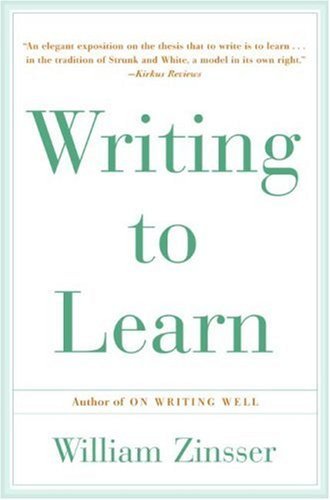
Writing to Learn: How to Write--And Think--Clearly about Any Subject at All
This is an essential book for everyone who wants to write clearly about any subject and use writing as a means of learning.
272 pages, Paperback
First published January 1, 1988
About the author
William Zinsser
48 books547 followersWilliam Knowlton Zinsser is an American writer, editor, literary critic, and teacher. He began his career as a journalist for the New York Herald Tribune, where he worked as a feature writer, drama editor, film critic, and editorial writer. He has been a longtime contributor to leading magazines.
Ratings & Reviews
Friends & Following
Create a free account to discover what your friends think of this book!
Community Reviews
Displaying 1 - 30 of 286 reviews

October 9, 2016
Humor is the most perilous of writing forms, full of risk; to make a vocation of brightening the reader’s day is an act of continuing gallantry.
Specialization inspires in me a certain existential dread. This is of two sorts. The first is the despairing thought that, by specializing, I will come to know only a certain, restricted corner of the vast universe. The second, more puerile fear is that, by becoming a specialist, I will commit myself on a path I won’t like very much.
Generalization is often, I suspect, motivated as much by fear of commitment as by humanistic curiosity. In Spanish there’s a word for a man who likes to sleep around—a picaflor—which conjures up the suggestive image of a bee going from flower to flower. Well, picaflores and Don Juans and Lotharios are generalists. Devoted husbands are specialists.
Promiscuity aside, we continue to do homage to generalists with our notion of the “Renaissance Man,” and the quintessential Renaissance Man was of course Leonardo da Vinci. His notebooks are filled not only with “art,” but studies of anatomy, light, physics, engineering, music, and so much else.
Last year I read a selection of Leonardo's notebooks, hoping to find out how one man could tackle so many disparate subjects. My conclusion was that his versatility was due to the application of his medium: drawing. By making careful, detailed sketches of things—bees, bodies, bridges—he came to understand them. His pencil thus acted as antennae, with which he probed and investigated his world.
I thought: Could I do something similar? Certainly I have little talent as regards visual art. But I do have a verbal addiction. Perhaps I could use writing in a way similar to how Leonardo used sketching? Such an idea was hardly original. Soon I found out that Zinsser, the writing guru, already had a book about it.
The idea of reading another Zinsser book was not especially appealing. I had already read his popular book On Writing Well, and came away with a sour taste in my mouth. But if I was going to be the next Leonardo, I had to swallow some pickles. Dutifully I bought this book; and, after equally dutiful procrastination, I am here to tell you about it.
My first reaction was, again, distaste. This is not entirely rational. Every good writer has what I call a “literary personality”—related to, but not identical with, their real personality—and I simply do not like Zinsser’s. I do not wish to spend time with him or to invite him to supper. I cannot really articulate why I dislike him, in the same way I can’t say exactly why I don’t like the sound of people eating apples. He’s a strong writer and I agree with much of what he says. He is thoughtful, curious, broadly educated, sensitive to art, music, and literature, and generally benign in his means and ends. When I think about it, I really ought to like him quite a bit. Yet I don’t.
Maybe this is because I object to the way he romanticizes his craft. Zinsser would have you believe that clear writing is one of the most difficult, dangerous, and distasteful activities in the world. It is so hard and so strenuous that it requires continual, backbreaking effort. Good writers are saints, many of them martyrs, including Zinsser himself: “I don’t like to write, but I take great pleasure in having written.” Zinsser makes very clear that his vocation is a heroic one, especially considering that he not only writes himself, but teaches it too:
Why, then, would anyone in his right mind want to be a writing teacher? The answer is that writing teachers aren’t altogether in their right mind. They are in one of the caring professions, no more sane in the allotment of their time and energy than the social worker or the day care worker or the nurse.
It takes serious audacity (to use a polite word) for a writing teacher to compare himself to a nurse. I also gag at this self-pity about the how hard it is to write well. Yes, it can be hard. Lots of things are hard. The only thing that sets writers apart is that they tend to whine the most eloquently.
Even when I put my personal dislike aside, however, I still must conclude that this book is disappointing. It begins with an unnecessary autobiographical section on Zinsser’s childhood education. (Considering how much Zinsser likes to talk about omitting unnecessary material, I found this especially ironic.) The rest of the book consists of long excerpts of what Zinsser considers to be successful examples of writing in different subjects, from anthropology to chemistry, from geology to mathematics. The book could easily have been an anthology, and probably should have been.
Most of what I wanted from this book is lacking. Yes, any subject can be written about engagingly—Zinsser didn’t need to prove this to me—but how do you go about doing that? Zinsser avoids the problem of methodology by insisting that good writing is learned by imitation. This is no doubt largely true; still I found it to be an abdication of this book’s promise: to give the would-be autodidact a strategy, or at least a few tips, for writing to learn.
Another serious omission is that Zinsser does not provide any concrete advice for teachers looking to apply this philosophy to their classes. There are a few reported examples of teachers who have done so, and a lot of hortatory passages about the benefits of “writing across the curriculum,” but very little in the way of concrete strategies for implementing this idea. As both a student and a teacher, I found this irksome.
Still, I suppose this book does have its value as a piece of propaganda. Zinsser is enthusiastic about writing, and his enthusiasm is contagious. For anyone skeptical that any subject—even chemistry, physics, or math—can be written well, or if you’re unsure whether writing can help you think and learn, you’ll find these doubts addressed here. For all its faults, this book does provide a glimpse of a compelling educational ideal: one that allows all of us to be picaflores in good conscience.
August 8, 2013
If you’ve read On Writing Well, you should read this book too. If you haven’t, you should read them both. Writing to Learn does a great job of summarizing the idea of “Writing Across the Curriculum.” It gives examples, justifications, and inspiration. I would sum up the book like this:
1. Writing helps us think.
2. Clear writing is clear thinking.
3. You can (and should to truly learn) about any subject.
4. Everyone (not just “writers”) writes.
5. We learn by imitation.
6. Every subject is accessible through clear writing.
7. Every field, subject, domain... has a literature.
8. There are two kinds of writing: explanatory and exploratory.
9. We can learn from anywhere, anyone.
10. We should look at the best examples in any field to learn.
Zinsser gives examples from the worlds of science, math, art, music, physics, chemistry, psychology. As a teacher, this book inspires me to find good examples from the worlds of technology, comedy, video games, cooking, sports, movies, and other fields that my students are really into.
Quote:
“Therefore, for the purposes of this book, I’ll generalize outrageously that there are two kinds of writing. One is explanatory writing: writing that transmits existing information or ideas. The other is exploratory writing: writing that enables us to discover what we want to say. Call it Type B. They are equally valid and useful.” (Loc 832 via Kindle)
Often exploratory writing is neglected in schools because it seems to “not have a point” or “not be graded” in the same way as final writing assignments might be. The irony, of course, is that the final writing assignment won’t be any good if the writer hasn’t explored the topic beforehand. This book helps explain how to to do that.
Other quotes too good not to share:
“...writing is a form of thinking, whatever the subject.” (Loc 36)
“But every discipline has a literature - a body of good writing that students and teachers can use as a model; writing is learned mainly by imitation.” (Loc 36)
“Clear writing is the logical arrangement of thought; a scientist who thinks clearly can write as well as the best writer.” (Loc 46)
“I thought of how often the act of writing even the simplest document - a letter, for instance - had clarified my half-formed ideas. Writing and thinking and learning were the same process.” (Loc 55)
“Learning, he seemed to be saying, takes a multitude of forms; expect to find them in places where you least expect them to be.” (Loc 180)
“Contrary to general belief, writing isn’t something that only “writers” do; writing is a basic skill for getting through life.” (Loc 188)
“Writing is thinking on paper. Anyone who thinks clearly should be able to write clearly - about any subject at all.” (Loc 188)
“Students should be learning a strong and unpretentious prose that will carry their thoughts about the world they live in.” (Loc 228)
“...there’s no subject that can’t be made accessible in good English with careful writing and editing.” (Loc 429)
“...a piece of writing is a piece of thinking.” (Loc 761)
“If clear writing is one of the foundations of a democratic society, don’t count on getting it from men and women with a college degree.” (Loc 1033)
“Writers and learners will write better and learn more if they understand the “why” of what they are studying.” (Loc 1267)
“Nonfiction writing should always have a point: It should leave the reader with a set of facts, or an idea, or a point of view, that he didn’t have before he started reading.” (Loc 1959)
“Writer’s who think they are being criticized when only their writing is being criticized are beyond a teacher’s reach.” (Loc 3035)
“If writing is learned by imitation, I want every learner to imitate the best.” (Loc 3156)
“Moral: think flexibly about the field you’re writing about. Its frontiers may no longer be where they were the last time you looked.” (Loc 3243)
1. Writing helps us think.
2. Clear writing is clear thinking.
3. You can (and should to truly learn) about any subject.
4. Everyone (not just “writers”) writes.
5. We learn by imitation.
6. Every subject is accessible through clear writing.
7. Every field, subject, domain... has a literature.
8. There are two kinds of writing: explanatory and exploratory.
9. We can learn from anywhere, anyone.
10. We should look at the best examples in any field to learn.
Zinsser gives examples from the worlds of science, math, art, music, physics, chemistry, psychology. As a teacher, this book inspires me to find good examples from the worlds of technology, comedy, video games, cooking, sports, movies, and other fields that my students are really into.
Quote:
“Therefore, for the purposes of this book, I’ll generalize outrageously that there are two kinds of writing. One is explanatory writing: writing that transmits existing information or ideas. The other is exploratory writing: writing that enables us to discover what we want to say. Call it Type B. They are equally valid and useful.” (Loc 832 via Kindle)
Often exploratory writing is neglected in schools because it seems to “not have a point” or “not be graded” in the same way as final writing assignments might be. The irony, of course, is that the final writing assignment won’t be any good if the writer hasn’t explored the topic beforehand. This book helps explain how to to do that.
Other quotes too good not to share:
“...writing is a form of thinking, whatever the subject.” (Loc 36)
“But every discipline has a literature - a body of good writing that students and teachers can use as a model; writing is learned mainly by imitation.” (Loc 36)
“Clear writing is the logical arrangement of thought; a scientist who thinks clearly can write as well as the best writer.” (Loc 46)
“I thought of how often the act of writing even the simplest document - a letter, for instance - had clarified my half-formed ideas. Writing and thinking and learning were the same process.” (Loc 55)
“Learning, he seemed to be saying, takes a multitude of forms; expect to find them in places where you least expect them to be.” (Loc 180)
“Contrary to general belief, writing isn’t something that only “writers” do; writing is a basic skill for getting through life.” (Loc 188)
“Writing is thinking on paper. Anyone who thinks clearly should be able to write clearly - about any subject at all.” (Loc 188)
“Students should be learning a strong and unpretentious prose that will carry their thoughts about the world they live in.” (Loc 228)
“...there’s no subject that can’t be made accessible in good English with careful writing and editing.” (Loc 429)
“...a piece of writing is a piece of thinking.” (Loc 761)
“If clear writing is one of the foundations of a democratic society, don’t count on getting it from men and women with a college degree.” (Loc 1033)
“Writers and learners will write better and learn more if they understand the “why” of what they are studying.” (Loc 1267)
“Nonfiction writing should always have a point: It should leave the reader with a set of facts, or an idea, or a point of view, that he didn’t have before he started reading.” (Loc 1959)
“Writer’s who think they are being criticized when only their writing is being criticized are beyond a teacher’s reach.” (Loc 3035)
“If writing is learned by imitation, I want every learner to imitate the best.” (Loc 3156)
“Moral: think flexibly about the field you’re writing about. Its frontiers may no longer be where they were the last time you looked.” (Loc 3243)

August 7, 2015
For anyone interested in the definition and use of "living books" in education, this is full of good examples and ponderings. It might be useful to accompany the topical chapters (such as "how to read social science") in Adler's How to Read a Book.

March 16, 2022
Excellent examples of creative and gripping non-fiction writing, but didn't cover the process of writing - specifically drafting and editing and thinking through writing- as much as I hoped.
August 21, 2021
The book name is misleading - a small quote from the book to prove my point - "Only two chapters—9 and 11—specifically demonstrate writing as a method of learning."
the writing is sometimes really misleading and confusing. A big part of the book is praises on the power of writing or just the author petting his own ego.
It does contain some helpful tips but are rare and sparsely scattered in the book. It does contain a lot of examples of good writing that can be helpful if you plan to write about the subject the examples are about.
This book might help people planing to write a book about the subjects discussed in the book or for teachers trying to add some sort of writing assignments to their courses.
the writing is sometimes really misleading and confusing. A big part of the book is praises on the power of writing or just the author petting his own ego.
It does contain some helpful tips but are rare and sparsely scattered in the book. It does contain a lot of examples of good writing that can be helpful if you plan to write about the subject the examples are about.
This book might help people planing to write a book about the subjects discussed in the book or for teachers trying to add some sort of writing assignments to their courses.

November 9, 2009
About six years ago I spent such a happy afternoon in the Melbourne library, reading Zinsser's On Writing Well (similar in style and content to Strunk and White's Elements of Style), I was happy to pick up another of his books when it came my way. The opening chapters were exciting: Zinsser wrote well about the pains and rewards of writing, and made an eloquent case that society (especially the educated, business class) has gone to the dogs by way of 'office-speak' and 'bureaucratese.' He even convinced me that writing should be taught 'across the curriculum;' in other words, math students should write about math. Economics students should write about economics. Not only does our culture need good, clear writing about all subjects, but people learn best from their subject if they write about it. Writing, he pleaded, is organized thought. Of course, he was preaching to the choir.
But, the book fell flat. The remaining chapters were devoted to samples of other people's writing, organized by category (the arts, sciences, etc.). Thing is, except for only an exception or two (you know Rachel Carson, the envronmentalist? The woman can write!), none of his examples wrote as well as Zinsser himself does. Toward the end, I found myself skipping the samples in favor of Zinsser's clever, albeit brief, commentaries.
Here is one passage in which I took great heart:
"Only when the job was over did I enjoy it. I don't like to write, but I take great pleasure in having written-- in having finally made an arrangement that has a certain inevitability, like the solution to a mathematical problem. Perhaps in no other line of work is delayed gratification so delayed."
But, the book fell flat. The remaining chapters were devoted to samples of other people's writing, organized by category (the arts, sciences, etc.). Thing is, except for only an exception or two (you know Rachel Carson, the envronmentalist? The woman can write!), none of his examples wrote as well as Zinsser himself does. Toward the end, I found myself skipping the samples in favor of Zinsser's clever, albeit brief, commentaries.
Here is one passage in which I took great heart:
"Only when the job was over did I enjoy it. I don't like to write, but I take great pleasure in having written-- in having finally made an arrangement that has a certain inevitability, like the solution to a mathematical problem. Perhaps in no other line of work is delayed gratification so delayed."

March 10, 2014
I expected instruction on how to enjoy what we learned by writing reflectively about it. What I got was a warm and engaging memoir that also conveyed the former. This author provides a kindred spirit to those who are curious about more than their essential daily function, and he will encourage this, and he will encourage it in any reader in whom curiosity has become just a flicker. He makes every field he touches accessible, and he encourages us to share his zest for life.

Read
August 11, 2022This was another book I finished this month after having it on my reading stack for 3-4 months. It was a good one to take in chunks, because less a how-to manual and more a book of examples. I can see why AO assigns it in high school and I will recommend it to my teens, although I don’t think it is sufficient for helping a teen learn the art of writing. However, solid, clear nonfiction prose that is more than merely descriptive is a hard skill to learn, so the book of examples from a variety of fields and numerous people - each with their own clear style - then commented upon (but not picked apart or really analyzed) by Zinsser is a good place to start so students get a sense for what’s being asked of them in a paper.
I’d highly recommend it to anyone who wants to write to be understood and to synthesize their own knowledge, not because it will teach you how but because it will demonstrate that it’s possible and desirable.
I’d highly recommend it to anyone who wants to write to be understood and to synthesize their own knowledge, not because it will teach you how but because it will demonstrate that it’s possible and desirable.
August 25, 2024
DNF
If you ever ask me what I thought about this book, I will tell you my entire life story in great detail, and maybe some thoughts about why books are important because of the stories they tell, and never answer your question at all.
If you ever ask me what I thought about this book, I will tell you my entire life story in great detail, and maybe some thoughts about why books are important because of the stories they tell, and never answer your question at all.

October 15, 2008
In one of my recent reads, Writing to Learn, William Zinsser makes the challenge to write about something that is intangible rather than concrete. For example, a music lesson. It is one thing to write descriptively about a work of art or a photograph~~~the reader can LOOK at what is being discussed. But to describe a musical technique requires the ability to conjure up sensory information of a different sort. In the author's own words:
"Writing about music also made me a better musician. The need to write clearly about an art form that the reader can never see or hear; one that evaporates with the playing of each note, forced me to think harder about the structure of music--about what I was trying to learn."
Zinsser's approach here is related, I think, to the concept of narration. Homeschoolers, especially of the Charlotte Mason variety, are well familiar with this technique of "telling back" what has been learned. In a homeschool setting, this most often involves telling back an episode in a book. But I'm finding that this deceivingly simple exercise is valuable in other settings, too.
The music lesson is just one "non book" example. How about narrating the way in which a math problem is solved? Or describing how to do a flip on the trampoline? Have you ever tried to describe in detail an elegant meal that you enjoyed?
Oral "tellings" are perfect for young children, but writing the narrations adds a new level of learning. Even adults find it challenging! I know this because I've tried tackling some of the writing assignments I've given to my children.
Zinsser tells us that writing forces the brain to reason in a linear, sequential way and thus is ideally suited to help us tackle subjects that we might view as difficult. When we write, we must break it down into bite-sized morsels and that is far less intimidating than sorting through a huge mass of information.
I have two very excellent writers in the family. But I have noticed that when I choose the "Achilles Heel" subject as a writing assignment, the result is less-than-excellent. So I am taking Zinsser's advice which includes:
*Providing excellent models of good writing across the curriculum
*Taking the time to write across-the-board, even where symbols are commonly preferred (math, music, physics, etc.)
J. Henri Fabre, the famous French writer and entomologist, honed his incredible writing ability over a period of 20+ years by writing textbooks. His care in writing enabled him to later pen books that have been described as the "Insects' Homer". His words sing, even after being translated into different languages.
The lesson I learn from Fabre is that writing is a lifetime pursuit! I'm excited that my own learning continues to unfold as I oversee the education of my children.
Life is rich!
"Writing about music also made me a better musician. The need to write clearly about an art form that the reader can never see or hear; one that evaporates with the playing of each note, forced me to think harder about the structure of music--about what I was trying to learn."
Zinsser's approach here is related, I think, to the concept of narration. Homeschoolers, especially of the Charlotte Mason variety, are well familiar with this technique of "telling back" what has been learned. In a homeschool setting, this most often involves telling back an episode in a book. But I'm finding that this deceivingly simple exercise is valuable in other settings, too.
The music lesson is just one "non book" example. How about narrating the way in which a math problem is solved? Or describing how to do a flip on the trampoline? Have you ever tried to describe in detail an elegant meal that you enjoyed?
Oral "tellings" are perfect for young children, but writing the narrations adds a new level of learning. Even adults find it challenging! I know this because I've tried tackling some of the writing assignments I've given to my children.
Zinsser tells us that writing forces the brain to reason in a linear, sequential way and thus is ideally suited to help us tackle subjects that we might view as difficult. When we write, we must break it down into bite-sized morsels and that is far less intimidating than sorting through a huge mass of information.
I have two very excellent writers in the family. But I have noticed that when I choose the "Achilles Heel" subject as a writing assignment, the result is less-than-excellent. So I am taking Zinsser's advice which includes:
*Providing excellent models of good writing across the curriculum
*Taking the time to write across-the-board, even where symbols are commonly preferred (math, music, physics, etc.)
J. Henri Fabre, the famous French writer and entomologist, honed his incredible writing ability over a period of 20+ years by writing textbooks. His care in writing enabled him to later pen books that have been described as the "Insects' Homer". His words sing, even after being translated into different languages.
The lesson I learn from Fabre is that writing is a lifetime pursuit! I'm excited that my own learning continues to unfold as I oversee the education of my children.
Life is rich!
August 9, 2021
The title is the best part of the book, and if he actually wrote about how to use writing to learn things better this would have been an amazing book. Unfortunately this was just him droning on about everything except the title of his book.

September 10, 2026
Enjoyed the practical examples.
Here is an author in love with good writing, and with endless curiosity about the world.
An insightful and inspirational read, this.
Here is an author in love with good writing, and with endless curiosity about the world.
An insightful and inspirational read, this.

October 24, 2025
Writing to Learn by William Zinsser is a book that argues a simple but powerful idea: writing is not just a way to show what you already know, but the best tool to figure out what you think and truly understand a subject. Zinsser believes that anyone, from a scientist to a student, can use writing to clarify their thoughts and master complex topics. He explains that the act of putting ideas into clear, simple sentences forces you to organize your knowledge and identify gaps in your understanding. The book is meant to free people from the fear of writing by showing its practical value as a learning tool, not just a final test.
The book succeeds wonderfully in its mission. Zinsser fills the book with real-world examples from fields like history, physics, and medicine, showing how clear writing and clear thinking go hand-in-hand. By reading these examples, you see his method in action. He doesn't just tell you that writing helps you learn; he proves it. The book is encouraging and practical, leaving you convinced that writing is a powerful skill you can use to explore and understand any subject that interests you, not just English class assignments.
The book succeeds wonderfully in its mission. Zinsser fills the book with real-world examples from fields like history, physics, and medicine, showing how clear writing and clear thinking go hand-in-hand. By reading these examples, you see his method in action. He doesn't just tell you that writing helps you learn; he proves it. The book is encouraging and practical, leaving you convinced that writing is a powerful skill you can use to explore and understand any subject that interests you, not just English class assignments.

March 21, 2023
William Zinsser demonstrates convincingly how writing about any subject should be clear, understandable, succinct and interesting. He believes good writing is a product of clear thinking. He also argues that the former can lead to the latter. In this book, he gives various examples of good writing from a range of disciplines: biology, chemistry, music, anthropology and more.

May 25, 2019
This book is a treat for 'generalists' that are curious about all subject matters and want to write about them, be it Mathematics, Sciences or Humanities! And you CAN successfully write about mathematics, chemistry and music in clear and plain English because Zissner will show you that you can. Chock full of examples exploring how the knowledgeable Greats of their subjects/fields have managed to do this with aplomb. This book is a handbook for people of any academic background who have ever felt that writing seemed to have belonged to the Humanities but that harboured a love for prose and wanted to incorporate it into their learning without the worry of being treated as non-serious. Prose writing about mathematics has integrity! Read this to find out the how's and whys. The book is full of highly quotable ideas that are a useful learning tool for all of us who don't want to fall into any one particular subject category and want to write across the curriculum. And demonstrates that 'the same principles of good writing would apply to them all'.
Some highlights
Preface:
'it's not necessary to be a "writer" to write well. Clear writing is the logical arrangement of thought'
'writing and thinking and learning were the same process'
P. 10
'I've become a clarity nut. I've also become a logic nut. I'm far less preoccupied than I once was with individual words and their picturesque roots and origins'
P. 11
'writing is thinking on paper'
P. 14
'writing is primarily an exercise in logic and that words are just tools designed to do a specific job'
P. 21
'Generalists, as interested in astronomy and mathematics and evolution as they are in physics and the genetic code and the processes of life'
P. 23
'we must say to students in every area of knowledge: "This is how other people have written about this subject. Read it, study it, think about it."'
Some highlights
Preface:
'it's not necessary to be a "writer" to write well. Clear writing is the logical arrangement of thought'
'writing and thinking and learning were the same process'
P. 10
'I've become a clarity nut. I've also become a logic nut. I'm far less preoccupied than I once was with individual words and their picturesque roots and origins'
P. 11
'writing is thinking on paper'
P. 14
'writing is primarily an exercise in logic and that words are just tools designed to do a specific job'
P. 21
'Generalists, as interested in astronomy and mathematics and evolution as they are in physics and the genetic code and the processes of life'
P. 23
'we must say to students in every area of knowledge: "This is how other people have written about this subject. Read it, study it, think about it."'

December 26, 2020
This book was not bad, exactly, just not what I was hoping for. Most of it is a repeat of On Writing Well. It was page after page of polished writing samples and analysis of why this sentence grabs you, or how this passage makes a technical subject accessible. It's more about learning to write than writing to learn. I'm disappointed because it falls short of what it claimed to be.
Not to completely disparage this book, the first two chapters do explain the benefit of using writing in subjects that are not typically writing-centric. The chapter on mathematics was also closer to what I was looking for, where a grade-school teacher uses writing to teach mathematics. The samples were rough, but they showed how students used writing to grasp mathematical concepts.
This book overemphasized the necessity of entertainment value and accessibility of writing. When you are student, it's important to write clearly, sure, but writing to learn shouldn't mean you have to write fantastic, engaging content like Rachel Carson. It is more about testing your thoughts in clear terms. The polishing should be secondary.
Not to completely disparage this book, the first two chapters do explain the benefit of using writing in subjects that are not typically writing-centric. The chapter on mathematics was also closer to what I was looking for, where a grade-school teacher uses writing to teach mathematics. The samples were rough, but they showed how students used writing to grasp mathematical concepts.
This book overemphasized the necessity of entertainment value and accessibility of writing. When you are student, it's important to write clearly, sure, but writing to learn shouldn't mean you have to write fantastic, engaging content like Rachel Carson. It is more about testing your thoughts in clear terms. The polishing should be secondary.

September 4, 2007
Zinsser's book is both an anthology and a narrative about his experience with the concept of "writing across the curriculum." He recounts how good writing in other fields helped break down his misconception that certain subjects were, at best boring, or at worst, unlearnable. He posits that writing is the best way for students to engage with material--any material.
Through carefully selected reading examples and personal examples, William Zinsser engages with the natural world, art, physics, music, chemistry, mathematics, anthropology, etc...the world of learning becomes limitless and accessible. Zinsser defines three "R"s for writing: No matter the subject, good writing will have Resonance, Relevancy and Responsibility (Accountability).
Through carefully selected reading examples and personal examples, William Zinsser engages with the natural world, art, physics, music, chemistry, mathematics, anthropology, etc...the world of learning becomes limitless and accessible. Zinsser defines three "R"s for writing: No matter the subject, good writing will have Resonance, Relevancy and Responsibility (Accountability).

May 31, 2023
I agree with this book’s premise. I am a retired financial controller. One issue I had over the
years is the inability of degreed accountants to write a coherent business letter. In my field, one
needs to be able to be brief and get to the point.
I am somewhat disappointed in this book. Although it gave abundant examples of writing in various disciplines, it never got around to showing how to improve one’s own writing. Some of the examples are guilty of the kind of writing the author is trying to discourage. In fact some of them are boring.
I do think that the author is correct that one should be able to write clearly what one has
learned.
years is the inability of degreed accountants to write a coherent business letter. In my field, one
needs to be able to be brief and get to the point.
I am somewhat disappointed in this book. Although it gave abundant examples of writing in various disciplines, it never got around to showing how to improve one’s own writing. Some of the examples are guilty of the kind of writing the author is trying to discourage. In fact some of them are boring.
I do think that the author is correct that one should be able to write clearly what one has
learned.

December 15, 2017
I read this and _On Writing Well_ back when the books were only a few years old and I was teaching my first ever classes -- freshman composition. Zinsser is such an easy (apparently) writer and thinker that I don't know why I haven't come back to these again and again.
Easily remedied.
Easily remedied.
June 15, 2021
I call this type of book an “ego” book: I did this, I did that, I meet this person or another, I went there… It’s just a rant about the author’s life. I expected some guidance but it has no value in this sense. Not worth.
January 13, 2022
Found this book in the Kindle bargain book bin, so my expectations were not high. And for good reason, this book falls short of what it claims to be. There are few good takeaways, however, a lot of ego stroking by the author.

March 2, 2018
Beyond being instructional on what makes for good writing, this book introduced me to some books that I have added to my ever-growing "want to read" list.

October 23, 2024
The first part of the book talks about how writing can help you learn and understand new ideas. It also gives tips on what makes a piece of writing good.
In the second part the author goes through a wide variety of areas and gives examples of good writing from those.
Areas include Geology, Chemistry, Maths, Anthropology, Cell biology, Physics, Music, Arts etc. It was great to know who's who of the 20th century along with their well written pieces. After demonstrating the pieces, the author gives a commentary on what was good in those.
I loved most of the examples, especially the speech written by Lewis Thomas and the piece by Geertz.
Cons -
I didn't agree with his idea that grammar and structure is very essential for a well written document.
For eg, he felt that Feynman's autobiography was a poorly written one (which I disagree).
Also most part of the book is not about "writing to learn" but "what good writing looks like in various fields".
And the parts where it did talk about "writing to learn" was mostly emphasizing how writing in curriculum might help students to learn and the teachers to judge in a better way.
--
Overall an easy read!
Personally I do believe that writing about something cements that idea in our brain as it requires us to think deeply.
I also believe that (mostly) you are only as good as your interfaces (communication skills), so improving my writing is something I would love to pursue.
Writing helps to clear your mind as well as to help give clarity of thought.
Ideas are generally half baked in your head but become tangible when put down on a paper.
Some quotes that I loved in this book :
One of the underestimated tasks in non fiction writing is to impose a narrative shape on an unwieldy mass of material.
I take great pleasure in having written - in finally having made an arrangement that has certain inevitability, like the solution to a math problem. Perhaps no other line of work is delayed gratification so delayed.
An idea can have value in itself, but it's usefulness dimishes to the extent that you can't articulate it to others.
Only there, where a writer is at his most vulnerable, having put some part of himself on paper, does he make the connection between principle and practice.
Where does writing figure in all this? Writing is a tool that enables people in every discipline to wrestle with facts and ideas. It's a physical activity, unlike reading. Writing requires us to operate some kind of mechanism-pencil, pen, typewriter, word processor-for getting our thoughts on paper. It compels us by the repeated effort of language to go after those thoughts and to organize them and present them clearly. It forces us to keep asking, "Am I saying what I want to say?" Very often the answer is "No." It's a useful piece of information
(Referring to the second law of thermodynamics) Writers are against nothing less than the fundamental anarchy of the universe, entropy, prince of disorder, is sprinkling noise on everything we write.
Writers may write for any number of good personal reasons - ego, therapy, recollection, validation of their lives. But what they produce will have a validity of its own to the extent it is useful to somebody else.
My interest in Fabre's interest in insects is high. The transaction between the writer and his subject is the central relationship in non fiction.
Timidity never produced a good piece of writing.
Writing can only be learnt when a writer coldly separates himself from what he has written and looks at it with the objectivity of a plumber examining a newly pipes bathroom to see if he got all the joints tight. (Basically don't put too much self-worth associated with your writing)
In the second part the author goes through a wide variety of areas and gives examples of good writing from those.
Areas include Geology, Chemistry, Maths, Anthropology, Cell biology, Physics, Music, Arts etc. It was great to know who's who of the 20th century along with their well written pieces. After demonstrating the pieces, the author gives a commentary on what was good in those.
I loved most of the examples, especially the speech written by Lewis Thomas and the piece by Geertz.
Cons -
I didn't agree with his idea that grammar and structure is very essential for a well written document.
For eg, he felt that Feynman's autobiography was a poorly written one (which I disagree).
Also most part of the book is not about "writing to learn" but "what good writing looks like in various fields".
And the parts where it did talk about "writing to learn" was mostly emphasizing how writing in curriculum might help students to learn and the teachers to judge in a better way.
--
Overall an easy read!
Personally I do believe that writing about something cements that idea in our brain as it requires us to think deeply.
I also believe that (mostly) you are only as good as your interfaces (communication skills), so improving my writing is something I would love to pursue.
Writing helps to clear your mind as well as to help give clarity of thought.
Ideas are generally half baked in your head but become tangible when put down on a paper.
Some quotes that I loved in this book :
One of the underestimated tasks in non fiction writing is to impose a narrative shape on an unwieldy mass of material.
I take great pleasure in having written - in finally having made an arrangement that has certain inevitability, like the solution to a math problem. Perhaps no other line of work is delayed gratification so delayed.
An idea can have value in itself, but it's usefulness dimishes to the extent that you can't articulate it to others.
Only there, where a writer is at his most vulnerable, having put some part of himself on paper, does he make the connection between principle and practice.
Where does writing figure in all this? Writing is a tool that enables people in every discipline to wrestle with facts and ideas. It's a physical activity, unlike reading. Writing requires us to operate some kind of mechanism-pencil, pen, typewriter, word processor-for getting our thoughts on paper. It compels us by the repeated effort of language to go after those thoughts and to organize them and present them clearly. It forces us to keep asking, "Am I saying what I want to say?" Very often the answer is "No." It's a useful piece of information
(Referring to the second law of thermodynamics) Writers are against nothing less than the fundamental anarchy of the universe, entropy, prince of disorder, is sprinkling noise on everything we write.
Writers may write for any number of good personal reasons - ego, therapy, recollection, validation of their lives. But what they produce will have a validity of its own to the extent it is useful to somebody else.
My interest in Fabre's interest in insects is high. The transaction between the writer and his subject is the central relationship in non fiction.
Timidity never produced a good piece of writing.
Writing can only be learnt when a writer coldly separates himself from what he has written and looks at it with the objectivity of a plumber examining a newly pipes bathroom to see if he got all the joints tight. (Basically don't put too much self-worth associated with your writing)

May 19, 2026
This is one mentioned on the Literary Life podcast (episode 40) and was described as a good book for a homeschool mom to read. It was pointed out that everything the author says about writing is also true of narration (especially as part of a Charlotte Mason education). I did find this to be true, and it was fascinating.
The author gave many (many!) examples of good writing across many disciplines, and demonstrated the importance of being able to write well and communicate clearly whether you are writing about the humanities or math and science--or anything at all. Every thought should be able to be translated into clear English and logical progression. We learn that writing is merely thinking on paper, and everyone can learn to organize his thoughts, find out what he doesn't know, and concisely communicate what he does know--in writing. Even the math and science guys!
I really enjoyed the chapters on writing in math and music (two disciplines that continue to baffle me).
The author's book "On Writing Well" has been recommended as a good book to hand to a high school student to read (which we have done), and the author recommends Strunk & White's "The Elements of Style" (which I'd like to track down).
Note: definite evolutionary perspective utilized quite often in the examples.
The author gave many (many!) examples of good writing across many disciplines, and demonstrated the importance of being able to write well and communicate clearly whether you are writing about the humanities or math and science--or anything at all. Every thought should be able to be translated into clear English and logical progression. We learn that writing is merely thinking on paper, and everyone can learn to organize his thoughts, find out what he doesn't know, and concisely communicate what he does know--in writing. Even the math and science guys!
I really enjoyed the chapters on writing in math and music (two disciplines that continue to baffle me).
The author's book "On Writing Well" has been recommended as a good book to hand to a high school student to read (which we have done), and the author recommends Strunk & White's "The Elements of Style" (which I'd like to track down).
Note: definite evolutionary perspective utilized quite often in the examples.

January 7, 2025
What an incredible book. I picked up this book because I thought it would give me some practical tips on writing a better script for the podcast I am starting but I got so much more from it. This book has been a paradigm shift regarding my appreciation for writing. I wish I had read it in college when I had to take those stupid WAC (writing-across-the-curriculum) courses. Back then I thought they were WACK courses. This book has changed that. William Zinsser does a good job of describing why writing matters and how it is a fundamental part of learning. He also peppers the book with sections of books he considers "good" writing. These short selections intrigued me greatly due to the clarity and interest of their writing and the books are now shelved as want to reads. Sometimes the book drags a little with some more technical explanations of good writing that I did not find particularly interesting but I can say with confidence that this is a book you should read. It will give you a new perspective on writing and help you to realize why those annoying English classes we took in college mattered and still impact your life today. I hope this book brings you the same amount of joy it brought me.

January 1, 2024
Excellent advice excellently formulated. Zinsser rightly highlights the interplay between the members of the holy trinity of mental fitness: reading, writing and thinking.
"Writing is thinking on paper. Anyone who thinks clearly should be able to write clearly—about any subject at all."
"Writing organizes and clarifies our thoughts. Writing is how we think our way into a subject and make it our own. Writing enables us to find out what we know—and what we don’t know—about whatever we’re trying to learn."
"Writing is a tool that enables people in every discipline to wrestle with facts and ideas. It’s a physical activity, unlike reading. Writing requires us to operate some kind of mechanism—pencil, pen, typewriter, word processor—for getting our thoughts on paper. It compels us by the repeated effort of language to go after those thoughts and to organize them and present them clearly. It forces us to keep asking, “Am I saying what I want to say?” Very often the answer is “No.” It’s a useful piece of information."
"The artist Paul Klee once told his students that “art is exactitude winged by intuition.” I like that equally as a definition of good writing."
"Writing is thinking on paper. Anyone who thinks clearly should be able to write clearly—about any subject at all."
"Writing organizes and clarifies our thoughts. Writing is how we think our way into a subject and make it our own. Writing enables us to find out what we know—and what we don’t know—about whatever we’re trying to learn."
"Writing is a tool that enables people in every discipline to wrestle with facts and ideas. It’s a physical activity, unlike reading. Writing requires us to operate some kind of mechanism—pencil, pen, typewriter, word processor—for getting our thoughts on paper. It compels us by the repeated effort of language to go after those thoughts and to organize them and present them clearly. It forces us to keep asking, “Am I saying what I want to say?” Very often the answer is “No.” It’s a useful piece of information."
"The artist Paul Klee once told his students that “art is exactitude winged by intuition.” I like that equally as a definition of good writing."

April 12, 2024
Eh - I liked the first part of his book (particularly when he noted ethics and critical thought were taken out of science education after Sputnik, and that has led to alarming results for American culture- so sorry, my guy, it gets worse!!) and (similar to other readers) was somewhat let down to go without a clearer plan for translating writing to learning. I suppose he doesn't have to, but I wish he did. He said it would have been patronizing, but I really don't think it would have been.
There are subtle changes writing style. What's considered good in one decade may become gratuitous in another. Which is to say, I found a few of Zinsser's "exemplar" pieces verbose and dry. I did not share is wonder. Then again, I don't think I'd share in the author's all-too-common derision of "lazy" writing.
I'd skip. The highlights will be enough.
There are subtle changes writing style. What's considered good in one decade may become gratuitous in another. Which is to say, I found a few of Zinsser's "exemplar" pieces verbose and dry. I did not share is wonder. Then again, I don't think I'd share in the author's all-too-common derision of "lazy" writing.
I'd skip. The highlights will be enough.

January 26, 2026
I really liked this! I’m not the target audience cuz it’s for non-English teachers to encourage all disciplines to teach writing and how to integrate it into all subjects, but I really appreciated this and agree 100% that it’s not the sole job of the English teacher to teach writing.
The Writing Mathematics chapter was so good. There are so many ways to integrate writing into other non-english centered subjects (ie to encourage the formulating and breaking down thoughts, synthesize info…). Chapter 11 was so interesting too. I thought it was interesting that they had multiple choice answers but you only got marks if you explained your answer too.
Overall, I really liked the chapters on how to teach writing in other subjects and I wish all chapters were on this and not just a snippet of “good writing in that discipline”
Chapter 10 was questionable
The Writing Mathematics chapter was so good. There are so many ways to integrate writing into other non-english centered subjects (ie to encourage the formulating and breaking down thoughts, synthesize info…). Chapter 11 was so interesting too. I thought it was interesting that they had multiple choice answers but you only got marks if you explained your answer too.
Overall, I really liked the chapters on how to teach writing in other subjects and I wish all chapters were on this and not just a snippet of “good writing in that discipline”
Chapter 10 was questionable

May 8, 2022
Absolutely brilliant. It was a bit slow going at the start but after that I just couldn't put it down. It makes you look at the world with fresh eyes. Some of the example paragraphs are simply luminous.
Amongst the examples of great writing are Einstein and Freud and many others. The section about art was my favourite but they are all great. As a result of reading this my bookshelves gained a few more older books (I just couldn't resist after reading some of the extracts, I particularly cannot wait to read the Grammatical Man) and I bought a few more of Zinssers books as well. I am his starry-eyed fan.
Amongst the examples of great writing are Einstein and Freud and many others. The section about art was my favourite but they are all great. As a result of reading this my bookshelves gained a few more older books (I just couldn't resist after reading some of the extracts, I particularly cannot wait to read the Grammatical Man) and I bought a few more of Zinssers books as well. I am his starry-eyed fan.
November 8, 2024
Zinsser is a great teacher who espouses the value of good and structural writing. One interesting point of discussion is that will a structured, rigid writing affect creativity? In my humble opinion, Zinsser does not force the readers to write a certain way like a high school teacher. Rather, he suggests styles and practices that allow the writing to be easily understood by the readers.
Additionally, this book has introduced me to great many books without regard to subject matter. Zinsser is proving his point when he states that the subject does not matter as much as how well the work is written. I guess now I have to read John Muir, Aldous Huxley, and Clifford Geertz.
Additionally, this book has introduced me to great many books without regard to subject matter. Zinsser is proving his point when he states that the subject does not matter as much as how well the work is written. I guess now I have to read John Muir, Aldous Huxley, and Clifford Geertz.
Displaying 1 - 30 of 286 reviews