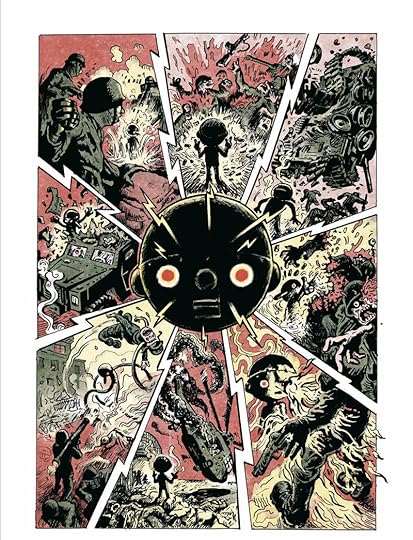
Lauréat du Fauve d’or 2009 ― prix du meilleur album ― du 36ème Festival International de la bande dessinée d''Angoulême.À travers des séquences souvent muettes, Winshluss livre dans Pinocchio un véritable opéra dessiné en nous faisant partager des émotions fortes et contradictoires, d''une richesse exceptionnelle. Un sommet d''inventions graphiques qui parvient à faire rire et réfléchir.Pré-publié en partie dans la revue Ferraille Illustré de 2003 à 2005 et interrompu par Winshluss pour se consacrer avec Marjane Satrapi à la réalisation du film d''animation Persepolis (primé au Festival de Cannes et aux Césars et nominé aux Oscars), Pinocchio narre les (més)aventures de la célèbre marionnette, revues et corrigées par ce bon petit diable de Winshluss. La trame y est globalement la même que dans le célèbre roman de Collodi, cependant l''intrigue y est largement modernisée : on retrouve ici un Pinocchio bien loin du gentil petit garçon de Walt Disney ! Le pantin de bois devient là un simple androïde conçu par un ingénieur en mal de reconnaissance. Tandis que « le grillon qui parle » (ici un cafard) connaît un sort plus enviable que celui du roman originel, puisqu''il s''agit d''un SDF qui trouve à squatter bien confortablement dans « la boite cranienne » du petit robot en question.Winshluss maltraite les codes de la bande dessinée populaire et les références cinématographiques avec virtuosité. Des clichés les plus éculés il invente des formes narratives des plus modernes. Mais toute la force du travail de l’auteur réside dans son traitement graphique. Outre un dessin très expressif, Winshluss fait preuve ici d’une maîtrise insolente du récit muet. Car ce Pinocchio ne contient quasiment aucun dialogue ni texte off. Avec Pinocchio, Winshluss s''ébat joyeusement dans l''univers des enfants pour le plaisir des plus grands … un peu comme si Bruno Bettelheim avait écrit pour Tex Avery !Ce livre imposant prouve que Winshluss est sans conteste l''un des auteurs de bande dessinée les plus virtuoses et passionnants de sa génération. Et même s''il est resté bien discret jusqu’à présent sous son pseudonyme de dessinateur de bande dessinée, nul doute que ce livre va enfin le révéler au plus large des publics !
Vincent Paronnaud (born 1970), a.k.a. Winshluss, is a French comics artist and filmmaker. Paronnaud was born in La Rochelle. He is best known for cowriting and codirecting with Marjane Satrapi the highly acclaimed animated film Persepolis (2007), for which they received numerous awards including the Jury Prize at the 2007 Cannes Film Festival[1] as well as an Academy Award nomination for Best Animated Feature.[2]
Whoa – we have a superstar on our hands!! Or at least a comic-book superstar… well, or at least a cartoonist who should be a comic-book superstar if it wasn't for the market being what it is… Anyway, his name is: Winshluss. Okay, it may not sound like much, but most of us comic and film buffs already admired Winshluss’ work when we watched Persepolis, the widely acclaimed animated feature Winshluss aka Vincent Paronnaud co-wrote and co-directed with Marjane Satrapi.
Yet Winshluss’ solo comic-book work is not nearly as widely known, which is a real shame because it happens to be every bit as accomplished and gutsy and exciting as his movie work. I can’t believe it took me years to finally stumble upon this beautifully designed and colored, meticulously crafted (in the Krazy-Kat-Kurtzman-Crumb tradition) artifact - I mean, its style and beauty are kinda obvious.
I guess I am generally not the biggest fan of "post-modern" versions of classic stories, but the thing is - this one is special: it manages to hit exactly the right notes to bring the famous 19th-century children’s novel (along with a few other classics) back to its folk roots, and as it turns out a wild combination of rough, reckless, sexually charged, delicious, humane, subversive, obscene, horrifying, hilarious post-Disney notes is the one that does the trick. Winshluss' Pinocchio has immediately become one of my all-time favorites, which does not happen very often at my age.
What can I say, my GR friends are awesome - thanks for posting positive reviews that caught my eye and made me pick up this absolutely wonderful book! And to those who have not yet read it: do yourself a favor and pick it up pronto!
The other day, at a reading of my novel, Heraclix & Pomp, I was approached by a reader who asked if the book was a children's book. My response was "only if you want to traumatize the child".
I'd like to repeat that same warning about Winshluss's Pinocchio this is not, Not, NOT a children's book! Au contraire, it is very much an adult book. Do not let children crack its pages, as their innocence will flee and never come back. Clear? OK.
This is a corruption clever re-telling of the horrors of the world and mankind's perversities the classic tale of Pinocchio. The artwork is most reminiscent of Robert Crumb's, et al, underground comix of the '60s and '70s. The cynicism is also in the same vein. But there's a lot less reefer and a little more playfulness in these stories within an overall story. Take, for instance, the Jimminy Cockroach subplot, showing the domestic concerns of the insect that inhabits Pinocchio's metal head (oh, did I not mention that Pinocchio is, in reality, a super-killer-robot? My bad.): The style in these subplots and the humor, remind me a great deal of Tony Millionaire's Maakies, but even a touch darker (yes, it's possible). Jimminy is despicable, but somehow Winschluss makes him almost lovable, for a time, anyway. And the blind-beggar turned apocalyptic messiah, while not quite adorable, has his moments of optimism . . . which quickly morph into maniacal plots to destroy large swaths of humanity.
So, if you can handle dark humor, and I mean *very* dark humor, Winschluss's Pinocchio is a . . . "fun" isn't the first word to come to mind, but I'll use it anyway . . . yes, fun read.
But don't say I didn't warn you about this not being a children's book. If you're going to have it in your collection at home, and there is the possibility of a child, any child, spotting the spine of this book through your window, you'd best top-shelf it and get yourself a security system. You do not want to be liable for the damages!
One of the most highly-praised BDs of the millennium, Winshluss's Pinocchio is a very dark modern updating of the classic children's story, in which a robotic Pinocchio goes on an odyssey through an absurd and horrific wasteland. I always found Collodi's story quite disturbing, indeed upsetting, so to me this interpretation makes perfect sense, but it can be an uncomfortable read.
Winshluss's art is remarkable, combining one-page strips in an "underground comix" style, wordless graphite-shaded sequences, black-and-white knockabout sketches, and beautifully rendered full-page pseudo-covers.
Whereas the original Pinocchio is a mendacious little shit who to some extent deserves what's coming to him, Winshluss's version is a silent naïf, who floats through the carnage all uncomprehending, his blank, neutral face somewhat reminiscent of Peter Blegvad's Leviathan. I thought the whole thing was an overwhelming experience – violent, blackly comic, inventive and visually delightful. You'll never wish upon a star in the same way again.
Some books transcend the typical 5-star rating to become true masterpieces, and this is one of those exceptional works.
The level of creativity displayed here is simply outstanding. It’s mind-boggling how a single person can be this imaginative. It's absolutely phenomenal. Every comic book author should reference this work, and every reader should have it on their "Comics to Read Before You Die" list.
I’ve never encountered such quality in a silent narrative. While it’s not entirely silent—there are interconnected stories with text—the main story is entirely wordless, making its impact even more impressive.
This is more than just an alternative retelling of the classic "Pinocchio" tale. It also incorporates elements from other stories like "Snow White" and "Titanic," creating a truly original and captivating narrative.
Words cannot adequately describe how extraordinary this story is. You simply have to experience it for yourself.
Unfortunately, it’s not easy to find nowadays, so I hope publishers take notice and bring this masterpiece back to the shelves.
Every personal library should have this book. It’s fabulous!
A great discovery, thanks to Andrew and Jan and others whose reviews encouraged me to seek it out. See their more elaborate and smarter reviews about it. A kind of dark adaptation of Pinocchio, for postmodernists and darker days. About creation, and the joys and perils of invention. And various clashing styles of art, carefully designed and beautifully captured in this large format hardcover. An impressive artist, whom Jan reminds me was the co-creator with Marjane Satrapi of the animated movie version of Persepolis. Feels like classic comics and certainly in the alternative tradition, with carnivalesque joyful buffoonery and wise commentary, again, as Jan points out, in the tradition of Crumb and Kurtzmann. What an impressive achievement!
Στο τραγούδι έχουμε το ερώτημα: «μουσική ή στίχοι»; Κατ’ αντιστοιχία, στα κόμικς θα ρωτούσαμε: «σχέδιο ή ιστορία»; Στο πρώτο, απαντώ εύκολα: μουσική. Αυτή είναι το τυράκι, αυτή είναι η μυρωδιά που έρχεται από την κουζίνα κάτω από τη μύτη μου και με τραβάει κυριολεκτικά προς τα εκεί για να με οδηγήσει στην κατσαρόλα. Αν η μουσική με «έχει», τότε θα προχωρήσω και στον στίχο. Δε θεωρώ δε απαραίτητη την ύπαρξη στίχου για να αποκαλέσω ένα κομμάτι αριστούργημα (βλέπε κλασική μουσική!)
Στο δεύτερο, απαντώ επίσης εύκολα: σχέδιο. Ένα "βουβό" κόμικ, μπορεί να μην υστερεί σε τίποτα μπροστά σε ένα κλασικό με λογάκια, μάλιστα η εικόνα μπορεί να είναι τόσο δυνατή που να συνταράξει τον αναγνώστη (βλέπε λαϊκή σοφία "μια εικόνα χίλιες λέξεις"). Μένει σιωπηλός μπροστά στη φιλοτεχνημένη σελίδα, παίρνει τον χρόνο του και ανοίγει τη δική του σήραγγα επικοινωνίας με τον καλλιτέχνη. Ανθοφόρα διαδικασία, αν μη τι άλλο. Τρανό παράδειγμα της 9ης τέχνης το The Arrival, όπου μένουμε εμβρόντητοι μπροστά στο δημιούργημα του Shaun Tan, έναν απίστευτα πλασμένο κόσμο. Σάμπως με τον Charlie Chaplin στον κινηματογράφο, κάτι τέτοιο δε συμβαίνει; Αυτό δε σημαίνει ότι η ιστορία, τα λόγια, δεν μπορεί να είναι σημαντικά, κάθε άλλο. Όμως εδώ υπερθεματίζω για το σχέδιο γιατί η περίπτωση του Pinocchio ανήκει σε αυτή την κατηγορία, των σχεδόν «βουβών» κόμικς.
Η μουσική, το σχέδιο, από μόνα τους, είναι μόνο το στιλβωμένο περιτύλιγμα; Όχι, κατηγορηματικά. Μπορεί εκεί να βρίσκεται όλη η ουσία.
Ο Winshluss μας δίνει έναν Pinocchio revisited, πατώντας στη γραμμή του κλασικού παραμυθιού, και τινάζοντας την αθώα, παιδική διάσταση στον αέρα. Ο Πινόκιο είναι από σίδερο και όχι από ξύλο, η μύτη του είναι πηγή δεινών και χρησιμεύει ως φονικό όπλο, ως καταστροφικό αντικείμενο εν γένει, μέχρι και ως.. φαλλικό αντικείμενο. Ηλεκτρισμένη trash ατμόσφαιρα, εμφάνιση των εφτά νάνων και της Χιονάτης όχι όσο ρομαντικά τους έχουμε στο μυαλό μας, splatter, απίθανες χρωματικές παλέτες, εναλλαγή σχεδιαστικής τεχνοτροπίας, και ένα άρρωστο underground κλίμα, τύπου joker, ίσως όπως ο μολυσματικός κόσμος που ζούμε.
Κάπου εκεί ανάμεσα, ο Τζίμινι, μια κατσαρίδα που θα έλεγε κανείς ότι έχει καφκικές αναφορές, παίρνει τον ρόλο της συνείδησης και κάνει εμφάνιση στην ουσία στις μοναδικές εμβόλιμες ομιλούσες σελίδες, με χιούμορ, μπάφους, σκοταδισμό.
O Πινόκιο περιδιαβαίνει τον κόσμο της σαπίλας, της βρομιάς και της δυσωδίας, είναι σχεδόν παρατηρητής της ίδιας του της ζωής παρά πρωταγωνιστής με ενεργοποιημένη τη βούλησή του. Είναι όμως ένα σιδερένιο ρομπότ και επιβιώνει, όπως όπως. Είναι κάτι από εμάς αυτή η φιγούρα; Μια trash αφήγηση που αφήνει σιωπηρά σχολιάκια σε κάθε καρέ και κλείνει με ένα αστείο φινάλε, όπου, μαζί με τον Τζίμινι... φεύγουμε και εμείς τρέχοντας ως αναγνώστες κακήν κακώς, χωρίς να ρίξουμε δεύτερη ματιά πίσω μας.
*Ο Winshluss συνυπέγραψε το σενάριο και τη σκηνοθεσία του Persepolis και του Chicken with plums μαζί με τη Marjane Satrapi. Για τον Pinocchio, του απονεμήθηκε το 2009 το πρώτο βραβείο στο διεθνές φεστιβάλ BD της Angoulême, το πιο σημαντικό φεστιβάλ κόμικς που λαμβάνει χώρα στην Ευρώπη.
It's impeccably crafted. The art is fantastic and varies. There's sub-plots that at first seem to be simply humorous diversions from the core story, but end up getting tied into the main plot in a meaningful way.
I haven't read anything else by this creator - I haven't been able to find anything else - and I'd love to read so much more.
I would have rather the author not have adapted Pinocchio, but have done his own fully original story instead,as I felt the Pinocchio tie-in just allowed me to predict the plot a bit too much, and Pinocchio has been done numerous time before. That being said, its only very loosely based on Pinocchio. Instead of being a puppet, Pinocchio was designed to be a death-dealing robot for military purposes.
Yes it is pretty cynical, but that is the only valid criticism that anyone can use against this amazing book. I have read a lot of graphic novels, but for the moment, this one is my favorite. The author's art style is beyond reproach, it is simply amazing. In my understanding, the majority of the work is supposed to be reminiscent of a 1920's or 1930's cartoon, maybe something published in a newspaper (George Herriman as a possible template), with a scratchy, simplified feel and a limited color palette. But Winshluss does not limit himself to this, different segments are done in completely different ways, giving it an experimental, underground comix look.
As for the story: it is very dark. But it has a very well thought-out approach. There are several side stories, that touch on the main plot and add to it. No threads are left dangling and every single panel serves a purpose.
Anyone reading this review doesn't know me or my tastes. But I actually write a review for everything I read. I have been reading comics for years and it is not often that something comes along that really impresses me. It's a shame that this did not garner a lot of attention when it was published in the US in 2011. If you are looking for the next great thing, check this one out.
This was so messed up and disturbing, that you can't look at pinocchio the same way again.
it's a very adult retelling of the wholesome story of pinocchio, and in this story: he is a robot boy built by a man hoping to sell his invention to the military, but pinocchio makes a mess and starts his journey like he did in the original story, but with the added infestation of a cockroach called jiminy.
the art is amazing and breathtaking, and it follows a lot of the beats of the original story in a creative way, so i really liked that about it. i was also suprised by the way this author decided to add his disturbing twist to some other stories as well, like snow white.
Sometimes I just thoroughly enjoy something, and it’s hard for me to pin down why.
The obvious thing to point to with this comic is the art. Winshluss employs a number of radically different styles and techniques: from fully painted splash pages to sections in a very rough, black-and-white underground style. The visuals always fit perfectly with the story, and every single page looks superb. Moreover, the cartooning is simply masterful: in the frequent textless passages, the images are so expressive that there’s never a moment’s doubt about what’s going on. The character designs are cartoony in a very goofy, Franco-Belgian way that reminds me of Charlie Hebdo or Emmanuel Larcenet; this isn't a look that usually appeals to me much, but it works perfectly here, where the pages are positively bursting with physical humour.
And yes, this is very much a humour comic. A lot of reviews seem to focus on how “dark” this work is, and that’s true in a sense – it features homelessness, animal cruelty, alcoholism, domestic violence, abductions, suicide, rape, murder, warfare and terrorism – but its serious subjects are mostly played for laughs. There are a handful of more sober and emotional moments, but most of this comic consists of anarchic, offensive, taboo-breaking comedy. In keeping with the cartoonish art, the jokes are mostly either vulgar, slapstick or both. To be perfectly honest, this isn’t my preferred brand of humour, and I don’t think the comic actually made me laugh even once. However, even if it doesn’t have me guffawing, everything that happens is hugely entertaining. The plot twists and turns in a completely absurd and unpredictable way, and yet it’s totally engrossing – the madness never gets tiring, and it never feels dumb.
Ultimately, I think the reason I enjoy this comic so much is that, in all respects, it just goes all-out. Where most comics feature a single art style, this one uses half a dozen, some incredibly intricate, and all executed perfectly. What’s more, it’s just as ambitious and rewarding narratively as it is aesthetically: the narrative style and overall mood shift together with the art – from slapstick wordless physical comedy to dialogue-heavy existential humour to sombrely realistic passages – and myriad plot threads are deftly weaved together. Moreover, the story is just wild: there’s just so much that happens that there’s never a dull moment. This comic gives the reader so much to chew on that I can’t imagine anyone could leave unsatisfied.
Wow, just wow. Dark doesn't begin to describe this story, Disney would be rolling over in his grave with the appearance of Snow White and her sadistic seven dwarfs and a voyeuristic Bambi look-a-like.
If you want an overly gory, violent, scary version of Pinocchio full of sexual deviants and slaughtered children then this is the story for you!
I'm assuming that the author was trying to say something deep and meaningful about life and society but whatever it was I missed it. The Jiminy Cockroach subplot was both boring and unsettling. Personally, I don't enjoy anthropomorphic characters taking drugs, drinking, defecating, and getting their brains blown out.
Aside from the shock value, there were some aspects of the story that I enjoyed or that, at the very least, commanded my attention.
Overall, I thought this was more of a fairy tale desecration than a re-telling.
Wow! Quiero decir... ¡WOW! ¿Qué más puedo añadir que no se haya escrito ya por ahí? El problema es que solo puedo desgranar los aspectos de todo lo que me ha impactado de forma secuencial y no sería capaz de transmitir cómo está todo perfectamente engranado: cómo la narrativa visual, la imaginería subvertida, el humor descarnado, negro, negrísimo, el subtexto social, la perversión del maquillaje frívolo con el que sobrevivimos la mirada a nuestro mundo y las escenas perturbadoras acaban formando una obra tan bella y tan überimpactante. ¿Acaso soy un gótico de incógnito? No, es solo que hay que saber urdir muy bien los materiales y afinar la mirada para parir una obra tan cruda y a la vez tan elegante. En fin, que no dudéis en echarle el guante si tenéis la ocasión.
No me suelen gustar los cómics con poco texto o sin él pero este ‘Pinocchio’ niega mi generalización: se trata de una maravillosa obra maestra del noveno arte que muestra y domina diferentes técnicas plásticas y cuya imaginación, pasando el archiconocido cuento por un tamiz de crítica a Babilonia, desborda los márgenes.
one of the best graphic novels i have ever read and i can easily say that Winshluss is the best Illustrator i have ever had the pleasure to experience his Legendary Art. not the best writer so but its a god dam good story it is. so here is the deal you will see Pinocchio's name and you will think this is your normal sweet Pinocchio story with a twist but no this is a whole different kind of story telling its chaotic its dark its profound its for adults only so don't get impressed by the look of the graphic novel and buy it for your kids lol that is a fast easy way to traumatize a kid. and i like it mainly because of how i see the world that is how i look at the bloody world a dark sad sadistic stupid place that we are stuck in and probably this is fucking hell right here if you don't do good in your life you will be sent back to this fucking hell hole and next time you don't know if it will be a pleasant experience. thank god kid that you are not a real kid and thanks winshluss for the amazing experience i loved it.
Si tomamos la sensiblería con que Disney suele edulcorar los cuentos tradicionales y la sustuimos con toda la sordidez del mundo contemporáneo, nos dará, basicamente, el Pinocchio de Winshluss. En esta version del clásico de Carlo Collodi, Pinocho es un pequeño robot construido por Gepetto para venderlo al ejército como prototipo de un arma de guerra, y Pepito Grillo se convierte en Pepito Cucaracha, un aspirante a escritor fracasado y vivalavirgen. En la historia hay tráfico de órganos, violaciones, asesinatos y un sinfín de sucesos horrendos. A pesar de parecer un semitocho, se lee con rapidez ya que apenas hay texto, ni lo necesita. Winshluss maneja el lenguaje del cómic como un maestro, y si uno no le hace ascos a contenidos tan abominables, este Pinocchio da para una lectura dinámica y entretenida. Solo hay una cosa que me ha mosqueado un poco: ¿por qué el único personaje de raza negra y Pepito Cucaracha son tan parecidos?
... merges Deitch's ease in cross-cutting between embedded and overlapping realities with a dirty, seam-bursting cartoon style reminiscent of Tony Millionaire and Milt Gross. Pinocchio won me with its furious page-to-page and panel-to-panel momentum, its perfect comedic timing, and its repeated backpedalling to pick up previous story threads and sew them into one surprising pair of pants. Geppetto is a profit-minded inventor; Pinocchio is a robot with potential military applications and no motive; and Jiminy Cockroach becomes a stand-in for both reader and author as a self-doubting, unemployed, down-on-his-luck would-be novelist who's taken up residence in Pinocchio's hollow skull, rent-free. Pinocchio's and Jiminy's narratives run parallel (and are distinguished by colour and black-and-white pictures, respectively) but intersect at several critical points, leading to Pinocchio's apocalyptic stand-off with the human military. Winshluss assembles bits of the original fairy tale and perverts them to his own aims. He contaminates Disneyesque human values such as romantic love, familial acceptance, home, and following one's dream; and then reaffirms the same values while suggesting that their comforts leave us hungry for some unnamed other. It probably isn't God. It definitely isn't religion, as is made clear in a subplot involving faith-based terrorism. By inserting Disney characters (Snow White and the Seven Dwarfs appear in a subplot) into a sex-, violence-, and greed-fueled milieu, Winshluss risks slipping into simple political satire; but the despair coursing through his panel gutters nullifies moral advice; and the link between Pinocchio's colourful, power-mad outer world and Jiminy's black-and-white, alcoholic inner world is infused with complex magickal potential -- a prayer for amplification of the individual imagination to world-transforming, giant-robot size. Where one political tyranny is in continual danger of being replaced by another political tyranny, Winshluss makes creative storytelling and black comedy its own kind of tyrant. Pinocchio for dictator-for-life.
I'm a massive fan of the old puppet son tale, and like my pretty comics so this was a no brainer for me. First off, the book is great quality, nice printed images on paper as thick as cereal box cardboard. Or maybe thinner. And the hardback edition comes with some nice shiny foil decals, this really is one of those books it feels good to hold. Once you start reading it, or staring at each panel for minutes at a time as I did, your little socks will be blown away by Winshluss' artwork, dark, chaotic scrawls for the most part but he also displays his talent using other mediums throughout the book. It has a vibe of early comic artwork, further added to by the colorists use of halftone that was used prolifically in those early superhero rags. Although these people go a bit further than using it as a quick colour fill tool, instead making each image a work of art in it's own right. The tale itself is darker than the original novel and waaaay gloomier than Disney's child friendly version but this is where the book is at it's weakest for I didn't find the tale to be that engrossing, not helped by it being mostless wordless but the amazing artwork kept me wanting to keep reading/drooling. I even limited myself to reading short sections at a time so it would last longer!
So much conveyed thru the images using text when only necessary. OK, so it isn't a classic adaptation of the Pinocchio tale we'd all grown to love as children. But this re-interpretation is positively genius! I loved the way the artist would weave together parts of his story that seemed, at first, completely un-related but would in fact become pivotal parts of the story. More than once I found myself going back a few chapters to get a piece of the story that I'd at first, put to the side. And how the hell does the artist make what at first appear to be simple doodlings into such wonderful art? The art sort of strikes me like the sort of stuff I do when I'm on a long phone call or conference and I'm just doodling away on a piece of paper... but there is no way I could ever make a cohesive story out of my doodles... but Winshluss does, and not only that, he makes his doodles frame-worthy, whereas I usually end up putting mine in the trash. This book is worthy of a page-by-page review.
8/10 In 1977, Italian writer Giorgio Manganelli published Pinocchio. Un libro parallelo ('Pinocchio. A parallel book'), one of my favourite reads ever. Therein, Manganelli uses his effusive and sophisticatedly convoluted prose to 'revisit' Pinocchio, the original 1883 children book by Carlo Collodi. Manganelli was an avant-garde novelist, a theoretician of narrative prose, a translator and critic of English literature and a vitriolic newspaper columnist, from the same multitasking generation of Italian intellectuals as Umberto Eco. In a way, all of this can be found in his 'Pinocchio 2.0'. Collodi's original book is a pretty dark story, full of melancholic references to poverty, death and violence, often on the edge of macabre. It also has an absurdist vibe, as Pinocchio meets a lot of strange creatures and places along his picaresque journey. Manganelli's 'revisitation' takes the form of a narrative expansion on those absurd characters and places, trying to conjecture about their lives and social environments. (Some sort of self-aware sophisticated fan fiction, if you want.) At the same time, Manganelli's game is one of psychological exploration of Collodi's book. From this point of view, Manganelli sees the blue fairy as the pivotal character of the story. A multiform female monster, basically a witch - in the original book, she sometimes appears as an adult woman of Marianic presence, sometimes as a disturbingly mature child - and the actual nemesis of Pinocchio. A vampire that takes lifeblood from the wooden puppet. For instance, she finds life leaving Pinocchio to die hanging from a tree. (Yes, that is in the original children book, in case you are only familiar with the sugary Disney exploitation movie.) And vice versa, when she dies in the middle of the book, it is so that Pinocchio can live and continue his journey. To be clear, Manganelli does not intend this to be the way to read Collodi's story: au contraire, he declared his book to be a literary game advocating the idea of non-existence of the author and author's intentions. Anyhow, this mother-son Freudian connection between the two characters left an impression on me. So much that reading this different 'revisiting' by French cartoonist Winshluss, the most striking thing for me was the complete absence of the blue fairy. Winshluss's Pinocchio is a parade of miserable hopeless characters in a miserable hopeless world. There are some moments of alleviation towards the end, most notably a cunnilingus scene between two women. But there is never any actual moment of redemption. From this perspective, I read the absence of the blue fairy as a statement by the author. There is no salvation in Winshluss's world. There is no savant-child-witch-virgin-mother to save you from depression, suicide, jail rape, police violence, and the many other horrible things depicted in this comic. The only mother in the story is a woman traumatised by an abortion. Her adopting the protagonist has the flavour of a happy ending, but it is muted by a final sequence of close-ups of the war-machine Pinocchio, possibly alluding to future tragedies that we are not given to see. (But that you can imagine, if you play Manganelli's game on this Pinocchio.) I may be giving the author more credits than are due. It is easy to just label this book as an over the top edgy mockery of Disney's Pinocchio. The inclusion of other Disney's characters and visual tropes from the 30's makes me lean towards such an interpretation. The mockery has nothing original. It is all rooted in the tradition of French humor comics. The history of French comics is full of anti-war, anti-capitalistic, anti-religion, anti-whatever strips relying mostly on vulgarity. Satire, in the sense that the Greeks themselves gave to the term: literally throwing shit at a society that tells you not to even mention shit. Honestly, all that edginess is not my cup of tea, and that put me out the book at my first attempt of reading it. The merits of Winshluss's book are elsewhere, for my tastes. Because yes, this is a great book. So, let's actually talk about the comic. This is mostly silent, in a masterful way. Seriously, this feels like the epitome of silent comics! The flow of the story is close to perfection. I got sucked into this 12-panels cage, and it felt like every square panel counted. The painted splash pages highlight key moments of the story with elegance. The drawing style is not my favourite, a bit too much leaning toward the Charlie Hebdo-style. But then again, this book is the apex of decades of French comic satire, so it is hard to imagine it drawn differently. And even within the scope of that specific art style, the book showcases a certain variety of style declinations and techniques. The colouring serves the art well. My favourite thing of the book is how well the many characters' stories are tied together. Plot virtuosity, I would call it. Jiminy Cockroach is the only part that I did not particularly like, maybe because it is the non-silent part of the book, and the most arm-dropping commonplace satirical take on the wannabe writer. The epilogue of the book on the character was not really necessary. By the way, calling the character 'Jiminy' is another clue that this book is mostly a parody of the Disney movie. (In Collodi's book the character is just referred to as 'the talking cricket'.)
To conclude: far from a groundbreaking take on Pinocchio, nor a particularly original satire of society (and a very low edge-lord satire of Disney, if that was the aim), nonetheless a masterful comic book, deserving the praises that it has received over the last twenty years.
A delight from end to end. Winshluss has absorbed and can draw perfectly in classic cartooning style (with some of the best colouring I have seen in comics) - but this then becomes the vehicle for his clever, dark and sometimes very funny distortions of the familiar stories. He takes the sanitised Disney stories, subeverts then and returns them to their violent sexually charged roots in folk mythology. This book is a vindication of everything that is exciting and entertaining in the comics medium. The book binding is also, like many new comics, a piece of art in its own right. Strongly recommended (though don't let the kids near it)
This comic book is absolutely phenomenal. Cynical, dark, deeply disturbing, brutally realistic and beautifully atmospheric. Winshluss's rendition of Collodi's classic tale is simply a masterpiece of the 9th art. Without speech bubbles on the biggest part of the album, Winshluss manages to tell his story in a more complete way through his superb drawing and the masterful coloring by Cizo.
Pinocchio, along with Jolies Tenebres by Vehlmann and Peter Pan by Loisel, belong to this really enjoyable genre of classic tales turned and twisted to tragic and horrific adult stories. And it's done successfully and with great power in their storytelling.