

What do you think?

Dark Back of Time
Called by its author a false novel, Dark Back of Time begins with the tale of the odd effects of publishing All Souls, his witty and sardonic 1989 Oxford novel. All Souls is a book Marias swears to be fiction, but which its characters--the real-life dons and professors and bookshop owners who have recognized themselves--fiercely maintain to be a roman a clef. With the sleepy world of Oxford set into fretful motion by a world that never existed, Dark Back of Time begins an odyssey into the nature of identity (we do not know anyone entirely, not even ourselves) and of time. Marias deftly weaves together autobiography (the brother who died as a child; the loss of his mother), a legendary kingdom, strange ghostly literary figures, halls of mirrors, a one-eyed pilot, a curse in Havana, and a bullet lost in Mexico. Dark Back of Time has been acclaimed here as superb (Review of Contemporary Fiction), fantastically original (Talk), brilliant (Virginia Quarterly Review), and a rare gift (The New York Times Book Review). In the best manner of Borges, The Hudson Review commented that this hybrid is lush and mysterious.
336 pages, Paperback
First published January 1, 1998
About the author
Javier Marías
148 books2,568 followersJavier Marías was a Spanish novelist, translator, and columnist. His work has been translated into 42 languages. Born in Madrid, his father was the philosopher Julián Marías, who was briefly imprisoned and then banned from teaching for opposing Franco. Parts of his childhood were spent in the United States, where his father taught at various institutions, including Yale University and Wellesley College. His mother died when Javier was 26 years old. He was educated at the Colegio Estudio in Madrid.
Marías began writing in earnest at an early age. "The Life and Death of Marcelino Iturriaga", one of the short stories in While the Women are Sleeping (2010), was written when he was just 14. He wrote his first novel, "Los dominios del lobo" (The Dominions of the Wolf), at age 17, after running away to Paris.
Marías operated a small publishing house under the name of Reino de Redonda. He also wrote a weekly column in El País. An English version of his column "La Zona Fantasma" is published in the monthly magazine The Believer.
In 1997 Marías won the Nelly Sachs Prize.
Marías began writing in earnest at an early age. "The Life and Death of Marcelino Iturriaga", one of the short stories in While the Women are Sleeping (2010), was written when he was just 14. He wrote his first novel, "Los dominios del lobo" (The Dominions of the Wolf), at age 17, after running away to Paris.
Marías operated a small publishing house under the name of Reino de Redonda. He also wrote a weekly column in El País. An English version of his column "La Zona Fantasma" is published in the monthly magazine The Believer.
In 1997 Marías won the Nelly Sachs Prize.
Ratings & Reviews
Friends & Following
Create a free account to discover what your friends think of this book!
Community Reviews
Displaying 1 - 30 of 123 reviews

December 15, 2023
El joven Marías lo llamaba Juan Benet para diferenciarlo de su padre, costumbre que adoptó igualmente el profesor Francisco Rico hasta convertirse con el paso del tiempo en una broma privada. Él mismo se lo tomaba a chacota al pensar “que dentro de cuarenta años todavía habrá alguien que al verme entrar en un salón dirá ‘Ahí llega el joven Marías’, y cuando los demás se vuelvan se encontrarán con un anciano de ochenta y cinco”. Catorce años le faltó al autor para vivir esa escena que imaginaba en los tiempos en los que redactaba este relato cuyo principio, y así lo dejó escrito, está fuera de él —en su novela ‘Todas las almas’— y cuyo final, también decía, quedaba fuera y coincidirá con el suyo. Pues ahora que terminó la novela es que yo la leo.
“… seguiré contándolo como hasta ahora, sin motivo ni apenas orden y sin trazar dibujo ni buscar coherencia; sin que a lo contado lo guíe ningún autor en el fondo aunque sea yo quien lo cuente; sin que responda a ningún plan ni se rija por ninguna brújula, ni tenga por qué formar un sentido ni constituir un argumento o trama ni obedecer a una armonía oculta, ni tan siquiera componer una historia con su principio y su espera y su silencio final”«Negra espalda del tiempo» es un artefacto complicado, autorreferencial, autoparódico, molesto en ocasiones, pues su propia forma, mezcla de biografías, anécdotas, recuerdos, ficciones, es utilizada para ejemplarizar el fondo de lo dicho, con resultados no siempre interesantes, por no decir claramente aburridos (como a veces me sucede, tras pensar y escribir sobre la obra, mi impresión cambia y de las tres estrellas he pasado a otorgarle las cuatro que ahora ven). Como amplia y generosa compensación, en la novela abundan momentos bellísimos, ejemplos de la mejor prosa que el autor fue capaz de regalarnos a lo largo y a lo ancho de su bibliografía para reunir en un mismo ejemplar a algunos de sus recurrentes fantasmas.
El principal de ellos, la mezcla de ficción y realidad y como la una influye en la otra (“No soy el primero ni seré el último escritor cuya vida se enriquece o condena o solamente varía por causa de lo que imaginó o fabuló y escribió y publicó; “… a veces de que hay que llevar cuidado con lo que uno inventa y escribe en los libros, porque en ocasiones se cumple“), como se entremezclan, como se confunden, si en el fondo no son la misma cosa, si eso que llamamos realidad no se convierte en ficción en el mismo momento en el que la pensamos o recordamos convirtiéndola así en relato (“Relatar lo ocurrido es inconcebible y vano, o bien es sólo posible como invención”).
La novela se inicia con un relato de las repercusiones que tuvo la publicación de su novela «Todas las almas» (con extensas pullas al trato que tuvo tanto él como su obra por su editor de entonces, Jorge Herralde, y al binomio Querejeta, productor y directora de una película supuestamente basada en la novela) y la casi general opinión de críticos y público acerca de su carácter autobiográfico, la identificación propia o ajena, cierta o falsa, de personas y personajes, el cómico disgusto de aquellos que se ven reflejados en esos personajes o de aquellos que no se ven incluidos, la posible revelación de secretos o la fama infundada sobre los posibles retratados. Uno de los momentos más humorísticos de la novela, o lo que sea este texto que lleva al extremo la característica frugalidad del autor en sus tramas, es el diálogo con Rico y su afán por verse inmortalizado en una de las novelas del autor. En el lado opuesto están los comentarios sobre aquellos cuya huella desaparece para siempre tras su muerte, incluso la de aquellos que disfrutaron de cierta fama en vida, por mucho que dejemos un breve rastro detrás que nos sobrevive durante un corto tiempo, cartas, palabras, fotografía, objetos…
“Hay demasiados que nacen y es como si no hubieran alcanzado ni atravesado jamás el mundo; son tan pocos de los que queda memoria o registro y hay tantos que se difuminan y despiden pronto como si la tierra careciera de tiempo para asistir a sus afanes y a sus fracasos o logros o hubiera urgencia por deshacerse de sus alientos y de sus voluntades aún incipientes”Y no solo desaparecen las personas, lo que fueron, lo que pasaron, lo que sintieron, lo que ansiaron, también desaparece lo que pensaron, lo que idearon e incluso escribieron o dejaron dicho.
"De casi nada hay registro, los pensamientos y movimientos fugaces, los planes y los deseos, la duda secreta, las ensoñaciones, la crueldad y el insulto, las palabras dichas y oídas y luego negadas o malentendidas o tergiversadas, las promesas hechas y no tenidas en cuenta, ni siquiera por aquellos a quienes se hicieron, todo se olvida o prescribe, cuanto se hace a solas y no se anota y también casi todo lo que no es solitario sino en compañía, cuán poco va quedando de cada individuo, de qué poco hay constancia, y de ese poco que queda tanto se calla, y de lo que se calla se recuerda después tan sólo una mínima parte, y durante un tiempo... "
Quizá porque siempre pensó, y así lo escribió, que podría acabar como Terence Ian Fytton Armstrong, autonombrado John Gawsworth, escritor que llegó a ser el miembro más joven de la Royal Society of Literature y que acabó sus días mendigando por las calles de Londres (y realmente hubo una gran coincidencia, aunque de forma muy distinta a la que temió Marías: ambos llegaron a ocupar el trono de Redonda), que decidió escribir sobre “algunos muertos reales a los que no he conocido y así seré una forma inesperada o lejana de posteridad para ellos”. En concreto se muestran las biografías de, además de Gawsworth, los escritores Wilfrid Ewart, Stephen Graham o Hugh Olofff de Wet, cuyas vidas parecen más ficción que realidad, y hasta ficción inverosímil, aunque para mí sea con mucho la parte más aburrida de la obra.
El otro gran tema del libro, íntimamente relacionado con todo lo anterior, es el que le da título, la negra espalda del tiempo. Con este amplio concepto el autor se refiere a prácticamente todo tiempo que no sea el estricto presente, ese raro instante que acaba de dejar de ser futuro para convertirse inmediatamente en pasado y que es, por tanto, prácticamente inasible. Así nos habla de un pasado que nunca acaba de irse (“… todos los ayeres laten bajo la tierra como si se resistieran a desaparecer del todo”, Macbeth), o se refiere también con él “al tiempo que no ha existido, al que nos aguarda y también al que no nos espera y no acontece por tanto, o sólo en una esfera que no es temporal propiamente y en la que quién sabe si no se hallará la escritura, o quizá solamente la ficción”. Un tiempo que no ha existido pero que podría haberse producido igualmente, pues "… es tan fácil que no se produzca nada de lo que tiene lugar y acontece, nada absolutamente, empezando por nuestro nacimiento…"
“Es todo tan azaroso y ridículo que no se entiende cómo podemos dotar de trascendencia alguna al hecho de nuestro nacimiento o nuestra existencia o de nuestra muerte… o cómo puede concederse ninguna importancia a nuestro paso frágil e insignificante que bien pudo no darse”Pero, como bien añade el autor, …
“… no cabe sino ser ridículo y dar importancia al producto de esas combinaciones… si no queremos que nuestro paso sea del todo idiota además de frágil e insignificante. Y así nos pasamos la vida fingiendo que somos únicos y escogidos… acabamos viendo la vida a la luz de lo último o de lo más reciente, como si el pasado hubiera sido sólo preparativos y lo fuéramos comprendiendo a medida que se nos aleja, y lo comprendiéramos del todo al término”Del mismo modo, tampoco podemos resistirnos a la necesidad de contar, otro de los grandes fantasmas del autor, tan bien resumido y expresado en esa frase de Otelo, “Apaga la luz, y luego, apaga la luz”, uno de los grandes mantras de la novela, como si, de no contarse el hecho, este no se hubiera producido realmente.
Digamos pues, Javier Marías ha muerto, y luego… shhhhhhhh.

October 7, 2013
This is a many-faceted book. First of all, it's a metanovel; a novel in reaction to another novel - the author's All Souls, a fictional account of academic intrigue at Oxford. He fictionalizes an account of reaction to his novel, particularly how, despite his best efforts to NOT make it a roman a clef, everyone saw themselves and their colleagues in it. The author fictionalized reality and discovered that fiction became reality. It's also a metanovel because the author frequently draws a distinction between the narrator and the author and, in effect, challenges the reader: "guess who's speaking now?"
Against this dual fictional backdrop, about a third of the work consists of mini biographies of early and mid-Twentieth Century British authors. I'm tempted to say "obscure British authors," but some of these folks, such as Stephen Graham, had fifty published works in their day. "Where are they now?" it seems the author is asking us. (Apparently this biographical exploration was a prelude to his biographical work on authors, Written Lives)
There are many recurring philosophical themes in this work. Death, the main one. World War I and the Spanish Civil War offer plenty of material. Fate is big. Another theme is authors seeking immortality through their books and actors seeking it through their films. Another is coincidence. Didn't Jung say there are no coincidences?
Marias expends the most biographical effort on the British author Wilfred Ewart, who spent his short life as if he were destined to be killed by a stray bullet entering his brain through his already-blind eye on a hotel balcony in Mexico City. The author constructs what-might-have-been scenarios, as he does for his three-year old brother who died before the author was born. He writes about special objects owned by us, such as a comb or cigarette lighter: "...it may be that objects are the only things that reconcile and balance past and present, and even the future, ... They go on living without missing us and for that very reason they don't change, and in that they are loyal to us."
There are many lyrical passages. Some samples:
"...his irises yellow under the stationary July sun;"
"...launching of quick anecdotes sharp as fencers' thrusts;" and
"...laughing in slow percussive bursts like pistons backfiring..."
If there is another author's work I am tempted to compare this book with, it is Proust. That's quite a comparison and I debated a while about giving this book a 4 (there are some tedious sections) or a 5. I decided on the latter because, how often do you encounter a work of this scope and depth? I think it's a work of genius.
Not light reading, but worthwhile reading. As the author unabashedly notes near the end of the work, "...if the reader should wonder what on earth is being recounted here or where this text is heading, the only proper answer, I fear, would be that it is simply running its course and heading toward its ending, just like anything else that passes through or happens in the world."
Revised 2/5/2017
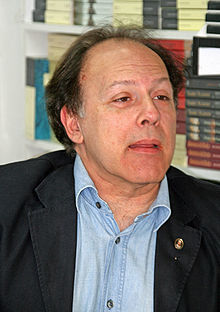
Photo of Marias from Wikipedia
Against this dual fictional backdrop, about a third of the work consists of mini biographies of early and mid-Twentieth Century British authors. I'm tempted to say "obscure British authors," but some of these folks, such as Stephen Graham, had fifty published works in their day. "Where are they now?" it seems the author is asking us. (Apparently this biographical exploration was a prelude to his biographical work on authors, Written Lives)
There are many recurring philosophical themes in this work. Death, the main one. World War I and the Spanish Civil War offer plenty of material. Fate is big. Another theme is authors seeking immortality through their books and actors seeking it through their films. Another is coincidence. Didn't Jung say there are no coincidences?
Marias expends the most biographical effort on the British author Wilfred Ewart, who spent his short life as if he were destined to be killed by a stray bullet entering his brain through his already-blind eye on a hotel balcony in Mexico City. The author constructs what-might-have-been scenarios, as he does for his three-year old brother who died before the author was born. He writes about special objects owned by us, such as a comb or cigarette lighter: "...it may be that objects are the only things that reconcile and balance past and present, and even the future, ... They go on living without missing us and for that very reason they don't change, and in that they are loyal to us."
There are many lyrical passages. Some samples:
"...his irises yellow under the stationary July sun;"
"...launching of quick anecdotes sharp as fencers' thrusts;" and
"...laughing in slow percussive bursts like pistons backfiring..."
If there is another author's work I am tempted to compare this book with, it is Proust. That's quite a comparison and I debated a while about giving this book a 4 (there are some tedious sections) or a 5. I decided on the latter because, how often do you encounter a work of this scope and depth? I think it's a work of genius.
Not light reading, but worthwhile reading. As the author unabashedly notes near the end of the work, "...if the reader should wonder what on earth is being recounted here or where this text is heading, the only proper answer, I fear, would be that it is simply running its course and heading toward its ending, just like anything else that passes through or happens in the world."
Revised 2/5/2017
Photo of Marias from Wikipedia

February 2, 2023
Zamanın Karanlık Yüzü edebi açıdan değil ancak içeriği ve yapısı itibariyle Marias’ın en iddialı eseri olabilir. Bu konuyu biraz daha açmaya çalışacağım ancak kitabın ortaya çıkış sebebi ve bu kadar önemli olmasıyla ilgili biraz geçmişe dönük bilgiler paylaşmanın daha mantıklı olduğunu düşünüyorum. 1998’de yazılan bu kitabın oluşum süreci yaklaşık 10 yıl öncesine dayanıyor. Zira Marias’ın “otobiyografik anlatı” konusuyla gündeme geldiği ilk kitap Tüm Ruhlar değil. Kendisinin ilk kitabı-hatta bizde basımı en sonlara kaldığı için neredeyse hiç sevilmeyen kitabı- Kurtlar Mıntıkası’nın ardından, kendisinin de gençliğinde İspanyol kültürü dışında geçirdiği bir dönemin varlığından ötürü, anlatısı gerçeklik ve kurgu ayrımı eleştirileri ile muhattap olmak zorunda kaldı. Zaten bir noktada, ne zaman İspanya dışında bir şeyler yazsa, bunun açığa çıkardığı kafa karışıklıklarını açıklamakla uğraşması sonucunda “homesick”ten muzdarip olmaya başladığını düşünüyorum artık.😅Konuya geri dönersek; bu tartışmaların ardından yayınladığı ve “otobiyografi ve kurgu” kavramlarını temel alan makalesinde; otobiyografik öğelerin bir kitapta ele alınabileceği üç yöntem olduğundan bahsediyor. Bunlardan ilk ikisi kurgu roman ve anı elbette. Ancak üçüncü tercih olarak sunduğu “bir kitabın kurgu ya da otobiyografik olup olmadığına dair hiçbir bilgi bulunmadan, içinde okurun “itiraf” gibi görünen ve okura yazarın kendisini hatırlatan izlerin sunulduğu bir belirsizlikle yapılabileceği”ni söylüyor. Tam da bu makaleden iki yıl sonra; daha ilk sayfasında anlatıcı- yazar belirsizliğine değinerek şüphe tohumları eken Tüm Ruhlar kitabının -bu makale ışığında- “otobiyografik” sanılması boşuna değil elbette. Ancak burada çoğunlukla kaçırılan nokta, Marias’ın gerçekle zihnindeki kurgu arasında devamlı zikzak çizerek bir roman inşa ettiği. Aynı bakış açısı, Tüm Ruhlar’dan altı yıl sonra gelen Zamanın Karanlık Yüzü’nü de genel olarak bu kitabın “otobiyografik” değil de “kurgu” olduğu yanıtı gibi görüyor. Ancak aslında kitabın daha başında “..kurgu ile gerçeği birbirine karıştırmamış olduğuma inanıyorum dedim, ancak ancak bazen, geriye dönüp baktığımda, o karışıklıktan kaçınmayı başarmakta güçlük çekmiyorum diyemem.” ile bu durumu belirsizlikte bırakmaktan yana olduğunu gösteriyor. Zaten bundan 30+ yıl önce Kurt Mıntıkası için dahi yaptığı “ deneyim ve gözlemlerin kurgusallaşması” ibaresi de bazı ipuçları veriyor bence. Peki o zaman Zamanın Karanlık Yüzü’nü bu kadar önemli ve iddialı yapan şey ne derseniz; Marias’ın -en azından kendi okuruna- roman kavramı ve kurgu ile gerçeklik arasındaki hassas ilişkiyi anlatıp, modern bir kurgunun nasıl okunması gerektiğini aktarabilmek adına kendi zihnini çok açık ve minimum filtrelemeyle okuruna açması elbette. Tabii burada bahsedilen zihnin açılması; düşünceler, hatıralar ya da olayların gerçekliği - kurgu olmasından ziyade zihnin nasıl işlediği ve kurguyu nasıl oluşturduğuna dair bir yansıma. Muhtemelen hiçbir taslak ya da sonunda varmayı planladığı yer olmaksınız zihninden geçenleri kağıda yansıtarak ilerlemiş gibi hissettiriyor. Zaten sonundaki bağlanmayla her zamanki gibi okuduğunuza hayran bıraksa da kitabın öncesi oldukça dağınık ilerliyor. Açıkcası benim okumakta en zorlandığım Marias kitabıydı kendisi. Çünkü o kopuklukta kaybolmadan ve sık sık durup Google araması yapmadan kitapta yol almanız ya da bir şeyleri zihninizde oturtmanız çok kolay değil.
Özetle bu kitap asla Marias ile tanışma kitabınız olmamalı hatta genel olarak yazarın külliyatını okumayı planlıyorsanız en sonlara bırakmanız; Tüm Ruhlar ile Beyaz Kalp, Yarın Savaşta Beni Düşün gibi pek çok eserinin ardından okumanız gereken kitaplardan birisi. Marias’ın filtreden geçirilip kurgulanmış metinleri dahi insanın beyninin ısınmasına sebep olurken bu kitapta o zihnin tüm açıklığıyla karşılaşmak çok yorucuydu. Açıkcası normalde Marias’ın yazdığı ya da onunla ilgili bulduğum her şeyi mümkün mertebe - maalesef değil Türkçe, İngilizce’de dahi bu metinlerin hepsine ulaşmak pek mümkün değil çünkü- okumaya çalışıp bunlardan keyif alan bir insanım normalde. Ama bu kitap beni gerçekten çok zorladı, bazı bağlantıları kurmaya çalışırken aldığım keyiften çok ödev niteliğine döndü. Javier Marias’ın diğer kitaplarını tekrar okuma planım var ama bu kitabı tekrar okur muyum emin değilim. O yüzden favorilerimden birisi diyemeyeceğim ama sunduğu eşsiz deneyimle çok kıymetli.
Özetle bu kitap asla Marias ile tanışma kitabınız olmamalı hatta genel olarak yazarın külliyatını okumayı planlıyorsanız en sonlara bırakmanız; Tüm Ruhlar ile Beyaz Kalp, Yarın Savaşta Beni Düşün gibi pek çok eserinin ardından okumanız gereken kitaplardan birisi. Marias’ın filtreden geçirilip kurgulanmış metinleri dahi insanın beyninin ısınmasına sebep olurken bu kitapta o zihnin tüm açıklığıyla karşılaşmak çok yorucuydu. Açıkcası normalde Marias’ın yazdığı ya da onunla ilgili bulduğum her şeyi mümkün mertebe - maalesef değil Türkçe, İngilizce’de dahi bu metinlerin hepsine ulaşmak pek mümkün değil çünkü- okumaya çalışıp bunlardan keyif alan bir insanım normalde. Ama bu kitap beni gerçekten çok zorladı, bazı bağlantıları kurmaya çalışırken aldığım keyiften çok ödev niteliğine döndü. Javier Marias’ın diğer kitaplarını tekrar okuma planım var ama bu kitabı tekrar okur muyum emin değilim. O yüzden favorilerimden birisi diyemeyeceğim ama sunduğu eşsiz deneyimle çok kıymetli.

July 18, 2012
First, I recommending that you read Mike Puma's review, since he provides such a thoughtful and comprehensive picture of this novel. Mike's accomplishment is all the more impressive because of the unique style and approach Marías takes in this novel. Is he writing a memoir or a novel? Is he providing historical analysis based on primary documents, or presenting a fictional depiction of historical characters? What is real? What relationship do storytelling and narrative play in our constructing our past as well as our present? Marías purposively and brilliantly explodes genre boundaries as he plays with themes having to do with reality and fiction, and the difficulty in distinguishing between them.
In Dark Back of Time, Marías begins with a humorous, affectionate, and (sometimes) exasperated depiction of the reception of his novel All Souls, which many friends and former colleagues take to be a roman á clef based on Marías's time spent in Oxford University. As Marías repeatedly insists that the novel sprung mainly from his imagination, he moves from a discussion of his novel to examinations of minor historical figures who appeared in the novel, through the lens of myriad historical documents - newspaper articles, oral histories, written documentation, and photographs, among others.
As a historian, I especially appreciated Marías's treatment of historical sources, which he understands to be fictions in their own way, based on the very different perspectives and motivations of their creators. I've always loved it when authors present a scrapbook of sources, not tidied up neatly in a clear story (although that also has its place), but with all the loose ends, ambiguities, and contradictions in place. This love of complexity and nuance is part of what interested me in studying history in the first place. There is something so human and involving to me about all those ragged edges of the past. As Marías says, "facts in themselves are nothing, language cannot reproduce them just as any number of repetitions, with their sharp edges, cannot reproduce the time that is past or gone, or revive the dead who have already gone past us and been lost in that time. And at this point who knows what has become real and what has become fictitious." (330) The blurred lines between fiction and reality are complex, messy, part of being human.
Marías' approach to understanding the past has all the elements of complexity and nuance that I describe above. He notes the accretions of the past on the written word, as well as what we lose through death and the dimming of memory: "With the passage or loss of time, old books are no longer text and binding alone but also what their former readers have left in them over the years, marks, comments, exclamations, profanities, photographs, dedications or ex libris, a letter, sheet of paper or signature, a waterspot, burn or stain or simply their names, as the books' owners." (286) Marías also makes a place for what he refers to as the dark back of time - a place where events and nonevents converge, where paths not taken, brothers lost at a young age, and parallel lives still carry on, and can be recovered if we are open to them.
This book is very highly recommended for readers who are open to Marîas' creative, philosophical, lyrical, and personal approach.
In Dark Back of Time, Marías begins with a humorous, affectionate, and (sometimes) exasperated depiction of the reception of his novel All Souls, which many friends and former colleagues take to be a roman á clef based on Marías's time spent in Oxford University. As Marías repeatedly insists that the novel sprung mainly from his imagination, he moves from a discussion of his novel to examinations of minor historical figures who appeared in the novel, through the lens of myriad historical documents - newspaper articles, oral histories, written documentation, and photographs, among others.
As a historian, I especially appreciated Marías's treatment of historical sources, which he understands to be fictions in their own way, based on the very different perspectives and motivations of their creators. I've always loved it when authors present a scrapbook of sources, not tidied up neatly in a clear story (although that also has its place), but with all the loose ends, ambiguities, and contradictions in place. This love of complexity and nuance is part of what interested me in studying history in the first place. There is something so human and involving to me about all those ragged edges of the past. As Marías says, "facts in themselves are nothing, language cannot reproduce them just as any number of repetitions, with their sharp edges, cannot reproduce the time that is past or gone, or revive the dead who have already gone past us and been lost in that time. And at this point who knows what has become real and what has become fictitious." (330) The blurred lines between fiction and reality are complex, messy, part of being human.
Marías' approach to understanding the past has all the elements of complexity and nuance that I describe above. He notes the accretions of the past on the written word, as well as what we lose through death and the dimming of memory: "With the passage or loss of time, old books are no longer text and binding alone but also what their former readers have left in them over the years, marks, comments, exclamations, profanities, photographs, dedications or ex libris, a letter, sheet of paper or signature, a waterspot, burn or stain or simply their names, as the books' owners." (286) Marías also makes a place for what he refers to as the dark back of time - a place where events and nonevents converge, where paths not taken, brothers lost at a young age, and parallel lives still carry on, and can be recovered if we are open to them.
This book is very highly recommended for readers who are open to Marîas' creative, philosophical, lyrical, and personal approach.

June 10, 2024
In “Dark Back of Time,” Javier Marias again displays his literary wizardry, examining the subtleties and deceptions imbedded in communication and perception. The structure of the novel mirrors the components of the author’s distinctive prose. The narrative swirls and meanders down sinuous pathways with no regard for straightforward exposition or plot. There are elements of meta fiction and autobiography that fuse into a playful and absorbing philosophical meditation.
The novel launches by recounting the reaction to the publication of “ All Souls,” the author’s earlier novel that centers on his two year stay immersed in Oxford’s academic intrigue and skulduggery.Marias insists that the account is fictional. Oxford’s academic community disagrees. These divergent views propel the book into a slithery contemplation of the nature of fiction and reality. Marias nudges the discussion in different directions, challenging the reader to decipher who is speaking, who is credible and what is factual.
Marias is a philosophical novelist who populates his novels with characters who brood, move forward and then retreat. “ Dark Back of Time” has no discernible plot. Instead, discourse and contemplation give the novel heft and momentum.A central thematic concern is the role of fiction and imagery in stimulating connections that further an understanding of the real world. However, in developing this theme, the author constantly questions what is actually real.One is left puzzling about what is truly known.
The early part of the novel is packed with ideas and innuendo. The later sections transition into short biographies of somewhat obscure British authors. Every author has an eccentric personality.Additionally, they share a physical deficiency…..they all have lost sight in an eye! By introducing visual impairment, Marias seems to imply that history is as unreliable as literary imaginings.Both are part of a spectrum of blurred realities.
The novel is not light reading. Although the text is suffused with wry wit,the subject matter at times becomes dense and occasionally arcane. Marias takes the reader on a circuitous journey through worlds of knowledge and reflection. By journey's end I was more informed and more enriched than I was at the outset of my adventure. Yet I still found myself scratching my head and wondering: " How does he do it?" 4.5stars rounded to 5
The novel launches by recounting the reaction to the publication of “ All Souls,” the author’s earlier novel that centers on his two year stay immersed in Oxford’s academic intrigue and skulduggery.Marias insists that the account is fictional. Oxford’s academic community disagrees. These divergent views propel the book into a slithery contemplation of the nature of fiction and reality. Marias nudges the discussion in different directions, challenging the reader to decipher who is speaking, who is credible and what is factual.
Marias is a philosophical novelist who populates his novels with characters who brood, move forward and then retreat. “ Dark Back of Time” has no discernible plot. Instead, discourse and contemplation give the novel heft and momentum.A central thematic concern is the role of fiction and imagery in stimulating connections that further an understanding of the real world. However, in developing this theme, the author constantly questions what is actually real.One is left puzzling about what is truly known.
The early part of the novel is packed with ideas and innuendo. The later sections transition into short biographies of somewhat obscure British authors. Every author has an eccentric personality.Additionally, they share a physical deficiency…..they all have lost sight in an eye! By introducing visual impairment, Marias seems to imply that history is as unreliable as literary imaginings.Both are part of a spectrum of blurred realities.
The novel is not light reading. Although the text is suffused with wry wit,the subject matter at times becomes dense and occasionally arcane. Marias takes the reader on a circuitous journey through worlds of knowledge and reflection. By journey's end I was more informed and more enriched than I was at the outset of my adventure. Yet I still found myself scratching my head and wondering: " How does he do it?" 4.5stars rounded to 5
May 7, 2013
CRITIQUE:
Fake Novel, Fake Memoir
Two primary concerns drive "Dark Back of Time": the relationship between fact and fiction, and the effect of the passage of time (including ephemerality and the desire to achieve immortality through creative endeavour, such as fiction).
The novel is a sequel of sorts to Marias' novel "All Souls". It arose out of allegations that the earlier novel was a roman a clef or thinly disguised autobiography or memoir. It is in effect a literary denial of these allegations.
To this extent, the second work is not a novel. Marias has described it as a "false novel". Perhaps it is more an autobiography or memoir than the first work could ever have been.
However, in the hands of Marias, I don't think it's safe to assume that. We can't assume that the first person narrator is Marias himself. Therefore, it shouldn't necessarily follow that the purported memoirs of this narrator are those of the actual author. They might be no more than the ostensible memoirs of the "author" of the novel referred to in the second novel as "All Souls".
Thus, you can read "Dark Side of Time" on two different levels: one that it actually is a memoir, and two that it is a fake or novelistic memoir.
I haven't seen anybody else mention this second alternative. However, it adds another level of metafiction to the enterprise that entertained me at least.
Why should readers trust this author or take him at face value? Why can't or shouldn't we create a fiction around his work? Why shouldn't we have as much fun with this work as he seems to have had?
Mistaking Fiction for Reality
In the first work, the question becomes: what is fact and what is fiction?
In the second, there are two converse questions: how has fact affected fiction, and how has fiction affected fact?
Real life people see themselves in the novel, mistakenly or regardless of whether the fictional character was based on a composite of people or character types (such as booksellers).
Real life friends of the "author" who are told that they could become the inspiration of a character, if they consented, express a desire to influence the qualities and dialogue of the character.
Fiction influences reality, and vice versa:
"I believe I've still never mistaken fiction for reality, though I have mixed them together more than once, as everyone does, not only novelists or writers but everyone who has recounted anything since the time we know began, and no one in that time has done anything but tell and tell, or prepare and ponder a tale, or plot one."
Marias denies that he has mistaken the two. He has never mistaken the one for the other. However, he admits to blending the two, as any storyteller or conversationalist does.
This is a product of the process of telling an anecdote, a story, a tale. It's implicit in language itself. Language can never capture reality. It can never reproduce it exactly. It can only approximate. It cannot be 100% authentic to reality:
"Anyone can relate an anecdote about something that happened, and the simple fact of saying it already distorts and twists it, language can't reproduce events and shouldn't attempt to, and that, I imagine, is why during some trials - the trials in movies, anyway, the ones I know best - the implicated parties are asked to perform a material or physical reconstruction of what happened...because it isn't enough to say it, to tell the story impassively and as precisely as possible, it must be seen, and an imitation, a representation or staging of it is required...this time in cool detachment and without racking up another crime or adding another victim to the list, but only as pretense and memory, because what they can never reproduce is the time gone by or lost, nor can they revive the dead who are lost within that time and gone."
Mistrust of Words
This sentence is Proustian in both length and subject matter.
However, in contrast to Proust, it denies the ability to recover the past precisely. We can only recover and see it through a flawed glass.
We see the past with one eye, imperfectly. Our memories are just make believe. The past swindles us, unless it is our our errant minds that are responsible. We are always arguing, questioning ourselves, "Are you sure?" We pretend the past, just as we pretend ourselves, and we pretend with words:
"I narrate myself."
Words too are imperfect, they are "metaphorical and imprecise". They consist of involuntary ornamentation, embellishment, they "alter and falsify" reality. They "twist and distort" it. They create an illusion or chimera, in other words, a fiction.
This leaves us with what Marias describes as the "ultimate mistrust of words".
The Dead and Deeds Long Gone
In the words of Othello, time "puts out the light" on the past and everything in it.
Our dead are gone, as are our deeds. They are lost and therefore trapped in the past. They cannot be retrieved and brought back to the present.
Our passage through life must occur in the present, even though we spend so much time contemplating, in words, the past.
In the trial that is life, our testimony cannot be truthful. Time and truth remain lost, gone, forgotten. They can only be replaced by fiction.
We cannot "salvage the past from oblivion", we can only falsify and fictionalise it.
The Territory That is Not Truth's
If the truth cannot be salvaged from oblivion, that doesn't mean that nothing can be perpetuated into the future.
Something can be perpetuated, only it is not reality or the truth, it is fiction.
Thus, through fiction, in the world of the imagination documented in imperfect words, something can be immortalised:
"...in the territory that is not truth's, everything goes on happening forever and ever, and there the light is not put out now or later, and perhaps it is never put out."
This concept gives the novel its title:
"...the other side of time, its dark back...the kind of time that has not existed, the time that awaits us and also the time that does not await us and therefore does not happen, or happens only in a sphere that isn't precisely temporal, a sphere in which writing, or perhaps only fiction, may - who knows - be found."
This dark side of time, as is so often the case with Marias, owes something to Shakespeare, in this case, "The Tempest":
"PROSPERO:
By what? by any other house or person?
Of any thing the image tell me that
Hath kept with thy remembrance.
MIRANDA:
'Tis far off
And rather like a dream than an assurance
That my remembrance warrants. Had I not
Four or five women once that tended me?
PROSPERO:
Thou hadst, and more, Miranda. But how is it
That this lives in thy mind? What seest thou else
In the dark backward and abysm of time?
If thou remember'st aught ere thou camest here,
How thou camest here thou mayst."
A Place Where the Lights are Never Put Out
Marias has one character refer to time as "the only dimension in which the living and the dead can communicate, the only one they have in common".
The narrator can only comprehend this comment in terms of the dark back of time:
"...that other side, that dark back through which the fickle and unpredictable voice we all know nevertheless passes, the voice of time when it has not yet gone by or been lost and perhaps for that reason is not even time, the voice that is permanently in our ears and that is always fictitious, I believe, as perhaps is and has been and will be until its end the voice that is speaking here."
Perhaps, in every moment we think and record reality, we are actually fictionalising it.
Perhaps it is we and our tendency to fictionalise and tell stories and tell tales that are the dark back of time.
And perhaps it is only in this world of fiction, of the imagination documented, that the light will never be put out.
And so the voice of us who will one day be dead will be heard in the future. Or rather it will be the voice, not of us, but of the fiction that we have created.
SOUNDTRACK:
Fake Novel, Fake Memoir
Two primary concerns drive "Dark Back of Time": the relationship between fact and fiction, and the effect of the passage of time (including ephemerality and the desire to achieve immortality through creative endeavour, such as fiction).
The novel is a sequel of sorts to Marias' novel "All Souls". It arose out of allegations that the earlier novel was a roman a clef or thinly disguised autobiography or memoir. It is in effect a literary denial of these allegations.
To this extent, the second work is not a novel. Marias has described it as a "false novel". Perhaps it is more an autobiography or memoir than the first work could ever have been.
However, in the hands of Marias, I don't think it's safe to assume that. We can't assume that the first person narrator is Marias himself. Therefore, it shouldn't necessarily follow that the purported memoirs of this narrator are those of the actual author. They might be no more than the ostensible memoirs of the "author" of the novel referred to in the second novel as "All Souls".
Thus, you can read "Dark Side of Time" on two different levels: one that it actually is a memoir, and two that it is a fake or novelistic memoir.
I haven't seen anybody else mention this second alternative. However, it adds another level of metafiction to the enterprise that entertained me at least.
Why should readers trust this author or take him at face value? Why can't or shouldn't we create a fiction around his work? Why shouldn't we have as much fun with this work as he seems to have had?
Mistaking Fiction for Reality
In the first work, the question becomes: what is fact and what is fiction?
In the second, there are two converse questions: how has fact affected fiction, and how has fiction affected fact?
Real life people see themselves in the novel, mistakenly or regardless of whether the fictional character was based on a composite of people or character types (such as booksellers).
Real life friends of the "author" who are told that they could become the inspiration of a character, if they consented, express a desire to influence the qualities and dialogue of the character.
Fiction influences reality, and vice versa:
"I believe I've still never mistaken fiction for reality, though I have mixed them together more than once, as everyone does, not only novelists or writers but everyone who has recounted anything since the time we know began, and no one in that time has done anything but tell and tell, or prepare and ponder a tale, or plot one."
Marias denies that he has mistaken the two. He has never mistaken the one for the other. However, he admits to blending the two, as any storyteller or conversationalist does.
This is a product of the process of telling an anecdote, a story, a tale. It's implicit in language itself. Language can never capture reality. It can never reproduce it exactly. It can only approximate. It cannot be 100% authentic to reality:
"Anyone can relate an anecdote about something that happened, and the simple fact of saying it already distorts and twists it, language can't reproduce events and shouldn't attempt to, and that, I imagine, is why during some trials - the trials in movies, anyway, the ones I know best - the implicated parties are asked to perform a material or physical reconstruction of what happened...because it isn't enough to say it, to tell the story impassively and as precisely as possible, it must be seen, and an imitation, a representation or staging of it is required...this time in cool detachment and without racking up another crime or adding another victim to the list, but only as pretense and memory, because what they can never reproduce is the time gone by or lost, nor can they revive the dead who are lost within that time and gone."
Mistrust of Words
This sentence is Proustian in both length and subject matter.
However, in contrast to Proust, it denies the ability to recover the past precisely. We can only recover and see it through a flawed glass.
We see the past with one eye, imperfectly. Our memories are just make believe. The past swindles us, unless it is our our errant minds that are responsible. We are always arguing, questioning ourselves, "Are you sure?" We pretend the past, just as we pretend ourselves, and we pretend with words:
"I narrate myself."
Words too are imperfect, they are "metaphorical and imprecise". They consist of involuntary ornamentation, embellishment, they "alter and falsify" reality. They "twist and distort" it. They create an illusion or chimera, in other words, a fiction.
This leaves us with what Marias describes as the "ultimate mistrust of words".
The Dead and Deeds Long Gone
In the words of Othello, time "puts out the light" on the past and everything in it.
Our dead are gone, as are our deeds. They are lost and therefore trapped in the past. They cannot be retrieved and brought back to the present.
Our passage through life must occur in the present, even though we spend so much time contemplating, in words, the past.
In the trial that is life, our testimony cannot be truthful. Time and truth remain lost, gone, forgotten. They can only be replaced by fiction.
We cannot "salvage the past from oblivion", we can only falsify and fictionalise it.
The Territory That is Not Truth's
If the truth cannot be salvaged from oblivion, that doesn't mean that nothing can be perpetuated into the future.
Something can be perpetuated, only it is not reality or the truth, it is fiction.
Thus, through fiction, in the world of the imagination documented in imperfect words, something can be immortalised:
"...in the territory that is not truth's, everything goes on happening forever and ever, and there the light is not put out now or later, and perhaps it is never put out."
This concept gives the novel its title:
"...the other side of time, its dark back...the kind of time that has not existed, the time that awaits us and also the time that does not await us and therefore does not happen, or happens only in a sphere that isn't precisely temporal, a sphere in which writing, or perhaps only fiction, may - who knows - be found."
This dark side of time, as is so often the case with Marias, owes something to Shakespeare, in this case, "The Tempest":
"PROSPERO:
By what? by any other house or person?
Of any thing the image tell me that
Hath kept with thy remembrance.
MIRANDA:
'Tis far off
And rather like a dream than an assurance
That my remembrance warrants. Had I not
Four or five women once that tended me?
PROSPERO:
Thou hadst, and more, Miranda. But how is it
That this lives in thy mind? What seest thou else
In the dark backward and abysm of time?
If thou remember'st aught ere thou camest here,
How thou camest here thou mayst."
A Place Where the Lights are Never Put Out
Marias has one character refer to time as "the only dimension in which the living and the dead can communicate, the only one they have in common".
The narrator can only comprehend this comment in terms of the dark back of time:
"...that other side, that dark back through which the fickle and unpredictable voice we all know nevertheless passes, the voice of time when it has not yet gone by or been lost and perhaps for that reason is not even time, the voice that is permanently in our ears and that is always fictitious, I believe, as perhaps is and has been and will be until its end the voice that is speaking here."
Perhaps, in every moment we think and record reality, we are actually fictionalising it.
Perhaps it is we and our tendency to fictionalise and tell stories and tell tales that are the dark back of time.
And perhaps it is only in this world of fiction, of the imagination documented, that the light will never be put out.
And so the voice of us who will one day be dead will be heard in the future. Or rather it will be the voice, not of us, but of the fiction that we have created.
SOUNDTRACK:

September 10, 2021
Adını neredeyse tüm Marias kitapları gibi yine bir Shakespeare tümcesinden alan bu tuhaf kitaba çok hazırlıksız yakalandım – içindeki ölüme ve yasa dair kısımlar (hacmen kitabın çok az bir bölümünü kaplıyor olsalar da) beni çok zorladı: Uzun bir aranın ardından yine kelimelerin beni korkutabileceğini, alıp tehlikeli yerlere götürebileceğini hatırladım. Yani benimki gibi bir kayıp yaşamışsanız uzak durmanızı öneririm aslında. Bunun dışında: sanırım Marias’ın beyninin nasıl çalıştığını en iyi görebildiğimiz kitabı bu. -Bence en iyi romanlarından biri olmayan- Tüm Ruhlar’ı okuduktan sonra okuyunuz mutlaka; Marias, romandaki kurgusal kişilikleri gerçek ve hatta kendileri sanan arkadaşlarının öyküsünü anlatıyor ve kitaptaki aslında tek gerçek kişinin izini sürüyor sahaflarda, arşivlerde, mektuplarda. Başta dağınık gibi başlayan öykü öyle bir toparlanıp, öyle bir birleşiyor ki; tarifi güç. Çok büyük bir yazarsın sevgili Marias, çok. Beni çok zorlayan bölümlerin birinden bir alıntıyla bitireyim: “Olanları kafamda evirip çevirmekten vazgeçmiyordum, geçmişte olan şeyler geri dönebilirdi, hem geçmişin nabzı hâlâ atıyor gibiydi, hâlâ da öyle geliyor. Geçmiş giderek uzuyor.” Geçmiş, benim için de, gerçekten, giderek uzuyor.

August 29, 2021
What a story! What is it about? Well, I need a side story.
I recently listened to an interview with Javier Marías (2017). He spoke about how every person needs imagination in their lives, to see their life as a story, or part of a story, and if you do, you live a much richer life, and if you don’t (and many people don’t), then you are not living your life thoroughly. He admitted that he does this. Don’t worry, I personally won’t be doing this, fearing a two page novel where I have to be very imaginative.
How does “Black Back of Time” begin? Well it really starts in “Todas las almas” (All Souls), a book published in 1989 (almost ten years earlier). Todas las almas is about the fictional professor who spends two years at All Souls College, Oxford, which of course, the real Marías did exactly this. According to the English translation, all the characters, except one, are fictional. The professor is not the real person, BTW.
This is a book about a fictional book. What happens when the fictional characters of one book are based on “real” fictional characters of another book. A false novel. Actually it seems the only real character is the author himself, Xavier Marias (sounds like “various”) but it’s really Javier Marías (please pronounce it correctly where the accent is). Xavier written backwards is Rievax.
Really? Really.
Or is it a Roman à clef? Que? French for “novel with a key” is a novel about real life events that is overlaid with a façade of fiction. The fictitious names in the novel represent real people, and the "key" is the relationship between the nonfiction and the fiction (Wikipedia). Todas las almas is a Roman à clef making Negra espalda del tiempo a what? An autobiographical novel? Well sort of. Maybe a collection of stories, fact and fiction together in one book? A false novel? Right.
We have side stories that intermingle with historical stories. Hmm, maybe they aren’t side stories. They are connected. They are very good stories. Did you notice that the main characters in the side stories have lost the sight in one eye? Verdad. A South African Boer doesn’t get the job with Franco, joins the reds, becomes a spy and writes a book. Another gets shot in the eye on New Year’s Eve in Mexico City. He wrote a book prior to this. These obscure writers are connected to the book sellers in Oxford. And what about Marías’ great grandfather? A curse? And that island of Redonda? Really un scalable?
Are you confused? What is really going on here? Is this the best book to read after Proust’s Le temps retrouvé? Time Regained? Lost Time? The black back of time? Holy Shakespeare! That Spanish writer has a thing for the bard, does he not?
If you are a fan of literature, this is a wondrous piece of writing. You are in good hands with Marías. Absolutely brilliant. It was perfect after Proust! Marías would be happy I stated this, and if I ever get the chance to tell him, and I know I won’t, I will tell him. Honestly I will tell him.
As for the interview, and it is a good one, please check it out. It’s an hour long so go for a walk and enjoy the verbal play. Or read the book. See for yourself. Oh, please read Todas las almas first.
https://www.cbc.ca/radio/writersandco...
I recently listened to an interview with Javier Marías (2017). He spoke about how every person needs imagination in their lives, to see their life as a story, or part of a story, and if you do, you live a much richer life, and if you don’t (and many people don’t), then you are not living your life thoroughly. He admitted that he does this. Don’t worry, I personally won’t be doing this, fearing a two page novel where I have to be very imaginative.
How does “Black Back of Time” begin? Well it really starts in “Todas las almas” (All Souls), a book published in 1989 (almost ten years earlier). Todas las almas is about the fictional professor who spends two years at All Souls College, Oxford, which of course, the real Marías did exactly this. According to the English translation, all the characters, except one, are fictional. The professor is not the real person, BTW.
This is a book about a fictional book. What happens when the fictional characters of one book are based on “real” fictional characters of another book. A false novel. Actually it seems the only real character is the author himself, Xavier Marias (sounds like “various”) but it’s really Javier Marías (please pronounce it correctly where the accent is). Xavier written backwards is Rievax.
Really? Really.
Or is it a Roman à clef? Que? French for “novel with a key” is a novel about real life events that is overlaid with a façade of fiction. The fictitious names in the novel represent real people, and the "key" is the relationship between the nonfiction and the fiction (Wikipedia). Todas las almas is a Roman à clef making Negra espalda del tiempo a what? An autobiographical novel? Well sort of. Maybe a collection of stories, fact and fiction together in one book? A false novel? Right.
We have side stories that intermingle with historical stories. Hmm, maybe they aren’t side stories. They are connected. They are very good stories. Did you notice that the main characters in the side stories have lost the sight in one eye? Verdad. A South African Boer doesn’t get the job with Franco, joins the reds, becomes a spy and writes a book. Another gets shot in the eye on New Year’s Eve in Mexico City. He wrote a book prior to this. These obscure writers are connected to the book sellers in Oxford. And what about Marías’ great grandfather? A curse? And that island of Redonda? Really un scalable?
Are you confused? What is really going on here? Is this the best book to read after Proust’s Le temps retrouvé? Time Regained? Lost Time? The black back of time? Holy Shakespeare! That Spanish writer has a thing for the bard, does he not?
If you are a fan of literature, this is a wondrous piece of writing. You are in good hands with Marías. Absolutely brilliant. It was perfect after Proust! Marías would be happy I stated this, and if I ever get the chance to tell him, and I know I won’t, I will tell him. Honestly I will tell him.
As for the interview, and it is a good one, please check it out. It’s an hour long so go for a walk and enjoy the verbal play. Or read the book. See for yourself. Oh, please read Todas las almas first.
https://www.cbc.ca/radio/writersandco...
June 20, 2025
Como antiguo hater de Javier Marías la verdad es que estoy desolado. Ni siquiera me gustó Todas las almas, ¿para qué leer su continuación espiritual? Supongo que siempre esperamos alguna sorpresa, un impacto imprevisto, que los cambios que experimentamos como lectores nos permita encajar lo que antes nos despertaba rechazo. Esto me ha ocurrido con este libro.
Leí por primera vez un título de Marías en septiembre de 2005, sólo he necesitado veinte años para encontrar uno de mi pleno agrado.
De la misma forma que Marías coloca un espejo en su Todas las almas, la novela que ficcionaliza su paso por Ofxord, y le sirve para abordar las disonancias entre imaginación y realidad, entre lo recordado y lo vivido, entre pasado lejano y pasado cercano, entre leído y lo experimentado, también yo contemplo divergencias entre el lector que era al inicio y el que por ahora soy.
Me refiero a que, a grandes rasgos, muchas percepciones que tuve entonces no han cambiado demasiado. Marías me parecía autor de narraciones divagantes, sin mucho foco, con prosa alambicada y rebuscada, de un calado reflexivo poco insustancial y habitante de un territorio literario acomodado, con personajes que viven en una burbuja alejada de los problemas diarios, que no entra de lleno en la parte más dura de la realidad. Parte de eso lo mantengo.
Dónde he aprendido a ser más tolerante quizás es con ese ánimo divagante. No es tanto que Marías sea un mal narrador como que desee eludir moldes acomodaticios de la narrativa, encontrar un terreno más puro, navegar por un mar de prosa antes que seguir la corriente de una trama y despreocuparse de ofrecer una narrativa funcional antes que un mundo autónomo, compuesto por las preocupaciones, afectaciones e intereses del autor. Efectivamente su amor por la digresión, por la frase de largo aliento antes me parecía un exceso de retórica, ahora eso lo digiero mejor y comprendo que no hay que demandarle ciertas expectativas que él rehúsa, es una exigencia artificial y te aleja del libro al que le estás dedicando tu tiempo, tu interés y tu esfuerzo intelectual.
Supongo que parte de este cambio se debe también a parte del plan narrativo de este libro, que retoma ese mundo narrativo de Oxford y profundiza en una serie de figuras que ahí aparecieron, a la postre construye una serie de indagaciones en personajes reales y misteriosos, escurridizos y dueños de existencias excéntricas, ya no es un simple esfuerzo imaginativo, nos habla de esquinas muy recónditas del mundo, le encuentro más asideros. Todo parte de John Gawsworth, de editor y combatiente a vagabundo. De ahí Marías busca conexiones y amplia el abanico narrativo, incluye a Wilfred Etwart, que murió en Ciudad de México de una forma chusca, tras haber sobrevivido a las batallas más feroces de la I Guerra Mundial en el primer día de 1924 un tiro errático lo alcanza por accidente y lo abate mientras estaba asomado en el balcón del hotel. También aparece de refilón el escritor inglés Olof De Wet, personaje del todo hemingwayano, escritor de dos novelitas autobiográficas, autor de la máscara mortuoria de Gawsworth, y piloto mercenario en Abisinia contra Mussolini, de la república española (primero se ofreció a Franco), espía y encarcelado por ello por los nazis, condenado a muerte pero al final librado de tan funesto destino.
Todos estos personajes aparecen, crecen, conforman diferentes ramas de un árbol narrativo que luego se van solapando unas con otras mientras el autor explora todo ese flujo del tiempo que a todos nos toca de forma lejana o indirecta. El autor aborda la figura de John Gawsworth porque era una figura enigmática con la que él se cruzó en su paso por Oxford, al bucear en ese pasado se encuentra una veta de experiencias ricas y sorprendentes, realidades con las que que Marías convivió de refilón. Luego por otro lado también está Julianín, el hermano que nunca conoció porque falleció demasiado pronto y de forma repentina antes que él naciera. Otra figura vaporosa a la que él accede por los relatos de otros, una pequeña figura que dejó un poso de tristeza en sus padres a pesar que él no pudo ni siquiera intercambiar una mirada, sin embargo el rastro en los vivos perdura, como perduran Olof de Wet y John Gawsworth en otras personas que se ponen en contacto con Marías.
La novela cuenta con varios bloques. En el primero, bastante divertido y egocéntrico, se encarga de explorar el efecto que tuvo la publicación de Todas las almas, revisa las diferencias, las coincidencias, observa con ironía como el hecho de no figurar dentro de la narración puede acarrear resentimiento por parte de alguno de los académicos, a otros les provoca cierta reticencia, entra en un terreno delicado, que podría acarrear incluso pleitos legales, pues el poder de la ficción puede también perturbar en la realidad por mucho que se narren hechos imaginarios.
Luego ya se embarca en esa exploración acerca de John Gawsworth, Olof de Wet o Wilfred Etwart, la novela adquiere tintes de novela de no ficción, y de ahí, a rachas, aparecen más fragmentos autobiográficos, busca conexiones insospechadas y nos habla efectivamente de una realidad inabarcable, en la que autores Etwart disfrutaron del éxito literario y hoy son completos desconocidos, el flujo del tiempo se alejó de ellos y el recuerdo que queda de estas personas es casi tan mínimo como de ese hermano prematuramente fallecido, es el tesoro oral de una camarilla verdaderamente reducida, en un caso se trata de eruditos rebuscados y en otros es la memoria dolorosa de una familia.
De forma que esas divergencias entre los hechos que Marías imaginó para su novela de 1989 y lo que de verdad fue luego se amplia y crece y se erige como una exploración de realidades recónditas, acerca de las casualidades del destino, analiza el efecto de las ficciones en la vida y de la vida en las ficciones, desde las maldiciones de un limosnero cubano a el relato autobiográfico de un piloto en la guerra contra Mussolini.
También encajo mejor el humor de Marías, me divierten su resentimiento incesante contra Jorge Herralde, el editor de Anagrama; sus divagaciones me resultaron esta vez más controladas, cabales, no simples pruritos literarios, también es verdad que hacia 1997 parece que en lo ideológico no estaba tan distanciado de mi propia percepción, lo cual sin duda contribuye, y parece que el manejar materiales reales, no necesariamente surgidos de la esfera privada, le ayuda a mantener cierto cauce narrativo, por más que reniegue de esas nociones de verosimilitud o de la búsqueda de armonías ocultas. Porque, no olvidemos que si el libro parte de esa indagación entre la realidad que él vivió en Oxford con la que luego imprimió en una ficción, hacia el tramo final se centra en el reino de Redonda. El islote de Redonda existe, es real, eso es indiscutible, pero entorno a él se erigió esa ficción del reino de Redonda, un linaje dinástico que parte del poco conocido escritor MP Shiel, continua con John Gawsworth y acabó recayendo en Marías, que entre bromas lo acabó empleando como un territorio literario propio, dónde ha entregado títulos nobiliarios a figuras como Eduardo Mendoza o J.M. Coetzee. Es decir que de la realidad trucada en ficción pasa de la realidad trucada en ficción.
Transito con más gusto la prosa de Marías, leo con más gusto las escenas que propone, me interesa más los personajes que dibuja, su libro me ha ofrecido cada vez que lo he retomado una cálida bienvenida, tomar de nuevo el hilo no ha sido tanto un esfuerzo añadido como la continuación de un gusto anteriormente pausado. No pensaba que este día llegara pero resulta que así ha sido. En verdad Travesía del horizonte y El hombre sentimental me gustaron razonablemente, este Espalda negra del tiempo ya lo encuentro un plato de mucho mejor gusto. Ahora me corresponde comprobar si ésta ha sido una feliz excepción o bien un cambio de dinámica con uno de los escritores más aplaudidos de la segunda mitad del siglo XX en España, puede que de la lengua española.
Leí por primera vez un título de Marías en septiembre de 2005, sólo he necesitado veinte años para encontrar uno de mi pleno agrado.
De la misma forma que Marías coloca un espejo en su Todas las almas, la novela que ficcionaliza su paso por Ofxord, y le sirve para abordar las disonancias entre imaginación y realidad, entre lo recordado y lo vivido, entre pasado lejano y pasado cercano, entre leído y lo experimentado, también yo contemplo divergencias entre el lector que era al inicio y el que por ahora soy.
Me refiero a que, a grandes rasgos, muchas percepciones que tuve entonces no han cambiado demasiado. Marías me parecía autor de narraciones divagantes, sin mucho foco, con prosa alambicada y rebuscada, de un calado reflexivo poco insustancial y habitante de un territorio literario acomodado, con personajes que viven en una burbuja alejada de los problemas diarios, que no entra de lleno en la parte más dura de la realidad. Parte de eso lo mantengo.
Dónde he aprendido a ser más tolerante quizás es con ese ánimo divagante. No es tanto que Marías sea un mal narrador como que desee eludir moldes acomodaticios de la narrativa, encontrar un terreno más puro, navegar por un mar de prosa antes que seguir la corriente de una trama y despreocuparse de ofrecer una narrativa funcional antes que un mundo autónomo, compuesto por las preocupaciones, afectaciones e intereses del autor. Efectivamente su amor por la digresión, por la frase de largo aliento antes me parecía un exceso de retórica, ahora eso lo digiero mejor y comprendo que no hay que demandarle ciertas expectativas que él rehúsa, es una exigencia artificial y te aleja del libro al que le estás dedicando tu tiempo, tu interés y tu esfuerzo intelectual.
Supongo que parte de este cambio se debe también a parte del plan narrativo de este libro, que retoma ese mundo narrativo de Oxford y profundiza en una serie de figuras que ahí aparecieron, a la postre construye una serie de indagaciones en personajes reales y misteriosos, escurridizos y dueños de existencias excéntricas, ya no es un simple esfuerzo imaginativo, nos habla de esquinas muy recónditas del mundo, le encuentro más asideros. Todo parte de John Gawsworth, de editor y combatiente a vagabundo. De ahí Marías busca conexiones y amplia el abanico narrativo, incluye a Wilfred Etwart, que murió en Ciudad de México de una forma chusca, tras haber sobrevivido a las batallas más feroces de la I Guerra Mundial en el primer día de 1924 un tiro errático lo alcanza por accidente y lo abate mientras estaba asomado en el balcón del hotel. También aparece de refilón el escritor inglés Olof De Wet, personaje del todo hemingwayano, escritor de dos novelitas autobiográficas, autor de la máscara mortuoria de Gawsworth, y piloto mercenario en Abisinia contra Mussolini, de la república española (primero se ofreció a Franco), espía y encarcelado por ello por los nazis, condenado a muerte pero al final librado de tan funesto destino.
Todos estos personajes aparecen, crecen, conforman diferentes ramas de un árbol narrativo que luego se van solapando unas con otras mientras el autor explora todo ese flujo del tiempo que a todos nos toca de forma lejana o indirecta. El autor aborda la figura de John Gawsworth porque era una figura enigmática con la que él se cruzó en su paso por Oxford, al bucear en ese pasado se encuentra una veta de experiencias ricas y sorprendentes, realidades con las que que Marías convivió de refilón. Luego por otro lado también está Julianín, el hermano que nunca conoció porque falleció demasiado pronto y de forma repentina antes que él naciera. Otra figura vaporosa a la que él accede por los relatos de otros, una pequeña figura que dejó un poso de tristeza en sus padres a pesar que él no pudo ni siquiera intercambiar una mirada, sin embargo el rastro en los vivos perdura, como perduran Olof de Wet y John Gawsworth en otras personas que se ponen en contacto con Marías.
La novela cuenta con varios bloques. En el primero, bastante divertido y egocéntrico, se encarga de explorar el efecto que tuvo la publicación de Todas las almas, revisa las diferencias, las coincidencias, observa con ironía como el hecho de no figurar dentro de la narración puede acarrear resentimiento por parte de alguno de los académicos, a otros les provoca cierta reticencia, entra en un terreno delicado, que podría acarrear incluso pleitos legales, pues el poder de la ficción puede también perturbar en la realidad por mucho que se narren hechos imaginarios.
Luego ya se embarca en esa exploración acerca de John Gawsworth, Olof de Wet o Wilfred Etwart, la novela adquiere tintes de novela de no ficción, y de ahí, a rachas, aparecen más fragmentos autobiográficos, busca conexiones insospechadas y nos habla efectivamente de una realidad inabarcable, en la que autores Etwart disfrutaron del éxito literario y hoy son completos desconocidos, el flujo del tiempo se alejó de ellos y el recuerdo que queda de estas personas es casi tan mínimo como de ese hermano prematuramente fallecido, es el tesoro oral de una camarilla verdaderamente reducida, en un caso se trata de eruditos rebuscados y en otros es la memoria dolorosa de una familia.
De forma que esas divergencias entre los hechos que Marías imaginó para su novela de 1989 y lo que de verdad fue luego se amplia y crece y se erige como una exploración de realidades recónditas, acerca de las casualidades del destino, analiza el efecto de las ficciones en la vida y de la vida en las ficciones, desde las maldiciones de un limosnero cubano a el relato autobiográfico de un piloto en la guerra contra Mussolini.
También encajo mejor el humor de Marías, me divierten su resentimiento incesante contra Jorge Herralde, el editor de Anagrama; sus divagaciones me resultaron esta vez más controladas, cabales, no simples pruritos literarios, también es verdad que hacia 1997 parece que en lo ideológico no estaba tan distanciado de mi propia percepción, lo cual sin duda contribuye, y parece que el manejar materiales reales, no necesariamente surgidos de la esfera privada, le ayuda a mantener cierto cauce narrativo, por más que reniegue de esas nociones de verosimilitud o de la búsqueda de armonías ocultas. Porque, no olvidemos que si el libro parte de esa indagación entre la realidad que él vivió en Oxford con la que luego imprimió en una ficción, hacia el tramo final se centra en el reino de Redonda. El islote de Redonda existe, es real, eso es indiscutible, pero entorno a él se erigió esa ficción del reino de Redonda, un linaje dinástico que parte del poco conocido escritor MP Shiel, continua con John Gawsworth y acabó recayendo en Marías, que entre bromas lo acabó empleando como un territorio literario propio, dónde ha entregado títulos nobiliarios a figuras como Eduardo Mendoza o J.M. Coetzee. Es decir que de la realidad trucada en ficción pasa de la realidad trucada en ficción.
Transito con más gusto la prosa de Marías, leo con más gusto las escenas que propone, me interesa más los personajes que dibuja, su libro me ha ofrecido cada vez que lo he retomado una cálida bienvenida, tomar de nuevo el hilo no ha sido tanto un esfuerzo añadido como la continuación de un gusto anteriormente pausado. No pensaba que este día llegara pero resulta que así ha sido. En verdad Travesía del horizonte y El hombre sentimental me gustaron razonablemente, este Espalda negra del tiempo ya lo encuentro un plato de mucho mejor gusto. Ahora me corresponde comprobar si ésta ha sido una feliz excepción o bien un cambio de dinámica con uno de los escritores más aplaudidos de la segunda mitad del siglo XX en España, puede que de la lengua española.

April 5, 2018
Ich glaube, daß ich Fiktion und Wirklichkeit noch nie verwechselt habe, wenn ich sie auch mehr als einmal miteinander vermischt habe, wie es jeder tut, nicht nur die Romanciers, nicht nur die Schriftsteller, sondern alle, die seit Beginn unserer bekannten Zeit irgend etwas erzählt haben, und in dieser bekannten Zeit hat niemand etwas anderes getan als eben zu erzählen und zu erzählen oder seine Erzählung aufzubereiten und zurechtzulegen oder sie sich auszudenken.
Soweit der erste Satz dieses Buches, in dem Javier Marías schreibt, »er glaube«, dass er Fiktion und Wirklichkeit noch nie verwechselt habe; so wie man an etwas glaubt, von dem man gerne möchte, dass es so wäre, aber sich nicht sicher sein kann und insgeheim vielleicht sogar daran zweifelt, wie ja der Glaube den Zweifel naturgemäß in sich trägt.
Ich weiss auch nicht, ob »ich« glauben soll, dass Javier Marías hier spricht, trotz aller biographischen Übereinstimmung, oder ein fiktiver Erzähler, der so tut, als wäre er Javier Marías, in Wirklichkeit aber eine seiner Figuren ist. Jedenfalls schreibt dieser »Autor« im ersten Teil über die Verwechslungen von Fiktion und Wirklichkeit im Hinblick auf eines seiner früheren Bücher namens Alle Seelen ; alle Welt glaubte, der Erzähler sei Javier Marías, nur weil beide in Oxford unterrichteten, wo die Handlung des Buches spielt. Außerdem erkannten sich diverse lebende Personen in den Figuren wieder. Der Autor beteuert, dass es sich um keinen Schlüsselroman handelt und alle Figuren einschließlich des Erzählers fiktiv sind.
Fiktion, Wirklichkeit, Schicksal, Zufall, Bestimmung und der schwarze Rücken der Zeit, soweit der Themenkreis dieses faszinierend verwirrenden Buches. Der schwarze Rücken der Zeit, der Ausdruck ist von Shakespeare übernommen, ist die unsichtbare Rückseite der Zeit, die Zeit, die nie existiert hat, außer in der Vorstellung oder in der Fiktion. So wie zum Beispiel die Zeit des älteren Bruders von Javier Marías, der vor dessen Geburt mit drei Jahren verstorben ist und von dem der Autor nur ein Foto und einige aufbewahrte Spielsachen kennt. Ich sollte sagen, von dem »der Erzähler« nur ein Foto und einige aufbewahrte Spielsachen kennt, der Erzähler scheint identisch mit Javier Marías, es ist aber eben nur ein Schein, eine Fiktion, auch wenn das tragische Schicksal dieses Bruders belegt ist und Bild und Spielsachen davon zeugen.
Irgendwann sinniert der Erzähler über unsere modernen, schnellen, kriegerischen Zeiten und sinniert über den Platz dieses Buches in diesen Zeiten:
[...] ich weiß nicht, ob dieses Buch Platz in ihnen findet, vielleicht erfordert es Geduld und Ausdauer; oder womöglich findet es ihn doch und ist nur typisch für diese Zeiten, denn alles in ihm ist ebenfalls flüchtig im Fortgang seiner Erzählung, und wenn ein Leser sich fragen sollte, was zum Teufel man ihm erzählt und wohin sich dieser Text bewegt, könnte man ihm, wie ich fürchte, nur antworten, daß er sich darauf beschränkt, seinem Weg zu folgen, und sich deshalb auf sein Ende zubewegt, wie alles, das durch die Welt hindurchgeht oder in ihr zu finden ist. Aber ich glaube nicht, daß jemand, der bis hierher gelangt ist, sich noch solche Fragen stellt.
Wer bis hierher gelangt ist, stellt sicher keine Frage mehr nach einer allfälligen Handlung. Hätte ich nicht gewusst, dass Javier Marías Laurence Sternes Tristram Shandy ins Spanische übersetzt hat, ich hätte vermutet, dass die Beiden zumindest gute Bekannte wären. Schwarzer Rücken der Zeit ist ein würdiges Mitglied in einer meiner Lieblingslisten auf GR - The Shandian Spawn als phantastisches Labyrinth aus Anektoten, Reflexionen, Abschweifungen, Einschüben, Abstechern, Zitaten aus anderen Romanen, obskuren Dokumenten, man kann unmöglich den Faden verlieren, denn es gibt keinen, vielmehr tausend Fäden, die wie ein unterirdisches Myzel alles zusammenhalten: nur vordergründig ist die Thematik die Verbindung, am Ende sind alle Bestandteile, Personen, Geschichten und Geschichtchen über erratische Koinzidenzen miteinander verwoben.
Wer bis hierher gelangt ist, wird vielleicht denken, schon wieder so ein neumodernes Machwerk, das ist ja auch nichts besonderes mehr. Das Besondere ist allerdings die sprachliche Qualität, die alle Romane Javier Marías so großartig macht. Es sind die langen Sätze und der Fluss der Worte, die wie auf Wellen tragen, es ist eine subtil schwingende Sprache, mit der man dahinschwebt und staunt, welche Wendungen und Ideen sie bereithält; oft trennt nur der Strichpunkt die einzelnen Bögen, um die Bewegung nicht mit einem zu harten Punkt zu unterbrechen. Javier Marías gehört zu den wenigen Autoren, deren Ton so unverwechselbar ist, dass man ihn blind erkennt, sowie in der Musik der Klang eines John Coltrane oder die Melodieführung Mozarts einzigartig sind.
Soweit der erste Satz dieses Buches, in dem Javier Marías schreibt, »er glaube«, dass er Fiktion und Wirklichkeit noch nie verwechselt habe; so wie man an etwas glaubt, von dem man gerne möchte, dass es so wäre, aber sich nicht sicher sein kann und insgeheim vielleicht sogar daran zweifelt, wie ja der Glaube den Zweifel naturgemäß in sich trägt.
Ich weiss auch nicht, ob »ich« glauben soll, dass Javier Marías hier spricht, trotz aller biographischen Übereinstimmung, oder ein fiktiver Erzähler, der so tut, als wäre er Javier Marías, in Wirklichkeit aber eine seiner Figuren ist. Jedenfalls schreibt dieser »Autor« im ersten Teil über die Verwechslungen von Fiktion und Wirklichkeit im Hinblick auf eines seiner früheren Bücher namens Alle Seelen ; alle Welt glaubte, der Erzähler sei Javier Marías, nur weil beide in Oxford unterrichteten, wo die Handlung des Buches spielt. Außerdem erkannten sich diverse lebende Personen in den Figuren wieder. Der Autor beteuert, dass es sich um keinen Schlüsselroman handelt und alle Figuren einschließlich des Erzählers fiktiv sind.
Fiktion, Wirklichkeit, Schicksal, Zufall, Bestimmung und der schwarze Rücken der Zeit, soweit der Themenkreis dieses faszinierend verwirrenden Buches. Der schwarze Rücken der Zeit, der Ausdruck ist von Shakespeare übernommen, ist die unsichtbare Rückseite der Zeit, die Zeit, die nie existiert hat, außer in der Vorstellung oder in der Fiktion. So wie zum Beispiel die Zeit des älteren Bruders von Javier Marías, der vor dessen Geburt mit drei Jahren verstorben ist und von dem der Autor nur ein Foto und einige aufbewahrte Spielsachen kennt. Ich sollte sagen, von dem »der Erzähler« nur ein Foto und einige aufbewahrte Spielsachen kennt, der Erzähler scheint identisch mit Javier Marías, es ist aber eben nur ein Schein, eine Fiktion, auch wenn das tragische Schicksal dieses Bruders belegt ist und Bild und Spielsachen davon zeugen.
Irgendwann sinniert der Erzähler über unsere modernen, schnellen, kriegerischen Zeiten und sinniert über den Platz dieses Buches in diesen Zeiten:
[...] ich weiß nicht, ob dieses Buch Platz in ihnen findet, vielleicht erfordert es Geduld und Ausdauer; oder womöglich findet es ihn doch und ist nur typisch für diese Zeiten, denn alles in ihm ist ebenfalls flüchtig im Fortgang seiner Erzählung, und wenn ein Leser sich fragen sollte, was zum Teufel man ihm erzählt und wohin sich dieser Text bewegt, könnte man ihm, wie ich fürchte, nur antworten, daß er sich darauf beschränkt, seinem Weg zu folgen, und sich deshalb auf sein Ende zubewegt, wie alles, das durch die Welt hindurchgeht oder in ihr zu finden ist. Aber ich glaube nicht, daß jemand, der bis hierher gelangt ist, sich noch solche Fragen stellt.
Wer bis hierher gelangt ist, stellt sicher keine Frage mehr nach einer allfälligen Handlung. Hätte ich nicht gewusst, dass Javier Marías Laurence Sternes Tristram Shandy ins Spanische übersetzt hat, ich hätte vermutet, dass die Beiden zumindest gute Bekannte wären. Schwarzer Rücken der Zeit ist ein würdiges Mitglied in einer meiner Lieblingslisten auf GR - The Shandian Spawn als phantastisches Labyrinth aus Anektoten, Reflexionen, Abschweifungen, Einschüben, Abstechern, Zitaten aus anderen Romanen, obskuren Dokumenten, man kann unmöglich den Faden verlieren, denn es gibt keinen, vielmehr tausend Fäden, die wie ein unterirdisches Myzel alles zusammenhalten: nur vordergründig ist die Thematik die Verbindung, am Ende sind alle Bestandteile, Personen, Geschichten und Geschichtchen über erratische Koinzidenzen miteinander verwoben.
Wer bis hierher gelangt ist, wird vielleicht denken, schon wieder so ein neumodernes Machwerk, das ist ja auch nichts besonderes mehr. Das Besondere ist allerdings die sprachliche Qualität, die alle Romane Javier Marías so großartig macht. Es sind die langen Sätze und der Fluss der Worte, die wie auf Wellen tragen, es ist eine subtil schwingende Sprache, mit der man dahinschwebt und staunt, welche Wendungen und Ideen sie bereithält; oft trennt nur der Strichpunkt die einzelnen Bögen, um die Bewegung nicht mit einem zu harten Punkt zu unterbrechen. Javier Marías gehört zu den wenigen Autoren, deren Ton so unverwechselbar ist, dass man ihn blind erkennt, sowie in der Musik der Klang eines John Coltrane oder die Melodieführung Mozarts einzigartig sind.

October 5, 2022
Marias bu sefer Oxford Üniversitesinin meşhur (ya da mahut mu deseydim) akademiya ortamında geçen Tüm Ruhlar romanının anılan kurumda yarattığı yankılar, karakterlerin gerçek hayatta kimler olabileceğine dair tartışmalar üzerine, bu romanın hikayesini anlatan yarı belgesel, yarı kurmaca veya daha doğru bir terimle “belgesel görünümlü kurmaca” denilebilecek bu kitabı yazmış. Belirttiğim özelliğinden ötürü Marias külliyatının öne çıkan parçalarından değil bence, fazla ayrıntı ve sapma var. Daha ziyade benim gibi Marias düşkünlerine hitap ediyor. Ama bu düşkünleri dahi zaman zaman boğsa, atlayarak okumaya itse de, Marias’ın insan sarraflığı ve bunu edebiyata dönüştürme kalitesinin pırıltılarına rastlamak okuyana teselli veriyor. Marias’dan ilk veya ikinci, hatta üçüncü bir kitap okuyacaksanız bundan uzak durun derim.
September 29, 2022
Brilliant! Review to come (when life gets calmer and gentler).
June 6, 2016
The beguiling sequel of sorts to All Souls demonstrates the capacity of prose that's sticky, engaging, unpredictable, flowing, insightful, and wholeheartedly written to leap the tall buildings of conventional narrative expectation in a single bound (book). At the end of "All Souls" there's a mention of going back to read the second half of Quixote, and this is sort of like that in a way, although I haven't yet read the second half of Quixote other than the preamble that mentions a false Quixote and the Emperor of China who wants the real Quixote to come read the book to him, or something like that. It starts by setting the record straight about what was fictionalized in All Souls except who can really believe the author in this one, distinct from the narrator in the first one. Author/narrator split or distinction is what a lot of this is about at first, as well as the difference between fiction and non-fiction, all up my alley, a major meat in the stew of my very non-academic studies on this topic. I've somehow had four JM novels on my shelves rotting away (pages yellowing), two of which I've had since reading a Vendela Vida essay about JM in The Believer in one of their first issues (so like around 2003 maybe). That's thirteen years I've failed to have this digressive technology in mind as a major obvious precedent when talking about lit or trying to write it. This one starts with talk about the reception of the previous novel, totally engagingly proceeds through the reaction of some actual Oxford colleagues, moves on to the booksellers actually named Stone instead of Alabaster, and then to an anthology of old horror stories JM edited, and to Gawsworth, a real entity in actuality, and another once-read writer lost to time who died on a balcony in Mexico when a New Year's Eve celebration sent a bullet through his eye. From there it focuses on death of the odd and sudden sort -- a tree branch falling on a young writer in Paris. The tragic death to a rare and incurable disease at the time of JM's eldest brother at the age of 3. A great section about Melville's publishers and JM's publishers' lowballing offers. The guy who made Gawsworth's death mask and a fantastical story involving Franco told by someone who knew him. Ending in part with meta-commentary about how JM doesn't care much about the book he's writing and straight-up exposition about the meaning of the title, the Shakespearean phrase "the dark back of time," which is fiction itself really, potential alternate realities, the future as past, the past as future, the unlived lives we would've lived had we never been born, that sort of thing that at best sends your comprehending capacities crisscrossing each other as though on charging horses armed with lances, that is, in a way that pleasurably disorients (I won't use the word "vertiginous") and at worst comes off a bit like bloviation, the sort of thing in my own manuscripts I inevitably decide to reduce to its best line or cut entirely, respecting the restlessness of readers my writing apparently shall never anyway find. Probably too long by 75 pages for me, particularly toward the end, the book's ever-darkening (in terms of lucidity) back-end (put out the light, put out the light), when it lost all explicit ties to its origins, or seemed to. But still I love this sort of thing and now intend to spend the rest of the summer reading the rest of Marias.

September 1, 2025
“The most such a person could ever tell would be the facts, and facts in themselves are nothing, language cannot reproduce them just as any number of repetitions, with their sharp edges, cannot reproduce the time that is past or gone, or revive the dead who have already gone past us and been lost in that time. And of this point who knows what has become real and what has become fictitious”. p330
Time has a dark back, the passage behind it where truth and fiction blur, unlived lives make their way, missed opportunities come to bear and where the impacts of events on people and places otherwise unrealised are evident. Javier Marías mesmerises me in his book, Dark Back of Time, and I am at a bit of a loss to describe what type of book it is. It’s not a story as such yet it is filled with stories. It doesn’t have a plot as such yet in and of itself it is a plot, a reflection on perceptions, realities, fictions and what is the nature of reality itself, something that is actually so specific to each individual who has ever walked the planet.
Marías opens Dark Back of Time around his novel, All Souls, set in Oxford, UK, highlighting the many readers from Oxford who claimed to identify the fictional characters that were based on themselves. The intrigue with which fiction and reality blur is something that Marías dwells on, reflecting on how much does fiction influence reality and what is fictional and what is real. If I see myself in a fictional character what does that mean? How am I then influenced by that fictional character and what traits of the fictional do I integrate into my reality and indeed what is reality? There’s a reality that’s not seen, that exists in time’s dark back. There’s an interplay here that Marías does an amazing job of exploring and dissecting.
I was struck by the way the whole book seems to be about the connectedness of life. How the events that happen to us, spontaneous or well planned, happen upon a range of seemingly random other connections, people, events and the list goes on. Are these random? Probably. Are these worth exploring because they are on our path? Definitely.
Time’s dark back is also evident through lives cut short. Marías spends a great deal of time in his book illuminating the stories of people I had no idea existed yet nevertheless had impact in their time and their way. I was struck by the notion of the premature deaths of some of these individuals, and the therefore interrogated meaning of their last days and the application of meaning to otherwise meaningless events and how the reality of those events become fictitious in their own way because an entirely different story is applied to them.
The death of Julianín, Marías’ older brother, who dies before Marías was born is another subject explored through time’s dark back…. “What meaning is there in the silent passage through the world of those who don’t even have the time to grow used to the air…” What impact did his brother’s death have on the trajectory of the family and the lives contained within it and touched by it? And what would have been the case otherwise? Unanswerable questions except in the back passage of time. Marías gives a space and place to these voices and again, what is fiction and what is not, and is life indeed all fiction?
I reflect on Marías’ life and death. A man whose books have been translated into 46 languages and sold close to nine million copies (according to Wikipedia). That’s a lot of connections. His death in 2022 at the age of 70 is now something to consider… what were the final days? What was their meaning that is now assigned? What is the impact of his trajectory on a random 57 year old Australian man? What about those close to him. What is the fate of his objects? Those things that held meaning for him? What is a life?
“And so what, if I hadn’t been born, and so what, if my brother faded away and said good bye so soon, as if the world’s weak wheel lacked the strength to include him fully in it’s revolutions and time to take in his enthusiasms and affections and grievances, or rushed to rid itself of his incipient will and forced it to cross over to its opposite side, it’s dark back, transformed into a ghost”. p225
“With the passage or loss of time, old books are no longer text and binding alone but also what their former readers have left in them over the years, marks, comments, exclamations, profanities, photographs, dedications or ex libris, a letter, sheet of paper or signature, a waterspot, burn or stain or simply their names, as the books’ owners” p286
This is a book to revisit time and again. I doubt I would read it again from cover to cover but pick and choose aspects and areas I want to ignite my understanding of and explore the random connections that this book has now added to my pathway of life.
Time has a dark back, the passage behind it where truth and fiction blur, unlived lives make their way, missed opportunities come to bear and where the impacts of events on people and places otherwise unrealised are evident. Javier Marías mesmerises me in his book, Dark Back of Time, and I am at a bit of a loss to describe what type of book it is. It’s not a story as such yet it is filled with stories. It doesn’t have a plot as such yet in and of itself it is a plot, a reflection on perceptions, realities, fictions and what is the nature of reality itself, something that is actually so specific to each individual who has ever walked the planet.
Marías opens Dark Back of Time around his novel, All Souls, set in Oxford, UK, highlighting the many readers from Oxford who claimed to identify the fictional characters that were based on themselves. The intrigue with which fiction and reality blur is something that Marías dwells on, reflecting on how much does fiction influence reality and what is fictional and what is real. If I see myself in a fictional character what does that mean? How am I then influenced by that fictional character and what traits of the fictional do I integrate into my reality and indeed what is reality? There’s a reality that’s not seen, that exists in time’s dark back. There’s an interplay here that Marías does an amazing job of exploring and dissecting.
I was struck by the way the whole book seems to be about the connectedness of life. How the events that happen to us, spontaneous or well planned, happen upon a range of seemingly random other connections, people, events and the list goes on. Are these random? Probably. Are these worth exploring because they are on our path? Definitely.
Time’s dark back is also evident through lives cut short. Marías spends a great deal of time in his book illuminating the stories of people I had no idea existed yet nevertheless had impact in their time and their way. I was struck by the notion of the premature deaths of some of these individuals, and the therefore interrogated meaning of their last days and the application of meaning to otherwise meaningless events and how the reality of those events become fictitious in their own way because an entirely different story is applied to them.
The death of Julianín, Marías’ older brother, who dies before Marías was born is another subject explored through time’s dark back…. “What meaning is there in the silent passage through the world of those who don’t even have the time to grow used to the air…” What impact did his brother’s death have on the trajectory of the family and the lives contained within it and touched by it? And what would have been the case otherwise? Unanswerable questions except in the back passage of time. Marías gives a space and place to these voices and again, what is fiction and what is not, and is life indeed all fiction?
I reflect on Marías’ life and death. A man whose books have been translated into 46 languages and sold close to nine million copies (according to Wikipedia). That’s a lot of connections. His death in 2022 at the age of 70 is now something to consider… what were the final days? What was their meaning that is now assigned? What is the impact of his trajectory on a random 57 year old Australian man? What about those close to him. What is the fate of his objects? Those things that held meaning for him? What is a life?
“And so what, if I hadn’t been born, and so what, if my brother faded away and said good bye so soon, as if the world’s weak wheel lacked the strength to include him fully in it’s revolutions and time to take in his enthusiasms and affections and grievances, or rushed to rid itself of his incipient will and forced it to cross over to its opposite side, it’s dark back, transformed into a ghost”. p225
“With the passage or loss of time, old books are no longer text and binding alone but also what their former readers have left in them over the years, marks, comments, exclamations, profanities, photographs, dedications or ex libris, a letter, sheet of paper or signature, a waterspot, burn or stain or simply their names, as the books’ owners” p286
This is a book to revisit time and again. I doubt I would read it again from cover to cover but pick and choose aspects and areas I want to ignite my understanding of and explore the random connections that this book has now added to my pathway of life.


October 9, 2013
i believe i've still never mistaken fiction for reality, though i have mixed them together more than once, as everyone does, not only novelists or writers but everyone who has recounted anything since the time we know began, and no one in that known time has done anything but tell and tell, or prepare and ponder a tale, or plot one.while javier marías may have never confused the two, many readers of his 1989 novel, all souls (todas las almas), clearly had. the spanish writer's earlier book, erroneously perceived to be a roman à clef, apparently led to quite a bit of consternation for its author. all souls, or marías's "oxford novel," though set in the english university town where the author once taught for two years, was not a fictionalization of his time spent teaching there. nonetheless, members of the faculty insistently recognized themselves as the inspiration behind many of the book's characters - despite marías's refutations to the contrary. the nature and frequency of these continuing assertions led to considerable reflection and, eventually, the genre-blending brilliance of dark back of time (negra espalda del tiempo).
in life, you can compensate or fluctuate or rectify, as long as the story hasn't yet ended—either in death, which arrives to bring everything to a close, or, above all, in the telling of life and death. what's attributed to you in a work of fiction, however, has little or no remedy, there's no debate about it, no amendment. thus it is written and thus it is repeated, identically, without compassion or hope—this is the story and these are its words—telling the same thing in the same way every time it's read or leafed through or consulted, just as the action of a painting, once it's "chosen and frozen," never moves forward or recedes, and we'll never see the face of the person who was painted from behind, or the nape of the neck of the one whose face was portrayed, or the hidden side of the one in profile.in dark back of time, marías uses the proliferative mischaracterizations that followed all souls's reception as a springboard from which to explore the nature of time, identity, life, death, memory, and disbelief in destiny (along with the expected authorial inquests into the lives of literature's ill-fated writers and also-rans). marías effortlessly blends elements of autobiography, fiction, history, bibliomania, journalism, and philosophical musings to form a coherent whole that well exceeds its constituent parts. as with its predecessor, little action takes place within the pages of dark back of time. the book relies more on the thematic connections between its subjects than it does on narrative action or the interplay of its characters.
"there was still so much left for him to do," as if what we do were what justified our lives or what we miss about our dead, and not their presence and their gestures and their unbiased accounts of events, or, even more, their listening attentiveness to our own account. the times become old times all too easily and are cast off, and what went before them becomes antediluvian, and yet they all gradually and deceptively overlap, we sometimes think there are no borders or abrupt stops or brutal cuts, that endings and beginnings are never marked out with the dividing line that, at other times, however, we think we see in retrospect; and that belief is deceptive, too, because neither the one nor the other exists, or only as an enormous exception: not the sure, clean slice—splinters always go flying—nor the juxtaposition or welter of confused and indistinguishable days—there are always forgotten patches and blotted out periods, i know them, to help us see the illusory limits. it's all more mysterious than that, more like an artificial prolongation, attenuating and inert, of what has already ceased, a ceremonial resistance to yielding or to marking the beginning of what is to come, like the streetlamps that stay lit for a while when day has already dawned in the great cities and towns and train stations and empty village depots; they stand there still, blinking and upright, in the face of natural light that advances to make them superfluous.throughout dark back of time marías makes reference to, and expounds upon, the lives of obscure literary figures and adventurers, including john gawsworth (english writer, poet, and onetime king of redonda - a reign since taken over by marías), wilfrid ewart, arthur machen, stephen graham, and oloff de wet, amongst others. in doing so, he draws links to the enigmatic essence and fragility of life, invoking the passing of his own brother at the young age of 3. marías, perhaps more determinist than fatalist, appears ever-curious about situational reality, intrigued as he is by the causality of events and their inescapable repercussions. too, the lingering effects or indelible impressions left by the past upon the present and future seem to be of considerable intrigue for our spanish author.
it isn't only that it can all happen now, it's that i don't know if in fact anything is really over or lost, at times i have the feeling that all the yesterdays are throbbing beneath the earth, refusing to disappear entirely, the enormous cumulation of the known and the unknown, stories told and stories silenced, recorded events and events that were never told or had no witnesses or were hidden, a vast mass of words and occurrences, passions, crimes, injustices, fear, laughter, aspirations and raptures, and above all thoughts: thoughts are what is most frequently passed on from one group of intruders and usurpers to another, down across the intruding and usurping generations, they are what survives longest and hardly changes and never concludes, like a permanent tumult beneath the earth's thin crust where the infinite men and women who passed this way are buried or dispersed, most of them having spent much of their time in passive, idle, ordinary thoughts, but also in the more spirited ones that give some impetus to the indolent, weak wheel of the world, the desires and plots, expectations and rancors, beliefs and chimeras, pity and secrets and humiliations and quarrels, the revenges that are schemed, the rejected lovers that arrive too late and the loves that never wear out: all are accompanied bu their own thoughts which are experienced as unique by each newly-arrived reiterative individual who thinks them. but that is not all. the prestige of the present moment is based on this idea, which mothers hurry to inculcate as a consolation or subterfuge in their offspring: "that which no longer is, has never been."readers of dark back of time will be better served coming into the work having already familiarized themselves with all souls. dark back of time is at times pensive, reflective, inquisitive, analytical, and even a little humorous. for those that prefer their fiction to be plot-driven, there may well be little to like in marías's composite outing - although his prose, amongst the finest being written today, is likely enough to keep even the cursory reader entranced. as companion pieces, all souls and dark back of time succeed wildly in examining the distinctions between fiction and reality - and not only in the context of these two books. the vulnerability of life, the evanescence of time and memory, the mutability of identity, the totality of the moment that yields forsakenly into the next - marías masterfully considers them all, not so much in an attempt to tease out the answers, reveal the mystery, or define the undefinable, but instead to shine light upon the sometimes imperceptible perimeters where hues begin to blend into one another. javier marías's remarkable and prodigious talents seem truly to know no boundaries.
yet all we can do is grant ridiculous importance to the products of these inchoate combinations, to each one and to our own—or rather, the one that we are—to those already obliterated and to those that are present, and even to those that are fictitious, if we don't want our passage through time to be entirely idiotic as well as fragile and insignificant. so we spend our lives pretending to be unique and chosen when in fact we're interchangeable, each the random outcome of a spin of the wheel of fortune at a dank, decrepit carnival. the pretence is necessary, but what's bad about it is that our actions or misfortunes or good luck make most of us forget, in the end, that that was all we were doing, just pretending. there are people who become convinced they were destined for what they attain or endure, as if the enduring or the attainment explained their history and the reason or cause for their birth, it is the cause, it is the cause. i've said what i'm saying here before, in a novel, but that doesn't matter: everything has to be said again and again so it won't be lost, until nothing is said any longer and there is no longer: the shortcuts and twisting paths taken by our efforts are what make us vary though we end up believing it was destiny, we end up seeing our whole lives in light of the last or most recent thing, as if the past had been only preparation, as if we were gradually coming to understand it as it withdraws from us and will understand it entirely in the end.
*translated from the spanish by esther allen (borges, martí, prieto, cendrars, et al.)

March 14, 2014
Without a thorough googling, it’s hard to know what is real and what is fiction in this book. Being called by its author a ‘false novel’ helps as much as it doesn’t. Dark Back of Time begins by rather casually delineating the insistent claims of a number of people (who may just be characters) that they are the real counterparts to the author’s proclaimed characters of his previous novel, All Souls (which, for all the reader knows, is only a fictional counterpart of the real). What seems to emerge is a human desire for immortality and the propensity to mistake a fictional correlation as such. In the middle of the book, Marias turns his attention to what he, in passing, calls, “ill-fated writers”. And though they could be said to have died strange and horrific deaths at young ages, it seems clear that it is their forgotten-ness that Marias means by “ill-fate”. From here he moves more loosely, wandering into some biographical material, making correlations here and there.
I like a writer that can bring all things into the philosophical. And surely such an ability allows a thread to be pulled through almost any collection of subjects. But the meandering sum of this collection seems more like a long conversation with an interesting friend than the penetrating and boiled down object that I like to think the philosophical novel is. Marias is talking about his characters, his colleagues, his book, his dead brother, his foolish publisher, even the lost literary figures he chronicles are former owners of books in his library or have in some way already figured into one or more of his previous works. And this common thread, this his-ness, though not egregious in itself, does beg the question: What could this book have been, if this thread wasn’t leading the way, or, if in the end Marias acknowledged it, pulled it, and revealed a dilemma–of his. As it is, the book lacks dilemma, the urgency thereof, and thus it lacks the philosophical depth that it flirts with. Don’t get me wrong: the book is good–Marias is at his brilliant best when riffing off of Shakespeare. And I’ll read him again–hopeful the next isn’t so casually plotted. But Marias himself (the narrator at least) feels it necessary to say in the text, “this book isn’t that important, not even to me”. Which is, I must say, both true and disappointing. Write the book that is that important to you. Life is too short for the rest.
I like a writer that can bring all things into the philosophical. And surely such an ability allows a thread to be pulled through almost any collection of subjects. But the meandering sum of this collection seems more like a long conversation with an interesting friend than the penetrating and boiled down object that I like to think the philosophical novel is. Marias is talking about his characters, his colleagues, his book, his dead brother, his foolish publisher, even the lost literary figures he chronicles are former owners of books in his library or have in some way already figured into one or more of his previous works. And this common thread, this his-ness, though not egregious in itself, does beg the question: What could this book have been, if this thread wasn’t leading the way, or, if in the end Marias acknowledged it, pulled it, and revealed a dilemma–of his. As it is, the book lacks dilemma, the urgency thereof, and thus it lacks the philosophical depth that it flirts with. Don’t get me wrong: the book is good–Marias is at his brilliant best when riffing off of Shakespeare. And I’ll read him again–hopeful the next isn’t so casually plotted. But Marias himself (the narrator at least) feels it necessary to say in the text, “this book isn’t that important, not even to me”. Which is, I must say, both true and disappointing. Write the book that is that important to you. Life is too short for the rest.

October 31, 2025
“Es todo tan azaroso y ridículo que no se entiende cómo podemos dotar de trascendencia alguna al hecho de nuestro nacimiento o nuestra existencia o de nuestra muerte, determinados por combinaciones erráticas tan antojadizas e imprevisibles como la voz del tiempo cuando aún no ha pasado ni se ha perdido, cuando aún no es ambiguo ni tan siquiera es tiempo, esa voz que todos conocemos y oímos como un murmullo según avanzamos o así creemos, porque es la voz lo que en realidad avanza; o cómo puede concederse ninguna importancia a nuestro paso frágil e insignificante que bien pudo no darse por una mentira o testimonio falso o bien sí darse por la fantasía y el odio excesivos de dos delatores al servicio de Franco —dos futuros catedráticos, lo fueron ambos en recompensa, o ya lo era uno— que fabricaron acusaciones demasiado improbables y novelescas contra quien no podía ni soñar todavía ser mi padre ni el padre de nadie; cómo podemos tomar en serio nuestro aliento siquiera, que debemos al ataque de una anticuada enfermedad o vértigo sobre la cubierta de un barco que viajaba al exilio, o a la maldición caprichosa y barroca que un mendigo mulato lanzó a un jinete despreciativo más allá del océano hace ciento veinticinco años, en una isla de otro continente; o que perdemos, ese aliento, por una bala que extravió el entusiasmo de una Nochevieja en México en aquel continente, o por el árbol que arranca de cuajo el rayo y cae sobre la cabeza de un extranjero que aguardaba para entrar al teatro”

August 22, 2012
Marias let's us know at the very beginning how to read and understand this philosophical, literary novel.
"I believe I've still never mistaken fiction for reality, though I have mixed them together more than once, as everyone does, not only novelists or writers but everyone who has recounted anything since the time we know began..."
"Anyone can relate an anecdote about something that happened, and the simple fact of saying it already distorts and twists it, language can't reproduce events and shouldn't attempt to..."
To further expand upon this we are told this is a book about his previous novel, "All Souls," (Best to read it first, although it is not completely clear whether this is biographical dealing with facts or a novel about a novel that we are holding in our hands. I am having the all too real human problem of being clear in my mind what it is I want to say but in the transition to words typed on the screen there is a yawning gap-or is this what Marias is after and has sent me there with a one-way ticket. Let's go on anyway. The supposedly real people in DBT (Besides their efficiency I love using abbreviations. They make me feel, sound, like I have mastered the text,) Don's, students at Oxford, see themselves in the published, AS novel and are either outraged at how they are portrayed or flattered. Distortions of what the text says is carried out by the DBT characters for their own benefit. At the same time they themselves change by how they are portrayed in the AS fiction. The overriding final importance in the DBT, or supposedly, real characters, is that they have been included in AS or any future Marias novel, even if they are obnoxious characters, to trick time and become immortal if indeed the book lasts through time. This is a novel that explores time, reality, and identity within the confines of fiction successfully.
Time is shown on its brutal rampage with the Dons and inhabitants at Oxford seeing their lives erased by time-the future becoming the present which fades into the past as soon as it comes to be. Their work and lives will no longer be remembered. It will be as if they haven't existed.
A major theme throughout this fictional book about a fictional book that sometimes shifts into biography and..., is problems with vision in many characters. This may be a nod toward Borges and blindness in the artist but seems also to be a statement about the different realities we all experience, even supposedly of the same event. Kant, Nietzsche, in my mind, visit Marias at his home drinking his wine and smoking his cigars. Is that Wittgenstein ringing the doorbell? This is played out in the many interpretations of how characters died, how events came to be, time passed or didn't, in the biographical sections.
"Yes, who can tell, and what does it matter, all these ifs, all these conditionals with which we pepper our whole lives to explain them to ourselves, to justify and confirm them, and so imagine that they could have been different, or that they couldn't have been; lamenting adversity all the more and rejoicing all the more in good fortune, yet both are only consolations or accolades or regrets or rhetorical vexations, serving only to keep us from entirely and immediately losing sight of what time has discarded, and time does nothing but discard."
"It may be, rather that nothing is ever unmixed and the thirst for totality is never quenched, perhaps because it is a false yearning. Nothing is whole or of a single piece, everything is fractured and envenomed..."
All of this certainly shakes the footings and rafters of identity-as well as this review. I am thirsty and need a drink but I am no longer sure if I am me thirsty or I am the one typing this review and therefore inside this review. If you know the answer please let me know ASAP so I can quench my thirst.
"Yet all we can do is grant ridiculous importance to the products of these inchoate combinations, to each one and to our own-or rather, the one that we are...if we don't want our passage through time to be entirely idiotic as well as fragile and insignificant. So we spend our lives pretending to be unique and chosen..." Are you feeling better now?
In this, You are Going to Face Reality, or, YGFR, novel Marias helps by rounding and polishing all edges with his immaculate, smooth prose. He can be writing about a woven basket, a toothbrush, and I would be right there inside his written words just for their cadenced sounds and a voice to carry as I carry certain pieces of music.
He carries us to the end by explaining the, dark back of time. This a Shakespeare quote though I never heard it or know where it comes from. Marias' understanding is that there is a sphere of time that is not past, present or future. Therefore it does not happen, or happens only in a sphere that is not temporal.
"...a sphere in which writing, or perhaps only fiction, may-who knows-be found."
Why not five stars? There were brief times that Marias overstated his theme. Overall it is a marvel and mind- bending. But in the end of this beautifully written confrontational novel it is writing and fiction that will save the day, which we at GR knew from the beginning.
"I believe I've still never mistaken fiction for reality, though I have mixed them together more than once, as everyone does, not only novelists or writers but everyone who has recounted anything since the time we know began..."
"Anyone can relate an anecdote about something that happened, and the simple fact of saying it already distorts and twists it, language can't reproduce events and shouldn't attempt to..."
To further expand upon this we are told this is a book about his previous novel, "All Souls," (Best to read it first, although it is not completely clear whether this is biographical dealing with facts or a novel about a novel that we are holding in our hands. I am having the all too real human problem of being clear in my mind what it is I want to say but in the transition to words typed on the screen there is a yawning gap-or is this what Marias is after and has sent me there with a one-way ticket. Let's go on anyway. The supposedly real people in DBT (Besides their efficiency I love using abbreviations. They make me feel, sound, like I have mastered the text,) Don's, students at Oxford, see themselves in the published, AS novel and are either outraged at how they are portrayed or flattered. Distortions of what the text says is carried out by the DBT characters for their own benefit. At the same time they themselves change by how they are portrayed in the AS fiction. The overriding final importance in the DBT, or supposedly, real characters, is that they have been included in AS or any future Marias novel, even if they are obnoxious characters, to trick time and become immortal if indeed the book lasts through time. This is a novel that explores time, reality, and identity within the confines of fiction successfully.
Time is shown on its brutal rampage with the Dons and inhabitants at Oxford seeing their lives erased by time-the future becoming the present which fades into the past as soon as it comes to be. Their work and lives will no longer be remembered. It will be as if they haven't existed.
A major theme throughout this fictional book about a fictional book that sometimes shifts into biography and..., is problems with vision in many characters. This may be a nod toward Borges and blindness in the artist but seems also to be a statement about the different realities we all experience, even supposedly of the same event. Kant, Nietzsche, in my mind, visit Marias at his home drinking his wine and smoking his cigars. Is that Wittgenstein ringing the doorbell? This is played out in the many interpretations of how characters died, how events came to be, time passed or didn't, in the biographical sections.
"Yes, who can tell, and what does it matter, all these ifs, all these conditionals with which we pepper our whole lives to explain them to ourselves, to justify and confirm them, and so imagine that they could have been different, or that they couldn't have been; lamenting adversity all the more and rejoicing all the more in good fortune, yet both are only consolations or accolades or regrets or rhetorical vexations, serving only to keep us from entirely and immediately losing sight of what time has discarded, and time does nothing but discard."
"It may be, rather that nothing is ever unmixed and the thirst for totality is never quenched, perhaps because it is a false yearning. Nothing is whole or of a single piece, everything is fractured and envenomed..."
All of this certainly shakes the footings and rafters of identity-as well as this review. I am thirsty and need a drink but I am no longer sure if I am me thirsty or I am the one typing this review and therefore inside this review. If you know the answer please let me know ASAP so I can quench my thirst.
"Yet all we can do is grant ridiculous importance to the products of these inchoate combinations, to each one and to our own-or rather, the one that we are...if we don't want our passage through time to be entirely idiotic as well as fragile and insignificant. So we spend our lives pretending to be unique and chosen..." Are you feeling better now?
In this, You are Going to Face Reality, or, YGFR, novel Marias helps by rounding and polishing all edges with his immaculate, smooth prose. He can be writing about a woven basket, a toothbrush, and I would be right there inside his written words just for their cadenced sounds and a voice to carry as I carry certain pieces of music.
He carries us to the end by explaining the, dark back of time. This a Shakespeare quote though I never heard it or know where it comes from. Marias' understanding is that there is a sphere of time that is not past, present or future. Therefore it does not happen, or happens only in a sphere that is not temporal.
"...a sphere in which writing, or perhaps only fiction, may-who knows-be found."
Why not five stars? There were brief times that Marias overstated his theme. Overall it is a marvel and mind- bending. But in the end of this beautifully written confrontational novel it is writing and fiction that will save the day, which we at GR knew from the beginning.

October 30, 2013
Undoubtedly a five-star book but the fact that I only "really liked it" is due to all the historical references that bogged down for me, especially near the end. And that is no fault of the writer, it is I who am the culprit here. History is something I respect and take seriously, but in general it bores me and I sometimes fall asleep, especially involved with lectures in large halls. But I do have other good qualities enough that it is hoped would and will forgive me of my sins against historical fiction and those who write it. I did love the digressions and the threads JM developed throughout the book. There are several great reviews of this book written on goodreads by my "friends" that I implore anyone reading this paltry piece to visit soon after leaving my page here. I will be continuing on with my JM study after a brief respite in which I might catch my breath.

April 15, 2011
Astonishing and wonderful Sebalesque romp, this never-ending torrent in which fictions, stories come to you without any volition on your part, the absolute blurring of 'fact' and 'fiction'. It is a truth universally denied that we all live in a state of denial - cover emptiness with stories as randomly assembled as the ocean of infinitely possible combination of infinite chance: we try to either pin down an object, a place, a person, a time or at best try to make linkages between the same, as if there are privileged, unique moments, places, personalities, relationships static against the flood. Yet all periodicity is artificial, artefactual, all neat borders and edges figmented fractures: "....time goes more quickly than any human will - for truce or salvation or hope - and so forces everything to remain unfinished;.... and the unceasing awareness that the only way to disrupt time is to die and emerge from it." So what if no one had ever been born? What if they have been born? All these affirmations we make, agreements, pomps, conditional what ifs, all the ingredients of the story we read about the story that made that story, and behind it the whirling story of myriad meaningless like a sphere where the future is already the past and the past is our future as it was then, and although we absurdly year for a final meaning, "nothing can be unique....And nothing is known with certainty, and everything is told figuratively." Everything has to be as if metaphor, one tiny bit of time impossibly aligned, compared with or contrasted against another.
However. There is the possibility of openness - "voices that are inexhaustible because they make no effort to emit sounds and be heard." Voices of Xavier or Javier, Marias with or without an accent, son and father or brother or colleague, writer, author, narrator or reader, the reader returning to the start of the loop in a cycle analogous to the whole huge sphere of a universe of words rescued from the abyss or waiting to be found as the happy reader or writer waits for them to find him or her, as the browser in a Borgsian bookshop, as the permanently digressive realisation that nothing ever ends, that nothing can ever be lost.
And however too. Beyond the ruthless drive to hold on to self or reputation or personality which must involve necessities of value judgments, rejections and attractions, the ultimately fictional reality of orienting the self by what one has or what one does, and thereby one's introjected universe of others seen by what they have or do, is the possibility of presence , the presence of another, the possibility of conversation as something like a stability, something like friendship, something like authenticity, something like gratuitous being - from where the rich and uplifting humour, that most serious and delightful of human attributes, finds its source.
Well, apart from all that. It's hilarious, like aesthetic jazz, ultra-high class stand up comedy, and carries throughout the (parodixically unique) voice of the present King of Redonda.
However. There is the possibility of openness - "voices that are inexhaustible because they make no effort to emit sounds and be heard." Voices of Xavier or Javier, Marias with or without an accent, son and father or brother or colleague, writer, author, narrator or reader, the reader returning to the start of the loop in a cycle analogous to the whole huge sphere of a universe of words rescued from the abyss or waiting to be found as the happy reader or writer waits for them to find him or her, as the browser in a Borgsian bookshop, as the permanently digressive realisation that nothing ever ends, that nothing can ever be lost.
And however too. Beyond the ruthless drive to hold on to self or reputation or personality which must involve necessities of value judgments, rejections and attractions, the ultimately fictional reality of orienting the self by what one has or what one does, and thereby one's introjected universe of others seen by what they have or do, is the possibility of presence , the presence of another, the possibility of conversation as something like a stability, something like friendship, something like authenticity, something like gratuitous being - from where the rich and uplifting humour, that most serious and delightful of human attributes, finds its source.
Well, apart from all that. It's hilarious, like aesthetic jazz, ultra-high class stand up comedy, and carries throughout the (parodixically unique) voice of the present King of Redonda.
February 26, 2024
"Lo más que podría contar ese alguien son los hechos, y los hechos en sí no son nada, la lengua no puede reproducirlos como tampoco pueden las repeticiones reproducir con su filo el tiempo pasado o perdido"
Es siempre curioso cómo nuestro recuerdo manipula lo vivido o lo (a veces solo a medias) sabido. De esta falsa novela o más falsas aún memorias se me había quedado indeleble y presente la historia de Lolita, y Julianín, y también del señor Marías padre, y esa poética y honda, y trascendental reflexión a la luz de esas farolas en la temprana mañana madrileña. En las obras de Xavier M. siempre hay un momento de quietud, de hacer pie, en el que el narrador observa a una mujer desde la ventana (ver ese histórico comienzo de Corazón tan blanco en que ella se le enfrenta) y yo, que tanto admiro la obra de este genial y desesperante novelista, veo estos pasajes permanecer como destellos silenciosos en un mundo siempre felizmente misterioso.
Más allá de su célebre estilo alambicado, serpenteante, personalísimo y genial, quisiera destacar hoy al hilo de esta aparente recolección de vivencias literarias y personales su fecunda y siempre pronta imaginación creadora, capaz no solo de encontrar la expresión justa y apropiada hasta el asombro, sino también y más importante de entresacar entre la mena las brillantes piedras con las que se construye la literatura de verdad. Más allá de una trama o de un tema apasionante o interesante (que tantísimas veces se resuelven en un libro mediocre), es la visión del autor y su constante y adecuada plasmación en la escritura lo que determina, creo yo, la originalidad de verdad, lo que aprendemos de la vida en los libros, y lo que mide la grandeza de un escritor, y el señor Marías era sin duda alguna de los más grandes.
Otra gozosa relectura del Rey de Redonda con el minúsculo grupo de mis queridos
"nos vamos de noche como miserables en tránsito"
"y las limpiadoras no contaran. O acaso es que éstas pueden realizar sus faenas a oscuras y con los ojos cerrados, como si las soñaran desde otros sitios. Quizá desde Mestre o Didcot, es difícil cambiar los destinos una vez que han empezado, si no se sabe que son destinos."
"Por ese revés del tiempo acaso transite todo, lo que está en el conocido tiempo y lo que él no conoce ni es por él registrado ni tomado en cuenta. Por esa negra espalda pueden también desfilar los hechos cuyos relato y memoria acaban por convertir en ficticios,"
"Nada es íntegro ni de una pieza, sino todo quebradizo y envenenado, corren venas de apaciguamiento por el cuerpo de la guerra y el odio se infiltra en los amores y las compasiones, la tregua en el lodazal de plomo y la bala en los entusiamos, nada soporta ser único ni prevalecer ni ser dominante y todo necesita fisuras y grietas, O su negación simultánea con su existencia. Y así nunca se sabe nada a ciencia cierta, y se cuenta todo figuradamente."
"Escrito está, la amenaza inmemorial espantosa. He dicho que lo que de veras clausura no es el fin sino el relato de ese fin y del transcurso previo, el cuento de la vida y muerte, sean éstas ficticias o también reales, O si la vida es ficticia ni siquiera se necesita muerte, la escritura hace sus veces, Contar es lo que más mata y lo que más sepulta, lo que fija y dibuja y hiela nuestro rostro"
Queda por contar todavía tanto reciente y lo venidero, y yo necesito tiempo. Pero sé que cuando quiera que sea y aunque no conozca eso venidero, seguiré contándolo como hasta ahora, sin motivo ni apenas orden y sin trazar dibujo ni buscar coherencia; sin que a lo contado lo guíe ningún autor en el fondo aunque sea yo quien lo cuente; sin que responda a ningún plan ni se rija por ninguna brújula, ni tenga por qué formar un sentido ni constituir un argumento o trama ni obedecer a una armonía oculta, ni tan siquiera componer una historia con su principio y su espera y su silencio final.
Es siempre curioso cómo nuestro recuerdo manipula lo vivido o lo (a veces solo a medias) sabido. De esta falsa novela o más falsas aún memorias se me había quedado indeleble y presente la historia de Lolita, y Julianín, y también del señor Marías padre, y esa poética y honda, y trascendental reflexión a la luz de esas farolas en la temprana mañana madrileña. En las obras de Xavier M. siempre hay un momento de quietud, de hacer pie, en el que el narrador observa a una mujer desde la ventana (ver ese histórico comienzo de Corazón tan blanco en que ella se le enfrenta) y yo, que tanto admiro la obra de este genial y desesperante novelista, veo estos pasajes permanecer como destellos silenciosos en un mundo siempre felizmente misterioso.
Más allá de su célebre estilo alambicado, serpenteante, personalísimo y genial, quisiera destacar hoy al hilo de esta aparente recolección de vivencias literarias y personales su fecunda y siempre pronta imaginación creadora, capaz no solo de encontrar la expresión justa y apropiada hasta el asombro, sino también y más importante de entresacar entre la mena las brillantes piedras con las que se construye la literatura de verdad. Más allá de una trama o de un tema apasionante o interesante (que tantísimas veces se resuelven en un libro mediocre), es la visión del autor y su constante y adecuada plasmación en la escritura lo que determina, creo yo, la originalidad de verdad, lo que aprendemos de la vida en los libros, y lo que mide la grandeza de un escritor, y el señor Marías era sin duda alguna de los más grandes.
Otra gozosa relectura del Rey de Redonda con el minúsculo grupo de mis queridos
"nos vamos de noche como miserables en tránsito"
"y las limpiadoras no contaran. O acaso es que éstas pueden realizar sus faenas a oscuras y con los ojos cerrados, como si las soñaran desde otros sitios. Quizá desde Mestre o Didcot, es difícil cambiar los destinos una vez que han empezado, si no se sabe que son destinos."
"Por ese revés del tiempo acaso transite todo, lo que está en el conocido tiempo y lo que él no conoce ni es por él registrado ni tomado en cuenta. Por esa negra espalda pueden también desfilar los hechos cuyos relato y memoria acaban por convertir en ficticios,"
"Nada es íntegro ni de una pieza, sino todo quebradizo y envenenado, corren venas de apaciguamiento por el cuerpo de la guerra y el odio se infiltra en los amores y las compasiones, la tregua en el lodazal de plomo y la bala en los entusiamos, nada soporta ser único ni prevalecer ni ser dominante y todo necesita fisuras y grietas, O su negación simultánea con su existencia. Y así nunca se sabe nada a ciencia cierta, y se cuenta todo figuradamente."
"Escrito está, la amenaza inmemorial espantosa. He dicho que lo que de veras clausura no es el fin sino el relato de ese fin y del transcurso previo, el cuento de la vida y muerte, sean éstas ficticias o también reales, O si la vida es ficticia ni siquiera se necesita muerte, la escritura hace sus veces, Contar es lo que más mata y lo que más sepulta, lo que fija y dibuja y hiela nuestro rostro"
Queda por contar todavía tanto reciente y lo venidero, y yo necesito tiempo. Pero sé que cuando quiera que sea y aunque no conozca eso venidero, seguiré contándolo como hasta ahora, sin motivo ni apenas orden y sin trazar dibujo ni buscar coherencia; sin que a lo contado lo guíe ningún autor en el fondo aunque sea yo quien lo cuente; sin que responda a ningún plan ni se rija por ninguna brújula, ni tenga por qué formar un sentido ni constituir un argumento o trama ni obedecer a una armonía oculta, ni tan siquiera componer una historia con su principio y su espera y su silencio final.

August 20, 2017
il passato e tutto quel che ne consegue...
delizioso esercizio postmoderno che ha per tema un libro su un altro libro, Marías parte dal suo precedente Tutte le anime per delineare una storia parallela e leggermente sbilenca dei personaggi veri e fantasticati che là erano raffigurati, lo scherzo aleggia in ogni pagina come anche lo stupore per esser riuscito a dare vita sulla carta a personaggi a cui quelli reali, che non sempre erano serviti da vera ispirazione, si sono poi adeguati, la superstizione per aver forse provocato più di una coincidenza semplicemente scrivendo cose che si sono avverate poi, è al contempo ingenua e divertente
la prosa è complessa e affabulatoria, ma regge benissimo per tutto il libro
si legge d'un fiato e si vorrebbe un seguito, o anche solo il telefono dell'autore per giocare un po' con lui...
ps. la cerca dei libri rari è anche un mio passatempo e mi sono ritrovata a sorridere delle sfide che Marías e i suoi amici si lanciano a chi è più veloce a reperire testi in pratica quasi inesistenti...
ps.2 il ritratto di Franco è da antologia...
delizioso esercizio postmoderno che ha per tema un libro su un altro libro, Marías parte dal suo precedente Tutte le anime per delineare una storia parallela e leggermente sbilenca dei personaggi veri e fantasticati che là erano raffigurati, lo scherzo aleggia in ogni pagina come anche lo stupore per esser riuscito a dare vita sulla carta a personaggi a cui quelli reali, che non sempre erano serviti da vera ispirazione, si sono poi adeguati, la superstizione per aver forse provocato più di una coincidenza semplicemente scrivendo cose che si sono avverate poi, è al contempo ingenua e divertente
la prosa è complessa e affabulatoria, ma regge benissimo per tutto il libro
si legge d'un fiato e si vorrebbe un seguito, o anche solo il telefono dell'autore per giocare un po' con lui...
ps. la cerca dei libri rari è anche un mio passatempo e mi sono ritrovata a sorridere delle sfide che Marías e i suoi amici si lanciano a chi è più veloce a reperire testi in pratica quasi inesistenti...
ps.2 il ritratto di Franco è da antologia...
March 10, 2019
Divertido, relato intermitente que nos sorprende para decirnos de pues que nada fue real

November 6, 2008
Hace rato, rato, no leo, y supongo que no leeré en un buen tiempo porque si he estado medio ocupada de aquí a lo que resta del año lo estaré más, y si voy a leer algo será en algunas vacaciones concedidas por mi misma (quien sabe cuándo) donde me levante de la cama solo para ir al baño (amo leer entre las cobijas todo el día ahí metida). A parte también quisiera vacaciones para ir a la Luis Ángel, y pasarme allá también todo el día, para ir a cine sola (podría decir que hace años no hago eso), ir a un cafecito por ahí y seguir leyendo (que lejos veo todo eso).
Todo lo que pueda escribir sobre libros, son opiniones mías, muy personales, desde mi punto de vista, no corresponden a reseñas de ningún tipo, son mis bestializaaciones, no estudie literatura ni periodismo, ni máster de eso ni nada parecido, no soy editora ni escritora, ni nada medianmente parecido (y cada vez que conozco mas la rosca pseudo intelectual de escritores, editores, literatos y demás parecidos de esta ciudad agradezco al universo nunca haber entrado allí), este blog es un juego a escribir sin profesionalismos, y seguiré escribiendo mis puntos de vista muy personales sobre lo que leo.
Creo que nunca he escrito nada de Javier Marías aunque me he leído como diez libros de él y casi todos son my buenos por no decir que todos. Llevo la mitad de mi vida leyendo por placer y hasta hace solo seis meses decido escribir sobre lo que leo. Siempre es que me demoro mi tiempo leyendo algunos libros de Marías, recuerdo que el primero que leí, Corazón tan Blanco, lo lei en menos de dos semanas, y así otros. Pero con otros de Marías he tardado meses, y los que mas me han gustado de el son los que más me he tardado en leer como los últimos tres libros de Tu Rostro Mañana.
Al señor Marías lo conocí por un alguien que me regalo un libro de él, y al que le gustan o gustaban los libros de Marías, y yo de obsesiva me empecé a leer libro tras libro del señor a ver si en algún momento entendía el misterio de ese alguien que un día desapareció sin decir más. Que si logre mi cometido de entendimiento? No lo sé, a veces leo libros para entender a la gente (leo los autores que le gustan a otros) porque hay seres humanos que nunca se dan a entender, que nunca se abren, que permanecen bajo el velo del no entendimiento. Lo que si me quedó muy claro es que independientemente de todo Marías me cautivó hasta el punto de no importarme más si era o es este autor de la predilección de quien quien sea (afortunadamente el tiempo pasa y algunos intereses se pierden).
Marías nunca me ha decepcionado y por eso siempre me termino sus libros, así pase que en un momento quiera dejarlos. Me parece que no es un tipo fácil de leer porque pareciera que todo lo que escribiera, cada frase, cada párrafo, sin escapar ninguno, todo lo que escribe es importante dentro de cada lectura, no se le puede perder el contenido de ninguna frase y por eso a veces resulta realmente difícil, no deja respirar. Él mismo dice que es obsesivo a la hora de escribir, que revisa muchas veces lo que escribe y que nunca podría parar de revisar, los autores que son así, al hacer sus escritos tan perfectos asfixian al lector o al menos a mí y quizá por eso me demore.
Marías no es un tipo que te haga llorar en sus novelas o algo así, sus libros no son el tipo de libros que cambian la vida, de hecho su escritura es bastante racional, irónica, muy muy ingeniosa, con muy buenas ideas, ideas que lo ponen a uno a pensar más que a sentir, uno podría detenerse en cada párrafo de los libros de Marías a pensar un buen rato en lo que dijo. Sus libros dan ganas de releerlos, no se agotan ni en un 20% en una primera lectura, cuando uno empieza a volverlos a leer pareciera que no los hubiera leído, porque para mí dice tanto que es imposible retenerlo todo en la mente en una sola primera lectura. Y paradójicamente sus historias son de lo más simple, en los libros de Marías no pasa mucho, no hay una acción constante.
La verdad es que los escritos de Marías son totalmente de una cabeza masculina, contienen una represión emocional impresionante, me parece, lo siento cada vez que acabo sus libros, siempre he sentido ese vacío cuando acabo los libros de él, un gran vacío, el vacio de las emociones, Marías a duras penas dice lo que siente, con el todo son ideas, y cuando necesito aplacar un tanto mis emociones me pongo a leer un libro de este señor, que no me hace sufrir en lo mas mínimo pero me hace pensar, pensar, pensar.
Con esta descripción podría parecer aburridísimo, pero no lo es porque Marías es un tipo con un cerebro brillante, es irónico y con tanta idea condensada es entretenido. Ando leyendo ahora Negra Espalda del Tiempo y me he demorado, porque es un libro enredado y a veces mi impaciencia me hace querer saber todo el tiempo que va a pasar más adelante y lo que pasa es que no pasa nada, o bueno si, pero va muy lento, y el te hace leer otros miles de acontecimientos pequeños antes de llegar al acontecimiento central, casi que lo desvía a uno, de hecho lo desvía, Marías no se puede leer con impaciencia porque lo importante de sus libros no radica en las acciones. Marías es malo con el lector nos hace querer saber que va a pasar y nos hace esperar demasiado y cuando llega el momento de la acción ni te lo imaginas , te sorprende .
Yo quería escribir sobre la muerte, tema presente en todos su libros, podría decir que lo mas emocional que he leído en los libros de Marías, ha sido en este lirbo Negra Espalda del Tiempo (nah, esto es falso), y ahora que lo pienso quizá ya entienda porque en su portada sale una mujer de espaldas cargando a una niña …. Oh ya lo entiendo, si, lo más emocional que he leido de Marías es el relato de cuando murió su madre a sus 26 años (26 mi edad actual, 26 el dia que naci), quizá es el único momento en que uno pueda sentir algo de lo que es Marías, de su debilidad. Cualquiera diría, pero bueno quien no se conmueve ante la muerte de la madre, pero es que lo impresionante es que Marías no muestra casi nada de su empcionalidad en sus libros, por eso esto resulta sorpresivo.
Ya no voy a acabar Negra Espalda del Tiempo, otro día será, un universo inaccesible para mi, El Reino de Redonda, cosas con las que se entretiene el género opuesto y que a mi me aburren. Primer libro del señor con el que claudico, en realidad ahora claudico con la literatura en general por el momento, no puedo leer a medias, no puedo leer en las noches medio dormida y tomarme un eternidad para acabar un libro mal leído en medio del cansancio, necesito tiempo y sin un buen tiempo prefiero no leer.
Todo lo que pueda escribir sobre libros, son opiniones mías, muy personales, desde mi punto de vista, no corresponden a reseñas de ningún tipo, son mis bestializaaciones, no estudie literatura ni periodismo, ni máster de eso ni nada parecido, no soy editora ni escritora, ni nada medianmente parecido (y cada vez que conozco mas la rosca pseudo intelectual de escritores, editores, literatos y demás parecidos de esta ciudad agradezco al universo nunca haber entrado allí), este blog es un juego a escribir sin profesionalismos, y seguiré escribiendo mis puntos de vista muy personales sobre lo que leo.
Creo que nunca he escrito nada de Javier Marías aunque me he leído como diez libros de él y casi todos son my buenos por no decir que todos. Llevo la mitad de mi vida leyendo por placer y hasta hace solo seis meses decido escribir sobre lo que leo. Siempre es que me demoro mi tiempo leyendo algunos libros de Marías, recuerdo que el primero que leí, Corazón tan Blanco, lo lei en menos de dos semanas, y así otros. Pero con otros de Marías he tardado meses, y los que mas me han gustado de el son los que más me he tardado en leer como los últimos tres libros de Tu Rostro Mañana.
Al señor Marías lo conocí por un alguien que me regalo un libro de él, y al que le gustan o gustaban los libros de Marías, y yo de obsesiva me empecé a leer libro tras libro del señor a ver si en algún momento entendía el misterio de ese alguien que un día desapareció sin decir más. Que si logre mi cometido de entendimiento? No lo sé, a veces leo libros para entender a la gente (leo los autores que le gustan a otros) porque hay seres humanos que nunca se dan a entender, que nunca se abren, que permanecen bajo el velo del no entendimiento. Lo que si me quedó muy claro es que independientemente de todo Marías me cautivó hasta el punto de no importarme más si era o es este autor de la predilección de quien quien sea (afortunadamente el tiempo pasa y algunos intereses se pierden).
Marías nunca me ha decepcionado y por eso siempre me termino sus libros, así pase que en un momento quiera dejarlos. Me parece que no es un tipo fácil de leer porque pareciera que todo lo que escribiera, cada frase, cada párrafo, sin escapar ninguno, todo lo que escribe es importante dentro de cada lectura, no se le puede perder el contenido de ninguna frase y por eso a veces resulta realmente difícil, no deja respirar. Él mismo dice que es obsesivo a la hora de escribir, que revisa muchas veces lo que escribe y que nunca podría parar de revisar, los autores que son así, al hacer sus escritos tan perfectos asfixian al lector o al menos a mí y quizá por eso me demore.
Marías no es un tipo que te haga llorar en sus novelas o algo así, sus libros no son el tipo de libros que cambian la vida, de hecho su escritura es bastante racional, irónica, muy muy ingeniosa, con muy buenas ideas, ideas que lo ponen a uno a pensar más que a sentir, uno podría detenerse en cada párrafo de los libros de Marías a pensar un buen rato en lo que dijo. Sus libros dan ganas de releerlos, no se agotan ni en un 20% en una primera lectura, cuando uno empieza a volverlos a leer pareciera que no los hubiera leído, porque para mí dice tanto que es imposible retenerlo todo en la mente en una sola primera lectura. Y paradójicamente sus historias son de lo más simple, en los libros de Marías no pasa mucho, no hay una acción constante.
La verdad es que los escritos de Marías son totalmente de una cabeza masculina, contienen una represión emocional impresionante, me parece, lo siento cada vez que acabo sus libros, siempre he sentido ese vacío cuando acabo los libros de él, un gran vacío, el vacio de las emociones, Marías a duras penas dice lo que siente, con el todo son ideas, y cuando necesito aplacar un tanto mis emociones me pongo a leer un libro de este señor, que no me hace sufrir en lo mas mínimo pero me hace pensar, pensar, pensar.
Con esta descripción podría parecer aburridísimo, pero no lo es porque Marías es un tipo con un cerebro brillante, es irónico y con tanta idea condensada es entretenido. Ando leyendo ahora Negra Espalda del Tiempo y me he demorado, porque es un libro enredado y a veces mi impaciencia me hace querer saber todo el tiempo que va a pasar más adelante y lo que pasa es que no pasa nada, o bueno si, pero va muy lento, y el te hace leer otros miles de acontecimientos pequeños antes de llegar al acontecimiento central, casi que lo desvía a uno, de hecho lo desvía, Marías no se puede leer con impaciencia porque lo importante de sus libros no radica en las acciones. Marías es malo con el lector nos hace querer saber que va a pasar y nos hace esperar demasiado y cuando llega el momento de la acción ni te lo imaginas , te sorprende .
Yo quería escribir sobre la muerte, tema presente en todos su libros, podría decir que lo mas emocional que he leído en los libros de Marías, ha sido en este lirbo Negra Espalda del Tiempo (nah, esto es falso), y ahora que lo pienso quizá ya entienda porque en su portada sale una mujer de espaldas cargando a una niña …. Oh ya lo entiendo, si, lo más emocional que he leido de Marías es el relato de cuando murió su madre a sus 26 años (26 mi edad actual, 26 el dia que naci), quizá es el único momento en que uno pueda sentir algo de lo que es Marías, de su debilidad. Cualquiera diría, pero bueno quien no se conmueve ante la muerte de la madre, pero es que lo impresionante es que Marías no muestra casi nada de su empcionalidad en sus libros, por eso esto resulta sorpresivo.
Ya no voy a acabar Negra Espalda del Tiempo, otro día será, un universo inaccesible para mi, El Reino de Redonda, cosas con las que se entretiene el género opuesto y que a mi me aburren. Primer libro del señor con el que claudico, en realidad ahora claudico con la literatura en general por el momento, no puedo leer a medias, no puedo leer en las noches medio dormida y tomarme un eternidad para acabar un libro mal leído en medio del cansancio, necesito tiempo y sin un buen tiempo prefiero no leer.

September 19, 2025
Sebald if he was Spanish
January 8, 2021
How's this for a sentence?
"Much later, in 1996, I acquired another book that does not silence its past, a first edition of Way of Revelation, the novel that was wept over in its day and whose author is now no longer remembered, published in November of 1921, barely thirteen months before the murderous, weary trajectory of the spent bullet, and barely five before its author's breakdown—and his hand and tongue began to disobey him—after having travelled to Liverpool in a storm to see Music Hall, out of Clifton Hall, ridden by Bilbie Rees, win the Grand National against thirty-one other horses, a triumph on which Ewart had placed a bet that paid off handsomely at odds of 100 to 9, as I'm informed by that authority on all matters related to the turf, Fernando Savater."
There's some of the nuggets here which make 'Dark Back of Time' such a dismal, infuriating, joyless read. Most clearly, we are rarely given an opportunity to forget that we're reading literary fiction. Seemingly disparate facts are tossed out and piled up, padded out with teasing profundities, tempting us to read something significant into them. Can't keep up? Come on, reader, join the dots. Reader, there is nothing to join up. A jocular tone encourages us to accept little literary jokes. Reader, these jokes are not funny.
A brief précis of 'Dark Back of Time' runs like this: I wrote a novel about a place I used to work and, hilariously, lots of my professorial colleagues thought characters were based on them, needling either their vanity, or their anger. Of course, that's ridiculous, because the relationship between author and narrator is much more complex, and there's no necessary relationship between the real world and the imaginative one. However, here's 300 pages of anecdotes in which I'm going to tempt you to read this text as somehow non-fictional. Are you like those silly professors? It's hardly an original concept, and it's even spelled out for us in the first few pages that all language is figurative and untrustworthy. In the hundreds of subsequent enactments of this point, the idea barely develops. Honestly, the whole endeavour is not just booring, but boorish. We're asked to keep up with connections that make sense only in the mind of the author, yet we're denied any of the playfulness and joy of Joyce or Flann O'Brien who have fun with the same sorts of leaps.
Sure, Marías at times writes beautifully, particularly when dashing off a quick pen portrait. Here, for instance, is a "young, fair-haired woman" at a train station, "in a rain coat and pearl necklace, smoking a cigarette and tapping out with her English feet in their low heels and buckles the remembered rhythm of a music no one else on that platform of nocturnal stragglers could hear". There's enough evocative detail, and canny observation here to make one sit up. Yet only a page later he's describing a "frail porter with the diaphanous gaze" and we've sat back again.
This could be a tight, poetic musing at a quarter of the the length. Instead it comes across as a turgid, bitchy vanity project.
"Much later, in 1996, I acquired another book that does not silence its past, a first edition of Way of Revelation, the novel that was wept over in its day and whose author is now no longer remembered, published in November of 1921, barely thirteen months before the murderous, weary trajectory of the spent bullet, and barely five before its author's breakdown—and his hand and tongue began to disobey him—after having travelled to Liverpool in a storm to see Music Hall, out of Clifton Hall, ridden by Bilbie Rees, win the Grand National against thirty-one other horses, a triumph on which Ewart had placed a bet that paid off handsomely at odds of 100 to 9, as I'm informed by that authority on all matters related to the turf, Fernando Savater."
There's some of the nuggets here which make 'Dark Back of Time' such a dismal, infuriating, joyless read. Most clearly, we are rarely given an opportunity to forget that we're reading literary fiction. Seemingly disparate facts are tossed out and piled up, padded out with teasing profundities, tempting us to read something significant into them. Can't keep up? Come on, reader, join the dots. Reader, there is nothing to join up. A jocular tone encourages us to accept little literary jokes. Reader, these jokes are not funny.
A brief précis of 'Dark Back of Time' runs like this: I wrote a novel about a place I used to work and, hilariously, lots of my professorial colleagues thought characters were based on them, needling either their vanity, or their anger. Of course, that's ridiculous, because the relationship between author and narrator is much more complex, and there's no necessary relationship between the real world and the imaginative one. However, here's 300 pages of anecdotes in which I'm going to tempt you to read this text as somehow non-fictional. Are you like those silly professors? It's hardly an original concept, and it's even spelled out for us in the first few pages that all language is figurative and untrustworthy. In the hundreds of subsequent enactments of this point, the idea barely develops. Honestly, the whole endeavour is not just booring, but boorish. We're asked to keep up with connections that make sense only in the mind of the author, yet we're denied any of the playfulness and joy of Joyce or Flann O'Brien who have fun with the same sorts of leaps.
Sure, Marías at times writes beautifully, particularly when dashing off a quick pen portrait. Here, for instance, is a "young, fair-haired woman" at a train station, "in a rain coat and pearl necklace, smoking a cigarette and tapping out with her English feet in their low heels and buckles the remembered rhythm of a music no one else on that platform of nocturnal stragglers could hear". There's enough evocative detail, and canny observation here to make one sit up. Yet only a page later he's describing a "frail porter with the diaphanous gaze" and we've sat back again.
This could be a tight, poetic musing at a quarter of the the length. Instead it comes across as a turgid, bitchy vanity project.

April 2, 2024
A great follow up to Marias' book All Souls. All Souls was about a Spanish author who spent two years at Oxford as a lecturer and hated it, which is exactly what Marias did, himself. The book read as a memoir and when I read it, I thought it was, but he insists that it was fictional. Evidently, many of his colleagues at Oxford as well as some of the people he knew there thought it was a memoir, also, because they recognized themselves but with slightly fictionalized names. Thats what this book is about. It's about the reaction of people he knew at Oxford who insist All Souls is not fiction and resent some of the unflattering descriptions he used. However, this book, Dark Back of Time, he is claiming is also fictional even though it reads exactly like a memoir and seems to lead the reader down the same rabbit-hole. It's a brilliant book that leaves the reader wondering what is real and what isn't but then that's to be expected from this master of psychological twists.
October 3, 2022
Ficção ou realidade? Onde estão uma e outra? Este foi o primeiro romance de Javier Marias que li, graças ao blogue Certas Palavras, de Marco Neves. Agradaram-me as intertextualidades, as referências a escritores com fins trágicos, e agradou-me especialmente não se saber nunca se o narrador é o autor e se o que conta aconteceu realmente. E isso realmente não é assim tão importante, como escreveu Pessoa, o poeta é um fingidor, e, por vezes, a realidade surpreende mais do que a ficção.
«Só deves temer, creio, a fúria daqueles que vás deixar sem posteridade literária», p.44
«Só deves temer, creio, a fúria daqueles que vás deixar sem posteridade literária», p.44
Displaying 1 - 30 of 123 reviews