Jump to ratings and reviews
Rate this book
Rate this book
Let’s say this is a joke. Even if it seems serious, it may also be a joke. Most jokes are cruel, some are bitter, some are no more than a shrug of the shoulders. Unless somebody laughs, until they do, a joke is only a half-thing, as precarious as a silhouette or shadow.

A promising American scholar, Josh Goetz, is left the last writings of his Swiss mentor and colleague, Professor Peter Müller, sent to him just before Müller’s death. They are a strange series of fragments on a seemingly disparate range of topics including puppets, tics, claustrophilia, floating, posterity, and jokes, the artist Giovanni Segantini and the author Robert Walser. What connects these short pieces, and do they contain clues to explain Müller’s suicide? Feeling a sense of responsibility about the manuscript, the chances of its eventual publication get tangled up with Josh’s burgeoning relationship with his young editor, Megan Taylor. The small is a story of rivalry, abandonment, and abuse, in which literature, art, and philosophy hold the key to a psychological case study of estrangement and despair. It is about the brutality of university culture today; about the failings of family and friendship across time and space, politics and geography; and about the complicated legacy of the European twentieth century. It is about what happens when a world gets lost. The small is the first book in a trilogy.

80 pages, Paperback

Published January 1, 2020

35 people want to read

About the author

Ratings & Reviews

What do you think?
Rate this book

Friends & Following

Create a free account to discover what your friends think of this book!

Community Reviews

5 stars
0 (0%)
4 stars
2 (66%)
3 stars
1 (33%)
2 stars
0 (0%)
1 star
0 (0%)
Displaying 1 of 1 review
Profile Image for Paul Fulcher.
Author 2 books1,965 followers
May 21, 2023
The dead man, who lay on the snowy slope, is a writer; who delighted in winter; with its light, merry dance of snowflakes... who longed like a child for a world of quiet...

Carl Seelig’s words after the death of the author Robert Walser on Christmas Day 1956 and the epigraph for the debut novel, 'The small' of Simon Wortham, published in 2020 by the small independent press MA BIBLIOTHÈQUE. Wortham is a Professor in the School of Arts, Culture and Communication at Kingston University, whose research is "concentrated on the connections between continental philosophy, literary theory and a variety of political and psychoanalytic texts."

Susan Bernofsky’s acclaimed autobiography of the author Robert Walser is titled Clairvoyant of the Small: The Life of Robert Walser. The phrase itself comes from Jo Catling’s translation of WG Sebald’s words in A Place in the Country (from his original Logos in einem Landhaus). As Catling explains:

Sebald's phrase is 'ein Hellseher im Kleinen'. In Walser's introduction to his first collection, Fritz Kochers Aufsatze (Fritz Kocher's Essays), the narrator explains how he has seen little of the wider world (` die groBe Welt'), but `dafür ist es ihm vergönnt gewesen, in seiner kleinen hell zu sehen' — he has been granted the gift of farsightedness in his own small world. `Hellsehen' (`seeing clearly') has in German the additional meaning of clairvoyance.

The framing device of 'The small' is email correspondence between a lecturer/author and his publisher: Dr Josh Goetz, Senior Lecturer in Contemporary Literature in the Department of Comparative Studies at (the fictitious) Central University in London and Megan Taylor, Commissioning Editor at Penham International (Academic), based in Bedford Square. Taylor had published Goetz's first book, Decolonising Gender, and is now finalising the details for his second, Decolonial Rights, with the reader reports coming in.

But Goetz is also keen to push the publication of 'The small', as he calls it, a collection he has assembled from a cache of computer files sent to him by Professor Peter Müller, former Chair of Goetz's department, shortly before Müller's death by suicide. But Taylor is unconvinced the work really warrants publication:

I did take a look at the material by Professor Müller, yes, although it was also quite late at night, and I confess I was skimming a bit. It's quite disparate, isn't it? (I do get that these are small essays about the `small', small things, the idea of the small, infancy, etc.) From the title, I was expecting maybe a sustained cultural history of miniature objects or something. The writing is obviously engaging in places, but in terms of publication I'm finding it difficult to position. Clearly he didn't intend it as a scholarly monograph, at least not in its current condition, but I'm not sure how it could be differently badged. It's not dead-centre a trade book, though with some rethinking you wonder if it could have been turned into a novel or even a memoir. Perhaps it could have been more like a cultural diary of some kind? There's obviously been a fad for `nonographs' (non-monographs) for a few years now, especially as interest has waned in some of the texts that Professor Muller was writing about (I had no idea, did you, that he had such an interest in psychoanalysis? I get the abiding concern with childhood, but I'm concerned it makes the whole thing a bit lopsided, especially since the text couldn't be sold as a decisive intervention in psychoanalytic theory as such.) It's interesting that you felt re-reading it brought you closer to him. I do wonder, to be frank, if that's because you knew him so well. In the circumstances, a discovery like this was always going to be compelling. But whether a general audience would share that experience in the same way is a bit of a question for me.

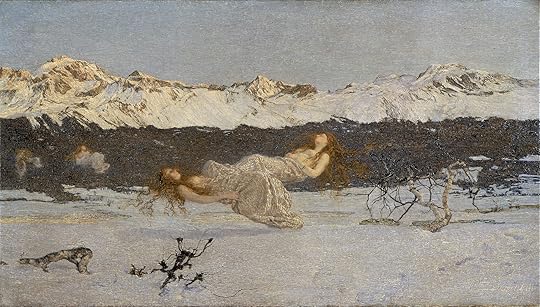
Müller's fragmentary series of short essays form a book within a book in the wider piece, reproduced in full in the text. As Taylor suggests they form a somewhat ecletic study of 'the small', although there are a number of themes that run throughout, particularly a potted history of Freudian psychology (e.g. one essay centres around the 1927 dispute between Melanie Klein and Anna Freud on the the psycho-analytical treatment of children), the life and works of Robert Walser and some of his contemporaries, and analysis (with a strongly psychoanalytical flavour) of various artists and their works such as Giovanni Segantini and his The Punishment of Lust:

description

What awaits Segantini highup in the mountains is, psychoanalytically-speaking, the destructive outcome of paternal rivalry or, in other words, the desire to come out on top: prohibited mother-love. At his heights the artist therefore needed to confront what, since his very first drawings, would inevitably lay him low, causing his demise. If this is the rather clumsy lesson taught by Freud's star pupil, its implications are nonetheless far-reaching, overspilling and dividing and space, whether artistic or analytical, that hoped to contain them (while never exactly floating free). In a certain passage of the text by Jacques Derrida called 'Parergon', found in his book The Truth in Painting, we are offered a reading of Immanuel Kant's Analytic of the Sublime, from his Critique of Judgement (1790), where the grand drama of sublimity—the terrible spectacle of a giant mountain, for instance—threatens to overwhelm ideas of beauty or aesthetic judgement, even while it arouses reason, stirring the philosophical desire for rational explanation to win out, or to come out on top.

As Taylor comments on 'The small':

So many of his references are canonical at a time when all sorts of canons are being contested, and the time-frame—running from the late nineteenth century through two world wars into the post-war period— recalls a set of Anglo-American fixations that seem increasingly dated (the focus is also very limited to Europe).

And Goetz suggests this change in emphasis in the academic world may lay at the heart of Müller's death:

Yes, I think Peter's personal difficulties very much coincided with the gradual disappearance of an academic world he identified with so strongly. The two things weren't absolutely identical, there were obviously other problems as well (it's clear he had a very difficult childhood, which was like a split-off part for him, a kind of secret part that nevertheless kept coming back). I'm sure the institutional problems didn't help, though. At their worst, universities have become utterly instrumentalised, little more than training grounds or the production of human capital (I don't need to tell you this!) and there's less and less room for theoretical speculation about literature or culture (unless you land a big grant, of course, then the managers love you again). But universities are also evolving spaces where you can harness and support growing enthusiasm for alternative political analyses and new types of activism and protest. Peter was sympathetic to the latter, but couldn't really find his own place in any project of that kind. So I think universities had become empty, or worse than empty, for him.

Meanwhile Goetz and Taylor's email correspondence becomes both flirtatious (the reader suspects the relationship may have crossed beyond the professional) but also somewhat antagonistic as Taylor rejects Goetz's various plans for publishing 'The small' and Goetz in turn reacts rather badly to some of the reader feedback. In particulrr he rejects the suggestion that he should include more on China (which Taylor supports as offering the book a way in to the exciting new Chinese market), with his head increasingly turned away from the smaller Penham to the siren call of the big US university presses.

I must admit that psychology is a subject in which I have limited interest and even less expertise, and I found some of those sections of Müller's essays a little heavy going, and was much better able to appreciate the sections on Segantini and, particularly, Robert Walser. And I suspect the novel has things to say about academic culture which I didn't fully pick up being long separated from that world.

Nonetheless this was a fascinating novel, one I would very much recommend. And I will now move on to the sequel, published in 2021, Early Mass, which is (or purports to be) an unpublished novel by Professor Peter Müller found amongst his papers, and which covers many of the same topics as his essays.
Displaying 1 of 1 review

Can't find what you're looking for?

Get help and learn more about the design.