Sylvia Townsend Warner was born at Harrow on the Hill, the only child of George Townsend Warner and his wife Eleanora (Nora) Hudleston. Her father was a house-master at Harrow School and was, for many years, associated with the prestigious Harrow History Prize which was renamed the Townsend Warner History Prize in his honor, after his death in 1916. As a child, Sylvia seemingly enjoyed an idyllic childhood in rural Devonshire, but was strongly affected by her father's death.
She moved to London and worked in a munitions factory at the outbreak of World War I. She was friendly with a number of the "Bright Young Things" of the 1920s. Her first major success was the novel Lolly Willowes. In 1923 Warner met T. F. Powys whose writing influenced her own and whose work she in turn encouraged. It was at T.F. Powys' house in 1930 that Warner first met Valentine Ackland, a young poet. The two women fell in love and settled at Frome Vauchurch in Dorset. Alarmed by the growing threat of fascism, they were active in the Communist Party of Great Britain, and visited Spain on behalf of the Red Cross during the Civil War. They lived together from 1930 until Ackland's death in 1969. Warner's political engagement continued for the rest of her life, even after her disillusionment with communism. She died on 1 May 1978.
The mythology of the phoenix is varied, but key and consistent features are its beauty and the fact that it dies and is (re)born in fire.
This is not a beautiful story.
Lord Strawberry (what a ridiculous name) has “the finest aviary in Europe”. A veritable utopia of incarceration that eventually includes a “fine phoenix, with a charming character”.
“The love of money is the root of all evil.” (1 Timothy 6:10) Later, the phoenix is acquired by Mr Tancred Poldero, owner and proprietor of Poldero's Wizard Wonderworld. As you can guess from his name, it’s all downhill from there, as a reader, and especially for the phoenix.
The only thing I really liked was the final paragraph, which meets Miss Prism's definition of fiction from Oscar Wilde’s The Importance of Being Earnest, "The good ended happily, and the bad unhappily" (my review HERE).
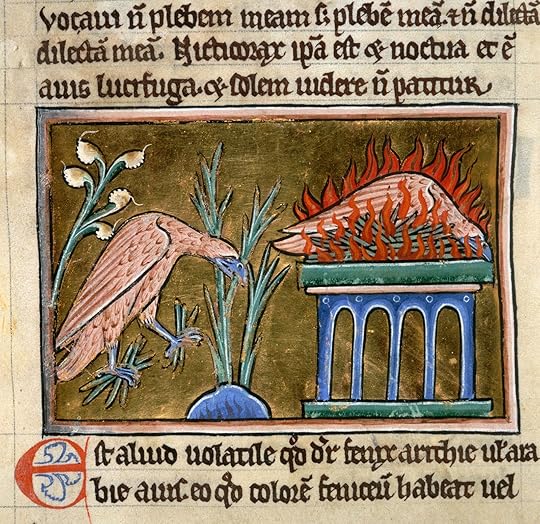
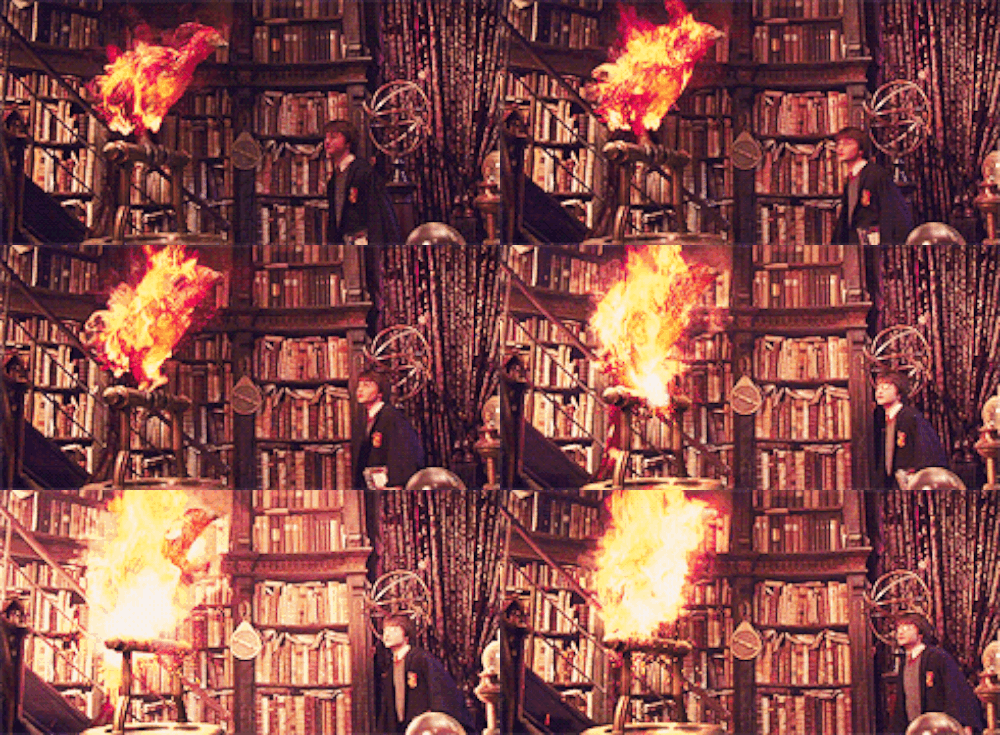
Online images of phoenix skew to Harry Potter and similar styling. Here’s something older:
Image: Phoenix plucking at vegetation (left) and lying in flames waiting to be reborn from the ashes (right), 12th-century Latin bestiary. (Source)
See also
• Kafka's A Hunger Artist explores similar ideas in a more profound way. It’s tragic, like this, but not so cruel. See my review HERE.
• Hilaire Belloc is another writer who could have told this story better, imo. See his Cautionary Tales for Children, which I reviewed HERE.
"The Phoenix" is an allegorical story about how the consequences of greed can be tragic. People from a colonial power were going into a third world countries to obtain the phoenix and other rare birds. There's been a long history of many colonial nations exploiting third world countries, as well as exploiting nature, due to greed. However, the mythical phoenix got revenge.
“Many authorities on bird life had assured Lord Strawberry that the phoenix is a fabulous bird, or that the breed was long extinct. Lord Strawberry was unconvinced: his family had always believed in phoenixes.”
A slight story but with a great ending, about the need to approach nature (and myths) with respect.
Convinced me to read more of this author, after a mixed experience with Lolly Willowes.
A clever, snappy short story (I want to say "plucky") about the search for a fabulous bird — the Phoenix.
The undercurrents of this very short piece swirl around obsession, hubris, and getting what you ask for.
2025 re-read}}. Wealthy ornithologist is determined to possess a Phoenix, and at last acquires one. After his death, in the aftermath of war, the Phoenix is purchased by a carnival, but the exotic Phoenix does nothing remarkable, and fails to earn a living. The "Wonderworld" owner has an idea . . .
The moral of the story is that we understand very little about the workings of our wonderful world.
In the style of Kipling's Just So Stories, told with humour and repetition , but not as subtle . Animals are more than they seem to the ignorant . A couple of good lines but the ending is predictable and the moral implications have been better told by others .
Redeemed by the idea of a Lord being ruined by the cost of birdseed and by the name of the greedy villain , Tancred Poldero .
Lord Strawberry is a nobleman collector, and proud owner of the most rare and unique bird on the world, the last and only mythical Phoenix. But when one day he unexpectedly dies his state is auctioned and the bird is acquired by Mr. Tancred Poldero, an unscrupulous businessman and cold-blooded showman.
This was good! Neither great or a letdown, just perfectly good. For a five page quick short story the plot was engaging and the tone was set right. And the ending was certainly something. I don't think Fawkes, nor I by the way, would approve of it too much, but that's just a matter of taste. Collateral happens.
----------------------------------------------- PERSONAL NOTE: [1940] [5p] [Fiction] [Almost Recommendable] -----------------------------------------------
Resucita de las cenizas.
Lord Strawberry es un noble coleccionista y orgulloso propietario del ave más rara y única del mundo, el último y único mítico Fénix. Pero cuando un día muere inesperadamente, su estado es subastado y el pájaro es adquirido por el Sr. Tancred Poldero, un inescrupuloso hombre de negocios y un showman de sangre fría.
¡Esto estuvo bien! Ni genial ni decepcionante, simplemente perfectamente bueno. Para ser una historia corta de cinco páginas, la trama es atractiva y el tono adecuado. Y el final ciertamente fue algo especial. No creo que Fawkes, ni yo dicho sea de paso, lo aprobaría demasiado, pero eso es sólo una cuestión de gustos. A veces lo colateral ocurre.
----------------------------------------------- NOTA PERSONAL: [1940] [5p] [Ficción] [Casi Recomendable] -----------------------------------------------
You know how surgeons don't operate on family members? Well, full disclosure - I have been working with surrendered, abused, and rescue parrots for 20 years. So take my opinion with a grain of feather.
There were a few clever lines, like [minor ]
One person in our group noted that "This was reality tv before reality tv." I would agree, however Kafka did a much better job of portraying it in A Hunger Artist.
Read with The Short Story Club group*. It didn't garner much discussion or depth of meaning with the group, unlike many of the short stories in the splendid Black Water 2: More Tales of the Fantastic anthology normally do.
It was at its heart a social commentary, with a little satisfactory charred bite at the end.
Este relato es la definición del dicho "Juega con fuego y te quemarás". Es poca cosa, apenas tres páginas, y puede resultar un poco decepcionante porque el ave Fénix me parece una criatura espléndida que podría haber dado más de sí, pero lo que sí que tiene es un final muy satisfactorio. Y me gustaría resaltar la mejor frase de todo el relato que me ha sacado una carcajada: "It was too quiet, too classical. So people went instead to watch the antics of the baboons, or to admire the crocodile who had eaten the woman".
This hits hard in a time where abuses are justified in the name of the good or development of the abused. Making someone “age” so the caretaker can profit off the abused… I’m insane about this short story actually.
Random contributing factors or not: author worked in a munitions factory - nice place to think about things going up in spectacular flames. Also, author (validly) concerned about fascism, thus (for a time) sympathetic with the communists; also about these times there were quite a few serious anarchists who pushed things to the point of blowing things up (and people too) - as a rather extreme means of fighting poor conditions, and what not. On a lighter note, this is one heck of a way of giving someone the bird (american English idiom)!