

What do you think?

Redwoods
An ordinary train ride becomes and extraordinary trip to the great ancient forests
A subway trip is transformed when a young boy happens upon a book about redwood forests. As he reads the information unfolds, and with each new bit of knowledge, he travels--all the way to California to climb into the Redwood canopy. Crammed with interesting and accurate information about these great natural wonders, Jason Chin's first book is innovative nonfiction set within a strong and beautiful picture storybook.
A subway trip is transformed when a young boy happens upon a book about redwood forests. As he reads the information unfolds, and with each new bit of knowledge, he travels--all the way to California to climb into the Redwood canopy. Crammed with interesting and accurate information about these great natural wonders, Jason Chin's first book is innovative nonfiction set within a strong and beautiful picture storybook.
40 pages, Hardcover
First published March 17, 2009
Ratings & Reviews
Friends & Following
Create a free account to discover what your friends think of this book!
Community Reviews
Displaying 1 - 30 of 361 reviews

May 6, 2019
I love this book. This book is about a boy reading a book in NYC about the Redwood forest. It gives all kinds of tips and facts about the forest. We see the city boy in the forest.
I have been to two different Redwood forests. One in Northern CA and the other outside San Fran. I loved both experiences. There is nothing on Earth like those grooves. They are simply amazing and humbling. The energy is so huge you can almost ride on it. I have never felt anything like it. I would love to be able to go there on a weekly basis. I think you would be much healthier. It’s too bad CA is so dang expensive. These forests are over 2,000 years old. A living thing older than history. It is so amazing to me really.
I thought the artwork was fun and the story really hooked the imagination. Both kids want to go see these trees. They could believe that animals live in the canopy and never touch the ground. That is wild to think about. This got the kids imaginations going too and they really can’t believe how big these trees are. You simply have to see them to comprehend them, I think. I hope the kids can go some day. The nephew gave this 5 stars and the niece gave this 4 stars. They were both under this book’s spell.
Love it
I have been to two different Redwood forests. One in Northern CA and the other outside San Fran. I loved both experiences. There is nothing on Earth like those grooves. They are simply amazing and humbling. The energy is so huge you can almost ride on it. I have never felt anything like it. I would love to be able to go there on a weekly basis. I think you would be much healthier. It’s too bad CA is so dang expensive. These forests are over 2,000 years old. A living thing older than history. It is so amazing to me really.
I thought the artwork was fun and the story really hooked the imagination. Both kids want to go see these trees. They could believe that animals live in the canopy and never touch the ground. That is wild to think about. This got the kids imaginations going too and they really can’t believe how big these trees are. You simply have to see them to comprehend them, I think. I hope the kids can go some day. The nephew gave this 5 stars and the niece gave this 4 stars. They were both under this book’s spell.
Love it

April 2, 2019
A bit heavy on facts but great illustrations. The world high above in the trees is awesome, and the gentle subtle story about city kids learning about trees is nice.

November 13, 2009
An innovative "non-fiction" picture book following a boy's journey through the science of the redwoods. A lot of information is packed into this little book, but the illustrations make it easy to digest and even fun. I love how the boy becomes so immersed in what he is reading that he actually finds himself in a redwood forest! There is a "conservation message" attached to the book, but it's not overly didactic and more emphasis is placed on how cool these trees are and how it would be great for the reader to be able to visit them someday.
As a life-long Northern California resident, I've been fortunate enough to see the beautiful redwood forests--we didn't make it far enough to see the most giant of them, but I plan to someday soon!
As a life-long Northern California resident, I've been fortunate enough to see the beautiful redwood forests--we didn't make it far enough to see the most giant of them, but I plan to someday soon!

May 24, 2009
Is it easier to write an excellent work of fiction than an excellent work of non-fiction? It’s sort of a trick question. Still, I’d argue that a poor work of fiction is going to appeal to a child more immediately than a poor work of non-fiction. Hand a kid a terrible picture book and they’re going to at least give it a glance. But hand them a poor work of non-fiction and what’s their reaction? “Boooooring!” So superior informational books for kids not only have to be interesting and well written but they also have to fight against the intended audience’s learned prejudices. That’s where Jason Chin comes in. In this debut non-fiction picture book from Roaring Brook, Chin takes a page from the Magic School Bus school of writing for kids. You want facts? Fine. We’ll give you facts. And on top of that we’ll also give you a fun story, great visuals, and small furry creature evident on almost every single page. You have kids that think non-fiction is dull as dishwater? Meet the cure.
A boy finds a book sitting on a seat in a subway platform. He picks it up, possibly drawn to the cover, which shows himself standing in a redwood forest looking up. As he reads facts about redwood trees, we read the same thing. We learn how old the trees are, the kinds of ecosystems they prefer, their resistance to forest fires, how tall they can grow, etc. As we learn, so too does the boy, and soon enough he finds himself in his own forest, scaling the trees, escaping fires, and meeting the creatures that rely on the plants. By the end he has found himself on a park bench and, in a rush, leaves the book behind where a girl will find it and have adventures of her own.
About four pages into this book I had to flip back to the cover. I was worried. Did the illustrator of this book inform the author of what he was up to when he decided to give the story a narrative? Of course I quickly saw that Jason Chin not only wrote the book but illustrated it as well. Aaahhh. It’s interesting that on the surface the facts about redwoods inform the pictures but don't describe them. While we’re hearing about a redwood tree’s natural ability to withstand forest fires, there runs our hero willy-nilly away from a magnificent blaze. And while we hear about the different forest residents that live in redwood forests, our hero is scaling a tree looking at them firsthand. Though the book doesn’t contain so much as a thought bubble, I began to think about graphic novels when considering Chin’s interaction between text and image. Though the text doesn’t rely on the pictures, the images do make significantly more sense when paired with the text.
As for those pictures themselves, they’re great. Full of action, adventure, and daring do (or is it "derring do"?). Young children, the pre-literacy crowd, may be drawn to the images at first and then enjoy the words later. Even better are the millions of tiny details peppered throughout this story. Kids will like noting that what the boy reads on the page is the same as what we are reading. I was particularly impressed that Chin managed to work the cover of this book into the art so many times. After all, covers of children’s books aren’t usually written in stone and can be prone to change. He must have established what the cover image would be right from the start before he even began. Kids will also love spotting the flying squirrel that attaches itself to the boy once he finds himself in redwood country (look closely and you’ll even spot it on the inside front bookflap). Third and fourth readings of the book reveal that the trash on the floor of the subway station consists of strange items with titles like “Polar Bear’s Last Stand”, possibly drilling home the book’s environmental message. Or maybe a future Chin project. And in a very interesting move, the title page of the book is from the boy’s p.o.v. You see his hands holding the book before you. But if you look a little closer at the page itself, the picture presented there isn’t of the boy, but of the girl who will come to pick up the book at the end of this tale.
I wouldn’t have thought it right off the bat, but I’ve seen Chin’s work before, and maybe you have too. Simon Winchester’s children's version of adult book on Krakatoa was published as The Day the World Exploded. In that title there were the usual photographs, timelines, and documents. A little less common, however, were some illustrated portions. An elephant running rampant in a hotel room. People fleeing for their lives. That kind of thing. Turns out that Jason Chin was behind those shots. Like this book they didn’t necessarily interact directly with the text, but they added to the overall reading experience. I’m pleased to see him doing the same thing here.
Books where kids read books about themselves are not unheard of. I’m thinking of The Red Book by Barbara Lehmann, or any story the pokes a hole or two in the fourth wall. What I like so much about this book, however, is Chin’s easygoing dance between fiction and non-fiction. He seems at home in this format, and the result is an eclectic and exciting book. Kids who might never voluntarily pick up a book about trees can find themselves drawn into the “story” from page one. Trick ‘em into learning, that’s what I say. Though it would have been nice to find a small Bibliography or list of sources at the end, Redwoods is bound to become a fine, fun purchase. More memorable than your average tree fare, no question.
Ages 5-10.
A boy finds a book sitting on a seat in a subway platform. He picks it up, possibly drawn to the cover, which shows himself standing in a redwood forest looking up. As he reads facts about redwood trees, we read the same thing. We learn how old the trees are, the kinds of ecosystems they prefer, their resistance to forest fires, how tall they can grow, etc. As we learn, so too does the boy, and soon enough he finds himself in his own forest, scaling the trees, escaping fires, and meeting the creatures that rely on the plants. By the end he has found himself on a park bench and, in a rush, leaves the book behind where a girl will find it and have adventures of her own.
About four pages into this book I had to flip back to the cover. I was worried. Did the illustrator of this book inform the author of what he was up to when he decided to give the story a narrative? Of course I quickly saw that Jason Chin not only wrote the book but illustrated it as well. Aaahhh. It’s interesting that on the surface the facts about redwoods inform the pictures but don't describe them. While we’re hearing about a redwood tree’s natural ability to withstand forest fires, there runs our hero willy-nilly away from a magnificent blaze. And while we hear about the different forest residents that live in redwood forests, our hero is scaling a tree looking at them firsthand. Though the book doesn’t contain so much as a thought bubble, I began to think about graphic novels when considering Chin’s interaction between text and image. Though the text doesn’t rely on the pictures, the images do make significantly more sense when paired with the text.
As for those pictures themselves, they’re great. Full of action, adventure, and daring do (or is it "derring do"?). Young children, the pre-literacy crowd, may be drawn to the images at first and then enjoy the words later. Even better are the millions of tiny details peppered throughout this story. Kids will like noting that what the boy reads on the page is the same as what we are reading. I was particularly impressed that Chin managed to work the cover of this book into the art so many times. After all, covers of children’s books aren’t usually written in stone and can be prone to change. He must have established what the cover image would be right from the start before he even began. Kids will also love spotting the flying squirrel that attaches itself to the boy once he finds himself in redwood country (look closely and you’ll even spot it on the inside front bookflap). Third and fourth readings of the book reveal that the trash on the floor of the subway station consists of strange items with titles like “Polar Bear’s Last Stand”, possibly drilling home the book’s environmental message. Or maybe a future Chin project. And in a very interesting move, the title page of the book is from the boy’s p.o.v. You see his hands holding the book before you. But if you look a little closer at the page itself, the picture presented there isn’t of the boy, but of the girl who will come to pick up the book at the end of this tale.
I wouldn’t have thought it right off the bat, but I’ve seen Chin’s work before, and maybe you have too. Simon Winchester’s children's version of adult book on Krakatoa was published as The Day the World Exploded. In that title there were the usual photographs, timelines, and documents. A little less common, however, were some illustrated portions. An elephant running rampant in a hotel room. People fleeing for their lives. That kind of thing. Turns out that Jason Chin was behind those shots. Like this book they didn’t necessarily interact directly with the text, but they added to the overall reading experience. I’m pleased to see him doing the same thing here.
Books where kids read books about themselves are not unheard of. I’m thinking of The Red Book by Barbara Lehmann, or any story the pokes a hole or two in the fourth wall. What I like so much about this book, however, is Chin’s easygoing dance between fiction and non-fiction. He seems at home in this format, and the result is an eclectic and exciting book. Kids who might never voluntarily pick up a book about trees can find themselves drawn into the “story” from page one. Trick ‘em into learning, that’s what I say. Though it would have been nice to find a small Bibliography or list of sources at the end, Redwoods is bound to become a fine, fun purchase. More memorable than your average tree fare, no question.
Ages 5-10.

June 17, 2019
A phenomenal picture-book blending factual narrative and fantastic adventure, Jason Chin's Redwoods follows a young boy as he learns about the astonishing Sequoia sempervirens - the tallest living creatures on our planet. A straightforward, informative text that covers everything from life-span - coast redwoods can live for more than 2000 years - to canopy ecosystem, is paired with gorgeous watercolor illustrations that depict a young boy in the process of reading and learning. Picking up a book on redwoods that he finds in the subway, the boy is transported to the forest, and his exploration - looking at seeds and stumps, climbing to the crown - mirrors the facts under discussion in the text.
This is an immensely appealing book on so many levels! Both educational and entertaining, it highlights the idea that learning is fun, and subtly hints at the fact that scientific exploration is inspired by, and uses, the same powers of creativity and imagination as any other kind of human endeavor. The illustrations themselves are beautiful, making this a visually pleasing book as well. I liked the little environmental messages that Chin works into his art: an abandoned newspaper on the subway reads: You Can Fight Global Warming, while a torn-down poster warns of the Polar Bears' Last Stand. Chin is to be commended for creating an outstanding non-fiction title for children, excellent in every aspect of its conception and production. Highly, highly recommended!
This is an immensely appealing book on so many levels! Both educational and entertaining, it highlights the idea that learning is fun, and subtly hints at the fact that scientific exploration is inspired by, and uses, the same powers of creativity and imagination as any other kind of human endeavor. The illustrations themselves are beautiful, making this a visually pleasing book as well. I liked the little environmental messages that Chin works into his art: an abandoned newspaper on the subway reads: You Can Fight Global Warming, while a torn-down poster warns of the Polar Bears' Last Stand. Chin is to be commended for creating an outstanding non-fiction title for children, excellent in every aspect of its conception and production. Highly, highly recommended!

February 18, 2017
3.5 out of 5
Although I personally prefer Jason Chin's illustrations in his later picturebooks (e.g., Island: A Story of the Galápagos, Grand Canyon, or my beloved Water is Water: A Book About the Water Cycle), Redwoods offers a fine blend of informational text and fantastical, engaging, playful, even metafictive images:

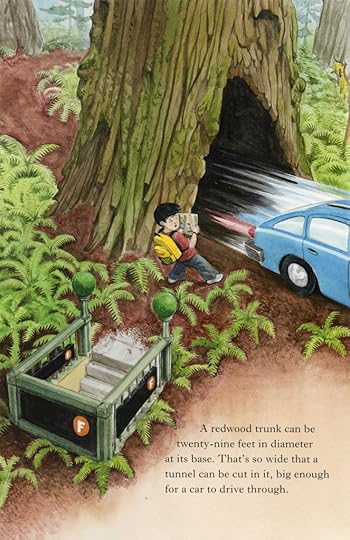
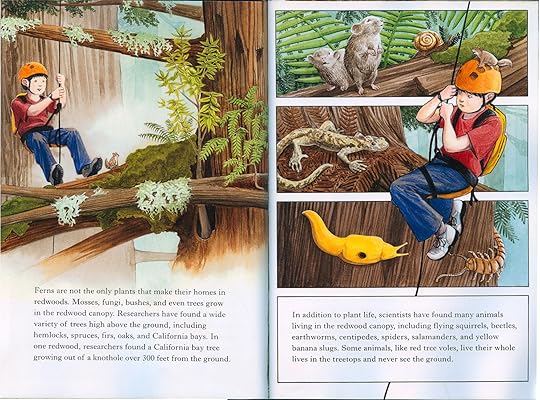


Although I personally prefer Jason Chin's illustrations in his later picturebooks (e.g., Island: A Story of the Galápagos, Grand Canyon, or my beloved Water is Water: A Book About the Water Cycle), Redwoods offers a fine blend of informational text and fantastical, engaging, playful, even metafictive images:

March 2, 2017
Redwoods by Jason Chin is a sensational children's book that educates children about coastal redwood trees.
Jason Chin combines fantasy with non-fiction which educates children in a fun, uncomplicated, and enjoyable manner. The illustrations are beautiful and there are heaps of facts on redwoods pertaining to size, needs, life span, appearance, defenses, and importance.
This is a perfect educational book for schools, libraries, or a home library. Parents can enjoy acquiring an education about redwoods right along with their children.
It concludes with an admirable author's note.
5*****
Jason Chin combines fantasy with non-fiction which educates children in a fun, uncomplicated, and enjoyable manner. The illustrations are beautiful and there are heaps of facts on redwoods pertaining to size, needs, life span, appearance, defenses, and importance.
This is a perfect educational book for schools, libraries, or a home library. Parents can enjoy acquiring an education about redwoods right along with their children.
It concludes with an admirable author's note.
5*****

November 13, 2010
2010: Excellent, excellent book! I'd love to see more nonfiction books in this style. Here's the rundown: text is typical nonfiction; lots of facts about redwood trees. But the illustrations tell a story of a little boy picking up a book and then traveling to a redwood forest in his imagination and climbing around in the trees. I loved it!

June 4, 2021
This is full of information on the mess beautiful giants. I loved what I learned and the illustrations are vivid and bring the canopy to life.

February 28, 2010
A boy discovers the glory of the ancient redwoods when he stumbles across a book about the trees while riding the subway. Well-researched and beautifully illustrated.

November 5, 2011
I saw this book mentioned in a discussion about Arbor Day in the Picture-Book Club in the Children's Books Group here at Goodreads. So, in honor of Arbor Day, we read a few books about trees.
This is a fascinating book that ends up being two stories in one. The narrative is a nonfiction description of the Redwood forests in California, telling about the history of the trees, the way the plant grows and the creatures that live within the canopy. But another story unfolds as you read the narrative. It is an unworded tale of a young boy that finds this book in a subway station, is transported to the majestic forest and learns all about the trees, and subsequently leaves the book behind for another child to discover. It is a silent, but wonderful tale of wonder and amazement at the natural giants. The illustrations are terrific and we had to read through the book a second time to truly appreciate them. We really enjoyed reading this book together.
I've never seen the Redwoods and I really hope to someday...
This is a fascinating book that ends up being two stories in one. The narrative is a nonfiction description of the Redwood forests in California, telling about the history of the trees, the way the plant grows and the creatures that live within the canopy. But another story unfolds as you read the narrative. It is an unworded tale of a young boy that finds this book in a subway station, is transported to the majestic forest and learns all about the trees, and subsequently leaves the book behind for another child to discover. It is a silent, but wonderful tale of wonder and amazement at the natural giants. The illustrations are terrific and we had to read through the book a second time to truly appreciate them. We really enjoyed reading this book together.
I've never seen the Redwoods and I really hope to someday...

September 21, 2020
I've read a few of Jason Chin's thoughtful and beautifuly illustrated books about appreciating and understanding the natural world--Grand Canyon, Galapegos, Coral Reefs--books about water, about babies, and the growing totality of his work is enough to make you love the world we live in more and nudge you to dig more deeply into knowing more about it.
I picked this up the other day because of the west coast in late summer 2020 as all the trees are burning there. I am a midwesterner who has many times seen the Redwoods and know it is important that the oldest living things on the planet, oldest of old growth forests, surviving thousands of years, are now, in this climate disaster, in danger of being lost forever in our very life time, because of us. I took my kids to see them and they liked seeing the book and looking at a map with some sadness and frustration to see where the fires are now.
I picked this up the other day because of the west coast in late summer 2020 as all the trees are burning there. I am a midwesterner who has many times seen the Redwoods and know it is important that the oldest living things on the planet, oldest of old growth forests, surviving thousands of years, are now, in this climate disaster, in danger of being lost forever in our very life time, because of us. I took my kids to see them and they liked seeing the book and looking at a map with some sadness and frustration to see where the fires are now.
November 3, 2015
Redwoods by Jason Chin is a wonderful informational text for upper elementary schools students. The beginning starts off discussing the life cycle of a Redwood tree (how they grow, how long they've been around, and the types of environments they need to live in). As the book goes on, the ecosystems that depend on the Redwood for survival are discussed. This includes the many plants and animals that live and grow in Redwood trees which include the endangered Marbled Murrelet. The language is simple enough for all grade levels, but would be most easily comprehended by 4th and 5th graders. Jason Chin does a wonderful job using examples that young readers could connect to, for example, he discusses how wildfires are actually healthy for Redwood forests because the fire rids the environment of life that would compete for resources. The fires can leave big holes in a Redwood's trunk (but the tree would keep growing) and this hole is big enough for a car to drive through. Moreover, the pictures are extremely beautiful and exemplify the many aspects of the text well.
There are so many ways to use this book as a resource in the classroom. I would use when teaching about Redwoods or as an example of one of the temperate zones. Life cycles could also be touched upon using this book as well as endangered species. This would also be a wonderful resource for students to use if they were doing a research project as it provides an ample amount of facts.
There are so many ways to use this book as a resource in the classroom. I would use when teaching about Redwoods or as an example of one of the temperate zones. Life cycles could also be touched upon using this book as well as endangered species. This would also be a wonderful resource for students to use if they were doing a research project as it provides an ample amount of facts.

November 30, 2016
1) Book summary, in your own words (3 pts)
-This book begins with a little boy picking up a book on a subway, this book is filled with fun facts and information about the redwoods. Suddenly, it's like the boy is there himself, seeing the ginormous, beautiful trees and gorgeous views. This book provides students with tons of information on one of the prettiest places in the world.
2) Grade level, interest level, lexile (1 pt)
-1st grade
3) Appropriate classroom use (subject area) (1 pt)
-Geography
4) Individual students who might benefit from reading (1 pt)
-Students that love nature
-Students that love to travel
5) Small group use (literature circles) (1 pt)
-I would have students read through book and then write a few sentences as if they were walking through the redwood forest to describe what they saw.
6) Whole class use (read aloud) (1 pt)
-Carpet reading
7) Related books in genre/subject or content area (1 pt)
-Island: A Story of the Galápagos by Jason Chin
8) Multimedia connections (audio book, movie) available (1 pt)
-Audiobook available.
-This book begins with a little boy picking up a book on a subway, this book is filled with fun facts and information about the redwoods. Suddenly, it's like the boy is there himself, seeing the ginormous, beautiful trees and gorgeous views. This book provides students with tons of information on one of the prettiest places in the world.
2) Grade level, interest level, lexile (1 pt)
-1st grade
3) Appropriate classroom use (subject area) (1 pt)
-Geography
4) Individual students who might benefit from reading (1 pt)
-Students that love nature
-Students that love to travel
5) Small group use (literature circles) (1 pt)
-I would have students read through book and then write a few sentences as if they were walking through the redwood forest to describe what they saw.
6) Whole class use (read aloud) (1 pt)
-Carpet reading
7) Related books in genre/subject or content area (1 pt)
-Island: A Story of the Galápagos by Jason Chin
8) Multimedia connections (audio book, movie) available (1 pt)
-Audiobook available.

April 21, 2009
A boy waiting for the subway finds a book on redwood trees on the bench next to him. As he becomes immersed in the information, the world around him changes until he finds himself in the middle of a redwood forest. Through the boy’s eyes readers will get to repel to the top of the redwood crowns, stand on enormous stumps, and view the redwoods compared to a city skyline. This book is the epitome of an informational book made accessible and fun. Though the text is primarily factual, the illustrations take it to a different level of wonder and interest.
Chin’s text culls the most fascinating facts about the great redwood trees while combining them with illustrations that are fantastical and fun. The book reads aloud well thanks to the charm of the illustrations and Chin’s talent at writing facts with readability and interest in mind.
This book will have your spirit soaring to the tops of these gargantuan trees and my is the view fine. Appropriate for ages 5-8.
Chin’s text culls the most fascinating facts about the great redwood trees while combining them with illustrations that are fantastical and fun. The book reads aloud well thanks to the charm of the illustrations and Chin’s talent at writing facts with readability and interest in mind.
This book will have your spirit soaring to the tops of these gargantuan trees and my is the view fine. Appropriate for ages 5-8.
October 4, 2015
This book has quickly become one of our favorites! We are nature lovers, so I was excited when my daughter picked this book up at the library. It's a fun, imaginative book full of lots of information about redwoods. It led us to do our own research on redwoods because my daughter had so many great questions after reading this book! I am getting ready to use it in a lesson for my classroom as well. If you're a nature lover like we are or even if you just like a good book, this is the book for you!
August 5, 2018
A subway ride (F Train at 14th St — woo!) turns into a “non-fiction” adventure into a redwood forest.
The text is straightforward facts about the trees — which by themselves are mesmerizing. By the end I was thinking, “No wonder they call the largest ones Titans; these trees are gods.”
The illustrations are where we get our boy on the subway, blending fantastical with non-fiction. I especially loved the redwood fitting in the city skyline, the redwood by the Statue of Liberty, the tiny boy perched in the crown of a great tree.
The text is straightforward facts about the trees — which by themselves are mesmerizing. By the end I was thinking, “No wonder they call the largest ones Titans; these trees are gods.”
The illustrations are where we get our boy on the subway, blending fantastical with non-fiction. I especially loved the redwood fitting in the city skyline, the redwood by the Statue of Liberty, the tiny boy perched in the crown of a great tree.

April 29, 2019
I knew I'd love Jason Chin's illustrations (not my first rodeo) but was pleasantly surprised at much the illustrations brought the facts to life. It follows a boy who is reading a book about Redwoods (the one we are reading actually) and the boy's presence in each spread really made the facts dynamic, showing scale and bringing Redwoods to life. Can't wait to share with my kids later today.

May 10, 2018
I must admit an affinity for Redwoods. I long to visit them again. Even though I have seen the Redwoods, I learned even more by reading this wonderful book. Everyone should read it, and visit the Redwoods.
March 31, 2021
Redwoods is a children's picture book written and illustrated by Jason Chin. It introduces the world of old-growth redwood forests to young readers in this effective mix of fiction and nonfiction.
Chin's text is rather simplistic, straightforward, and informative. The straightforward narrative is given enormous energy by the inventive format and realistic watercolor illustrations – their soft edges and muted hues suit the mist-shrouded giants. Chin adeptly captures the singular and spectacular nature of redwoods in this smartly layered book.
The premise of the book is rather straightforward. The framing story opens with a boy finding a copy of the book on a subway station bench. He delves in, and facts about the ancient trees spring to life around him. Emerging from the station to find himself in the middle of a redwood forest, his adventures mirror what he's learning.
All in all, Redwoods is an inventive, eye-opening adventure and as grand as the trees themselves.
Chin's text is rather simplistic, straightforward, and informative. The straightforward narrative is given enormous energy by the inventive format and realistic watercolor illustrations – their soft edges and muted hues suit the mist-shrouded giants. Chin adeptly captures the singular and spectacular nature of redwoods in this smartly layered book.
The premise of the book is rather straightforward. The framing story opens with a boy finding a copy of the book on a subway station bench. He delves in, and facts about the ancient trees spring to life around him. Emerging from the station to find himself in the middle of a redwood forest, his adventures mirror what he's learning.
All in all, Redwoods is an inventive, eye-opening adventure and as grand as the trees themselves.
February 22, 2025
Absolutely amazing--I love how the illustrations show the boy reading the book on the subway and imagining the redwood forest around him. Lots of detail about how redwoods thrive and grow. Simply a stellar picture book.

January 10, 2023
Very informative, yet appropriate for kids. I definitely learned stuff!

July 5, 2025
I oftentimes like to imagine being someone who didn't grow up with redwoods.

October 25, 2009
I can see myself picking this as my favorite nonfiction picture book. I love the text and the pictures perfectly complement the text. Redwoods serve as a fascinating subject yet have not been overdone as a subject.
The text information is supplemented with an author's note explaining his interest in the subject and a note about the danger to redwoods. No bibliography which is disappointing but not absolutely necessary.
There really is only one obstacle to adding this to my shortlist: What do kids think? I must try this book out on my primary students.
A bit from the book:
Redwoods by Jason Chin
“The coast redwoods are among
the oldest trees in the world.
Their ancestors lived about 165 million
years ago, during the Jurassic period.”
(Illustrations show a boy reading a book about redwoods, getting on a subway, and sitting and reading the book on the subway while in the windows behind him lurk three green dinosaurs.”
The text information is supplemented with an author's note explaining his interest in the subject and a note about the danger to redwoods. No bibliography which is disappointing but not absolutely necessary.
There really is only one obstacle to adding this to my shortlist: What do kids think? I must try this book out on my primary students.
A bit from the book:
Redwoods by Jason Chin
“The coast redwoods are among
the oldest trees in the world.
Their ancestors lived about 165 million
years ago, during the Jurassic period.”
(Illustrations show a boy reading a book about redwoods, getting on a subway, and sitting and reading the book on the subway while in the windows behind him lurk three green dinosaurs.”

December 18, 2012
Redwoods was absolutely jam packed with fascinating facts about redwood trees, but the information was all presented in a way that was not overwhelming to kids. I was impressed with how Jason Chin was able to capture the extraordinarily interesting facts about these beings, and convey the absolute awe-inspiring majesty of these trees. When I read this book to myself before reading it to the kids, I was completely absorbed by it. I spent time with this book! After I read this to my niece and nephew I asked them what they thought of it. My niece sighed out a reverential, "I loved it." It is a rather stellar book.

May 31, 2018
I checked out this book after reading Jason Chin's Grand Canyon book. A young boy is reading this exact book (Redwoods) while learning all the details about these trees. It covers everything I could imagine a child (or adult) wanting to know about Redwoods. The artwork was absolutely stunning and I would love it in my collection for this fact, alone. The one thing that surprised/disappointed me was the fact that there was no list of sources for further reading. There was, however, a brief Author's Note at the end which explained Chin's inspiration for researching and writing about redwoods.
For more kidlit, MGlit, and YAlit book reviews, please visit my book review blog: The Miller Memo.
For more kidlit, MGlit, and YAlit book reviews, please visit my book review blog: The Miller Memo.

March 2, 2017
I was drawn to this book because of its cover - a kid in the middle of a redwood forest.
It is a bit of a longer book, text wise, because it has a lot of information about redwood forests.
It's creative non-fiction in that the little boy starts off in the city (on the subway) and ends up in the redwood forest just by looking at this book, but the content is factual.
The kids enjoyed this book. They learned interesting facts about redwood trees.
I would recommend this book for kids who like science and trees. It would also work if discussing plants in class. Because of the length I would recommend it for elementary students- not so much for preschoolers.
It is a bit of a longer book, text wise, because it has a lot of information about redwood forests.
It's creative non-fiction in that the little boy starts off in the city (on the subway) and ends up in the redwood forest just by looking at this book, but the content is factual.
The kids enjoyed this book. They learned interesting facts about redwood trees.
I would recommend this book for kids who like science and trees. It would also work if discussing plants in class. Because of the length I would recommend it for elementary students- not so much for preschoolers.

June 16, 2013
What a great book to add to your shelf. I like this book because it is a story within a story. The author found a great way to introduce the lose of redwood trees. The redwood trees are an important concept to add to your science lesson plans. It is a simplistic concept that can easily be age appropriate and full of activities like: planting their own trees, drawing pictures of the leaves, or starting tree club.

January 30, 2010
Facts about redwood trees are shared in a narrative format, spread throughout beautiful watercolor illustrations. The concept is really neat, with a boy reading a book about redwoods that comes alive around him and replaces the cityscape of New York with rainforest. The concept, layout, and color scheme is reminiscent of Barbara Lehman's wordless books.

April 7, 2010
This book brings back memories of visiting the Armstrong Redwoods State Natural Reserve. My children have walked amongst the redwoods and they were in awe at the height of the trees much like the young boy in this book. My 8 year old son really enjoyed the abundance of scientific information that was contained in this beautifully illustrated book.
Displaying 1 - 30 of 361 reviews