Dame Agatha Mary Clarissa Christie, Lady Mallowan, DBE (née Miller) was an English writer known for her 66 detective novels and 14 short story collections, particularly those revolving around fictional detectives Hercule Poirot and Miss Marple. She also wrote the world's longest-running play, the murder mystery The Mousetrap, which has been performed in the West End of London since 1952. A writer during the "Golden Age of Detective Fiction", Christie has been called the "Queen of Crime". She also wrote six novels under the pseudonym Mary Westmacott. In 1971, she was made a Dame (DBE) by Queen Elizabeth II for her contributions to literature. Guinness World Records lists Christie as the best-selling fiction writer of all time, her novels having sold more than two billion copies.
This best-selling author of all time wrote 66 crime novels and story collections, fourteen plays, and six novels under a pseudonym in romance. Her books sold more than a billion copies in the English language and a billion in translation. According to Index Translationum, people translated her works into 103 languages at least, the most for an individual author. Of the most enduring figures in crime literature, she created Hercule Poirot and Miss Jane Marple. She atuhored The Mousetrap, the longest-running play in the history of modern theater.
Poirot's car breaks down. As they do. And he ends up in a garage where he meets a handsome young god mechanic. He fixes his car and then begs Poirot to find the lady's maid of a famous dancer who stole the heart and then disappeared.
Can Poirot find this Arcadian Deer and convince her that it's not too late to return to the man who still loves her? There's more to it than this, of course, and there's a twist to the story that most mystery fans will probably see coming right away, but I thought it was sweet.
Originally published in The Strand Magazine in 1940 & put together with 11 other stories in 1947 and then published as The Labours of Hercules. These 12 cases are chosen by Poirot as his own labors of Hercules that he will undertake before his supposed retirement. You can't really say you're a Christie fan if you haven't read these, you know? Recommended.
4 Stars. What can one say except that M. Poirot is a romantic. In his desire to match the Labours of Hercules, all twelve of them, he takes on a love quest as the third. He even turns down an offer by his potential client to pay five pounds or ten! The story was first published in "The Strand" in 1940 although I read it as one of one of the 51 in "Hercule Poirot The Complete Short Stories" of 1999. There's no crime in the fourteen pages, although our unique detective might disagree, what with his car breaking down and the Black Swan Pub and Hotel failing to match his elevated standards in accommodations and meals. Tom Williamson, the mechanic working on his car, approaches him and hesitatingly asks for help to locate a beautiful young woman with golden hair he met only once a half year earlier. Nita was her name, Nita Valetta. She was the maid who accompanied a ballet star on a visit to Grasslawn, owned by Sir George Sanderfield in the village. Poirot sees it as an honourable quest but, it "necessitated more travelling and more interviews than could have been imagined possible." We ultimately end up in Switzerland! (May 2021)
A very sweet and moving story of love at first sight, potential love and what may have been. After Poirot’s car breaks down in a rural village, a story told by a young mechanic takes Poirot all over Europe.
The Arcadian Deer is a short story by Agatha Christie which was first published in the U.K. in The Strand Magazine in January 1940. In the U.S. it was first published in This Week in May 1940. In 1947, the story was grouped with 11 others, a foreword was added, and published as The Labours of Hercules.
The setting is on the eve of one of Poirot's many planned retirements. He wants his crowning achievement to be a series of 12 cases which he will specially selected to match those of the Twelve Labours of Heracles in Greek mythology. In the sequence of the labours pursued by Poirot, The Arcadian Deer is the third of twelve.
A wonderful story as it reveals so much were perhaps overlook in our reading of Poirot. The thought of him walking a mile and a half in his patent shoes amid snow showers after his car broke down. His bedraggled state arriving at a local pub and putting up with basic cuisine.
More in that it reveals his romantic nature and the lengths he would go to resolve a case. The magic of our favourite detective is that he never gave up and could talk to people of all trades and classes. He is non-judgemental and able to tease out the truth revealing both information and emotion content.
I loved this story and the truths it hides in plain sight.
Poirot is stuck in a snowstorm after his car breaks down. The mechanic boldly asks him to track down the maid of a guest at the big house as he has fallen in love with her and wants to marry her after one meeting.
Poirot follows the trail, but it goes dead after every clue. He finally tracks down the guest from the big house, and his deductions tell him the woman searched for is not dead.
In "The Arcadian Deer," Hercule Poirot finds himself helping a young mechanic, Ted Williamson, who is desperate to find a woman he fell in love with after a brief encounter. The woman, known only as Nita, has mysteriously vanished, leaving Ted heartbroken and confused. Poirot’s investigation takes him across England and into Europe, unraveling a tale of lost love, hidden identities, and the fleeting nature of happiness. Through a blend of mythological allusions and a bittersweet conclusion, the story showcases Poirot's compassionate side as he seeks to bring closure to a young man’s poignant love story.
OMG, I'm such a sucker for the Happily Ever After endings. And now, I suppose we can deduce, that so is our Heroic Hercule Poirot character... who'll trapes all over the world to locate the beautiful/graceful/now-in-despair dancer he remembered from his own yesteryears. And Hercule hears the Arcadian Deer's story and Deduces the Happy Ending. QED
We should all be as skilled as Agatha at writing happy endings in our lives.
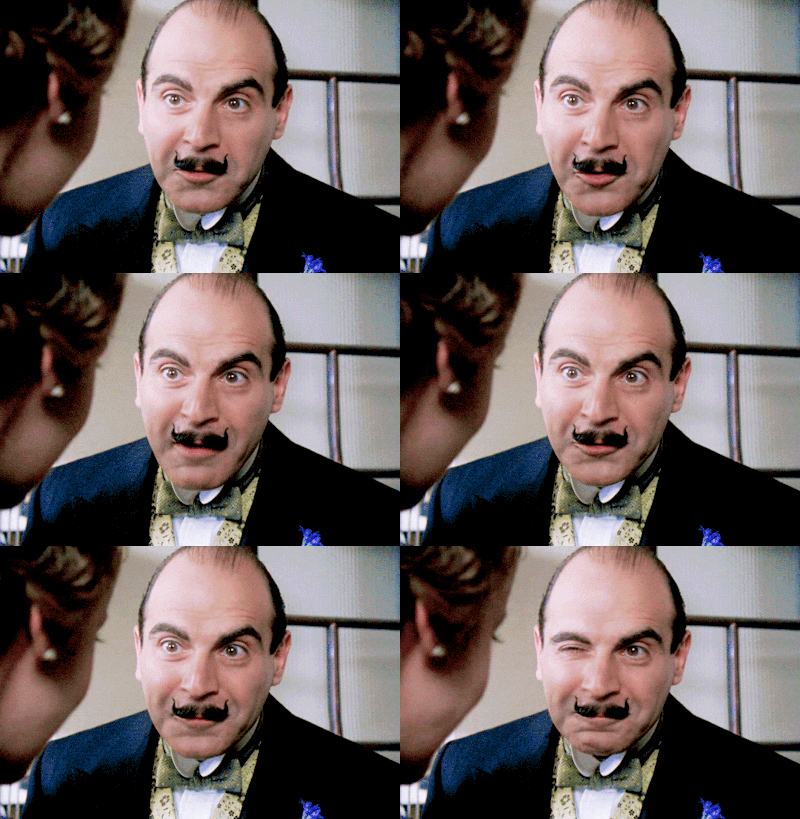
I adore the TV adaptation of this case (alltogether with the next one). And that's the reason I decided to read this story collection. I have to admit, I love the series adaptation more (I know such a crime! Sorry). I feel the character's there are more fleshed out and the motivations a little bit more beliveable.
After Poirot’s car breaks down, he finds that the mechanic had an afternoon spent with who he thinks is a maid. He wants Poirot to find her since she mysteriously disappeared. Poirot gets on with it and finds out where the maid is. Definitely recommended
One of the poorest Poirot short stories, this story jumps from scene to scene without drawing any tension or drama. The solution is not contrived but instead pretty simple.
Jos jedan neobican slucaj kojeg je Poirot prihvatio jer se na neki nacin uklapao u Herkulova djela. Kraj je skroz neocekivan, a Poirot se kroz pricu dosta i naputovao.